Unit 0
SELF-PROTECTION PLAN
1Mª José Hernández González
CONCEPTS
Danger: The probability that a specific harmful effect occurring
within a given period of time or under certain circumstances.
Risk: The probability that a hazard would lead to an injury.
Occupational risk: It will be the realization of a hazard that is
present in the workplace.
Emergency: It will be the realization of a hazard that is present in
the workplace. Types of Emergencies:
Technological emergencies: they are those occurring phenomena such
as fires, explosions, spills and leaks.
Natural emergencies: output of water from an aquifer or a forest fire
caused by a lightning strike on a tree or flooding.
Social emergencies: they are those that generate a situation of "out of
control" presented by the impact of a disaster.
2Mª José Hernández González
Self-protection: A system of actions and measures taken by
the holders of public and private activities with its own means
and resources, within its competence to prevent and control risks
of possible emergency situations and ensure the integration of
these actions in the public system of civil protection (Annex III of
the RD 393/2007).
Self- protection plan: The organizational and functional
framework provided for an activity center, accommodation
space, facility or agency, in order to prevent and control risks to
people and property and to adequately respond to possible
emergencies in the area under the responsibility of the holder,
ensuring the integration of these activities in the public system of
civil protection (Annex III of the RD 393/2007).
Mª José Hernández González 3
Legal Regulations
Article 15 Spanish Constitution: right to life and to physical
and moral integrity, which means that public authorities are
required to ensure compliance.
Royal Decree 393/2007, 23 March, on the basic rule of self-
protection centers, establishments and agencies engaged in
activities that may lead to emergency situations approved.
Article 14 Law 31/1995, 7 November, occupational risk
prevention: establishes the obligation of the employer to
ensure the safety and health of workers at your service in
emergency situations, take the necessary measures for first
aid, fire fighting and evacuation of workers.
Mª José Hernández González
4
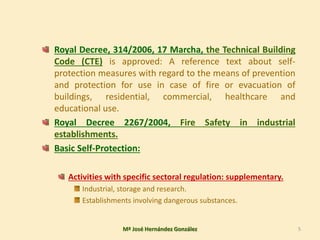
Royal Decree, 314/2006, 17 Marcha, the Technical Building
Code (CTE) is approved: A reference text about self-
protection measures with regard to the means of prevention
and protection for use in case of fire or evacuation of
buildings, residential, commercial, healthcare and
educational use.
Royal Decree 2267/2004, Fire Safety in industrial
establishments.
Basic Self-Protection:
Activities with specific sectoral regulation: supplementary.
Industrial, storage and research.
Establishments involving dangerous substances.
Mª José Hernández González 5
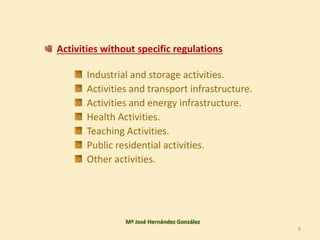
Activities without specific regulations
Industrial and storage activities.
Activities and transport infrastructure.
Activities and energy infrastructure.
Health Activities.
Teaching Activities.
Public residential activities.
Other activities.
Mª José Hernández González
6
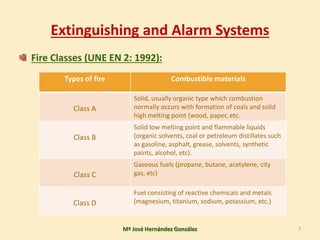
Extinguishing and Alarm Systems
Fire Classes (UNE EN 2: 1992):
Mª José Hernández González 7
Types of fire Combustible materials
Class A
Solid, usually organic type which combustion
normally occurs with formation of coals and solid
high melting point (wood, paper, etc.
Class B
Solid low melting point and flammable liquids
(organic solvents, coal or petroleum distillates such
as gasoline, asphalt, grease, solvents, synthetic
paints, alcohol, etc).
Class C
Gaseous fuels (propane, butane, acetylene, city
gas, etc)
Class D
Fuel consisting of reactive chemicals and metals
(magnesium, titanium, sodium, potassium, etc.)
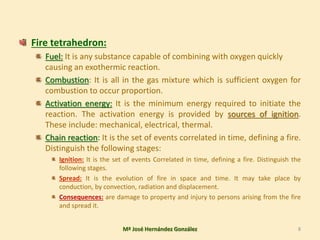
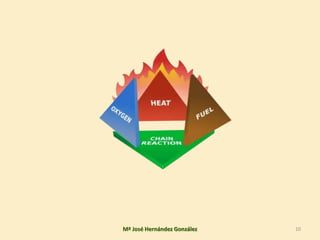
Fire tetrahedron:
Fuel: It is any substance capable of combining with oxygen quickly
causing an exothermic reaction.
Combustion: It is all in the gas mixture which is sufficient oxygen for
combustion to occur proportion.
Activation energy: It is the minimum energy required to initiate the
reaction. The activation energy is provided by sources of ignition.
These include: mechanical, electrical, thermal.
Chain reaction: It is the set of events correlated in time, defining a fire.
Distinguish the following stages:
Ignition: It is the set of events Correlated in time, defining a fire. Distinguish the
following stages.
Spread: It is the evolution of fire in space and time. It may take place by
conduction, by convection, radiation and displacement.
Consequences: are damage to property and injury to persons arising from the fire
and spread it.
Mª José Hernández González 8
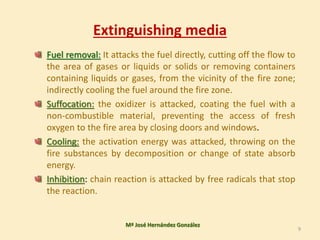
Extinguishing media
Fuel removal: It attacks the fuel directly, cutting off the flow to
the area of gases or liquids or solids or removing containers
containing liquids or gases, from the vicinity of the fire zone;
indirectly cooling the fuel around the fire zone.
Suffocation: the oxidizer is attacked, coating the fuel with a
non-combustible material, preventing the access of fresh
oxygen to the fire area by closing doors and windows.
Cooling: the activation energy was attacked, throwing on the
fire substances by decomposition or change of state absorb
energy.
Inhibition: chain reaction is attacked by free radicals that stop
the reaction.
Mª José Hernández González
9
Mª José Hernández González 10
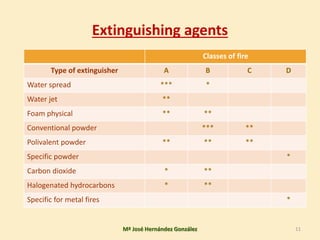
Extinguishing agents
Classes of fire
Type of extinguisher A B C D
Water spread *** *
Water jet **
Foam physical ** **
Conventional powder *** **
Polivalent powder ** ** **
Specific powder *
Carbon dioxide * **
Halogenated hydrocarbons * **
Specific for metal fires *
Mª José Hernández González 11
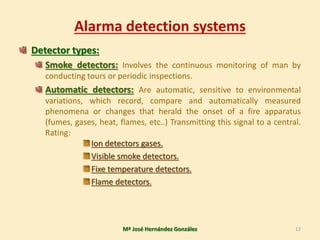
Alarma detection systems
Detector types:
Smoke detectors: Involves the continuous monitoring of man by
conducting tours or periodic inspections.
Automatic detectors: Are automatic, sensitive to environmental
variations, which record, compare and automatically measured
phenomena or changes that herald the onset of a fire apparatus
(fumes, gases, heat, flames, etc..) Transmitting this signal to a central.
Rating:
Ion detectors gases.
Visible smoke detectors.
Fixe temperature detectors.
Flame detectors.
Mª José Hernández González 12
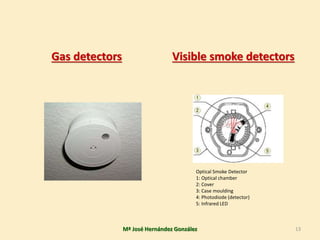
Gas detectors Visible smoke detectors
Mª José Hernández González 13
Optical Smoke Detector
1: Optical chamber
2: Cover
3: Case moulding
4: Photodiode (detector)
5: Infrared LED
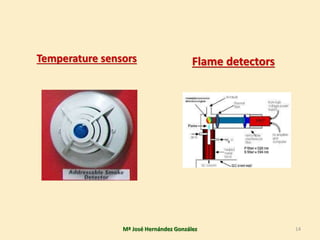
Flame detectors
Mª José Hernández González 14
Temperature sensors
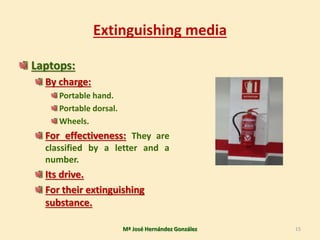
Extinguishing media
Laptops:
By charge:
Portable hand.
Portable dorsal.
Wheels.
For effectiveness: They are
classified by a letter and a
number.
Its drive.
For their extinguishing
substance.
Mª José Hernández González 15
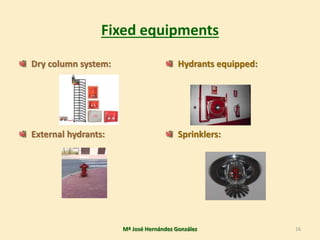
Fixed equipments
Dry column system:
External hydrants:
Hydrants equipped:
Sprinklers:
Mª José Hernández González 16
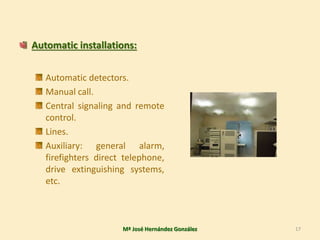
Automatic installations:
Automatic detectors.
Manual call.
Central signaling and remote
control.
Lines.
Auxiliary: general alarm,
firefighters direct telephone,
drive extinguishing systems,
etc.
Mª José Hernández González 17
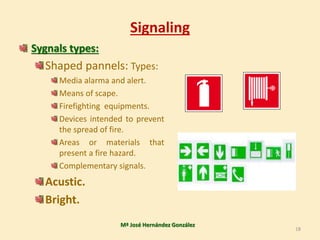
Signaling
Sygnals types:
Shaped pannels: Types:
Media alarma and alert.
Means of scape.
Firefighting equipments.
Devices intended to prevent
the spread of fire.
Areas or materials that
present a fire hazard.
Complementary signals.
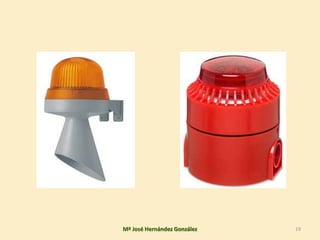
Acustic.
Bright.
Mª José Hernández González
18
Mª José Hernández González 19

Unit 0 english

  • 1.
    Unit 0 SELF-PROTECTION PLAN 1MªJosé Hernández González
  • 2.
    CONCEPTS Danger: The probabilitythat a specific harmful effect occurring within a given period of time or under certain circumstances. Risk: The probability that a hazard would lead to an injury. Occupational risk: It will be the realization of a hazard that is present in the workplace. Emergency: It will be the realization of a hazard that is present in the workplace. Types of Emergencies: Technological emergencies: they are those occurring phenomena such as fires, explosions, spills and leaks. Natural emergencies: output of water from an aquifer or a forest fire caused by a lightning strike on a tree or flooding. Social emergencies: they are those that generate a situation of "out of control" presented by the impact of a disaster. 2Mª José Hernández González
  • 3.
    Self-protection: A systemof actions and measures taken by the holders of public and private activities with its own means and resources, within its competence to prevent and control risks of possible emergency situations and ensure the integration of these actions in the public system of civil protection (Annex III of the RD 393/2007). Self- protection plan: The organizational and functional framework provided for an activity center, accommodation space, facility or agency, in order to prevent and control risks to people and property and to adequately respond to possible emergencies in the area under the responsibility of the holder, ensuring the integration of these activities in the public system of civil protection (Annex III of the RD 393/2007). Mª José Hernández González 3
  • 4.
    Legal Regulations Article 15Spanish Constitution: right to life and to physical and moral integrity, which means that public authorities are required to ensure compliance. Royal Decree 393/2007, 23 March, on the basic rule of self- protection centers, establishments and agencies engaged in activities that may lead to emergency situations approved. Article 14 Law 31/1995, 7 November, occupational risk prevention: establishes the obligation of the employer to ensure the safety and health of workers at your service in emergency situations, take the necessary measures for first aid, fire fighting and evacuation of workers. Mª José Hernández González 4
  • 5.
    Royal Decree, 314/2006,17 Marcha, the Technical Building Code (CTE) is approved: A reference text about self- protection measures with regard to the means of prevention and protection for use in case of fire or evacuation of buildings, residential, commercial, healthcare and educational use. Royal Decree 2267/2004, Fire Safety in industrial establishments. Basic Self-Protection: Activities with specific sectoral regulation: supplementary. Industrial, storage and research. Establishments involving dangerous substances. Mª José Hernández González 5
  • 6.
    Activities without specificregulations Industrial and storage activities. Activities and transport infrastructure. Activities and energy infrastructure. Health Activities. Teaching Activities. Public residential activities. Other activities. Mª José Hernández González 6
  • 7.
    Extinguishing and AlarmSystems Fire Classes (UNE EN 2: 1992): Mª José Hernández González 7 Types of fire Combustible materials Class A Solid, usually organic type which combustion normally occurs with formation of coals and solid high melting point (wood, paper, etc. Class B Solid low melting point and flammable liquids (organic solvents, coal or petroleum distillates such as gasoline, asphalt, grease, solvents, synthetic paints, alcohol, etc). Class C Gaseous fuels (propane, butane, acetylene, city gas, etc) Class D Fuel consisting of reactive chemicals and metals (magnesium, titanium, sodium, potassium, etc.)
  • 8.
    Fire tetrahedron: Fuel: Itis any substance capable of combining with oxygen quickly causing an exothermic reaction. Combustion: It is all in the gas mixture which is sufficient oxygen for combustion to occur proportion. Activation energy: It is the minimum energy required to initiate the reaction. The activation energy is provided by sources of ignition. These include: mechanical, electrical, thermal. Chain reaction: It is the set of events correlated in time, defining a fire. Distinguish the following stages: Ignition: It is the set of events Correlated in time, defining a fire. Distinguish the following stages. Spread: It is the evolution of fire in space and time. It may take place by conduction, by convection, radiation and displacement. Consequences: are damage to property and injury to persons arising from the fire and spread it. Mª José Hernández González 8
  • 9.
    Extinguishing media Fuel removal:It attacks the fuel directly, cutting off the flow to the area of gases or liquids or solids or removing containers containing liquids or gases, from the vicinity of the fire zone; indirectly cooling the fuel around the fire zone. Suffocation: the oxidizer is attacked, coating the fuel with a non-combustible material, preventing the access of fresh oxygen to the fire area by closing doors and windows. Cooling: the activation energy was attacked, throwing on the fire substances by decomposition or change of state absorb energy. Inhibition: chain reaction is attacked by free radicals that stop the reaction. Mª José Hernández González 9
  • 10.
  • 11.
    Extinguishing agents Classes offire Type of extinguisher A B C D Water spread *** * Water jet ** Foam physical ** ** Conventional powder *** ** Polivalent powder ** ** ** Specific powder * Carbon dioxide * ** Halogenated hydrocarbons * ** Specific for metal fires * Mª José Hernández González 11
  • 12.
    Alarma detection systems Detectortypes: Smoke detectors: Involves the continuous monitoring of man by conducting tours or periodic inspections. Automatic detectors: Are automatic, sensitive to environmental variations, which record, compare and automatically measured phenomena or changes that herald the onset of a fire apparatus (fumes, gases, heat, flames, etc..) Transmitting this signal to a central. Rating: Ion detectors gases. Visible smoke detectors. Fixe temperature detectors. Flame detectors. Mª José Hernández González 12
  • 13.
    Gas detectors Visiblesmoke detectors Mª José Hernández González 13 Optical Smoke Detector 1: Optical chamber 2: Cover 3: Case moulding 4: Photodiode (detector) 5: Infrared LED
  • 14.
    Flame detectors Mª JoséHernández González 14 Temperature sensors
  • 15.
    Extinguishing media Laptops: By charge: Portablehand. Portable dorsal. Wheels. For effectiveness: They are classified by a letter and a number. Its drive. For their extinguishing substance. Mª José Hernández González 15
  • 16.
    Fixed equipments Dry columnsystem: External hydrants: Hydrants equipped: Sprinklers: Mª José Hernández González 16
  • 17.
    Automatic installations: Automatic detectors. Manualcall. Central signaling and remote control. Lines. Auxiliary: general alarm, firefighters direct telephone, drive extinguishing systems, etc. Mª José Hernández González 17
  • 18.
    Signaling Sygnals types: Shaped pannels:Types: Media alarma and alert. Means of scape. Firefighting equipments. Devices intended to prevent the spread of fire. Areas or materials that present a fire hazard. Complementary signals. Acustic. Bright. Mª José Hernández González 18
  • 19.