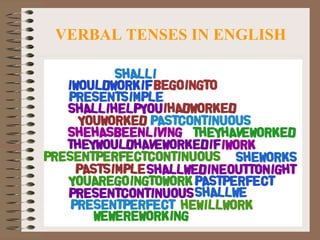
VERBAL TENSES IN ENGLISH
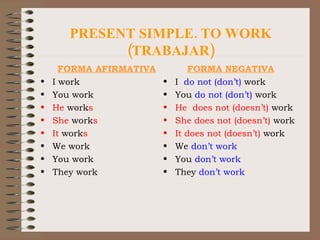
PRESENT SIMPLE. TO WORK (TRABAJAR) FORMA AFIRMATIVA I work You work He  work s She  work s It  work s We work You work They work FORMA NEGATIVA I  do not (don’t)  work You  do not (don’t)  work He  does not (doesn’t)  work She does not (doesn’t)  work It does not (doesn’t)  work We  don’t work You  don’t work   They  don’t work
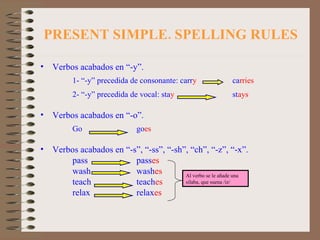
PRESENT SIMPLE. SPELLING RULES Verbos acabados en “-y”. 1- “-y” precedida de consonante: carr y     ca rries 2- “-y” precedida de vocal: sta y    st ays Verbos acabados en “-o”. Go  go es Verbos acabados en “-s”, “-ss”, “-sh”, “ch”, “-z”, “-x”. pass  pass es wash  wash es teach  teach es relax  relax es Al verbo se le añade una sílaba, que suena /iz/
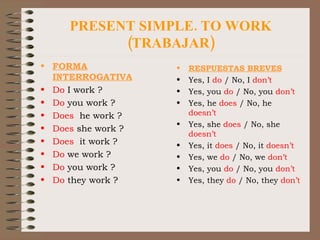
PRESENT SIMPLE. TO WORK (TRABAJAR) FORMA INTERROGATIVA Do  I work ? Do  you work ? Does   he work ? Does  she work ? Does   it work ? Do  we work ? Do  you work ? Do  they work ? RESPUESTAS BREVES Yes, I  do  / No, I  don’t Yes, you  do  / No, you  don’t Yes, he  does  / No, he  doesn’t Yes, she  does  / No, she  doesn’t Yes, it  does  / No, it  doesn’t Yes, we  do  / No, we  don’t Yes, you  do  / No, you  don’t Yes, they  do  / No, they  don’t
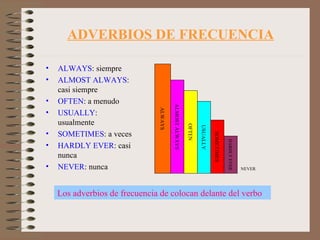
ADVERBIOS DE FRECUENCIA ALWAYS : siempre ALMOST ALWAYS : casi siempre OFTEN : a menudo USUALLY : usualmente SOMETIMES : a veces HARDLY EVER : casi nunca NEVER : nunca ALWAYS ALMOST ALWAYS OFTEN USUALLY SOMETIMES HARDLY EVER NEVER Los adverbios de frecuencia de colocan delante del verbo
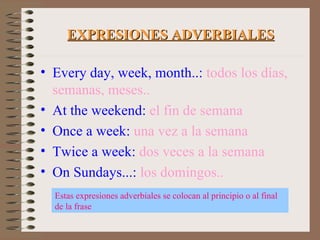
EXPRESIONES ADVERBIALES Every day, week, month..:   todos los días, semanas, meses.. At the weekend:   el fin de semana Once a week:   una vez a la semana Twice a week:   dos veces a la semana On Sundays...:   los domingos.. Estas expresiones adverbiales se colocan al principio o al final de la frase
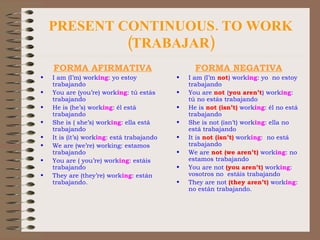
PRESENT CONTINUOUS. TO WORK (TRABAJAR) FORMA AFIRMATIVA I am (I’m) work ing : yo estoy trabajando You are (you’re) work ing : tú estás trabajando He is (he’s) work ing : él está trabajando She is ( she’s) work ing : ella está trabajando It is (it’s) work ing : está trabajando We are (we’re) working: estamos trabajando You are ( you’re) work ing : estáis trabajando They are (they’re) work ing : están trabajando. FORMA NEGATIVA I am (I’m  not ) work ing : yo  no estoy trabajando You are  not  ( you aren’t ) work ing : tú no estás trabajando He is  not (isn’t)  work ing : él no está trabajando She is not (isn’t) work ing : ella no está trabajando It is  not (isn’t)  work ing :  no está trabajando We are  not (we aren’t)  work ing : no estamos trabajando You are not  (you aren’t)  work ing : vosotros no  estáis trabajando They are not  (they aren’t)  work ing : no están trabajando.
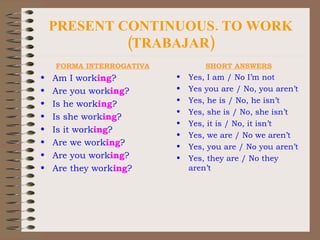
PRESENT CONTINUOUS. TO WORK (TRABAJAR) FORMA INTERROGATIVA Am I work ing ? Are you work ing ? Is he work ing ? Is she work ing ? Is it work ing ? Are we work ing ? Are you work ing ? Are they work ing ? SHORT ANSWERS Yes, I am / No I’m not Yes you are / No, you aren’t Yes, he is / No, he isn’t Yes, she is / No, she isn’t Yes, it is / No, it isn’t Yes, we are / No we aren’t Yes, you are / No you aren’t Yes, they are / No they aren’t
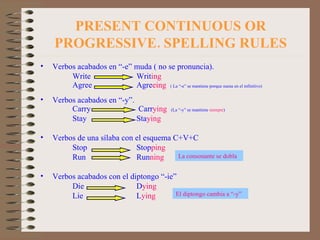
PRESENT CONTINUOUS OR PROGRESSIVE. SPELLING RULES Verbos acabados en “-e” muda ( no se pronuncia). Write  Writ ing Agree  Agre eing  ( La “-e” se mantiene porque suena en el infinitivo) Verbos acabados en “-y”. Carry   Carr ying  (La “-y” se mantiene  siempre ) Stay Sta ying Verbos de una sílaba con el esquema C+V+C Stop  Stop ping Run Run ning   Verbos acabados con el diptongo “-ie” Die  D ying Lie  L ying La consonante se dobla El diptongo cambia a “-y”
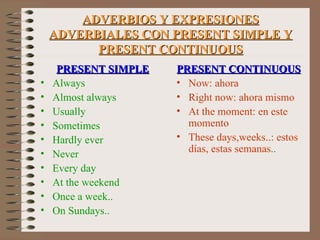
ADVERBIOS Y EXPRESIONES ADVERBIALES CON PRESENT SIMPLE Y PRESENT CONTINUOUS PRESENT SIMPLE Always Almost always Usually Sometimes Hardly ever Never Every day At the weekend Once a week.. On Sundays.. PRESENT CONTINUOUS Now: ahora Right now: ahora mismo At the moment: en este momento These days,weeks..: estos días, estas semanas ..
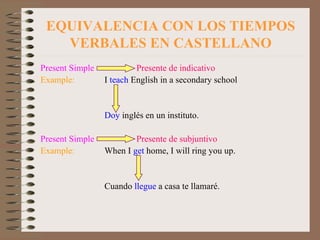
EQUIVALENCIA CON LOS TIEMPOS VERBALES EN CASTELLANO Present Simple   Presente de indicativo Example: I  teach  English in a secondary school Doy  inglés en un instituto. Present Simple   Presente de subjuntivo Example: When I  get  home, I will ring you up. Cuando  llegue  a casa te llamaré.
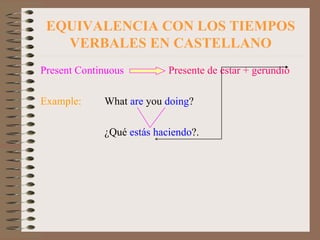
EQUIVALENCIA CON LOS TIEMPOS VERBALES EN CASTELLANO Present Continuous    Presente de estar + gerundio Example: What  are  you  doing ? ¿Qué  estás haciendo ?.
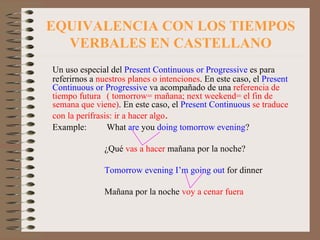
EQUIVALENCIA CON LOS TIEMPOS VERBALES EN CASTELLANO Un uso especial del  Present Continuous or Progressive  es para referirnos a  nuestros planes o intenciones . En este caso, el  Present Continuous or Progressive  va acompañado de una  referencia de tiempo futura   ( tomorrow= mañana; next weekend= el fin de semana   que viene) . En este caso, el  Present Continuous   se traduce con la perífrasis: ir a hacer algo . Example:  What  are  you  doing   tomorrow evening ? ¿Qué  vas a hacer  mañana por la noche? Tomorrow evening I’m going out  for dinner Mañana por la noche  voy a cenar fuera
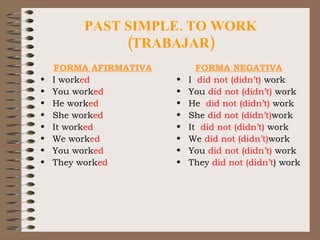
PAST SIMPLE. TO WORK (TRABAJAR) FORMA AFIRMATIVA I work ed You work ed He work ed She work ed It work ed We work ed You work ed They work ed FORMA NEGATIVA I  did not (didn’t)  work You  did not   (didn’t)  work He  did not (didn’t)  work She  did not (didn’t) work It  did not (didn’t)  work We  did not (didn’t) work You  did not (didn’t)  work They  did not (didn’t ) work
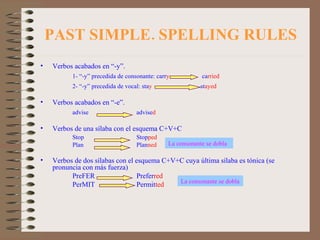
PAST SIMPLE. SPELLING RULES Verbos acabados en “-y”. 1- “-y” precedida de consonante: carr y    ca rried 2- “-y” precedida de vocal: sta y    st ayed Verbos acabados en “-e”.  advise  advise d Verbos de una sílaba con el esquema C+V+C Stop  Stop ped Plan Plan ned Verbos de dos sílabas con el esquema C+V+C cuya última sílaba es tónica (se pronuncia con más fuerza) PreFER  Prefer red PerMIT  Permit ted La consonante se dobla La consonante se dobla
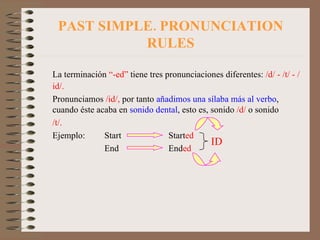
PAST SIMPLE. PRONUNCIATION RULES La terminación  “-ed”  tiene tres pronunciaciones diferentes:  /d/ - /t/ - /id/. Pronunciamos  /id/,  por tanto  añadimos una sílaba más al verbo , cuando éste acaba en  sonido dental , esto es, sonido  /d/  o sonido  /t/. Ejemplo:  Start Start ed End End ed ID
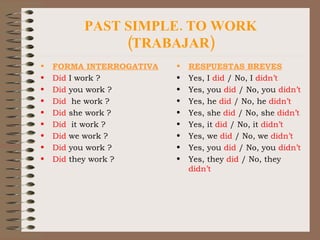
PAST SIMPLE. TO WORK (TRABAJAR) FORMA INTERROGATIVA Did  I work ? Did  you work ? Did   he work ? Did  she work ? Did   it work ? Did  we work ? Did  you work ? Did  they work ? RESPUESTAS BREVES Yes, I  did  / No, I  didn’t Yes, you  did  / No, you  didn’t Yes, he  did  / No, he  didn’t Yes, she  did  / No, she  didn’t Yes, it  did  / No, it  didn’t Yes, we  did  / No, we  didn’t Yes, you  did  / No, you  didn’t Yes, they  did  / No, they  didn’t
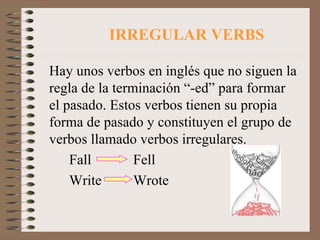
IRREGULAR VERBS Hay unos verbos en inglés que no siguen la regla de la terminación “-ed” para formar el pasado. Estos verbos tienen su propia forma de pasado y constituyen el grupo de verbos llamado verbos irregulares.  Fall Fell Write Wrote
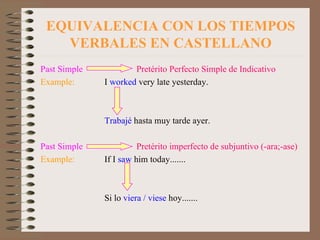
EQUIVALENCIA CON LOS TIEMPOS VERBALES EN CASTELLANO Past Simple    Pretérito Perfecto Simple de Indicativo Example: I  worked  very late yesterday. Trabajé  hasta muy tarde ayer. Past Simple   Pretérito imperfecto de subjuntivo (-ara;-ase) Example: If I  saw  him today....... Si lo  viera / viese  hoy.......
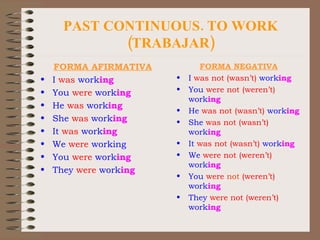
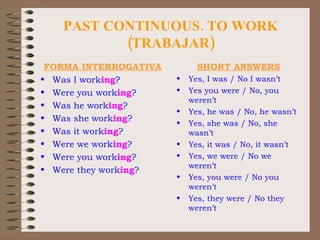
PAST CONTINUOUS. TO WORK (TRABAJAR) FORMA AFIRMATIVA I  was  work ing You  were  work ing He  was  work ing She  was  work ing It  was  work ing We  were  working You  were  work ing They  were  work ing FORMA NEGATIVA I  was   not   (wasn’t)  work ing  You  were   not   (weren’t)  work ing He  was   not   (wasn’t)  work ing She  was not (wasn’t)  work ing It  was   not   (wasn’t)  work ing We  were   not   (weren’t)  work ing You  were  not   (weren’t)  work ing They  were not   (weren’t)  work ing
PAST CONTINUOUS. TO WORK (TRABAJAR) FORMA INTERROGATIVA Was I work ing ? Were you work ing ? Was he work ing ? Was she work ing ? Was it work ing ? Were we work ing ? Were you work ing ? Were they work ing ? SHORT ANSWERS Yes, I was / No I wasn’t Yes you were / No, you weren’t Yes, he was / No, he wasn’t Yes, she was / No, she wasn’t Yes, it was / No, it wasn’t Yes, we were / No we weren’t Yes, you were / No you weren’t Yes, they were / No they weren’t
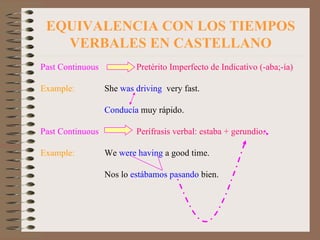
EQUIVALENCIA CON LOS TIEMPOS VERBALES EN CASTELLANO Past Continuous    Pretérito Imperfecto de Indicativo (-aba;-ía) Example: She  was   driving   very fast. Conducía  muy rápido. Past Continuous   Perífrasis verbal: estaba + gerundio. Example: We  were having  a good time. Nos lo  estábamos pasando  bien.
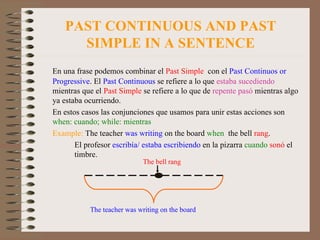
PAST CONTINUOUS AND PAST SIMPLE IN A SENTENCE En una frase podemos combinar el  Past Simple   con el  Past Continuos or Progressive . El  Past   Continuous  se refiere a lo que  estaba sucediendo  mientras que el  Past Simple  se refiere a lo que de  repente pasó  mientras algo ya estaba ocurriendo. En estos casos las conjunciones que usamos para unir estas acciones son  when: cuando; while: mientras Example:   The teacher  was writing  on the board  when   the bell  rang .   El profesor  escribía/ estaba escribiendo  en la pizarra  cuando   sonó  el     timbre. The teacher was writing on the board The bell rang
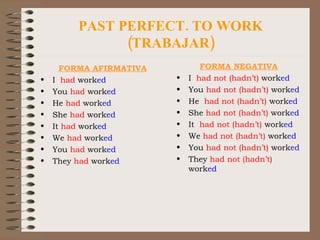
PAST PERFECT. TO WORK (TRABAJAR) FORMA AFIRMATIVA I  had  work ed You  had  work ed He  had  work ed She  had  work ed It  had  work ed We  had  work ed You  had  work ed They  had  work ed FORMA NEGATIVA I  had not (hadn’t)  work ed You  had not   (hadn’t)  work ed He  had not (hadn’t)  work ed She  had not (hadn’t)  work ed It  had not (hadn’t)  work ed We  had not (hadn’t)  work ed You  had not (hadn’t)  work ed They  had not (hadn’t)  work ed
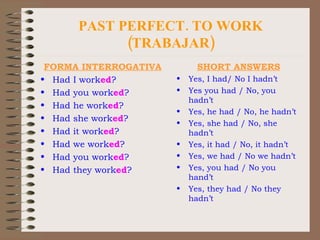
PAST PERFECT. TO WORK (TRABAJAR) FORMA INTERROGATIVA Had I work ed ? Had you work ed ? Had he work ed ? Had she work ed ? Had it work ed ? Had we work ed ? Had you work ed ? Had they work ed ? SHORT ANSWERS Yes, I had/ No I hadn’t Yes you had / No, you hadn’t Yes, he had / No, he hadn’t Yes, she had / No, she hadn’t Yes, it had / No, it hadn’t Yes, we had / No we hadn’t Yes, you had / No you hand’t Yes, they had / No they hadn’t
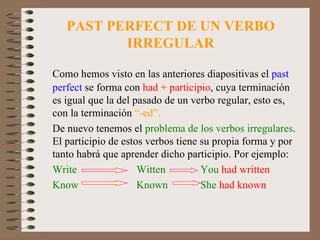
PAST PERFECT DE UN VERBO IRREGULAR Como hemos visto en las anteriores diapositivas el  past   perfect  se forma con  had + participio , cuya terminación es igual que la del pasado de un verbo regular, esto es, con la terminación  “-ed”. De nuevo tenemos el  problema de los verbos irregulares . El participio de estos verbos tiene su propia forma y por tanto habrá que aprender dicho participio. Por ejemplo: Write  Witten  You  had written Know Known She  had known
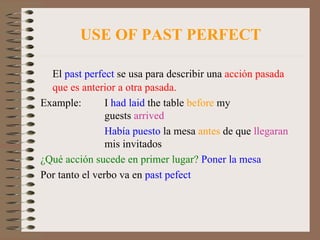
USE OF PAST PERFECT El  past perfect  se usa para describir una  acción pasada que es anterior a otra pasada. Example: I  had laid  the table  before  my  guests  arrived Había puesto  la mesa  antes  de que  llegaran   mis invitados ¿Qué acción sucede en primer lugar?   Poner la mesa Por tanto el verbo va en  past pefect
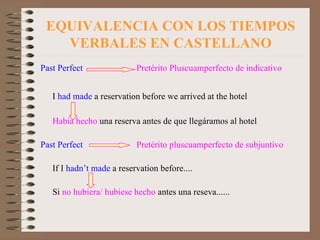
EQUIVALENCIA CON LOS TIEMPOS VERBALES EN CASTELLANO Past Perfect Pretérito Pluscuamperfecto de indicativo I  had made  a reservation before we arrived at the hotel Había hecho  una reserva antes de que llegáramos al hotel Past Perfect Pretérito pluscuamperfecto de subjuntivo If I  hadn’t made  a reservation before.... Si  no hubiera/ hubiese hecho  antes una reseva......
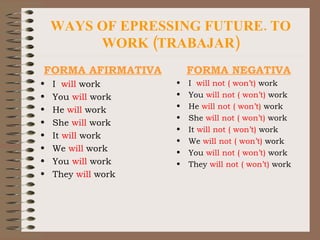
WAYS OF EPRESSING FUTURE. TO WORK (TRABAJAR) FORMA AFIRMATIVA I  will  work You  will  work He  will  work She  will  work It  will  work We  will  work You  will  work They  will  work FORMA NEGATIVA I  will not ( won’t)  work You  will not ( won’t)  work He  will not ( won’t)  work She  will not ( won’t)  work It  will not ( won’t)  work We  will not ( won’t)  work You  will not ( won’t)  work They  will not ( won’t)  work
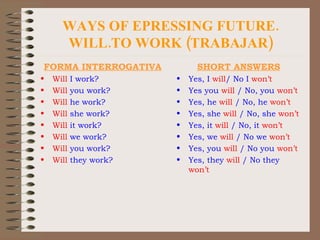
WAYS OF EPRESSING FUTURE. WILL.TO WORK (TRABAJAR) FORMA INTERROGATIVA Will  I work? Will  you work? Will  he work? Will  she work? Will  it work? Will  we work? Will  you work? Will  they work? SHORT ANSWERS Yes, I  will / No I  won’t Yes you  will  / No, you  won’t   Yes, he  will  / No, he  won’t Yes, she  will  / No, she  won’t Yes, it  will  / No, it  won’t Yes, we  will  / No we  won’t Yes, you  will  / No you  won’t Yes, they  will  / No they  won’t
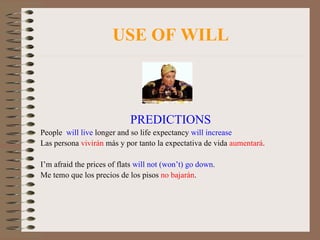
USE OF WILL PREDICTIONS People  will live  longer and so life expectancy  will increase Las persona  vivirán  más y por tanto la expectativa de vida  aumentará . I’m afraid the prices of flats  will not (won’t) go down . Me temo que los precios de los pisos  no bajarán .
USE OF WILL PROMISES I promise I  wont’ let  you  down. Prometo que  no  te  defraudaré.
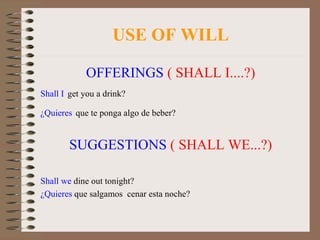
OFFERINGS  ( SHALL I....?) Shall I   get you a drink? ¿Quieres   que te ponga algo de beber? SUGGESTIONS  ( SHALL WE...?) Shall we  dine out tonight? ¿Quieres  que salgamos  cenar esta noche? USE OF WILL
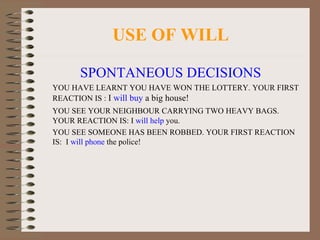
USE OF WILL SPONTANEOUS DECISIONS YOU HAVE LEARNT YOU HAVE WON THE LOTTERY. YOUR FIRST REACTION IS :  I  will buy  a big house! YOU SEE YOUR NEIGHBOUR CARRYING TWO HEAVY BAGS. YOUR REACTION IS: I  will help  you. YOU SEE SOMEONE HAS BEEN ROBBED. YOUR FIRST REACTION IS:  I  will phone  the police!
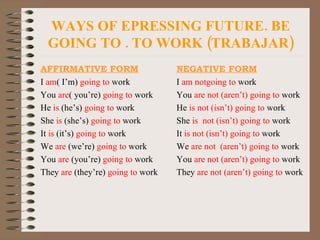
WAYS OF EPRESSING FUTURE. BE GOING TO . TO WORK (TRABAJAR) AFFIRMATIVE FORM I  am ( I’m)  going to  work You  are ( you’re)  going to  work He  is  (he’s)  going to  work She  is  (she’s)  going to  work It  is  (it’s)  going to  work We  are  (we’re)  going to  work You  are  (you’re)  going to  work They  are  (they’re)  going to  work NEGATIVE FORM   I  am notgoing to  work You  are not (aren’t)   going to  work He  is not (isn’t)   going to  work She  is  not (isn’t)   going to  work It  is not   (isn’t)   going to  work We  are not  (aren’t)   going to  work You  are not   (aren’t)   going to  work They  are not   (aren’t)   going to  work
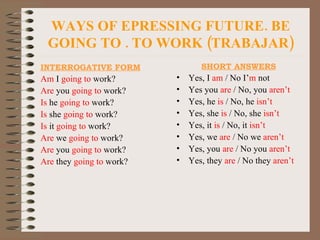
WAYS OF EPRESSING FUTURE. BE GOING TO . TO WORK (TRABAJAR) INTERROGATIVE FORM Am  I  going to  work? Are  you  going   to  work? Is  he  going to  work? Is  she  going to  work? Is  it  going to  work? Are  we  going to  work? Are  you  going to  work? Are  they  going to  work? SHORT ANSWERS Yes, I  am  / No I’ m  not Yes you  are  / No, you  aren’t Yes, he  is  / No, he  isn’t Yes, she  is  / No, she  isn’t Yes, it  is  / No, it  isn’t Yes, we  are  / No we  aren’t Yes, you  are  / No you  aren’t Yes, they  are  / No they  aren’t
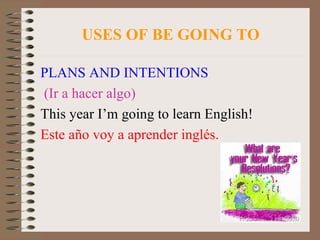
USES OF BE GOING TO PLANS AND INTENTIONS (Ir a hacer algo) This year I’m going to learn English! Este año voy a aprender inglés.
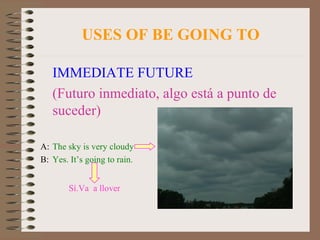
USES OF BE GOING TO IMMEDIATE FUTURE (Futuro inmediato, algo está a punto de suceder) A: The sky is very cloudy B: Yes. It’s going to rain. Sí.Va  a llover
WAYS OF EXPRESSING FUTURE. PRESENT CONTINUOUS HAZ CLICK  AQUÍ  PARA IR A LA DIAPOSITIVA CORRESPONDIENTE
PRESENT PERFECT. TO WORK (TRABAJAR) FORMA AFIRMATIVA I  have  work ed You  have  work ed He  has  work ed She  has  work ed It  has  work ed We  have  work ed You  have  work ed They  have  work ed FORMA NEGATIVA I  have not / haven’t  work ed You  have not / haven’t  work ed He  has not / hasn’t  work ed She  has not / hasn’t  work ed It  has not / hasn’t  work ed We  have not / haven’t  work ed You  have not / haven’t  work ed They  have not / haven’t  work ed
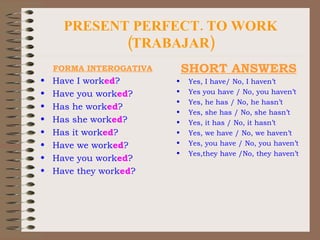
PRESENT PERFECT. TO WORK (TRABAJAR) FORMA INTEROGATIVA Have I work ed ? Have you work ed ? Has he work ed ? Has she work ed ? Has it work ed ? Have we work ed ? Have you work ed ? Have they work ed ? SHORT ANSWERS Yes, I have/ No, I haven’t Yes you have / No, you haven’t Yes, he has / No, he hasn’t Yes, she has / No, she hasn’t Yes, it has / No, it hasn’t Yes, we have / No, we haven’t Yes, you have / No, you haven’t Yes,they have /No, they haven’t
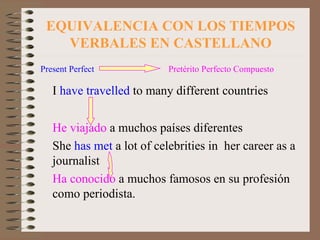
EQUIVALENCIA CON LOS TIEMPOS VERBALES EN CASTELLANO Present Perfect  Pretérito Perfecto Compuesto I  have travelled  to many different countries He viajado  a muchos países diferentes She  has met  a lot of celebrities in  her career as a journalist Ha conocido  a muchos famosos en su profesión como periodista.
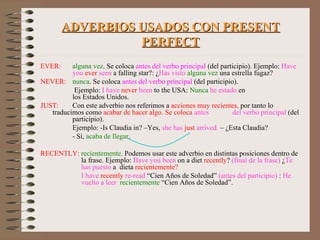
ADVERBIOS USADOS CON PRESENT PERFECT EVER:  alguna vez . Se coloca  antes del verbo principal  (del participio). Ejemplo:  Have  you   ever   seen  a falling star?: ¿ Has visto   alguna vez  una estrella fugaz? NEVER:  nunca . Se coloca  antes del verbo principal  (del participio).    Ejemplo:  I have  never  been  to the USA:  Nunca   he estado  en      los Estados Unidos. JUST:  Con este adverbio nos referimos a  acciones muy recientes,  por tanto lo  traducimos como  acabar de hacer algo. Se coloca  antes  del verbo principal  (del  participio). Ejemplo: -Is Claudia in? –Yes,  she has   just   arrived.  – ¿Esta Claudia? - Sí,  acaba de llegar . RECENTLY:  recientemente . Podemos usar este adverbio en distintas posiciones dentro de    la frase. Ejemplo:  Have you been  on a diet  recently ?  (final de la frase)  ¿ Te     has puesto  a  dieta  recientemente?   I have   recently   re-read  “Cien Años de Soledad”  (antes del participio)  :  He      vuelto a leer   recientemente  “Cien Años de Soledad”.
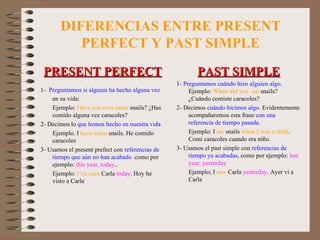
DIFERENCIAS ENTRE PRESENT PERFECT Y PAST SIMPLE PRESENT PERFECT 1-   Preguntamos si alguien ha hecho alguna vez  en su vida: Ejemplo:  Have you ever   eaten  snails? ¿Has comido alguna vez caracoles? 2- Decimos lo  que hemos hecho en nuestra vida Ejemplo. I  have eaten  snails. He comido caracoles 3- Usamos el present prefect con  referencias de   tiempo que aún no han   acabado  .como por ejemplo:  this year, today .. Ejemplo:  I’ve seen  Carla  today . Hoy he visto a Carla PAST SIMPLE 1-  Preguntamos cuándo hizo alguien algo . Ejemplo:  When did you  eat  snails? ¿Cuándo comiste caracoles? 2- Decimos  cuándo hicimos algo . Evidentemente acompañaremos esta frase  con una referencia de tiempo pasada.  Ejemplo: I  ate  snails  when I was a child . Comí caracoles cuando era niño. 3- Usamos el past simple con  referencias de   tiempo ya acabadas , como por ejemplo:  last   year, yesterday Ejemplo; I  saw  Carla  yesterday . Ayer vi a Carla
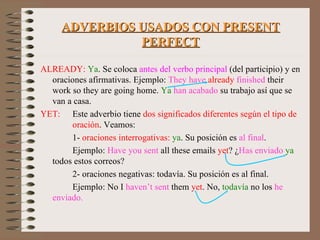
ADVERBIOS USADOS CON PRESENT PERFECT ALREADY:  Ya . Se coloca  antes del verbo principal  (del participio) y en oraciones afirmativas. Ejemplo:  They have  already   finished  their work so they are going home.  Ya  han acabado  su trabajo así que se van a casa. YET:  Este adverbio tiene  dos significados diferentes según el tipo de   oración . Veamos: 1-  oraciones interrogativas:   ya . Su posición es  al final . Ejemplo:  Have you sent  all these emails  yet ? ¿ Has enviado   ya  todos estos correos? 2- oraciones negativas: todavía. Su posición es al final. Ejemplo: No I  haven’t sent  them  yet . No,  todavía  no los  he  enviado.
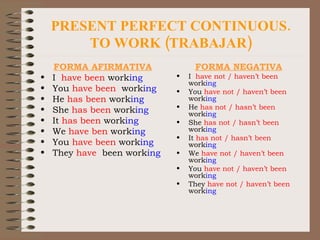
PRESENT PERFECT CONTINUOUS. TO WORK (TRABAJAR) FORMA AFIRMATIVA I  have been  work ing You  have been  work ing He  has   been  work ing She  has been  work ing It  has been  work ing We  have ben  work ing You  have been  work ing They  have   been work ing FORMA NEGATIVA I  have not / haven’t been  work ing You  have not / haven’t been  work ing He  has not / hasn’t been  work ing She  has not / hasn’t been  work ing It  has not / hasn’t been  work ing We  have not / haven’t been  work ing You  have not / haven’t been  work ing They  have not / haven’t been  work ing
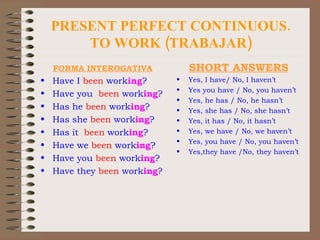
PRESENT PERFECT CONTINUOUS. TO WORK (TRABAJAR) FORMA INTEROGATIVA Have I  been  work ing ? Have you  been  work ing ? Has he  been  work ing ? Has she  been  work ing ? Has it  been  work ing ? Have we  been  work ing ? Have you  been  work ing ? Have they  been  work ing ? SHORT ANSWERS Yes, I have/ No, I haven’t Yes you have / No, you haven’t Yes, he has / No, he hasn’t Yes, she has / No, she hasn’t Yes, it has / No, it hasn’t Yes, we have / No, we haven’t Yes, you have / No, you haven’t Yes,they have /No, they haven’t
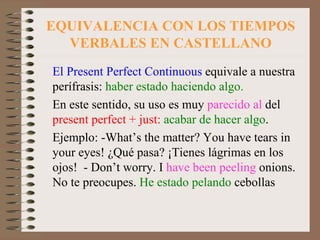
EQUIVALENCIA CON LOS TIEMPOS VERBALES EN CASTELLANO El Present Perfect Continuous  equivale a nuestra perífrasis:  haber estado haciendo algo. En este sentido, su uso es muy  parecido al  del  present perfect + just:   acabar de hacer algo . Ejemplo: -What’s the matter? You have tears in your eyes! ¿Qué pasa? ¡Tienes lágrimas en los ojos!  - Don’t worry. I  have been peeling  onions. No te preocupes.  He estado pelando  cebollas
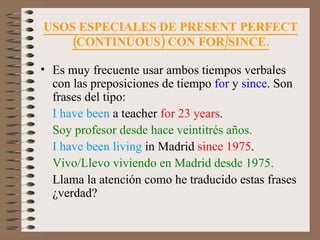
USOS ESPECIALES DE PRESENT PERFECT (CONTINUOUS) CON FOR/SINCE. Es muy frecuente usar ambos tiempos verbales con las preposiciones de tiempo  for  y  since . Son frases del tipo: I have been  a teacher  for 23 years . Soy profesor desde hace veintitrés años. I have been living  in Madrid  since 1975 . Vivo/Llevo viviendo en Madrid desde 1975. Llama la atención como he traducido estas frases ¿verdad?
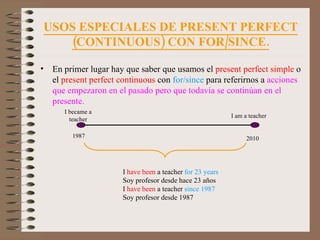
USOS ESPECIALES DE PRESENT PERFECT (CONTINUOUS) CON FOR/SINCE. En primer lugar hay que saber que usamos el  present perfect simple  o el  present perfect continuous  con  for/since  para referirnos a  acciones que empezaron en el pasado pero que todavía se continúan en el presente. I became a teacher 1987 2010 I am a teacher I   have been  a teacher  for 23 years Soy profesor desde hace 23 años I  have been  a teacher  since 1987 Soy profesor desde 1987
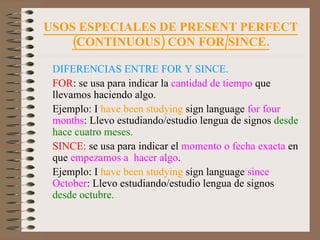
USOS ESPECIALES DE PRESENT PERFECT (CONTINUOUS) CON FOR/SINCE. DIFERENCIAS ENTRE FOR Y SINCE. FOR : se usa para indicar la  cantidad de tiempo  que llevamos haciendo algo. Ejemplo: I  have been studying  sign language  for four   months : Llevo estudiando/estudio lengua de signos  desde hace cuatro meses. SINCE:  se usa para indicar el  momento o fecha exacta  en que  empezamos a  hacer algo . Ejemplo: I  have been studying  sign language  since   October : Llevo estudiando/estudio lengua de signos  desde octubre.
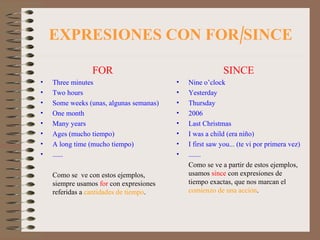
EXPRESIONES CON FOR/SINCE FOR Three minutes Two hours Some weeks (unas, algunas semanas) One month Many years Ages (mucho tiempo) A long time (mucho tiempo) ...... Como se  ve con estos ejemplos, siempre usamos  for  con expresiones referidas a  cantidades de tiempo . SINCE Nine o’clock Yesterday Thursday 2006 Last Christmas I was a child (era niño) I first saw you... (te vi por primera vez) ....... Como se ve a partir de estos ejemplos, usamos  since  con expresiones de tiempo exactas, que nos marcan el  comienzo de una acción .
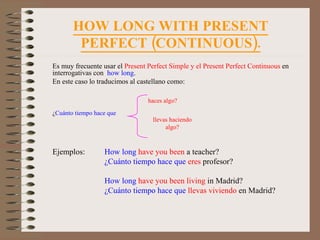
HOW LONG WITH PRESENT PERFECT (CONTINUOUS). Es muy frecuente usar el  Present Perfect Simple y el Present Perfect Continuous  en interrogativas con  how long . En este caso lo traducimos al castellano como: ¿ Cuánto tiempo hace que Ejemplos:  How long   have you been  a teacher? ¿Cuánto tiempo hace que   eres  profesor? How long   have you been living  in Madrid? ¿Cuánto tiempo hace que   llevas viviendo  en Madrid? haces algo? llevas haciendo algo?
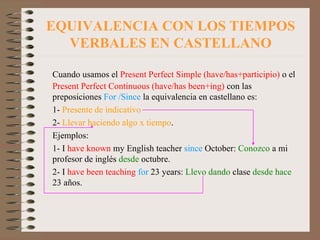
EQUIVALENCIA CON LOS TIEMPOS VERBALES EN CASTELLANO Cuando usamos el  Present Perfect Simple (have/has+participio)  o el  Present Perfect Continuous (have/has been+ing)  con las preposiciones  For /Since  la equivalencia en castellano es:  1-  Presente de indicativo 2-  Llevar haciendo algo x tiempo . Ejemplos: 1- I  have known  my English teacher  since  October:  Conozco  a mi profesor de inglés  desde  octubre. 2- I  have been teaching   for  23 years:  Llevo dando  clase  desde hace  23 años.
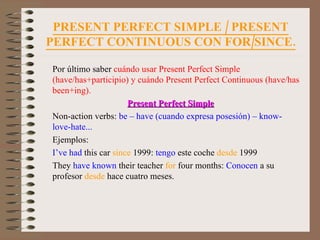
PRESENT PERFECT SIMPLE / PRESENT PERFECT CONTINUOUS CON FOR/SINCE. Por último saber  cuándo usar Present Perfect Simple (have/has+participio) y cuándo Present Perfect Continuous (have/has been+ing). Present Perfect Simple Non-action verbs:  be – have (cuando expresa posesión) – know-  love-hate... Ejemplos: I’ve had  this car  since  1999:  tengo  este coche  desde  1999 They  have known  their teacher  for  four months:  Conocen  a su profesor  desde  hace cuatro meses.
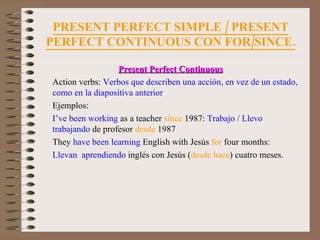
PRESENT PERFECT SIMPLE / PRESENT PERFECT CONTINUOUS CON FOR/SINCE. Present Perfect Continuous Action verbs:  Verbos que describen una acción, en vez de un estado, como en la diapositiva anterior Ejemplos: I’ve been working  as a teacher  since  1987:  Trabajo  /  Llevo trabajando  de profesor  desde  1987 They  have been learning  English with Jesús  for  four months:  Llevan  aprendiendo  inglés con Jesús ( desde hace )   cuatro meses .

Tenses

  • 1.
  • 2.
    PRESENT SIMPLE. TOWORK (TRABAJAR) FORMA AFIRMATIVA I work You work He work s She work s It work s We work You work They work FORMA NEGATIVA I do not (don’t) work You do not (don’t) work He does not (doesn’t) work She does not (doesn’t) work It does not (doesn’t) work We don’t work You don’t work They don’t work
  • 3.
    PRESENT SIMPLE. SPELLINGRULES Verbos acabados en “-y”. 1- “-y” precedida de consonante: carr y ca rries 2- “-y” precedida de vocal: sta y st ays Verbos acabados en “-o”. Go go es Verbos acabados en “-s”, “-ss”, “-sh”, “ch”, “-z”, “-x”. pass pass es wash wash es teach teach es relax relax es Al verbo se le añade una sílaba, que suena /iz/
  • 4.
    PRESENT SIMPLE. TOWORK (TRABAJAR) FORMA INTERROGATIVA Do I work ? Do you work ? Does he work ? Does she work ? Does it work ? Do we work ? Do you work ? Do they work ? RESPUESTAS BREVES Yes, I do / No, I don’t Yes, you do / No, you don’t Yes, he does / No, he doesn’t Yes, she does / No, she doesn’t Yes, it does / No, it doesn’t Yes, we do / No, we don’t Yes, you do / No, you don’t Yes, they do / No, they don’t
  • 5.
    ADVERBIOS DE FRECUENCIAALWAYS : siempre ALMOST ALWAYS : casi siempre OFTEN : a menudo USUALLY : usualmente SOMETIMES : a veces HARDLY EVER : casi nunca NEVER : nunca ALWAYS ALMOST ALWAYS OFTEN USUALLY SOMETIMES HARDLY EVER NEVER Los adverbios de frecuencia de colocan delante del verbo
  • 6.
    EXPRESIONES ADVERBIALES Everyday, week, month..: todos los días, semanas, meses.. At the weekend: el fin de semana Once a week: una vez a la semana Twice a week: dos veces a la semana On Sundays...: los domingos.. Estas expresiones adverbiales se colocan al principio o al final de la frase
  • 7.
    PRESENT CONTINUOUS. TOWORK (TRABAJAR) FORMA AFIRMATIVA I am (I’m) work ing : yo estoy trabajando You are (you’re) work ing : tú estás trabajando He is (he’s) work ing : él está trabajando She is ( she’s) work ing : ella está trabajando It is (it’s) work ing : está trabajando We are (we’re) working: estamos trabajando You are ( you’re) work ing : estáis trabajando They are (they’re) work ing : están trabajando. FORMA NEGATIVA I am (I’m not ) work ing : yo no estoy trabajando You are not ( you aren’t ) work ing : tú no estás trabajando He is not (isn’t) work ing : él no está trabajando She is not (isn’t) work ing : ella no está trabajando It is not (isn’t) work ing : no está trabajando We are not (we aren’t) work ing : no estamos trabajando You are not (you aren’t) work ing : vosotros no estáis trabajando They are not (they aren’t) work ing : no están trabajando.
  • 8.
    PRESENT CONTINUOUS. TOWORK (TRABAJAR) FORMA INTERROGATIVA Am I work ing ? Are you work ing ? Is he work ing ? Is she work ing ? Is it work ing ? Are we work ing ? Are you work ing ? Are they work ing ? SHORT ANSWERS Yes, I am / No I’m not Yes you are / No, you aren’t Yes, he is / No, he isn’t Yes, she is / No, she isn’t Yes, it is / No, it isn’t Yes, we are / No we aren’t Yes, you are / No you aren’t Yes, they are / No they aren’t
  • 9.
    PRESENT CONTINUOUS ORPROGRESSIVE. SPELLING RULES Verbos acabados en “-e” muda ( no se pronuncia). Write Writ ing Agree Agre eing ( La “-e” se mantiene porque suena en el infinitivo) Verbos acabados en “-y”. Carry Carr ying (La “-y” se mantiene siempre ) Stay Sta ying Verbos de una sílaba con el esquema C+V+C Stop Stop ping Run Run ning Verbos acabados con el diptongo “-ie” Die D ying Lie L ying La consonante se dobla El diptongo cambia a “-y”
  • 10.
    ADVERBIOS Y EXPRESIONESADVERBIALES CON PRESENT SIMPLE Y PRESENT CONTINUOUS PRESENT SIMPLE Always Almost always Usually Sometimes Hardly ever Never Every day At the weekend Once a week.. On Sundays.. PRESENT CONTINUOUS Now: ahora Right now: ahora mismo At the moment: en este momento These days,weeks..: estos días, estas semanas ..
  • 11.
    EQUIVALENCIA CON LOSTIEMPOS VERBALES EN CASTELLANO Present Simple Presente de indicativo Example: I teach English in a secondary school Doy inglés en un instituto. Present Simple Presente de subjuntivo Example: When I get home, I will ring you up. Cuando llegue a casa te llamaré.
  • 12.
    EQUIVALENCIA CON LOSTIEMPOS VERBALES EN CASTELLANO Present Continuous Presente de estar + gerundio Example: What are you doing ? ¿Qué estás haciendo ?.
  • 13.
    EQUIVALENCIA CON LOSTIEMPOS VERBALES EN CASTELLANO Un uso especial del Present Continuous or Progressive es para referirnos a nuestros planes o intenciones . En este caso, el Present Continuous or Progressive va acompañado de una referencia de tiempo futura ( tomorrow= mañana; next weekend= el fin de semana que viene) . En este caso, el Present Continuous se traduce con la perífrasis: ir a hacer algo . Example: What are you doing tomorrow evening ? ¿Qué vas a hacer mañana por la noche? Tomorrow evening I’m going out for dinner Mañana por la noche voy a cenar fuera
  • 14.
    PAST SIMPLE. TOWORK (TRABAJAR) FORMA AFIRMATIVA I work ed You work ed He work ed She work ed It work ed We work ed You work ed They work ed FORMA NEGATIVA I did not (didn’t) work You did not (didn’t) work He did not (didn’t) work She did not (didn’t) work It did not (didn’t) work We did not (didn’t) work You did not (didn’t) work They did not (didn’t ) work
  • 15.
    PAST SIMPLE. SPELLINGRULES Verbos acabados en “-y”. 1- “-y” precedida de consonante: carr y ca rried 2- “-y” precedida de vocal: sta y st ayed Verbos acabados en “-e”. advise advise d Verbos de una sílaba con el esquema C+V+C Stop Stop ped Plan Plan ned Verbos de dos sílabas con el esquema C+V+C cuya última sílaba es tónica (se pronuncia con más fuerza) PreFER Prefer red PerMIT Permit ted La consonante se dobla La consonante se dobla
  • 16.
    PAST SIMPLE. PRONUNCIATIONRULES La terminación “-ed” tiene tres pronunciaciones diferentes: /d/ - /t/ - /id/. Pronunciamos /id/, por tanto añadimos una sílaba más al verbo , cuando éste acaba en sonido dental , esto es, sonido /d/ o sonido /t/. Ejemplo: Start Start ed End End ed ID
  • 17.
    PAST SIMPLE. TOWORK (TRABAJAR) FORMA INTERROGATIVA Did I work ? Did you work ? Did he work ? Did she work ? Did it work ? Did we work ? Did you work ? Did they work ? RESPUESTAS BREVES Yes, I did / No, I didn’t Yes, you did / No, you didn’t Yes, he did / No, he didn’t Yes, she did / No, she didn’t Yes, it did / No, it didn’t Yes, we did / No, we didn’t Yes, you did / No, you didn’t Yes, they did / No, they didn’t
  • 18.
    IRREGULAR VERBS Hayunos verbos en inglés que no siguen la regla de la terminación “-ed” para formar el pasado. Estos verbos tienen su propia forma de pasado y constituyen el grupo de verbos llamado verbos irregulares. Fall Fell Write Wrote
  • 19.
    EQUIVALENCIA CON LOSTIEMPOS VERBALES EN CASTELLANO Past Simple Pretérito Perfecto Simple de Indicativo Example: I worked very late yesterday. Trabajé hasta muy tarde ayer. Past Simple Pretérito imperfecto de subjuntivo (-ara;-ase) Example: If I saw him today....... Si lo viera / viese hoy.......
  • 20.
    PAST CONTINUOUS. TOWORK (TRABAJAR) FORMA AFIRMATIVA I was work ing You were work ing He was work ing She was work ing It was work ing We were working You were work ing They were work ing FORMA NEGATIVA I was not (wasn’t) work ing You were not (weren’t) work ing He was not (wasn’t) work ing She was not (wasn’t) work ing It was not (wasn’t) work ing We were not (weren’t) work ing You were not (weren’t) work ing They were not (weren’t) work ing
  • 21.
    PAST CONTINUOUS. TOWORK (TRABAJAR) FORMA INTERROGATIVA Was I work ing ? Were you work ing ? Was he work ing ? Was she work ing ? Was it work ing ? Were we work ing ? Were you work ing ? Were they work ing ? SHORT ANSWERS Yes, I was / No I wasn’t Yes you were / No, you weren’t Yes, he was / No, he wasn’t Yes, she was / No, she wasn’t Yes, it was / No, it wasn’t Yes, we were / No we weren’t Yes, you were / No you weren’t Yes, they were / No they weren’t
  • 22.
    EQUIVALENCIA CON LOSTIEMPOS VERBALES EN CASTELLANO Past Continuous Pretérito Imperfecto de Indicativo (-aba;-ía) Example: She was driving very fast. Conducía muy rápido. Past Continuous Perífrasis verbal: estaba + gerundio. Example: We were having a good time. Nos lo estábamos pasando bien.
  • 23.
    PAST CONTINUOUS ANDPAST SIMPLE IN A SENTENCE En una frase podemos combinar el Past Simple con el Past Continuos or Progressive . El Past Continuous se refiere a lo que estaba sucediendo mientras que el Past Simple se refiere a lo que de repente pasó mientras algo ya estaba ocurriendo. En estos casos las conjunciones que usamos para unir estas acciones son when: cuando; while: mientras Example: The teacher was writing on the board when the bell rang . El profesor escribía/ estaba escribiendo en la pizarra cuando sonó el timbre. The teacher was writing on the board The bell rang
  • 24.
    PAST PERFECT. TOWORK (TRABAJAR) FORMA AFIRMATIVA I had work ed You had work ed He had work ed She had work ed It had work ed We had work ed You had work ed They had work ed FORMA NEGATIVA I had not (hadn’t) work ed You had not (hadn’t) work ed He had not (hadn’t) work ed She had not (hadn’t) work ed It had not (hadn’t) work ed We had not (hadn’t) work ed You had not (hadn’t) work ed They had not (hadn’t) work ed
  • 25.
    PAST PERFECT. TOWORK (TRABAJAR) FORMA INTERROGATIVA Had I work ed ? Had you work ed ? Had he work ed ? Had she work ed ? Had it work ed ? Had we work ed ? Had you work ed ? Had they work ed ? SHORT ANSWERS Yes, I had/ No I hadn’t Yes you had / No, you hadn’t Yes, he had / No, he hadn’t Yes, she had / No, she hadn’t Yes, it had / No, it hadn’t Yes, we had / No we hadn’t Yes, you had / No you hand’t Yes, they had / No they hadn’t
  • 26.
    PAST PERFECT DEUN VERBO IRREGULAR Como hemos visto en las anteriores diapositivas el past perfect se forma con had + participio , cuya terminación es igual que la del pasado de un verbo regular, esto es, con la terminación “-ed”. De nuevo tenemos el problema de los verbos irregulares . El participio de estos verbos tiene su propia forma y por tanto habrá que aprender dicho participio. Por ejemplo: Write Witten You had written Know Known She had known
  • 27.
    USE OF PASTPERFECT El past perfect se usa para describir una acción pasada que es anterior a otra pasada. Example: I had laid the table before my guests arrived Había puesto la mesa antes de que llegaran mis invitados ¿Qué acción sucede en primer lugar? Poner la mesa Por tanto el verbo va en past pefect
  • 28.
    EQUIVALENCIA CON LOSTIEMPOS VERBALES EN CASTELLANO Past Perfect Pretérito Pluscuamperfecto de indicativo I had made a reservation before we arrived at the hotel Había hecho una reserva antes de que llegáramos al hotel Past Perfect Pretérito pluscuamperfecto de subjuntivo If I hadn’t made a reservation before.... Si no hubiera/ hubiese hecho antes una reseva......
  • 29.
    WAYS OF EPRESSINGFUTURE. TO WORK (TRABAJAR) FORMA AFIRMATIVA I will work You will work He will work She will work It will work We will work You will work They will work FORMA NEGATIVA I will not ( won’t) work You will not ( won’t) work He will not ( won’t) work She will not ( won’t) work It will not ( won’t) work We will not ( won’t) work You will not ( won’t) work They will not ( won’t) work
  • 30.
    WAYS OF EPRESSINGFUTURE. WILL.TO WORK (TRABAJAR) FORMA INTERROGATIVA Will I work? Will you work? Will he work? Will she work? Will it work? Will we work? Will you work? Will they work? SHORT ANSWERS Yes, I will / No I won’t Yes you will / No, you won’t Yes, he will / No, he won’t Yes, she will / No, she won’t Yes, it will / No, it won’t Yes, we will / No we won’t Yes, you will / No you won’t Yes, they will / No they won’t
  • 31.
    USE OF WILLPREDICTIONS People will live longer and so life expectancy will increase Las persona vivirán más y por tanto la expectativa de vida aumentará . I’m afraid the prices of flats will not (won’t) go down . Me temo que los precios de los pisos no bajarán .
  • 32.
    USE OF WILLPROMISES I promise I wont’ let you down. Prometo que no te defraudaré.
  • 33.
    OFFERINGS (SHALL I....?) Shall I get you a drink? ¿Quieres que te ponga algo de beber? SUGGESTIONS ( SHALL WE...?) Shall we dine out tonight? ¿Quieres que salgamos cenar esta noche? USE OF WILL
  • 34.
    USE OF WILLSPONTANEOUS DECISIONS YOU HAVE LEARNT YOU HAVE WON THE LOTTERY. YOUR FIRST REACTION IS : I will buy a big house! YOU SEE YOUR NEIGHBOUR CARRYING TWO HEAVY BAGS. YOUR REACTION IS: I will help you. YOU SEE SOMEONE HAS BEEN ROBBED. YOUR FIRST REACTION IS: I will phone the police!
  • 35.
    WAYS OF EPRESSINGFUTURE. BE GOING TO . TO WORK (TRABAJAR) AFFIRMATIVE FORM I am ( I’m) going to work You are ( you’re) going to work He is (he’s) going to work She is (she’s) going to work It is (it’s) going to work We are (we’re) going to work You are (you’re) going to work They are (they’re) going to work NEGATIVE FORM I am notgoing to work You are not (aren’t) going to work He is not (isn’t) going to work She is not (isn’t) going to work It is not (isn’t) going to work We are not (aren’t) going to work You are not (aren’t) going to work They are not (aren’t) going to work
  • 36.
    WAYS OF EPRESSINGFUTURE. BE GOING TO . TO WORK (TRABAJAR) INTERROGATIVE FORM Am I going to work? Are you going to work? Is he going to work? Is she going to work? Is it going to work? Are we going to work? Are you going to work? Are they going to work? SHORT ANSWERS Yes, I am / No I’ m not Yes you are / No, you aren’t Yes, he is / No, he isn’t Yes, she is / No, she isn’t Yes, it is / No, it isn’t Yes, we are / No we aren’t Yes, you are / No you aren’t Yes, they are / No they aren’t
  • 37.
    USES OF BEGOING TO PLANS AND INTENTIONS (Ir a hacer algo) This year I’m going to learn English! Este año voy a aprender inglés.
  • 38.
    USES OF BEGOING TO IMMEDIATE FUTURE (Futuro inmediato, algo está a punto de suceder) A: The sky is very cloudy B: Yes. It’s going to rain. Sí.Va a llover
  • 39.
    WAYS OF EXPRESSINGFUTURE. PRESENT CONTINUOUS HAZ CLICK AQUÍ PARA IR A LA DIAPOSITIVA CORRESPONDIENTE
  • 40.
    PRESENT PERFECT. TOWORK (TRABAJAR) FORMA AFIRMATIVA I have work ed You have work ed He has work ed She has work ed It has work ed We have work ed You have work ed They have work ed FORMA NEGATIVA I have not / haven’t work ed You have not / haven’t work ed He has not / hasn’t work ed She has not / hasn’t work ed It has not / hasn’t work ed We have not / haven’t work ed You have not / haven’t work ed They have not / haven’t work ed
  • 41.
    PRESENT PERFECT. TOWORK (TRABAJAR) FORMA INTEROGATIVA Have I work ed ? Have you work ed ? Has he work ed ? Has she work ed ? Has it work ed ? Have we work ed ? Have you work ed ? Have they work ed ? SHORT ANSWERS Yes, I have/ No, I haven’t Yes you have / No, you haven’t Yes, he has / No, he hasn’t Yes, she has / No, she hasn’t Yes, it has / No, it hasn’t Yes, we have / No, we haven’t Yes, you have / No, you haven’t Yes,they have /No, they haven’t
  • 42.
    EQUIVALENCIA CON LOSTIEMPOS VERBALES EN CASTELLANO Present Perfect Pretérito Perfecto Compuesto I have travelled to many different countries He viajado a muchos países diferentes She has met a lot of celebrities in her career as a journalist Ha conocido a muchos famosos en su profesión como periodista.
  • 43.
    ADVERBIOS USADOS CONPRESENT PERFECT EVER: alguna vez . Se coloca antes del verbo principal (del participio). Ejemplo: Have you ever seen a falling star?: ¿ Has visto alguna vez una estrella fugaz? NEVER: nunca . Se coloca antes del verbo principal (del participio). Ejemplo: I have never been to the USA: Nunca he estado en los Estados Unidos. JUST: Con este adverbio nos referimos a acciones muy recientes, por tanto lo traducimos como acabar de hacer algo. Se coloca antes del verbo principal (del participio). Ejemplo: -Is Claudia in? –Yes, she has just arrived. – ¿Esta Claudia? - Sí, acaba de llegar . RECENTLY: recientemente . Podemos usar este adverbio en distintas posiciones dentro de la frase. Ejemplo: Have you been on a diet recently ? (final de la frase) ¿ Te has puesto a dieta recientemente? I have recently re-read “Cien Años de Soledad” (antes del participio) : He vuelto a leer recientemente “Cien Años de Soledad”.
  • 44.
    DIFERENCIAS ENTRE PRESENTPERFECT Y PAST SIMPLE PRESENT PERFECT 1- Preguntamos si alguien ha hecho alguna vez en su vida: Ejemplo: Have you ever eaten snails? ¿Has comido alguna vez caracoles? 2- Decimos lo que hemos hecho en nuestra vida Ejemplo. I have eaten snails. He comido caracoles 3- Usamos el present prefect con referencias de tiempo que aún no han acabado .como por ejemplo: this year, today .. Ejemplo: I’ve seen Carla today . Hoy he visto a Carla PAST SIMPLE 1- Preguntamos cuándo hizo alguien algo . Ejemplo: When did you eat snails? ¿Cuándo comiste caracoles? 2- Decimos cuándo hicimos algo . Evidentemente acompañaremos esta frase con una referencia de tiempo pasada. Ejemplo: I ate snails when I was a child . Comí caracoles cuando era niño. 3- Usamos el past simple con referencias de tiempo ya acabadas , como por ejemplo: last year, yesterday Ejemplo; I saw Carla yesterday . Ayer vi a Carla
  • 45.
    ADVERBIOS USADOS CONPRESENT PERFECT ALREADY: Ya . Se coloca antes del verbo principal (del participio) y en oraciones afirmativas. Ejemplo: They have already finished their work so they are going home. Ya han acabado su trabajo así que se van a casa. YET: Este adverbio tiene dos significados diferentes según el tipo de oración . Veamos: 1- oraciones interrogativas: ya . Su posición es al final . Ejemplo: Have you sent all these emails yet ? ¿ Has enviado ya todos estos correos? 2- oraciones negativas: todavía. Su posición es al final. Ejemplo: No I haven’t sent them yet . No, todavía no los he enviado.
  • 46.
    PRESENT PERFECT CONTINUOUS.TO WORK (TRABAJAR) FORMA AFIRMATIVA I have been work ing You have been work ing He has been work ing She has been work ing It has been work ing We have ben work ing You have been work ing They have been work ing FORMA NEGATIVA I have not / haven’t been work ing You have not / haven’t been work ing He has not / hasn’t been work ing She has not / hasn’t been work ing It has not / hasn’t been work ing We have not / haven’t been work ing You have not / haven’t been work ing They have not / haven’t been work ing
  • 47.
    PRESENT PERFECT CONTINUOUS.TO WORK (TRABAJAR) FORMA INTEROGATIVA Have I been work ing ? Have you been work ing ? Has he been work ing ? Has she been work ing ? Has it been work ing ? Have we been work ing ? Have you been work ing ? Have they been work ing ? SHORT ANSWERS Yes, I have/ No, I haven’t Yes you have / No, you haven’t Yes, he has / No, he hasn’t Yes, she has / No, she hasn’t Yes, it has / No, it hasn’t Yes, we have / No, we haven’t Yes, you have / No, you haven’t Yes,they have /No, they haven’t
  • 48.
    EQUIVALENCIA CON LOSTIEMPOS VERBALES EN CASTELLANO El Present Perfect Continuous equivale a nuestra perífrasis: haber estado haciendo algo. En este sentido, su uso es muy parecido al del present perfect + just: acabar de hacer algo . Ejemplo: -What’s the matter? You have tears in your eyes! ¿Qué pasa? ¡Tienes lágrimas en los ojos! - Don’t worry. I have been peeling onions. No te preocupes. He estado pelando cebollas
  • 49.
    USOS ESPECIALES DEPRESENT PERFECT (CONTINUOUS) CON FOR/SINCE. Es muy frecuente usar ambos tiempos verbales con las preposiciones de tiempo for y since . Son frases del tipo: I have been a teacher for 23 years . Soy profesor desde hace veintitrés años. I have been living in Madrid since 1975 . Vivo/Llevo viviendo en Madrid desde 1975. Llama la atención como he traducido estas frases ¿verdad?
  • 50.
    USOS ESPECIALES DEPRESENT PERFECT (CONTINUOUS) CON FOR/SINCE. En primer lugar hay que saber que usamos el present perfect simple o el present perfect continuous con for/since para referirnos a acciones que empezaron en el pasado pero que todavía se continúan en el presente. I became a teacher 1987 2010 I am a teacher I have been a teacher for 23 years Soy profesor desde hace 23 años I have been a teacher since 1987 Soy profesor desde 1987
  • 51.
    USOS ESPECIALES DEPRESENT PERFECT (CONTINUOUS) CON FOR/SINCE. DIFERENCIAS ENTRE FOR Y SINCE. FOR : se usa para indicar la cantidad de tiempo que llevamos haciendo algo. Ejemplo: I have been studying sign language for four months : Llevo estudiando/estudio lengua de signos desde hace cuatro meses. SINCE: se usa para indicar el momento o fecha exacta en que empezamos a hacer algo . Ejemplo: I have been studying sign language since October : Llevo estudiando/estudio lengua de signos desde octubre.
  • 52.
    EXPRESIONES CON FOR/SINCEFOR Three minutes Two hours Some weeks (unas, algunas semanas) One month Many years Ages (mucho tiempo) A long time (mucho tiempo) ...... Como se ve con estos ejemplos, siempre usamos for con expresiones referidas a cantidades de tiempo . SINCE Nine o’clock Yesterday Thursday 2006 Last Christmas I was a child (era niño) I first saw you... (te vi por primera vez) ....... Como se ve a partir de estos ejemplos, usamos since con expresiones de tiempo exactas, que nos marcan el comienzo de una acción .
  • 53.
    HOW LONG WITHPRESENT PERFECT (CONTINUOUS). Es muy frecuente usar el Present Perfect Simple y el Present Perfect Continuous en interrogativas con how long . En este caso lo traducimos al castellano como: ¿ Cuánto tiempo hace que Ejemplos: How long have you been a teacher? ¿Cuánto tiempo hace que eres profesor? How long have you been living in Madrid? ¿Cuánto tiempo hace que llevas viviendo en Madrid? haces algo? llevas haciendo algo?
  • 54.
    EQUIVALENCIA CON LOSTIEMPOS VERBALES EN CASTELLANO Cuando usamos el Present Perfect Simple (have/has+participio) o el Present Perfect Continuous (have/has been+ing) con las preposiciones For /Since la equivalencia en castellano es: 1- Presente de indicativo 2- Llevar haciendo algo x tiempo . Ejemplos: 1- I have known my English teacher since October: Conozco a mi profesor de inglés desde octubre. 2- I have been teaching for 23 years: Llevo dando clase desde hace 23 años.
  • 55.
    PRESENT PERFECT SIMPLE/ PRESENT PERFECT CONTINUOUS CON FOR/SINCE. Por último saber cuándo usar Present Perfect Simple (have/has+participio) y cuándo Present Perfect Continuous (have/has been+ing). Present Perfect Simple Non-action verbs: be – have (cuando expresa posesión) – know- love-hate... Ejemplos: I’ve had this car since 1999: tengo este coche desde 1999 They have known their teacher for four months: Conocen a su profesor desde hace cuatro meses.
  • 56.
    PRESENT PERFECT SIMPLE/ PRESENT PERFECT CONTINUOUS CON FOR/SINCE. Present Perfect Continuous Action verbs: Verbos que describen una acción, en vez de un estado, como en la diapositiva anterior Ejemplos: I’ve been working as a teacher since 1987: Trabajo / Llevo trabajando de profesor desde 1987 They have been learning English with Jesús for four months: Llevan aprendiendo inglés con Jesús ( desde hace ) cuatro meses .