The present perfect continuous can be used:
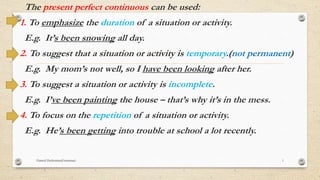
1. To emphasize the duration of a situation or activity.
E.g. It’s been snowing all day.
2. To suggest that a situation or activity is temporary.(not permanent)
E.g. My mom’s not well, so I have been looking after her.
3. To suggest a situation or activity is incomplete.
E.g. I’ve been painting the house – that’s why it’s in the mess.
4. To focus on the repetition of a situation or activity.
E.g. He’s been getting into trouble at school a lot recently.
Hamed Hashemian(Grammar) 1
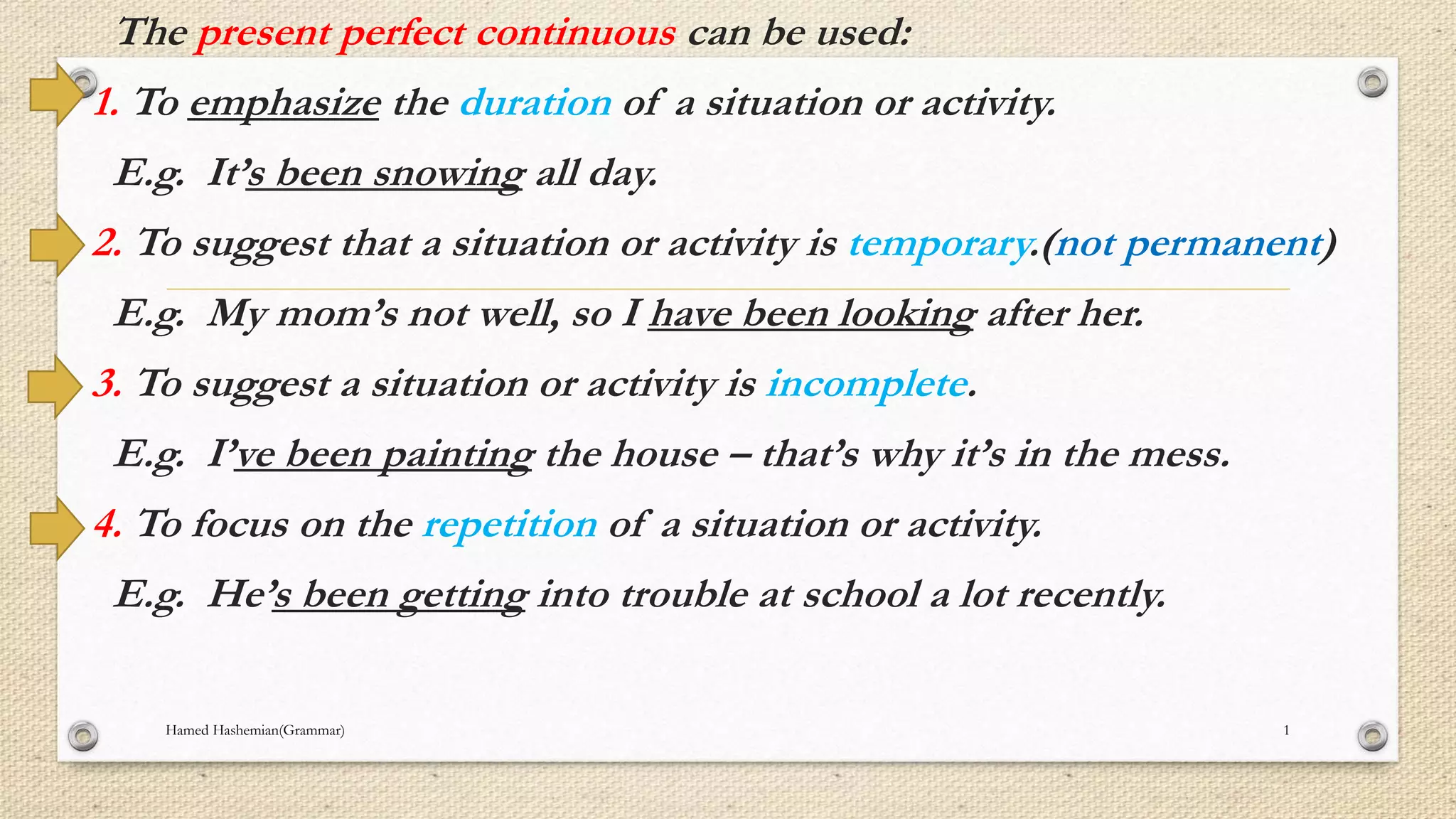
The present perfect simple and continuous:
1. Both simple and continuous forms of the present perfect can be used to talk about the
effects in the present of a past event.
Your new shoes are ruined! You’ve been playing football in them, haven’t you?(an activity)
I can’t do any sport for a few weeks; I’ve broken my arm.(a single action)
2. The continuous form is not used if we talk about the number of things that have been
completed or the number of times a thing has been done.
She’s been eating chocolate biscuits.
She’s eaten six chocolate biscuits.
3. Stative verbs such as have(to possess/own), think(to have an opinion), be , like,
believe, understand and know are not normally used in the continuous form.
We’ve known each other for a long time.(correct)
We’ve been knowing each other for a long time.(not correct)Hamed Hashemian(Grammar) 2
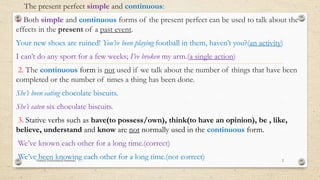
You’ve been living in a village for nearly five years now.
I’m decorating my room so I’ve been sleeping on the sofa.
We’ve been painting the house. We hope to finish it soon.
I’ve been trying to phone Tim all day, but there is no reply.
Duration
Temporary
Incomplete
Repetition
Hamed Hashemian(Grammar) 3
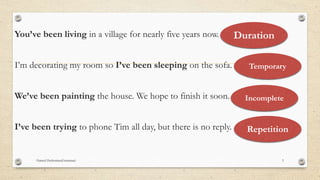
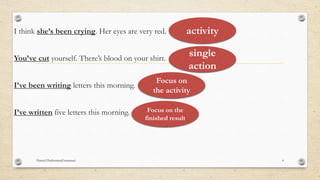
I think she’s been crying. Her eyes are very red.
You’ve cut yourself. There’s blood on your shirt.
I’ve been writing letters this morning.
I’ve written five letters this morning.
activity
single
action
Focus on
the activity
Focus on the
finished result
Hamed Hashemian(Grammar) 4

Present perfect continuous(unit 7)

  • 1.
    The present perfectcontinuous can be used: 1. To emphasize the duration of a situation or activity. E.g. It’s been snowing all day. 2. To suggest that a situation or activity is temporary.(not permanent) E.g. My mom’s not well, so I have been looking after her. 3. To suggest a situation or activity is incomplete. E.g. I’ve been painting the house – that’s why it’s in the mess. 4. To focus on the repetition of a situation or activity. E.g. He’s been getting into trouble at school a lot recently. Hamed Hashemian(Grammar) 1
  • 2.
    The present perfectsimple and continuous: 1. Both simple and continuous forms of the present perfect can be used to talk about the effects in the present of a past event. Your new shoes are ruined! You’ve been playing football in them, haven’t you?(an activity) I can’t do any sport for a few weeks; I’ve broken my arm.(a single action) 2. The continuous form is not used if we talk about the number of things that have been completed or the number of times a thing has been done. She’s been eating chocolate biscuits. She’s eaten six chocolate biscuits. 3. Stative verbs such as have(to possess/own), think(to have an opinion), be , like, believe, understand and know are not normally used in the continuous form. We’ve known each other for a long time.(correct) We’ve been knowing each other for a long time.(not correct)Hamed Hashemian(Grammar) 2
  • 3.
    You’ve been livingin a village for nearly five years now. I’m decorating my room so I’ve been sleeping on the sofa. We’ve been painting the house. We hope to finish it soon. I’ve been trying to phone Tim all day, but there is no reply. Duration Temporary Incomplete Repetition Hamed Hashemian(Grammar) 3
  • 4.
    I think she’sbeen crying. Her eyes are very red. You’ve cut yourself. There’s blood on your shirt. I’ve been writing letters this morning. I’ve written five letters this morning. activity single action Focus on the activity Focus on the finished result Hamed Hashemian(Grammar) 4