More Related Content

PDF
Hwy pre int_grammar_reference 
PDF
Advanced 1 - Grammar and vocabulary Practice.pdf 
PPTX
Overview of Present Tenses 
PPT

PPTX

PPTX
Past simple regular and irregular verbs 
PPTX
Tiempos verbales-INGLÉS123456770294.pptx 
PPTX
Similar to NewHeadway4th_PreIntermediate_Grammar.pptx

PPT
Past vs present for english teaching.ppt 
PPTX
1.1 Grammar PowerPoint on present tenses 
PPTX
Tenses review (1).pptx repaso de toda la gramática 
PPT
Present Simple, present continuous & present perfect 
PPT
Tenses express time: past, present, or future. 
PPTX
Presentation about Present and Past Tenses.pptx 
PDF
Aca f16 actividades - plan de apoyo apa grado 9venos 2015 
PDF
Present time present_simple_present_cont 
PPTX
Grammar Simple Present. Present tense grammar 
PDF
Present perfect handout enblog 
PPTX

DOC

PPTX
PAST SIMPLE VS PAST CONTINUOUS presntation 
PPT
Present perfect vs past simple 
PPTX

DOC
Ejercicios repaso 3º septiembre 
PPTX
TENSES Practica 2 chacon guzman grupo 1 
PPT
Verbtensespresentsimple 090314094456-phpapp02 
PPTX

PPTX
Verbaltenses 130529144944-phpapp02 Recently uploaded

PPTX
OCCULTISM IN JEHOVAH'S WITNESSES' ARTWORK 
PDF
CHUYÊN ĐỀ ÔN LUYỆN TUYỂN SINH 9 LÊN 10 - MÔN TOÁN - CÓ LỜI GIẢI CHI TIẾT - TH... 
PDF
PULSE according to Physiology special pdf for all medical sectors students & ... 
PDF
Master3 Realms and Yoga All students by LDMMIA 
PDF
3.Empires-and-Kingdoms-6th-to-10th-Centuries ppt.pdf/Social science Grade 7 p... 
PPTX
Insertion of Suppositories..........pptx 
PPTX
ANTISEPTICS AND DISINFECTANTS CHAPTER NO.05.pptx 
PPTX
VITAMINS CHAPTER NO.05 PHARMACOGNOSY D. PHARMACY 
PDF
eSAT-for-Teachers-2025-2028-ver.2-Nov2025 idp.pdf 
PDF
Exp.No.2 To study glassware used in Medicinal Chemistry. 
PPTX
Regenerate invoice in odoo 19 Accounting 
PPTX
OXYGEN ADMINISTRATION/THERAPY ......pptx 
PPTX
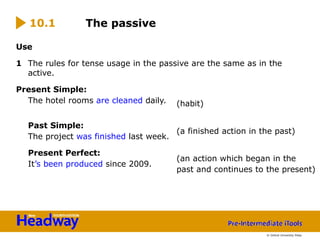
What are the Allocation warning in Odoo 19 Timeoff 
PPTX
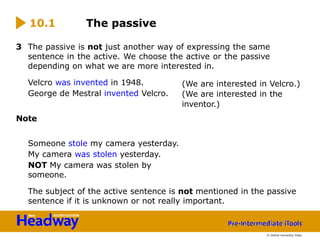
Blood, Blood Composition, Blood Groups, Disorders of Blood.pptx 
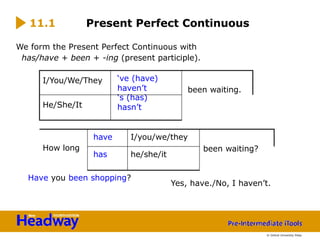
PDF
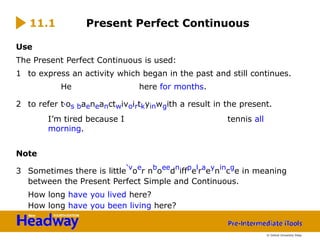
5.India-A-Home-to-Many.pdf/Social science Grade 7 part/:K SANDEEP SWAMY(M.Sc,... 
PPTX
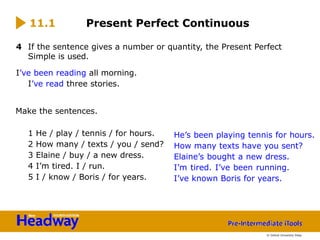
ANTI- RHEUMATICS CHAPTER NO.05 PHARMACOGNOSY 
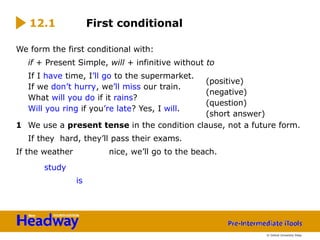
PPTX
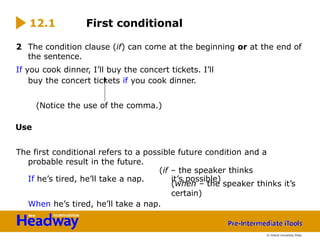
CPAR 11_12 Q1 02 Classification of Art Forms PS 1.pptx 
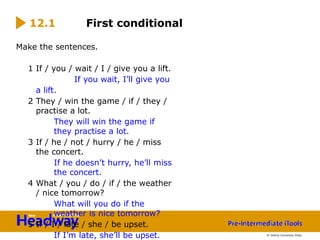
PPTX
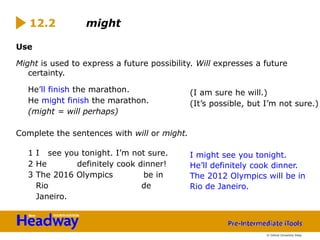
GW4 BioMed Interview Support Webinar 2026 
PPTX
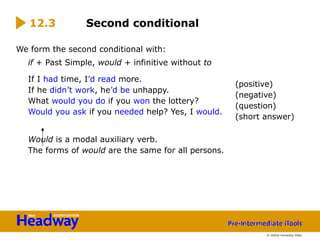
Throat painting and throat swab.....pptx 
PPTX
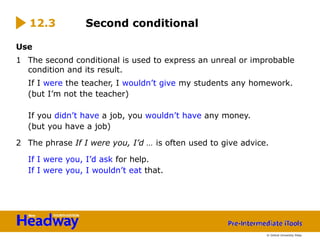
When UDL is no longer enough: Examining post-UDL reflections on inclusive des... NewHeadway4th_PreIntermediate_Grammar.pptx
- 1.
1 Unit 1aims to revise what you already know about present tenses,
past tenses, and future forms.
Carla has three children.
We’re studying for a test.
Paolo arrived yesterday.
I’m going to buy a new
car.
2 Complete the sentences with the correct form of the verb.
1 Ted / arrive / next week.
2 I / play / tennis every day.
3 They / not watch TV last night.
4 We / leave right now.
1.1 Tenses
Present Simple
Present Continuous
Past Simple
going to
Ted’s going to arrive next week.
I play tennis every day.
They didn’t watch TV last night.
We’re leaving right now.
© Oxford University Press
- 2.
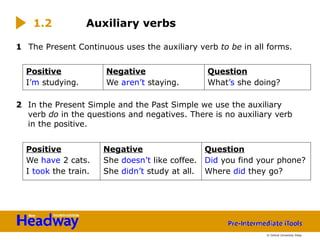
1 The PresentContinuous uses the auxiliary verb to be in all forms.
2 In the Present Simple and the Past Simple we use the auxiliary
verb do in the questions and negatives. There is no auxiliary verb
in the positive.
1.2 Auxiliary verbs
Positive
I’m studying.
Negative
We aren’t staying.
Question
What’s she doing?
Positive
We have 2 cats.
I took the train.
Negative
She doesn’t like coffee.
She didn’t study at all.
Question
Did you find your phone?
Where did they go?
© Oxford University Press
- 3.
Complete the sentenceswith the correct auxiliary, if necessary.
1 Where / you / stay / last night?
2 John / not / work / this week.
3 Lara / arrive / yesterday.
4 What / you / read now?
5 I / not / see Paul in Berlin.
1.2 Auxiliary verbs
Where did you stay last night?
John isn’t working this week.
Lara arrived yesterday.
What are you reading now?
I didn’t see Paul in Berlin.
© Oxford University Press
- 4.
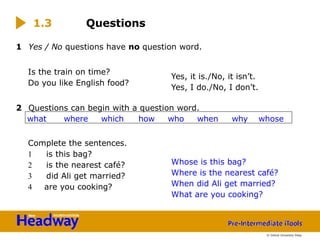
1 Yes /No questions have no question word.
Is the train on time?
Do you like English food?
2 Questions can begin with a question word.
Complete the sentences.
1 is this bag?
2 is the nearest café?
3 did Ali get married?
4 are you cooking?
1.3 Questions
Yes, it is./No, it isn’t.
Yes, I do./No, I don’t.
Whose is this bag?
Where is the nearest café?
When did Ali get married?
What are you cooking?
what where which how who when why whose
© Oxford University Press
- 5.
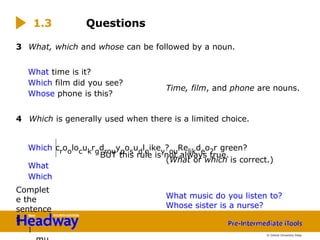
3 What, whichand whose can be followed by a noun.
What time is it?
Which film did you see?
Whose phone is this?
4 Which is generally used when there is a limited choice.
Which croolocukrgdrouyposudloikey?ouRelikdeo?r green?
BUT this rule is not always true.
What
Which
Complet
e the
sentence
s.
1
1.3 Questions
Time, film, and phone are nouns.
(What or which is correct.)
What music do you listen to?
Whose sister is a nurse?
© Oxford University Press
- 6.
5 How canbe followed by an adjective or an adverb.
How old is he?
Adjective
6 How can also be followed by much or many.
How much money do you need?
How many cats does Irina have?
Complete the sentences.
1 long is the film?
2 much is the ticket?
3 are my keys?
4 time did you arrive?
1.3 Questions
How often do you swim?
Adverb
How long is the film?
How much is the ticket?
Where are my keys?
What time did you
arrive?
© Oxford University Press
- 7.
1 The PresentSimple uses the auxiliary do in questions and negatives.
Do you watch American films?
Does Ella play the saxophone?
2.1 Present Simple
Yes, I do.
No, she doesn’t.
I/You/We/They live
don’t live in London.
He/She/It
lives
doesn’t live
finish?
When
do I/you/we/they
does he/she/it
© Oxford University Press
- 8.
2 Kris /like / music festivals?
3 Per / love / horror films.
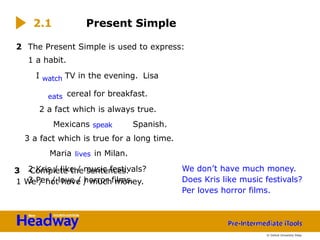
2 The Present Simple is used to express:
1 a habit.
I watch TV in the evening. Lisa
eats cereal for breakfast.
2 a fact which is always true.
Mexicans speak Spanish.
3 a fact which is true for a long time.
Maria lives in Milan.
3 Complete the sentences.
1 We / not have / much money.
2.1 Present Simple
We don’t have much money.
Does Kris like music festivals?
Per loves horror films.
© Oxford University Press
- 9.
1 We formthe Present Continuous using am/is/are + verb + -ing
(present participle).
2.2 Present Continuous
I ‘m (am)
‘m not
He/She/It
‘s (is)
isn’t
‘re (are)
listening.
You/We/They aren’t
Where
am I
is
are
he/she/it going?
you/we/they
© Oxford University Press
- 10.
2 She /wear / a new dress.
3 They / not enjoy / the party.
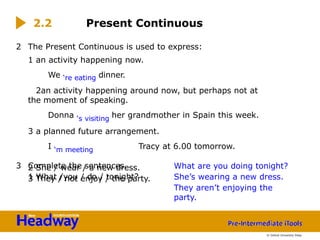
2 The Present Continuous is used to express:
1 an activity happening now.
We ‘re eating dinner.
2an activity happening around now, but perhaps not at
the moment of speaking.
Donna ‘s visiting her grandmother in Spain this week.
3 a planned future arrangement.
I ‘m meeting Tracy at 6.00 tomorrow.
3 Complete the sentences.
1 What /you / do / tonight?
2.2 Present Continuous
What are you doing tonight?
She’s wearing a new dress.
They aren’t enjoying the
party.
© Oxford University Press
- 11.
1 Some verbsexpress a state, not an activity, and are usually used
in the Present Simple only.
Irina needs a new
laptop.
understand own
think
2 Complete the sentences.
1 I / not understand / it.
3 We / like / the same
music.
4 You / think / it’s cold?
5 Ivan / own / two
cafés.
Present Simple and Present
Continuous
NOT Irina is needing a new laptop.
agree love like know
I don’t understand it.
We like the same music.
Do you think it’s cold?
Ivan owns two cafés.
2.3
© Oxford University Press
- 12.
1 Have andhave got mean the same but have different forms.
We t, but not with have.
I/You/We/They don’t have
haven’t got a phone.
He/She/It
can use
contracti
doesn’t have
hasn’t got
ons with have go
I ‘ve got two cats. I
have two dogs.
2.4 have got/have
I/You/We/They have
‘ve got a new home.
He/She/It
has
‘s got
© Oxford University Press
- 13.
2 The questionforms for have and have got are different.
Does Dan have a car?
Has Dan got a car?
Complete the
sentences.
1 Have got (you) / a
passport?
2 Tanya / have / a
sister?
2.4 have got/have
Yes, he does./No, he doesn’t.
Yes, he has./No, he hasn’t.
Have you got a passport?
Does Tanya have a sister?
Do I/you/we/they
Does he/she
have
a website?
Have
Has
I/you/we/they
he/she
got
© Oxford University Press
- 14.
3 Have gotis more informal than have. We use it a lot when we
speak, but not so much when we write.
Have you got a minute?
New York has three airports.
4 Have and have got express possession.
She’s got blue eyes.
5 When have + noun expresses an activity or habit, have (not
have got) is used.
NOT I’ve got breakfast at
7.00.
I
h
a
v
e
b
2.4 have got/have
(informal)
(formal)
She has blue eyes.
© Oxford University Press
- 15.
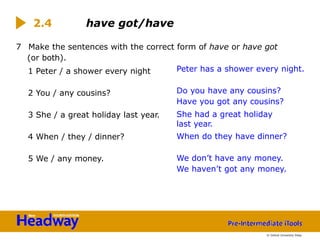
7 Make thesentences with the correct form of have or have got
(or both).
1 Peter / a shower every night
2 You / any cousins?
3 She / a great holiday last year.
4 When / they / dinner?
5 We / any money.
2.4 have got/have
Peter has a shower every night.
Do you have any cousins?
Have you got any cousins?
She had a great holiday
last year.
When do they have dinner?
We don’t have any money.
We haven’t got any money.
© Oxford University Press
- 16.
1 The formof the Past Simple is the same for all persons.
2 The negative of the Past Simple is formed with didn’t.
3 Th
I/He/She/It/
You/We/They
e question in
the Pa
didn’t leave
didn’t wait
st Simple is
for
yesterday.
med with
did.
What
d you
arrive
did
this mor
I/he/she/it/
nyinogu?/we/
they Yes,
say?
I did./No, I
didn
Di
3.1 Past Simple
I/He/She/It/
You/We/They
started
moved
last week.
’t.
© Oxford University Press
- 17.
4 The normalspelling rule is to add -ed or -d.
like
watch
5 Some short verbs with only one syllable double the consonant.
plan
6 Verbs ending in a consonant + -y change the -y to -ied.
hurry
play
There are many common irregular verbs.
eat
think
3.1 Past Simple
liked play played
watched decide decided
planned
hurried
played
ate
thought
make
begin
made
began
© Oxford University Press
- 18.
7 The PastSimple expresses a completed past action.
They got married in 2009.
Tina arrived last Tuesday.
I finished work an hour ago.
Notice the time expressions
8 Make the sentences.
1 When / they / meet / Diana?
2 Ted / buy / a car / yesterday.
3 I / not drink / any coffee.
4 We / study / French at school.
3.1 Past Simple
When did they meet Diana?
Ted bought a car yesterday.
I didn’t drink any coffee.
We studied French at
school.
© Oxford University Press
- 19.
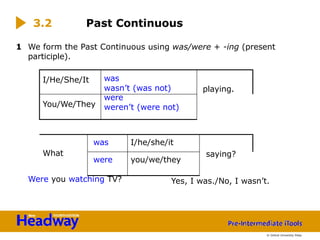
1 We formthe Past Continuous using was/were + -ing (present
participle).
Were you watching TV?
3.2 Past Continuous
Yes, I was./No, I wasn’t.
I/He/She/It was
wasn’t (was not) playing.
You/We/They
were
weren’t (were not)
saying?
What
was I/he/she/it
were you/we/they
© Oxford University Press
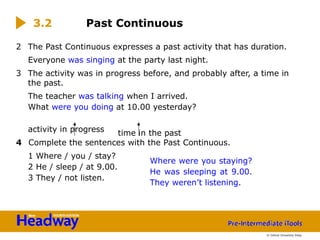
- 20.
time in thepast
Where were you staying?
He was sleeping at 9.00.
They weren’t listening.
2 The Past Continuous expresses a past activity that has duration.
Everyone was singing at the party last night.
3 The activity was in progress before, and probably after, a time in
the past.
The teacher was talking when I arrived.
What were you doing at 10.00 yesterday?
activity in progress
4 Complete the sentences with the Past Continuous.
1 Where / you / stay?
2 He / sleep / at 9.00.
3 They / not listen.
3.2 Past Continuous
© Oxford University Press
- 21.
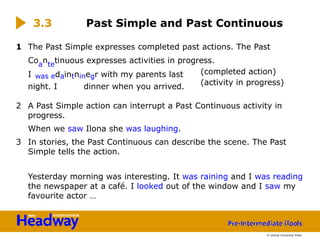
1 The PastSimple expresses completed past actions. The Past
Coa
nte
tinuous expresses activities in progress.
I was edaintninegr with my parents last
night. I dinner when you arrived.
2 A Past Simple action can interrupt a Past Continuous activity in
progress.
When we saw Ilona she was laughing.
3 In stories, the Past Continuous can describe the scene. The Past
Simple tells the action.
Yesterday morning was interesting. It was raining and I was reading
the newspaper at a café. I looked out of the window and I saw my
favourite actor …
3.3 Past Simple and Past Continuous
(completed action)
(activity in progress)
© Oxford University Press
- 22.
4 Complete thesentences.
1 Ali / sleep / when / we / go out.
2 When / Tom / phone / I / clean.
3 I / go / Beijing / 2 years ago.
4 It / snow / so / we / leave.
5 What / you / do / when / I / ring. What were you doing when I rang?
3.3 Past Simple and Past Continuous
Ali was sleeping when we went out.
When Tom phoned I was cleaning.
I went to Beijing 2 years ago.
It was snowing so we left.
© Oxford University Press
- 23.
1 We canuse at, on, or in with different time expressions.
3.4 Prepositions in time expressions
at in on
… three o’clock … 2011 … Wednesday
… midnight … the morning … Sunday evening
… Christmas … the afternoon … Christmas day
… the weekend … the evening … August 14th
… winter
… two days’ time
no preposition
… a week ago
… next year
… tomorrow night
… this evening
© Oxford University Press
- 24.
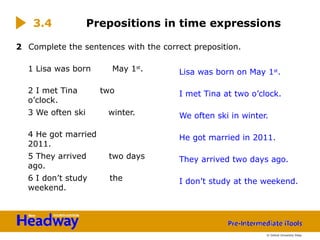
2 Complete thesentences with the correct preposition.
1 Lisa was born May 1st
.
2 I met Tina two
o’clock.
3 We often ski winter.
4 He got married
2011.
5 They arrived two days
ago.
6 I don’t study the
weekend.
3.4 Prepositions in time expressions
Lisa was born on May 1st
.
I met Tina at two o’clock.
We often ski in winter.
He got married in 2011.
They arrived two days ago.
I don’t study at the weekend.
© Oxford University Press
- 25.
Count and uncountnouns
1 It is important to understand the difference between count and
uncount nouns.
Count nouns:
can be singular or plural.
We can say two books.
We can count them.
4.1 Expressions of quantity
Count nouns Uncount nouns
a biscuit
biscuits
a boy boys
a carrot carrots
a book books
tea
pasta
homework
meat
Uncount nouns:
can only be singular.
We cannot say two meats.
We cannot count them.
© Oxford University Press
- 26.
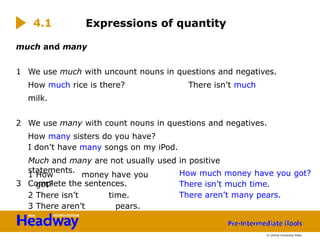
much and many
1We use much with uncount nouns in questions and negatives.
How much rice is there? There isn’t much
milk.
2 We use many with count nouns in questions and negatives.
How many sisters do you have?
I don’t have many songs on my iPod.
Much and many are not usually used in positive
statements.
3 Complete the sentences.
1 How money have you
got?
2 There isn’t time.
3 There aren’t pears.
Expressions of quantity
4.1
© Oxford University Press
How much money have you got?
There isn’t much time.
There aren’t many pears.
- 27.
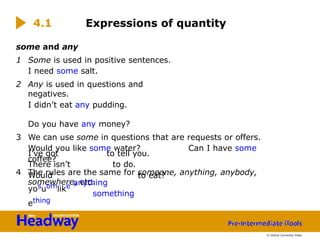
some and any
1Some is used in positive sentences.
I need some salt.
2 Any is used in questions and
negatives.
I didn’t eat any pudding.
Do you have any money?
3 We can use some in questions that are requests or offers.
Would you like some water? Can I have some
coffee?
4 The rules are the same for someone, anything, anybody,
somewhere, etc.
to tell you.
to do.
I’ve got
There isn’t
Would
yosuomlike
ething
to eat?
Expressions of quantity
4.1
© Oxford University Press
anything
something
- 28.
a few anda little
1 We use a few with count nouns.
I have a few photos of my trip, but not many.
2 We use a little with uncount nouns.
We only have a little money left.
3 Complete the sentences with a few
or a little.
1 Do you have minutes?
2 I’ve only got
homework.
3 There are crisps left.
4 I’d like chocolate.
4.1 Expressions of quantity
Do you have a few minutes?
I’ve only got a little homework.
There are a few crisps left.
I’d like a little chocolate.
© Oxford University Press
- 29.
a lot/lots of
1We use a lot/lots of with both count and uncount nouns.
He has lots of questions.
They’ve got a lot of money.
2 A lot/lots of can be used in questions and negatives.
Are there lots of shops in the town centre?
There isn’t a lot of sugar, but there’s enough.
3 Choose the correct option.
1 There are a lot of / a little children in the garden.
2 I eat lots of / a little fruit. I don’t like it much.
3 We only have a little / a few friends here.
Expressions of quantity
4.1
© Oxford University Press
a lot of
a little
a few
- 30.
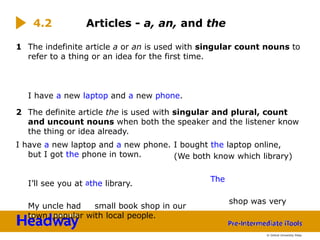
1 The indefinitearticle a or an is used with singular count nouns to
refer to a thing or an idea for the first time.
I have a new laptop and a new phone.
2 The definite article the is used with singular and plural, count
and uncount nouns when both the speaker and the listener know
the thing or idea already.
I have a new laptop and a new phone. I bought the laptop online,
but I got the phone in town.
I’ll see you at athe library.
My uncle had small book shop in our
town. popular with local people.
shop was very
4.2 Articles - a, an, and the
(We both know which library)
The
© Oxford University Press
- 31.
Indefinite article
The indefinitearticle is used:
1 with
pSrhoefe’sssaiodnosctor
.
2 with saompaeireoxfpressions of
quaantfietwy. a
couple of a
little
3 with soonmce aexwperekssions of
freqtwueicnecya. day
4 in excWlahmaat taiosnhsawmiteh! what +
aWchoautnat bneoauunt.iful baby!
4.2 Articles - a, an, and the
I’m an engineer.
three times a year
© Oxford University Press
- 32.
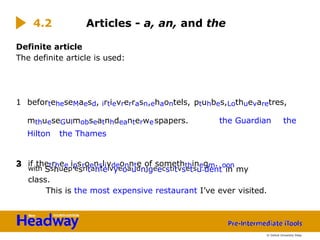
Definite article
The definitearticle is used:
1 beforteheseMaesd, irtievrerrasn,ehaontels, ptuhbes,Lothuevaretres,
mthueseGulmobseatnhdeanterwespapers. the Guardian the
Hilton the Thames
2 if thetrhee ipsroensliydeonnte of someththinegm. oon
3
with Sshuep’esrltahteivyeoaudnjgeecstitvsetsu.dent in my
class.
This is the most expensive restaurant I’ve ever visited.
4.2 Articles - a, an, and the
© Oxford University Press
- 33.
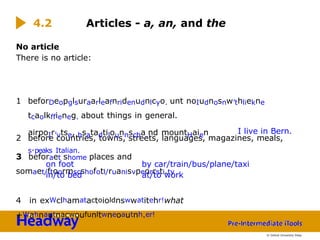
No article
There isno article:
1 beforDeopglsuraarleafnridenudnlcyo. unt noIudnosnw’thliekne
tcaolkffieneg. about things in general.
2 before countries, towns, streets, languages, magazines, meals,
airpoIr’vtse, hsatadtilounnscha.nd mountHaien
s.peaks Italian.
3 beforaet shome places and
somaet/ftoormscshofotl/ruanisvpeorrsti.ty
4 in exWclhamatactoioldnswwatitehr!what
+Wahnautnacwoufunltwneoautnh.er!
4.2 Articles - a, an, and the
I live in Bern.
on foot
in/to bed
by car/train/bus/plane/taxi
at/to work
© Oxford University Press
- 34.
Complete the sentenceswith a/an/the/- (no article).
a
1 My brother is _- journalist.
2 Laura speaks the_ Russian.
3 It’s warma in sun.
4 I have _- couple of questions.
5 What _th_e_ terrible news!
6 He’s oldest pearson here.
7 I run tohree timebsy week.
8 I go work car.
4.2 Articles - a, an, and the
© Oxford University Press
- 35.
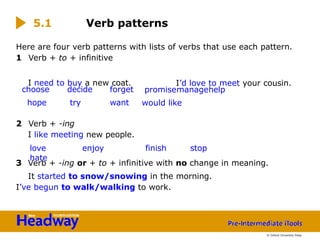
Here are fourverb patterns with lists of verbs that use each pattern.
1 Verb + to + infinitive
I need to buy a new coat. I’d love to meet your cousin.
promisemanagehelp
2 Verb + -ing
I like meeting new people.
love enjoy
hate
3 Verb + -ing or + to + infinitive with no change in meaning.
It started to snow/snowing in the morning.
I’ve begun to walk/walking to work.
5.1 Verb patterns
choose
hope
© Oxford University Press
decide
try
forget
want would like
finish stop
- 36.
4 Verb +preposition + -ing
He’s thinking of having a party for his birthday.
We’re looking forward to finishing our exams.
like doing and would like to do
1 Like doing and love doing express a general enjoyment.
I love living in London.
I like studying Spanish.
2 Would like to do and would love to do express a preference now or
at a specific time.
I’d love to live in London.
I’d like to study Spanish.
5.1 Verb patterns
I live in London now and I love it.
I study Spanish and I like it.
I want to live in London in the future.
I want to study Spanish, if possible.
© Oxford University Press
- 37.
3 Notice howto answer questions with would you like.
Yes, I would./Yes, I’d love to.
Yes, I would./No, thank you.
Would you like to join us?
Would you like to come for lunch? This is the polite way to
say no.
NOT No, I wouldn’t.
4 Complete the sentences.
1 Tom promised
(help) me.
2 I hate (cook)!
3 I’m thinking of
(move).
4 We’d like (go) on
holiday.
5 It’s stopped (rain).
5.1 Verb patterns
Tom promised to help me.
I hate cooking!
I’m thinking of moving.
We’d like to go on holiday.
It’s stopped raining.
© Oxford University Press
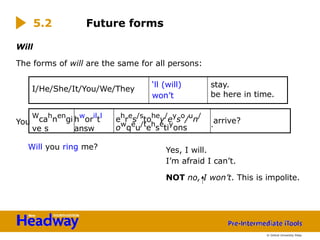
- 38.
Will
The forms ofwill are the same for all persons:
You
W
cah
nen
gi
ve s
hw
oril
tl
answ
eh
re
s/s
tohe
y/
ey
so
/u
n/
ow
qe
u/t
eh
se
tiy
ons .
arrive?
Will you ring me?
5.2 Future forms
Yes, I will.
I’m afraid I can’t.
NOT no, I won’t. This is impolite.
I/He/She/It/You/We/They
‘ll (will)
won’t
stay.
be here in time.
© Oxford University Press
- 39.
Will is used:
1to express a future intention made at the moment of speaking.
Is Paul back already? I’ll call him later.
2 to express an offer.
I’ll buy the tickets for you.
3 to express a future fact you think is sure to happen in the future.
Paul will be 50 next year.
There is no intention, plan or personal opinion in this statement.
Future forms
5.2
© Oxford University Press
- 40.
going to
We useam/is/are + going to + infinitive:
5.2 Future forms
I ‘m (am)/‘m not
He/She/It ‘s (is)/isn’t
going to worry.
You/We/They
‘re (are)/aren’t
© Oxford University Press
Where
am I
is
are
he/she/it going to be?
you/we/they
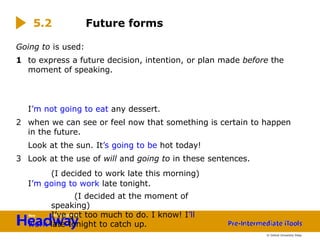
- 41.
Going to isused:
1 to express a future decision, intention, or plan made before the
moment of speaking.
I’m not going to eat any dessert.
2 when we can see or feel now that something is certain to happen
in the future.
Look at the sun. It’s going to be hot today!
3 Look at the use of will and going to in these sentences.
(I decided to work late this morning)
I’m going to work late tonight.
(I decided at the moment of
speaking)
I’ve got too much to do. I know! I’ll
work late tonight to catch up.
Future forms
5.2
© Oxford University Press
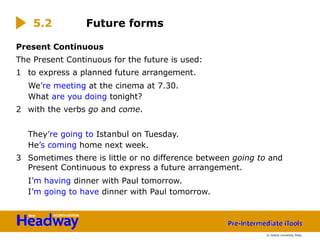
- 42.
Present Continuous
The PresentContinuous for the future is used:
1 to express a planned future arrangement.
We’re meeting at the cinema at 7.30.
What are you doing tonight?
2 with the verbs go and come.
They’re going to Istanbul on Tuesday.
He’s coming home next week.
3 Sometimes there is little or no difference between going to and
Present Continuous to express a future arrangement.
I’m having dinner with Paul tomorrow.
I’m going to have dinner with Paul tomorrow.
5.2 Future forms
© Oxford University Press
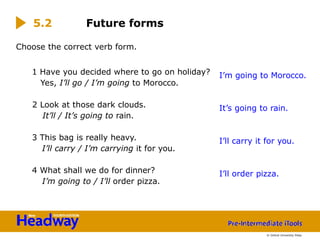
- 43.
Choose the correctverb form.
1 Have you decided where to go on holiday?
Yes, I’ll go / I’m going to Morocco.
2 Look at those dark clouds.
It’ll / It’s going to rain.
3 This bag is really heavy.
I’ll carry / I’m carrying it for you.
4 What shall we do for dinner?
I’m going to / I’ll order pizza.
5.2 Future forms
I’m going to Morocco.
It’s going to rain.
I’ll carry it for you.
I’ll order pizza.
© Oxford University Press
- 44.
1 We formthe question with what + to be + like?
Question
What’s New York like?
What was the party like?
What are the shops like?
Like is a preposition, not a verb.
In these sentences like is a verb:
What does Carla like?
6.1 What … like?
Answer
It’s very exciting.
It was wonderful. I had a great time.
They’re nice, but a bit expensive.
We don’t use like in the answer.
She likes clothes and shopping.
© Oxford University Press
- 45.
1 What wasthe test like?
2 How’s Khaled?
3 What’s Rome like?
Use
1 What … like? asks for a description.
What’s Paul like? He’s very funny and
intelligent.
2 How’s …? Asks about health. It doesn’t ask for a description.
How’s your sister? She’s fine, thank you.
3 Write in the appropriate question.
What does Amy like?
What … like?
4
The test was really difficult.
Khaled’s much better, thank you.
Rome is an amazing, historic city.
Amy really likes clothes and fashion.
6.1
© Oxford University Press
- 46.
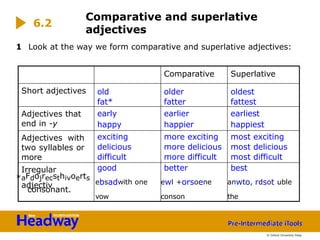
1 Look atthe way we form comparative and superlative adjectives:
*
Comparative Superlative
Short adjectives old
fat*
older
fatter
oldest
fattest
Adjectives that
end in -y
early
happy
earlier
happier
earliest
happiest
Adjectives with
two syllables or
more
exciting
delicious
difficult
more exciting
more delicious
more difficult
most exciting
most delicious
most difficult
Irregular
aFdojrecsthivoerts
adjectiv
consonant.
good
ebsadwith one
vow
better
ewl +orsoene
conson
best
anwto, rdsot uble
the
Comparative and superlative
adjectives
6.2
© Oxford University Press
- 47.
Comparative and superlative
adjectives
6.2
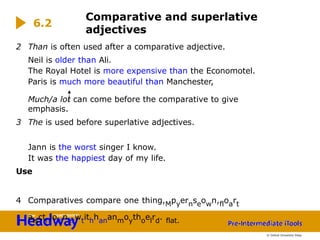
2Than is often used after a comparative adjective.
Neil is older than Ali.
The Royal Hotel is more expensive than the Economotel.
Paris is much more beautiful than Manchester,
Much/a lot can come before the comparative to give
emphasis.
3 The is used before superlative adjectives.
Jann is the worst singer I know.
It was the happiest day of my life.
Use
4 Comparatives compare one thing,Mpyernseown,floart
aisctnioicnerwtithhananmoythoelrd. flat.
© Oxford University Press
- 48.
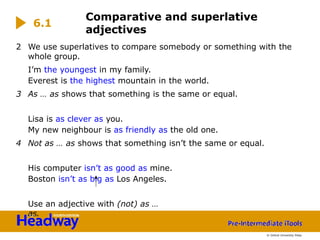
2 We usesuperlatives to compare somebody or something with the
whole group.
I’m the youngest in my family.
Everest is the highest mountain in the world.
3 As … as shows that something is the same or equal.
Lisa is as clever as you.
My new neighbour is as friendly as the old one.
4 Not as … as shows that something isn’t the same or equal.
His computer isn’t as good as mine.
Boston isn’t as big as Los Angeles.
Use an adjective with (not) as …
as.
Comparative and superlative
adjectives
6.1
© Oxford University Press
- 49.
Make the sentences.
1Tokyo / more modern / Rome.
2 Lisa / young / in our class.
3 Mumbai / big / city in India.
4 He / not / nice / his brother.
5 The weather / bad / last year.
Comparative and superlative
adjectives
6.2
© Oxford University Press
Tokyo is more modern than Rome.
Lisa is the youngest in our class.
Mumbai is the biggest city in India.
He isn’t as nice as his brother.
The weather is worse than last
year.
- 50.
Form
We form thePresent Perfect using have/has + past participle.
Have you seen this film?
Has he worked here long?
been to Canada?
You can give short answers to yes/no questions.
7.1 Present Perfect
Yes, I have./No, I haven’t.
Yes, he has./No, he hasn’t.
I/You/We/They ‘ve (have)
haven’t eaten dinner.
He/She/It ‘s (has)
hasn’t
travelled much.
© Oxford University Press
Have I/you/we/they finished?
Has he/she/it
- 51.
Use
1 The PresentPerfect expresses an action or state which began in
the past and continues to the present.
I’ve worked here for five months.
PAST
5 months
1 2 3
4
We’ve lived in Bristol since 2009.
PAST
2009
for
since
Present Perfect
Use for with a period of time.
NOW
Use since with a point in time.
NOW
7.1
two years three hours a few years a long time
Tuesday last week 1999 6.30
© Oxford University Press
- 52.
We’ve lived inten different countries.
He’s met several Presidents.
‘ve made
Use
2 The Present Perfect connects the present and the past. It expresses
experiences in life before now.
(before now)
(in his life)
The action can continue to the present, and probably into the future.
I three films.
Ever and never are common with this use.
Have you ever studied another language?
I’ve never flown in a small plane.
Present Perfect
(so far – I might make more)
7.1
© Oxford University Press
- 53.
Use
3 The PresentPerfect expresses a past action with results in the
present. It is often a recent past action.
I’ve found some keys.
He’s eaten breakfast.
We’ve made a cake.
The adverbs just, already and yet are common with this use.
She’s just left you a message.
Marco has already made dinner.Yet is used in questions and negatives.
Has Tony arrived yet?
He hasn’t called yet.
Present Perfect
(I’ve got them now.)
(He’s not hungry now.)
(It’s ready now.)
7.1
© Oxford University Press
- 54.
Make the sentences.Add for or since if necessary.
1 I / know / Carlos / last July.
2 We / have / car / two years.
3 He / write / three books / 2005. He’s written three books since 2005.
4 She / just / lose / the game.
5 You / ever / see / a whale?
6 They / never / try / sushi.
7.1 Present Perfect
I’ve known Carlos since last July.
We’ve had a car for two years.
She’s just lost the game.
Have you ever seen a whale?
They’ve never tried sushi.
© Oxford University Press
- 55.
1 The PastPerfect refers to a finished action, or a definite time in the
past. The Present Perfect refers to an unfinished action, or an
experience in your life.
I’ve worked for IBM since 2008.
I worked for IBM in the 1990s.
He’s been to China many times.
She went to China last summer.
- Have you ever met a famous
person?
- Yes, I met David Beckham five years ago.
Make the sentences.
1 You / ever / eat / Thai food/?
2 We / see / Sonia / last month.
7.2 Present Perfect and Past Simple
(the action is not finished)
(the action is finished)
(an experience in his life)
(at a definite past time)
(experience)
(definite time)
Have you ever eaten Thai food?
We saw Sonia last month.
© Oxford University Press
- 56.
2 These arecommon time expressions used with the Past Simple and
the Present Perfect.
7.2 Present Perfect and Past Simple
Past Simple Present Perfect
last month since Friday
yesterday ever
the day before yesterday never
in 2011 just
on December 19th
already
two weeks ago yet
for two years (but now ended) for two years (and continues)
© Oxford University Press
- 57.
3 Make thesentences.
1 We / never / visit / Lisbon.
2 I / fly to Boston / in March.
3 You / ever / sleep / in a tent?
4 He / not / write / his book yet.
5 We / speak to Brian / last week.
7.2 Present Perfect and Past Simple
We’ve never visited Lisbon.
I flew to Boston in March.
Have you ever slept in a tent?
He hasn’t written his book yet.
We spoke to Brian last week.
© Oxford University Press
- 58.
1 Has/have +to + infinitive expresses obligation.
You can give short answers to yes/no questions.
Does he have to leave?
Do you have to work?
8.1 have to
Yes, he does./No, he doesn’t.
Yes, I do./No, I don’t.
to
© Oxford University Press
do anything.
I/You/We/They have/don’t have
He/She/It has/doesn’t have
have to go now?
Do
Does
I/you/we/they
he/she/it
- 59.
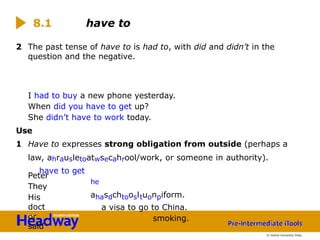
2 The pasttense of have to is had to, with did and didn’t in the
question and the negative.
Peter
They
His
doct
or
said
I had to buy a new phone yesterday.
When did you have to get up?
She didn’t have to work today.
Use
1 Have to expresses strong obligation from outside (perhaps a
law, ahrausletoatwsecahrool/work, or someone in authority).
have to get
he
ahasdchtoosltuonpiform.
a visa to go to China.
smoking.
8.1 have to
© Oxford University Press
- 60.
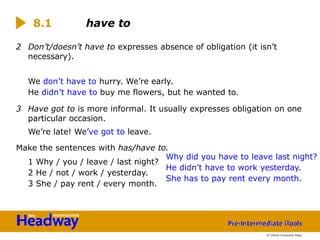
2 Don’t/doesn’t haveto expresses absence of obligation (it isn’t
necessary).
We don’t have to hurry. We’re early.
He didn’t have to buy me flowers, but he wanted to.
3 Have got to is more informal. It usually expresses obligation on one
particular occasion.
We’re late! We’ve got to leave.
1 Why / you / leave / last night?
2 He / not / work / yesterday.
3 She / pay rent / every month.
Make the sentences with has/have to.
Why did you have to leave last night?
8.1 have to
He didn’t have to work yesterday.
She has to pay rent every month.
© Oxford University Press
- 61.
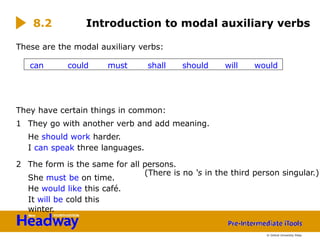
These are themodal auxiliary verbs:
They have certain things in common:
1 They go with another verb and add meaning.
He should work harder.
I can speak three languages.
2 The form is the same for all persons.
She must be on time.
He would like this café.
It will be cold this
winter.
8.2 Introduction to modal auxiliary verbs
(There is no ‘s in the third person singular.)
can could must shall should will would
© Oxford University Press
- 62.
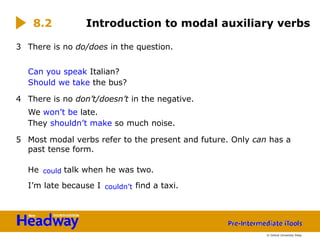
3 There isno do/does in the question.
Can you speak Italian?
Should we take the bus?
4 There is no don’t/doesn’t in the negative.
We won’t be late.
They shouldn’t make so much noise.
5 Most modal verbs refer to the present and future. Only can has a
past tense form.
He could talk when he was two.
I’m late because I couldn’t find a taxi.
8.2 Introduction to modal auxiliary verbs
© Oxford University Press
- 63.
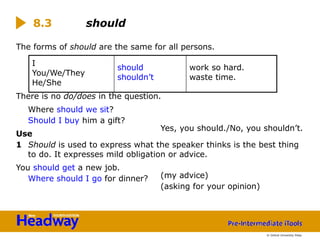
The forms ofshould are the same for all persons.
There is no do/does in the question.
Where should we sit?
Should I buy him a gift?
Use
1 Should is used to express what the speaker thinks is the best thing
to do. It expresses mild obligation or advice.
You should get a new job.
Where should I go for dinner?
8.3 should
Yes, you should./No, you shouldn’t.
(my advice)
(asking for your opinion)
I
You/We/They
He/She
should
shouldn’t
work so hard.
waste time.
© Oxford University Press
- 64.
2 Shouldn’t expressesnegative advice.
You shouldn’t eat so much sugar. It’s not healthy.
3 Should expresses the opinion of the speaker. It is often introduced
by I think or I don’t think.
I think you should take a holiday.
I don’t think children should watch TV.
Make the sentences with should or shouldn’t.
1 You / smoke. It isn’t healthy.
2 I / not / think / he / eat it.
8.3 should
You shouldn’t smoke.
I don’t think he should eat it.
© Oxford University Press
- 65.
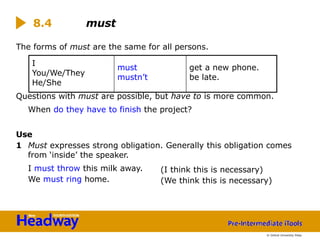
The forms ofmust are the same for all persons.
Questions with must are possible, but have to is more common.
When do they have to finish the project?
Use
1 Must expresses strong obligation. Generally this obligation comes
from ‘inside’ the speaker.
I must throw this milk away.
We must ring home.
8.4 must
(I think this is necessary)
(We think this is necessary)
I
You/We/They
He/She
must
mustn’t
get a new phone.
be late.
© Oxford University Press
- 66.
2 You must… can express a strong suggestion.
You must go to Paris. It’s really beautiful.
You mustn’t forget to call me when you arrive.
Make the sentences with must or mustn’t, etc.
1 I / miss / Paul’s concert.
I
mustn’t
miss
Paul’s
concert.
2 We / get / some batteries / today.
We
must
get
some
batterie
s today.
8.4 must
© Oxford University Press
- 67.
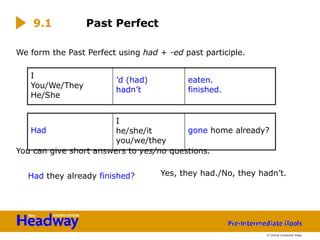
We form thePast Perfect using had + -ed past participle.
You can give short answers to yes/no questions.
Had they already finished?
9.1 Past Perfect
Yes, they had./No, they hadn’t.
I
You/We/They
He/She
’d (had)
hadn’t
eaten.
finished.
© Oxford University Press
Had
I
he/she/it
you/we/they
gone home already?
- 68.
Use
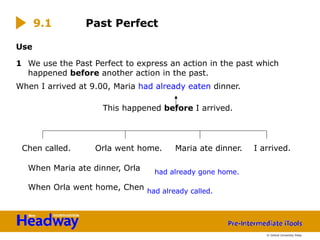
1 We usethe Past Perfect to express an action in the past which
happened before another action in the past.
When I arrived at 9.00, Maria had already eaten dinner.
This happened before I arrived.
Past Perfect
9.1
Chen called. Orla went home. Maria ate dinner.
When Maria ate dinner, Orla had already gone home.
When Orla went home, Chen had already called.
© Oxford University Press
I arrived.
- 69.
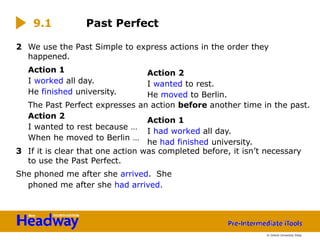
2 We usethe Past Simple to express actions in the order they
happened.
Action 1
I worked all day.
He finished university.
The Past Perfect expresses an action before another time in the past.
Action 2
I wanted to rest because …
When he moved to Berlin …
3 If it is clear that one action was completed before, it isn’t necessary
to use the Past Perfect.
She phoned me after she arrived. She
phoned me after she had arrived.
9.1 Past Perfect
Action 2
I wanted to rest.
He moved to Berlin.
Action 1
I had worked all day.
he had finished university.
© Oxford University Press
- 70.
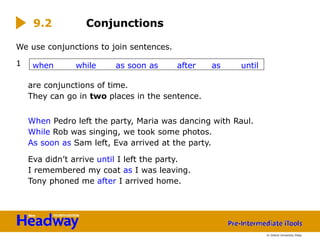
We use conjunctionsto join sentences.
1
are conjunctions of time.
They can go in two places in the sentence.
When Pedro left the party, Maria was dancing with Raul.
While Rob was singing, we took some photos.
As soon as Sam left, Eva arrived at the party.
Eva didn’t arrive until I left the party.
I remembered my coat as I was leaving.
Tony phoned me after I arrived home.
9.2 Conjunctions
when while as soon as after as until
© Oxford University Press
- 71.
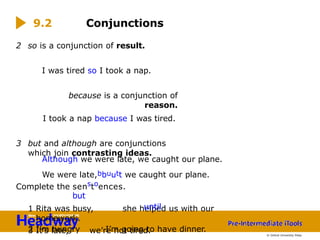
2 so isa conjunction of result.
I was tired so I took a nap.
because is a conjunction of
reason.
I took a nap because I was tired.
3 but and although are conjunctions
which join contrasting ideas.
1 Rita was busy, she helped us with our
homework.
2 I’m hungry I’m going to have dinner.
3 It’s late, we’re not tired.
Although we were late, we caught our plane.
We were late,bbuutt we caught our plane.
Complete the senstoences.
but
until
9.2 Conjunctions
© Oxford University Press
- 72.
So and suchare used for emphasizing an adjective or noun.
They are used more in spoken than written English.
so + adjective/adverb
I was so happy!
She always works so hard.
such a + adjective + singular noun
You are such a good singer.
such + adjective + plural/uncountable noun
Tina and Mike are such lovely people!
9.3 so, such (a), so many, so much
(so and such are often exclamations)
© Oxford University Press
- 73.
so many +plural nouns
Lara has so many shoes.
so much + uncountable nouns
We have so much work at
the moment.
Complete the sentences.
1 Dana is funny girl!
2 They ate food!
3 Ken always speaks
fast.
4 They’re terrible
students!
9.3 so, such (a), so many, so much
Dana is such a funny girl!
They ate so much food!
Ken always speaks so fast.
They’re such terrible students!
© Oxford University Press
- 74.
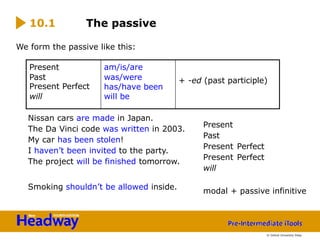
We form thepassive like this:
Nissan cars are made in Japan.
The Da Vinci code was written in 2003.
My car has been stolen!
I haven’t been invited to the party.
The project will be finished tomorrow.
Smoking shouldn’t be allowed inside.
10.1 The passive
Present
Past
Present Perfect
Present Perfect
will
modal + passive infinitive
Present am/is/are
Past
Present Perfect
was/were
has/have been
+ -ed (past participle)
will will be
© Oxford University Press
- 75.
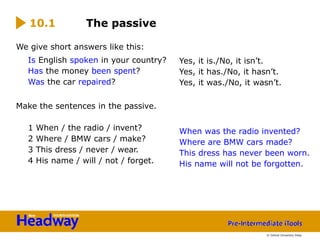
We give shortanswers like this:
Is English spoken in your country?
Has the money been spent?
Was the car repaired?
Make the sentences in the passive.
1 When / the radio / invent?
2 Where / BMW cars / make?
3 This dress / never / wear.
4 His name / will / not / forget.
10.1 The passive
Yes, it is./No, it isn’t.
Yes, it has./No, it hasn’t.
Yes, it was./No, it wasn’t.
When was the radio invented?
Where are BMW cars made?
This dress has never been worn.
His name will not be forgotten.
© Oxford University Press
- 76.
Use
1 The rulesfor tense usage in the passive are the same as in the
active.
Present Simple:
The hotel rooms are cleaned daily.
Past Simple:
The project was finished last week.
Present Perfect:
It’s been produced since 2009.
The passive
(habit)
(a finished action in the past)
(an action which began in the
past and continues to the present)
10.1
© Oxford University Press
- 77.
2 The objectof an active verb becomes the subject of a passive verb.
Active
Object
Da Vinci painted the Mona Lisa.
Passive The Mona Lisa was painted by Da Vinci.
Change the sentence to the passive.
Mark Zuckerberg founded Facebook.
Facebook was founded by Mark Zuckerberg.
10.1 The passive
Notice the use of by in the passive.
Subject
© Oxford University Press
- 78.
3 The passiveis not just another way of expressing the same
sentence in the active. We choose the active or the passive
depending on what we are more interested in.
Velcro was invented in 1948.
George de Mestral invented Velcro.
Note
Someone stole my camera yesterday.
My camera was stolen yesterday.
NOT My camera was stolen by
someone.
The subject of the active sentence is not mentioned in the passive
sentence if it is unknown or not really important.
10.1 The passive
(We are interested in Velcro.)
(We are interested in the
inventor.)
© Oxford University Press
- 79.
We form thePresent Perfect Continuous with
has/have + been + -ing (present participle).
Have you been shopping?
11.1 Present Perfect Continuous
Yes, have./No, I haven’t.
I/You/We/They ‘ve (have)
haven’t been waiting.
He/She/It
‘s (has)
hasn’t
been waiting?
How long
have I/you/we/they
has he/she/it
© Oxford University Press
- 80.
Use
The Present PerfectContinuous is used:
1 to express an activity which began in the past and still continues.
He here for months.
2 to refer t‘os baeneanctwivoirtkyinwgith a result in the present.
I’m tired because I tennis all
morning.
Note
3 Sometimes there is little‘v
oe
r nb
oee
dn
iffp
el
ra
ey
nin
cg
e in meaning
between the Present Perfect Simple and Continuous.
How long have you lived here?
How long have you been living here?
11.1 Present Perfect Continuous
© Oxford University Press
- 81.
2 Some verbshave the idea of a long time.
These verbs can often be found in the Present Perfect Continuous.
Some verbs don’t have the idea of a long time.
found
a new apartment.
We’ve been travelling
around Europe since June.
3 Verbs that express a state are not found in the Present Perfect
Continuous.
11.1 Present Perfect Continuous
wait work learn travel play
He’s
find
start
© Oxford University Press
buy die lose break stop
like love know have
- 82.
4 If thesentence gives a number or quantity, the Present Perfect
Simple is used.
I’ve been reading all morning.
I’ve read three stories.
Make the sentences.
1 He / play / tennis / for hours.
2 How many / texts / you / send?
3 Elaine / buy / a new dress.
4 I’m tired. I / run.
5 I / know / Boris / for years.
11.1 Present Perfect Continuous
He’s been playing tennis for hours.
How many texts have you sent?
Elaine’s bought a new dress.
I’m tired. I’ve been running.
I’ve known Boris for years.
© Oxford University Press
- 83.
We form thefirst conditional with:
if + Present Simple, will + infinitive without to
If I have time, I’ll go to the supermarket.
If we don’t hurry, we’ll miss our train.
What will you do if it rains?
Will you ring if you’re late? Yes, I will.
1 We use a present tense in the condition clause, not a future form.
If they hard, they’ll pass their exams.
If the weather nice, we’ll go to the beach.
study
is
12.1 First conditional
(positive)
(negative)
(question)
(short answer)
© Oxford University Press
- 84.
If he’s tired,he’ll take a nap.
2 The condition clause (if) can come at the beginning or at the end of
the sentence.
If you cook dinner, I’ll buy the concert tickets. I’ll
buy the concert tickets if you cook dinner.
(Notice the use of the comma.)
Use
The first conditional refers to a possible future condition and a
probable result in the future.
(if – the speaker thinks
it’s possible)
When he’s tired, he’ll take a nap.
12.1 First conditional
(when – the speaker thinks it’s
certain)
© Oxford University Press
- 85.
Make the sentences.
1If / you / wait / I / give you a lift.
If you wait, I’ll give you
a lift.
2 They / win the game / if / they /
practise a lot.
They will win the game if
they practise a lot.
3 If / he / not / hurry / he / miss
the concert.
If he doesn’t hurry, he’ll miss
the concert.
4 What / you / do / if / the weather
/ nice tomorrow?
What will you do if the
weather is nice tomorrow?
5 If / I / late / she / be upset.
If I’m late, she’ll be upset.
12.1 First conditional
© Oxford University Press
- 86.
The forms ofmight are the same for all persons:
might + infinitive without to
The negative is often expressed with I don’t think + will.
I don’t think I’ll go to work today.
Might you? is unusual. We usually ask questions with:
Do you think … + will …?
‘Do you think they’ll see us?’
‘They might.’ (Short answer)
12.2 might
I
You/We/They
He/She/It
might
might not
go on holiday.
arrive on time.
be here
tomorrow.
© Oxford University Press
- 87.
Use
Might is usedto express a future possibility. Will expresses a future
certainty.
He’ll finish the marathon.
He might finish the marathon.
(might = will perhaps)
Complete the sentences with will or might.
1 I see you tonight. I’m not sure.
2 He definitely cook dinner!
3 The 2016 Olympics be in
Rio de
Janeiro.
12.2 might
(I am sure he will.)
(It’s possible, but I’m not sure.)
I might see you tonight.
He’ll definitely cook dinner.
The 2012 Olympics will be in
Rio de Janeiro.
© Oxford University Press
- 88.
We form thesecond conditional with:
if + Past Simple, would + infinitive without to
If I had time, I’d read more.
If he didn’t work, he’d be unhappy.
What would you do if you won the lottery?
Would you ask if you needed help? Yes, I would.
Would is a modal auxiliary verb.
The forms of would are the same for all persons.
12.3 Second conditional
(positive)
(negative)
(question)
(short answer)
© Oxford University Press
- 89.
1 The conditionclause (if) can come at the beginning or at the end of
the sentence.
If you watched less TV, you’d have more time.
You’d have more time if you watched less TV.
2 Were is often used instead of was in the condition clause.
If I were you, I’d buy a new car.
If he were rich, he’d buy a new house.
3 The use of the past tense and would does not refer to past time. It
expresses distance from the present and unreality because it is
different to facts we know.
If I spoke German ...
… I would move to Berlin.
12.3 Second conditional
(but I don’t)
(but I won’t)
© Oxford University Press
- 90.
Use
1 The secondconditional is used to express an unreal or improbable
condition and its result.
If I were the teacher, I wouldn’t give my students any homework.
(but I’m not the teacher)
If you didn’t have a job, you wouldn’t have any money.
(but you have a job)
2 The phrase If I were you, I’d … is often used to give advice.
If I were you, I’d ask for help.
If I were you, I wouldn’t eat that.
Second conditional
12.3
© Oxford University Press
- 91.
The first conditionalis possible and probable.
The second conditional is improbable or impossible.
If I win the lottery, I’ll buy a new car.
If I won the lottery, I’d buy a new car.
Make the sentences.
1 If I (be) you, I’d leave right
now. If I were you, I’d leave right
now.
2 If we go to Spain, I (go) to
the beach every day.
If we go to Spain, I’ll go to the
beach every day.
3 If he (work) harder, he’d get a promotion.
If he worked harder, he’d get a
promotion.
12.3 Second conditional
(I think it’s possible.)
(I don’t think I will.)
© Oxford University Press