Differences
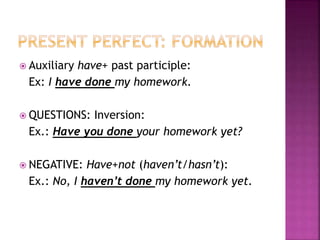
 Auxiliary have+ past participle:
Ex: I have done my homework.
 QUESTIONS: Inversion:
Ex.: Have you done your homework yet?
 NEGATIVE: Have+not (haven’t/hasn’t):
Ex.: No, I haven’t done my homework yet.
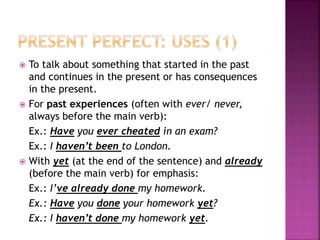
 To talk about something that started in the past
and continues in the present or has consequences
in the present.
 For past experiences (often with ever/ never,
always before the main verb):
Ex.: Have you ever cheated in an exam?
Ex.: I haven’t been to London.
 With yet (at the end of the sentence) and already
(before the main verb) for emphasis:
Ex.: I’ve already done my homework.
Ex.: Have you done your homework yet?
Ex.: I haven’t done my homework yet.
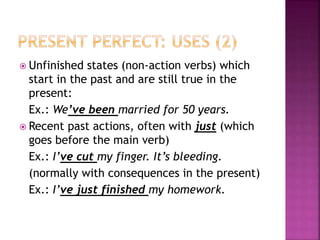
 Unfinished states (non-action verbs) which
start in the past and are still true in the
present:
Ex.: We’ve been married for 50 years.
 Recent past actions, often with just (which
goes before the main verb)
Ex.: I’ve cut my finger. It’s bleeding.
(normally with consequences in the present)
Ex.: I’ve just finished my homework.
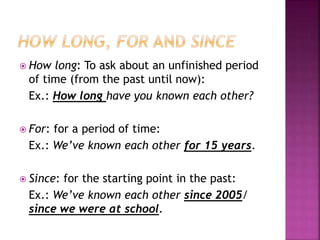
 How long: To ask about an unfinished period
of time (from the past until now):
Ex.: How long have you known each other?
 For: for a period of time:
Ex.: We’ve known each other for 15 years.
 Since: for the starting point in the past:
Ex.: We’ve known each other since 2005/
since we were at school.
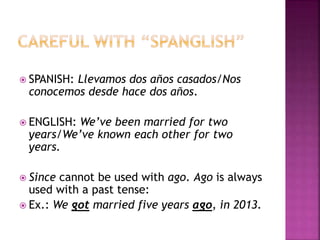
 SPANISH: Llevamos dos años casados/Nos
conocemos desde hace dos años.
 ENGLISH: We’ve been married for two
years/We’ve known each other for two
years.
 Since cannot be used with ago. Ago is always
used with a past tense:
 Ex.: We got married five years ago, in 2013.
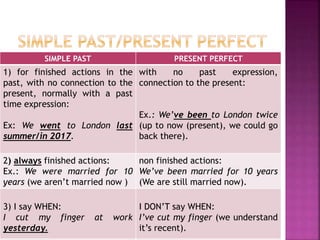
SIMPLE PAST PRESENT PERFECT
1) for finished actions in the
past, with no connection to the
present, normally with a past
time expression:
Ex: We went to London last
summer/in 2017.
with no past expression,
connection to the present:
Ex.: We’ve been to London twice
(up to now (present), we could go
back there).
2) always finished actions:
Ex.: We were married for 10
years (we aren’t married now )
non finished actions:
We’ve been married for 10 years
(We are still married now).
3) I say WHEN:
I cut my finger at work
yesterday.
I DON’T say WHEN:
I’ve cut my finger (we understand
it’s recent).

Present perfect and simple past

  • 1.
  • 2.
     Auxiliary have+past participle: Ex: I have done my homework.  QUESTIONS: Inversion: Ex.: Have you done your homework yet?  NEGATIVE: Have+not (haven’t/hasn’t): Ex.: No, I haven’t done my homework yet.
  • 3.
     To talkabout something that started in the past and continues in the present or has consequences in the present.  For past experiences (often with ever/ never, always before the main verb): Ex.: Have you ever cheated in an exam? Ex.: I haven’t been to London.  With yet (at the end of the sentence) and already (before the main verb) for emphasis: Ex.: I’ve already done my homework. Ex.: Have you done your homework yet? Ex.: I haven’t done my homework yet.
  • 4.
     Unfinished states(non-action verbs) which start in the past and are still true in the present: Ex.: We’ve been married for 50 years.  Recent past actions, often with just (which goes before the main verb) Ex.: I’ve cut my finger. It’s bleeding. (normally with consequences in the present) Ex.: I’ve just finished my homework.
  • 5.
     How long:To ask about an unfinished period of time (from the past until now): Ex.: How long have you known each other?  For: for a period of time: Ex.: We’ve known each other for 15 years.  Since: for the starting point in the past: Ex.: We’ve known each other since 2005/ since we were at school.
  • 6.
     SPANISH: Llevamosdos años casados/Nos conocemos desde hace dos años.  ENGLISH: We’ve been married for two years/We’ve known each other for two years.  Since cannot be used with ago. Ago is always used with a past tense:  Ex.: We got married five years ago, in 2013.
  • 7.
    SIMPLE PAST PRESENTPERFECT 1) for finished actions in the past, with no connection to the present, normally with a past time expression: Ex: We went to London last summer/in 2017. with no past expression, connection to the present: Ex.: We’ve been to London twice (up to now (present), we could go back there). 2) always finished actions: Ex.: We were married for 10 years (we aren’t married now ) non finished actions: We’ve been married for 10 years (We are still married now). 3) I say WHEN: I cut my finger at work yesterday. I DON’T say WHEN: I’ve cut my finger (we understand it’s recent).