Universidad Nacional de
Colombia
Extension Program
A1 students
Simple Past
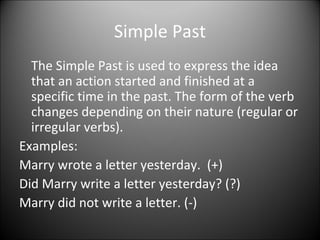
The Simple Past is used to express the idea
that an action started and finished at a
specific time in the past. The form of the verb
changes depending on their nature (regular or
irregular verbs).
Examples:
Marry wrote a letter yesterday. (+)
Did Marry write a letter yesterday? (?)
Marry did not write a letter. (-)
Auxiliar Did
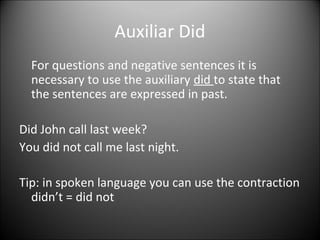
For questions and negative sentences it is
necessary to use the auxiliary did to state that
the sentences are expressed in past.
Did John call last week?
You did not call me last night.
Tip: in spoken language you can use the contraction
didn’t = did not
Verb to be in the simple past
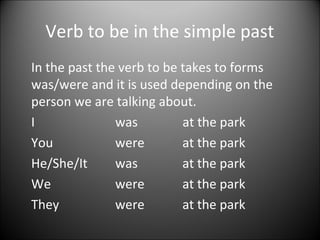
In the past the verb to be takes to forms
was/were and it is used depending on the
person we are talking about.
I
was
at the park
You
were
at the park
He/She/It
was
at the park
We
were
at the park
They
were
at the park
Uses
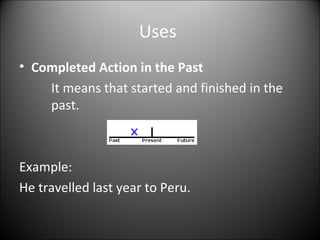
• Completed Action in the Past
It means that started and finished in the
past.

Example:
He travelled last year to Peru.
Uses
• A Series of Completed Actions
to list a series of completed actions in the past.
These actions happen 1st, 2nd, 3rd, 4th, and so
on.

Example:
I finished my homework, went to the theater, and
met Michele.
Uses
• Duration in Past
The Simple Past can be used with a duration which starts
and stops in the past. A duration is a longer action
often indicated by expressions such as: for two years,
for five minutes, all day, all year, etc.

Example:
They lived in England for five years
Uses
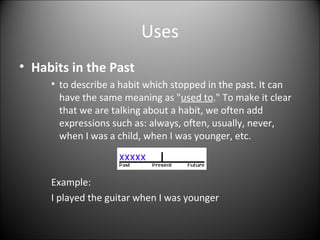
• Habits in the Past
• to describe a habit which stopped in the past. It can
have the same meaning as "used to." To make it clear
that we are talking about a habit, we often add
expressions such as: always, often, usually, never,
when I was a child, when I was younger, etc.

Example:
I played the guitar when I was younger
Uses
• Past Facts or Generalizations
to describe past facts or generalizations which are no
longer true. This use of the Simple Past is quite similar
to the expression "used to.“

Example:
She was shy as a child, but now she is very outgoing.
Resources
• For more information go to:
http://www.englishpage.com/verbpage/simpl
epast.html

Simple past lesson

  • 1.
  • 2.
    Simple Past The SimplePast is used to express the idea that an action started and finished at a specific time in the past. The form of the verb changes depending on their nature (regular or irregular verbs). Examples: Marry wrote a letter yesterday. (+) Did Marry write a letter yesterday? (?) Marry did not write a letter. (-)
  • 3.
    Auxiliar Did For questionsand negative sentences it is necessary to use the auxiliary did to state that the sentences are expressed in past. Did John call last week? You did not call me last night. Tip: in spoken language you can use the contraction didn’t = did not
  • 4.
    Verb to bein the simple past In the past the verb to be takes to forms was/were and it is used depending on the person we are talking about. I was at the park You were at the park He/She/It was at the park We were at the park They were at the park
  • 5.
    Uses • Completed Actionin the Past It means that started and finished in the past. Example: He travelled last year to Peru.
  • 6.
    Uses • A Seriesof Completed Actions to list a series of completed actions in the past. These actions happen 1st, 2nd, 3rd, 4th, and so on. Example: I finished my homework, went to the theater, and met Michele.
  • 7.
    Uses • Duration inPast The Simple Past can be used with a duration which starts and stops in the past. A duration is a longer action often indicated by expressions such as: for two years, for five minutes, all day, all year, etc. Example: They lived in England for five years
  • 8.
    Uses • Habits inthe Past • to describe a habit which stopped in the past. It can have the same meaning as "used to." To make it clear that we are talking about a habit, we often add expressions such as: always, often, usually, never, when I was a child, when I was younger, etc. Example: I played the guitar when I was younger
  • 9.
    Uses • Past Factsor Generalizations to describe past facts or generalizations which are no longer true. This use of the Simple Past is quite similar to the expression "used to.“ Example: She was shy as a child, but now she is very outgoing.
  • 10.
    Resources • For moreinformation go to: http://www.englishpage.com/verbpage/simpl epast.html