Gerund or
Infinitive?
VERB + ING
• When the verb is the subject of the
sentence
• “Paying attention is essential in class”
• After prepositions
• “I am looking forward to hearing from you”
After certain verbal expressions:
• CAN’T STAND
• CAN’T HELP
• BE/GET USED TO
• DON’T MIND/WOULD MIND
• FEEL LIKE
“I can’t help getting angry when pupils speak in
class”
We select the –ing form....
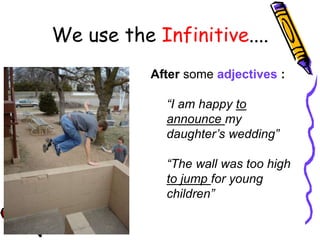
After some adjectives :
“I am happy to
announce my
daughter’s wedding”
“The wall was too high
to jump for young
children”
We use the Infinitive....
To express purpose:
“We are going to the beach to lie in the sun”
“To watch the clip again, press replay”
We use the Infinitive....
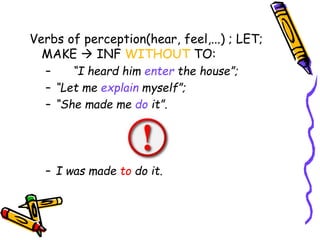
Verbs of perception(hear, feel,...) ; LET;
MAKE  INF WITHOUT TO:
– “I heard him enter the house”;
– “Let me explain myself”;
– “She made me do it”.
– I was made to do it.
Verbs that can be followed by both
“INFINITIVE” or “-ING”
•No change in meaning: begin, love, start...
•Change in meaning: Remember, stop …
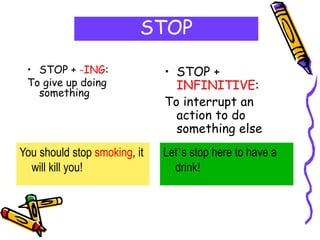
STOP
• STOP + -ING:
To give up doing
something
• STOP +
INFINITIVE:
To interrupt an
action to do
something else
You should stop smoking, it
will kill you!
Let’s stop here to have a
drink!
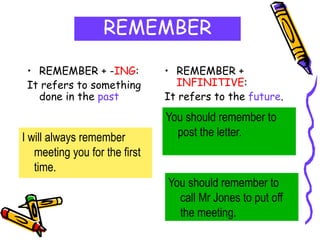
REMEMBER
• REMEMBER + -ING:
It refers to something
done in the past
• REMEMBER +
INFINITIVE:
It refers to the future.
I will always remember
meeting you for the first
time.
You should remember to
call Mr Jones to put off
the meeting.
You should remember to
post the letter.
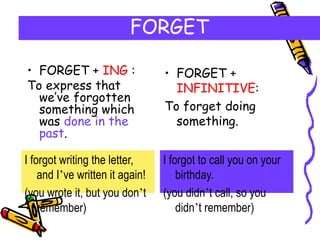
FORGET
• FORGET + ING :
To express that
we’ve forgotten
something which
was done in the
past.
• FORGET +
INFINITIVE:
To forget doing
something.
I forgot writing the letter,
and I’ve written it again!
(you wrote it, but you don’t
remember)
I forgot to call you on your
birthday.
(you didn’t call, so you
didn’t remember)
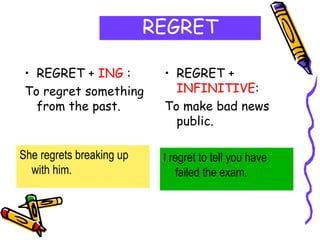
REGRET
• REGRET + ING :
To regret something
from the past.
• REGRET +
INFINITIVE:
To make bad news
public.
She regrets breaking up
with him.
I regret to tell you have
failed the exam.
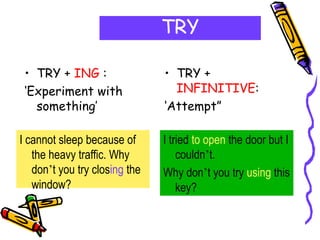
TRY
• TRY + ING :
‘Experiment with
something’
• TRY +
INFINITIVE:
‘Attempt”
I cannot sleep because of
the heavy traffic. Why
don’t you try closing the
window?
I tried to open the door but I
couldn’t.
Why don’t you try using this
key?
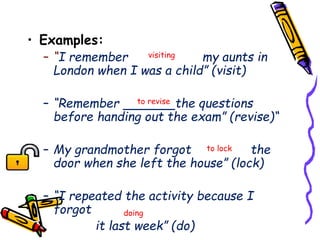
• Examples:
– “I remember my aunts in
London when I was a child” (visit)
– “Remember the questions
before handing out the exam” (revise)“
– My grandmother forgot the
door when she left the house” (lock)
– “I repeated the activity because I
forgot
it last week” (do)
visiting
to revise
to lock
doing
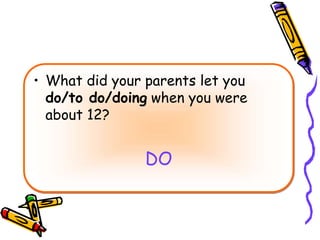
• What did your parents let you
do/to do/doing when you were
about 12?
DO
• What do you hope do/to do/doing
in ten years´time?
TO DO
• Is there anything you have stopped
do/to/doing recently?
DOING
What activities can´t you stand do/to
do/doing?
DOING
What makes you laugh/to
laugh/laughing?
LAUGH
Do you think you wouldn´t mind do/to
do/doing a well-paid but boring job?
DOING
• How often do you invite your
friends come/to come/coming for
dinner or just a chat?
TO COME
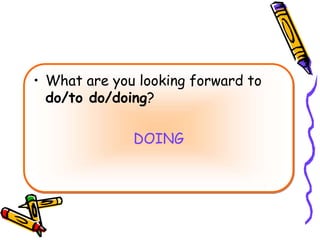
• What are you looking forward to
do/to do/doing?
DOING

Verb Patterns

  • 2.
  • 3.
    VERB + ING •When the verb is the subject of the sentence • “Paying attention is essential in class” • After prepositions • “I am looking forward to hearing from you”
  • 4.
    After certain verbalexpressions: • CAN’T STAND • CAN’T HELP • BE/GET USED TO • DON’T MIND/WOULD MIND • FEEL LIKE “I can’t help getting angry when pupils speak in class” We select the –ing form....
  • 5.
    After some adjectives: “I am happy to announce my daughter’s wedding” “The wall was too high to jump for young children” We use the Infinitive....
  • 6.
    To express purpose: “Weare going to the beach to lie in the sun” “To watch the clip again, press replay” We use the Infinitive....
  • 7.
    Verbs of perception(hear,feel,...) ; LET; MAKE  INF WITHOUT TO: – “I heard him enter the house”; – “Let me explain myself”; – “She made me do it”. – I was made to do it.
  • 9.
    Verbs that canbe followed by both “INFINITIVE” or “-ING” •No change in meaning: begin, love, start... •Change in meaning: Remember, stop …
  • 10.
    STOP • STOP +-ING: To give up doing something • STOP + INFINITIVE: To interrupt an action to do something else You should stop smoking, it will kill you! Let’s stop here to have a drink!
  • 11.
    REMEMBER • REMEMBER +-ING: It refers to something done in the past • REMEMBER + INFINITIVE: It refers to the future. I will always remember meeting you for the first time. You should remember to call Mr Jones to put off the meeting. You should remember to post the letter.
  • 12.
    FORGET • FORGET +ING : To express that we’ve forgotten something which was done in the past. • FORGET + INFINITIVE: To forget doing something. I forgot writing the letter, and I’ve written it again! (you wrote it, but you don’t remember) I forgot to call you on your birthday. (you didn’t call, so you didn’t remember)
  • 13.
    REGRET • REGRET +ING : To regret something from the past. • REGRET + INFINITIVE: To make bad news public. She regrets breaking up with him. I regret to tell you have failed the exam.
  • 14.
    TRY • TRY +ING : ‘Experiment with something’ • TRY + INFINITIVE: ‘Attempt” I cannot sleep because of the heavy traffic. Why don’t you try closing the window? I tried to open the door but I couldn’t. Why don’t you try using this key?
  • 15.
    • Examples: – “Iremember my aunts in London when I was a child” (visit) – “Remember the questions before handing out the exam” (revise)“ – My grandmother forgot the door when she left the house” (lock) – “I repeated the activity because I forgot it last week” (do) visiting to revise to lock doing
  • 16.
    • What didyour parents let you do/to do/doing when you were about 12? DO
  • 17.
    • What doyou hope do/to do/doing in ten years´time? TO DO
  • 18.
    • Is thereanything you have stopped do/to/doing recently? DOING
  • 19.
    What activities can´tyou stand do/to do/doing? DOING
  • 20.
    What makes youlaugh/to laugh/laughing? LAUGH
  • 21.
    Do you thinkyou wouldn´t mind do/to do/doing a well-paid but boring job? DOING
  • 22.
    • How oftendo you invite your friends come/to come/coming for dinner or just a chat? TO COME
  • 23.
    • What areyou looking forward to do/to do/doing? DOING