Child Development
Program
Pre-school
What is Preschool?
Relating to the time before a child is
old enough to go to kindergarten or
elementary school
Relating to children who are between 3
to 4 years old
Important goals of preschool
programs are to help children
acquire social skills and
learning-related skills.
Pre school programs
provide early
childhood education
and care for children
and help them develop
a range of skills that
make them ready to
learn when they start
school such as:
 Social Skills
 Language Skills
 Executive
function Skills
 Emotional
Regulation Skills
 Self-regulation in
Learning Skills
SOCIAL SKILLS
The ability to
empathize and
interact successfully
with their peer
group, and also
relate easily to
adults.
LANGUAGE SKILLS
The ability to have
adequate language
skills in order to benefit
from experiences
facilitating their
cognitive, educational
and social
development.
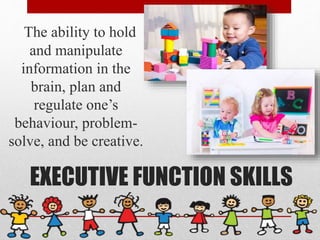
EXECUTIVE FUNCTION SKILLS
The ability to hold
and manipulate
information in the
brain, plan and
regulate one’s
behaviour, problem-
solve, and be creative.
EMOTIONAL SELF-REGULATION SKILLS
The ability to adapt
behaviours
depending on the
situation, to control
impulses and to shift
attention.
SELF-REGULATION IN LEARNING SKILLS
The ability to
postpone immediate
satisfaction to attain
long-term goals,
sustain attention, be
persistent, and
remain concentrated.
A well-designed preschool curriculum lays the
foundation for success in learning and life.
 COGNITIVE: Secure, well-structured environments, nurturing
caregivers, and stimulating activities promote essential brain-cell
connection.
 SOCIO-EMOTIONAL: The early relationships with parents and
peers influences how a child learns to manage emotions, interact,
and share for the rest of his/her life. RESPONSIVENESS and
COMMUNICATION is key to socio-emotional development.
 PHYSICAL: The child needs a safe place to master his/her new
physical abilities. Age-appropriate play equipment helps further the
development of gross and fine motor skills.
PLANNING A FLEXIBLE DAILY
SCHEDULE
Planning a flexible daily
schedule
• The keynote of curriculum planning in early
childhood programs is FLEXIBILITY.
• It must accommodate a group of 15-20 lively
youngsters and at the same time meet the
particular needs of the individuals.
Planning a flexible daily
schedule
PLANNING is not merely a matter of scheduling
time but it is so much more. It involves knowing the
children in your care, knowing what they are like as a
group as well as how they differ as individuals. It
also involves getting a feeling for how the children
feel at different times of the day.
GOALS
The goal of your child’s early childhood
education center, pre-school, learning center,
or toddler time program is to ensure that each
child receives a solid academic foundation.
Planning a flexible daily
schedule
TIME BLOCKS
A simple but effective way many programs
schedule activities is in the form of time blocks.
Time blocks are labeled periods of time that occur
in approximately the same order everyday, but
within which there is flexibility for many things to
happen.
Planning a flexible daily
schedule
The time blocks used in many programs include the following:
1. ARRIVAL
2. OPENING CIRCLE
3. FREE CHOICE (AM)
4. SNACK TIME (AM)
5. PLAYGROUND
6. STORY TIME
7. LUNCHTIME
8. NAP TIME
9. SNACK (PM)
10. FREE CHOICE (PM)
11. CLOSING CIRCLE
12. DEPARTURE
TIME BLOCKS
ARRIVAL
The most helpful
element is greeting
children
individually and
having a brief
conversation
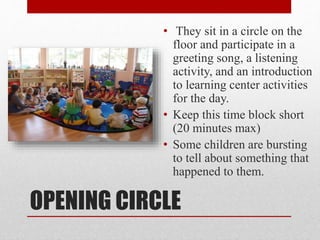
OPENING CIRCLE
• They sit in a circle on the
floor and participate in a
greeting song, a listening
activity, and an introduction
to learning center activities
for the day.
• Keep this time block short
(20 minutes max)
• Some children are bursting
to tell about something that
happened to them.
FREE CHOICE (AM/PM)
• Activity can be as varied as:
o play dough, rolling pins, and cutting cutter for making
cookies;
o a table yarn and uncooked macaroni for stringing
necklaces;
o a portable climber and mats for jumping; a
• In light of your daily goal, you need to identify those
elements in the free-choice period that promote this goal.
FREE CHOICE (AM/PM)
TRANSITION
• Using transition activities helps children move from time
block to another smoothly, you will not only be helping
children understand how the schedule works, but also
preventing squabbles, confusion, and unnecessary
running around.
• Such activities can be brief songs, fingerplays, marching
games, follow-leader games, puppet fun, or whatever else
your creativity can conjure up.
• Remember: Don’t keep the children waiting with nothing
to do. Make waiting fun.
PLAYGROUND
Children who have been
inside all day need to get
outside and engage in some
kind of vigorous activity on
a daily basis. If you have no
playground, you may want
to take children on a run
round the building, or a hop,
skip, and jump down.
STORY TIME
This is the time for a brief
total-group listening
activity such as story time.
You may want to do oral
story telling without using
a book, or invite a special
reader to read a book they
have brought.
LUNCH TIME
Teachers, student
teachers, volunteers sit at
the tables with the
children, sharing the food
and the conversation. It is
a time of enjoyment and
relaxation.
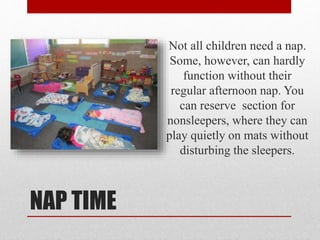
NAP TIME
Not all children need a nap.
Some, however, can hardly
function without their
regular afternoon nap. You
can reserve section for
nonsleepers, where they can
play quietly on mats without
disturbing the sleepers.
CLOSING CIRCLE
• The purpose is to pull together the daily
happenings and help the children make
sense of them.
• If teachers listen carefully to children’s
answers, they can gain valuable insights
about the activities that made the greatest
or the least impression on the children, and
why.
DEPARTURE
• Children need to feel satisfied about the day they
have just finished to look forward with pleasure to the
next.
• Helping children dress or supporting them in their
own efforts, conversing about what they have done
during the day, checking out a book or a toy to home
overnight, greeting parents who pick up their
children, saying a final farewell—these should be
pleasurable activities for all involved.
CONCLUSION
The effectiveness of a preschool program is as much about
the quality of the curriculum as it is about the partnership
between educators and parents, as well as anyone else with a
stake in the child’s learning. It is a need to work closely with
parents and family to clearly define and set learning goals.
These collaborative efforts create a strong base for your
child’s formative experiences to blossom into a lifelong love
of learning.

Preschool report

  • 2.
  • 3.
    What is Preschool? Relatingto the time before a child is old enough to go to kindergarten or elementary school Relating to children who are between 3 to 4 years old
  • 4.
    Important goals ofpreschool programs are to help children acquire social skills and learning-related skills.
  • 5.
    Pre school programs provideearly childhood education and care for children and help them develop a range of skills that make them ready to learn when they start school such as:  Social Skills  Language Skills  Executive function Skills  Emotional Regulation Skills  Self-regulation in Learning Skills
  • 6.
    SOCIAL SKILLS The abilityto empathize and interact successfully with their peer group, and also relate easily to adults.
  • 7.
    LANGUAGE SKILLS The abilityto have adequate language skills in order to benefit from experiences facilitating their cognitive, educational and social development.
  • 8.
    EXECUTIVE FUNCTION SKILLS Theability to hold and manipulate information in the brain, plan and regulate one’s behaviour, problem- solve, and be creative.
  • 9.
    EMOTIONAL SELF-REGULATION SKILLS Theability to adapt behaviours depending on the situation, to control impulses and to shift attention.
  • 10.
    SELF-REGULATION IN LEARNINGSKILLS The ability to postpone immediate satisfaction to attain long-term goals, sustain attention, be persistent, and remain concentrated.
  • 11.
    A well-designed preschoolcurriculum lays the foundation for success in learning and life.  COGNITIVE: Secure, well-structured environments, nurturing caregivers, and stimulating activities promote essential brain-cell connection.  SOCIO-EMOTIONAL: The early relationships with parents and peers influences how a child learns to manage emotions, interact, and share for the rest of his/her life. RESPONSIVENESS and COMMUNICATION is key to socio-emotional development.  PHYSICAL: The child needs a safe place to master his/her new physical abilities. Age-appropriate play equipment helps further the development of gross and fine motor skills.
  • 12.
    PLANNING A FLEXIBLEDAILY SCHEDULE
  • 13.
    Planning a flexibledaily schedule • The keynote of curriculum planning in early childhood programs is FLEXIBILITY. • It must accommodate a group of 15-20 lively youngsters and at the same time meet the particular needs of the individuals.
  • 14.
    Planning a flexibledaily schedule PLANNING is not merely a matter of scheduling time but it is so much more. It involves knowing the children in your care, knowing what they are like as a group as well as how they differ as individuals. It also involves getting a feeling for how the children feel at different times of the day.
  • 15.
    GOALS The goal ofyour child’s early childhood education center, pre-school, learning center, or toddler time program is to ensure that each child receives a solid academic foundation. Planning a flexible daily schedule
  • 16.
    TIME BLOCKS A simplebut effective way many programs schedule activities is in the form of time blocks. Time blocks are labeled periods of time that occur in approximately the same order everyday, but within which there is flexibility for many things to happen. Planning a flexible daily schedule
  • 17.
    The time blocksused in many programs include the following: 1. ARRIVAL 2. OPENING CIRCLE 3. FREE CHOICE (AM) 4. SNACK TIME (AM) 5. PLAYGROUND 6. STORY TIME 7. LUNCHTIME 8. NAP TIME 9. SNACK (PM) 10. FREE CHOICE (PM) 11. CLOSING CIRCLE 12. DEPARTURE TIME BLOCKS
  • 18.
    ARRIVAL The most helpful elementis greeting children individually and having a brief conversation
  • 19.
    OPENING CIRCLE • Theysit in a circle on the floor and participate in a greeting song, a listening activity, and an introduction to learning center activities for the day. • Keep this time block short (20 minutes max) • Some children are bursting to tell about something that happened to them.
  • 20.
    FREE CHOICE (AM/PM) •Activity can be as varied as: o play dough, rolling pins, and cutting cutter for making cookies; o a table yarn and uncooked macaroni for stringing necklaces; o a portable climber and mats for jumping; a • In light of your daily goal, you need to identify those elements in the free-choice period that promote this goal.
  • 21.
  • 22.
    TRANSITION • Using transitionactivities helps children move from time block to another smoothly, you will not only be helping children understand how the schedule works, but also preventing squabbles, confusion, and unnecessary running around. • Such activities can be brief songs, fingerplays, marching games, follow-leader games, puppet fun, or whatever else your creativity can conjure up. • Remember: Don’t keep the children waiting with nothing to do. Make waiting fun.
  • 23.
    PLAYGROUND Children who havebeen inside all day need to get outside and engage in some kind of vigorous activity on a daily basis. If you have no playground, you may want to take children on a run round the building, or a hop, skip, and jump down.
  • 24.
    STORY TIME This isthe time for a brief total-group listening activity such as story time. You may want to do oral story telling without using a book, or invite a special reader to read a book they have brought.
  • 25.
    LUNCH TIME Teachers, student teachers,volunteers sit at the tables with the children, sharing the food and the conversation. It is a time of enjoyment and relaxation.
  • 26.
    NAP TIME Not allchildren need a nap. Some, however, can hardly function without their regular afternoon nap. You can reserve section for nonsleepers, where they can play quietly on mats without disturbing the sleepers.
  • 27.
    CLOSING CIRCLE • Thepurpose is to pull together the daily happenings and help the children make sense of them. • If teachers listen carefully to children’s answers, they can gain valuable insights about the activities that made the greatest or the least impression on the children, and why.
  • 28.
    DEPARTURE • Children needto feel satisfied about the day they have just finished to look forward with pleasure to the next. • Helping children dress or supporting them in their own efforts, conversing about what they have done during the day, checking out a book or a toy to home overnight, greeting parents who pick up their children, saying a final farewell—these should be pleasurable activities for all involved.
  • 29.
    CONCLUSION The effectiveness ofa preschool program is as much about the quality of the curriculum as it is about the partnership between educators and parents, as well as anyone else with a stake in the child’s learning. It is a need to work closely with parents and family to clearly define and set learning goals. These collaborative efforts create a strong base for your child’s formative experiences to blossom into a lifelong love of learning.