Meal Preparation 
Meal pattern 
Menu planning 
Marketing Guide
Meal Pattern and Menu Planning 
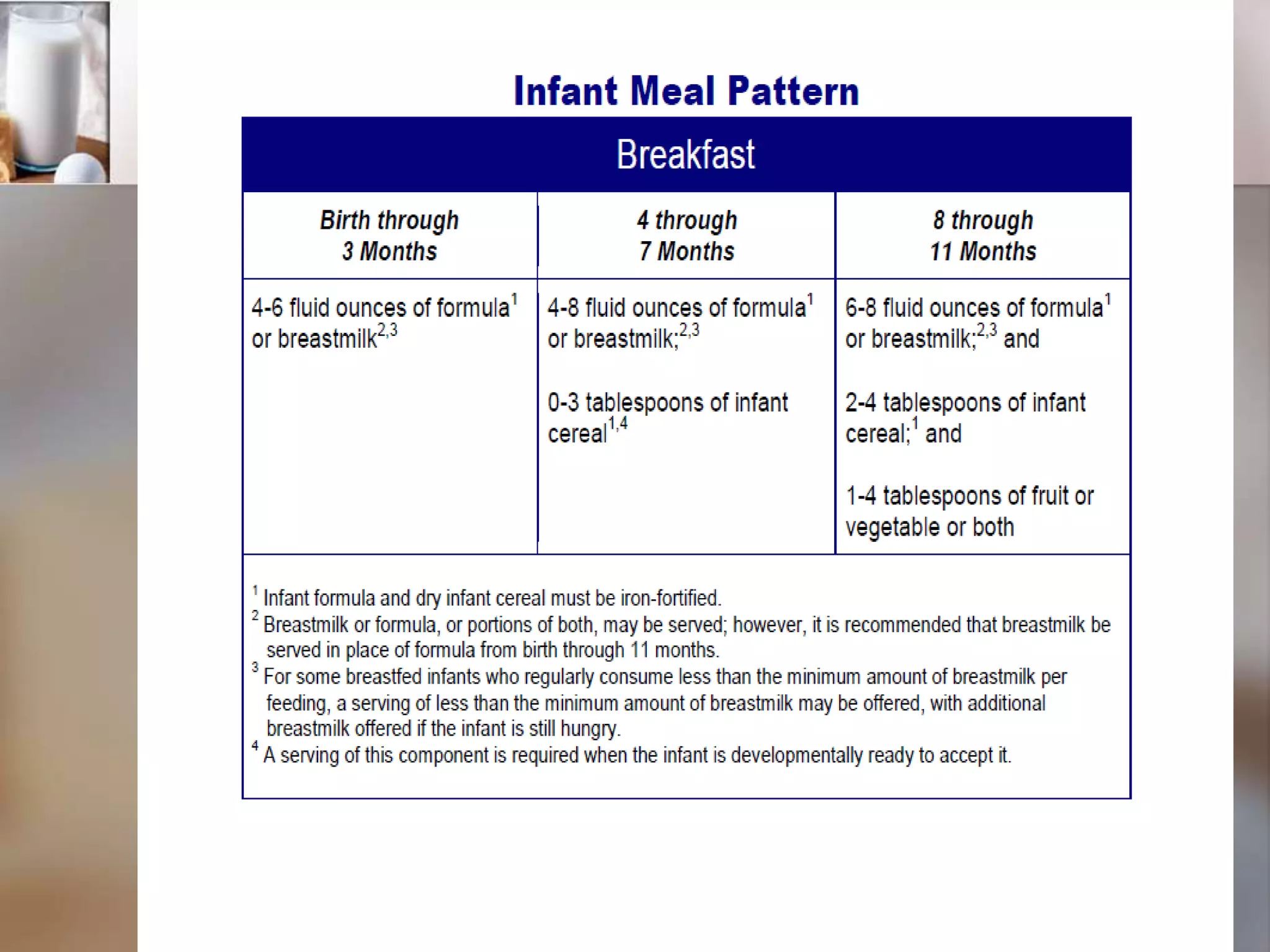
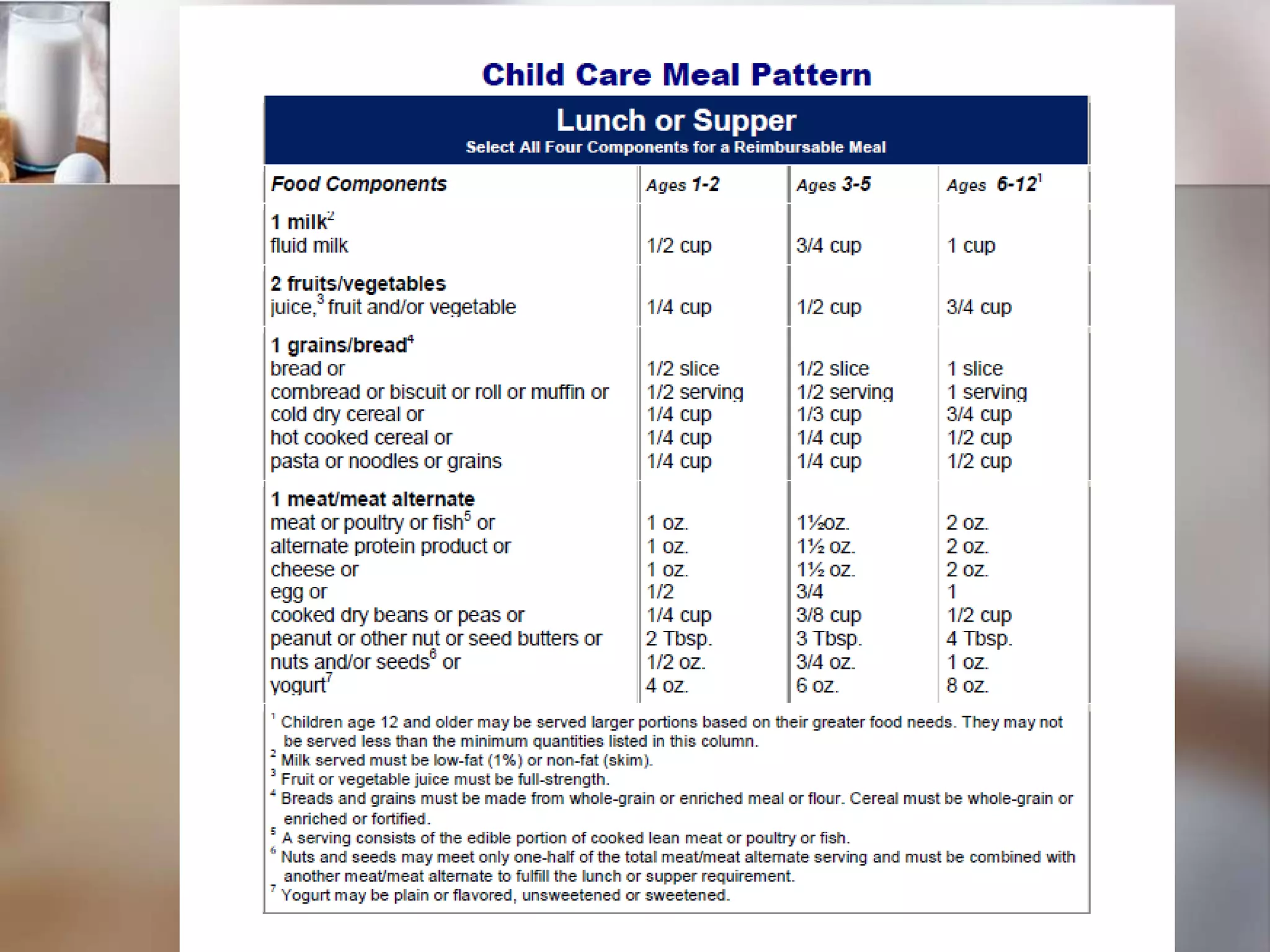
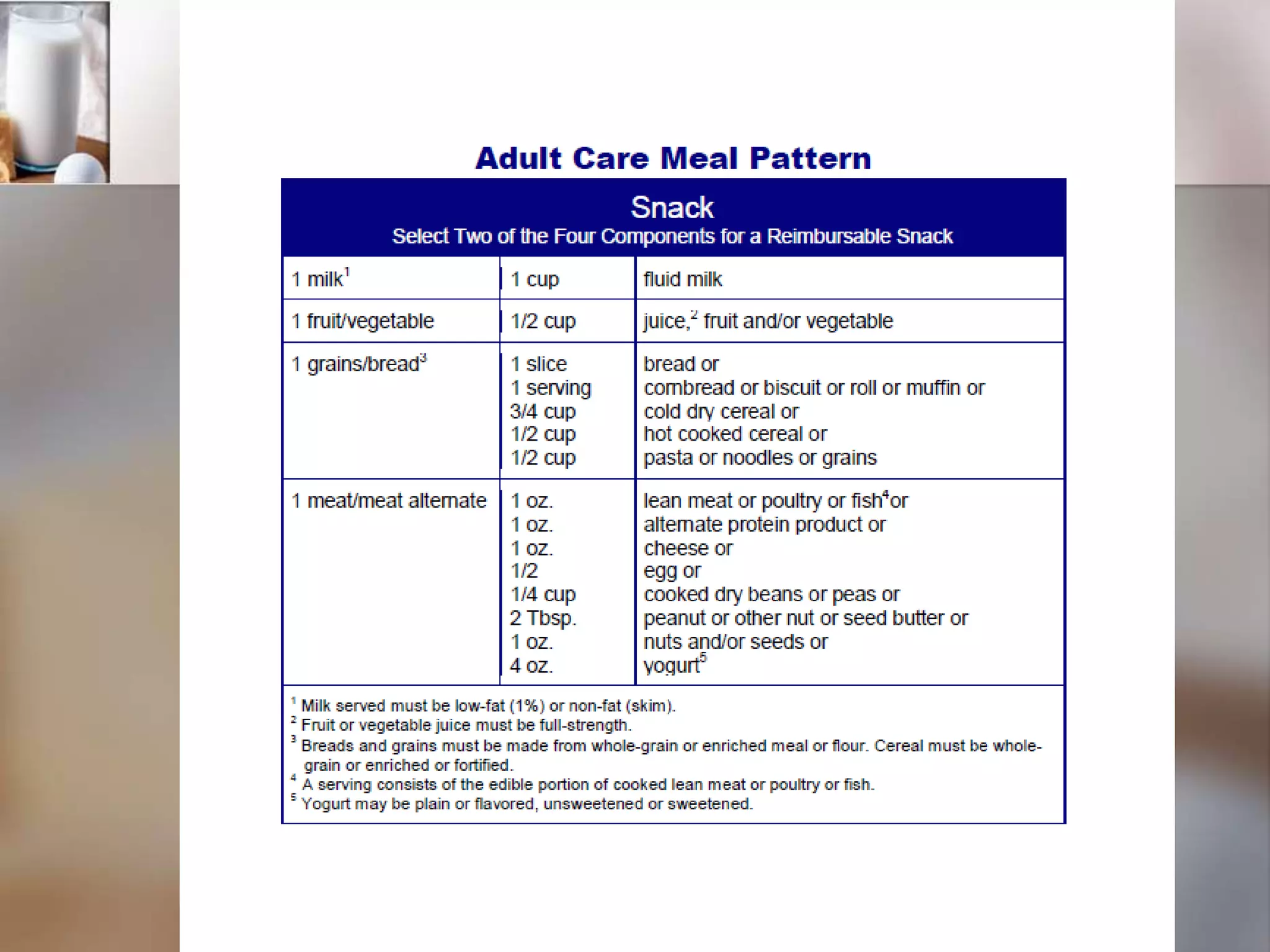
 A meal pattern is a menu-planning tool 
used to develop menus for a specific age 
group. 
 It is a set of food components, food 
items, and minimum quantities required 
for a breakfast, supplement (snack), or 
lunch or supper for a specific age group. 
 In schools, meal patterns are used to 
create menus with the healthiest meals 
for students.
Meal Pattern and Menu Planning 
 It should include food from each of four 
food groups- meat/meat alternate, 
vegetable/fruit, bread/bread alternate, 
and milk/milk alternate. 
 Patterns can incorporate standards 
including: low sodium, low fat, low 
saturated fat, and low cholesterol as 
designated by State Units of Aging (SUA) 
guidelines.
How is a meal pattern used to develop a 
menu? 
 When developing a menu, each meal is 
required to include a variety of foods to 
assure that it contains at least 1/3 of the 
Recommended Daily Allowance (RDAs). 
 The meal pattern is a template for the 
menu planner. It provides a framework of 
foods to include. 
 Proper food preparation and handling should 
also be addressed.
What are the benefits of using a meal 
pattern to develop a menu? 
 Meal patterns are simple and 
cost efficient tools that ensure 
the number of servings per 
food group are met at each 
meal.
Why is meal planning important? 
 Many family members 
are balancing: multiple 
roles ex.) parents, 
employees, children, 
volunteer 
 Families are trying to 
meet good nutritional 
standards. 
 The busier & unprepared 
a family is the more 
tendencies the family 
may have to develop 
poor eating habits.
Why is meal planning important? 
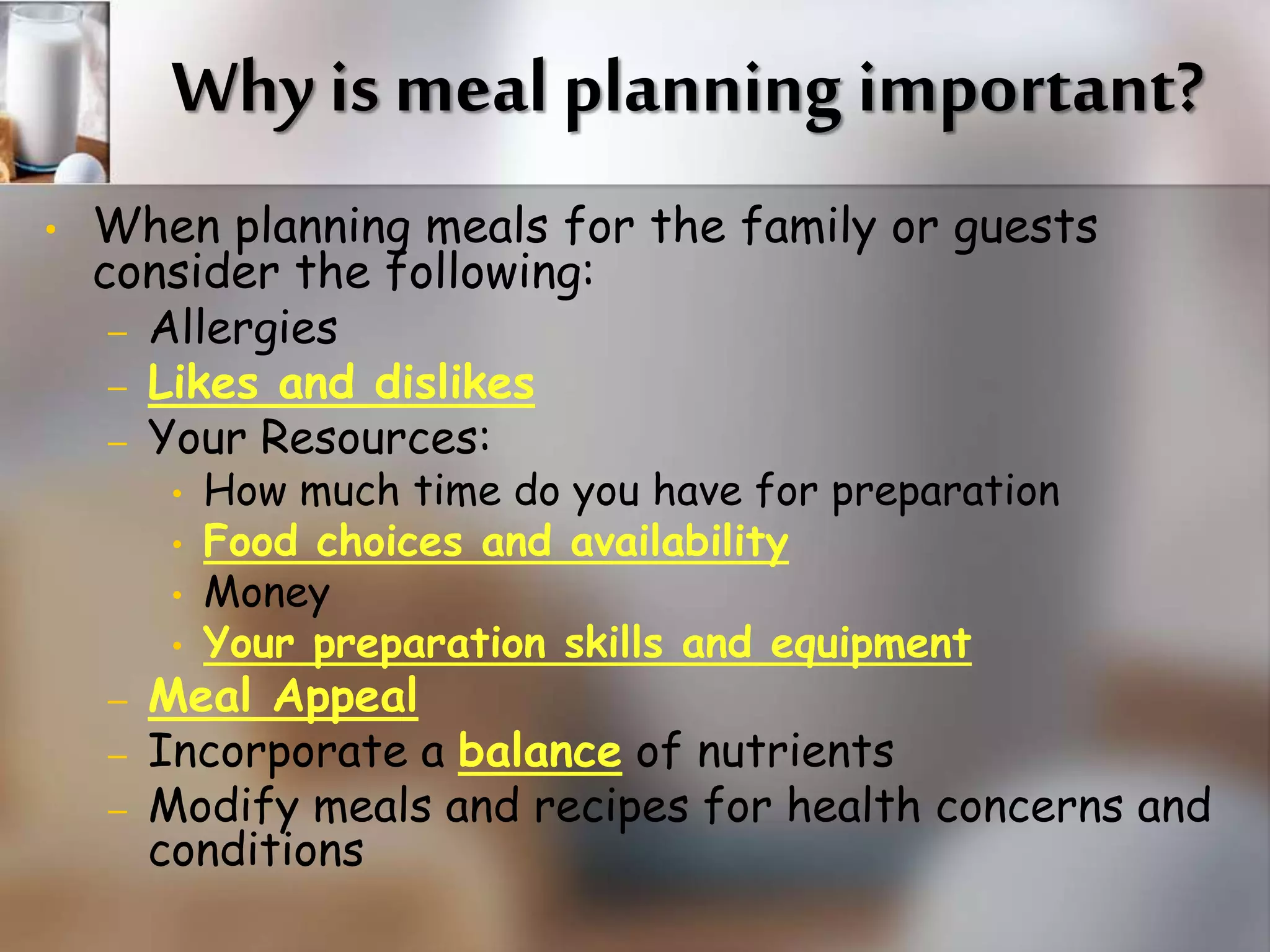
• When planning meals for the family or guests 
consider the following: 
– Allergies 
– Likes and dislikes 
– Your Resources: 
• How much time do you have for preparation 
• Food choices and availability 
• Money 
• Your preparation skills and equipment 
– Meal Appeal 
– Incorporate a balance of nutrients 
– Modify meals and recipes for health concerns and 
conditions
Time Management 
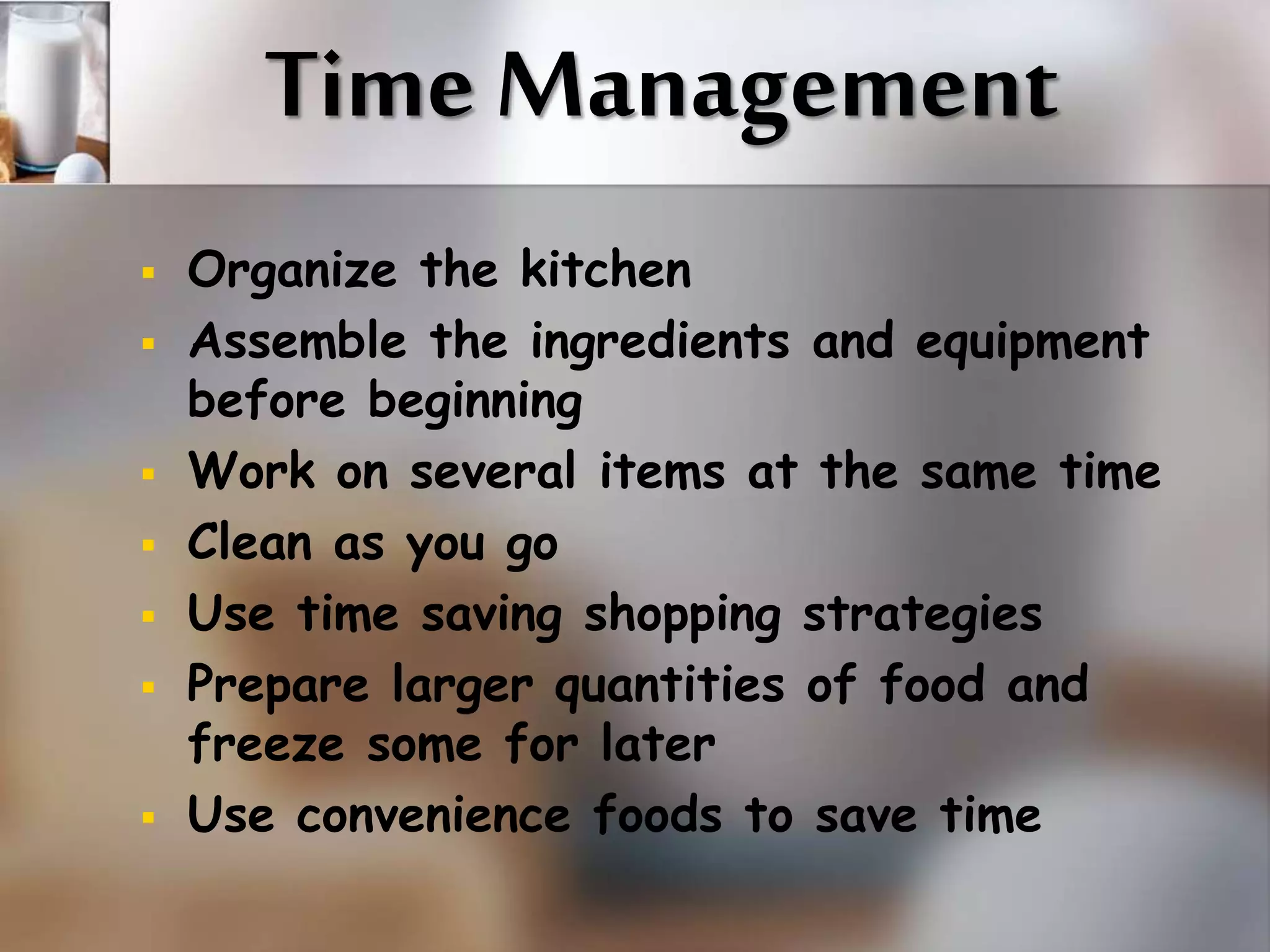
 Organize the kitchen 
 Assemble the ingredients and equipment 
before beginning 
 Work on several items at the same time 
 Clean as you go 
 Use time saving shopping strategies 
 Prepare larger quantities of food and 
freeze some for later 
 Use convenience foods to save time
A Good Meal Includes… 
 Following the food pyramid 
 Following the dietary guidelines 
 Maintaining nutritional balance 
 Making food look good to eat 
(aesthetics)
Follow Food Guide Pyramid 
Recommendations 
Food Groups No. of Servings 
Bread, cereal, rice & pasta Group 6-11 servings 
Fruit Group 2-4 servings 
Vegetable Group 3-5 servings 
Meat, poultry, fish, dry beans, eggs 
& nuts Group 
2-3 servings 
Milk, yogurt & cheese Group 2-3 servings 
(teenagers : 3-4 servings) 
Fats, oils & sweets Use sparingly
Understand aesthetic guidelines 
of meal planning 
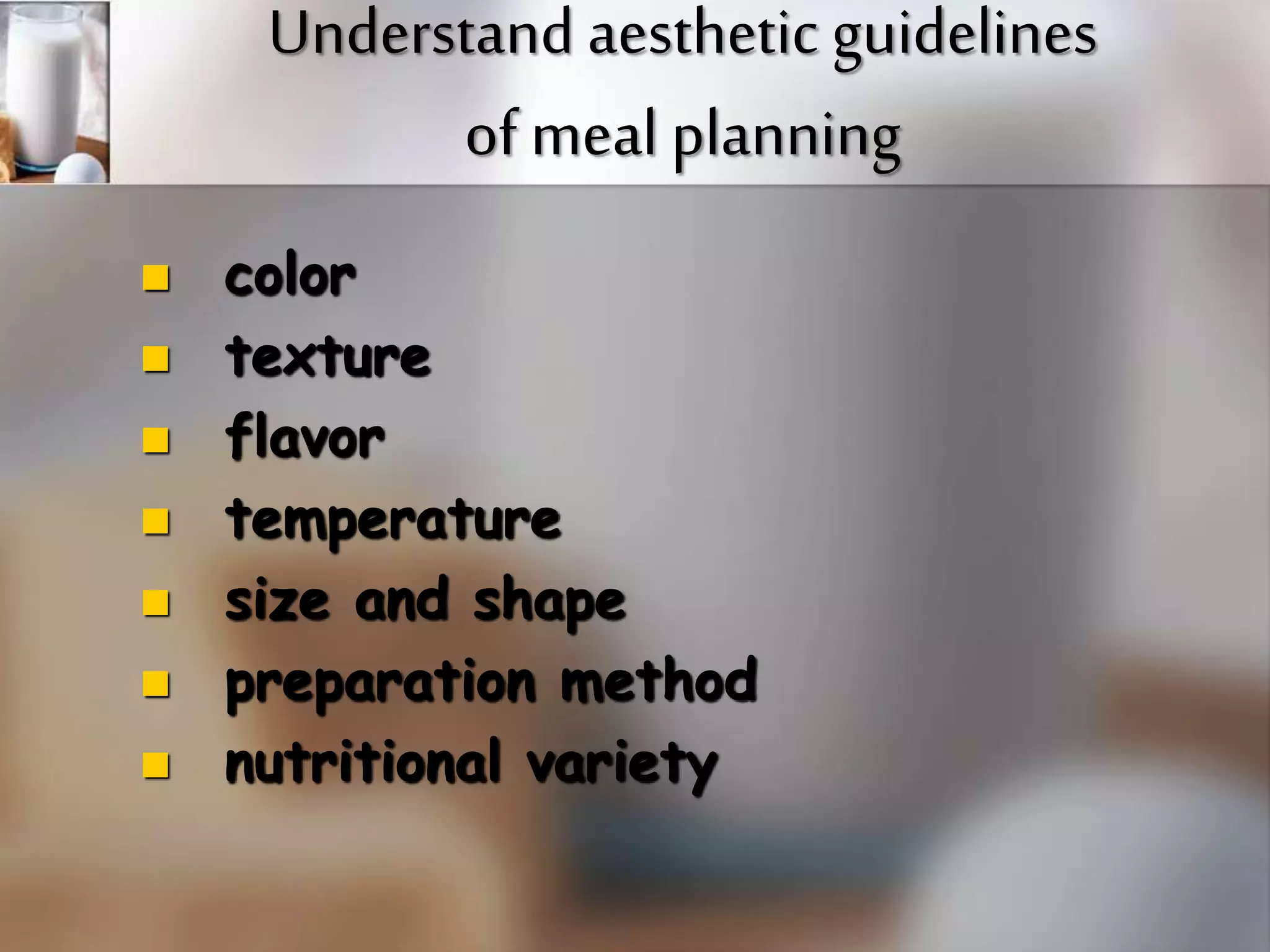
 color 
 texture 
 flavor 
 temperature 
 size and shape 
 preparation method 
 nutritional variety
COLOR 
 Many colors of food are available. Color 
combinations can be appealing or make you 
lose your appetite. Colors that are nearly 
the same are dull and boring. 
 Example of a dinner served to special guests: 
- fresh broccoli, raisin, peanut salad 
(green) 
- cran-raspberry drink (red) 
- chicken cordon blue (yellow) 
- rolls with blackberry jam (dark purple)
COLOR
TEXTURE 
 What can’t be seen; it can be felt with the 
tongue. A variety of textures adds 
interest; i.e., smooth, rough, lumpy, soft, 
crisp. The way food feels when you chew 
it, such as soft, hard, crisp, or chewy. 
 Some foods that have similar textures: 
- soup, milk, pudding 
- chili, stew, some casseroles, baked 
beans 
- tacos, chips, crackers
TEXTURE
FLAVOR 
 Variety is important! Each person has 
9,000 tastebuds that can taste 
sweet, bitter, sour, and salt. Smell 
is also important to tell small 
differences. Avoid using foods with 
similar flavors in one meal. If all the 
foods have a strong flavor, the 
combination can be unpleasant. 
Instead, serve both strong-flavored 
and mild foods for a meal.
FLAVOR
TEMPERATURE 
 Meals are more interesting if some 
are hot and some cold foods are 
used. 
 Hot foods should be served piping 
hot and cold foods should be 
crispy, chilled and served on 
separate plates. The temperature 
outside is a consideration.
TEMPERATURE
Size and Shape 
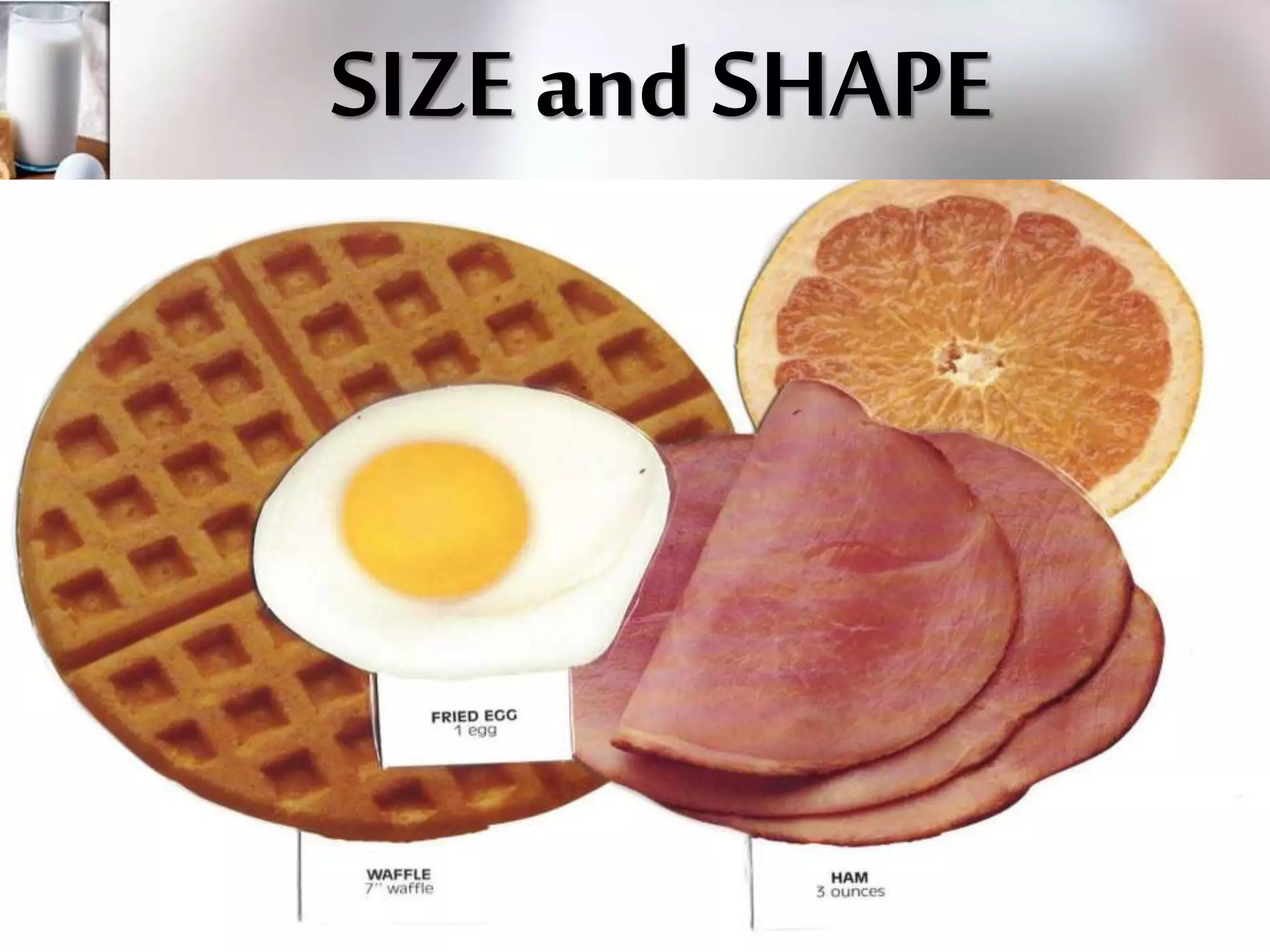
 Use various sizes and shapes. 
Meatballs, peas and olives are 
different colors but not different 
shapes.
SIZE and SHAPE
Heavy/Light 
 Rich, very sweet or fatty foods 
need to balance with lighter foods. 
When planning a menu start with a 
main dish, add appetizers, 
beverages, and a dessert that 
complements it.
Parts of a Meal 
 Appetizers: Include fruit/vegetable 
juice, raw fruits/vegetables, soup, sea 
food, etc. 
 Main dish: A main dish can be meat, 
seafood, poultry, a salad, an omelet, 
pancakes or a casserole 
 Accompaniments: Vegetables, breads, 
rolls, sauces, relishes. 
 Salad: Tossed vegetable or fruit, jellied. 
 Dessert: Cakes, cookies, pies, puddings,
Family Differences 
 Family Size: This affects the amount of 
money needed, the preparation time, and the 
style of table service preferred. 
 Age: Babies, children, teenagers and parents 
need different foods and don’t eat the same 
amount. 
 Activity Level: With more exercise, the body 
requires more energy. 
 Food Preferences: All families don’t like the 
same kinds of foods because of culture and 
traditions.
 Time: Recipes vary greatly in preparation time 
required. When there is little time, fix foods 
requiring little time. 
 Special Diets: Health considerations such as 
diabetes, high blood pressure, lactose 
intolerance, ulcer, stroke, and heart problems 
influence what people eat. 
 Food Budget: If money if limited, foods from 
basic ingredients prepared from scratch may 
be a better choice than fast-food or 
convenience foods.
Marketing Guide 
-Marketing Strategy- 
A marketing strategy includes 
determining your target market, choosing 
how to position your product, deciding how 
your market will find out about you, creating 
a reason why customers should buy from 
you, and developing a consistent message 
and focus for your business.
An Effective Marketing Strategy 
focuses on these Key Elements: 
 identifying the target market, 
 creating a company identity, 
 reaching the market and determining how 
much it will cost to do this.
Actions are the actual ways to 
carry out the strategies it includes: 
• Publicity 
• Trade shows 
• Advertising 
• Internet presence 
• Networking 
• Alliances with others selling products or 
services that compliment yours.
Successful marketing 
of a food product depends on: 
1. The Marketing Environment 
 This includes trends in consumer behavior, 
developments in technology, competition, the 
economy, changes in business structures and 
opportunities. 
2. The Goals of the Firm 
 Launch a new business or product, maintain 
market share, or expand and grow.
Continuation… 
3. The Capabilities of the Firm 
 Production capabilities, financial limitations, 
management skills, strengths and weaknesses 
within the organization. 
4. The Target Market 
Who is the consumer, what are the consumer's 
needs and wants, and where is the consumer 
most likely to purchase the product.
Continuation… 
5. The Product 
 Desired image, the storage, handling and 
preparation required, and label information. 
6. The Economic Feasibility 
 costs, price and profitability
Distribution 
Strategy 
A distribution strategy answers the question: 
 "How will I sell my product?“ 
Examples 
A manufacturer of chocolate and chocolate products 
could sell: 
 from a store-front directly to consumers 
 customized packages and shapes for businesses to 
use as gifts 
 chocolates packaged with a store's own brand to a 
supermarket chain
Product Promotion 
This may be through the following: 
 Advertising 
 Price promotion 
 Public relations activities 
Pricing 
The pricing of the product is important. Costs of 
production and overhead must be met
Prepared by: 
Abano, Nieza 
Alfonso, Senen 
Agudo, Kristine Claire 
Al-shidhani, Saidha Ly 
Bachinilla, Donna Claire 
BEEd – 4D3

Meal preparation

  • 2.
    Meal Preparation Mealpattern Menu planning Marketing Guide
  • 3.
    Meal Pattern andMenu Planning  A meal pattern is a menu-planning tool used to develop menus for a specific age group.  It is a set of food components, food items, and minimum quantities required for a breakfast, supplement (snack), or lunch or supper for a specific age group.  In schools, meal patterns are used to create menus with the healthiest meals for students.
  • 4.
    Meal Pattern andMenu Planning  It should include food from each of four food groups- meat/meat alternate, vegetable/fruit, bread/bread alternate, and milk/milk alternate.  Patterns can incorporate standards including: low sodium, low fat, low saturated fat, and low cholesterol as designated by State Units of Aging (SUA) guidelines.
  • 5.
    How is ameal pattern used to develop a menu?  When developing a menu, each meal is required to include a variety of foods to assure that it contains at least 1/3 of the Recommended Daily Allowance (RDAs).  The meal pattern is a template for the menu planner. It provides a framework of foods to include.  Proper food preparation and handling should also be addressed.
  • 6.
    What are thebenefits of using a meal pattern to develop a menu?  Meal patterns are simple and cost efficient tools that ensure the number of servings per food group are met at each meal.
  • 10.
    Why is mealplanning important?  Many family members are balancing: multiple roles ex.) parents, employees, children, volunteer  Families are trying to meet good nutritional standards.  The busier & unprepared a family is the more tendencies the family may have to develop poor eating habits.
  • 11.
    Why is mealplanning important? • When planning meals for the family or guests consider the following: – Allergies – Likes and dislikes – Your Resources: • How much time do you have for preparation • Food choices and availability • Money • Your preparation skills and equipment – Meal Appeal – Incorporate a balance of nutrients – Modify meals and recipes for health concerns and conditions
  • 12.
    Time Management Organize the kitchen  Assemble the ingredients and equipment before beginning  Work on several items at the same time  Clean as you go  Use time saving shopping strategies  Prepare larger quantities of food and freeze some for later  Use convenience foods to save time
  • 13.
    A Good MealIncludes…  Following the food pyramid  Following the dietary guidelines  Maintaining nutritional balance  Making food look good to eat (aesthetics)
  • 14.
    Follow Food GuidePyramid Recommendations Food Groups No. of Servings Bread, cereal, rice & pasta Group 6-11 servings Fruit Group 2-4 servings Vegetable Group 3-5 servings Meat, poultry, fish, dry beans, eggs & nuts Group 2-3 servings Milk, yogurt & cheese Group 2-3 servings (teenagers : 3-4 servings) Fats, oils & sweets Use sparingly
  • 15.
    Understand aesthetic guidelines of meal planning  color  texture  flavor  temperature  size and shape  preparation method  nutritional variety
  • 16.
    COLOR  Manycolors of food are available. Color combinations can be appealing or make you lose your appetite. Colors that are nearly the same are dull and boring.  Example of a dinner served to special guests: - fresh broccoli, raisin, peanut salad (green) - cran-raspberry drink (red) - chicken cordon blue (yellow) - rolls with blackberry jam (dark purple)
  • 17.
  • 18.
    TEXTURE  Whatcan’t be seen; it can be felt with the tongue. A variety of textures adds interest; i.e., smooth, rough, lumpy, soft, crisp. The way food feels when you chew it, such as soft, hard, crisp, or chewy.  Some foods that have similar textures: - soup, milk, pudding - chili, stew, some casseroles, baked beans - tacos, chips, crackers
  • 19.
  • 20.
    FLAVOR  Varietyis important! Each person has 9,000 tastebuds that can taste sweet, bitter, sour, and salt. Smell is also important to tell small differences. Avoid using foods with similar flavors in one meal. If all the foods have a strong flavor, the combination can be unpleasant. Instead, serve both strong-flavored and mild foods for a meal.
  • 21.
  • 22.
    TEMPERATURE  Mealsare more interesting if some are hot and some cold foods are used.  Hot foods should be served piping hot and cold foods should be crispy, chilled and served on separate plates. The temperature outside is a consideration.
  • 23.
  • 24.
    Size and Shape  Use various sizes and shapes. Meatballs, peas and olives are different colors but not different shapes.
  • 25.
  • 26.
    Heavy/Light  Rich,very sweet or fatty foods need to balance with lighter foods. When planning a menu start with a main dish, add appetizers, beverages, and a dessert that complements it.
  • 27.
    Parts of aMeal  Appetizers: Include fruit/vegetable juice, raw fruits/vegetables, soup, sea food, etc.  Main dish: A main dish can be meat, seafood, poultry, a salad, an omelet, pancakes or a casserole  Accompaniments: Vegetables, breads, rolls, sauces, relishes.  Salad: Tossed vegetable or fruit, jellied.  Dessert: Cakes, cookies, pies, puddings,
  • 28.
    Family Differences Family Size: This affects the amount of money needed, the preparation time, and the style of table service preferred.  Age: Babies, children, teenagers and parents need different foods and don’t eat the same amount.  Activity Level: With more exercise, the body requires more energy.  Food Preferences: All families don’t like the same kinds of foods because of culture and traditions.
  • 29.
     Time: Recipesvary greatly in preparation time required. When there is little time, fix foods requiring little time.  Special Diets: Health considerations such as diabetes, high blood pressure, lactose intolerance, ulcer, stroke, and heart problems influence what people eat.  Food Budget: If money if limited, foods from basic ingredients prepared from scratch may be a better choice than fast-food or convenience foods.
  • 30.
    Marketing Guide -MarketingStrategy- A marketing strategy includes determining your target market, choosing how to position your product, deciding how your market will find out about you, creating a reason why customers should buy from you, and developing a consistent message and focus for your business.
  • 31.
    An Effective MarketingStrategy focuses on these Key Elements:  identifying the target market,  creating a company identity,  reaching the market and determining how much it will cost to do this.
  • 32.
    Actions are theactual ways to carry out the strategies it includes: • Publicity • Trade shows • Advertising • Internet presence • Networking • Alliances with others selling products or services that compliment yours.
  • 33.
    Successful marketing ofa food product depends on: 1. The Marketing Environment  This includes trends in consumer behavior, developments in technology, competition, the economy, changes in business structures and opportunities. 2. The Goals of the Firm  Launch a new business or product, maintain market share, or expand and grow.
  • 34.
    Continuation… 3. TheCapabilities of the Firm  Production capabilities, financial limitations, management skills, strengths and weaknesses within the organization. 4. The Target Market Who is the consumer, what are the consumer's needs and wants, and where is the consumer most likely to purchase the product.
  • 35.
    Continuation… 5. TheProduct  Desired image, the storage, handling and preparation required, and label information. 6. The Economic Feasibility  costs, price and profitability
  • 36.
    Distribution Strategy Adistribution strategy answers the question:  "How will I sell my product?“ Examples A manufacturer of chocolate and chocolate products could sell:  from a store-front directly to consumers  customized packages and shapes for businesses to use as gifts  chocolates packaged with a store's own brand to a supermarket chain
  • 37.
    Product Promotion Thismay be through the following:  Advertising  Price promotion  Public relations activities Pricing The pricing of the product is important. Costs of production and overhead must be met
  • 38.
    Prepared by: Abano,Nieza Alfonso, Senen Agudo, Kristine Claire Al-shidhani, Saidha Ly Bachinilla, Donna Claire BEEd – 4D3