PAYING THE
COLLEGE BILL
MASSACHUSETTS EDUCATIONAL FINANCING AUTHORITY
Welcome
Congratulations on your college
acceptances, students and parents!
Be Informed About Merit-Based vs. Need-Based Aid
Merit-Based Aid
•Awarded in recognition of student achievements
(academic, artistic, athletic, etc.)
•Awarding criteria differs from school to school
•Often has requirements for renewal (grades, volunteering, etc.)
Need-Based Aid
•Awarded based on each family’s financial eligibility
•Determined by a standardized formula
•Includes most federal, state, and institutional (college) aid
Understand Your Financial Aid Awards
•Learn about types of aid:
– Grants/Scholarships
– Work-study
– Loans
•Sources: federal, state, &
colleges
•Financial aid award letters look
different!
•Accept all or part of your aid
by May 1st
This example is an estimate only.
Federal Direct Student Loans
•Every student who submits the FAFSA is eligible for them
•The student is the borrower and there’s no credit check
•Annual limits: $5,500 freshman year $6,500 sophomore year
$7,500 junior year $7,500 senior year
•Fixed interest rate changes annually: 4.29% for 2015-16
•Two types:
– Subsidized: Interest accrues after student leaves school
– Unsubsidized: Interest accrues immediately
•1.068% fee deducted from the loan amount
•Promissory Note & Entrance Counseling requirements:
•No payments due on interest or principal while in school
•Several repayment options
Verification
•Colleges verify data on financial aid applications
•Students are selected by the Dept. of Ed or the college
•Students must comply to receive financial aid
•Families submit additional documentation:
– IRS Data Retrieval Tool
– Tax Return Transcript
– Verification Worksheet
– Asset Account Statements
•Some schools use IDOC
If You Have Not Applied For Aid
•Federal & state financial aid is still available
– File the FAFSA for federal and state aid
– The Massachusetts financial aid deadline is May 1st
•Many college financial aid deadlines have passed
•Interest-free payment plans are open to all
•Anyone may apply for private loans
A Word About the Waitlist
•Some schools have a very long waitlist
•You must submit an enrollment deposit at another school
– This is usually non-refundable
•Accepted off the waitlist usually means minimal financial aid
•Steps to take when on the waitlist:
– Formally accept your spot on the waitlist
– Write a short note to the admissions counselor
– Update the school with recent grades and awards
– Keep in touch with the school over social media
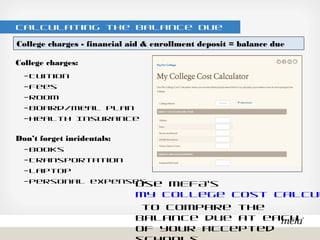
Calculating the Balance Due
College charges:
– Tuition
– Fees
– Room
– Board/Meal Plan
– Health Insurance
Don’t forget incidentals:
– Books
– Transportation
– Laptop
– Personal expenses
Use MEFA’s My College Cost Calculator
to compare the balance due at each of
your accepted schools
College charges - financial aid & enrollment deposit = balance due
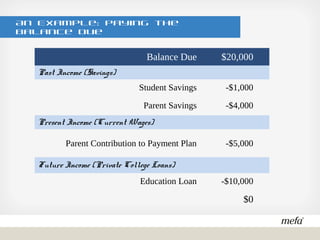
An Example: Paying the Balance Due
Balance Due $20,000
Past Income (Savings)
Student Savings -$1,000
Parent Savings -$4,000
Present Income (Current Wages)
Parent Contribution to Payment
Plan
-$5,000
Future Income (Private College Loans)
Education Loan -$10,000
$0
Past Income: Savings
•529 College Savings Plans
•Prepaid Tuition Plans
•Savings Bonds
•Stocks
•CDs
•Parent Bank Accounts
•Student Bank Accounts
•Other Investments
Many families use savings to pay a portion of the college bill:
Utilizing Savings from the U.Plan and U.Fund
U.Plan Prepaid Tuition Program
– U.Plan Distribution Request Forms will be mailed in April
– Questions?
• Email info@mefa.org
• Call (800) 449-MEFA (6332), option #1
U.Fund College Investing Plan
– Visit fidelity.com/saving-for-college/529-plan-distributions to:
• Obtain a 529 College Investing Plan Distribution Form
• Set up BillPay® to send funds directly to the college
– Questions?
• Call (800) 544-2776
Present Income: Salary
•Pay over 5 to 12 months
•No interest charges or credit requirements
•Minimal enrollment fee
•Great option to minimize borrowing
•Plans typically begin in May, June, or July
•Contact the college for more information
Consider using an interest-free monthly payment plan
Future Income: Private Loans
Be a wise borrower when considering private loans
•Know your credit history
•Borrow only what you need
•Think in terms of total enrollment (4+ years) and total debt
- Consider the post-graduation monthly repayment
•Consider major/career, employment rates, & starting salary
•Understand:
- Fixed vs. variable interest rate
- Repayment timeline
- Who is the primary borrower?
•Attend our Comparing Loan Options Webinar
- Thursday, June 2nd @ noon
- Tuesday, July 12th @ noon
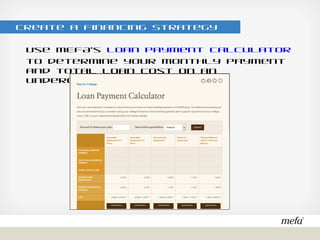
Create a Financing Strategy
Use MEFA’s Loan Payment Calculator to determine your monthly
payment and total loan cost on an undergraduate MEFA loan
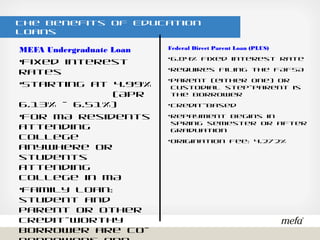
The Benefits of Education Loans
MEFA Undergraduate Loan
•Fixed interest rates
•Starting at 4.99%
(APR 6.13% - 6.51%)
•For MA residents attending
college anywhere or students
attending college in MA
•Family loan: student and
parent or other credit-worthy
borrower are co-borrowers and
share responsibility
•Credit-based
•Multiple repayment options
•Origination fee: 4%
Federal Direct Parent Loan (PLUS)
•6.84% fixed interest rate
•Requires filing the FAFSA
•Parent (either one) or custodial
step-parent is the borrower
•Credit-based
•Repayment begins in spring
semester or after graduation
•Origination fee: 4.272%
Timing: Paying Your Bill
•Fall semester bill sent in June or July
•Fall semester bill due in July or August
•Apply for private loans at least 2 weeks before the bill deadline
•Set up payment plans according to the college schedule
Use the Financial Aid Office as a Resource
Learn about your financial aid
•Know your financial aid renewability criteria (financial, academic)
•Understand how your private scholarships are treated
Ask about special considerations
•Is it possible to appeal your award?
•What if you have changes in family circumstances?
Find out additional details
•Get information on Open House and Orientation programs
•Ask about additional financial resources
•Use every avenue
Review the Financial Aid Office website
•Set up an in-person meeting with the financial aid counselor
•Call the Financial Aid Office
What’s Next?
•Pay your enrollment deposit by May 1 (if required)
•Make plans to attend Orientation
•Create a plan as a family to pay the balance due
•Utilize MEFA as your resource
– Sign up for MEFA emails to stay on track
– Use tools on mefa.org: webinars, calculators, videos
– Take advantage of one-on-one counseling with the MEFA team
• Phone: (800) 449-MEFA (6332)
• Email: info@mefa.org
Connect with MEFA on Social Media
Another great place to get your questions answered!
Thank You
Questions?
mefa.org
(800) 449-MEFA (6332)
info@mefa.org

Paying the College Bill | blog

  • 1.
    PAYING THE COLLEGE BILL MASSACHUSETTSEDUCATIONAL FINANCING AUTHORITY
  • 2.
    Welcome Congratulations on yourcollege acceptances, students and parents!
  • 3.
    Be Informed AboutMerit-Based vs. Need-Based Aid Merit-Based Aid •Awarded in recognition of student achievements (academic, artistic, athletic, etc.) •Awarding criteria differs from school to school •Often has requirements for renewal (grades, volunteering, etc.) Need-Based Aid •Awarded based on each family’s financial eligibility •Determined by a standardized formula •Includes most federal, state, and institutional (college) aid
  • 4.
    Understand Your FinancialAid Awards •Learn about types of aid: – Grants/Scholarships – Work-study – Loans •Sources: federal, state, & colleges •Financial aid award letters look different! •Accept all or part of your aid by May 1st This example is an estimate only.
  • 5.
    Federal Direct StudentLoans •Every student who submits the FAFSA is eligible for them •The student is the borrower and there’s no credit check •Annual limits: $5,500 freshman year $6,500 sophomore year $7,500 junior year $7,500 senior year •Fixed interest rate changes annually: 4.29% for 2015-16 •Two types: – Subsidized: Interest accrues after student leaves school – Unsubsidized: Interest accrues immediately •1.068% fee deducted from the loan amount •Promissory Note & Entrance Counseling requirements: •No payments due on interest or principal while in school •Several repayment options
  • 6.
    Verification •Colleges verify dataon financial aid applications •Students are selected by the Dept. of Ed or the college •Students must comply to receive financial aid •Families submit additional documentation: – IRS Data Retrieval Tool – Tax Return Transcript – Verification Worksheet – Asset Account Statements •Some schools use IDOC
  • 7.
    If You HaveNot Applied For Aid •Federal & state financial aid is still available – File the FAFSA for federal and state aid – The Massachusetts financial aid deadline is May 1st •Many college financial aid deadlines have passed •Interest-free payment plans are open to all •Anyone may apply for private loans
  • 8.
    A Word Aboutthe Waitlist •Some schools have a very long waitlist •You must submit an enrollment deposit at another school – This is usually non-refundable •Accepted off the waitlist usually means minimal financial aid •Steps to take when on the waitlist: – Formally accept your spot on the waitlist – Write a short note to the admissions counselor – Update the school with recent grades and awards – Keep in touch with the school over social media
  • 9.
    Calculating the BalanceDue College charges: – Tuition – Fees – Room – Board/Meal Plan – Health Insurance Don’t forget incidentals: – Books – Transportation – Laptop – Personal expenses Use MEFA’s My College Cost Calculator to compare the balance due at each of your accepted schools College charges - financial aid & enrollment deposit = balance due
  • 10.
    An Example: Payingthe Balance Due Balance Due $20,000 Past Income (Savings) Student Savings -$1,000 Parent Savings -$4,000 Present Income (Current Wages) Parent Contribution to Payment Plan -$5,000 Future Income (Private College Loans) Education Loan -$10,000 $0
  • 11.
    Past Income: Savings •529College Savings Plans •Prepaid Tuition Plans •Savings Bonds •Stocks •CDs •Parent Bank Accounts •Student Bank Accounts •Other Investments Many families use savings to pay a portion of the college bill:
  • 12.
    Utilizing Savings fromthe U.Plan and U.Fund U.Plan Prepaid Tuition Program – U.Plan Distribution Request Forms will be mailed in April – Questions? • Email info@mefa.org • Call (800) 449-MEFA (6332), option #1 U.Fund College Investing Plan – Visit fidelity.com/saving-for-college/529-plan-distributions to: • Obtain a 529 College Investing Plan Distribution Form • Set up BillPay® to send funds directly to the college – Questions? • Call (800) 544-2776
  • 13.
    Present Income: Salary •Payover 5 to 12 months •No interest charges or credit requirements •Minimal enrollment fee •Great option to minimize borrowing •Plans typically begin in May, June, or July •Contact the college for more information Consider using an interest-free monthly payment plan
  • 14.
    Future Income: PrivateLoans Be a wise borrower when considering private loans •Know your credit history •Borrow only what you need •Think in terms of total enrollment (4+ years) and total debt - Consider the post-graduation monthly repayment •Consider major/career, employment rates, & starting salary •Understand: - Fixed vs. variable interest rate - Repayment timeline - Who is the primary borrower? •Attend our Comparing Loan Options Webinar - Thursday, June 2nd @ noon - Tuesday, July 12th @ noon
  • 15.
    Create a FinancingStrategy Use MEFA’s Loan Payment Calculator to determine your monthly payment and total loan cost on an undergraduate MEFA loan
  • 16.
    The Benefits ofEducation Loans MEFA Undergraduate Loan •Fixed interest rates •Starting at 4.99% (APR 6.13% - 6.51%) •For MA residents attending college anywhere or students attending college in MA •Family loan: student and parent or other credit-worthy borrower are co-borrowers and share responsibility •Credit-based •Multiple repayment options •Origination fee: 4% Federal Direct Parent Loan (PLUS) •6.84% fixed interest rate •Requires filing the FAFSA •Parent (either one) or custodial step-parent is the borrower •Credit-based •Repayment begins in spring semester or after graduation •Origination fee: 4.272%
  • 17.
    Timing: Paying YourBill •Fall semester bill sent in June or July •Fall semester bill due in July or August •Apply for private loans at least 2 weeks before the bill deadline •Set up payment plans according to the college schedule
  • 18.
    Use the FinancialAid Office as a Resource Learn about your financial aid •Know your financial aid renewability criteria (financial, academic) •Understand how your private scholarships are treated Ask about special considerations •Is it possible to appeal your award? •What if you have changes in family circumstances? Find out additional details •Get information on Open House and Orientation programs •Ask about additional financial resources •Use every avenue Review the Financial Aid Office website •Set up an in-person meeting with the financial aid counselor •Call the Financial Aid Office
  • 19.
    What’s Next? •Pay yourenrollment deposit by May 1 (if required) •Make plans to attend Orientation •Create a plan as a family to pay the balance due •Utilize MEFA as your resource – Sign up for MEFA emails to stay on track – Use tools on mefa.org: webinars, calculators, videos – Take advantage of one-on-one counseling with the MEFA team • Phone: (800) 449-MEFA (6332) • Email: info@mefa.org
  • 20.
    Connect with MEFAon Social Media Another great place to get your questions answered!
  • 21.

Editor's Notes

  • #2 Introduce yourself and share your background Let families know you’ll be speaking on making the college decision and how to pay the college bill Provide the timeframe: presentation will be approximately 1 hour followed by a Q&A Let families know if you’ll be taking questions throughout or just at the end Let families know that this is a presentation timely for seniors in high school and their families Remind families to complete the evaluation following the presentation Tell families that the slides to this presentation can be found online on mefa.org/Events
  • #3 Encourage the audience to give themselves a round of applause for getting through this process - they are almost there!
  • #4 Describe two main categories of financial aid: Merit-based: Awarded in recognition of student achievement Only some colleges award merit aid Awarding practices vary significantly from college to college Discuss some of the ways students may have needed to apply for merit aid: a separate application, essay, nomination, etc. Discuss how students may lose academic merit awards if they don’t meet GPA requirements One example from MA: John & Abigail Adams Scholarship: Non need-based Based on high 10th grade MCAS score No application: winners are notified in fall of senior year Covers tuition (NOT fees) at MA public colleges & universities Must be MA resident and U.S. citizen or eligible non-citizen Must submit the FAFSA (even though it’s not need-based) Students must maintain a 3.0 GPA for renewability Don’t mention this at private high schools, as private high schools are not required to take the MCAS Most other financial aid is need-based: awarded based on the financial & household information the family reported on the financial aid applications and based on a standard formula Most of the financial aid on the financial aid award letters will likely be need-based
  • #5 Forget the EFC – what matters now is what you received in financial aid. It’s not what the college costs. It’s what the college costs YOU. Award letters differ by institution Your award may still be an estimate, pending receipt of your completed tax information You will need to apply for financial aid EVERY YEAR May or may not show full cost of attendance Will list types of aid student is eligible to receive You may accept or decline any components of the financial aid award Negotiating/asking a school to reconsider the aid Grants and Scholarships: May be federal – Pell, Federal SEOG May be from the State (can mention osfa.mass.edu for more info): Adams, Mass Grant, Mass Tuition Waivers, Gilbert Grant May be Institutional: merit or need-based, or a combination of the two. Get information about criteria for renewability Review differences between merit and need-based awards PRIVATE/OUTSIDE SCHOLARSHIPS WORK-STUDY: A job on campus that is partially or fully funded by the federal government or the institution Is NOT applied to the bill; rather, is earned every pay period The amount on the award letter is the maximum the student can earn; students who don’t work will not receive the funds Often possible to find an on-campus job if not offered work-study LOANS: For federal student loans (Federal Direct Loan or Perkins Loan), the student is the sole borrower – more info on student loans next in the presentation The PLUS Loan is not aid; it is a credit-based loan offered as an option to pay balance – families may pay their balance any way they wish - will discuss options and more info on the PLUS later in the presentation.
  • #6 Federal loan options should ALWAYS be considered first. Go over details and limits for students Student will need to complete entrance counseling and sign a promissory note Many repayment options for borrowers, including one that can be tailored to the student’s income. Forgiveness provisions for certain professions. See StudentLoans.gov for details. IF YOU HAVE NOT YET APPLIED FOR AID, it is still possible to go through the process and have your child take advantage of low-cost federal loans. File the FAFSA. Interest rates listed are for 2015-16 academic year loans. Rates are set annually to the 10-Year Treasury Note + 2.05% and will not exceed 8.25%. 2016-17 rates will be announced in May What is reasonable student loan debt? Seven in 10 seniors (69%) who graduated from college in 2014 had student loan debt, with an average of $28,950 per borrower. $27,000 maximum 4-year eligibility = standard repayment of approximately $300/month for 10 years Mention additional Unsub for PLUS denials as well. Fees are deducted from loan amount: Fees for Direct Loans: 1.068% for Student DL Two types: Subsidized & Unsubsidized – have the same interest rate Can also mention possibility of NIL and Perkins and PLUS on award letters.
  • #7 Families will receive notification of verification from colleges Some families cannot use the IRS Data Retrieval Tool: Married individuals who file married filing separately or head of household tax returns Change in the marital status after the end of tax year Amended Tax Returns Foreign Tax Returns (even if U.S. return is also filed) Filers with Tax ID Number (TIN) FAFSA and tax return address do not match Families can download a tax return transcript immediately by using the Get Transcript tool on IRS.gov. PDF’s are currently not available and are mailed. Takes 5-10 days. May be selected for Verification from some schools and not others IDOC is a scanning service used to collect tax documents from families as part of the college verification process. It is run by the College Board and used by many colleges that require the CSS/Financial Aid PROFILE.
  • #8 Many families may not yet have applied for aid Can still apply for loans and Pell Grants even if it’s past the college’s deadline. Deadline for Massachusetts financial aid programs is May 1st. Borrow federal student loans first Adams and Koplik Scholarships require you to file the FAFSA
  • #9 More and more students are being waitlisted. A Center on Higher Education Reform study on the 2012-13 admissions cycle showed that some schools (Bates College and U of Richmond) waitlisted as many as 40% of applicants (Washington Post) 43% of schools use a waitlist Percentage is higher for highly selective schools: 63% (NACAC State of College Admission) But only 25% on average are accepted off the waitlist (Boston Globe, 5/2/14) Some schools have more students on the waitlist than accepted Students usually have to accept their place on the waitlist
  • #10 The EFC is now irrelevant. What matters now is the cost of college minus the aid received. Remember this is a 4-year expense Don’t forget to deduct federal loan fees and check with college to see if there are any other fees that can be waived. How to pick a school? Look at the bottom line cost and figure out what you can afford from there. MEFA has a terrific tool, the My College Cost Calculator, located on MEFA.org, to help you determine direct costs. ***PULL UP THE CALCULATOR ONLINE and do an example here. You will be able to line up as many as six different colleges, list aid packages and calculate the balances due for direct costs. You can print your results. Click on graphic to show how the cost calculator works. Sample #’s to use: Private College A: Direct Costs-Tuition($34K), Fees($500), Room & Board ($13,300), Health Insurance ($1600 if not waived); Grants/Scholarships- Pell ($2,000), SEOG ($1,000), State Grant ($500), Institutional Grant ($20K), Outside Sch. ($2K); Loans- Sub $3,500, Unsub. $2,000; Savings- $1,000. Public College B: Direct Costs-Tuition($900; Zero w/ Adams Sch.), Fees($6K), Room & Board ($4800), Health Insurance ($1300 if not waived); Grants/Scholarships- Pell ($2,000), SEOG ($0), State Grant ($500), Institutional Grant ($0), Outside Sch. ($2K); Loans- Sub $3,500, Unsub. $2,000; Savings- $1,000.. One confusing aspect of college bills is understanding the difference between direct costs and indirect costs. DON’T FORGET TO WAIVE HEALTH INSURANCE IF ALREADY COVERED. Explain process to waive costs via Bursars office. ALSO, realize that many colleges now only e-bill, and that often students will need to grant rights to parents/others to view the bill due to FERPA. The financial aid office gives you an estimate of your indirect costs. If your student is living off campus, you will see an allowance for rent in there. If commuting, an estimate will be included for those expenses. Realize that these are not hard and fast figures and that your totals may vary. There are opportunities for saving here. Students can opt to rent books on some campuses, or may already own a laptop for example. They may have options for less expensive housing or smaller meal plans if they won’t be eating all their meals on campus.
  • #11 Families decide the best plan to meet the balance due at the college based on their own personal finances. The options fall under three major categories: past, present, and future income. Families don’t need to choose just one option (past, present, or future income) to pay the balance due, and combination plans can save money in the long run. Past Income: savings or other investment such as college saving plans Present Income: Explain payment plan, i.e., owe $1,000? pay $100 per month for 10 months. Better than ANY loan Future Income: borrowing loans. This will be in addition to student loans that are offered in the financial aid award. If families are considering financing any portion of the student’s education, they should take advantage of federal student loans first Families need to be thinking about a long-term plan when deciding what options to use. This includes the total number of years the student plans to be enrolled as well as multiple children who plan to attend college Colleges who use institutional methodology often expect the student to contribute from savings and/or summer work. Students are able to contribute to the payment plan along with the parents. For families who are not receiving aid, you can still use these same steps. You will not be able to subtract aid, but if you have private scholarships be sure to subtract them from direct costs.
  • #12 Further details will be provided on the next slide regarding withdrawing funds from a U.Plan or U.Fund, should you have one. When to use 529 funds? Divide among all 4 years? Use all of it the first year to delay borrowing? Family decision. Save NOW for younger students. And can even save until the fall for your HS senior.
  • #13 Steps to use your U.Plan Savings: Distribution Request Forms will be sent to you in April; return to MEFA to access savings. MEFA sends college notification of amount in June, once MEFA receives the form back Funds are applied directly to the bill in August. Family receives a confirmation letter from MEFA indicating the amount sent to the college. The family makes the decision of how to allocate college savings funds (evenly over 4 years, most in the first year, etc.) Using your U.Fund Savings: How and when can I take distributions from the account? You can withdraw money from your 529 account for qualified educational expenses such tuition, room and board, books, and supplies. Funds can be sent directly to the college, yourself or a third party, such as a payment plan. (You may NOT take loans against your 529 account. Note: Withdrawals for non-qualified expenses may incur federal income tax and a 10% federal penalty tax.) You have several ways to withdraw money (take a distribution) from your 529 account: Complete the College Investing Plan Distribution form (PDF) Pay college bills online by enrolling now in Fidelity BillPay® for 529 accounts. Call a Fidelity representative at 800-544-2776 1099-Q for tax reporting purposes. Additional documentation (college invoice, statement, receipts) may be required by the IRS to verify that such payments are qualified. What is Fidelity BillPay® for 529 accounts? Fidelity BillPay for 529 accounts is a free online service that allows you to make single and recurring payments to colleges, tuition payment services, the account owner, or the beneficiary. To learn more, view the Fidelity BillPay for 529 Accounts demo. A minimum $2,500 balance is required to activate the service. If you do not meet the minimum balance requirement within 60 days of enrollment, the service will be cancelled automatically, and you will be required to re-enroll in the future.
  • #14 Think of your financing strategy and all 4 years. A payment plan can be an important cash flow tool that can help minimize borrowing In general, a monthly payment plan allows parents to make monthly payments instead of a lump-sum semester payment. Parents should receive information about the school’s monthly payment plan in the student’s financial aid award letter or subsequent mailing from the school. Parents may need to sign up for the plan and begin making payments up to 2 or 3 months prior to the beginning of the semester (check with individual school). Some independent high schools (St. Joe’s Prep., BC High, Phillips Andover) have payment plans- you may be using one already
  • #15 Colleges are a business. This is a business decision for your family. Annualcreditreport.com – free annual credit reports Acknowledge that most families in the audience will have to borrow in some capacity; College education is a good investment, much like a home - not expected to pay in one lump some Debt considerations: do not just sign on the dotted line. These are ideas to consider when deciding how much to borrow Consider the factors to look at when choosing loans Many colleges put together a list of recommended lenders to help families with their parent loan research Refer to average loan debt stats when talking about the primary borrower and how much debt is reasonable for a student to absorb on his or her own. Factor in post-graduation monthly repayment. Seven in 10 seniors (69%) who graduated from college in 2014 had student loan debt, with an average of $28,950 per borrower. Primary borrower – explain parent loans vs. student loans Point to the Be a Wise Borrower sheet available at the seminar tonight Where to find loans? Look at school’s financial aid website. Your own bank, credit union. Let families know that they can shop for loans within a 30-day period and it will only count as one “hit” on their credit, because it’s obvious that they’re shopping for one item We’ll offer two webinars on Comparing Loan Options – a helpful presentation giving families information to help them make a decision on private loans. Families can register on mefa.org/Events Thursday, June 2nd @ noon Tuesday, July 12th @ noon
  • #16 Use Hyperlink in graphic to demonstrate live MEFA’s Loan Monthly Payment Plan calculator to determine the true cost of borrowing a loan. MEFA always recommends a combination strategy: use a no-interest monthly payment plan for at least part of the balance if planning to borrow FOUR WAYS TO PAY A $20,000 BALANCE DUE Most people will consider a monthly payment plan, loan, or combination of the two to cover the balance due: 1) Sign up for an interest-free monthly payment plan, divide payments over 10 months for nominal fee (around $65-80). This would be $2,000 per month for 10 months = $0,000 (pay no interest, use no savings – best way to finance if you can afford it). 2) Borrow the full $20,000. For example, a MEFA Undergraduate Loan with 10-Yr Immediate Repayment 4.99% while in school, with a 4% origination fee, and with 4 yrs til graduation would be $223/month while in school and $228/month after school 3) Customized combination plan: let’s say you can afford more than $250 per month (loan option) but not the full $2,000 per month (payment plan) you can use a combination plan based on your budget. If you determine that $700 is a reasonable monthly payment, you could do a combination plan to keep debt levels low: $575 per month in a monthly payment plant ($5,750 total) Approx. $122 per month in a MEFA Undergraduate Loan with 15-Yr Immediate Repayment ($14,250 at fixed rate of 5.39% while in school and 6.24% out of school and 4% disbursement fee) (payment goes up to $127/month after school) 4) No disposable income? Consider deferred loans
  • #17 MEFA UG Loan- Rate starting at 4.99% (for 10-Yr Immediate Repay) Who’s Eligible: MA residents going in or out of state and students from across the U.S. attending a Massachusetts college or university Most states do not have this benefit No tiered pricing – all qualified borrowers receive the same rate MEFA’s sole purpose for over 30 years has been to provide low-cost college financing for students Provides stable and predictable monthly payments Many repayment options help families pick a loan that best fits their needs Reference the Be a Wise Borrower Loan Chart You can apply for a MEFA Loan beginning April 1st. The PLUS credit check lasts 180 days. PLUS: 6.84% interest rate and 4.272% origination fee Interest rates listed are for 2015-16 academic year loans. Rates are set annually to the 10-Year Treasury Note + 4.60%. 2016-17 rates will be announced in May/June Even though the FAFSA is not required for a MEFA loan, families should still file to borrow their maximum under student loans Additional $4,000 (FR & SO) or $5,000 (JR & SR) per year in Unsub if the parent is denied a PLUS. Funds are sent directly to the school Apply for the whole year, not just one semester Can borrow the full COA minus Financial Aid Remember to multiply any annual borrowing by 4 years There are other options to pay for college – home equity loan, credit cards, borrowing from retirement funds – but be sure to understand all implications of using one of these methods before doing so
  • #18 Point out the timeline in the folder and point out: Bill arrival for both semesters Bill deadline for both semesters When to reapply for financial aid *Remind families to waive the health insurance if covered under a parent’s plan Work-study recipients should expect information from the college regarding employment late summer or at the start of the term Electronic bills – students have to give parents access – most schools are now using e-billing Loans – borrow the amount for the full year – money is sent to the school – describe the loan process
  • #19 The college admitted you, so they want to help you find a way to afford it Ask what is required to renew the financial aid in future years Find out how scholarships are treated Special circumstances: you may be able to appeal your award (meaning, ask for additional financial aid): Some colleges can provide some (small) additional grant funding if you ask. Some may require you to present a reason for the needed additional funds, which may include a recent job loss or family expense, such as a medical bill or home repair. You also may have had a one-time increase in your income in the past year, which raised your income unrealistically Contact your financial aid counselor to ask for additional funds. You will need to submit documentation of your situation
  • #20 If a housing deposit is due, make sure to pay that as well. Families can also research online textbook sites. What to do if you’re on the waitlist.
  • #21 Stress to families how active MEFA is on Twitter and Facebook, and that we have several helpful videos on YouTube. Also mention to families that we answer questions on Facebook and Twitter, and it’s helpful for families to see the questions of others and the answers from MEFA, so we encourage using that avenue.
  • #22 Take any questions from the audience and let attendees know you will stay after to answer individual questions on financial aid award letters