MASSACHUSETTS EDUCATIONAL FINANCING AUTHORITY
COLLEGE ADMISSIONS
Fall 2016
Trends in College Admissions
•Earlier Process: Sophomores & juniors are college planning
•Students are applying to a greater number of schools
•Colleges notate if students demonstrate interest in a school
•Admission to public institutions is now more competitive
•Admissions has become more of a parent-driven process
(though students should be driving!)
•Rise of social media in communications with students
•Globalization: more international students are coming to the U.S.
2
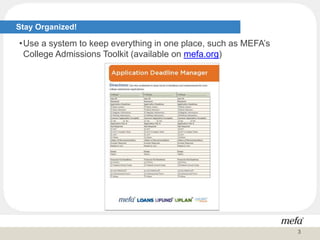
Stay Organized!
•Use a system to keep everything in one place, such as MEFA’s
College Admissions Toolkit (available on mefa.org)
3
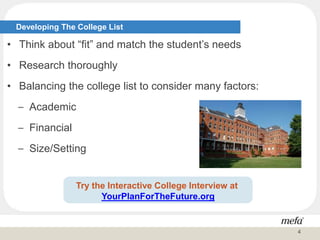
Developing The College List
• Think about “fit” and match the student’s needs
• Research thoroughly
• Balancing the college list to consider many factors:
− Academic
− Financial
− Size/Setting
Try the Interactive College Interview at
YourPlanForTheFuture.org
4
Assess Prospects for Admission
Develop a final list with colleges of each type:
•Probable: Chances for admission are strong
(Make sure at least one is affordable)
•Target: Chances for admission are 50/50
•Reach: Chances for admission are less than 50%
Important: Make sure the student would be excited to
attend every school on the list
5
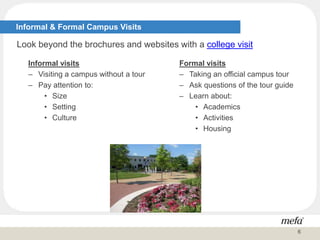
Informal visits
– Visiting a campus without a tour
– Pay attention to:
• Size
• Setting
• Culture
Informal & Formal Campus Visits
Look beyond the brochures and websites with a college visit
Formal visits
– Taking an official campus tour
– Ask questions of the tour guide
– Learn about:
• Academics
• Activities
• Housing
6
College Representative Visits & College Fairs
•Take advantage of college rep visits at the high school
•College fair tips:
–Check out the college list beforehand
–Have a plan of attack before you arrive
–Head to the info booth first
–Take advantage of information sessions
–Check NACACnet.org and NEACAC.org for fall fairs
7
College Application Options
•Regular Decision
•Early Action: Restricted and Unrestricted
•Early Decision
•Rolling Admission
•Open Admission
Deadlines are important! Make sure to stay on
track.
Manage deadlines with MEFA’s
College Admissions Toolkit
8
College Application Types & Components
College Application Types:
•Common App
•Universal College App
•Coalition App
•College website online app
•Paper
Your application may include:
• Application form
• High school transcript
• Standardized test scores
• Recommendations
• Activity list or resume
• Personal essay
• Interview
• Audition
• Portfolio
Application requirements may vary at each college
9
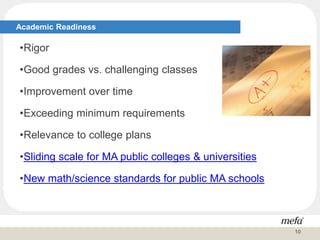
Academic Readiness
•Rigor
•Good grades vs. challenging classes
•Improvement over time
•Exceeding minimum requirements
•Relevance to college plans
•Sliding scale for MA public colleges & universities
•New math/science standards for public MA schools
10
Standardized Tests
• Max score of 1600
• Separate, optional essay
• No guessing penalties
• More relevant vocabulary
• Real-world context
• Free test prep online
•SAT Subject Tests & AP Tests show subject knowledge
•Accuplacer & Compass determine placement in college courses
•There are over 850 test-optional schools in the U.S. (FairTest.org)
•PSAT for practice and assessment
•SAT and ACT measure college readiness
– Check with your school counselor for registration dates
– The new SAT began in March 2016:
11
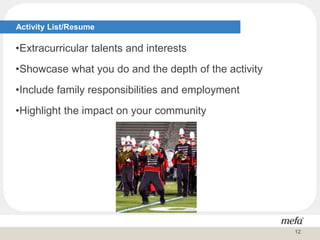
Activity List/Resume
•Extracurricular talents and interests
•Showcase what you do and the depth of the activity
•Include family responsibilities and employment
•Highlight the impact on your community
12
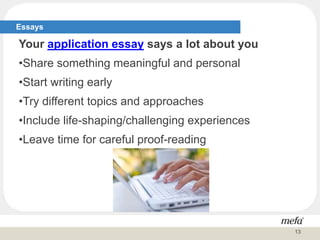
Essays
Your application essay says a lot about you
•Share something meaningful and personal
•Start writing early
•Try different topics and approaches
•Include life-shaping/challenging experiences
•Leave time for careful proof-reading
13
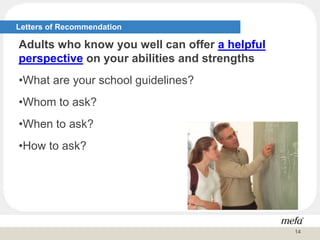
Letters of Recommendation
Adults who know you well can offer a helpful
perspective on your abilities and strengths
•What are your school guidelines?
•Whom to ask?
•When to ask?
•How to ask?
14
Interviews
A face-to-face conversation lets colleges see
the person behind the numbers
•Two types: 1. Informational and 2. Evaluative
•Be prepared to answer open-ended questions
•Know your reasons for applying to the college
•Ask thoughtful questions
•Cover the basics
•Relax and be yourself
Prep for interviews with MEFA’s
College Admissions Toolkit
15
A Word About the Waitlist
•Increasing popularity
•Some schools have a very long list
•Must submit enrollment deposit at an accepted school
–This is usually non-refundable
•Accepted off the waitlist = minimal financial aid
•Steps to take when on the waitlist:
–Write a short note to the admissions counselor
–Update the school with recent grades and awards
16
Understanding College Affordability
Research costs and financial aid now
•What is the Cost of Attendance and Net Price?
–Use Net Price Calculators on college websites
•What applications are required and when are they due?
•Need-based vs. merit-based aid and different deadlines
•Start looking for private scholarships now
17
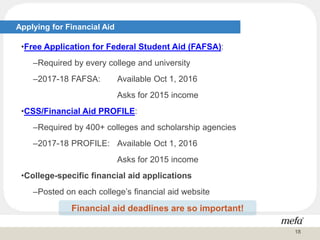
Applying for Financial Aid
•Free Application for Federal Student Aid (FAFSA):
–Required by every college and university
–2017-18 FAFSA: Available Oct 1, 2016
Asks for 2015 income
•CSS/Financial Aid PROFILE:
–Required by 400+ colleges and scholarship agencies
–2017-18 PROFILE: Available Oct 1, 2016
Asks for 2015 income
•College-specific financial aid applications
–Posted on each college’s financial aid website
Financial aid deadlines are so important!
18
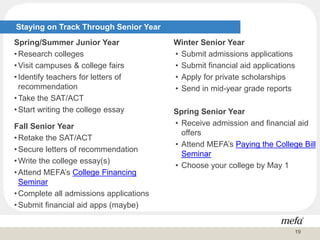
Staying on Track Through Senior Year
Spring/Summer Junior Year
•Research colleges
•Visit campuses & college fairs
•Identify teachers for letters of
recommendation
•Take the SAT/ACT
•Start writing the college essay
Fall Senior Year
•Retake the SAT/ACT
•Secure letters of recommendation
•Write the college essay(s)
•Attend MEFA’s College Financing
Seminar
•Complete all admissions applications
•Submit financial aid apps (maybe)
Winter Senior Year
• Submit admissions applications
• Submit financial aid applications
• Apply for private scholarships
• Send in mid-year grade reports
Spring Senior Year
• Receive admission and financial aid
offers
• Attend MEFA’s Paying the College Bill
Seminar
• Choose your college by May 1
19
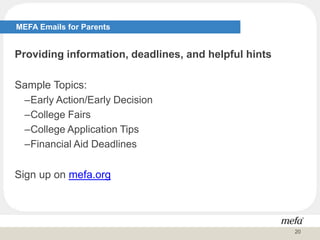
Providing information, deadlines, and helpful hints
Sample Topics:
–Early Action/Early Decision
–College Fairs
–College Application Tips
–Financial Aid Deadlines
Sign up on mefa.org
MEFA Emails for Parents
20
YourPlanForTheFuture.org
FREE college and career planning tool
Resources include:
–Skills and interests assessments
–Career exploration
–College search
–Financial aid and scholarship information
–Personalized portfolio
Available in English and Spanish
21
•Net Price Calculators: Located on school websites
– Provide personal net price at each college
•College Navigator: CollegeNavigator.gov
–College search with admissions, academic, & cost info
•College Scorecard: CollegeScorecard.ed.gov
–Avg net price, student debt, 6-year grad rate, & alumni salary
•College Board: CollegeBoard.org
•Common App: CommonApp.org
•Universal College App: UniversalCollegeApp.com
•Coalition App: CoalitionForCollegeAccess.org
•MEFA: mefa.org
•Up Next: Text “COLLEGE” to 44044 for college planning tips
Free College Planning Resources
22
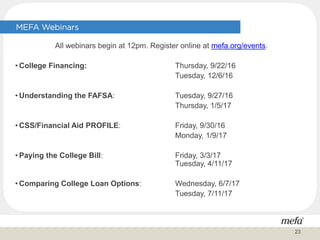
All webinars begin at 12pm. Register online at mefa.org/events.
• College Financing: Thursday, 9/22/16
Tuesday, 12/6/16
• Understanding the FAFSA: Tuesday, 9/27/16
Thursday, 1/5/17
• CSS/Financial Aid PROFILE: Friday, 9/30/16
Monday, 1/9/17
• Paying the College Bill: Friday, 3/3/17
Tuesday, 4/11/17
• Comparing College Loan Options: Wednesday, 6/7/17
Tuesday, 7/11/17
MEFA Webinars
23
•Complete the seminar evaluation & sign up for MEFA
emails
•Research colleges and plan a campus visit
•Download the College Admissions Toolkit on mefa.org
•Set up a profile at
YourPlanForTheFuture.org
What You Can Do Now
24
Thank You
MEFA
mefa.org
info@mefa.org
(800) 449-MEFA (6332)
25

College Admissions

  • 1.
    MASSACHUSETTS EDUCATIONAL FINANCINGAUTHORITY COLLEGE ADMISSIONS Fall 2016
  • 2.
    Trends in CollegeAdmissions •Earlier Process: Sophomores & juniors are college planning •Students are applying to a greater number of schools •Colleges notate if students demonstrate interest in a school •Admission to public institutions is now more competitive •Admissions has become more of a parent-driven process (though students should be driving!) •Rise of social media in communications with students •Globalization: more international students are coming to the U.S. 2
  • 3.
    Stay Organized! •Use asystem to keep everything in one place, such as MEFA’s College Admissions Toolkit (available on mefa.org) 3
  • 4.
    Developing The CollegeList • Think about “fit” and match the student’s needs • Research thoroughly • Balancing the college list to consider many factors: − Academic − Financial − Size/Setting Try the Interactive College Interview at YourPlanForTheFuture.org 4
  • 5.
    Assess Prospects forAdmission Develop a final list with colleges of each type: •Probable: Chances for admission are strong (Make sure at least one is affordable) •Target: Chances for admission are 50/50 •Reach: Chances for admission are less than 50% Important: Make sure the student would be excited to attend every school on the list 5
  • 6.
    Informal visits – Visitinga campus without a tour – Pay attention to: • Size • Setting • Culture Informal & Formal Campus Visits Look beyond the brochures and websites with a college visit Formal visits – Taking an official campus tour – Ask questions of the tour guide – Learn about: • Academics • Activities • Housing 6
  • 7.
    College Representative Visits& College Fairs •Take advantage of college rep visits at the high school •College fair tips: –Check out the college list beforehand –Have a plan of attack before you arrive –Head to the info booth first –Take advantage of information sessions –Check NACACnet.org and NEACAC.org for fall fairs 7
  • 8.
    College Application Options •RegularDecision •Early Action: Restricted and Unrestricted •Early Decision •Rolling Admission •Open Admission Deadlines are important! Make sure to stay on track. Manage deadlines with MEFA’s College Admissions Toolkit 8
  • 9.
    College Application Types& Components College Application Types: •Common App •Universal College App •Coalition App •College website online app •Paper Your application may include: • Application form • High school transcript • Standardized test scores • Recommendations • Activity list or resume • Personal essay • Interview • Audition • Portfolio Application requirements may vary at each college 9
  • 10.
    Academic Readiness •Rigor •Good gradesvs. challenging classes •Improvement over time •Exceeding minimum requirements •Relevance to college plans •Sliding scale for MA public colleges & universities •New math/science standards for public MA schools 10
  • 11.
    Standardized Tests • Maxscore of 1600 • Separate, optional essay • No guessing penalties • More relevant vocabulary • Real-world context • Free test prep online •SAT Subject Tests & AP Tests show subject knowledge •Accuplacer & Compass determine placement in college courses •There are over 850 test-optional schools in the U.S. (FairTest.org) •PSAT for practice and assessment •SAT and ACT measure college readiness – Check with your school counselor for registration dates – The new SAT began in March 2016: 11
  • 12.
    Activity List/Resume •Extracurricular talentsand interests •Showcase what you do and the depth of the activity •Include family responsibilities and employment •Highlight the impact on your community 12
  • 13.
    Essays Your application essaysays a lot about you •Share something meaningful and personal •Start writing early •Try different topics and approaches •Include life-shaping/challenging experiences •Leave time for careful proof-reading 13
  • 14.
    Letters of Recommendation Adultswho know you well can offer a helpful perspective on your abilities and strengths •What are your school guidelines? •Whom to ask? •When to ask? •How to ask? 14
  • 15.
    Interviews A face-to-face conversationlets colleges see the person behind the numbers •Two types: 1. Informational and 2. Evaluative •Be prepared to answer open-ended questions •Know your reasons for applying to the college •Ask thoughtful questions •Cover the basics •Relax and be yourself Prep for interviews with MEFA’s College Admissions Toolkit 15
  • 16.
    A Word Aboutthe Waitlist •Increasing popularity •Some schools have a very long list •Must submit enrollment deposit at an accepted school –This is usually non-refundable •Accepted off the waitlist = minimal financial aid •Steps to take when on the waitlist: –Write a short note to the admissions counselor –Update the school with recent grades and awards 16
  • 17.
    Understanding College Affordability Researchcosts and financial aid now •What is the Cost of Attendance and Net Price? –Use Net Price Calculators on college websites •What applications are required and when are they due? •Need-based vs. merit-based aid and different deadlines •Start looking for private scholarships now 17
  • 18.
    Applying for FinancialAid •Free Application for Federal Student Aid (FAFSA): –Required by every college and university –2017-18 FAFSA: Available Oct 1, 2016 Asks for 2015 income •CSS/Financial Aid PROFILE: –Required by 400+ colleges and scholarship agencies –2017-18 PROFILE: Available Oct 1, 2016 Asks for 2015 income •College-specific financial aid applications –Posted on each college’s financial aid website Financial aid deadlines are so important! 18
  • 19.
    Staying on TrackThrough Senior Year Spring/Summer Junior Year •Research colleges •Visit campuses & college fairs •Identify teachers for letters of recommendation •Take the SAT/ACT •Start writing the college essay Fall Senior Year •Retake the SAT/ACT •Secure letters of recommendation •Write the college essay(s) •Attend MEFA’s College Financing Seminar •Complete all admissions applications •Submit financial aid apps (maybe) Winter Senior Year • Submit admissions applications • Submit financial aid applications • Apply for private scholarships • Send in mid-year grade reports Spring Senior Year • Receive admission and financial aid offers • Attend MEFA’s Paying the College Bill Seminar • Choose your college by May 1 19
  • 20.
    Providing information, deadlines,and helpful hints Sample Topics: –Early Action/Early Decision –College Fairs –College Application Tips –Financial Aid Deadlines Sign up on mefa.org MEFA Emails for Parents 20
  • 21.
    YourPlanForTheFuture.org FREE college andcareer planning tool Resources include: –Skills and interests assessments –Career exploration –College search –Financial aid and scholarship information –Personalized portfolio Available in English and Spanish 21
  • 22.
    •Net Price Calculators:Located on school websites – Provide personal net price at each college •College Navigator: CollegeNavigator.gov –College search with admissions, academic, & cost info •College Scorecard: CollegeScorecard.ed.gov –Avg net price, student debt, 6-year grad rate, & alumni salary •College Board: CollegeBoard.org •Common App: CommonApp.org •Universal College App: UniversalCollegeApp.com •Coalition App: CoalitionForCollegeAccess.org •MEFA: mefa.org •Up Next: Text “COLLEGE” to 44044 for college planning tips Free College Planning Resources 22
  • 23.
    All webinars beginat 12pm. Register online at mefa.org/events. • College Financing: Thursday, 9/22/16 Tuesday, 12/6/16 • Understanding the FAFSA: Tuesday, 9/27/16 Thursday, 1/5/17 • CSS/Financial Aid PROFILE: Friday, 9/30/16 Monday, 1/9/17 • Paying the College Bill: Friday, 3/3/17 Tuesday, 4/11/17 • Comparing College Loan Options: Wednesday, 6/7/17 Tuesday, 7/11/17 MEFA Webinars 23
  • 24.
    •Complete the seminarevaluation & sign up for MEFA emails •Research colleges and plan a campus visit •Download the College Admissions Toolkit on mefa.org •Set up a profile at YourPlanForTheFuture.org What You Can Do Now 24
  • 25.