Metamorphism
The word "Metamorphism" comes from the
Greek word: meta = after, morph = form, so
metamorphism means the after form.
Metamorphism
Mineralogical and structural adjustments
of solid rocks to physical and chemical
conlditions differing from those under
which the rocks originally formed.
Changes produced by surface conditions
such as compaction are usually excluded.
Metamorphism
Important
Factors that
affect
Metamorphism
Temperature
Pressure
Fluids.
This refers to the
changes
in mineral assemblage
and texture that result
from subjecting a rock
to pressures and
temperatures different
from those under which
the rock originally
formed.
PROTOLITH
The original rock that has
undergone metamorphism is called the
protolith.
Protolith can be any type of rock and
sometimes the changes in texture and mineralogy
are so dramatic that is difficult to distinguish
what the protolith was
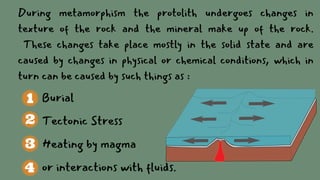
During metamorphism the protolith undergoes changes in
texture of the rock and the mineral make up of the rock.
These changes take place mostly in the solid state and are
caused by changes in physical or chemical conditions, which in
turn can be caused by such things as :
Burial
Tectonic Stress
Heating by magma
or interactions with fluids.
Factors that Control
Metamorphism
-Temperature increases with depth in the Earth
along
the Geothermal Gradient. Thus higher temperature
can occur by burial of rock.
-Temperature can also increase due to igneous
intrusion.
Temperature
This increases with depth of burial, thus, both
pressure and temperature will vary with depth in
the Earth. Pressure is defined as a force acting
equally from all directions. It is a type of stress,
called hydrostatic stress, or uniform stress. If the
stress is not equal from all directions, then the
stress is called a differential stress.
Pressure
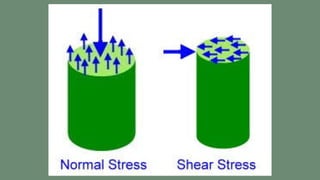
causes objects to be compressed in the direction of maximum principal
stress and extended in the direction of minimal stress. If differential
stress is present during metamorphism, it can have a profound effect on
the texture of the rock.
causes objects to be smeared out in the direction of applied stress.
Differential stress if acting on a rocks can have a profound affect on the
appearance or texture of the rock.
Shear stress
Normal Stress
Any existing open space between mineral grains in a rock
can potentially contain a fluid. This fluid is mostly H2O, but contains
dissolved ions.
The fluid phase is important because chemical reactions
that involve changing a solid mineral into a
new solid mineral can be greatly speeded up
by having dissolved ions transported by the fluid.
The process is called metasomatism,
If chemical alteration of the rock takes place as a result of these
fluids.
Fluid Phase
Since metamorphism involves changing the rock while it's
solid,
metamorphic change is a slow process.
During metamorphism, several processes are at work.
Recrystallization causes changes in minerals size and shape.
Chemical reactions occur between the minerals to form new
sets of minerals that are more stable at the pressure and
temperature of the environment tend new minerals form as
a result.
Time
Three types of metamorphism may occur
depending on
the relative effect of mechanical and chemical
changes.
Three types of metamorphism:
Dynamic metamorphism, Contact metamorphism,
Regional metamorphism
THE THREE TYPES OF METAMORPHISM
THANK YOU FOR LISTENING !
Sources:
https://www.britannica.com/science/metamorphism
"Metamorphic Rocks"
https://www2.tulane.edu/~sanelson/eens1110/metamorphic.htmhttps://www.s
ciencedirect.com/topics/earth-and-planetary-
sciences/metamorphism#:~:text=Metamorphism%20is%20a%20process%20of,
From%3A%20Unconventional%20Petroleum%20Geology%2C%202013"Metamo
rphic Rocks Lesson #14 | Volcano World | Oregon State University"
https://volcano.oregonstate.edu/metamorphic-rocks-lesson-14
https://link.springer.com/chapter/10.1007/978-3-662-04914-3_1

Metamorphism presentation .pdf

  • 1.
  • 2.
    The word "Metamorphism"comes from the Greek word: meta = after, morph = form, so metamorphism means the after form. Metamorphism
  • 3.
    Mineralogical and structuraladjustments of solid rocks to physical and chemical conlditions differing from those under which the rocks originally formed. Changes produced by surface conditions such as compaction are usually excluded. Metamorphism
  • 4.
  • 5.
    Temperature Pressure Fluids. This refers tothe changes in mineral assemblage and texture that result from subjecting a rock to pressures and temperatures different from those under which the rock originally formed.
  • 6.
  • 7.
    The original rockthat has undergone metamorphism is called the protolith. Protolith can be any type of rock and sometimes the changes in texture and mineralogy are so dramatic that is difficult to distinguish what the protolith was
  • 8.
    During metamorphism theprotolith undergoes changes in texture of the rock and the mineral make up of the rock. These changes take place mostly in the solid state and are caused by changes in physical or chemical conditions, which in turn can be caused by such things as : Burial Tectonic Stress Heating by magma or interactions with fluids.
  • 9.
  • 10.
    -Temperature increases withdepth in the Earth along the Geothermal Gradient. Thus higher temperature can occur by burial of rock. -Temperature can also increase due to igneous intrusion. Temperature
  • 11.
    This increases withdepth of burial, thus, both pressure and temperature will vary with depth in the Earth. Pressure is defined as a force acting equally from all directions. It is a type of stress, called hydrostatic stress, or uniform stress. If the stress is not equal from all directions, then the stress is called a differential stress. Pressure
  • 13.
    causes objects tobe compressed in the direction of maximum principal stress and extended in the direction of minimal stress. If differential stress is present during metamorphism, it can have a profound effect on the texture of the rock. causes objects to be smeared out in the direction of applied stress. Differential stress if acting on a rocks can have a profound affect on the appearance or texture of the rock. Shear stress Normal Stress
  • 15.
    Any existing openspace between mineral grains in a rock can potentially contain a fluid. This fluid is mostly H2O, but contains dissolved ions. The fluid phase is important because chemical reactions that involve changing a solid mineral into a new solid mineral can be greatly speeded up by having dissolved ions transported by the fluid. The process is called metasomatism, If chemical alteration of the rock takes place as a result of these fluids. Fluid Phase
  • 16.
    Since metamorphism involveschanging the rock while it's solid, metamorphic change is a slow process. During metamorphism, several processes are at work. Recrystallization causes changes in minerals size and shape. Chemical reactions occur between the minerals to form new sets of minerals that are more stable at the pressure and temperature of the environment tend new minerals form as a result. Time
  • 17.
    Three types ofmetamorphism may occur depending on the relative effect of mechanical and chemical changes. Three types of metamorphism: Dynamic metamorphism, Contact metamorphism, Regional metamorphism THE THREE TYPES OF METAMORPHISM
  • 18.
    THANK YOU FORLISTENING ! Sources: https://www.britannica.com/science/metamorphism "Metamorphic Rocks" https://www2.tulane.edu/~sanelson/eens1110/metamorphic.htmhttps://www.s ciencedirect.com/topics/earth-and-planetary- sciences/metamorphism#:~:text=Metamorphism%20is%20a%20process%20of, From%3A%20Unconventional%20Petroleum%20Geology%2C%202013"Metamo rphic Rocks Lesson #14 | Volcano World | Oregon State University" https://volcano.oregonstate.edu/metamorphic-rocks-lesson-14 https://link.springer.com/chapter/10.1007/978-3-662-04914-3_1