Premium
Learning outcomes
After this discussion, you shall be familiar
with :
• Definitions of premium & renewal premium
• Components of premium
• Types of premium
• Premium calculation
• Valuation
• Bonus
• Life fund
What is premium ?
• Premium – consideration against insurance
contract
• First premium – consideration for contract to
COME into force
• Subsequent premia - for contract to REMAIN
in force
• Insurance policies priced first, cost of
production known later
• Calculation is very complex involving
statistical and actuarial principles.
Components of premium
• Interest
• Expenses
• Mortality
• Benefits under contract
• Bonus loading
• Taxation
• Inflation
Types
• Risk premium - covers risk of death
• Net or pure - Risk premium plus interest
• Office premium – Net premium plus
management expenses
Risk Premium
• Risk premium adequate to pay claims if all
policies were term policies for one year
• Risk premium based on probability of death
at various ages , using mortality tables
containing data for such probabilities.
• In Endowment cases, claims to be paid on
survival after some years
• Actual premium collected would have to be
more than risk premium
Net premium
• Premium collected are not utilised every year
for payment of claims
• Reasons -
Real experience may not be exactly as per
mortality tables
Premiums collected in Endowment plans will
be much higher initially than required since
company has to cover risk & pay survival
amount if policyholder survives term.
Contd……
• Hence premium should provide for the
Pure Endowment part of the policy also.
• Excess premium collected, in either case,
is invested by insurer
• This belongs to policyholders and will be
passed on to them
• Co assumes a certain rate of interest,
based on its experience, while computing
premium rates.
Contd…..
• Since life insurance contracts are very
long-term contracts, investments made by
company also will be long-term.
• Higher the interest earned, lower will be
premium
• Premium based on combination of
mortality rate and interest factor is Net
Premium
Office Premium
• If co was to charge only NP, then no
provision for expenses, hence certain
loadings to NP.
• In life insurance, expenses of procuring
business very high
• Cost of maintaining a policy is low
• Lesser RP goes towards expenses
• Uneven distribution of expenses in FYP & RP
Contd…..
• Expenses of a life insurance company
Salaries
Commission
Medical fee
Stamp duty
Printing & stationary
Postage
Advertisement/publicity
Contd….
• Establishment charges
Legal fees
Consultancy/training
Taxation
• When expenses are loaded, the premium
arrived at is the office premium.
This premium is now ready for use.
Is printed in promotional literature/
brochures
Level premium
• Insurers spread risk premium uniformly
throughout term of policy
• Premium remains same throughout term
• This is level premium
• Implies that premium collected in early years
of policy would be more than necessary for
risk and less than necessary towards latter
part of policy
• If premia were to increase with age, difficult
for policyholders to continue.
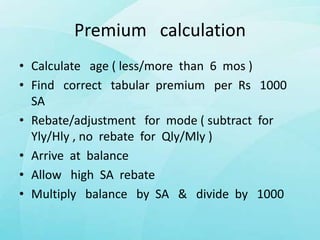
Premium calculation
• Calculate age ( less/more than 6 mos )
• Find correct tabular premium per Rs 1000
SA
• Rebate/adjustment for mode ( subtract for
Yly/Hly , no rebate for Qly/Mly )
• Arrive at balance
• Allow high SA rebate
• Multiply balance by SA & divide by 1000
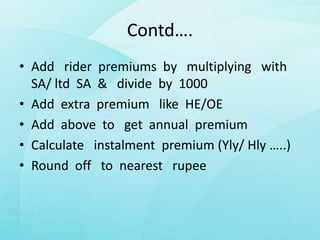
Contd….
• Add rider premiums by multiplying with
SA/ ltd SA & divide by 1000
• Add extra premium like HE/OE
• Add above to get annual premium
• Calculate instalment premium (Yly/ Hly …..)
• Round off to nearest rupee
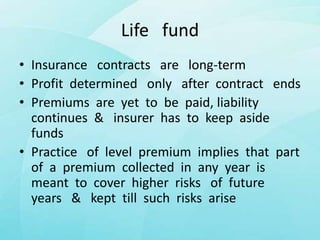
Life fund
• Insurance contracts are long-term
• Profit determined only after contract ends
• Premiums are yet to be paid, liability
continues & insurer has to keep aside
funds
• Practice of level premium implies that part
of a premium collected in any year is
meant to cover higher risks of future
years & kept till such risks arise
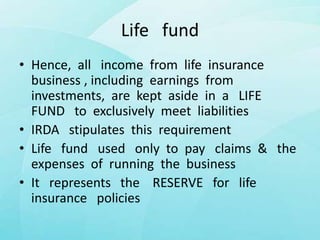
Life fund
• Hence, all income from life insurance
business , including earnings from
investments, are kept aside in a LIFE
FUND to exclusively meet liabilities
• IRDA stipulates this requirement
• Life fund used only to pay claims & the
expenses of running the business
• It represents the RESERVE for life
insurance policies
Valuation
• Premium is calculated considering likely
future experiences in respect of mortality,
interest & expenses
• These are assumptions or expectations
• Reality could be different from expectations
• If expectations conform, business properly
funded
• If experience is worse ( mortality/expenses are
more or interest earnings are less ), premium
would be inadequate & problems for co.
Contd…..
• All insurers check validity of these
assumptions annually to ensure business is
on sound footing .
• Process called ACTUARIAL VALUATION
• In any valuation actuary estimates liabilities
of insurer in respect of business in it’s books
& estimates amount of premia receivable
• Difference between the two is the fund
insurer must have to remain solvent.
• Data compared to existing life fund.
• If present fund more, insurer solvent.
• Method of valuation very complex.
• Each co to have full-time actuary.
Bonus /types
• If valuation shows fund is more than
estimated liabilities, insurer has a SURPLUS
• Valuation surplus is distributed to
policyholders through BONUS
• Participating policyholders pay extra
premium due to “bonus loading”
• Simple reversionary bonus – Bonus plus SA
• Compound reversionary bonus – Bonus plus
(SA plus bonus)
Types
• Vesting bonus – payable only when claim
arises, not if policy terminated for other
reasons.
• Terminal / final additional bonus – one-time
bonus for policies in force for at least 15
years
• Interim bonus - payable only to policies
maturing between a declared valuation &
valuation next year i.e mid-year
THANK YOU !

Premium

  • 1.
  • 2.
    Learning outcomes After thisdiscussion, you shall be familiar with : • Definitions of premium & renewal premium • Components of premium • Types of premium • Premium calculation • Valuation • Bonus • Life fund
  • 3.
    What is premium? • Premium – consideration against insurance contract • First premium – consideration for contract to COME into force • Subsequent premia - for contract to REMAIN in force • Insurance policies priced first, cost of production known later • Calculation is very complex involving statistical and actuarial principles.
  • 4.
    Components of premium •Interest • Expenses • Mortality • Benefits under contract • Bonus loading • Taxation • Inflation
  • 5.
    Types • Risk premium- covers risk of death • Net or pure - Risk premium plus interest • Office premium – Net premium plus management expenses
  • 6.
    Risk Premium • Riskpremium adequate to pay claims if all policies were term policies for one year • Risk premium based on probability of death at various ages , using mortality tables containing data for such probabilities. • In Endowment cases, claims to be paid on survival after some years • Actual premium collected would have to be more than risk premium
  • 7.
    Net premium • Premiumcollected are not utilised every year for payment of claims • Reasons - Real experience may not be exactly as per mortality tables Premiums collected in Endowment plans will be much higher initially than required since company has to cover risk & pay survival amount if policyholder survives term.
  • 8.
    Contd…… • Hence premiumshould provide for the Pure Endowment part of the policy also. • Excess premium collected, in either case, is invested by insurer • This belongs to policyholders and will be passed on to them • Co assumes a certain rate of interest, based on its experience, while computing premium rates.
  • 9.
    Contd….. • Since lifeinsurance contracts are very long-term contracts, investments made by company also will be long-term. • Higher the interest earned, lower will be premium • Premium based on combination of mortality rate and interest factor is Net Premium
  • 10.
    Office Premium • Ifco was to charge only NP, then no provision for expenses, hence certain loadings to NP. • In life insurance, expenses of procuring business very high • Cost of maintaining a policy is low • Lesser RP goes towards expenses • Uneven distribution of expenses in FYP & RP
  • 11.
    Contd….. • Expenses ofa life insurance company Salaries Commission Medical fee Stamp duty Printing & stationary Postage Advertisement/publicity
  • 12.
    Contd…. • Establishment charges Legalfees Consultancy/training Taxation • When expenses are loaded, the premium arrived at is the office premium. This premium is now ready for use. Is printed in promotional literature/ brochures
  • 13.
    Level premium • Insurersspread risk premium uniformly throughout term of policy • Premium remains same throughout term • This is level premium • Implies that premium collected in early years of policy would be more than necessary for risk and less than necessary towards latter part of policy • If premia were to increase with age, difficult for policyholders to continue.
  • 14.
    Premium calculation • Calculateage ( less/more than 6 mos ) • Find correct tabular premium per Rs 1000 SA • Rebate/adjustment for mode ( subtract for Yly/Hly , no rebate for Qly/Mly ) • Arrive at balance • Allow high SA rebate • Multiply balance by SA & divide by 1000
  • 15.
    Contd…. • Add riderpremiums by multiplying with SA/ ltd SA & divide by 1000 • Add extra premium like HE/OE • Add above to get annual premium • Calculate instalment premium (Yly/ Hly …..) • Round off to nearest rupee
  • 16.
    Life fund • Insurancecontracts are long-term • Profit determined only after contract ends • Premiums are yet to be paid, liability continues & insurer has to keep aside funds • Practice of level premium implies that part of a premium collected in any year is meant to cover higher risks of future years & kept till such risks arise
  • 17.
    Life fund • Hence,all income from life insurance business , including earnings from investments, are kept aside in a LIFE FUND to exclusively meet liabilities • IRDA stipulates this requirement • Life fund used only to pay claims & the expenses of running the business • It represents the RESERVE for life insurance policies
  • 18.
    Valuation • Premium iscalculated considering likely future experiences in respect of mortality, interest & expenses • These are assumptions or expectations • Reality could be different from expectations • If expectations conform, business properly funded • If experience is worse ( mortality/expenses are more or interest earnings are less ), premium would be inadequate & problems for co.
  • 19.
    Contd….. • All insurerscheck validity of these assumptions annually to ensure business is on sound footing . • Process called ACTUARIAL VALUATION • In any valuation actuary estimates liabilities of insurer in respect of business in it’s books & estimates amount of premia receivable • Difference between the two is the fund insurer must have to remain solvent.
  • 20.
    • Data comparedto existing life fund. • If present fund more, insurer solvent. • Method of valuation very complex. • Each co to have full-time actuary.
  • 21.
    Bonus /types • Ifvaluation shows fund is more than estimated liabilities, insurer has a SURPLUS • Valuation surplus is distributed to policyholders through BONUS • Participating policyholders pay extra premium due to “bonus loading” • Simple reversionary bonus – Bonus plus SA • Compound reversionary bonus – Bonus plus (SA plus bonus)
  • 22.
    Types • Vesting bonus– payable only when claim arises, not if policy terminated for other reasons. • Terminal / final additional bonus – one-time bonus for policies in force for at least 15 years • Interim bonus - payable only to policies maturing between a declared valuation & valuation next year i.e mid-year
  • 23.