A COMPARATIVE STUDY ON
PRECAST CONSTRUCTION AND
CONVENTIONAL CONSTRUCTION FOR
LOWCOST HOUSING
BY:
N.SHABAZ-18MCT0015
SCE, VIT
INTRODUCTION
• Precast concrete is a construction product produced by casting
concrete in a reusable mould or "form" which is then cured in a
controlled environment, transported to the construction site and
lifted into place ("tilt up").
• In contrast, standard concrete is poured into site-specific forms and
cured on site. Precast stone is distinguished from precast concrete
using a fine aggregate in the mixture, so the final product approaches
the appearance of naturally occurring rock or stone.
OBJECTIVE
The main objective of this project is to find out an optimal construction
technique which has a minimal cost and gives a minimum duration of
time by doing a comparative study between precast and conventional
construction.
• To compare the cost and time of precast construction vs conventional
construction.
• To determine the type of construction that would reduce the
construction cost.
• To determine the method of construction that would help to finish
the construction project in shorter duration.
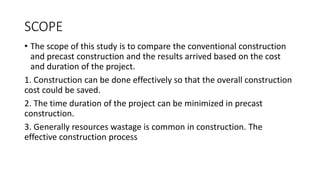
SCOPE
• The scope of this study is to compare the conventional construction
and precast construction and the results arrived based on the cost
and duration of the project.
1. Construction can be done effectively so that the overall construction
cost could be saved.
2. The time duration of the project can be minimized in precast
construction.
3. Generally resources wastage is common in construction. The
effective construction process
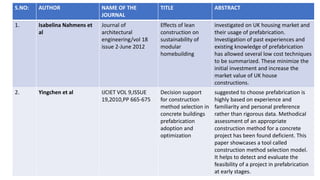
S.NO: AUTHOR NAME OF THE
JOURNAL
TITLE ABSTRACT
1. Isabelina Nahmens et
al
Journal of
architectural
engineering/vol 18
issue 2-June 2012
Effects of lean
construction on
sustainability of
modular
homebuilding
investigated on UK housing market and
their usage of prefabrication.
Investigation of past experiences and
existing knowledge of prefabrication
has allowed several low cost techniques
to be summarized. These minimize the
initial investment and increase the
market value of UK house
constructions.
2. Yingchen et al IJCIET VOL 9,ISSUE
19,2010,PP 665-675
Decision support
for construction
method selection in
concrete buildings
prefabrication
adoption and
optimization
suggested to choose prefabrication is
highly based on experience and
familiarity and personal preference
rather than rigorous data. Methodical
assessment of an appropriate
construction method for a concrete
project has been found deficient. This
paper showcases a tool called
construction method selection model.
It helps to detect and evaluate the
feasibility of a project in prefabrication
at early stages.
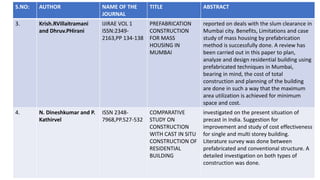
S.NO: AUTHOR NAME OF THE
JOURNAL
TITLE ABSTRACT
3. Krish.RVillaitramani
and Dhruv.PHirani
IJIRAE VOL 1
ISSN:2349-
2163,PP 134-138
PREFABRICATION
CONSTRUCTION
FOR MASS
HOUSING IN
MUMBAI
reported on deals with the slum clearance in
Mumbai city. Benefits, Limitations and case
study of mass housing by prefabrication
method is successfully done. A review has
been carried out in this paper to plan,
analyze and design residential building using
prefabricated techniques in Mumbai,
bearing in mind, the cost of total
construction and planning of the building
are done in such a way that the maximum
area utilization is achieved for minimum
space and cost.
4. N. Dineshkumar and P.
Kathirvel
ISSN 2348-
7968,PP.527-532
COMPARATIVE
STUDY ON
CONSTRUCTION
WITH CAST IN SITU
CONSTRUCTION OF
RESIDENTIAL
BUILDING
investigated on the present situation of
precast in India. Suggestion for
improvement and study of cost effectiveness
for single and multi storey building.
Literature survey was done between
prefabricated and conventional structure. A
detailed investigation on both types of
construction was done.
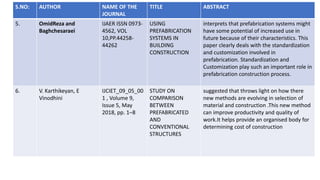
S.NO: AUTHOR NAME OF THE
JOURNAL
TITLE ABSTRACT
5. OmidReza and
Baghchesaraei
IJAER ISSN 0973-
4562, VOL
10,PP.44258-
44262
USING
PREFABRICATION
SYSTEMS IN
BUILDING
CONSTRUCTION
interprets that prefabrication systems might
have some potential of increased use in
future because of their characteristics. This
paper clearly deals with the standardization
and customization involved in
prefabrication. Standardization and
Customization play such an important role in
prefabrication construction process.
6. V. Karthikeyan, E
Vinodhini
IJCIET_09_05_00
1 , Volume 9,
Issue 5, May
2018, pp. 1–8
STUDY ON
COMPARISON
BETWEEN
PREFABRICATED
AND
CONVENTIONAL
STRUCTURES
suggested that throws light on how there
new methods are evolving in selection of
material and construction .This new method
can improve productivity and quality of
work.It helps provide an organised body for
determining cost of construction
METHODOLOGY OF THE STUDY
General:
This chapter presents the method of the study on comparison of prefabrication
construction with conventional construction. A residential building is taken for
comparing and it includes the preparation of plan, data collection from precast
industry, estimation of quantities, and determination of project duration.
Plan Preparation:
Plan preparation is done for residential building to estimate the quantities of
conventional and precast constructions. A building is taken to estimate the
quantities.
Estimation Of Quantities:
Estimation is used to find out the requirement of the materials for both the
constructions. The details of the materials which are used in the construction from
the companies were collected. By getting these details we can estimate the
quantities of the materials. The estimation of quantities for the double storey
building is presented in
METHODOLOGY OF THE STUDY
Project Duration:
Project duration of the each construction was collected from the
similar companies and compares the time of completion period by
using Critical Path method with Primavera P6.gives the project duration
of precast and conventional construction of the building
Cost Analysis:
This is the main factor which is considered in the project is to find out
the comparison of cost analysis of A building for the prefab
construction and conventional construction. In this analysis we want to
consider the resources of labour, material and machineries
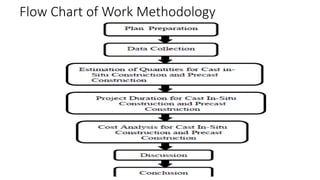
Flow Chart of Work Methodology
CASE STUDY
• For the purpose of comparison and analysis of conventional
technique and precast technique a case study is chosen.
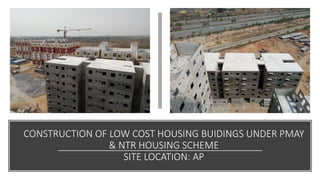
• It is a real time project that is located near AMARAVATI (A.P). The
building is A Residential Building Being Constructed by Govt of AP For
Poor People Under NTR Housing Scheme.
• Cost estimation and scheduling will be done for the same building for
both precast construction and conventional construction.
Why Precast concrete?
• Precast concrete lowers total cost of construction in greater
extent.
• Precast also has lower lifetime costs than any other building
solution.
• It is possible due to high quality of industrially produced
products.
• Compared to cast-in-situ, precast uses less cement, less
water, less steel, and less labor.
• It produces less waste on the site and in the factory. This
makes CO2 footprint of precast much smaller than in cast-in-
situ construction.
Why Precast concrete?
• The including parameters will be comparing cost of precast concrete vs. cast in place
concrete (i.e. conventional) on following:
Cost comparison on:
• Material wastage at site.
• Labors policy, training, skills development.
• Money required for safety at site.
• Time required for completion of project.
• Heavy equipment cost machinery cost.
• Transportation cost.
• Rework if required.
• Money required achieving quality work.
• Shuttering material manufacturing cost, maintenance cost shuttering and deshutterig
cost.
• To find out how precast is cost efficient than cast in place.
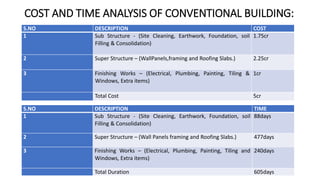
COST AND TIME ANALYSIS OF CONVENTIONAL BUILDING:
S.NO DESCRIPTION COST
1 Sub Structure - (Site Cleaning, Earthwork, Foundation, soil
Filling & Consolidation)
1.75cr
2 Super Structure – (WallPanels,framing and Roofing Slabs.) 2.25cr
3 Finishing Works – (Electrical, Plumbing, Painting, Tiling &
Windows, Extra items)
1cr
Total Cost 5cr
S.NO DESCRIPTION TIME
1 Sub Structure - (Site Cleaning, Earthwork, Foundation, soil
Filling & Consolidation)
88days
2 Super Structure – (Wall Panels framing and Roofing Slabs.) 477days
3 Finishing Works – (Electrical, Plumbing, Painting, Tiling and
Windows, Extra items)
240days
Total Duration 605days
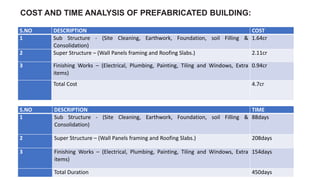
S.NO DESCRIPTION COST
1 Sub Structure - (Site Cleaning, Earthwork, Foundation, soil Filling &
Consolidation)
1.64cr
2 Super Structure – (Wall Panels framing and Roofing Slabs.) 2.11cr
3 Finishing Works – (Electrical, Plumbing, Painting, Tiling and Windows, Extra
items)
0.94cr
Total Cost 4.7cr
COST AND TIME ANALYSIS OF PREFABRICATED BUILDING:
S.NO DESCRIPTION TIME
1 Sub Structure - (Site Cleaning, Earthwork, Foundation, soil Filling &
Consolidation)
88days
2 Super Structure – (Wall Panels framing and Roofing Slabs.) 208days
3 Finishing Works – (Electrical, Plumbing, Painting, Tiling and Windows, Extra
items)
154days
Total Duration 450days
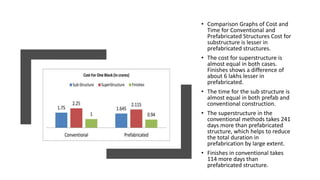
• Comparison Graphs of Cost and
Time for Conventional and
Prefabricated Structures Cost for
substructure is lesser in
prefabricated structures.
• The cost for superstructure is
almost equal in both cases.
Finishes shows a difference of
about 6 lakhs lesser in
prefabricated.
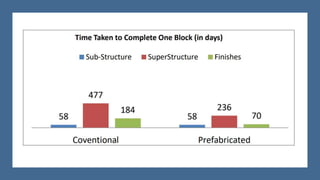
• The time for the sub structure is
almost equal in both prefab and
conventional construction.
• The superstructure in the
conventional methods takes 241
days more than prefabricated
structure, which helps to reduce
the total duration in
prefabrication by large extent.
• Finishes in conventional takes
114 more days than
prefabricated structure.
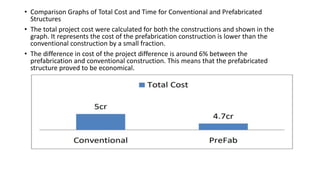
• Comparison Graphs of Total Cost and Time for Conventional and Prefabricated
Structures
• The total project cost were calculated for both the constructions and shown in the
graph. It represents the cost of the prefabrication construction is lower than the
conventional construction by a small fraction.
• The difference in cost of the project difference is around 6% between the
prefabrication and conventional construction. This means that the prefabricated
structure proved to be economical.
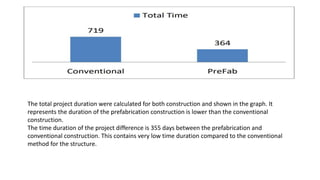
The total project duration were calculated for both construction and shown in the graph. It
represents the duration of the prefabrication construction is lower than the conventional
construction.
The time duration of the project difference is 355 days between the prefabrication and
conventional construction. This contains very low time duration compared to the conventional
method for the structure.
CONSTRUCTION OF LOW COST HOUSING BUIDINGS UNDER PMAY
& NTR HOUSING SCHEME
SITE LOCATION: AP
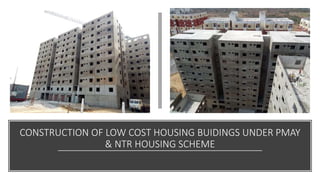
CONSTRUCTION OF LOW COST HOUSING BUIDINGS UNDER PMAY
& NTR HOUSING SCHEME
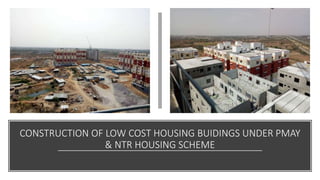
CONSTRUCTION OF LOW COST HOUSING BUIDINGS UNDER PMAY
& NTR HOUSING SCHEME
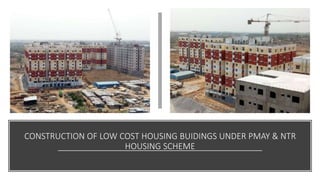
CONSTRUCTION OF LOW COST HOUSING BUIDINGS UNDER PMAY & NTR
HOUSING SCHEME
MEASURES to PROMOTE the GROWTH OF PCC in
India:
Five major measures to promote the PCC in India are suggested in this
section.
• Investment in research and development
• Standardization of precast concrete elements:
• Increasing the number of qualified engineers and designer:
• Incentives for adopting PCC:
• Creation of land inventory:
MEASURES to PROMOTE the GROWTH OF PCC
in India:
Investment in research and development
• There is a developing requirement for innovative work in the territory
of associations and joints for precast solid frameworks for India.
• In the present situation, numerous pre-throwing firms are using
association frameworks, which are costly and guaranteed by outside
establishments and not by Indian experts or testing offices expanding
the expense.
MEASURES to PROMOTE the GROWTH OF PCC
in India:
Standardization of precast concrete elements:
• Indian construction industry and the open come up short on the trust in precast
solid frameworks for the ideal basic execution and quality as they have for
auxiliary steel items. Albeit precast solid components are made items similarly as
basic steel items, they loath more trust than steel items. This is on the grounds
that steel items are as of now institutionalized and are guaranteed.
• Different steel items come in various lengths and measurements and there is a
positive recognition inside the business. Credit for this goes to the IS benchmarks
that have encouraged the testing and confirmation forms for steel items. On
comparative lines, there is a need to institutionalize precast solid components.
• Confirmation of precast solid components requires great testing offices, which
are restricted in India. Some of them are accessible in the organizations of
national significance.
MEASURES to PROMOTE the GROWTH OF PCC
in India:
Increasing the number of qualified engineers and designer:
• There is a need to build the quantity of qualified creators and
designers for PCC in India. Different establishments can offer seminars
on 'Precast Concrete Design and Construction' in undergrad and
graduate dimensions.
• A few organizations are eager to present the courses; in any case, it
will set aside some effort to make an undeniable scholastic
educational module. It is conceivable to furnish an organized course
with a mechanical tie-up.
MEASURES to PROMOTE the GROWTH OF PCC
in India:
Incentives for adopting PCC:
• Government of India is intending to give motivations to the clients by
diminishing the Stamp Duty of current 7 percent to an ostensible
incentive for precast solid lodging ventures for LIG and EWS
gatherings.
• This would help in expanding the interest for precast solid items.
More such plans can be actualized by the focal and state
governments. Another parallel impetus that can be actualized is the
unwinding in the Excise Duty for PCC. In this manner, both interest
and supply would be boosted.
MEASURES to PROMOTE the GROWTH OF PCC
in India:
• Creation of land inventory:
• There is a need to make a land stock for states and urban
communities, which can be utilized as Special Residential Zones.
These private zones, whenever developed with precasting
innovations, ought to give nearby assembling base to precast solid
activities.
• Government ought to likewise plan to decrease the time taken for the
endorsement of substantial precast solid lodging ventures. Decrease
in the endorsement time, money related advantages, and different
motivations would give the market a motivator to go for PCC
DISCUSSIONS:
• In general, there are two systems used by the precaster for the private structure
areas, one is Framed structure and the other is divider and piece framework.
• The contractual worker can pick one of these frameworks to be received for
construction works and there are favorable circumstances and hindrances in both
the frameworks.
• In the precast confined structure, the structure is on a par with conventional
strategy for construction and the contractual worker is allowed to utilize light
weight square works, which decreases the heap on the structure and there will
be some significant funds in establishment fills in also and here again the
temporary worker needs to draw in colossal work solidarity to finish the
assignment.
• In the divider and chunk framework, the brick work works is nearly disposed of
and the divider thickness is a lot lesser than the tradition framework which gives
bigger floor covering region, however there will be some expansion in the
expense as the RCC divider replaces the light weight squares.
CONCLUSION:
• The fundamental objectives of the work have been accomplished.
• The aggregate cost and length have been resolved for both prefab and ordinary development And
additionally we had thought about the focal points and detriments of both construction and traditional
development by the overview directed.
• The examination shows there isn't a colossal cost contrast between the techniques (6%), prefab being
more temperate in tall structures when contrasted with regular. In the meantime the prefab
development diminishes the undertaking length, lessened by 335 days when contrasted with the
ordinary.
• Because of overview we had Study on Comparison between Prefabricated and Conventional Structures
realized that the prefab development have more points of interest and obtainment in industrialized,
substantial frameworks.
• Materials that have turned out to be profoundly particular, with specialist vacillations in cost and
accessibility, can be accumulated at construction shops or processing plants. Moreover, the
institutionalization of building segments makes it workable for development to occur where the crude
material is minimum costly.
• To decide if construction is a decent choice you have to consider. Proper cost analysis and planning can
help to achieve at an economical estimate for prefab construction. Educating student’s trainers and
even labourers more about prefabrication in depth will help provide more trained and educated work
force for prefabrication.
• It can also change the conventional mindset of people and accept to try modern construction methods.
Use of standardized elements from companies that have variety of options to choose from can help
make structure unique.
• One time investment in good quality lifting machines and proper maintenance can help in further
savings.
REFERENCES :
• 1. CREDAI (2014). “Assessing the Economic Impact of the Real Estate
Sector.” The Confederation of Real Estate Developers’ Associations of India
(CREDAI).
• 2.Arditi, D., Ergin, U., and Gunhan , S (2000). “Factors affecting the use of
precast concrete system.” Journal of Architectural Engineering,6(3), 79-86.
• 3.Wadwa, K., N., Kumar, N.,(2009) “Affordable housing For Urban Poor.”
National Resource center, School of Planning and Architecture, New Delhi..
• 4..MGI (2014). “A blueprint for addressing affordable housing Challenge ”
McKinsey Global Institute, October – 2014
• 5. Chaitanya, R., and Goyal, (2013). “Casting a Concrete Future: Indian Pre-
Cast concrete Building Industry.” The Masterbuilder magazine, Volume 15
(4), 121-126.
THANK YOU

A COMPARATIVE STUDY ON PRECAST CONSTRUCTION AND CONVENTIONAL CONSTRUCTION FOR LOWCOST HOUSING by Shabaz Khan

  • 1.
    A COMPARATIVE STUDYON PRECAST CONSTRUCTION AND CONVENTIONAL CONSTRUCTION FOR LOWCOST HOUSING BY: N.SHABAZ-18MCT0015 SCE, VIT
  • 2.
    INTRODUCTION • Precast concreteis a construction product produced by casting concrete in a reusable mould or "form" which is then cured in a controlled environment, transported to the construction site and lifted into place ("tilt up"). • In contrast, standard concrete is poured into site-specific forms and cured on site. Precast stone is distinguished from precast concrete using a fine aggregate in the mixture, so the final product approaches the appearance of naturally occurring rock or stone.
  • 3.
    OBJECTIVE The main objectiveof this project is to find out an optimal construction technique which has a minimal cost and gives a minimum duration of time by doing a comparative study between precast and conventional construction. • To compare the cost and time of precast construction vs conventional construction. • To determine the type of construction that would reduce the construction cost. • To determine the method of construction that would help to finish the construction project in shorter duration.
  • 4.
    SCOPE • The scopeof this study is to compare the conventional construction and precast construction and the results arrived based on the cost and duration of the project. 1. Construction can be done effectively so that the overall construction cost could be saved. 2. The time duration of the project can be minimized in precast construction. 3. Generally resources wastage is common in construction. The effective construction process
  • 5.
    S.NO: AUTHOR NAMEOF THE JOURNAL TITLE ABSTRACT 1. Isabelina Nahmens et al Journal of architectural engineering/vol 18 issue 2-June 2012 Effects of lean construction on sustainability of modular homebuilding investigated on UK housing market and their usage of prefabrication. Investigation of past experiences and existing knowledge of prefabrication has allowed several low cost techniques to be summarized. These minimize the initial investment and increase the market value of UK house constructions. 2. Yingchen et al IJCIET VOL 9,ISSUE 19,2010,PP 665-675 Decision support for construction method selection in concrete buildings prefabrication adoption and optimization suggested to choose prefabrication is highly based on experience and familiarity and personal preference rather than rigorous data. Methodical assessment of an appropriate construction method for a concrete project has been found deficient. This paper showcases a tool called construction method selection model. It helps to detect and evaluate the feasibility of a project in prefabrication at early stages.
  • 6.
    S.NO: AUTHOR NAMEOF THE JOURNAL TITLE ABSTRACT 3. Krish.RVillaitramani and Dhruv.PHirani IJIRAE VOL 1 ISSN:2349- 2163,PP 134-138 PREFABRICATION CONSTRUCTION FOR MASS HOUSING IN MUMBAI reported on deals with the slum clearance in Mumbai city. Benefits, Limitations and case study of mass housing by prefabrication method is successfully done. A review has been carried out in this paper to plan, analyze and design residential building using prefabricated techniques in Mumbai, bearing in mind, the cost of total construction and planning of the building are done in such a way that the maximum area utilization is achieved for minimum space and cost. 4. N. Dineshkumar and P. Kathirvel ISSN 2348- 7968,PP.527-532 COMPARATIVE STUDY ON CONSTRUCTION WITH CAST IN SITU CONSTRUCTION OF RESIDENTIAL BUILDING investigated on the present situation of precast in India. Suggestion for improvement and study of cost effectiveness for single and multi storey building. Literature survey was done between prefabricated and conventional structure. A detailed investigation on both types of construction was done.
  • 7.
    S.NO: AUTHOR NAMEOF THE JOURNAL TITLE ABSTRACT 5. OmidReza and Baghchesaraei IJAER ISSN 0973- 4562, VOL 10,PP.44258- 44262 USING PREFABRICATION SYSTEMS IN BUILDING CONSTRUCTION interprets that prefabrication systems might have some potential of increased use in future because of their characteristics. This paper clearly deals with the standardization and customization involved in prefabrication. Standardization and Customization play such an important role in prefabrication construction process. 6. V. Karthikeyan, E Vinodhini IJCIET_09_05_00 1 , Volume 9, Issue 5, May 2018, pp. 1–8 STUDY ON COMPARISON BETWEEN PREFABRICATED AND CONVENTIONAL STRUCTURES suggested that throws light on how there new methods are evolving in selection of material and construction .This new method can improve productivity and quality of work.It helps provide an organised body for determining cost of construction
  • 8.
    METHODOLOGY OF THESTUDY General: This chapter presents the method of the study on comparison of prefabrication construction with conventional construction. A residential building is taken for comparing and it includes the preparation of plan, data collection from precast industry, estimation of quantities, and determination of project duration. Plan Preparation: Plan preparation is done for residential building to estimate the quantities of conventional and precast constructions. A building is taken to estimate the quantities. Estimation Of Quantities: Estimation is used to find out the requirement of the materials for both the constructions. The details of the materials which are used in the construction from the companies were collected. By getting these details we can estimate the quantities of the materials. The estimation of quantities for the double storey building is presented in
  • 9.
    METHODOLOGY OF THESTUDY Project Duration: Project duration of the each construction was collected from the similar companies and compares the time of completion period by using Critical Path method with Primavera P6.gives the project duration of precast and conventional construction of the building Cost Analysis: This is the main factor which is considered in the project is to find out the comparison of cost analysis of A building for the prefab construction and conventional construction. In this analysis we want to consider the resources of labour, material and machineries
  • 10.
    Flow Chart ofWork Methodology
  • 11.
    CASE STUDY • Forthe purpose of comparison and analysis of conventional technique and precast technique a case study is chosen. • It is a real time project that is located near AMARAVATI (A.P). The building is A Residential Building Being Constructed by Govt of AP For Poor People Under NTR Housing Scheme. • Cost estimation and scheduling will be done for the same building for both precast construction and conventional construction.
  • 12.
    Why Precast concrete? •Precast concrete lowers total cost of construction in greater extent. • Precast also has lower lifetime costs than any other building solution. • It is possible due to high quality of industrially produced products. • Compared to cast-in-situ, precast uses less cement, less water, less steel, and less labor. • It produces less waste on the site and in the factory. This makes CO2 footprint of precast much smaller than in cast-in- situ construction.
  • 13.
    Why Precast concrete? •The including parameters will be comparing cost of precast concrete vs. cast in place concrete (i.e. conventional) on following: Cost comparison on: • Material wastage at site. • Labors policy, training, skills development. • Money required for safety at site. • Time required for completion of project. • Heavy equipment cost machinery cost. • Transportation cost. • Rework if required. • Money required achieving quality work. • Shuttering material manufacturing cost, maintenance cost shuttering and deshutterig cost. • To find out how precast is cost efficient than cast in place.
  • 14.
    COST AND TIMEANALYSIS OF CONVENTIONAL BUILDING: S.NO DESCRIPTION COST 1 Sub Structure - (Site Cleaning, Earthwork, Foundation, soil Filling & Consolidation) 1.75cr 2 Super Structure – (WallPanels,framing and Roofing Slabs.) 2.25cr 3 Finishing Works – (Electrical, Plumbing, Painting, Tiling & Windows, Extra items) 1cr Total Cost 5cr S.NO DESCRIPTION TIME 1 Sub Structure - (Site Cleaning, Earthwork, Foundation, soil Filling & Consolidation) 88days 2 Super Structure – (Wall Panels framing and Roofing Slabs.) 477days 3 Finishing Works – (Electrical, Plumbing, Painting, Tiling and Windows, Extra items) 240days Total Duration 605days
  • 15.
    S.NO DESCRIPTION COST 1Sub Structure - (Site Cleaning, Earthwork, Foundation, soil Filling & Consolidation) 1.64cr 2 Super Structure – (Wall Panels framing and Roofing Slabs.) 2.11cr 3 Finishing Works – (Electrical, Plumbing, Painting, Tiling and Windows, Extra items) 0.94cr Total Cost 4.7cr COST AND TIME ANALYSIS OF PREFABRICATED BUILDING: S.NO DESCRIPTION TIME 1 Sub Structure - (Site Cleaning, Earthwork, Foundation, soil Filling & Consolidation) 88days 2 Super Structure – (Wall Panels framing and Roofing Slabs.) 208days 3 Finishing Works – (Electrical, Plumbing, Painting, Tiling and Windows, Extra items) 154days Total Duration 450days
  • 16.
    • Comparison Graphsof Cost and Time for Conventional and Prefabricated Structures Cost for substructure is lesser in prefabricated structures. • The cost for superstructure is almost equal in both cases. Finishes shows a difference of about 6 lakhs lesser in prefabricated. • The time for the sub structure is almost equal in both prefab and conventional construction. • The superstructure in the conventional methods takes 241 days more than prefabricated structure, which helps to reduce the total duration in prefabrication by large extent. • Finishes in conventional takes 114 more days than prefabricated structure.
  • 18.
    • Comparison Graphsof Total Cost and Time for Conventional and Prefabricated Structures • The total project cost were calculated for both the constructions and shown in the graph. It represents the cost of the prefabrication construction is lower than the conventional construction by a small fraction. • The difference in cost of the project difference is around 6% between the prefabrication and conventional construction. This means that the prefabricated structure proved to be economical.
  • 19.
    The total projectduration were calculated for both construction and shown in the graph. It represents the duration of the prefabrication construction is lower than the conventional construction. The time duration of the project difference is 355 days between the prefabrication and conventional construction. This contains very low time duration compared to the conventional method for the structure.
  • 20.
    CONSTRUCTION OF LOWCOST HOUSING BUIDINGS UNDER PMAY & NTR HOUSING SCHEME SITE LOCATION: AP
  • 21.
    CONSTRUCTION OF LOWCOST HOUSING BUIDINGS UNDER PMAY & NTR HOUSING SCHEME
  • 22.
    CONSTRUCTION OF LOWCOST HOUSING BUIDINGS UNDER PMAY & NTR HOUSING SCHEME
  • 23.
    CONSTRUCTION OF LOWCOST HOUSING BUIDINGS UNDER PMAY & NTR HOUSING SCHEME
  • 24.
    MEASURES to PROMOTEthe GROWTH OF PCC in India: Five major measures to promote the PCC in India are suggested in this section. • Investment in research and development • Standardization of precast concrete elements: • Increasing the number of qualified engineers and designer: • Incentives for adopting PCC: • Creation of land inventory:
  • 25.
    MEASURES to PROMOTEthe GROWTH OF PCC in India: Investment in research and development • There is a developing requirement for innovative work in the territory of associations and joints for precast solid frameworks for India. • In the present situation, numerous pre-throwing firms are using association frameworks, which are costly and guaranteed by outside establishments and not by Indian experts or testing offices expanding the expense.
  • 26.
    MEASURES to PROMOTEthe GROWTH OF PCC in India: Standardization of precast concrete elements: • Indian construction industry and the open come up short on the trust in precast solid frameworks for the ideal basic execution and quality as they have for auxiliary steel items. Albeit precast solid components are made items similarly as basic steel items, they loath more trust than steel items. This is on the grounds that steel items are as of now institutionalized and are guaranteed. • Different steel items come in various lengths and measurements and there is a positive recognition inside the business. Credit for this goes to the IS benchmarks that have encouraged the testing and confirmation forms for steel items. On comparative lines, there is a need to institutionalize precast solid components. • Confirmation of precast solid components requires great testing offices, which are restricted in India. Some of them are accessible in the organizations of national significance.
  • 27.
    MEASURES to PROMOTEthe GROWTH OF PCC in India: Increasing the number of qualified engineers and designer: • There is a need to build the quantity of qualified creators and designers for PCC in India. Different establishments can offer seminars on 'Precast Concrete Design and Construction' in undergrad and graduate dimensions. • A few organizations are eager to present the courses; in any case, it will set aside some effort to make an undeniable scholastic educational module. It is conceivable to furnish an organized course with a mechanical tie-up.
  • 28.
    MEASURES to PROMOTEthe GROWTH OF PCC in India: Incentives for adopting PCC: • Government of India is intending to give motivations to the clients by diminishing the Stamp Duty of current 7 percent to an ostensible incentive for precast solid lodging ventures for LIG and EWS gatherings. • This would help in expanding the interest for precast solid items. More such plans can be actualized by the focal and state governments. Another parallel impetus that can be actualized is the unwinding in the Excise Duty for PCC. In this manner, both interest and supply would be boosted.
  • 29.
    MEASURES to PROMOTEthe GROWTH OF PCC in India: • Creation of land inventory: • There is a need to make a land stock for states and urban communities, which can be utilized as Special Residential Zones. These private zones, whenever developed with precasting innovations, ought to give nearby assembling base to precast solid activities. • Government ought to likewise plan to decrease the time taken for the endorsement of substantial precast solid lodging ventures. Decrease in the endorsement time, money related advantages, and different motivations would give the market a motivator to go for PCC
  • 30.
    DISCUSSIONS: • In general,there are two systems used by the precaster for the private structure areas, one is Framed structure and the other is divider and piece framework. • The contractual worker can pick one of these frameworks to be received for construction works and there are favorable circumstances and hindrances in both the frameworks. • In the precast confined structure, the structure is on a par with conventional strategy for construction and the contractual worker is allowed to utilize light weight square works, which decreases the heap on the structure and there will be some significant funds in establishment fills in also and here again the temporary worker needs to draw in colossal work solidarity to finish the assignment. • In the divider and chunk framework, the brick work works is nearly disposed of and the divider thickness is a lot lesser than the tradition framework which gives bigger floor covering region, however there will be some expansion in the expense as the RCC divider replaces the light weight squares.
  • 31.
    CONCLUSION: • The fundamentalobjectives of the work have been accomplished. • The aggregate cost and length have been resolved for both prefab and ordinary development And additionally we had thought about the focal points and detriments of both construction and traditional development by the overview directed. • The examination shows there isn't a colossal cost contrast between the techniques (6%), prefab being more temperate in tall structures when contrasted with regular. In the meantime the prefab development diminishes the undertaking length, lessened by 335 days when contrasted with the ordinary. • Because of overview we had Study on Comparison between Prefabricated and Conventional Structures realized that the prefab development have more points of interest and obtainment in industrialized, substantial frameworks. • Materials that have turned out to be profoundly particular, with specialist vacillations in cost and accessibility, can be accumulated at construction shops or processing plants. Moreover, the institutionalization of building segments makes it workable for development to occur where the crude material is minimum costly. • To decide if construction is a decent choice you have to consider. Proper cost analysis and planning can help to achieve at an economical estimate for prefab construction. Educating student’s trainers and even labourers more about prefabrication in depth will help provide more trained and educated work force for prefabrication. • It can also change the conventional mindset of people and accept to try modern construction methods. Use of standardized elements from companies that have variety of options to choose from can help make structure unique. • One time investment in good quality lifting machines and proper maintenance can help in further savings.
  • 32.
    REFERENCES : • 1.CREDAI (2014). “Assessing the Economic Impact of the Real Estate Sector.” The Confederation of Real Estate Developers’ Associations of India (CREDAI). • 2.Arditi, D., Ergin, U., and Gunhan , S (2000). “Factors affecting the use of precast concrete system.” Journal of Architectural Engineering,6(3), 79-86. • 3.Wadwa, K., N., Kumar, N.,(2009) “Affordable housing For Urban Poor.” National Resource center, School of Planning and Architecture, New Delhi.. • 4..MGI (2014). “A blueprint for addressing affordable housing Challenge ” McKinsey Global Institute, October – 2014 • 5. Chaitanya, R., and Goyal, (2013). “Casting a Concrete Future: Indian Pre- Cast concrete Building Industry.” The Masterbuilder magazine, Volume 15 (4), 121-126.
  • 33.