Predictive Models and Data Linkage

Sharing international experience: Linking disease registry
information and predictive modelling to improve quality and
efficiency

September 2012


Martin Bardsley
Head of Research
The Nuffield Trust
                                                              © Nuffield Trust
Applications of predictive risk in the UK


• Case finding for people at high risk of admission seen as
  increasingly important for people with LTCs and complex
  conditions
• Examples of predicting across health and social care
• Scope to make the most of linked data sets in describing
  care pathways
• Evaluation and risk adjustment


                                                              © Nuffield Trust
Predictive risk and case finding


                                   © Nuffield Trust
Predictive modelling in UK

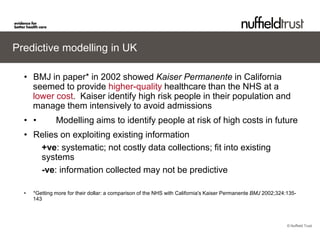
  • BMJ in paper* in 2002 showed Kaiser Permanente in California
    seemed to provide higher-quality healthcare than the NHS at a
    lower cost. Kaiser identify high risk people in their population and
    manage them intensively to avoid admissions
  • •          Modelling aims to identify people at risk of high costs in future
  • Relies on exploiting existing information
     +ve: systematic; not costly data collections; fit into existing
     systems
     -ve: information collected may not be predictive

  •   *Getting more for their dollar: a comparison of the NHS with California's Kaiser Permanente BMJ 2002;324:135-
      143


                                                                                                               © Nuffield Trust
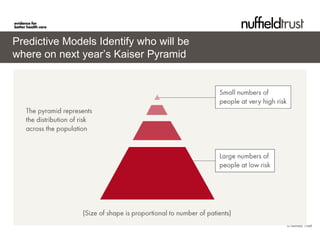
Predictive Models Identify who will be
where on next year’s Kaiser Pyramid


                                         © Nuffield Trust
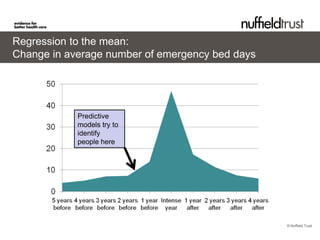
Regression to the mean:
Change in average number of emergency bed days


            Predictive
            models try to
            identify
            people here


                                                 © Nuffield Trust
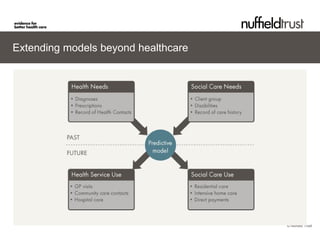
Extending models beyond healthcare


                                     © Nuffield Trust
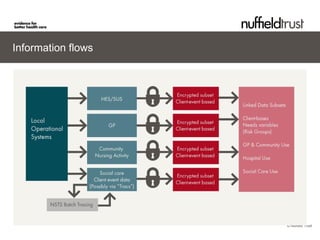
Information flows


                    © Nuffield Trust
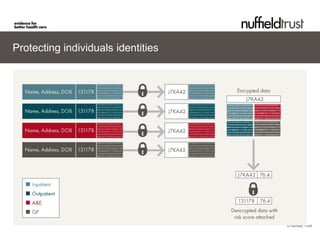
Protecting individuals identities


                                    © Nuffield Trust
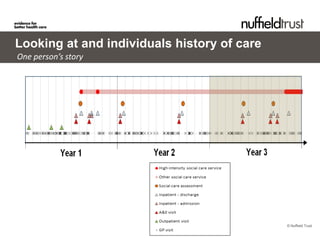
Looking at and individuals history of care
One person’s story


                                             © Nuffield Trust
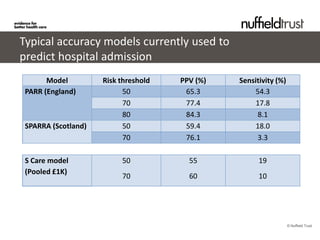
Typical accuracy models currently used to
predict hospital admission
       Model         Risk threshold   PPV (%)   Sensitivity (%)
 PARR (England)            50          65.3         54.3
                           70          77.4         17.8
                           80          84.3          8.1
 SPARRA (Scotland)         50          59.4         18.0
                           70          76.1          3.3

 S Care model             50            55            19
 (Pooled £1K)
                          70            60            10


                                                                  © Nuffield Trust
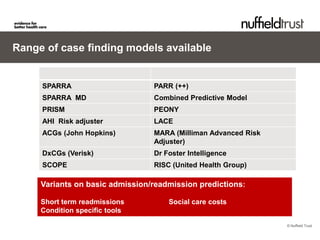
Range of case finding models available


     SPARRA                      PARR (++)
     SPARRA MD                   Combined Predictive Model
     PRISM                       PEONY
     AHI Risk adjuster           LACE
     ACGs (John Hopkins)         MARA (Milliman Advanced Risk
                                 Adjuster)
     DxCGs (Verisk)              Dr Foster Intelligence
     SCOPE                       RISC (United Health Group)

     Variants on basic admission/readmission predictions:

     Short term readmissions         Social care costs
     Condition specific tools

                                                                © Nuffield Trust
Wider applications of linked data


                                    © Nuffield Trust
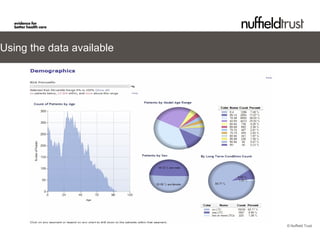
Using the data available


                           © Nuffield Trust
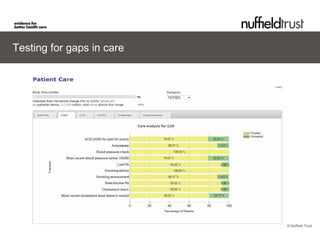
Testing for gaps in care


                           © Nuffield Trust
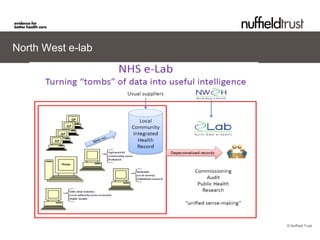
North West e-lab


                   © Nuffield Trust
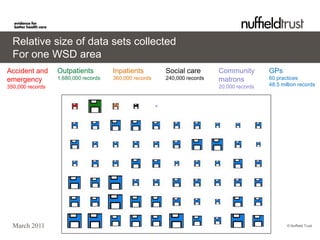
Relative size of data sets collected
  For one WSD area
Accident and      Outpatients         Inpatients        Social care       Community        GPs
emergency         1,680,000 records   360,000 records   240,000 records   matrons          60 practices
350,000 records                                                           20,000 records   48.5 million records


  March 2011                                                                                      © Nuffield Trust
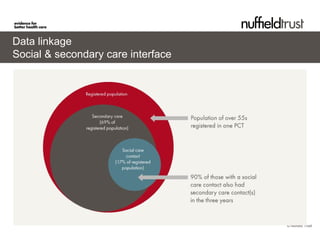
Data linkage
Social & secondary care interface


                                    © Nuffield Trust
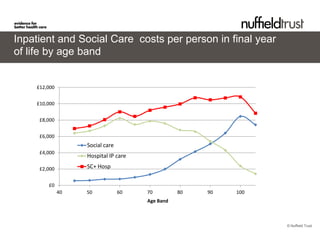
Inpatient and Social Care costs per person in final year
of life by age band

over two lines
    £12,000


    £10,000


     £8,000


     £6,000
                   Social care
     £4,000
                   Hospital IP care

     £2,000        SC+ Hosp

        £0
              40   50            60   70         80   90   100
                                      Age Band


                                                                 © Nuffield Trust
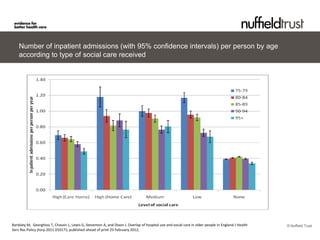
Number of inpatient admissions (with 95% confidence intervals) per person by age
    according to type of social care received


Bardsley M, Georghiou T, Chassin L, Lewis G, Steventon A, and Dixon J. Overlap of hospital use and social care in older people in England J Health   © Nuffield Trust
Serv Res Policy jhsrp.2011.010171; published ahead of print 23 February 2012,
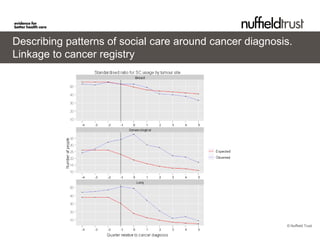
Describing patterns of social care around cancer diagnosis.
Linkage to cancer registry


                                                         © Nuffield Trust
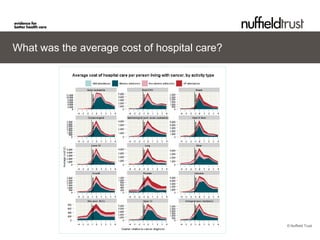
What was the average cost of hospital care?


                                              © Nuffield Trust
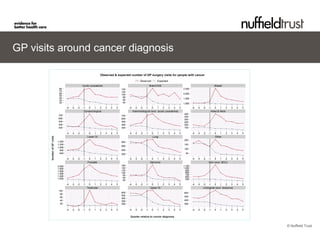
GP visits around cancer diagnosis


                                    © Nuffield Trust
Risk adjustment and Evaluation


a. Prospective Trials
b. Retrospective evaluations


                                 © Nuffield Trust
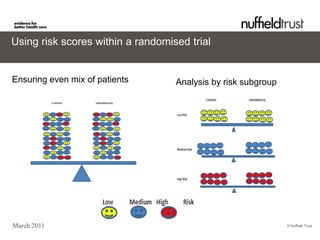
Using risk scores within a randomised trial


Ensuring even mix of patients      Analysis by risk subgroup


March 2011                                                     © Nuffield Trust
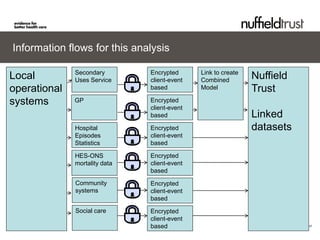
Information flows for this analysis

Local         Secondary
              Uses Service
                               Encrypted
                               client-event
                                              Link to create
                                              Combined         Nuffield
operational                    based          Model            Trust
systems       GP               Encrypted
                               client-event
                               based                           Linked
              Hospital         Encrypted                       datasets
              Episodes         client-event
              Statistics       based

              HES-ONS          Encrypted
              mortality data   client-event
                               based
              Community        Encrypted
              systems          client-event
                               based
              Social care      Encrypted
                               client-event
                               based                                  © Nuffield Trust
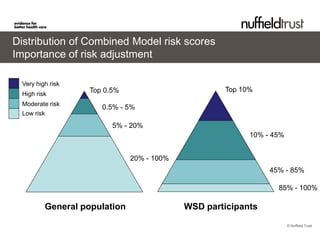
Distribution of Combined Model risk scores
Importance of risk adjustment

 Very high risk
                  Top 0.5%                         Top 10%
 High risk
 Moderate risk
                     0.5% - 5%
 Low risk
                        5% - 20%
                                                         10% - 45%


                              20% - 100%
                                                              45% - 85%

                                                                85% - 100%

         General population                WSD participants
                                                                     © Nuffield Trust
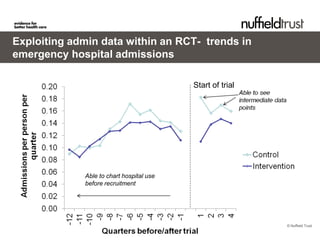
Exploiting admin data within an RCT- trends in
emergency hospital admissions

                                          Start of trial


             Able to chart hospital use
             before recruitment


                                                           © Nuffield Trust
Linked data in RCTS

•   Enables larger sample sizes as its relatively cheap information
•   Able to generate multiple outcome measures
•   Track patient histories before baseline – and inform risk adjustment
•   Generate intermediate points

• BUT
•   Constrained by type of information collected and quality
•   May exclude care from some sectors


                                                                           © Nuffield Trust
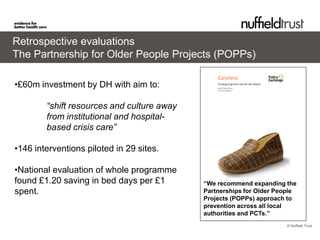
Retrospective evaluations
The Partnership for Older People Projects (POPPs)

•£60m investment by DH with aim to:

        “shift resources and culture away
        from institutional and hospital-
        based crisis care”

•146 interventions piloted in 29 sites.

•National evaluation of whole programme
found £1.20 saving in bed days per £1       “We recommend expanding the
spent.                                      Partnerships for Older People
                                            Projects (POPPs) approach to
                                            prevention across all local
                                            authorities and PCTs.”
                                                                      © Nuffield Trust
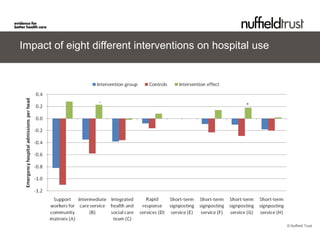
From the 146 interventions offered under POPP, we
selected 8 for an in-depth study of hospital use


         Support workers for community matrons

         Intermediate care service with generic workers

         Integrated health and social care teams

         Out-of-hours and daytime response service


         + 4 different short term assessment and
         signposting services

                                                          © Nuffield Trust
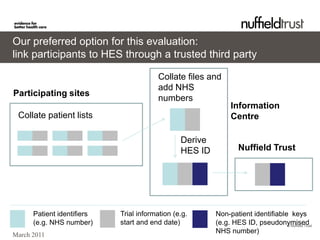
Our preferred option for this evaluation:
link participants to HES through a trusted third party

                                         Collate files and
                                         add NHS
Participating sites
                                         numbers
                                                               Information
 Collate patient lists                                         Centre

                                                Derive
                                                HES ID            Nuffield Trust


      Patient identifiers   Trial information (e.g.      Non-patient identifiable keys
      (e.g. NHS number)     start and end date)          (e.g. HES ID, pseudonymised
                                                                                 © Nuffield Trust
                                                         NHS number)
March 2011
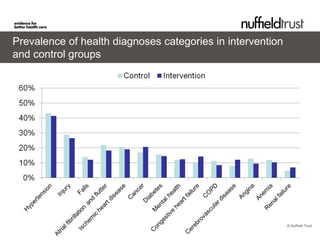
Prevalence of health diagnoses categories in intervention
and control groups


                                                            © Nuffield Trust
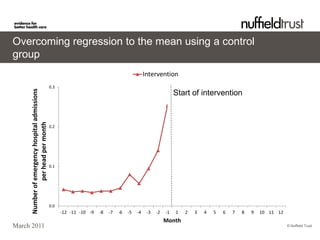
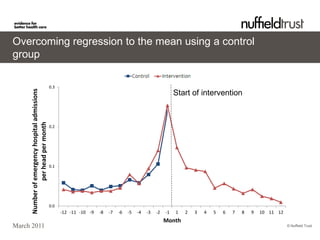
Overcoming regression to the mean using a control
group
                                                                                               Intervention
                                               0.3
                                                                                                               Start of intervention
     Number of emergency hospital admissions
               per head per month


                                               0.2


                                               0.1


                                               0.0
                                                     -12 -11 -10 -9   -8   -7   -6   -5   -4    -3   -2   -1   1   2   3   4   5   6   7   8   9   10 11 12
                                                                                                          Month
March 2011                                                                                                                                                    © Nuffield Trust
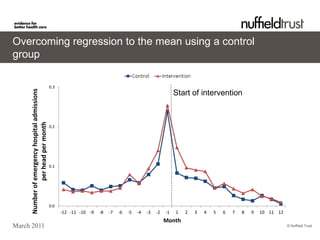
Overcoming regression to the mean using a control
group
                                                                                               Intervention
                                               0.3
                                                                                                               Start of intervention
     Number of emergency hospital admissions
               per head per month


                                               0.2


                                               0.1


                                               0.0
                                                     -12 -11 -10 -9   -8   -7   -6   -5   -4    -3   -2   -1   1   2   3   4   5   6   7   8   9   10 11 12
                                                                                                          Month
March 2011                                                                                                                                                    © Nuffield Trust
Overcoming regression to the mean using a control
group
                                                                                               Intervention
                                               0.3
                                                                                                               Start of intervention
     Number of emergency hospital admissions
               per head per month


                                               0.2


                                               0.1


                                               0.0
                                                     -12 -11 -10 -9   -8   -7   -6   -5   -4    -3   -2   -1   1   2   3   4   5   6   7   8   9   10 11 12
                                                                                                          Month
March 2011                                                                                                                                                    © Nuffield Trust
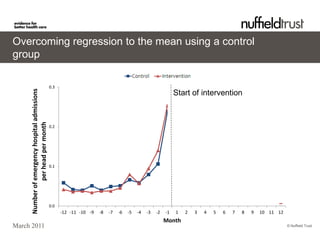
Overcoming regression to the mean using a control
group
                                                                                     Control              Intervention
                                               0.3
                                                                                                                Start of intervention
     Number of emergency hospital admissions
               per head per month


                                               0.2


                                               0.1


                                               0.0
                                                     -12 -11 -10 -9   -8   -7   -6    -5   -4   -3   -2    -1   1   2   3   4   5   6   7   8   9   10 11 12
                                                                                                          Month
March 2011                                                                                                                                                     © Nuffield Trust
Impact of eight different interventions on hospital use


                                                          © Nuffield Trust
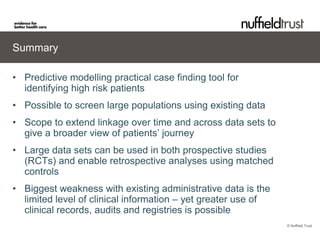
Summary

• Predictive modelling practical case finding tool for
  identifying high risk patients
• Possible to screen large populations using existing data
• Scope to extend linkage over time and across data sets to
  give a broader view of patients’ journey
• Large data sets can be used in both prospective studies
  (RCTs) and enable retrospective analyses using matched
  controls
• Biggest weakness with existing administrative data is the
  limited level of clinical information – yet greater use of
  clinical records, audits and registries is possible
                                                               © Nuffield Trust
www.nuffieldtrust.org.uk


Sign-up for our newsletter
www.nuffieldtrust.org.uk/newsletter


Follow us on Twitter
(http://twitter.com/NuffieldTrust)


                                      © Nuffield Trust

                                      © Nuffield Trust

Predictive Models and data linkage

  • 1.
    Predictive Models andData Linkage Sharing international experience: Linking disease registry information and predictive modelling to improve quality and efficiency September 2012 Martin Bardsley Head of Research The Nuffield Trust © Nuffield Trust
  • 2.
    Applications of predictiverisk in the UK • Case finding for people at high risk of admission seen as increasingly important for people with LTCs and complex conditions • Examples of predicting across health and social care • Scope to make the most of linked data sets in describing care pathways • Evaluation and risk adjustment © Nuffield Trust
  • 3.
    Predictive risk andcase finding © Nuffield Trust
  • 4.
    Predictive modelling inUK • BMJ in paper* in 2002 showed Kaiser Permanente in California seemed to provide higher-quality healthcare than the NHS at a lower cost. Kaiser identify high risk people in their population and manage them intensively to avoid admissions • • Modelling aims to identify people at risk of high costs in future • Relies on exploiting existing information +ve: systematic; not costly data collections; fit into existing systems -ve: information collected may not be predictive • *Getting more for their dollar: a comparison of the NHS with California's Kaiser Permanente BMJ 2002;324:135- 143 © Nuffield Trust
  • 5.
    Predictive Models Identifywho will be where on next year’s Kaiser Pyramid © Nuffield Trust
  • 6.
    Regression to themean: Change in average number of emergency bed days Predictive models try to identify people here © Nuffield Trust
  • 7.
    Extending models beyondhealthcare © Nuffield Trust
  • 8.
    Information flows © Nuffield Trust
  • 9.
  • 10.
    Looking at andindividuals history of care One person’s story © Nuffield Trust
  • 11.
    Typical accuracy modelscurrently used to predict hospital admission Model Risk threshold PPV (%) Sensitivity (%) PARR (England) 50 65.3 54.3 70 77.4 17.8 80 84.3 8.1 SPARRA (Scotland) 50 59.4 18.0 70 76.1 3.3 S Care model 50 55 19 (Pooled £1K) 70 60 10 © Nuffield Trust
  • 12.
    Range of casefinding models available SPARRA PARR (++) SPARRA MD Combined Predictive Model PRISM PEONY AHI Risk adjuster LACE ACGs (John Hopkins) MARA (Milliman Advanced Risk Adjuster) DxCGs (Verisk) Dr Foster Intelligence SCOPE RISC (United Health Group) Variants on basic admission/readmission predictions: Short term readmissions Social care costs Condition specific tools © Nuffield Trust
  • 13.
    Wider applications oflinked data © Nuffield Trust
  • 14.
    Using the dataavailable © Nuffield Trust
  • 15.
    Testing for gapsin care © Nuffield Trust
  • 16.
    North West e-lab © Nuffield Trust
  • 17.
    Relative size ofdata sets collected For one WSD area Accident and Outpatients Inpatients Social care Community GPs emergency 1,680,000 records 360,000 records 240,000 records matrons 60 practices 350,000 records 20,000 records 48.5 million records March 2011 © Nuffield Trust
  • 18.
    Data linkage Social &secondary care interface © Nuffield Trust
  • 19.
    Inpatient and SocialCare costs per person in final year of life by age band over two lines £12,000 £10,000 £8,000 £6,000 Social care £4,000 Hospital IP care £2,000 SC+ Hosp £0 40 50 60 70 80 90 100 Age Band © Nuffield Trust
  • 20.
    Number of inpatientadmissions (with 95% confidence intervals) per person by age according to type of social care received Bardsley M, Georghiou T, Chassin L, Lewis G, Steventon A, and Dixon J. Overlap of hospital use and social care in older people in England J Health © Nuffield Trust Serv Res Policy jhsrp.2011.010171; published ahead of print 23 February 2012,
  • 21.
    Describing patterns ofsocial care around cancer diagnosis. Linkage to cancer registry © Nuffield Trust
  • 22.
    What was theaverage cost of hospital care? © Nuffield Trust
  • 23.
    GP visits aroundcancer diagnosis © Nuffield Trust
  • 24.
    Risk adjustment andEvaluation a. Prospective Trials b. Retrospective evaluations © Nuffield Trust
  • 25.
    Using risk scoreswithin a randomised trial Ensuring even mix of patients Analysis by risk subgroup March 2011 © Nuffield Trust
  • 26.
    Information flows forthis analysis Local Secondary Uses Service Encrypted client-event Link to create Combined Nuffield operational based Model Trust systems GP Encrypted client-event based Linked Hospital Encrypted datasets Episodes client-event Statistics based HES-ONS Encrypted mortality data client-event based Community Encrypted systems client-event based Social care Encrypted client-event based © Nuffield Trust
  • 27.
    Distribution of CombinedModel risk scores Importance of risk adjustment Very high risk Top 0.5% Top 10% High risk Moderate risk 0.5% - 5% Low risk 5% - 20% 10% - 45% 20% - 100% 45% - 85% 85% - 100% General population WSD participants © Nuffield Trust
  • 28.
    Exploiting admin datawithin an RCT- trends in emergency hospital admissions Start of trial Able to chart hospital use before recruitment © Nuffield Trust
  • 29.
    Linked data inRCTS • Enables larger sample sizes as its relatively cheap information • Able to generate multiple outcome measures • Track patient histories before baseline – and inform risk adjustment • Generate intermediate points • BUT • Constrained by type of information collected and quality • May exclude care from some sectors © Nuffield Trust
  • 30.
    Retrospective evaluations The Partnershipfor Older People Projects (POPPs) •£60m investment by DH with aim to: “shift resources and culture away from institutional and hospital- based crisis care” •146 interventions piloted in 29 sites. •National evaluation of whole programme found £1.20 saving in bed days per £1 “We recommend expanding the spent. Partnerships for Older People Projects (POPPs) approach to prevention across all local authorities and PCTs.” © Nuffield Trust
  • 31.
    From the 146interventions offered under POPP, we selected 8 for an in-depth study of hospital use Support workers for community matrons Intermediate care service with generic workers Integrated health and social care teams Out-of-hours and daytime response service + 4 different short term assessment and signposting services © Nuffield Trust
  • 32.
    Our preferred optionfor this evaluation: link participants to HES through a trusted third party Collate files and add NHS Participating sites numbers Information Collate patient lists Centre Derive HES ID Nuffield Trust Patient identifiers Trial information (e.g. Non-patient identifiable keys (e.g. NHS number) start and end date) (e.g. HES ID, pseudonymised © Nuffield Trust NHS number) March 2011
  • 33.
    Prevalence of healthdiagnoses categories in intervention and control groups © Nuffield Trust
  • 34.
    Overcoming regression tothe mean using a control group Intervention 0.3 Start of intervention Number of emergency hospital admissions per head per month 0.2 0.1 0.0 -12 -11 -10 -9 -8 -7 -6 -5 -4 -3 -2 -1 1 2 3 4 5 6 7 8 9 10 11 12 Month March 2011 © Nuffield Trust
  • 35.
    Overcoming regression tothe mean using a control group Intervention 0.3 Start of intervention Number of emergency hospital admissions per head per month 0.2 0.1 0.0 -12 -11 -10 -9 -8 -7 -6 -5 -4 -3 -2 -1 1 2 3 4 5 6 7 8 9 10 11 12 Month March 2011 © Nuffield Trust
  • 36.
    Overcoming regression tothe mean using a control group Intervention 0.3 Start of intervention Number of emergency hospital admissions per head per month 0.2 0.1 0.0 -12 -11 -10 -9 -8 -7 -6 -5 -4 -3 -2 -1 1 2 3 4 5 6 7 8 9 10 11 12 Month March 2011 © Nuffield Trust
  • 37.
    Overcoming regression tothe mean using a control group Control Intervention 0.3 Start of intervention Number of emergency hospital admissions per head per month 0.2 0.1 0.0 -12 -11 -10 -9 -8 -7 -6 -5 -4 -3 -2 -1 1 2 3 4 5 6 7 8 9 10 11 12 Month March 2011 © Nuffield Trust
  • 38.
    Impact of eightdifferent interventions on hospital use © Nuffield Trust
  • 39.
    Summary • Predictive modellingpractical case finding tool for identifying high risk patients • Possible to screen large populations using existing data • Scope to extend linkage over time and across data sets to give a broader view of patients’ journey • Large data sets can be used in both prospective studies (RCTs) and enable retrospective analyses using matched controls • Biggest weakness with existing administrative data is the limited level of clinical information – yet greater use of clinical records, audits and registries is possible © Nuffield Trust
  • 40.
    www.nuffieldtrust.org.uk Sign-up for ournewsletter www.nuffieldtrust.org.uk/newsletter Follow us on Twitter (http://twitter.com/NuffieldTrust) © Nuffield Trust © Nuffield Trust