Queensland Department of
Health Data Linkage Service
Catherine Taylor and Trisha Johnston,
Statistical Analysis and Linkage Unit,
Statistical Services Branch
Health data linkage in Australia
• Funded by National Collaborative Research
Infrastructure (NCRIS) Strategy and
coordinated nationally by the Population
Health Research Network (PHRN) since 2005
• NCRIS and one-off DEEDI Funds received in
Queensland since 2011
• Queensland Department of Health now
recurrently funds 10 linkage positions and
various in-kind in addition to NCRIS funds
QH Data Linkage Team
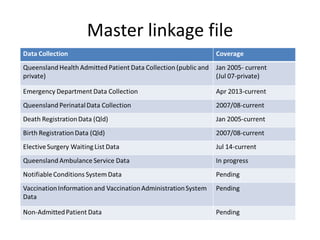
• Production Linkage – creation of a Master
Linkage File (MLF) with enduring linkages
between core health data collections (TBD)
which is maintained in near-real time
• Request linkage – provision of data from the
MLF and custom linkage for ad hoc research
and government requests
Access to linked data
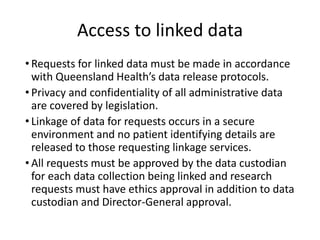
• Requests for linked data must be made in accordance
with Queensland Health’s data release protocols.
• Privacy and confidentiality of all administrative data
are covered by legislation.
• Linkage of data for requests occurs in a secure
environment and no patient identifying details are
released to those requesting linkage services.
• All requests must be approved by the data custodian
for each data collection being linked and research
requests must have ethics approval in addition to data
custodian and Director-General approval.
Access to linked data
For research, data are available via Public Health Act
application and approval from an authorised ethics
committee
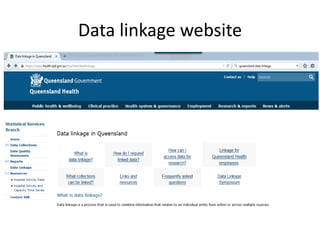
1. See QH data linkage website and Framework at
– https://www.health.qld.gov.au/hsu/link/datali
nk.asp
– http://www.health.qld.gov.au/hsu/pdf/other/q
lddatalinkframework.pdf
2. Contact HSBresearch@health.qld.gov.au
Why link?
• Combining data sources can provide far richer
information – whole > sum of parts
• Track patients across facilities
• Obtain follow-up information on a cohort of
interest
• Ensure study participants have not died when
making contact
What can we link?
• Anything! Subject to approval
• Must have compatible identifying information
– Name
– DOB
– Address
– Common ID
• Doesn’t have to involve SSB-owned data – we can
still provide stand-alone linkage service
• Discuss feasibility with QH linkage team
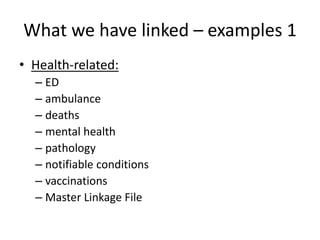
What we have linked – examples 1
• Health-related:
– ED
– ambulance
– deaths
– mental health
– pathology
– notifiable conditions
– vaccinations
– Master Linkage File
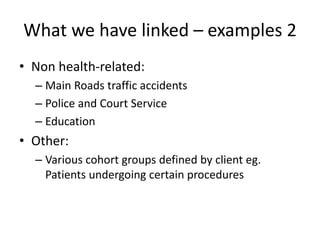
What we have linked – examples 2
• Non health-related:
– Main Roads traffic accidents
– Police and Court Service
– Education
• Other:
– Various cohort groups defined by client eg.
Patients undergoing certain procedures
Master linkage file
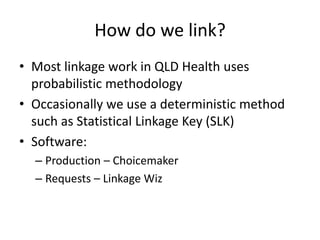
How do we link?
• Most linkage work in QLD Health uses
probabilistic methodology
• Occasionally we use a deterministic method
such as Statistical Linkage Key (SLK)
• Software:
– Production – Choicemaker
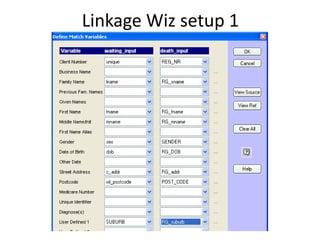
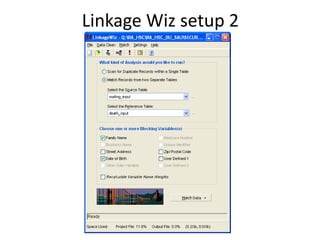
– Requests – Linkage Wiz
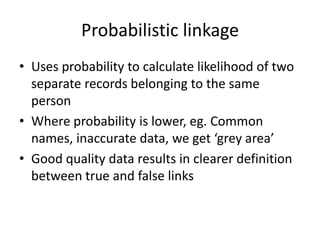
Probabilistic linkage
• Uses probability to calculate likelihood of two
separate records belonging to the same
person
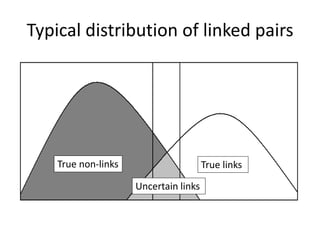
• Where probability is lower, eg. Common
names, inaccurate data, we get ‘grey area’
• Good quality data results in clearer definition
between true and false links
Typical distribution of linked pairs
True non-links True links
Uncertain links
Linkage Wiz setup 1
Linkage Wiz setup 2
Data linkage website
Queensland Data Linkage
Framework
Contacts & Links
General linkage queries:
catherine.taylor2@health.qld.gov.au
Tel: 07 3234 0709
Data linkage website:
https://www.health.qld.gov.au/hsu/link/datalink
.asp

Brisbane Health-y Data: Queensland Data Linkage Framework

  • 1.
    Queensland Department of HealthData Linkage Service Catherine Taylor and Trisha Johnston, Statistical Analysis and Linkage Unit, Statistical Services Branch
  • 2.
    Health data linkagein Australia • Funded by National Collaborative Research Infrastructure (NCRIS) Strategy and coordinated nationally by the Population Health Research Network (PHRN) since 2005 • NCRIS and one-off DEEDI Funds received in Queensland since 2011 • Queensland Department of Health now recurrently funds 10 linkage positions and various in-kind in addition to NCRIS funds
  • 3.
    QH Data LinkageTeam • Production Linkage – creation of a Master Linkage File (MLF) with enduring linkages between core health data collections (TBD) which is maintained in near-real time • Request linkage – provision of data from the MLF and custom linkage for ad hoc research and government requests
  • 5.
    Access to linkeddata • Requests for linked data must be made in accordance with Queensland Health’s data release protocols. • Privacy and confidentiality of all administrative data are covered by legislation. • Linkage of data for requests occurs in a secure environment and no patient identifying details are released to those requesting linkage services. • All requests must be approved by the data custodian for each data collection being linked and research requests must have ethics approval in addition to data custodian and Director-General approval.
  • 6.
    Access to linkeddata For research, data are available via Public Health Act application and approval from an authorised ethics committee 1. See QH data linkage website and Framework at – https://www.health.qld.gov.au/hsu/link/datali nk.asp – http://www.health.qld.gov.au/hsu/pdf/other/q lddatalinkframework.pdf 2. Contact HSBresearch@health.qld.gov.au
  • 7.
    Why link? • Combiningdata sources can provide far richer information – whole > sum of parts • Track patients across facilities • Obtain follow-up information on a cohort of interest • Ensure study participants have not died when making contact
  • 8.
    What can welink? • Anything! Subject to approval • Must have compatible identifying information – Name – DOB – Address – Common ID • Doesn’t have to involve SSB-owned data – we can still provide stand-alone linkage service • Discuss feasibility with QH linkage team
  • 9.
    What we havelinked – examples 1 • Health-related: – ED – ambulance – deaths – mental health – pathology – notifiable conditions – vaccinations – Master Linkage File
  • 10.
    What we havelinked – examples 2 • Non health-related: – Main Roads traffic accidents – Police and Court Service – Education • Other: – Various cohort groups defined by client eg. Patients undergoing certain procedures
  • 11.
  • 12.
    How do welink? • Most linkage work in QLD Health uses probabilistic methodology • Occasionally we use a deterministic method such as Statistical Linkage Key (SLK) • Software: – Production – Choicemaker – Requests – Linkage Wiz
  • 13.
    Probabilistic linkage • Usesprobability to calculate likelihood of two separate records belonging to the same person • Where probability is lower, eg. Common names, inaccurate data, we get ‘grey area’ • Good quality data results in clearer definition between true and false links
  • 14.
    Typical distribution oflinked pairs True non-links True links Uncertain links
  • 15.
  • 16.
  • 17.
  • 18.
  • 19.
    Contacts & Links Generallinkage queries: catherine.taylor2@health.qld.gov.au Tel: 07 3234 0709 Data linkage website: https://www.health.qld.gov.au/hsu/link/datalink .asp