Predictive Maintenance Fredrik Ljungberg [email_address]
Agenda Maintenance from an overall perspective Examples Food for thoughts
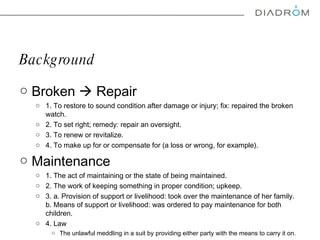
Background Broken    Repair 1. To restore to sound condition after damage or injury; fix: repaired the broken watch. 2. To set right; remedy: repair an oversight. 3. To renew or revitalize. 4. To make up for or compensate for (a loss or wrong, for example). Maintenance 1. The act of maintaining or the state of being maintained. 2. The work of keeping something in proper condition; upkeep. 3. a. Provision of support or livelihood: took over the maintenance of her family. b. Means of support or livelihood: was ordered to pay maintenance for both children. 4. Law  The unlawful meddling in a suit by providing either party with the means to carry it on.
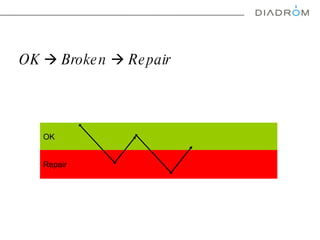
OK    Broken    Repair Repair OK
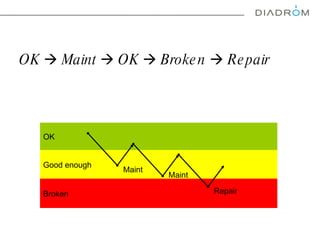
OK    Maint    OK    Broken    Repair Good enough Broken OK Maint Repair Maint
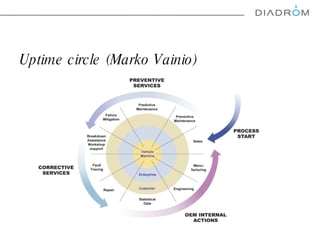
Uptime circle ( Marko Vainio )
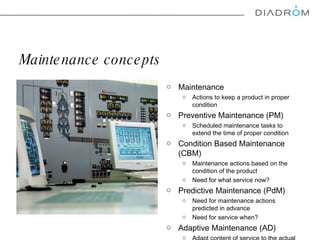
Maintenance concepts  Maintenance  Actions to keep a product in proper condition Preventive Maintenance (PM) Scheduled maintenance tasks to extend the time of proper condition  Condition Based Maintenance (CBM) Maintenance actions based on the condition of the product  Need for  what  service now? Predictive Maintenance (PdM) Need for maintenance actions predicted in advance  Need for service when? Adaptive Maintenance (AD) Adapt content of service to the actual condition of the product
Examples from  the car industry
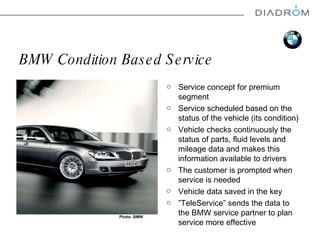
BMW Condition Based Service Service concept for premium segment Service schedule d  based on the status of the vehicle (its condition) Vehicle checks continuously the status of parts, fluid levels and mileage data and makes this information available to drivers  The customer is prompted when service is needed Vehicle data saved in the key ” TeleService ”  sends the data to the BMW service partner to plan service more effective Photo: BMW
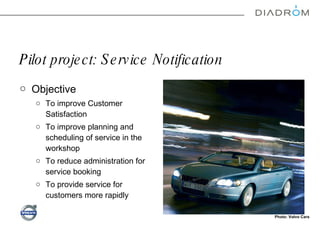
Pilot project: Service Notification Objective  To improve Customer Satisfaction To improve planning and scheduling of service in the workshop To reduce administration for service booking To provide service for customers more rapidly  Photo: Volvo Cars
Pilot project: Service Notification Approx. 200 cars for 1 year Software added to phone module SMS every 1 000 km Conclusion Customers pleased with this way of booking services SMS from car to VCC back office Service need assessment by server software Customer gets email with web form Web form filled in and sent to workshop Workshop propose time for service Customer confirms Service of car
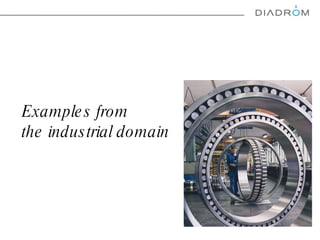
Examples from  the industrial domain
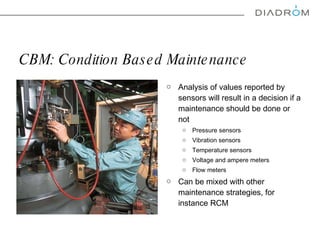
CBM:  Condition Based Maintenance Analysis of values reported by sensors will result in a decision if a maintenance should be done or not Pressure sensors Vibration sensors Temperature sensors Voltage and ampere meters Flow meters Can be mixed with other maintenance strategies, for instance RCM
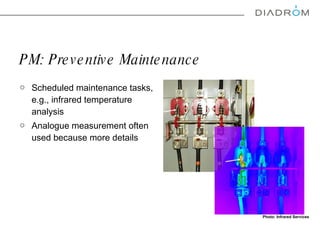
PM: Preventive Maintenance Scheduled maintenance tasks, e.g., infrared temperature analysis Analogue measurement often used because more details  Photo: Infrared Services
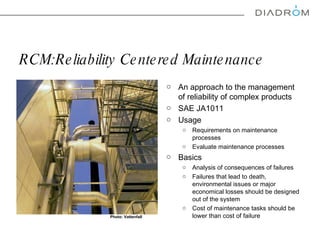
RCM : Reliability Centered Maintenance An approach to the management of reliability of complex products SAE JA1011  Usage Requirements on maintenance processes Evaluate maintenance processes  Basics  Analysis of consequences of failures Failures that lead to death, environmental issues or major economical losses should be designed out of the system  Cost of maintenance tasks should be lower than cost of failure Photo: Vattenfall
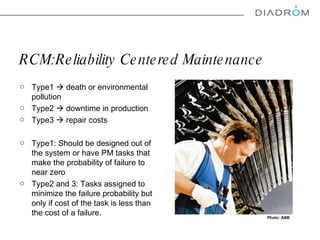
RCM : Reliability Centered Maintenance Type1    death or environmental pollution Type2    downtime in production Type3    repair costs Type1: Should be designed out of the system or have PM tasks that make the probability of failure to near zero Type2 and 3: Tasks assigned to minimize the failure probability but only if cost of the task is less than the cost of a failure. Photo: ABB
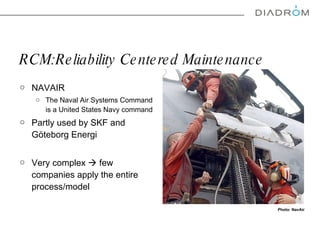
RCM : Reliability Centered Maintenance NAVAIR  The Naval Air Systems Command is a United States Navy command Partly used by SKF and  Göteborg  Energi Very complex    few companies apply the entire process/model Photo: NavAir
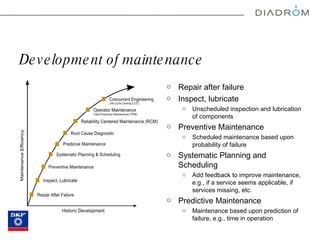
Development of maintenance  Repair after failure Inspect, lubricate Unscheduled inspection and lubrication of components Preventive Maintenance Scheduled maintenance based upon probability of failure Systematic Planning and Scheduling Add feedback to improve maintenance, e.g., if a service seems applicable, if services missing, etc.  Predictive Maintenance Maintenance based upon prediction of failure, e.g., time in operation
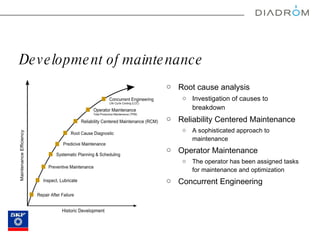
Development of maintenance Root cause analysis Investigation of causes to breakdown  Reliability Centered Maintenance A sophisticated approach to maintenance Operator Maintenance The operator has been assigned tasks for maintenance and optimization Concurrent Engineering
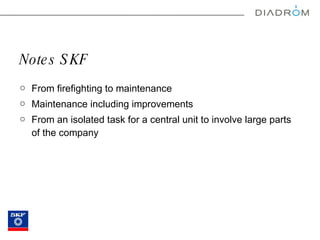
Notes SKF From firefighting to maintenance Maintenance including improvements From an isolated task for a central unit to involve large parts of the company
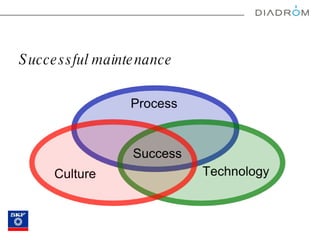
Successful maintenance
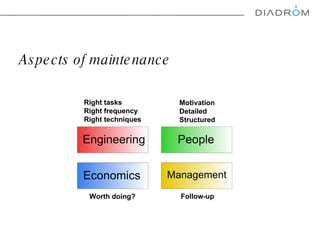
Aspects of maintenance  Worth doing? Follow-up Right tasks Right frequency Right techniques Motivation Detailed Structured
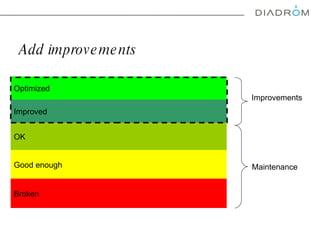
Add improvements Good enough Broken OK Maintenance Improved Optimized Improvements
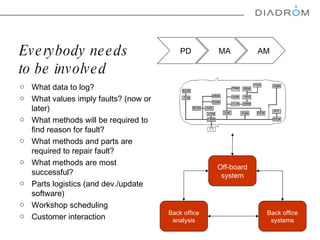
Everybody needs  to be involved What data to log?  What values imply faults? (now or later)  What methods will be required to find reason for fault?  What methods and parts are required to repair fault?  What methods are most successful?  Parts logistics (and dev./update software)  Workshop scheduling Customer interaction  Off-board system Back office analysis Back office systems PD MA AM
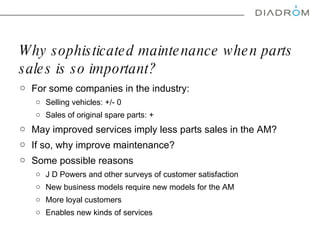
Why sophisticated maintenance when parts sales is so important?  For some companies in the industry: Selling vehicles: +/- 0 Sales of original spare parts: + May i mproved services  imply  less parts sales in the AM ?  If so, w hy improve maintenance?  Some possible reasons  J D Powers and other surveys of customer satisfaction  New business models require new models for the AM More loyal customers  Enables new kinds of services
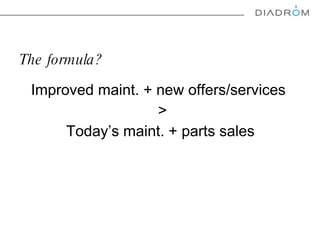
The formula ? Improved maint .  + new offers /services   > Today’s maint. + parts sales
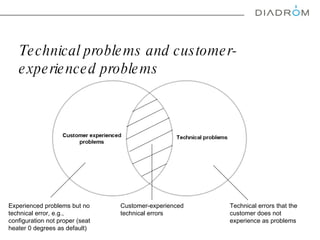
Technical problems and customer-experienced problems Technical errors that the customer does not experience as problems Experienced problems but no technical error, e.g., configuration not proper (seat heater 0 degrees as default) Cust om er-experienced technical errors
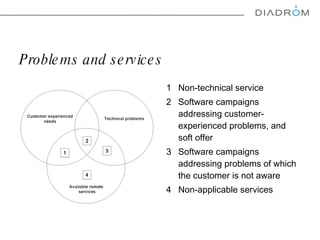
Problems and services 1  Non-technical service 2  Software campaigns addressing customer-experienced problems, and  soft offer 3  Software campaigns addressing problems of which the customer is not aware 4  Non-applicable services
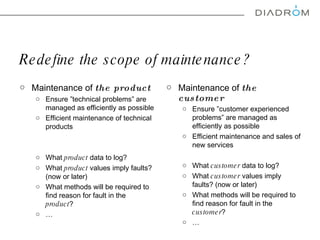
Redefine the scope of maintenance ?   Maintenance of  the product   Ensure ”technical problems” are managed as efficiently as possible Efficient maintenance of technical products What  product   data to log?  What  product   values imply faults? (now or later)  What methods will be required to find reason for fault  in the  product ?  … Maintenance of  the customer Ensure ”customer experienced problems” are managed as efficiently as possible Efficient maintenance and sales of new services What  customer   data to log?  What  customer   values imply faults? (now or later)  What methods will be required to find reason for fault  in the  customer ?  …
Thank you!

Predictive Maintenance

  • 1.
    Predictive Maintenance FredrikLjungberg [email_address]
  • 2.
    Agenda Maintenance froman overall perspective Examples Food for thoughts
  • 3.
    Background Broken  Repair 1. To restore to sound condition after damage or injury; fix: repaired the broken watch. 2. To set right; remedy: repair an oversight. 3. To renew or revitalize. 4. To make up for or compensate for (a loss or wrong, for example). Maintenance 1. The act of maintaining or the state of being maintained. 2. The work of keeping something in proper condition; upkeep. 3. a. Provision of support or livelihood: took over the maintenance of her family. b. Means of support or livelihood: was ordered to pay maintenance for both children. 4. Law The unlawful meddling in a suit by providing either party with the means to carry it on.
  • 4.
    OK  Broken  Repair Repair OK
  • 5.
    OK  Maint  OK  Broken  Repair Good enough Broken OK Maint Repair Maint
  • 6.
    Uptime circle (Marko Vainio )
  • 7.
    Maintenance concepts Maintenance Actions to keep a product in proper condition Preventive Maintenance (PM) Scheduled maintenance tasks to extend the time of proper condition Condition Based Maintenance (CBM) Maintenance actions based on the condition of the product Need for what service now? Predictive Maintenance (PdM) Need for maintenance actions predicted in advance Need for service when? Adaptive Maintenance (AD) Adapt content of service to the actual condition of the product
  • 8.
    Examples from the car industry
  • 9.
    BMW Condition BasedService Service concept for premium segment Service schedule d based on the status of the vehicle (its condition) Vehicle checks continuously the status of parts, fluid levels and mileage data and makes this information available to drivers The customer is prompted when service is needed Vehicle data saved in the key ” TeleService ” sends the data to the BMW service partner to plan service more effective Photo: BMW
  • 10.
    Pilot project: ServiceNotification Objective To improve Customer Satisfaction To improve planning and scheduling of service in the workshop To reduce administration for service booking To provide service for customers more rapidly Photo: Volvo Cars
  • 11.
    Pilot project: ServiceNotification Approx. 200 cars for 1 year Software added to phone module SMS every 1 000 km Conclusion Customers pleased with this way of booking services SMS from car to VCC back office Service need assessment by server software Customer gets email with web form Web form filled in and sent to workshop Workshop propose time for service Customer confirms Service of car
  • 12.
    Examples from the industrial domain
  • 13.
    CBM: ConditionBased Maintenance Analysis of values reported by sensors will result in a decision if a maintenance should be done or not Pressure sensors Vibration sensors Temperature sensors Voltage and ampere meters Flow meters Can be mixed with other maintenance strategies, for instance RCM
  • 14.
    PM: Preventive MaintenanceScheduled maintenance tasks, e.g., infrared temperature analysis Analogue measurement often used because more details Photo: Infrared Services
  • 15.
    RCM : ReliabilityCentered Maintenance An approach to the management of reliability of complex products SAE JA1011 Usage Requirements on maintenance processes Evaluate maintenance processes Basics Analysis of consequences of failures Failures that lead to death, environmental issues or major economical losses should be designed out of the system Cost of maintenance tasks should be lower than cost of failure Photo: Vattenfall
  • 16.
    RCM : ReliabilityCentered Maintenance Type1  death or environmental pollution Type2  downtime in production Type3  repair costs Type1: Should be designed out of the system or have PM tasks that make the probability of failure to near zero Type2 and 3: Tasks assigned to minimize the failure probability but only if cost of the task is less than the cost of a failure. Photo: ABB
  • 17.
    RCM : ReliabilityCentered Maintenance NAVAIR The Naval Air Systems Command is a United States Navy command Partly used by SKF and Göteborg Energi Very complex  few companies apply the entire process/model Photo: NavAir
  • 18.
    Development of maintenance Repair after failure Inspect, lubricate Unscheduled inspection and lubrication of components Preventive Maintenance Scheduled maintenance based upon probability of failure Systematic Planning and Scheduling Add feedback to improve maintenance, e.g., if a service seems applicable, if services missing, etc. Predictive Maintenance Maintenance based upon prediction of failure, e.g., time in operation
  • 19.
    Development of maintenanceRoot cause analysis Investigation of causes to breakdown Reliability Centered Maintenance A sophisticated approach to maintenance Operator Maintenance The operator has been assigned tasks for maintenance and optimization Concurrent Engineering
  • 20.
    Notes SKF Fromfirefighting to maintenance Maintenance including improvements From an isolated task for a central unit to involve large parts of the company
  • 21.
  • 22.
    Aspects of maintenance Worth doing? Follow-up Right tasks Right frequency Right techniques Motivation Detailed Structured
  • 23.
    Add improvements Goodenough Broken OK Maintenance Improved Optimized Improvements
  • 24.
    Everybody needs to be involved What data to log? What values imply faults? (now or later) What methods will be required to find reason for fault? What methods and parts are required to repair fault? What methods are most successful? Parts logistics (and dev./update software) Workshop scheduling Customer interaction Off-board system Back office analysis Back office systems PD MA AM
  • 25.
    Why sophisticated maintenancewhen parts sales is so important? For some companies in the industry: Selling vehicles: +/- 0 Sales of original spare parts: + May i mproved services imply less parts sales in the AM ? If so, w hy improve maintenance? Some possible reasons J D Powers and other surveys of customer satisfaction New business models require new models for the AM More loyal customers Enables new kinds of services
  • 26.
    The formula ?Improved maint . + new offers /services > Today’s maint. + parts sales
  • 27.
    Technical problems andcustomer-experienced problems Technical errors that the customer does not experience as problems Experienced problems but no technical error, e.g., configuration not proper (seat heater 0 degrees as default) Cust om er-experienced technical errors
  • 28.
    Problems and services1 Non-technical service 2 Software campaigns addressing customer-experienced problems, and soft offer 3 Software campaigns addressing problems of which the customer is not aware 4 Non-applicable services
  • 29.
    Redefine the scopeof maintenance ? Maintenance of the product Ensure ”technical problems” are managed as efficiently as possible Efficient maintenance of technical products What product data to log? What product values imply faults? (now or later) What methods will be required to find reason for fault in the product ? … Maintenance of the customer Ensure ”customer experienced problems” are managed as efficiently as possible Efficient maintenance and sales of new services What customer data to log? What customer values imply faults? (now or later) What methods will be required to find reason for fault in the customer ? …
  • 30.