Digital Marketing
Campaign Conversion
Prediction
-Scott Rodrigues
Introduction
• This project aims to enhance campaign effectiveness in the digital marketing sector
by accurately predicting customer conversions.
• By leveraging machine learning, the project seeks to identify potential converters
and optimize marketing strategies.
• The objective is to develop a robust machine learning model that predicts customer
conversions based on various demographic and engagement factors, enabling
improved campaign targeting, increased conversion rates, and maximized return
on advertising spend (ROAS).
Exploratory Data Analysis(EDA)
Data Preprocessing
• Data preprocessing is a critical step that involves cleaning and transforming
raw data into a format suitable for modeling. This step ensures that the
machine learning model can effectively learn from the data without being
misled by inconsistencies, missing values, or irrelevant information.
• We convert categorical Data type into numerical so that the algorithm can
understand the data.
• We have used One-Hot Encoder which represents characters or words by
a vector where only one element is set to one and all others are zero,
based on their position in the vocabulary
• Standardize numerical features like Age, Income, AdSpend,
ClickThroughRate, ConversionRate, WebsiteVisits, etc., to have a mean of
0 and a standard deviation of 1. This is especially important for
algorithms like Decision Tree and Random Forest Classsification which
are sensitive to the scale of the features.
• Split the dataset into training and testing sets, typically with a 70-30 or
80-20 ratio. This allows you to train the model on one portion of the data
and evaluate its performance on unseen data
• This step ensures that the model's performance is generalizable and not
just specific to the data it was trained on
TRAIN TEST SPLIT
Model Selection
Models Considered:
• Decision Tree
• Gradient Boosting Method
• Random Forest
Decision Tree
Supervised machine learning used to categorize or make predictions based on how a previous set of
questions were answered.
Random Forest:
Random Forest is a robust supervised algorithm suitable for both regression and classification tasks.
Gradient Boosting Method
It is a technique that combines weak models to create a more accurate predictive model.
Accuracy
Accuracy is a metric that measures how often a model correctly predicts an outcome
Precision
Precision is a metric in machine learning that measures how well a model makes positive predictions.
F1 score
It is a metric used in machine learning (ML) to evaluate the performance of a model by combining
precision and recall into a single score.
Recall
Recall is a metric that measures how well a model correctly identifies positive instances in a dataset.
EVALUATION
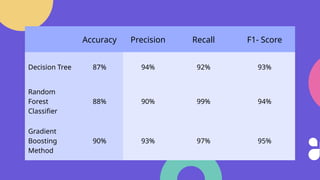
Accuracy Precision Recall F1- Score
Decision Tree 87% 94% 92% 93%
Random
Forest
Classifier
88% 90% 99% 94%
Gradient
Boosting
Method
90% 93% 97% 95%
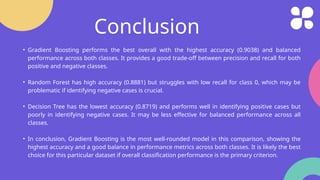
• Gradient Boosting performs the best overall with the highest accuracy (0.9038) and balanced
performance across both classes. It provides a good trade-off between precision and recall for both
positive and negative classes.
• Random Forest has high accuracy (0.8881) but struggles with low recall for class 0, which may be
problematic if identifying negative cases is crucial.
• Decision Tree has the lowest accuracy (0.8719) and performs well in identifying positive cases but
poorly in identifying negative cases. It may be less effective for balanced performance across all
classes.
• In conclusion, Gradient Boosting is the most well-rounded model in this comparison, showing the
highest accuracy and a good balance in performance metrics across both classes. It is likely the best
choice for this particular dataset if overall classification performance is the primary criterion.
Conclusion
Thank you!

Predicting Digital Marketing Success: Conversion Forecasting Strategies

  • 2.
  • 3.
    Introduction • This projectaims to enhance campaign effectiveness in the digital marketing sector by accurately predicting customer conversions. • By leveraging machine learning, the project seeks to identify potential converters and optimize marketing strategies. • The objective is to develop a robust machine learning model that predicts customer conversions based on various demographic and engagement factors, enabling improved campaign targeting, increased conversion rates, and maximized return on advertising spend (ROAS).
  • 4.
  • 5.
  • 6.
    Data Preprocessing • Datapreprocessing is a critical step that involves cleaning and transforming raw data into a format suitable for modeling. This step ensures that the machine learning model can effectively learn from the data without being misled by inconsistencies, missing values, or irrelevant information. • We convert categorical Data type into numerical so that the algorithm can understand the data.
  • 7.
    • We haveused One-Hot Encoder which represents characters or words by a vector where only one element is set to one and all others are zero, based on their position in the vocabulary • Standardize numerical features like Age, Income, AdSpend, ClickThroughRate, ConversionRate, WebsiteVisits, etc., to have a mean of 0 and a standard deviation of 1. This is especially important for algorithms like Decision Tree and Random Forest Classsification which are sensitive to the scale of the features.
  • 8.
    • Split thedataset into training and testing sets, typically with a 70-30 or 80-20 ratio. This allows you to train the model on one portion of the data and evaluate its performance on unseen data • This step ensures that the model's performance is generalizable and not just specific to the data it was trained on TRAIN TEST SPLIT
  • 9.
    Model Selection Models Considered: •Decision Tree • Gradient Boosting Method • Random Forest
  • 10.
    Decision Tree Supervised machinelearning used to categorize or make predictions based on how a previous set of questions were answered. Random Forest: Random Forest is a robust supervised algorithm suitable for both regression and classification tasks. Gradient Boosting Method It is a technique that combines weak models to create a more accurate predictive model.
  • 11.
    Accuracy Accuracy is ametric that measures how often a model correctly predicts an outcome Precision Precision is a metric in machine learning that measures how well a model makes positive predictions. F1 score It is a metric used in machine learning (ML) to evaluate the performance of a model by combining precision and recall into a single score. Recall Recall is a metric that measures how well a model correctly identifies positive instances in a dataset. EVALUATION
  • 12.
    Accuracy Precision RecallF1- Score Decision Tree 87% 94% 92% 93% Random Forest Classifier 88% 90% 99% 94% Gradient Boosting Method 90% 93% 97% 95%
  • 13.
    • Gradient Boostingperforms the best overall with the highest accuracy (0.9038) and balanced performance across both classes. It provides a good trade-off between precision and recall for both positive and negative classes. • Random Forest has high accuracy (0.8881) but struggles with low recall for class 0, which may be problematic if identifying negative cases is crucial. • Decision Tree has the lowest accuracy (0.8719) and performs well in identifying positive cases but poorly in identifying negative cases. It may be less effective for balanced performance across all classes. • In conclusion, Gradient Boosting is the most well-rounded model in this comparison, showing the highest accuracy and a good balance in performance metrics across both classes. It is likely the best choice for this particular dataset if overall classification performance is the primary criterion. Conclusion
  • 14.