CONFIDENTIAL: The information in this document belongs to Boston Institute of Analytics LLC. Any unauthorized sharing of this
material is prohibited and subject to legal action under breach of IP and confidentiality clauses.
Employee Retention Prediction
CONFIDENTIAL: The information in this document belongs to Boston Institute of Analytics LLC. Any unauthorized sharing of this
material is prohibited and subject to legal action under breach of IP and confidentiality clauses.
Agenda
1.Key Sections: Business Context
2.Dataset Overview
3.Exploratory Data Analysis (EDA)
4.Preprocessing and Feature Engineering
5.Model Training and Evaluation
6.Insights
7.Conclusion
CONFIDENTIAL: The information in this document belongs to Boston Institute of Analytics LLC. Any unauthorized sharing of this
material is prohibited and subject to legal action under breach of IP and confidentiality clauses.
Why This Matters
• High attrition disrupts workflows and team stability.
• Recruiting replacements is costly and time-consuming.
• Retaining talent boosts productivity and morale.
Objective
• Predict employees likely to leave using machine learning.
• Enable HR teams to optimize resource allocation.
• Provides actionable insights for retention strategies.
Business Context
CONFIDENTIAL: The information in this document belongs to Boston Institute of Analytics LLC. Any unauthorized sharing of this
material is prohibited and subject to legal action under breach of IP and confidentiality clauses.
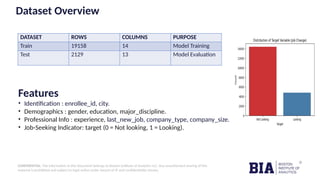
Dataset Overview
DATASET ROWS COLUMNS PURPOSE
Train 19158 14 Model Training
Test 2129 13 Model Evaluation
Features
• Identification : enrollee_id, city.
• Demographics : gender, education, major_discipline.
• Professional Info : experience, last_new_job, company_type, company_size.
• Job-Seeking Indicator: target (0 = Not looking, 1 = Looking).
CONFIDENTIAL: The information in this document belongs to Boston Institute of Analytics LLC. Any unauthorized sharing of this
material is prohibited and subject to legal action under breach of IP and confidentiality clauses.
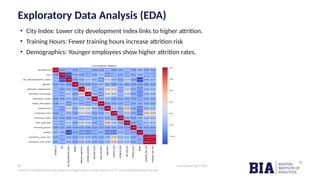
Exploratory Data Analysis (EDA)
• City Index: Lower city development index links to higher attrition.
• Training Hours: Fewer training hours increase attrition risk
• Demographics: Younger employees show higher attrition rates.
CONFIDENTIAL: The information in this document belongs to Boston Institute of Analytics LLC. Any unauthorized sharing of this
material is prohibited and subject to legal action under breach of IP and confidentiality clauses.
Preprocessing and Feature Engineering
• Data Standardization: Applied manual replacement and string manipulation.
• Handling Missing Data: Used statistical imputation (mode and mean).
• Text Cleaning: Used string operations (replace) for cleaning text columns.
• Categorical Encoding: Used Label Encoding.
• Feature Transformation: Converted ranges into numeric features using split and pd.to_numeric
• New feature : Created a new feature named ‘experience_level’
CONFIDENTIAL: The information in this document belongs to Boston Institute of Analytics LLC. Any unauthorized sharing of this
material is prohibited and subject to legal action under breach of IP and confidentiality clauses.
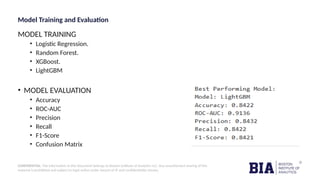
Model Training and Evaluation
MODEL TRAINING
• Logistic Regression.
• Random Forest.
• XGBoost.
• LightGBM
• MODEL EVALUATION
• Accuracy
• ROC-AUC
• Precision
• Recall
• F1-Score
• Confusion Matrix
CONFIDENTIAL: The information in this document belongs to Boston Institute of Analytics LLC. Any unauthorized sharing of this
material is prohibited and subject to legal action under breach of IP and confidentiality clauses.
Insights
• Training Hours: Employees with fewer training hours are more likely to leave.
• City Development Index: Attrition is higher among employees in cities with a lower development
index (e.g., ≤0.5).
• Relevant Experience: Employees without relevant experience show a higher likelihood of attrition.
• Company Size: Smaller companies (e.g., company size ≤10 employees) tend to have higher attrition
rates.
• Enrolled University: Employees not pursuing higher education may feel less engaged and are at
greater risk of leaving.
CONFIDENTIAL: The information in this document belongs to Boston Institute of Analytics LLC. Any unauthorized sharing of this
material is prohibited and subject to legal action under breach of IP and confidentiality clauses.
Conclusion
• The predictive analysis has revealed key drivers of employee attrition,
such as training hours, city development index, and relevant experience.
• These insights empower organizations to adopt targeted strategies for
retaining talent, including enhanced training programs and city-specific
initiatives.
• This data-driven approach underscores the value of machine learning in
strategic decision-making.
CONFIDENTIAL: The information in this document belongs to Boston Institute of Analytics LLC. Any unauthorized sharing of this
material is prohibited and subject to legal action under breach of IP and confidentiality clauses.
Questions ?
CONFIDENTIAL: The information in this document belongs to Boston Institute of Analytics LLC. Any unauthorized sharing of this
material is prohibited and subject to legal action under breach of IP and confidentiality clauses.
Thank You!

Employee Retention Prediction: Leveraging Data for Workforce Stability

  • 1.
    CONFIDENTIAL: The informationin this document belongs to Boston Institute of Analytics LLC. Any unauthorized sharing of this material is prohibited and subject to legal action under breach of IP and confidentiality clauses. Employee Retention Prediction
  • 2.
    CONFIDENTIAL: The informationin this document belongs to Boston Institute of Analytics LLC. Any unauthorized sharing of this material is prohibited and subject to legal action under breach of IP and confidentiality clauses. Agenda 1.Key Sections: Business Context 2.Dataset Overview 3.Exploratory Data Analysis (EDA) 4.Preprocessing and Feature Engineering 5.Model Training and Evaluation 6.Insights 7.Conclusion
  • 3.
    CONFIDENTIAL: The informationin this document belongs to Boston Institute of Analytics LLC. Any unauthorized sharing of this material is prohibited and subject to legal action under breach of IP and confidentiality clauses. Why This Matters • High attrition disrupts workflows and team stability. • Recruiting replacements is costly and time-consuming. • Retaining talent boosts productivity and morale. Objective • Predict employees likely to leave using machine learning. • Enable HR teams to optimize resource allocation. • Provides actionable insights for retention strategies. Business Context
  • 4.
    CONFIDENTIAL: The informationin this document belongs to Boston Institute of Analytics LLC. Any unauthorized sharing of this material is prohibited and subject to legal action under breach of IP and confidentiality clauses. Dataset Overview DATASET ROWS COLUMNS PURPOSE Train 19158 14 Model Training Test 2129 13 Model Evaluation Features • Identification : enrollee_id, city. • Demographics : gender, education, major_discipline. • Professional Info : experience, last_new_job, company_type, company_size. • Job-Seeking Indicator: target (0 = Not looking, 1 = Looking).
  • 5.
    CONFIDENTIAL: The informationin this document belongs to Boston Institute of Analytics LLC. Any unauthorized sharing of this material is prohibited and subject to legal action under breach of IP and confidentiality clauses. Exploratory Data Analysis (EDA) • City Index: Lower city development index links to higher attrition. • Training Hours: Fewer training hours increase attrition risk • Demographics: Younger employees show higher attrition rates.
  • 6.
    CONFIDENTIAL: The informationin this document belongs to Boston Institute of Analytics LLC. Any unauthorized sharing of this material is prohibited and subject to legal action under breach of IP and confidentiality clauses. Preprocessing and Feature Engineering • Data Standardization: Applied manual replacement and string manipulation. • Handling Missing Data: Used statistical imputation (mode and mean). • Text Cleaning: Used string operations (replace) for cleaning text columns. • Categorical Encoding: Used Label Encoding. • Feature Transformation: Converted ranges into numeric features using split and pd.to_numeric • New feature : Created a new feature named ‘experience_level’
  • 7.
    CONFIDENTIAL: The informationin this document belongs to Boston Institute of Analytics LLC. Any unauthorized sharing of this material is prohibited and subject to legal action under breach of IP and confidentiality clauses. Model Training and Evaluation MODEL TRAINING • Logistic Regression. • Random Forest. • XGBoost. • LightGBM • MODEL EVALUATION • Accuracy • ROC-AUC • Precision • Recall • F1-Score • Confusion Matrix
  • 8.
    CONFIDENTIAL: The informationin this document belongs to Boston Institute of Analytics LLC. Any unauthorized sharing of this material is prohibited and subject to legal action under breach of IP and confidentiality clauses. Insights • Training Hours: Employees with fewer training hours are more likely to leave. • City Development Index: Attrition is higher among employees in cities with a lower development index (e.g., ≤0.5). • Relevant Experience: Employees without relevant experience show a higher likelihood of attrition. • Company Size: Smaller companies (e.g., company size ≤10 employees) tend to have higher attrition rates. • Enrolled University: Employees not pursuing higher education may feel less engaged and are at greater risk of leaving.
  • 9.
    CONFIDENTIAL: The informationin this document belongs to Boston Institute of Analytics LLC. Any unauthorized sharing of this material is prohibited and subject to legal action under breach of IP and confidentiality clauses. Conclusion • The predictive analysis has revealed key drivers of employee attrition, such as training hours, city development index, and relevant experience. • These insights empower organizations to adopt targeted strategies for retaining talent, including enhanced training programs and city-specific initiatives. • This data-driven approach underscores the value of machine learning in strategic decision-making.
  • 10.
    CONFIDENTIAL: The informationin this document belongs to Boston Institute of Analytics LLC. Any unauthorized sharing of this material is prohibited and subject to legal action under breach of IP and confidentiality clauses. Questions ?
  • 11.
    CONFIDENTIAL: The informationin this document belongs to Boston Institute of Analytics LLC. Any unauthorized sharing of this material is prohibited and subject to legal action under breach of IP and confidentiality clauses. Thank You!