Predictive Maintenance: A holistic
approach to predict vehicle
maintenance using Demographic
and sensor data
Manikandan Prasad
Project Scope
The scope involves developing two separate predictive maintenance models, each
tailored to a specific type of data: demographic data and sensor data.These models
will independently predict maintenance needs and provide actionable insights for
vehicle service managers and individual owners.This dual-model approach allows for
comprehensive analysis while maintaining modularity and focus on distinct data types.
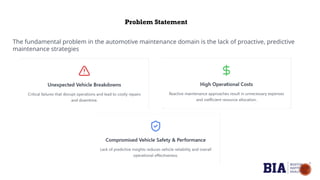
Problem Statement
The fundamental problem in the automotive maintenance domain is the lack of proactive, predictive
maintenance strategies
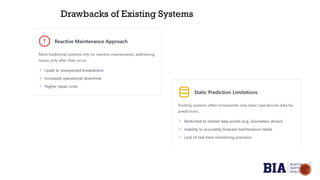
Drawbacks of Existing Systems
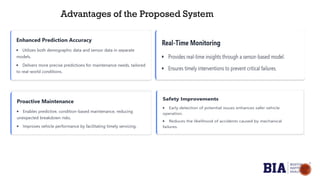
Advantages of the Proposed System
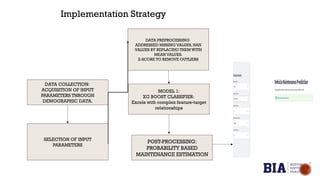
DATA COLLECTION:
ACQUISITION OF INPUT
PARAMETERS THROUGH
DEMOGRAPHIC DATA.
Implementation Strategy
SELECTION OF INPUT
PARAMETERS
DATA PREPROCESSING:
ADDRESSED MISSING VALUES, NAN
VALUES BY REPLACING THEM WITH
MEAN VALUES.
Z-SCORE TO REMOVE OUTLIERS
MODEL 1:
XG BOOST CLASSIFIER:
Excels with complex feature-target
relationships
POST-PROCESSING:
PROBABILITY BASED
MAINTENANCE ESTIMATION
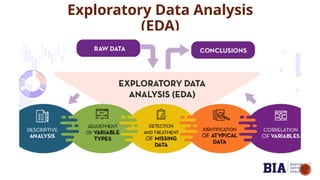
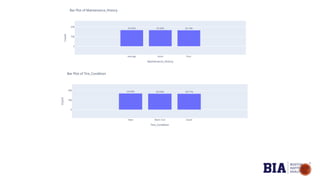
Exploratory Data Analysis
(EDA)
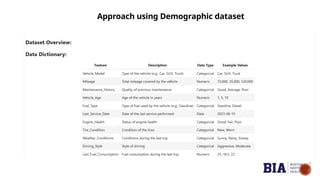
Approach using Demographic dataset
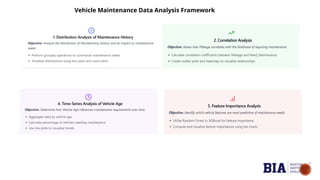
Vehicle Maintenance Data Analysis Framework
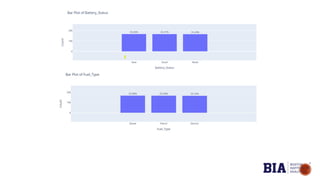
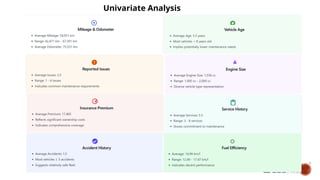
Univariate Analysis
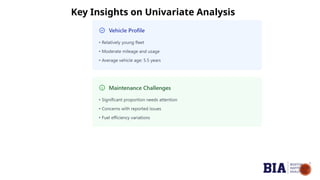
Key Insights on Univariate Analysis
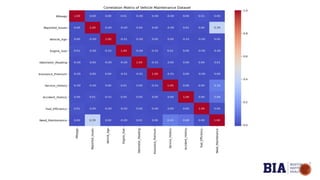
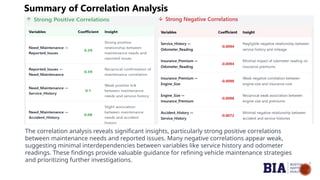
Summary of Correlation Analysis
The correlation analysis reveals significant insights, particularly strong positive correlations
between maintenance needs and reported issues. Many negative correlations appear weak,
suggesting minimal interdependencies between variables like service history and odometer
readings. These findings provide valuable guidance for refining vehicle maintenance strategies
and prioritizing further investigations.
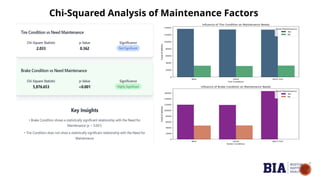
Chi-Squared Analysis of Maintenance Factors
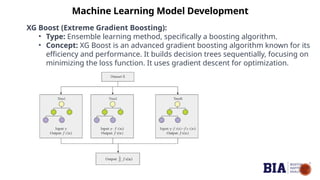
Machine Learning Model Development
XG Boost (Extreme Gradient Boosting):
• Type: Ensemble learning method, specifically a boosting algorithm.
• Concept: XG Boost is an advanced gradient boosting algorithm known for its
efficiency and performance. It builds decision trees sequentially, focusing on
minimizing the loss function. It uses gradient descent for optimization.
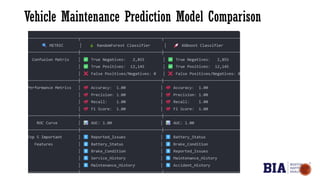
Vehicle Maintenance Prediction Model Comparison
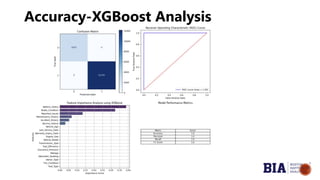
Accuracy-XGBoost Analysis
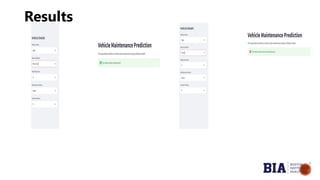
Results
Approach using Sensor data
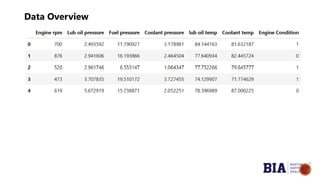
Data Overview
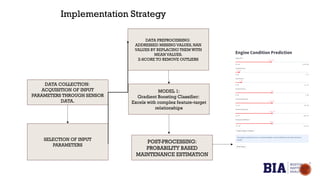
DATA COLLECTION:
ACQUISITION OF INPUT
PARAMETERS THROUGH SENSOR
DATA.
Implementation Strategy
SELECTION OF INPUT
PARAMETERS
DATA PREPROCESSING:
ADDRESSED MISSING VALUES, NAN
VALUES BY REPLACING THEM WITH
MEAN VALUES.
Z-SCORE TO REMOVE OUTLIERS
MODEL 1:
Gradient Boosting Classifier:
Excels with complex feature-target
relationships
POST-PROCESSING:
PROBABILITY BASED
MAINTENANCE ESTIMATION
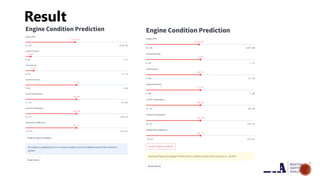
Result
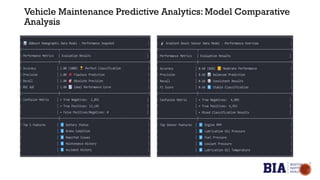
Vehicle Maintenance Predictive Analytics: Model Comparative
Analysis
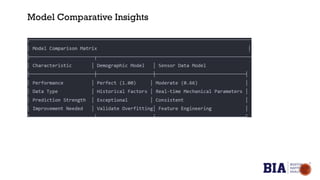
Model Comparative Insights
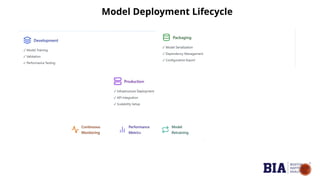
Model Deployment Lifecycle
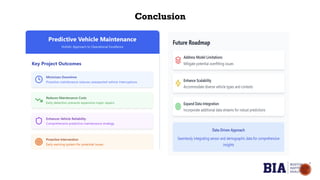
Conclusion
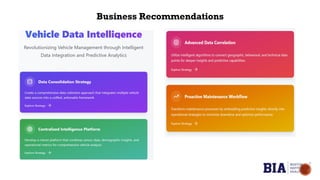
Business Recommendations
Questions ?
Thank You !

Predictive Maintenance: Revolutionizing Vehicle Care with Demographic and Sensor Data