Competition II: Springleaf
Sha Li (Team leader)
Xiaoyan Chong, Minglu Ma, Yue Wang
CAMCOS Fall 2015
San Jose State University
Agenda
• Kaggle Competition: Springleaf dataset
introduction
• Data Preprocessing
• Classification Methodologies & Results
• Logistic Regression
• Random Forest
• XGBoost
• Stacking
• Summary & Conclusion
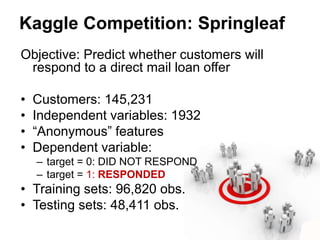
Kaggle Competition: Springleaf
Objective: Predict whether customers will
respond to a direct mail loan offer
• Customers: 145,231
• Independent variables: 1932
• “Anonymous” features
• Dependent variable:
– target = 0: DID NOT RESPOND
– target = 1: RESPONDED
• Training sets: 96,820 obs.
• Testing sets: 48,411 obs.
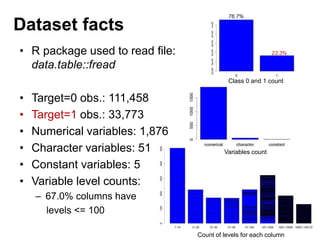
Dataset facts
• R package used to read file:
data.table::fread
• Target=0 obs.: 111,458
• Target=1 obs.: 33,773
• Numerical variables: 1,876
• Character variables: 51
• Constant variables: 5
• Variable level counts:
– 67.0% columns have
levels <= 100
Count of levels for each column
76.7%
23.3%
Class 0 and 1 count
Variables count
Missing values
• “”, “NA”: 0.6%
• “[]”, -1: 2.0%
• -99999, 96, …, 999, …,
99999999: 24.9%
• 25.3% columns have
missing values 61.7%
Count of NAs in each column Count of NAs in each row
Challenges for classification
• Huge Dataset (145,231 X 1932)
• “Anonymous” features
• Uneven distribution of response variable
• 27.6% of missing values
• Deal with both numerical and categorical
variables
• Undetermined portion of Categorical
variables
• Data pre-processing complexity
Data preprocessing
Remove ID and target
Replace NA by median Replace NA randomly
Replace [] and -1 as NA
Remove duplicate cols
Replace character cols
Remove low variance cols
Regard NA as a new group
Normalize Log(1+|x|)
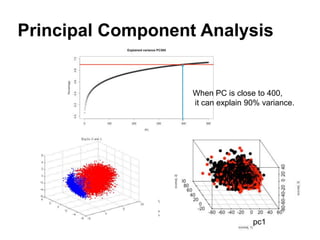
Principal Component Analysis
When PC is close to 400,
it can explain 90% variance.
pc1
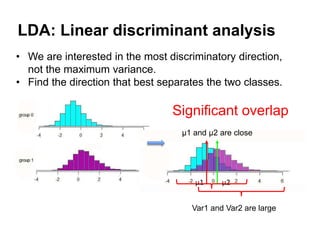
LDA: Linear discriminant analysis
• We are interested in the most discriminatory direction,
not the maximum variance.
• Find the direction that best separates the two classes.
Var1 and Var2 are large
Significant overlap
µ1 µ2
µ1 and µ2 are close
Methodology
• K Nearest Neighbor (KNN)
• Support Vector Machine (SVM)
• Logistic Regression
• Random Forest
• XGBoost (eXtreme Gradient Boosting)
• Stacking
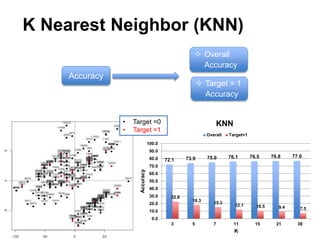
K Nearest Neighbor (KNN)
• Target =0
• Target =1
 Overall
Accuracy
 Target = 1
Accuracy
Accuracy
72.1 73.9 75.0 76.1 76.5 76.8 77.0
22.8
18.3 15.3
12.1 10.5 9.4 7.5
0.0
10.0
20.0
30.0
40.0
50.0
60.0
70.0
80.0
90.0
100.0
3 5 7 11 15 21 39
Accuracy
K
KNN
Overall Target=1
Support Vector Machine (SVM)
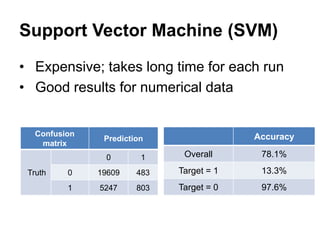
• Expensive; takes long time for each run
• Good results for numerical data
Accuracy
Overall 78.1%
Target = 1 13.3%
Target = 0 97.6%
Confusion
matrix
Prediction
Truth
0 1
0 19609 483
1 5247 803
Logistic Regression
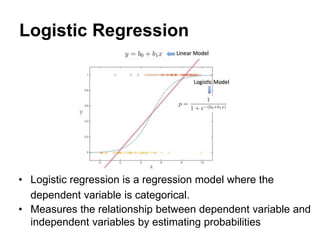
• Logistic regression is a regression model where the
dependent variable is categorical.
• Measures the relationship between dependent variable and
independent variables by estimating probabilities
Logistic Regression
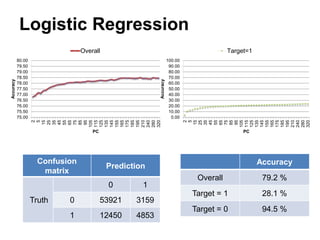
Accuracy
Overall 79.2 %
Target = 1 28.1 %
Target = 0 94.5 %
Confusion
matrix
Prediction
Truth
0 1
0 53921 3159
1 12450 4853
75.00
75.50
76.00
76.50
77.00
77.50
78.00
78.50
79.00
79.50
80.00
2
5
15
25
35
45
55
65
75
85
95
105
115
125
135
145
155
165
175
185
195
210
240
280
320
Accuracy
PC
Overall
0.00
10.00
20.00
30.00
40.00
50.00
60.00
70.00
80.00
90.00
100.00
2
5
15
25
35
45
55
65
75
85
95
105
115
125
135
145
155
165
175
185
195
210
240
280
320
Accuracy
PC
Target=1
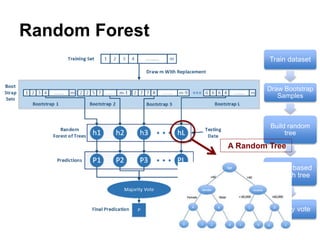
Random Forest
• Machine learning ensemble algorithm
-- Combining multiple predictors
• Based on tree model
• For both regression and classification
• Automatic variable selection
• Handles missing values
• Robust, improving model stability and accuracy
Random Forest
Train dataset
Draw Bootstrap
Samples
Build random
tree
Predict based
on each tree
Majority vote
A Random Tree
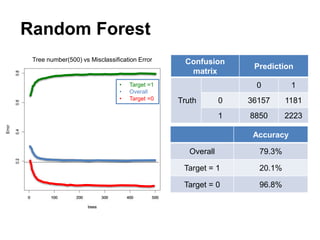
Random Forest
Accuracy
Overall 79.3%
Target = 1 20.1%
Target = 0 96.8%
Confusion
matrix
Prediction
Truth
0 1
0 36157 1181
1 8850 2223
• Target =1
• Overall
• Target =0
Tree number(500) vs Misclassification Error
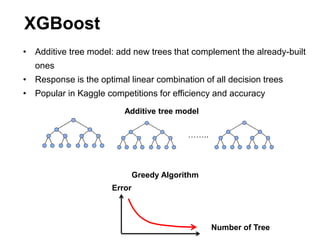
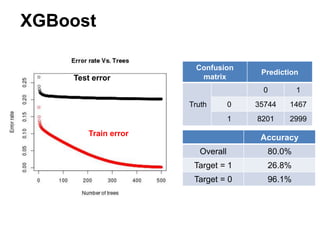
XGBoost
• Additive tree model: add new trees that complement the already-built
ones
• Response is the optimal linear combination of all decision trees
• Popular in Kaggle competitions for efficiency and accuracy
……..
Greedy Algorithm
Number of Tree
Error
Additive tree model
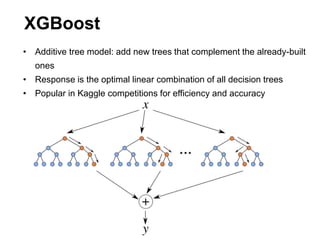
XGBoost
• Additive tree model: add new trees that complement the already-built
ones
• Response is the optimal linear combination of all decision trees
• Popular in Kaggle competitions for efficiency and accuracy
XGBoost
Accuracy
Overall 80.0%
Target = 1 26.8%
Target = 0 96.1%
Train error
Test error
Confusion
matrix
Prediction
Truth
0 1
0 35744 1467
1 8201 2999
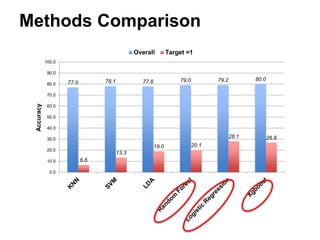
Methods Comparison
77.0 78.1 77.8 79.0 79.2 80.0
6.6
13.3
19.0 20.1
28.1 26.8
0.0
10.0
20.0
30.0
40.0
50.0
60.0
70.0
80.0
90.0
100.0
Accuracy
Overall Target =1
Winner or Combination ?
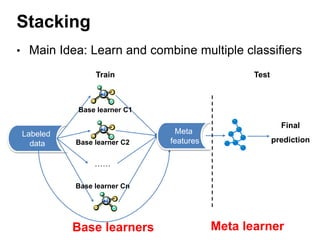
Stacking
Base learners Meta learner
Labeled
data
……
Final
prediction
Test
Base learner C1
Base learner C2
Base learner Cn
• Main Idea: Learn and combine multiple classifiers
Meta
features
Train
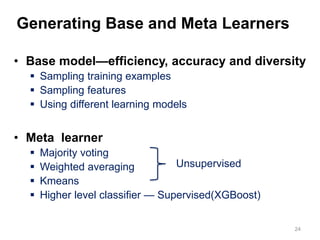
Generating Base and Meta Learners
• Base model—efficiency, accuracy and diversity
 Sampling training examples
 Sampling features
 Using different learning models
• Meta learner
 Majority voting
 Weighted averaging
 Kmeans
 Higher level classifier — Supervised(XGBoost)
24
Unsupervised
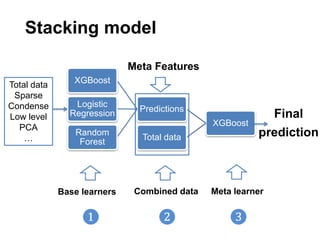
Stacking model
XGBoost
Predictions
XGBoost
Logistic
Regression
Random
Forest
Total data
Base learners Meta learner
Final
prediction
Meta Features
❶ ❸
❷
Combined data
Total data
Sparse
Condense
Low level
PCA
…
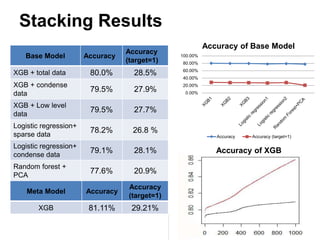
Stacking Results
Base Model Accuracy
Accuracy
(target=1)
XGB + total data 80.0% 28.5%
XGB + condense
data
79.5% 27.9%
XGB + Low level
data
79.5% 27.7%
Logistic regression+
sparse data
78.2% 26.8 %
Logistic regression+
condense data
79.1% 28.1%
Random forest +
PCA
77.6% 20.9%
Meta Model Accuracy
Accuracy
(target=1)
XGB 81.11% 29.21%
Averaging 79.44% 27.31%
Kmeans 77.45% 23.91%
Accuracy of XGB
0.00%
20.00%
40.00%
60.00%
80.00%
100.00%
Accuracy of Base Model
Accuracy Accuracy (target=1)
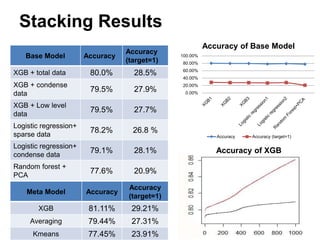
Stacking Results
Base Model Accuracy
Accuracy
(target=1)
XGB + total data 80.0% 28.5%
XGB + condense
data
79.5% 27.9%
XGB + Low level
data
79.5% 27.7%
Logistic regression+
sparse data
78.2% 26.8 %
Logistic regression+
condense data
79.1% 28.1%
Random forest +
PCA
77.6% 20.9%
Meta Model Accuracy
Accuracy
(target=1)
XGB 81.11% 29.21%
Averaging 79.44% 27.31%
Kmeans 77.45% 23.91%
Accuracy of XGB
0.00%
20.00%
40.00%
60.00%
80.00%
100.00%
Accuracy of Base Model
Accuracy Accuracy (target=1)
Summary and Conclusion
• Data mining project in the real world
 Huge and noisy data
• Data preprocessing
 Feature encoding
 Different missing value process:
New level, Median / Mean, or Random assignment
• Classification techniques
 Classifiers based on distance are not suitable
 Classifiers handling mixed type of variables are preferred
 Categorical variables are dominant
 Stacking makes further promotion
• Biggest improvement came from model selection, parameter tuning,
stacking
• Result comparison: Winner result: 80.4%
Our result: 79.5%
Acknowledgements
We would like to express our deep gratitude to
the following people / organization:
• Profs. Bremer and Simic for their proposal that
made this project possible
• Woodward Foundation for funding
• Profs. Simic and CAMCOS for all the support
• Prof. Chen for his guidance, valuable
comments and suggestions
QUESTIONS
?

CAMCOS_final Presentation_Group2.pptx

  • 1.
    Competition II: Springleaf ShaLi (Team leader) Xiaoyan Chong, Minglu Ma, Yue Wang CAMCOS Fall 2015 San Jose State University
  • 2.
    Agenda • Kaggle Competition:Springleaf dataset introduction • Data Preprocessing • Classification Methodologies & Results • Logistic Regression • Random Forest • XGBoost • Stacking • Summary & Conclusion
  • 3.
    Kaggle Competition: Springleaf Objective:Predict whether customers will respond to a direct mail loan offer • Customers: 145,231 • Independent variables: 1932 • “Anonymous” features • Dependent variable: – target = 0: DID NOT RESPOND – target = 1: RESPONDED • Training sets: 96,820 obs. • Testing sets: 48,411 obs.
  • 4.
    Dataset facts • Rpackage used to read file: data.table::fread • Target=0 obs.: 111,458 • Target=1 obs.: 33,773 • Numerical variables: 1,876 • Character variables: 51 • Constant variables: 5 • Variable level counts: – 67.0% columns have levels <= 100 Count of levels for each column 76.7% 23.3% Class 0 and 1 count Variables count
  • 5.
    Missing values • “”,“NA”: 0.6% • “[]”, -1: 2.0% • -99999, 96, …, 999, …, 99999999: 24.9% • 25.3% columns have missing values 61.7% Count of NAs in each column Count of NAs in each row
  • 6.
    Challenges for classification •Huge Dataset (145,231 X 1932) • “Anonymous” features • Uneven distribution of response variable • 27.6% of missing values • Deal with both numerical and categorical variables • Undetermined portion of Categorical variables • Data pre-processing complexity
  • 7.
    Data preprocessing Remove IDand target Replace NA by median Replace NA randomly Replace [] and -1 as NA Remove duplicate cols Replace character cols Remove low variance cols Regard NA as a new group Normalize Log(1+|x|)
  • 8.
    Principal Component Analysis WhenPC is close to 400, it can explain 90% variance. pc1
  • 9.
    LDA: Linear discriminantanalysis • We are interested in the most discriminatory direction, not the maximum variance. • Find the direction that best separates the two classes. Var1 and Var2 are large Significant overlap µ1 µ2 µ1 and µ2 are close
  • 10.
    Methodology • K NearestNeighbor (KNN) • Support Vector Machine (SVM) • Logistic Regression • Random Forest • XGBoost (eXtreme Gradient Boosting) • Stacking
  • 11.
    K Nearest Neighbor(KNN) • Target =0 • Target =1  Overall Accuracy  Target = 1 Accuracy Accuracy 72.1 73.9 75.0 76.1 76.5 76.8 77.0 22.8 18.3 15.3 12.1 10.5 9.4 7.5 0.0 10.0 20.0 30.0 40.0 50.0 60.0 70.0 80.0 90.0 100.0 3 5 7 11 15 21 39 Accuracy K KNN Overall Target=1
  • 12.
    Support Vector Machine(SVM) • Expensive; takes long time for each run • Good results for numerical data Accuracy Overall 78.1% Target = 1 13.3% Target = 0 97.6% Confusion matrix Prediction Truth 0 1 0 19609 483 1 5247 803
  • 13.
    Logistic Regression • Logisticregression is a regression model where the dependent variable is categorical. • Measures the relationship between dependent variable and independent variables by estimating probabilities
  • 14.
    Logistic Regression Accuracy Overall 79.2% Target = 1 28.1 % Target = 0 94.5 % Confusion matrix Prediction Truth 0 1 0 53921 3159 1 12450 4853 75.00 75.50 76.00 76.50 77.00 77.50 78.00 78.50 79.00 79.50 80.00 2 5 15 25 35 45 55 65 75 85 95 105 115 125 135 145 155 165 175 185 195 210 240 280 320 Accuracy PC Overall 0.00 10.00 20.00 30.00 40.00 50.00 60.00 70.00 80.00 90.00 100.00 2 5 15 25 35 45 55 65 75 85 95 105 115 125 135 145 155 165 175 185 195 210 240 280 320 Accuracy PC Target=1
  • 15.
    Random Forest • Machinelearning ensemble algorithm -- Combining multiple predictors • Based on tree model • For both regression and classification • Automatic variable selection • Handles missing values • Robust, improving model stability and accuracy
  • 16.
    Random Forest Train dataset DrawBootstrap Samples Build random tree Predict based on each tree Majority vote A Random Tree
  • 17.
    Random Forest Accuracy Overall 79.3% Target= 1 20.1% Target = 0 96.8% Confusion matrix Prediction Truth 0 1 0 36157 1181 1 8850 2223 • Target =1 • Overall • Target =0 Tree number(500) vs Misclassification Error
  • 18.
    XGBoost • Additive treemodel: add new trees that complement the already-built ones • Response is the optimal linear combination of all decision trees • Popular in Kaggle competitions for efficiency and accuracy …….. Greedy Algorithm Number of Tree Error Additive tree model
  • 19.
    XGBoost • Additive treemodel: add new trees that complement the already-built ones • Response is the optimal linear combination of all decision trees • Popular in Kaggle competitions for efficiency and accuracy
  • 20.
    XGBoost Accuracy Overall 80.0% Target =1 26.8% Target = 0 96.1% Train error Test error Confusion matrix Prediction Truth 0 1 0 35744 1467 1 8201 2999
  • 21.
    Methods Comparison 77.0 78.177.8 79.0 79.2 80.0 6.6 13.3 19.0 20.1 28.1 26.8 0.0 10.0 20.0 30.0 40.0 50.0 60.0 70.0 80.0 90.0 100.0 Accuracy Overall Target =1
  • 22.
  • 23.
    Stacking Base learners Metalearner Labeled data …… Final prediction Test Base learner C1 Base learner C2 Base learner Cn • Main Idea: Learn and combine multiple classifiers Meta features Train
  • 24.
    Generating Base andMeta Learners • Base model—efficiency, accuracy and diversity  Sampling training examples  Sampling features  Using different learning models • Meta learner  Majority voting  Weighted averaging  Kmeans  Higher level classifier — Supervised(XGBoost) 24 Unsupervised
  • 25.
    Stacking model XGBoost Predictions XGBoost Logistic Regression Random Forest Total data Baselearners Meta learner Final prediction Meta Features ❶ ❸ ❷ Combined data Total data Sparse Condense Low level PCA …
  • 26.
    Stacking Results Base ModelAccuracy Accuracy (target=1) XGB + total data 80.0% 28.5% XGB + condense data 79.5% 27.9% XGB + Low level data 79.5% 27.7% Logistic regression+ sparse data 78.2% 26.8 % Logistic regression+ condense data 79.1% 28.1% Random forest + PCA 77.6% 20.9% Meta Model Accuracy Accuracy (target=1) XGB 81.11% 29.21% Averaging 79.44% 27.31% Kmeans 77.45% 23.91% Accuracy of XGB 0.00% 20.00% 40.00% 60.00% 80.00% 100.00% Accuracy of Base Model Accuracy Accuracy (target=1)
  • 27.
    Stacking Results Base ModelAccuracy Accuracy (target=1) XGB + total data 80.0% 28.5% XGB + condense data 79.5% 27.9% XGB + Low level data 79.5% 27.7% Logistic regression+ sparse data 78.2% 26.8 % Logistic regression+ condense data 79.1% 28.1% Random forest + PCA 77.6% 20.9% Meta Model Accuracy Accuracy (target=1) XGB 81.11% 29.21% Averaging 79.44% 27.31% Kmeans 77.45% 23.91% Accuracy of XGB 0.00% 20.00% 40.00% 60.00% 80.00% 100.00% Accuracy of Base Model Accuracy Accuracy (target=1)
  • 28.
    Summary and Conclusion •Data mining project in the real world  Huge and noisy data • Data preprocessing  Feature encoding  Different missing value process: New level, Median / Mean, or Random assignment • Classification techniques  Classifiers based on distance are not suitable  Classifiers handling mixed type of variables are preferred  Categorical variables are dominant  Stacking makes further promotion • Biggest improvement came from model selection, parameter tuning, stacking • Result comparison: Winner result: 80.4% Our result: 79.5%
  • 29.
    Acknowledgements We would liketo express our deep gratitude to the following people / organization: • Profs. Bremer and Simic for their proposal that made this project possible • Woodward Foundation for funding • Profs. Simic and CAMCOS for all the support • Prof. Chen for his guidance, valuable comments and suggestions
  • 30.