© 2015 Avanade Inc. All Rights Reserved.
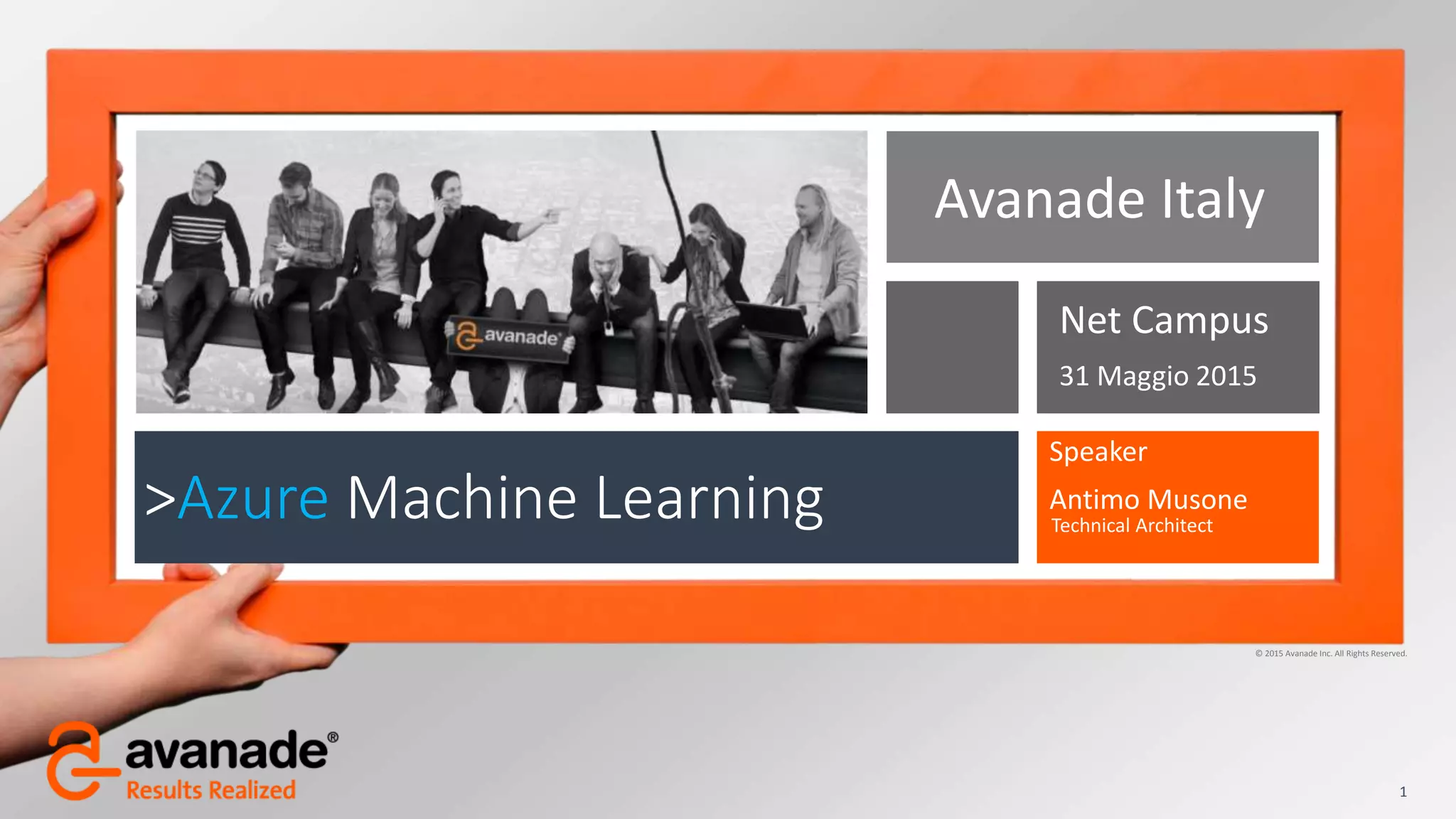
>Azure Machine Learning
Avanade Italy
Speaker
Antimo Musone
Net Campus
31 Maggio 2015
1
Technical Architect
© 2015 Avanade Inc. All Rights Reserved. | 2
About Me
Engineer of II University of Naples
In Avanade dal 2006
Technical Architect Cloud & Mobile
Co-Founder Fifth Ingenium
© 2015 Avanade Inc. All Rights Reserved.
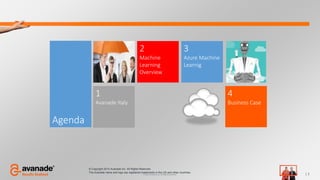
Agenda
2
Machine
Learning
Overview
1
Avanade Italy
3
Azure Machine
Learnig
4
Business Case
| 3
© Copyright 2014 Avanade Inc. All Rights Reserved.
The Avanade name and logo are registered trademarks in the US and other countries.
4
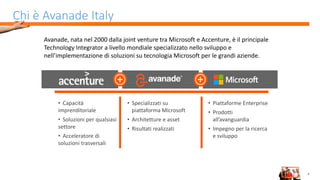
Chi è Avanade Italy
Avanade, nata nel 2000 dalla joint venture tra Microsoft e Accenture, è il principale
Technology Integrator a livello mondiale specializzato nello sviluppo e
nell’implementazione di soluzioni su tecnologia Microsoft per le grandi aziende.
• Capacità
imprenditoriale
• Soluzioni per qualsiasi
settore
• Acceleratore di
soluzioni trasversali
• Specializzati su
piattaforma Microsoft
• Architetture e asset
• Risultati realizzati
• Piattaforme Enterprise
• Prodotti
all’avanguardia
• Impegno per la ricerca
e sviluppo
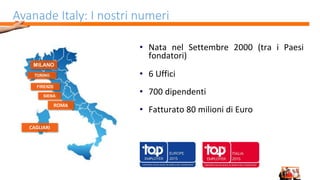
Avanade Italy: I nostri numeri
CAGLIARI
• Nata nel Settembre 2000 (tra i Paesi
fondatori)
• 6 Uffici
• 700 dipendenti
• Fatturato 80 milioni di Euro
ROMA
What is Machine Learning ?
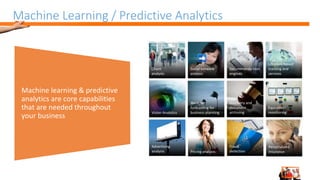
Machine Learning / Predictive Analytics
Vision Analytics
Recommenda-tion
engines
Advertising
analysis
Weather
forecasting for
business planning
Social network
analysis
Legal
discovery and
document
archiving
Pricing analysis
Fraud
detection
Churn
analysis
Equipment
monitoring
Location-based
tracking and
services
Personalized
Insurance
Machine learning & predictive
analytics are core capabilities
that are needed throughout
your business
Machine Learning Overview
• Formal definition: “The field of machine learning is concerned with the
question of how to construct computer programs that automatically improve
with experience” - Tom M. Mitchell
• Another definition: “The goal of machine learning is to program computers
to use example data or past experience to solve a given problem.” – Introduction to
Machine Learning, 2nd Edition, MIT Press
• ML often involves two primary techniques:
• Supervised Learning: Finding the mapping between inputs and outputs using correct
values to “train” a model
• Unsupervised Learning: Finding patterns in the input data (similar to Density Estimates in
Statistics)
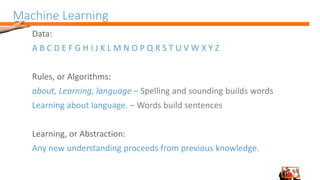
Machine Learning
Data:
A B C D E F G H I J K L M N O P Q R S T U V W X Y Z
Rules, or Algorithms:
about, Learning, language – Spelling and sounding builds words
Learning about language. – Words build sentences
Learning, or Abstraction:
Any new understanding proceeds from previous knowledge.
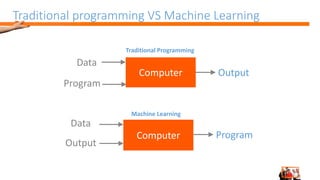
Traditional programming VS Machine Learning
Computer
Data
Program
Output
Computer
Data
Output
Program
Traditional Programming
Machine Learning
No, more like gardening
Gardener = You
Seeds = Algorithms
Nutrients = Data
Plants = Programs
Sample Application
• Web search
• Computational biology
• Finance
• E-commerce
• Space exploration
• Robotics
• Information extraction
• Social networks
• Debugging
• [Your favorite area]
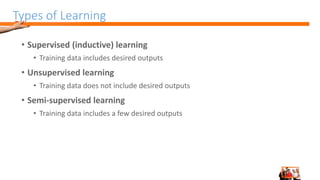
Types of Learning
• Supervised (inductive) learning
• Training data includes desired outputs
• Unsupervised learning
• Training data does not include desired outputs
• Semi-supervised learning
• Training data includes a few desired outputs
Machine Learning Problem
Classification or
Categorization
Clustering
Regression
Dimensionality
reduction
Supervised Learning Unsupervised Learning
DiscreteContinuous
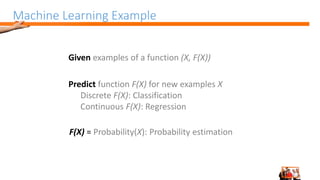
Machine Learning Example
Predict function F(X) for new examples X
Discrete F(X): Classification
Continuous F(X): Regression
F(X) = Probability(X): Probability estimation
Given examples of a function (X, F(X))
Machine Learning Example
• Training: given a training set of labeled examples {(x1,y1), …, (xN,yN)}, estimate the prediction
function f by minimizing the prediction error on the training set
• Testing: apply f to a never before seen test example x and output the predicted value y = f(x)
output prediction
function
Image
feature
y = f(x)
Apply a prediction function to a feature representation of the image to get the desired
output:
F( ) = «apple»
F( ) = «tomato»
F( ) = «dog»
Supervised Learning
1. Used when you want to predict unknown answers from answers you already
have
2. Data is divided into two parts: the data you will use to “teach” the system (data
set), and the data to test the algorithm (test set)
3. After you select and clean the data, you select data points that show the right
relationships in the data. The answers are “labels”, the
categories/columns/attributes are “features” and the values are…values.
4. Then you select an algorithm to compute the outcome. (Often you choose more
than one)
5. You run the program on the data set, and check to see if you got the right answer
from the test set.
6. Once you perform the experiment, you select the best model. This is the final
output – the model is then used against more data to get the answers you need
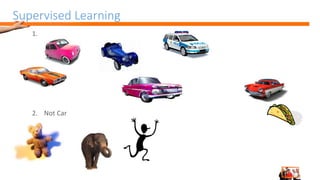
Supervised Learning
1. Car
2. Not Car
Unsupervised Learning
1. Used when you want to find unknown answers – mostly groupings -
directly from data
2. No simple way to evaluate accuracy of what you learn
3. Evaluates more vectors, groups into sets or classifications
4. Start with the data
5. Apply algorithm
6. Evaluate groups
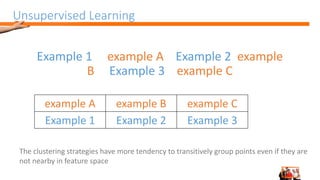
Unsupervised Learning
Example 1 example A Example 2 example
B Example 3 example C
example A example B example C
Example 1 Example 2 Example 3
The clustering strategies have more tendency to transitively group points even if they are
not nearby in feature space
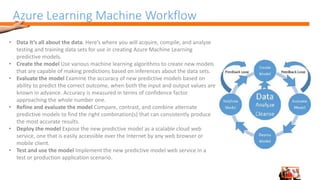
Azure Learning Machine Workflow
• Data It’s all about the data. Here’s where you will acquire, compile, and analyze
testing and training data sets for use in creating Azure Machine Learning
predictive models.
• Create the model Use various machine learning algorithms to create new models
that are capable of making predictions based on inferences about the data sets.
• Evaluate the model Examine the accuracy of new predictive models based on
ability to predict the correct outcome, when both the input and output values are
known in advance. Accuracy is measured in terms of confidence factor
approaching the whole number one.
• Refine and evaluate the model Compare, contrast, and combine alternate
predictive models to find the right combination(s) that can consistently produce
the most accurate results.
• Deploy the model Expose the new predictive model as a scalable cloud web
service, one that is easily accessible over the Internet by any web browser or
mobile client.
• Test and use the model Implement the new predictive model web service in a
test or production application scenario.
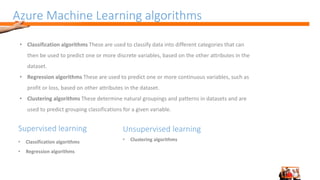
Azure Machine Learning algorithms
• Classification algorithms These are used to classify data into different categories that can
then be used to predict one or more discrete variables, based on the other attributes in the
dataset.
• Regression algorithms These are used to predict one or more continuous variables, such as
profit or loss, based on other attributes in the dataset.
• Clustering algorithms These determine natural groupings and patterns in datasets and are
used to predict grouping classifications for a given variable.
Supervised learning
• Classification algorithms
• Regression algorithms
Unsupervised learning
• Clustering algorithms
Steps Recap
Deploying a prediction model
The deployment of a new prediction model takes the form of exposing a web service
which can then be invoked via the Representational State Transfer (REST) protocol.
• Azure Machine Learning web services can be called via two different exposed interfaces:
• Single, request/response-style calls.
• “Batch” style calls, where multiple input records are passed into the web service in a single call and the corresponding
response contains an output list of predictions for each input record.
When a new machine learning prediction model is exposed on the Web, it performs the
following operations:
• New input data is passed into the web service in the form of a JavaScript Object Notation (JSON) payload.
• The web service then passes the incoming data as inputs into the Azure Machine Learning prediction model engine.
• The Azure Machine Learning model then generates a new prediction based on the input data and returns the new
prediction results to the caller via a JSON payload.
AzureML
• Why AzureML?
• Setting up a Microsoft Azure Account
• Setting up a Storage Account
• Loading Data
• Setting up an AzureML Workspace
• Accessing AzureML Studio
• AzureML Studio Tour
Azure ML Getting Started
Option 1 Take advantage of a free Azure trial offer at
http://azure.microsoft.com/en-us/pricing/free-trial
Option 2 Take advantage of the (free) Azure Machine Learning
trial offer at https://studio.azureml.net/Home
How to get started ?
Azure ML Getting Started
Option 1 Take advantage of a free Azure trial offer at
http://azure.microsoft.com/en-us/pricing/free-trial
Option 2 Take advantage of the (free) Azure Machine Learning
trial offer at https://studio.azureml.net/Home
Azure Machine Learning workspaces
• Experiments
• Azure ML Studio
• Web Services
• Datasets
• Modules
Demo
Azure Machine Learning Portal Overview
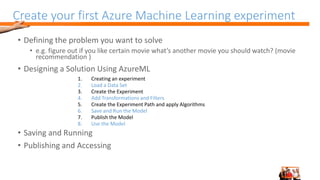
Create your first Azure Machine Learning experiment
• Defining the problem you want to solve
• e.g. figure out if you like certain movie what’s another movie you should watch? (movie
recommendation )
• Designing a Solution Using AzureML
1. Creating an experiment
2. Load a Data Set
3. Create the Experiment
4. Add Transformations and Filters
5. Create the Experiment Path and apply Algorithms
6. Save and Run the Model
7. Publish the Model
8. Use the Model
• Saving and Running
• Publishing and Accessing
Demo
Azure Machine Learning Demo
 Predict ratings for a given user and movie
 Recommend movie to a given user
 Find users related to a given user
 Find items related to a given item
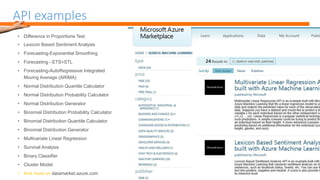
API examples
• Difference in Proportions Test
• Lexicon Based Sentiment Analysis
• Forecasting-Exponential Smoothing
• Forecasting - ETS+STL
• Forecasting-AutoRegressive Integrated
Moving Average (ARIMA)
• Normal Distribution Quantile Calculator
• Normal Distribution Probability Calculator
• Normal Distribution Generator
• Binomial Distribution Probability Calculator
• Binomial Distribution Quantile Calculator
• Binomial Distribution Generator
• Multivariate Linear Regression
• Survival Analysis
• Binary Classifier
• Cluster Model
datamarket.azure.com
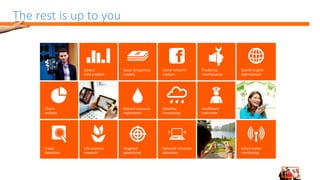
The rest is up to you
Sell your Azure Machine Learnig Service
Publish Azure Machine Learning Web Service to the Azure Marketplace
• http://azure.microsoft.com/en-us/documentation/articles/machine-learning-publish-web-service-to-
azure-marketplace
• http://datamarket.azure.com
Azure Marketplace
Check out the Machine Learning marketplace
at datamarket.azure.com
Learn how to on-board to the
marketplace off azure.com at
Machine Learning Center
Visit the Microsoft booth to talk
to the team
Next Steps
Avanade Business Case
Connected Mine Walk Through
( IOT + Azure Machine Learning)
© 2014 Avanade Inc. All Rights Reserved.
Thanks!
39
© 2015 Avanade Inc. All Rights Reserved.
Follow us on:
http://www.avanade.com/it-it/home
http://blog.avanade.com/inside-avanade/
https://it-it.facebook.com/avanade.italy
https://twitter.com/avanadeitaly
https://www.linkedin.com/company/avanade-italy?trk=biz-brand-tree-
co-name

PREDICT THE FUTURE , MACHINE LEARNING & BIG DATA

  • 1.
    © 2015 AvanadeInc. All Rights Reserved. >Azure Machine Learning Avanade Italy Speaker Antimo Musone Net Campus 31 Maggio 2015 1 Technical Architect
  • 2.
    © 2015 AvanadeInc. All Rights Reserved. | 2 About Me Engineer of II University of Naples In Avanade dal 2006 Technical Architect Cloud & Mobile Co-Founder Fifth Ingenium
  • 3.
    © 2015 AvanadeInc. All Rights Reserved. Agenda 2 Machine Learning Overview 1 Avanade Italy 3 Azure Machine Learnig 4 Business Case | 3 © Copyright 2014 Avanade Inc. All Rights Reserved. The Avanade name and logo are registered trademarks in the US and other countries.
  • 4.
    4 Chi è AvanadeItaly Avanade, nata nel 2000 dalla joint venture tra Microsoft e Accenture, è il principale Technology Integrator a livello mondiale specializzato nello sviluppo e nell’implementazione di soluzioni su tecnologia Microsoft per le grandi aziende. • Capacità imprenditoriale • Soluzioni per qualsiasi settore • Acceleratore di soluzioni trasversali • Specializzati su piattaforma Microsoft • Architetture e asset • Risultati realizzati • Piattaforme Enterprise • Prodotti all’avanguardia • Impegno per la ricerca e sviluppo
  • 5.
    Avanade Italy: Inostri numeri CAGLIARI • Nata nel Settembre 2000 (tra i Paesi fondatori) • 6 Uffici • 700 dipendenti • Fatturato 80 milioni di Euro ROMA
  • 6.
    What is MachineLearning ?
  • 7.
    Machine Learning /Predictive Analytics Vision Analytics Recommenda-tion engines Advertising analysis Weather forecasting for business planning Social network analysis Legal discovery and document archiving Pricing analysis Fraud detection Churn analysis Equipment monitoring Location-based tracking and services Personalized Insurance Machine learning & predictive analytics are core capabilities that are needed throughout your business
  • 8.
    Machine Learning Overview •Formal definition: “The field of machine learning is concerned with the question of how to construct computer programs that automatically improve with experience” - Tom M. Mitchell • Another definition: “The goal of machine learning is to program computers to use example data or past experience to solve a given problem.” – Introduction to Machine Learning, 2nd Edition, MIT Press • ML often involves two primary techniques: • Supervised Learning: Finding the mapping between inputs and outputs using correct values to “train” a model • Unsupervised Learning: Finding patterns in the input data (similar to Density Estimates in Statistics)
  • 9.
    Machine Learning Data: A BC D E F G H I J K L M N O P Q R S T U V W X Y Z Rules, or Algorithms: about, Learning, language – Spelling and sounding builds words Learning about language. – Words build sentences Learning, or Abstraction: Any new understanding proceeds from previous knowledge.
  • 10.
    Traditional programming VSMachine Learning Computer Data Program Output Computer Data Output Program Traditional Programming Machine Learning
  • 11.
    No, more likegardening Gardener = You Seeds = Algorithms Nutrients = Data Plants = Programs
  • 12.
    Sample Application • Websearch • Computational biology • Finance • E-commerce • Space exploration • Robotics • Information extraction • Social networks • Debugging • [Your favorite area]
  • 13.
    Types of Learning •Supervised (inductive) learning • Training data includes desired outputs • Unsupervised learning • Training data does not include desired outputs • Semi-supervised learning • Training data includes a few desired outputs
  • 14.
    Machine Learning Problem Classificationor Categorization Clustering Regression Dimensionality reduction Supervised Learning Unsupervised Learning DiscreteContinuous
  • 15.
    Machine Learning Example Predictfunction F(X) for new examples X Discrete F(X): Classification Continuous F(X): Regression F(X) = Probability(X): Probability estimation Given examples of a function (X, F(X))
  • 16.
    Machine Learning Example •Training: given a training set of labeled examples {(x1,y1), …, (xN,yN)}, estimate the prediction function f by minimizing the prediction error on the training set • Testing: apply f to a never before seen test example x and output the predicted value y = f(x) output prediction function Image feature y = f(x) Apply a prediction function to a feature representation of the image to get the desired output: F( ) = «apple» F( ) = «tomato» F( ) = «dog»
  • 17.
    Supervised Learning 1. Usedwhen you want to predict unknown answers from answers you already have 2. Data is divided into two parts: the data you will use to “teach” the system (data set), and the data to test the algorithm (test set) 3. After you select and clean the data, you select data points that show the right relationships in the data. The answers are “labels”, the categories/columns/attributes are “features” and the values are…values. 4. Then you select an algorithm to compute the outcome. (Often you choose more than one) 5. You run the program on the data set, and check to see if you got the right answer from the test set. 6. Once you perform the experiment, you select the best model. This is the final output – the model is then used against more data to get the answers you need
  • 18.
  • 19.
    Unsupervised Learning 1. Usedwhen you want to find unknown answers – mostly groupings - directly from data 2. No simple way to evaluate accuracy of what you learn 3. Evaluates more vectors, groups into sets or classifications 4. Start with the data 5. Apply algorithm 6. Evaluate groups
  • 20.
    Unsupervised Learning Example 1example A Example 2 example B Example 3 example C example A example B example C Example 1 Example 2 Example 3 The clustering strategies have more tendency to transitively group points even if they are not nearby in feature space
  • 21.
    Azure Learning MachineWorkflow • Data It’s all about the data. Here’s where you will acquire, compile, and analyze testing and training data sets for use in creating Azure Machine Learning predictive models. • Create the model Use various machine learning algorithms to create new models that are capable of making predictions based on inferences about the data sets. • Evaluate the model Examine the accuracy of new predictive models based on ability to predict the correct outcome, when both the input and output values are known in advance. Accuracy is measured in terms of confidence factor approaching the whole number one. • Refine and evaluate the model Compare, contrast, and combine alternate predictive models to find the right combination(s) that can consistently produce the most accurate results. • Deploy the model Expose the new predictive model as a scalable cloud web service, one that is easily accessible over the Internet by any web browser or mobile client. • Test and use the model Implement the new predictive model web service in a test or production application scenario.
  • 22.
    Azure Machine Learningalgorithms • Classification algorithms These are used to classify data into different categories that can then be used to predict one or more discrete variables, based on the other attributes in the dataset. • Regression algorithms These are used to predict one or more continuous variables, such as profit or loss, based on other attributes in the dataset. • Clustering algorithms These determine natural groupings and patterns in datasets and are used to predict grouping classifications for a given variable. Supervised learning • Classification algorithms • Regression algorithms Unsupervised learning • Clustering algorithms
  • 23.
  • 24.
    Deploying a predictionmodel The deployment of a new prediction model takes the form of exposing a web service which can then be invoked via the Representational State Transfer (REST) protocol. • Azure Machine Learning web services can be called via two different exposed interfaces: • Single, request/response-style calls. • “Batch” style calls, where multiple input records are passed into the web service in a single call and the corresponding response contains an output list of predictions for each input record. When a new machine learning prediction model is exposed on the Web, it performs the following operations: • New input data is passed into the web service in the form of a JavaScript Object Notation (JSON) payload. • The web service then passes the incoming data as inputs into the Azure Machine Learning prediction model engine. • The Azure Machine Learning model then generates a new prediction based on the input data and returns the new prediction results to the caller via a JSON payload.
  • 25.
    AzureML • Why AzureML? •Setting up a Microsoft Azure Account • Setting up a Storage Account • Loading Data • Setting up an AzureML Workspace • Accessing AzureML Studio • AzureML Studio Tour
  • 26.
    Azure ML GettingStarted Option 1 Take advantage of a free Azure trial offer at http://azure.microsoft.com/en-us/pricing/free-trial Option 2 Take advantage of the (free) Azure Machine Learning trial offer at https://studio.azureml.net/Home How to get started ?
  • 27.
    Azure ML GettingStarted Option 1 Take advantage of a free Azure trial offer at http://azure.microsoft.com/en-us/pricing/free-trial Option 2 Take advantage of the (free) Azure Machine Learning trial offer at https://studio.azureml.net/Home
  • 28.
    Azure Machine Learningworkspaces • Experiments • Azure ML Studio • Web Services • Datasets • Modules
  • 29.
  • 30.
    Create your firstAzure Machine Learning experiment • Defining the problem you want to solve • e.g. figure out if you like certain movie what’s another movie you should watch? (movie recommendation ) • Designing a Solution Using AzureML 1. Creating an experiment 2. Load a Data Set 3. Create the Experiment 4. Add Transformations and Filters 5. Create the Experiment Path and apply Algorithms 6. Save and Run the Model 7. Publish the Model 8. Use the Model • Saving and Running • Publishing and Accessing
  • 31.
    Demo Azure Machine LearningDemo  Predict ratings for a given user and movie  Recommend movie to a given user  Find users related to a given user  Find items related to a given item
  • 32.
    API examples • Differencein Proportions Test • Lexicon Based Sentiment Analysis • Forecasting-Exponential Smoothing • Forecasting - ETS+STL • Forecasting-AutoRegressive Integrated Moving Average (ARIMA) • Normal Distribution Quantile Calculator • Normal Distribution Probability Calculator • Normal Distribution Generator • Binomial Distribution Probability Calculator • Binomial Distribution Quantile Calculator • Binomial Distribution Generator • Multivariate Linear Regression • Survival Analysis • Binary Classifier • Cluster Model datamarket.azure.com
  • 33.
    The rest isup to you
  • 34.
    Sell your AzureMachine Learnig Service Publish Azure Machine Learning Web Service to the Azure Marketplace • http://azure.microsoft.com/en-us/documentation/articles/machine-learning-publish-web-service-to- azure-marketplace • http://datamarket.azure.com Azure Marketplace
  • 35.
    Check out theMachine Learning marketplace at datamarket.azure.com Learn how to on-board to the marketplace off azure.com at Machine Learning Center Visit the Microsoft booth to talk to the team Next Steps
  • 36.
    Avanade Business Case ConnectedMine Walk Through ( IOT + Azure Machine Learning)
  • 37.
    © 2014 AvanadeInc. All Rights Reserved. Thanks! 39
  • 38.
    © 2015 AvanadeInc. All Rights Reserved. Follow us on: http://www.avanade.com/it-it/home http://blog.avanade.com/inside-avanade/ https://it-it.facebook.com/avanade.italy https://twitter.com/avanadeitaly https://www.linkedin.com/company/avanade-italy?trk=biz-brand-tree- co-name

Editor's Notes

  • #5 Avanade è un’azienda nata nel 2000 dalla join venture tra microsoft ed Accenture ed è il principale Technology Integrator nello sviluppo di soluzioni basati su tecnologia Microsoft. Avanade è quindi un’azienda specializzata su tecnologie microsoft che eredita da microsoft ed accenture i punti di forza quali, ad esempio, lo sviluppo di soluzioni tramite l’utilizzo di prodotti all’avanguardia creando dei valori aggiunti sia per i clienti che per i propri dipendenti che hanno, così, la possibilità di conoscere nuove tecnologie.
  • #10 I Dati + Rule = Machine Learning