Template designed by
cert-path
70-483 – Programming in C#
Roberto Freato – Freelance IT Consultant & Trainer
MVP on Windows Azure, Microsoft Certified Trainer
child@ocdstudio.net - @childotg
• Cos’è il cert path del DotNetCampus?
• Le certificazioni professionali, tecniche e di prodotto
• I diversi percorsi di certificazione Microsoft – MCP e MCT
• L’ esame 70-483: Programming in C#
cert path
• La lingua universale del software (en-us)
• Esperienza vs. Studio
• Il programma d’esame
• Il metodo d’esame
focus
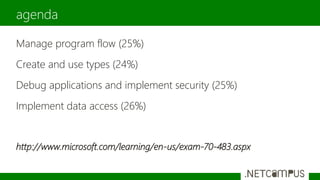
Manage program flow (25%)
Create and use types (24%)
Debug applications and implement security (25%)
Implement data access (26%)
http://www.microsoft.com/learning/en-us/exam-70-483.aspx
agenda
Let’sgo
Manage program flow
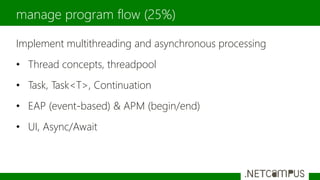
Implement multithreading and asynchronous processing
• Thread concepts, threadpool
• Task, Task<T>, Continuation
• EAP (event-based) & APM (begin/end)
• UI, Async/Await
manage program flow (25%)
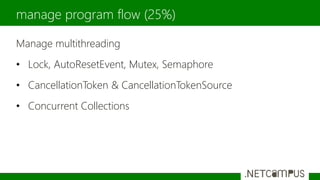
Manage multithreading
• Lock, AutoResetEvent, Mutex, Semaphore
• CancellationToken & CancellationTokenSource
• Concurrent Collections
manage program flow (25%)
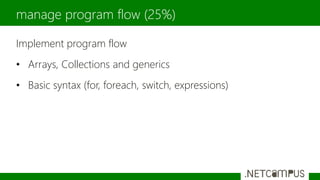
Implement program flow
• Arrays, Collections and generics
• Basic syntax (for, foreach, switch, expressions)
manage program flow (25%)
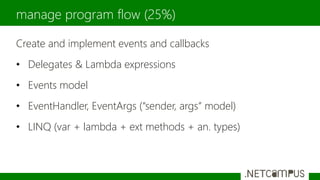
Create and implement events and callbacks
• Delegates & Lambda expressions
• Events model
• EventHandler, EventArgs (“sender, args” model)
• LINQ (var + lambda + ext methods + an. types)
manage program flow (25%)
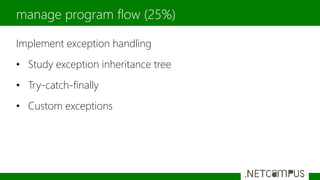
Implement exception handling
• Study exception inheritance tree
• Try-catch-finally
• Custom exceptions
manage program flow (25%)
domanda
Let’sgo
Create and use types
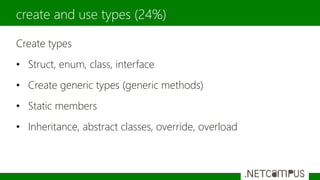
Create types
• Struct, enum, class, interface
• Create generic types (generic methods)
• Static members
• Inheritance, abstract classes, override, overload
create and use types (24%)
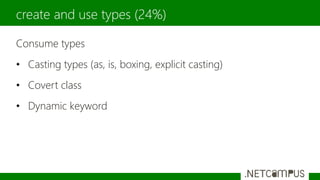
Consume types
• Casting types (as, is, boxing, explicit casting)
• Covert class
• Dynamic keyword
create and use types (24%)
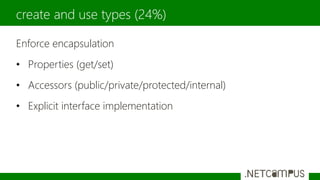
Enforce encapsulation
• Properties (get/set)
• Accessors (public/private/protected/internal)
• Explicit interface implementation
create and use types (24%)
Create and implement a class hierarchy
• Inheritance, abstract methods
• Common interfaces: IComparable, IDisposable
• IEnumerable!!!!!!!!!!
• IUnknown?!?!?
create and use types (24%)
Find, execute, and create types at runtime by using reflection
• Assembly, PropertyInfo, Type class
• Object base type
• NB: “reflect everything”
create and use types (24%)
Manage the object life cycle
• IDisposable again (finalization, using)
• Garbage collection (really?)
create and use types (24%)
Manipulate strings
• StringBuilder
• StringReader/Writer
• Regular Expressions
• String class, string.Format, Split, etc..
create and use types (24%)
domanda
Let’sgo
Debug applications and
implement security
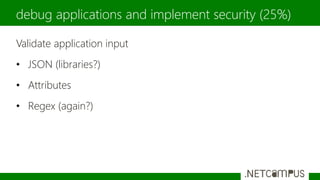
Validate application input
• JSON (libraries?)
• Attributes
• Regex (again?)
debug applications and implement security (25%)
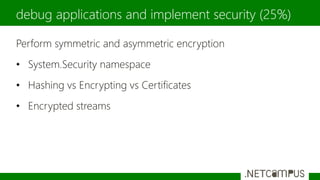
Perform symmetric and asymmetric encryption
• System.Security namespace
• Hashing vs Encrypting vs Certificates
• Encrypted streams
debug applications and implement security (25%)
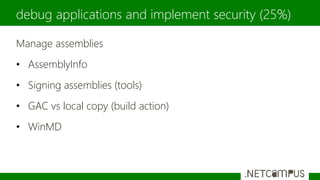
Manage assemblies
• AssemblyInfo
• Signing assemblies (tools)
• GAC vs local copy (build action)
• WinMD
debug applications and implement security (25%)
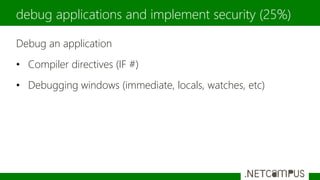
Debug an application
• Compiler directives (IF #)
• Debugging windows (immediate, locals, watches, etc)
debug applications and implement security (25%)
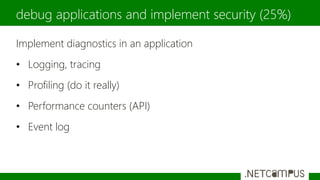
Implement diagnostics in an application
• Logging, tracing
• Profiling (do it really)
• Performance counters (API)
• Event log
debug applications and implement security (25%)
domanda
Let’sgo
Implement data access
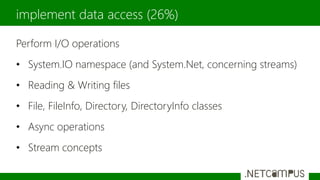
Perform I/O operations
• System.IO namespace (and System.Net, concerning streams)
• Reading & Writing files
• File, FileInfo, Directory, DirectoryInfo classes
• Async operations
• Stream concepts
implement data access (26%)
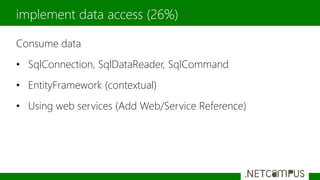
Consume data
• SqlConnection, SqlDataReader, SqlCommand
• EntityFramework (contextual)
• Using web services (Add Web/Service Reference)
implement data access (26%)
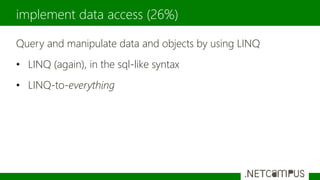
Query and manipulate data and objects by using LINQ
• LINQ (again), in the sql-like syntax
• LINQ-to-everything
implement data access (26%)
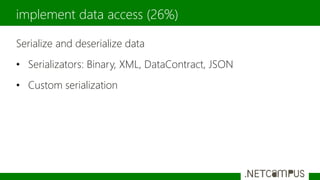
Serialize and deserialize data
• Serializators: Binary, XML, DataContract, JSON
• Custom serialization
implement data access (26%)
Store data in and retrieve data from collections
• Dictionaries, dictionaries, dictionaries
• Collections’ interfaces
• Typed vs. non-typed
implement data access (26%)
domanda
Template designed by
cert-path
70-483 – Programming in C#
Roberto Freato – Freelance IT Consultant & Trainer
MVP on Windows Azure, Microsoft Certified Trainer
child@ocdstudio.net - @childotg

70-483: PROGRAMMING IN C#

  • 1.
    Template designed by cert-path 70-483– Programming in C# Roberto Freato – Freelance IT Consultant & Trainer MVP on Windows Azure, Microsoft Certified Trainer child@ocdstudio.net - @childotg
  • 2.
    • Cos’è ilcert path del DotNetCampus? • Le certificazioni professionali, tecniche e di prodotto • I diversi percorsi di certificazione Microsoft – MCP e MCT • L’ esame 70-483: Programming in C# cert path
  • 3.
    • La linguauniversale del software (en-us) • Esperienza vs. Studio • Il programma d’esame • Il metodo d’esame focus
  • 4.
    Manage program flow(25%) Create and use types (24%) Debug applications and implement security (25%) Implement data access (26%) http://www.microsoft.com/learning/en-us/exam-70-483.aspx agenda
  • 5.
  • 6.
    Implement multithreading andasynchronous processing • Thread concepts, threadpool • Task, Task<T>, Continuation • EAP (event-based) & APM (begin/end) • UI, Async/Await manage program flow (25%)
  • 7.
    Manage multithreading • Lock,AutoResetEvent, Mutex, Semaphore • CancellationToken & CancellationTokenSource • Concurrent Collections manage program flow (25%)
  • 8.
    Implement program flow •Arrays, Collections and generics • Basic syntax (for, foreach, switch, expressions) manage program flow (25%)
  • 9.
    Create and implementevents and callbacks • Delegates & Lambda expressions • Events model • EventHandler, EventArgs (“sender, args” model) • LINQ (var + lambda + ext methods + an. types) manage program flow (25%)
  • 10.
    Implement exception handling •Study exception inheritance tree • Try-catch-finally • Custom exceptions manage program flow (25%)
  • 11.
  • 12.
  • 13.
    Create types • Struct,enum, class, interface • Create generic types (generic methods) • Static members • Inheritance, abstract classes, override, overload create and use types (24%)
  • 14.
    Consume types • Castingtypes (as, is, boxing, explicit casting) • Covert class • Dynamic keyword create and use types (24%)
  • 15.
    Enforce encapsulation • Properties(get/set) • Accessors (public/private/protected/internal) • Explicit interface implementation create and use types (24%)
  • 16.
    Create and implementa class hierarchy • Inheritance, abstract methods • Common interfaces: IComparable, IDisposable • IEnumerable!!!!!!!!!! • IUnknown?!?!? create and use types (24%)
  • 17.
    Find, execute, andcreate types at runtime by using reflection • Assembly, PropertyInfo, Type class • Object base type • NB: “reflect everything” create and use types (24%)
  • 18.
    Manage the objectlife cycle • IDisposable again (finalization, using) • Garbage collection (really?) create and use types (24%)
  • 19.
    Manipulate strings • StringBuilder •StringReader/Writer • Regular Expressions • String class, string.Format, Split, etc.. create and use types (24%)
  • 20.
  • 21.
  • 22.
    Validate application input •JSON (libraries?) • Attributes • Regex (again?) debug applications and implement security (25%)
  • 23.
    Perform symmetric andasymmetric encryption • System.Security namespace • Hashing vs Encrypting vs Certificates • Encrypted streams debug applications and implement security (25%)
  • 24.
    Manage assemblies • AssemblyInfo •Signing assemblies (tools) • GAC vs local copy (build action) • WinMD debug applications and implement security (25%)
  • 25.
    Debug an application •Compiler directives (IF #) • Debugging windows (immediate, locals, watches, etc) debug applications and implement security (25%)
  • 26.
    Implement diagnostics inan application • Logging, tracing • Profiling (do it really) • Performance counters (API) • Event log debug applications and implement security (25%)
  • 27.
  • 28.
  • 29.
    Perform I/O operations •System.IO namespace (and System.Net, concerning streams) • Reading & Writing files • File, FileInfo, Directory, DirectoryInfo classes • Async operations • Stream concepts implement data access (26%)
  • 30.
    Consume data • SqlConnection,SqlDataReader, SqlCommand • EntityFramework (contextual) • Using web services (Add Web/Service Reference) implement data access (26%)
  • 31.
    Query and manipulatedata and objects by using LINQ • LINQ (again), in the sql-like syntax • LINQ-to-everything implement data access (26%)
  • 32.
    Serialize and deserializedata • Serializators: Binary, XML, DataContract, JSON • Custom serialization implement data access (26%)
  • 33.
    Store data inand retrieve data from collections • Dictionaries, dictionaries, dictionaries • Collections’ interfaces • Typed vs. non-typed implement data access (26%)
  • 34.
  • 35.
    Template designed by cert-path 70-483– Programming in C# Roberto Freato – Freelance IT Consultant & Trainer MVP on Windows Azure, Microsoft Certified Trainer child@ocdstudio.net - @childotg