Consumer Behaviour:
     Perception


 Presented By: Rodrigue Eid
CONTENTS OF THE PRESENTATION
•   Perception process
•   Exposure / attention
•   Attention Grabbing
•   The Sensory Stimuli
•   The use of various methods to grab attention
•   Ethics
•   Conclusion
Perception Process
 The process whereby stimuli are received and interpreted by
  individuals & translated into a response (Engel et al, 1992)
 Perceptions are unique to each and every individual

                               Perception


               Exposure        Attention      Interpretation


       Eyes         Ears         Nose         Mouth              Skin


      Sights       Sounds       Smells         Tastes          Textures


                                            Adapted from: Solomon (2011)
EXPOSURE / ATTENTION
  • UK consumers are exposed to at least 2000 messages a day
    but only notice 5% (Blythe, 2008)
  • Americans are exposed to 18 million unsolicited phone calls
    daily and receive 3000 coupons a year (Blythe, 2008)
  • Consumers in Italy and Spain are exposed to over
    20,000 adverts per year (Blythe, 2008)

 Increase in advertising clutter
 There is no guarantee that the market will see or pay attention to messages
 Consumers scan the media and focus their attention on relevant messages
  [Initial attention] where as if something does not interest them
  they carry on scanning [persistent scanning] (Evans et al, 2006)
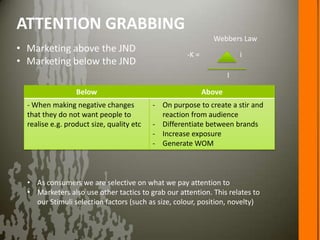
ATTENTION GRABBING
                                                              Webbers Law
• Marketing above the JND
                                                     -K =               i
• Marketing below the JND
                                                                    I

                  Below                                     Above
  - When making negative changes           - On purpose to create a stir and
  that they do not want people to            reaction from audience
  realise e.g. product size, quality etc   - Differentiate between brands
                                           - Increase exposure
                                           - Generate WOM


  • As consumers we are selective on what we pay attention to
  • Marketers also use other tactics to grab our attention. This relates to
    our Stimuli selection factors (such as size, colour, position, novelty)
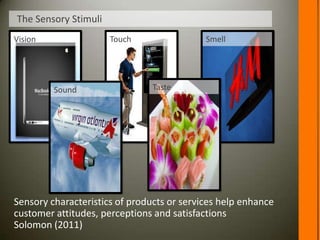
The Sensory Stimuli
Vision                Touch                 Smell


         Sound                  Taste


Sensory characteristics of products or services help enhance
customer attitudes, perceptions and satisfactions
Solomon (2011)
Sex                    Shock


            Packaging               Humour


Novelty &               Celebrity
 contrast
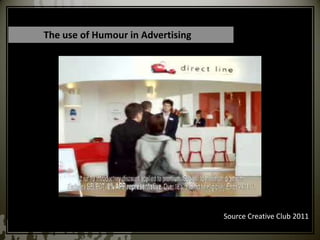
The use of Humour in Advertising


                                   Source Creative Club 2011
The use of Shock in Advertising
The use of Music in Advertising
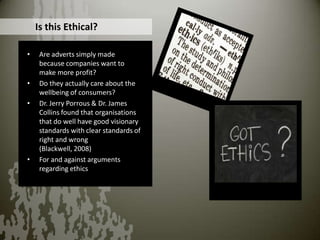
Is this Ethical?

•    Are adverts simply made
     because companies want to
     make more profit?
•    Do they actually care about the
     wellbeing of consumers?
•    Dr. Jerry Porrous & Dr. James
     Collins found that organisations
     that do well have good visionary
     standards with clear standards of
     right and wrong
     (Blackwell, 2008)
•    For and against arguments
     regarding ethics
Here are some more
     examples
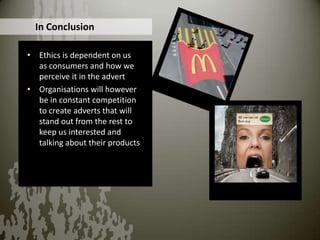
In Conclusion

• Ethics is dependent on us
  as consumers and how we
  perceive it in the advert
• Organisations will however
  be in constant competition
  to create adverts that will
  stand out from the rest to
  keep us interested and
  talking about their products
Any Questions?
References:

-   Blythe J. (2008) Consumer Behaviour. London: Thomson Learning
-   Evans, M,. Foxall, G,. And Jamal, A,. (2006) Consumer Behaviour. West
    Sussex: John Witley & Sons
-   Blackwell, R,. Engel, J,. And Minard, P,. Consumer Behaviour. China:
    Thomson Learning
-   Solomon, M,. (2011) Consumer Behaviour. 9th ed. London: Prentice
    hall
-   Engel AK, Kõnig P, Kreiter AK, Schilin TB, and Singer W (1992) Temporal
    coding in the visual cortex; new vistas on itergration in the nervous
    system. Trends Neurosci 15:218-226
-   www.google.co.uk
-   www.creativeclub.co.uk
-   www.youtube.co.uk

Preception presentation

  • 1.
    Consumer Behaviour: Perception Presented By: Rodrigue Eid
  • 2.
    CONTENTS OF THEPRESENTATION • Perception process • Exposure / attention • Attention Grabbing • The Sensory Stimuli • The use of various methods to grab attention • Ethics • Conclusion
  • 3.
    Perception Process  Theprocess whereby stimuli are received and interpreted by individuals & translated into a response (Engel et al, 1992)  Perceptions are unique to each and every individual Perception Exposure Attention Interpretation Eyes Ears Nose Mouth Skin Sights Sounds Smells Tastes Textures Adapted from: Solomon (2011)
  • 4.
    EXPOSURE / ATTENTION • UK consumers are exposed to at least 2000 messages a day but only notice 5% (Blythe, 2008) • Americans are exposed to 18 million unsolicited phone calls daily and receive 3000 coupons a year (Blythe, 2008) • Consumers in Italy and Spain are exposed to over 20,000 adverts per year (Blythe, 2008)  Increase in advertising clutter  There is no guarantee that the market will see or pay attention to messages  Consumers scan the media and focus their attention on relevant messages [Initial attention] where as if something does not interest them they carry on scanning [persistent scanning] (Evans et al, 2006)
  • 5.
    ATTENTION GRABBING Webbers Law • Marketing above the JND -K = i • Marketing below the JND I Below Above - When making negative changes - On purpose to create a stir and that they do not want people to reaction from audience realise e.g. product size, quality etc - Differentiate between brands - Increase exposure - Generate WOM • As consumers we are selective on what we pay attention to • Marketers also use other tactics to grab our attention. This relates to our Stimuli selection factors (such as size, colour, position, novelty)
  • 6.
    The Sensory Stimuli Vision Touch Smell Sound Taste Sensory characteristics of products or services help enhance customer attitudes, perceptions and satisfactions Solomon (2011)
  • 7.
    Sex Shock Packaging Humour Novelty & Celebrity contrast
  • 8.
    The use ofHumour in Advertising Source Creative Club 2011
  • 9.
    The use ofShock in Advertising
  • 10.
    The use ofMusic in Advertising
  • 11.
    Is this Ethical? • Are adverts simply made because companies want to make more profit? • Do they actually care about the wellbeing of consumers? • Dr. Jerry Porrous & Dr. James Collins found that organisations that do well have good visionary standards with clear standards of right and wrong (Blackwell, 2008) • For and against arguments regarding ethics
  • 12.
    Here are somemore examples
  • 13.
    In Conclusion • Ethicsis dependent on us as consumers and how we perceive it in the advert • Organisations will however be in constant competition to create adverts that will stand out from the rest to keep us interested and talking about their products
  • 14.
  • 15.
    References: - Blythe J. (2008) Consumer Behaviour. London: Thomson Learning - Evans, M,. Foxall, G,. And Jamal, A,. (2006) Consumer Behaviour. West Sussex: John Witley & Sons - Blackwell, R,. Engel, J,. And Minard, P,. Consumer Behaviour. China: Thomson Learning - Solomon, M,. (2011) Consumer Behaviour. 9th ed. London: Prentice hall - Engel AK, Kõnig P, Kreiter AK, Schilin TB, and Singer W (1992) Temporal coding in the visual cortex; new vistas on itergration in the nervous system. Trends Neurosci 15:218-226 - www.google.co.uk - www.creativeclub.co.uk - www.youtube.co.uk

Editor's Notes

  • #2 This template can be used as a starter file for a photo album.