OneOne--dimensional Consolidation anddimensional Consolidation and
Oedometer TestOedometer Test
Lecture No. 12
October 24, 2002
2
Settlement of a Soil LayerSettlement of a Soil Layer
• The settlement is defined as the compression of a
soil layer due to the loading applied at or near its
top surface.
• The total settlement of a soil layer consists of three
parts:
– Immediate or Elastic Compression
– Compression due to Primary Consolidation
– Compression due to Secondary Consolidation
• The immediate or elastic compression can be
calculated using the elastic theory if the elastic
modulus of the soil layer is known.
• In this topic, we will learn the consolidation
theory that is used to estimate the compression
due to primary and secondary consolidation.
3
What is Consolidation?What is Consolidation?
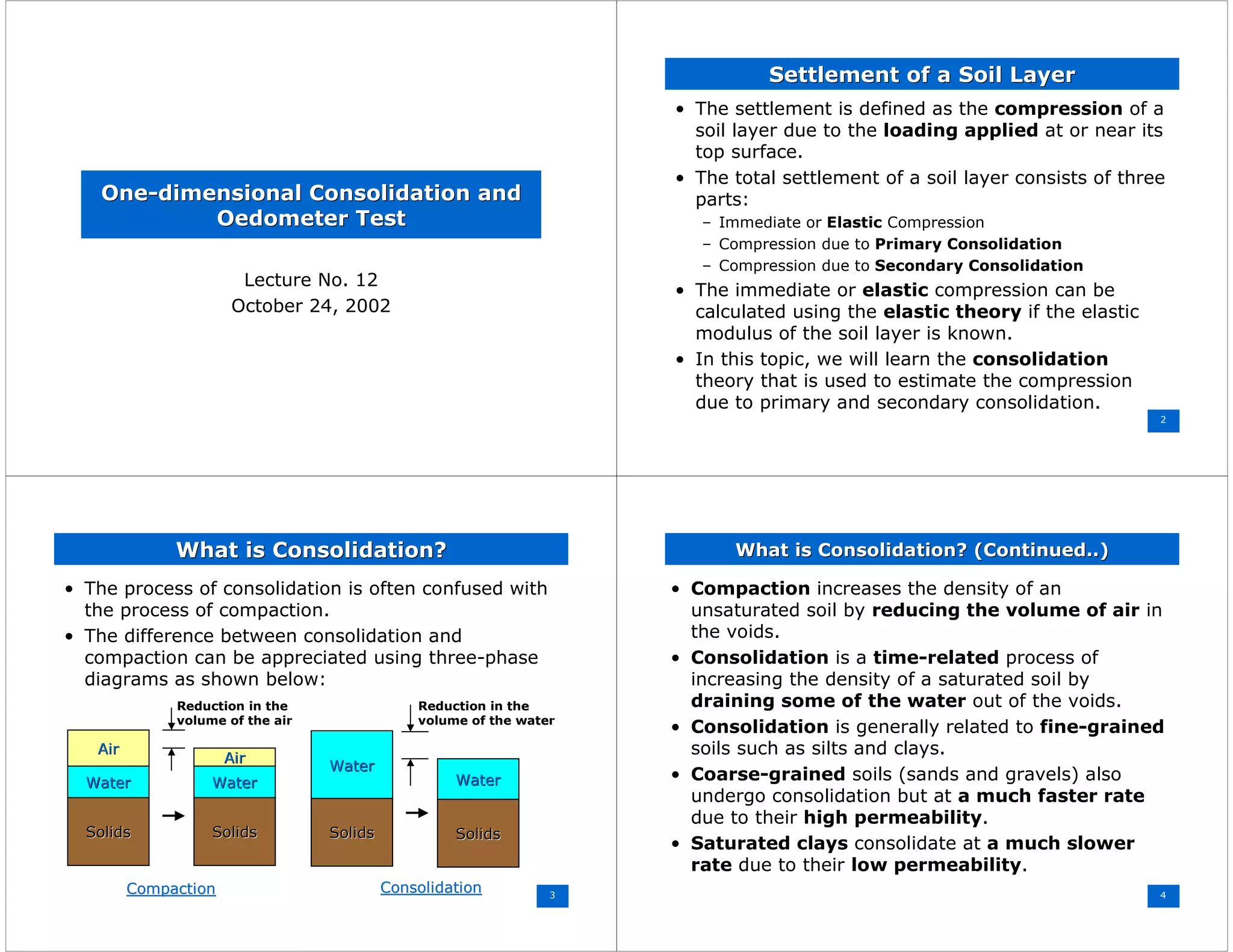
• The process of consolidation is often confused with
the process of compaction.
• The difference between consolidation and
compaction can be appreciated using three-phase
diagrams as shown below:
AirAir
WaterWater
SolidsSolids
AirAir
WaterWater
SolidsSolids
Reduction in the
volume of the air
CompactionCompaction
WaterWater
SolidsSolids
ConsolidationConsolidation
WaterWater
SolidsSolids
Reduction in the
volume of the water
4
What is Consolidation? (Continued..)What is Consolidation? (Continued..)
• Compaction increases the density of an
unsaturated soil by reducing the volume of air in
the voids.
• Consolidation is a time-related process of
increasing the density of a saturated soil by
draining some of the water out of the voids.
• Consolidation is generally related to fine-grained
soils such as silts and clays.
• Coarse-grained soils (sands and gravels) also
undergo consolidation but at a much faster rate
due to their high permeability.
• Saturated clays consolidate at a much slower
rate due to their low permeability.
5
The Need for Consolidation TheoryThe Need for Consolidation Theory
• Consolidation theory is required
for the prediction of both the
magnitude and the rate of
consolidation settlements to
ensure the serviceability of
structures founded on a
compressible soil layer.
• Differential settlements that
can lead to structural failures
due to tilting should be
avoided. Otherwise, you’ll need
extreme measures to save your
structure !
6
OneOne--dimensional Consolidationdimensional Consolidation
• Since water can flow out of a saturated soil
sample in any direction, the process of
consolidation is essentially three-dimensional.
• However, in most field situations, water will not
be able to flow out of the soil by flowing
horizontally because of the vast expanse of the
soil in horizontal direction.
• Therefore, the direction of flow of water is
primarily vertical or one-dimensional.
• As a result, the soil layer undergoes one-
dimensional or 1-D consolidation settlement
in the vertical direction.
7
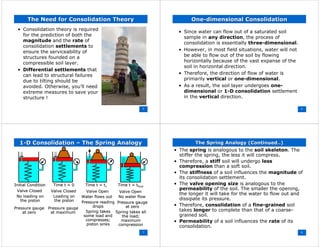
11--D ConsolidationD Consolidation –– The Spring AnalogyThe Spring Analogy
Initial ConditionInitial Condition Time t = 0Time t = 0 Time t = tTime t = t11 Time t =Time t = ttfinalfinal
Valve ClosedValve Closed
Pressure gaugePressure gauge
at zeroat zero
No loading onNo loading on
the pistonthe piston
Pressure gaugePressure gauge
at maximumat maximum
Loading onLoading on
the pistonthe piston
Valve ClosedValve Closed Valve OpenValve Open
Water flows outWater flows out
Pressure readingPressure reading
dropsdrops
Spring takesSpring takes
some load andsome load and
compresses;compresses;
piston sinkspiston sinks
Valve OpenValve Open
No water flowNo water flow
Pressure gaugePressure gauge
at zeroat zero
Spring takes allSpring takes all
the load;the load;
maximummaximum
compressioncompression
8
The Spring Analogy (Continued..)The Spring Analogy (Continued..)
• The spring is analogous to the soil skeleton. The
stiffer the spring, the less it will compress.
• Therefore, a stiff soil will undergo less
compression than a soft soil.
• The stiffness of a soil influences the magnitude of
its consolidation settlement.
• The valve opening size is analogous to the
permeability of the soil. The smaller the opening,
the longer it will take for the water to flow out and
dissipate its pressure.
• Therefore, consolidation of a fine-grained soil
takes longer to complete than that of a coarse-
grained soil.
• Permeability of a soil influences the rate of its
consolidation.
9
The Oedometer TestThe Oedometer Test
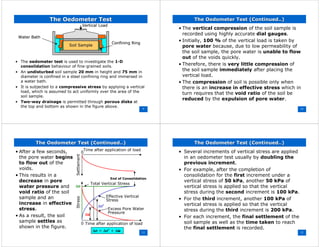
• The oedometer test is used to investigate the 1-D
consolidation behaviour of fine-grained soils.
• An undisturbed soil sample 20 mm in height and 75 mm in
diameter is confined in a steel confining ring and immersed in
a water bath.
• It is subjected to a compressive stress by applying a vertical
load, which is assumed to act uniformly over the area of the
soil sample.
• Two-way drainage is permitted through porous disks at
the top and bottom as shown in the figure above.
Soil SampleSoil Sample
Vertical LoadVertical Load
Confining RingConfining Ring
Water BathWater Bath
10
The Oedometer Test (Continued..)The Oedometer Test (Continued..)
• The vertical compression of the soil sample is
recorded using highly accurate dial gauges.
• Initially, 100 % of the vertical load is taken by
pore water because, due to low permeability of
the soil sample, the pore water is unable to flow
out of the voids quickly.
• Therefore, there is very little compression of
the soil sample immediately after placing the
vertical load.
• The compression of soil is possible only when
there is an increase in effective stress which in
turn requires that the void ratio of the soil be
reduced by the expulsion of pore water.
11
The Oedometer Test (Continued..)The Oedometer Test (Continued..)
• After a few seconds,
the pore water begins
to flow out of the
voids.
• This results in a
decrease in pore
water pressure and
void ratio of the soil
sample and an
increase in effective
stress.
• As a result, the soil
sample settles as
shown in the figure.
Time after application of load
Settlement
0
0 Time after application of load
Stress
Total Vertical Stress
Effective Vertical
Stress
Excess Pore Water
Pressure
End of Consolidation
∆u
∆σ’
∆σ
∆σ == ∆σ’ ++ ∆u 12
The Oedometer Test (Continued..)The Oedometer Test (Continued..)
• Several increments of vertical stress are applied
in an oedometer test usually by doubling the
previous increment.
• For example, after the completion of
consolidation for the first increment under a
vertical stress of 50 kPa, another 50 kPa of
vertical stress is applied so that the vertical
stress during the second increment is 100 kPa.
• For the third increment, another 100 kPa of
vertical stress is applied so that the vertical
stress during the third increment is 200 kPa.
• For each increment, the final settlement of the
soil sample as well as the time taken to reach
the final settlement is recorded.
13
The Oedometer Test (Continued..)The Oedometer Test (Continued..)
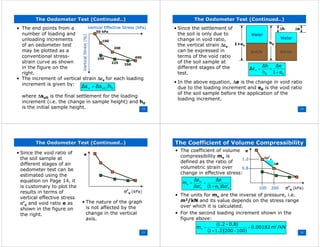
• The end points from a
number of loading and
unloading increments
of an oedometer test
may be plotted as a
conventional stress-
strain curve as shown
in the figure on the
right.
Vertical Effective Stress (Vertical Effective Stress (kPakPa))
50 kPa
100
200
400
350
225
100
VerticalStrain(%)VerticalStrain(%)
• The increment of vertical strain ∆εv for each loading
increment is given by:
0ultv h∆s∆ε =
where ∆sult is the final settlement for the loading
increment (i.e. the change in sample height) and h0
is the initial sample height. 14
The Oedometer Test (Continued..)The Oedometer Test (Continued..)
• Since the settlement of
the soil is only due to
change in void ratio,
the vertical strain ∆εv
can be expressed in
terms of the void ratio
of the soil sample at
different stages of the
test.
WaterWater
SolidsSolids
WaterWater
SolidsSolids
h0
∆h
1+eo
∆e
00
v
e1
∆e
h
∆h
∆ε
+
==
• In the above equation, ∆e is the change in void ratio
due to the loading increment and e0 is the void ratio
of the soil sample before the application of the
loading increment.
15
The Oedometer Test (Continued..)The Oedometer Test (Continued..)
• Since the void ratio of
the soil sample at
different stages of an
oedometer test can be
estimated using the
equation on Page 14, it
is customary to plot the
results in terms of
vertical effective stress
σ’v and void ratio e as
shown in the figure on
the right.
σ’v (kPa)
e
• The nature of the graph
is not affected by the
change in the vertical
axis.
16
The Coefficient of Volume CompressibilityThe Coefficient of Volume Compressibility
• The coefficient of volume
compressibility mv is
defined as the ratio of
volumetric strain over
change in effective stress:
σ’v (kPa)
e
∆∆ee
∆σ∆σ’’vv
( ) v0v
v
v
σ∆e1
∆e
σ∆
∆ε
m
′+
=
′
=
1.21.2
0.80.8
100100 200200
• The units for mv are the inverse of pressure, i.e.
m2/kN and its value depends on the stress range
over which it is calculated.
• For the second loading increment shown in the
figure above:
( )
( )( )
/kNm0.00182
1002001.21
0.8-1.2
m 2
v =
−+
=
17
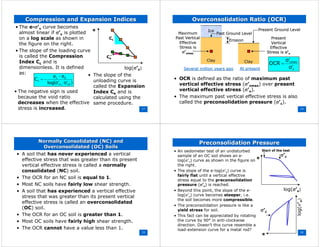
Compression and Expansion IndicesCompression and Expansion Indices
• The e-σ’v curve becomes
almost linear if σ’v is plotted
on a log scale as shown in
the figure on the right.
• The slope of the loading curve
is called the Compression
Index Cc and is
dimensionless. It is defined
as:
log(σ’v)
e
CCcc
CCee
( )v0v1
01
c
σσlog
ee
C
′′
−
−=
• The negative sign is used
because the void ratio
decreases when the effective
stress is increased.
• The slope of the
unloading curve is
called the Expansion
Index Ce and is
calculated using the
same procedure.
18
OverconsolidationOverconsolidation Ratio (OCR)Ratio (OCR)
• OCR is defined as the ratio of maximum past
vertical effective stress (σ’vmax) over present
vertical effective stress (σ’v).
• The maximum past vertical effective stress is also
called the preconsolidation pressure (σ’c).
IceIce
Past Ground LevelPast Ground Level
Present Ground LevelPresent Ground Level
ErosionErosion
ClayClay ClayClay
PresentPresent
VerticalVertical
EffectiveEffective
Stress isStress is σσ’’vv
MaximumMaximum
Past VerticalPast Vertical
EffectiveEffective
Stress isStress is
σσ’’vmaxvmax
Several million years agoSeveral million years ago At presentAt present v
vmax
σ
σ
OCR
′
′
=
19
Normally Consolidated (NC) andNormally Consolidated (NC) and
Overconsolidated (OC) SoilsOverconsolidated (OC) Soils
• A soil that has never experienced a vertical
effective stress that was greater than its present
vertical effective stress is called a normally
consolidated (NC) soil.
• The OCR for an NC soil is equal to 1.
• Most NC soils have fairly low shear strength.
• A soil that has experienced a vertical effective
stress that was greater than its present vertical
effective stress is called an overconsolidated
(OC) soil.
• The OCR for an OC soil is greater than 1.
• Most OC soils have fairly high shear strength.
• The OCR cannot have a value less than 1.
20
PreconsolidationPreconsolidation PressurePressure
• An oedometer test of an undisturbed
sample of an OC soil shows an e-
log(σ’v) curve as shown in the figure on
the right.
• The slope of the e-log(σ’v) curve is
fairly flat until a vertical effective
stress equal to the preconsolidation
pressure (σ’c) is reached.
• Beyond this point, the slope of the e-
log(σ’v) curve becomes steeper, i.e.
the soil becomes more compressible.
• The preconsolidation pressure is like a
yield stress for soil.
• This fact can be appreciated by rotating
the curve by 90° in anti-clockwise
direction. Doesn’t this curve resemble a
load-extension curve for a metal rod?
log(σ’v)
e
Start of the test
σ’c
log(σ’v)
e
σ’c

Thi nghiem eodometer

  • 1.
    OneOne--dimensional Consolidation anddimensionalConsolidation and Oedometer TestOedometer Test Lecture No. 12 October 24, 2002 2 Settlement of a Soil LayerSettlement of a Soil Layer • The settlement is defined as the compression of a soil layer due to the loading applied at or near its top surface. • The total settlement of a soil layer consists of three parts: – Immediate or Elastic Compression – Compression due to Primary Consolidation – Compression due to Secondary Consolidation • The immediate or elastic compression can be calculated using the elastic theory if the elastic modulus of the soil layer is known. • In this topic, we will learn the consolidation theory that is used to estimate the compression due to primary and secondary consolidation. 3 What is Consolidation?What is Consolidation? • The process of consolidation is often confused with the process of compaction. • The difference between consolidation and compaction can be appreciated using three-phase diagrams as shown below: AirAir WaterWater SolidsSolids AirAir WaterWater SolidsSolids Reduction in the volume of the air CompactionCompaction WaterWater SolidsSolids ConsolidationConsolidation WaterWater SolidsSolids Reduction in the volume of the water 4 What is Consolidation? (Continued..)What is Consolidation? (Continued..) • Compaction increases the density of an unsaturated soil by reducing the volume of air in the voids. • Consolidation is a time-related process of increasing the density of a saturated soil by draining some of the water out of the voids. • Consolidation is generally related to fine-grained soils such as silts and clays. • Coarse-grained soils (sands and gravels) also undergo consolidation but at a much faster rate due to their high permeability. • Saturated clays consolidate at a much slower rate due to their low permeability.
  • 2.
    5 The Need forConsolidation TheoryThe Need for Consolidation Theory • Consolidation theory is required for the prediction of both the magnitude and the rate of consolidation settlements to ensure the serviceability of structures founded on a compressible soil layer. • Differential settlements that can lead to structural failures due to tilting should be avoided. Otherwise, you’ll need extreme measures to save your structure ! 6 OneOne--dimensional Consolidationdimensional Consolidation • Since water can flow out of a saturated soil sample in any direction, the process of consolidation is essentially three-dimensional. • However, in most field situations, water will not be able to flow out of the soil by flowing horizontally because of the vast expanse of the soil in horizontal direction. • Therefore, the direction of flow of water is primarily vertical or one-dimensional. • As a result, the soil layer undergoes one- dimensional or 1-D consolidation settlement in the vertical direction. 7 11--D ConsolidationD Consolidation –– The Spring AnalogyThe Spring Analogy Initial ConditionInitial Condition Time t = 0Time t = 0 Time t = tTime t = t11 Time t =Time t = ttfinalfinal Valve ClosedValve Closed Pressure gaugePressure gauge at zeroat zero No loading onNo loading on the pistonthe piston Pressure gaugePressure gauge at maximumat maximum Loading onLoading on the pistonthe piston Valve ClosedValve Closed Valve OpenValve Open Water flows outWater flows out Pressure readingPressure reading dropsdrops Spring takesSpring takes some load andsome load and compresses;compresses; piston sinkspiston sinks Valve OpenValve Open No water flowNo water flow Pressure gaugePressure gauge at zeroat zero Spring takes allSpring takes all the load;the load; maximummaximum compressioncompression 8 The Spring Analogy (Continued..)The Spring Analogy (Continued..) • The spring is analogous to the soil skeleton. The stiffer the spring, the less it will compress. • Therefore, a stiff soil will undergo less compression than a soft soil. • The stiffness of a soil influences the magnitude of its consolidation settlement. • The valve opening size is analogous to the permeability of the soil. The smaller the opening, the longer it will take for the water to flow out and dissipate its pressure. • Therefore, consolidation of a fine-grained soil takes longer to complete than that of a coarse- grained soil. • Permeability of a soil influences the rate of its consolidation.
  • 3.
    9 The Oedometer TestTheOedometer Test • The oedometer test is used to investigate the 1-D consolidation behaviour of fine-grained soils. • An undisturbed soil sample 20 mm in height and 75 mm in diameter is confined in a steel confining ring and immersed in a water bath. • It is subjected to a compressive stress by applying a vertical load, which is assumed to act uniformly over the area of the soil sample. • Two-way drainage is permitted through porous disks at the top and bottom as shown in the figure above. Soil SampleSoil Sample Vertical LoadVertical Load Confining RingConfining Ring Water BathWater Bath 10 The Oedometer Test (Continued..)The Oedometer Test (Continued..) • The vertical compression of the soil sample is recorded using highly accurate dial gauges. • Initially, 100 % of the vertical load is taken by pore water because, due to low permeability of the soil sample, the pore water is unable to flow out of the voids quickly. • Therefore, there is very little compression of the soil sample immediately after placing the vertical load. • The compression of soil is possible only when there is an increase in effective stress which in turn requires that the void ratio of the soil be reduced by the expulsion of pore water. 11 The Oedometer Test (Continued..)The Oedometer Test (Continued..) • After a few seconds, the pore water begins to flow out of the voids. • This results in a decrease in pore water pressure and void ratio of the soil sample and an increase in effective stress. • As a result, the soil sample settles as shown in the figure. Time after application of load Settlement 0 0 Time after application of load Stress Total Vertical Stress Effective Vertical Stress Excess Pore Water Pressure End of Consolidation ∆u ∆σ’ ∆σ ∆σ == ∆σ’ ++ ∆u 12 The Oedometer Test (Continued..)The Oedometer Test (Continued..) • Several increments of vertical stress are applied in an oedometer test usually by doubling the previous increment. • For example, after the completion of consolidation for the first increment under a vertical stress of 50 kPa, another 50 kPa of vertical stress is applied so that the vertical stress during the second increment is 100 kPa. • For the third increment, another 100 kPa of vertical stress is applied so that the vertical stress during the third increment is 200 kPa. • For each increment, the final settlement of the soil sample as well as the time taken to reach the final settlement is recorded.
  • 4.
    13 The Oedometer Test(Continued..)The Oedometer Test (Continued..) • The end points from a number of loading and unloading increments of an oedometer test may be plotted as a conventional stress- strain curve as shown in the figure on the right. Vertical Effective Stress (Vertical Effective Stress (kPakPa)) 50 kPa 100 200 400 350 225 100 VerticalStrain(%)VerticalStrain(%) • The increment of vertical strain ∆εv for each loading increment is given by: 0ultv h∆s∆ε = where ∆sult is the final settlement for the loading increment (i.e. the change in sample height) and h0 is the initial sample height. 14 The Oedometer Test (Continued..)The Oedometer Test (Continued..) • Since the settlement of the soil is only due to change in void ratio, the vertical strain ∆εv can be expressed in terms of the void ratio of the soil sample at different stages of the test. WaterWater SolidsSolids WaterWater SolidsSolids h0 ∆h 1+eo ∆e 00 v e1 ∆e h ∆h ∆ε + == • In the above equation, ∆e is the change in void ratio due to the loading increment and e0 is the void ratio of the soil sample before the application of the loading increment. 15 The Oedometer Test (Continued..)The Oedometer Test (Continued..) • Since the void ratio of the soil sample at different stages of an oedometer test can be estimated using the equation on Page 14, it is customary to plot the results in terms of vertical effective stress σ’v and void ratio e as shown in the figure on the right. σ’v (kPa) e • The nature of the graph is not affected by the change in the vertical axis. 16 The Coefficient of Volume CompressibilityThe Coefficient of Volume Compressibility • The coefficient of volume compressibility mv is defined as the ratio of volumetric strain over change in effective stress: σ’v (kPa) e ∆∆ee ∆σ∆σ’’vv ( ) v0v v v σ∆e1 ∆e σ∆ ∆ε m ′+ = ′ = 1.21.2 0.80.8 100100 200200 • The units for mv are the inverse of pressure, i.e. m2/kN and its value depends on the stress range over which it is calculated. • For the second loading increment shown in the figure above: ( ) ( )( ) /kNm0.00182 1002001.21 0.8-1.2 m 2 v = −+ =
  • 5.
    17 Compression and ExpansionIndicesCompression and Expansion Indices • The e-σ’v curve becomes almost linear if σ’v is plotted on a log scale as shown in the figure on the right. • The slope of the loading curve is called the Compression Index Cc and is dimensionless. It is defined as: log(σ’v) e CCcc CCee ( )v0v1 01 c σσlog ee C ′′ − −= • The negative sign is used because the void ratio decreases when the effective stress is increased. • The slope of the unloading curve is called the Expansion Index Ce and is calculated using the same procedure. 18 OverconsolidationOverconsolidation Ratio (OCR)Ratio (OCR) • OCR is defined as the ratio of maximum past vertical effective stress (σ’vmax) over present vertical effective stress (σ’v). • The maximum past vertical effective stress is also called the preconsolidation pressure (σ’c). IceIce Past Ground LevelPast Ground Level Present Ground LevelPresent Ground Level ErosionErosion ClayClay ClayClay PresentPresent VerticalVertical EffectiveEffective Stress isStress is σσ’’vv MaximumMaximum Past VerticalPast Vertical EffectiveEffective Stress isStress is σσ’’vmaxvmax Several million years agoSeveral million years ago At presentAt present v vmax σ σ OCR ′ ′ = 19 Normally Consolidated (NC) andNormally Consolidated (NC) and Overconsolidated (OC) SoilsOverconsolidated (OC) Soils • A soil that has never experienced a vertical effective stress that was greater than its present vertical effective stress is called a normally consolidated (NC) soil. • The OCR for an NC soil is equal to 1. • Most NC soils have fairly low shear strength. • A soil that has experienced a vertical effective stress that was greater than its present vertical effective stress is called an overconsolidated (OC) soil. • The OCR for an OC soil is greater than 1. • Most OC soils have fairly high shear strength. • The OCR cannot have a value less than 1. 20 PreconsolidationPreconsolidation PressurePressure • An oedometer test of an undisturbed sample of an OC soil shows an e- log(σ’v) curve as shown in the figure on the right. • The slope of the e-log(σ’v) curve is fairly flat until a vertical effective stress equal to the preconsolidation pressure (σ’c) is reached. • Beyond this point, the slope of the e- log(σ’v) curve becomes steeper, i.e. the soil becomes more compressible. • The preconsolidation pressure is like a yield stress for soil. • This fact can be appreciated by rotating the curve by 90° in anti-clockwise direction. Doesn’t this curve resemble a load-extension curve for a metal rod? log(σ’v) e Start of the test σ’c log(σ’v) e σ’c