1
CE-335 (2 Credit Hours)
Geotechnical Engineering-II
Consolidation
Instructor:
Dr. Muhammad Adeel Arshad
Courtesy:
Prof- Dr Irshad Ahmad
Lecture-02
Department of Civil Engineering
University of Engineering and Technology, Peshawar
2
CONTENTS
• 1D Consolidation,
• Oedometer Test,
• e- curve, e-log() curve,
• OCR, OCC, and NCC,
• Compression index, recompression index,
• Determination of Pre-consolidation Pressure by
Casagrande Method
• Schmertmann Procedure to obtain in-situ e-log()
curve
• Coefficient of volume compressibility
• Consolidation settlement calculations for NCC and
OCC
3
One Dimensional Consolidation
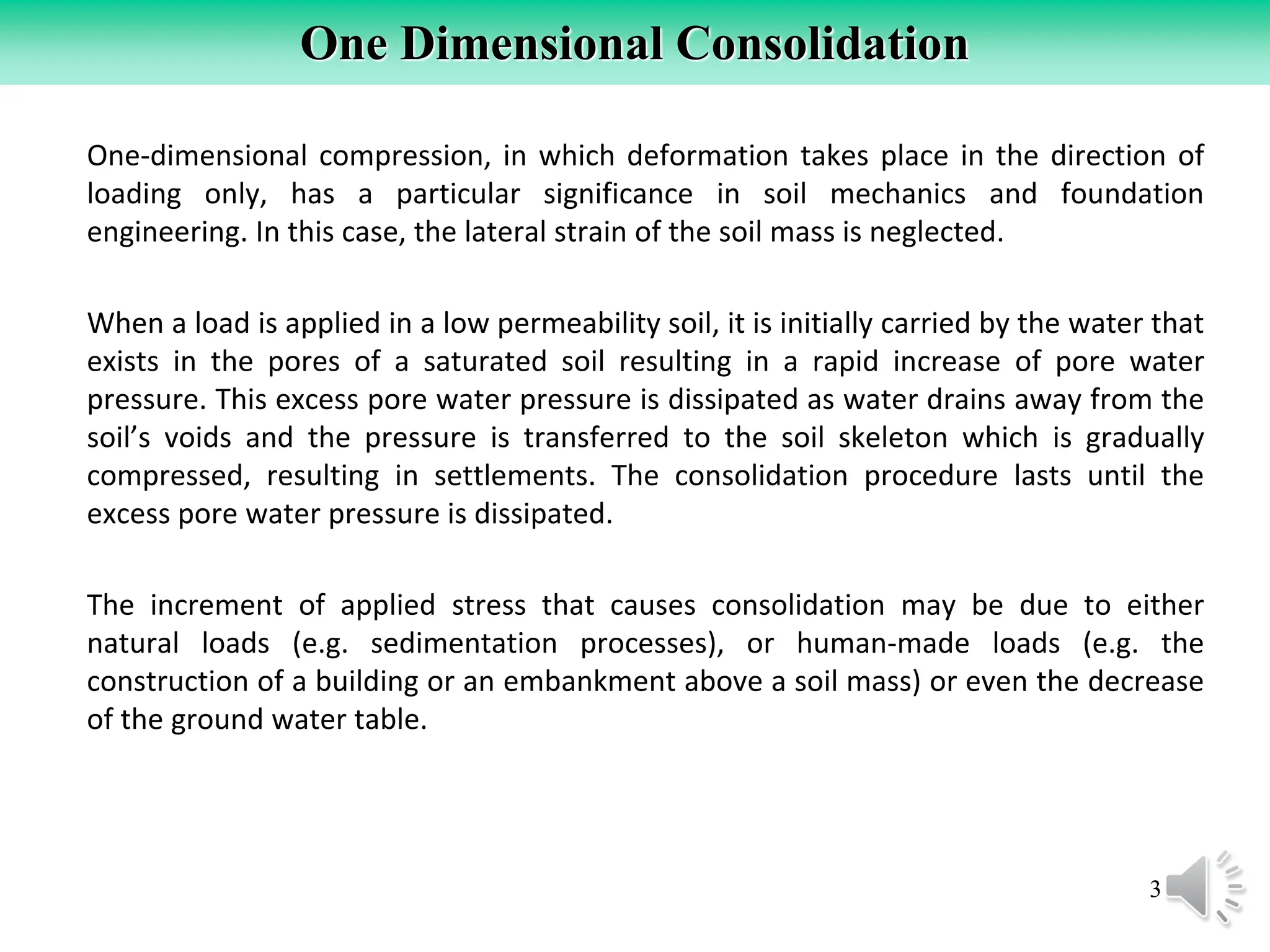
One-dimensional compression, in which deformation takes place in the direction of
loading only, has a particular significance in soil mechanics and foundation
engineering. In this case, the lateral strain of the soil mass is neglected.
When a load is applied in a low permeability soil, it is initially carried by the water that
exists in the pores of a saturated soil resulting in a rapid increase of pore water
pressure. This excess pore water pressure is dissipated as water drains away from the
soil’s voids and the pressure is transferred to the soil skeleton which is gradually
compressed, resulting in settlements. The consolidation procedure lasts until the
excess pore water pressure is dissipated.
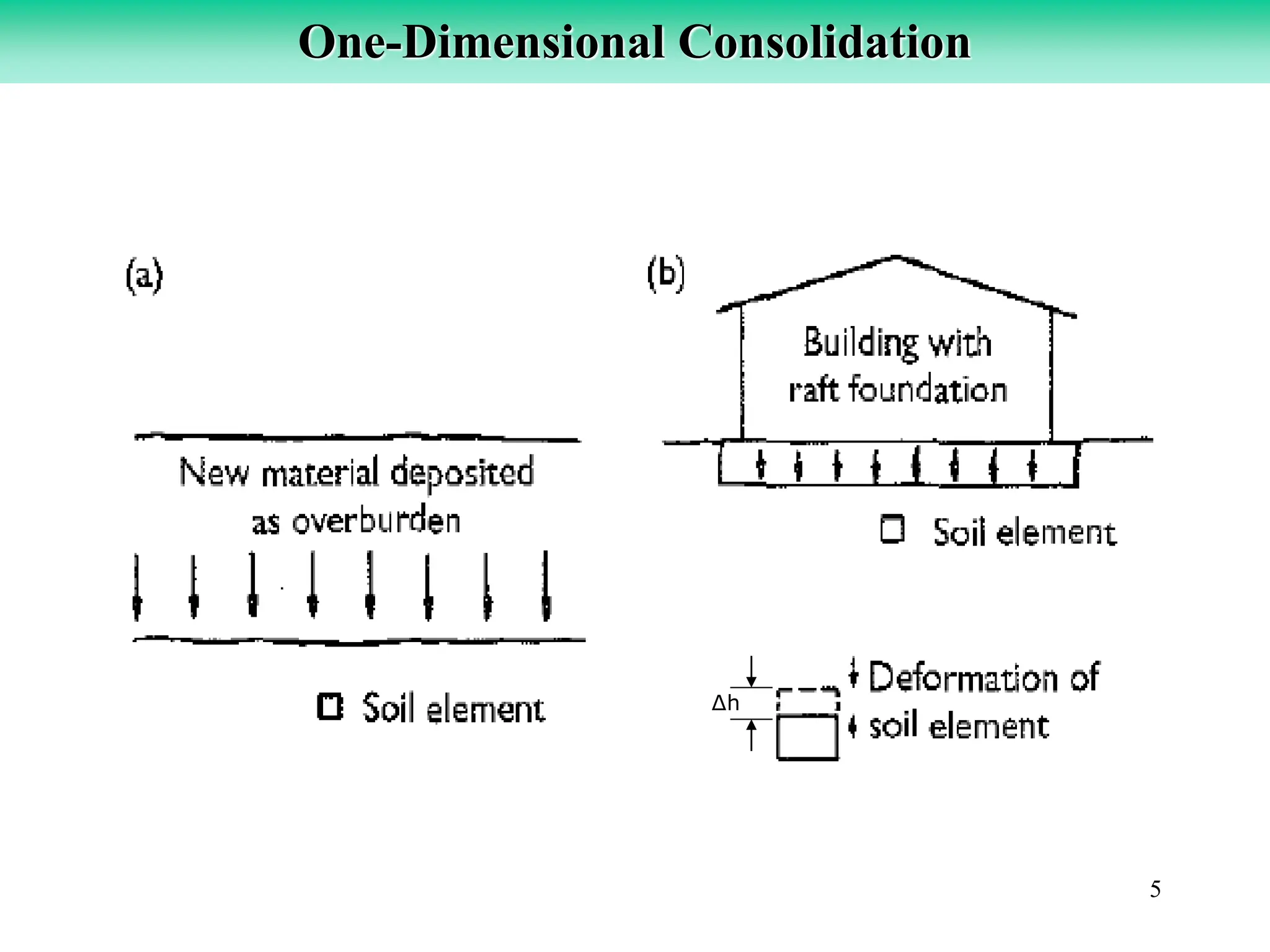
The increment of applied stress that causes consolidation may be due to either
natural loads (e.g. sedimentation processes), or human-made loads (e.g. the
construction of a building or an embankment above a soil mass) or even the decrease
of the ground water table.
4
One Dimensional Consolidation
Duration of Consolidation:
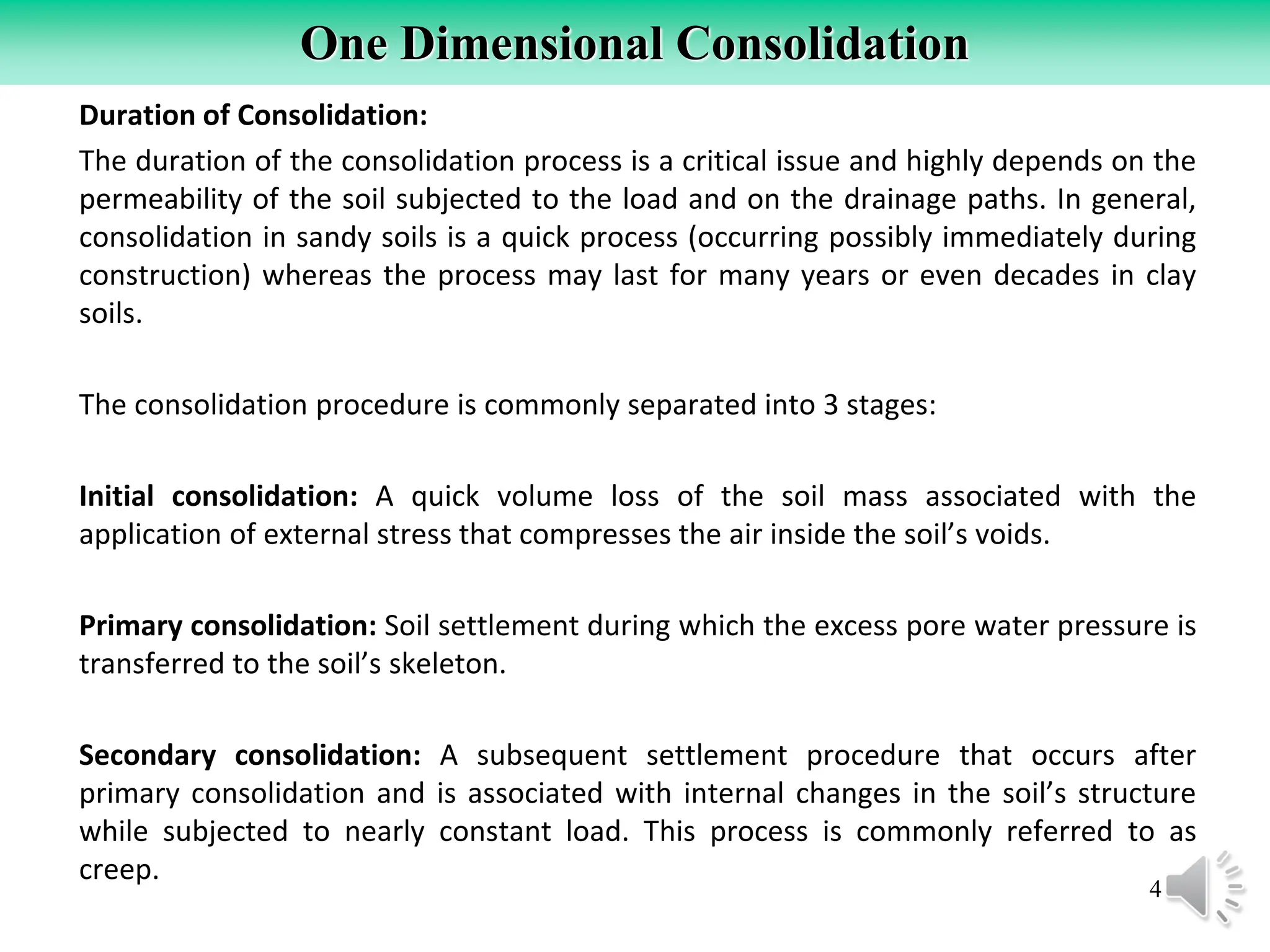
The duration of the consolidation process is a critical issue and highly depends on the
permeability of the soil subjected to the load and on the drainage paths. In general,
consolidation in sandy soils is a quick process (occurring possibly immediately during
construction) whereas the process may last for many years or even decades in clay
soils.
The consolidation procedure is commonly separated into 3 stages:
Initial consolidation: A quick volume loss of the soil mass associated with the
application of external stress that compresses the air inside the soil’s voids.
Primary consolidation: Soil settlement during which the excess pore water pressure is
transferred to the soil’s skeleton.
Secondary consolidation: A subsequent settlement procedure that occurs after
primary consolidation and is associated with internal changes in the soil’s structure
while subjected to nearly constant load. This process is commonly referred to as
creep.
5
One-Dimensional Consolidation
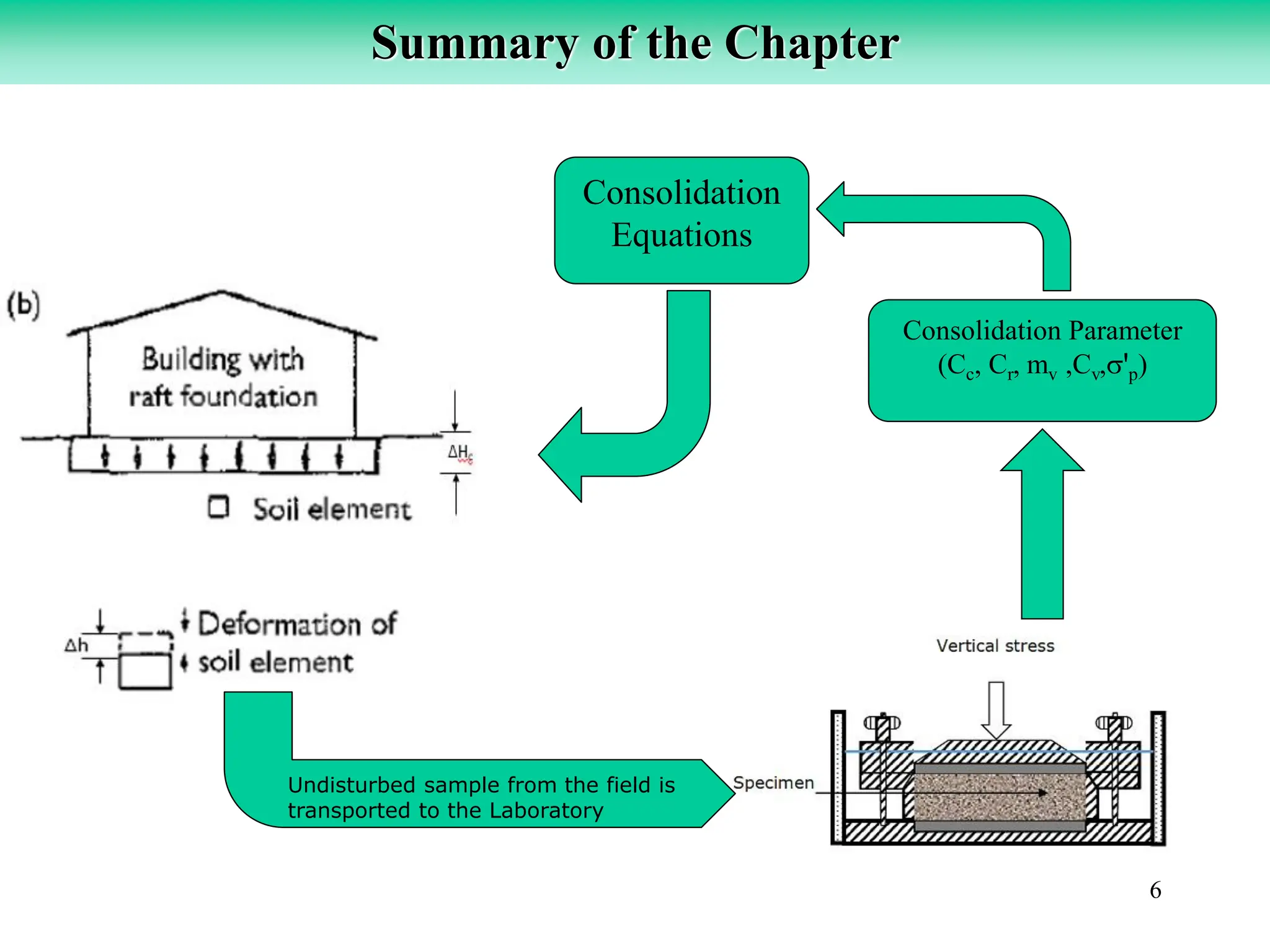
∆h
6
Consolidation Parameter
(Cc, Cr, mv ,Cv,ꞌp)
Consolidation
Equations
Summary of the Chapter
Undisturbed sample from the field is
transported to the Laboratory
7
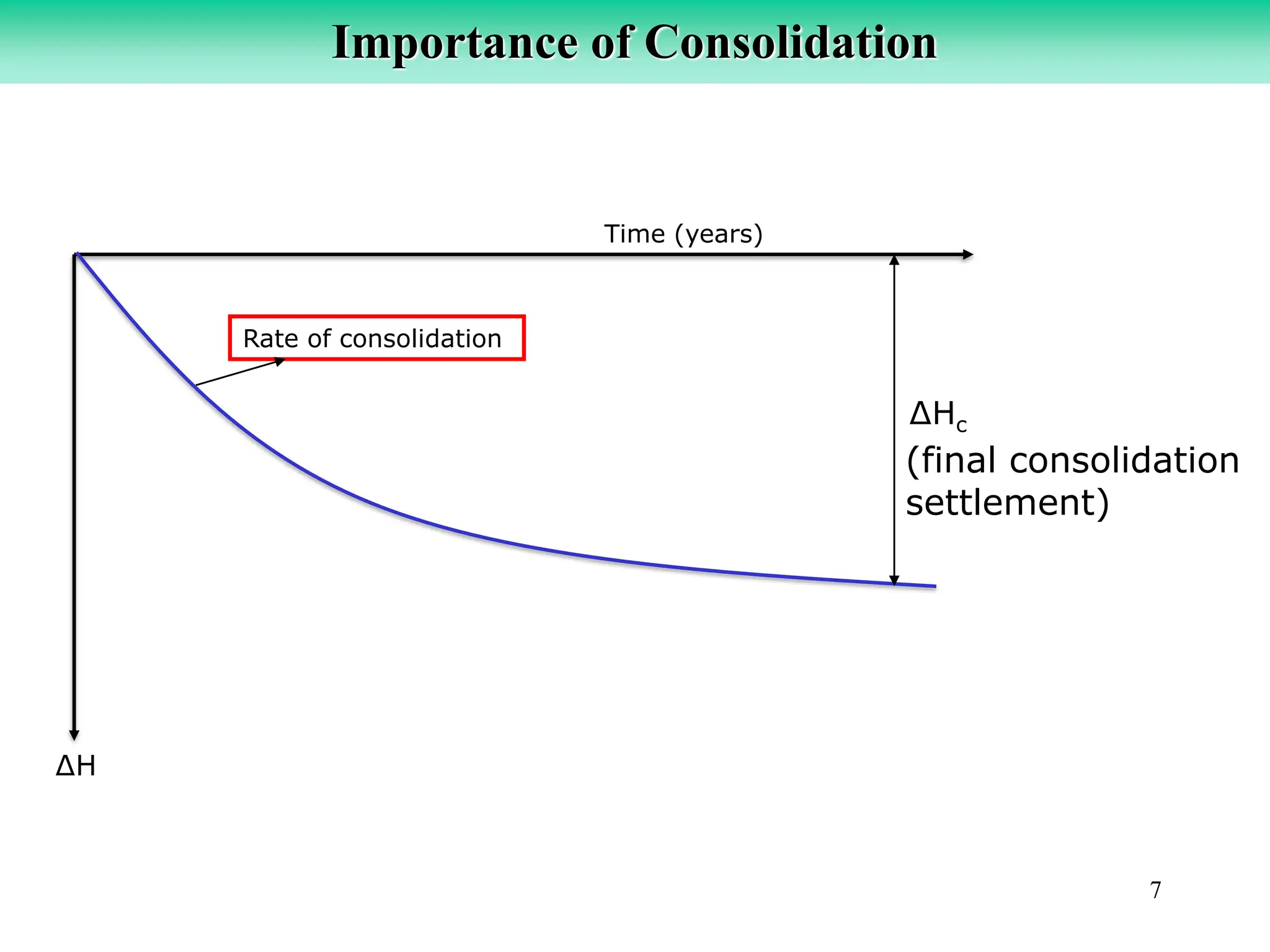
∆Hc
Rate of consolidation
∆H
Time (years)
Importance of Consolidation
(final consolidation
settlement)
8
1D Oedometer Test
• Geotechnical investigation to measures a soil's consolidation properties.
• The term “Oedometer” derives from the Ancient Greek language and means “to
swell”.
• Oedometer tests are performed by applying different loads to the cylindrical,
saturated soil sample and measuring the deformation response.
9
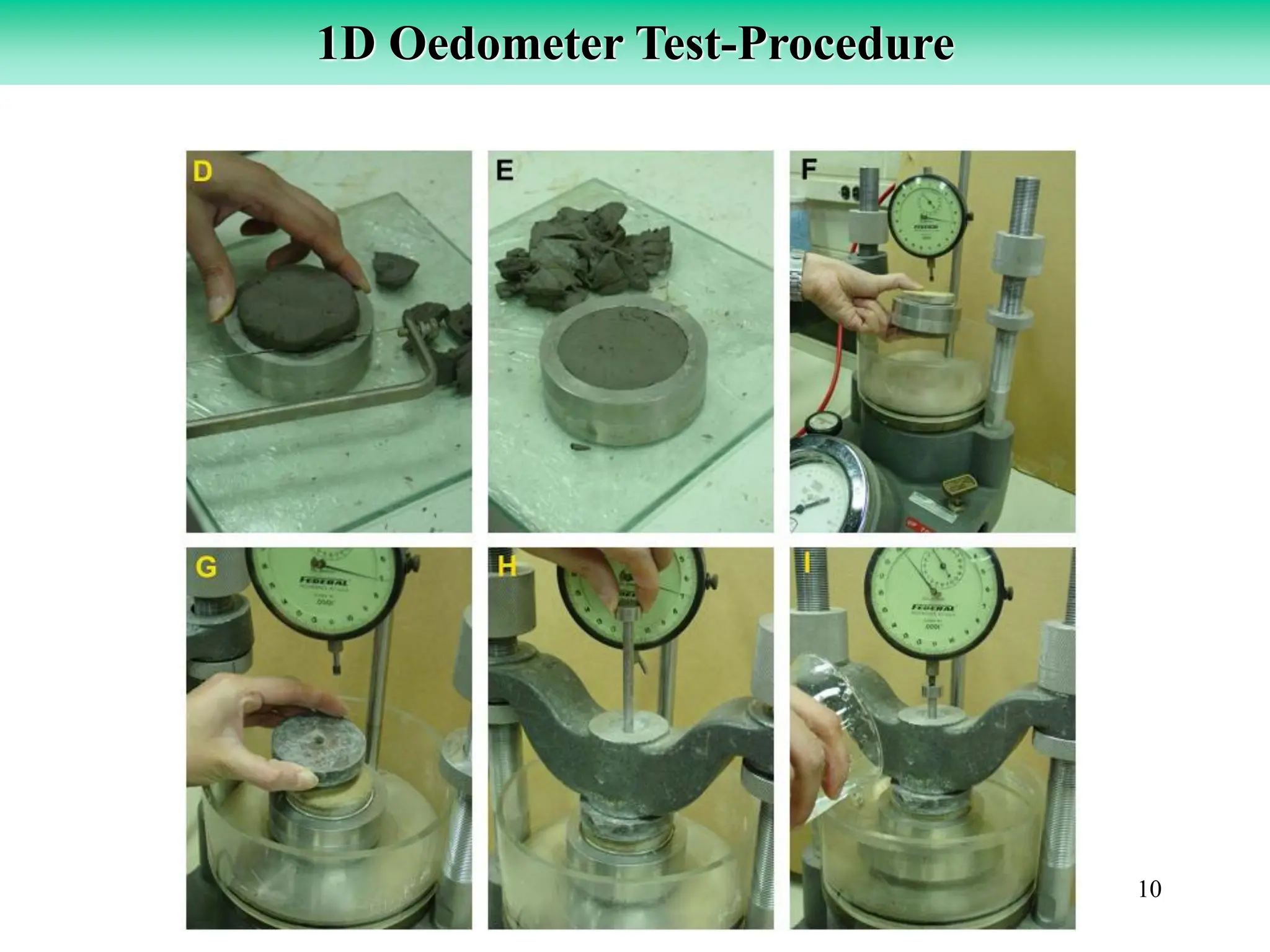
1D Oedometer Test-Procedure
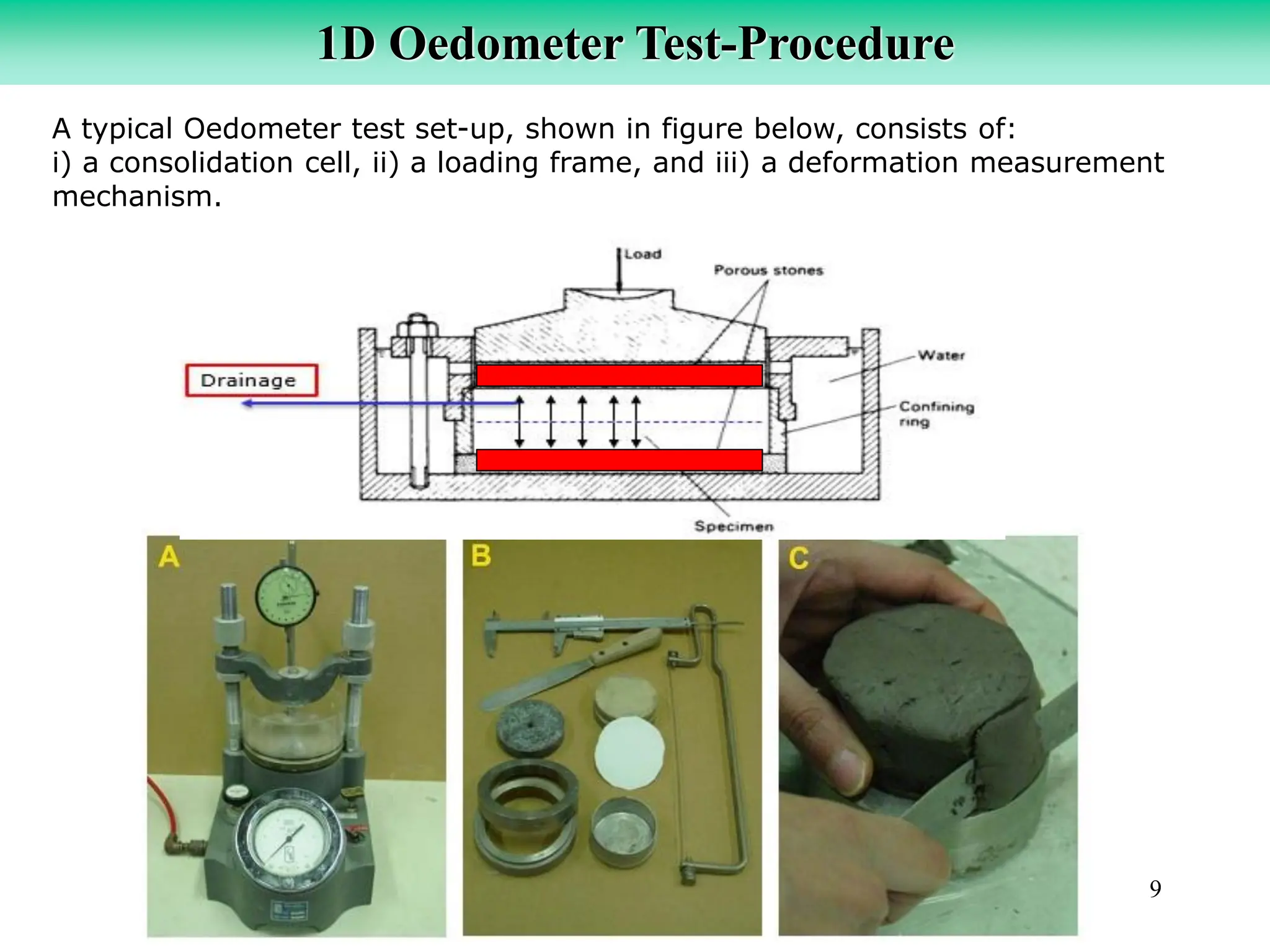
A typical Oedometer test set-up, shown in figure below, consists of:
i) a consolidation cell, ii) a loading frame, and iii) a deformation measurement
mechanism.
10
1D Oedometer Test-Procedure
11
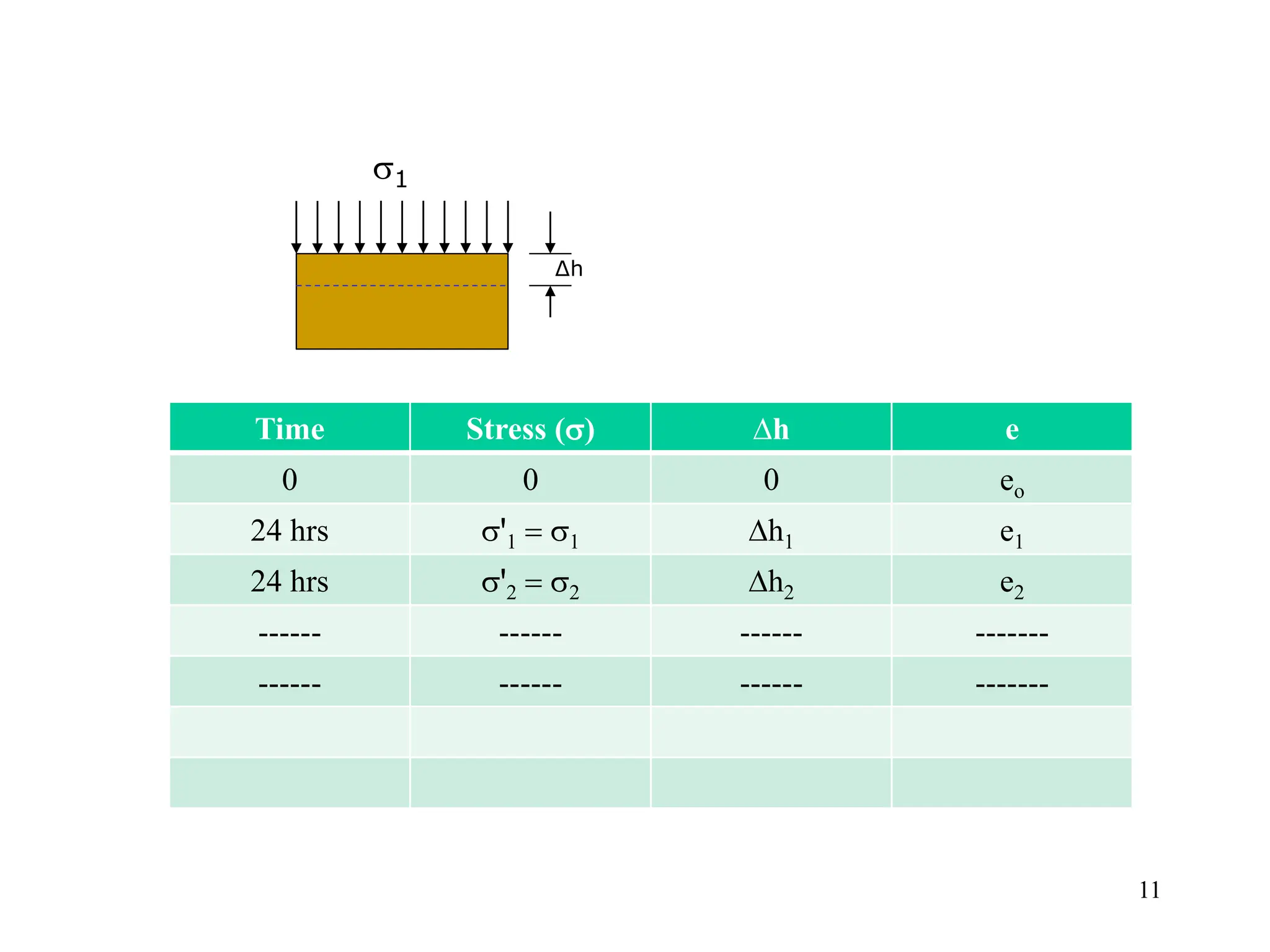
∆h
1
Time Stress () ∆h e
0 0 0 eo
24 hrs ꞌ1 = 1 ∆h1 e1
24 hrs ꞌ2 = 2 ∆h2 e2
------ ------ ------ -------
------ ------ ------ -------
12
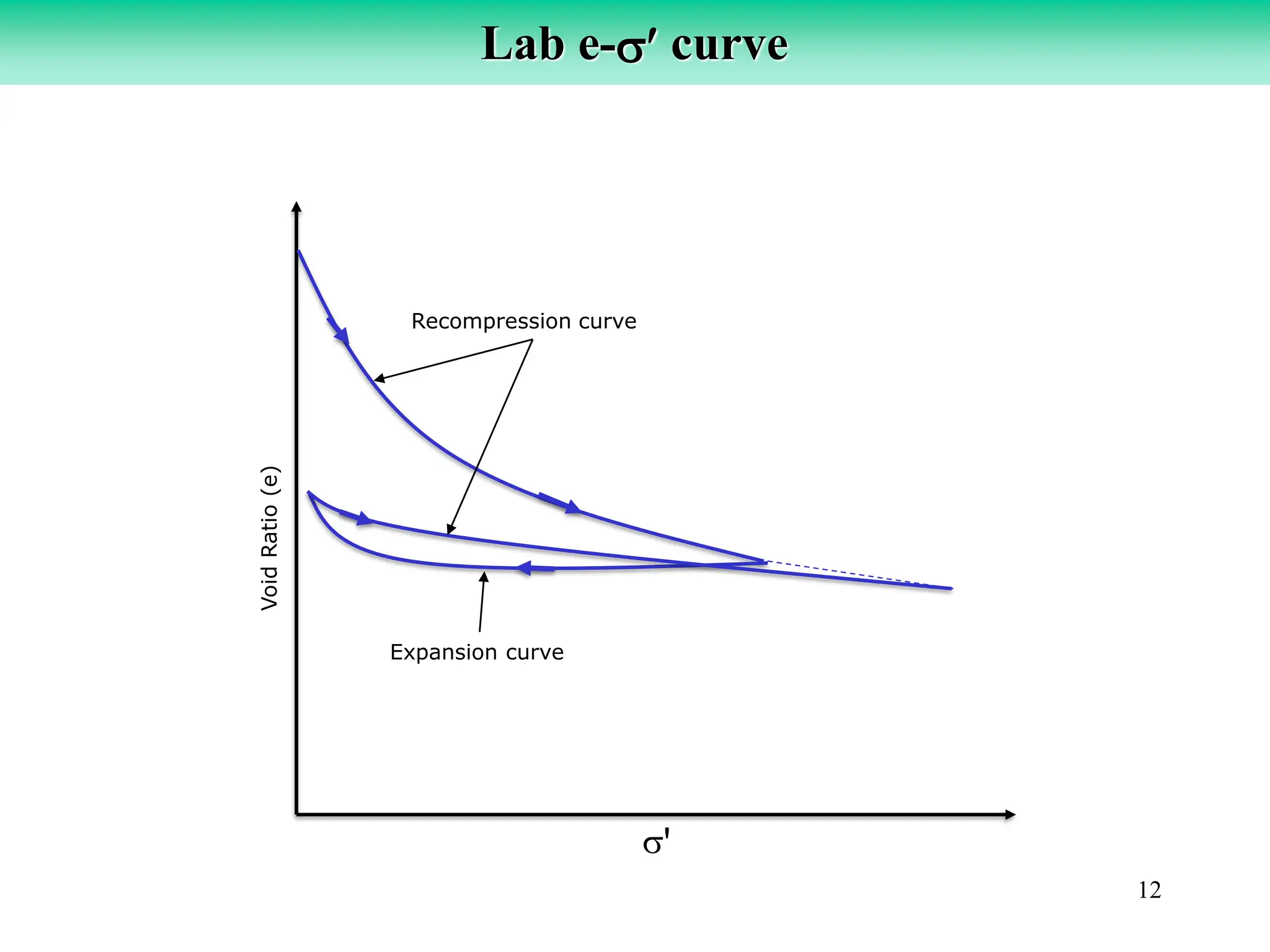
Lab e- curve
Void
Ratio
(e)
ꞌ
Recompression curve
Expansion curve
13
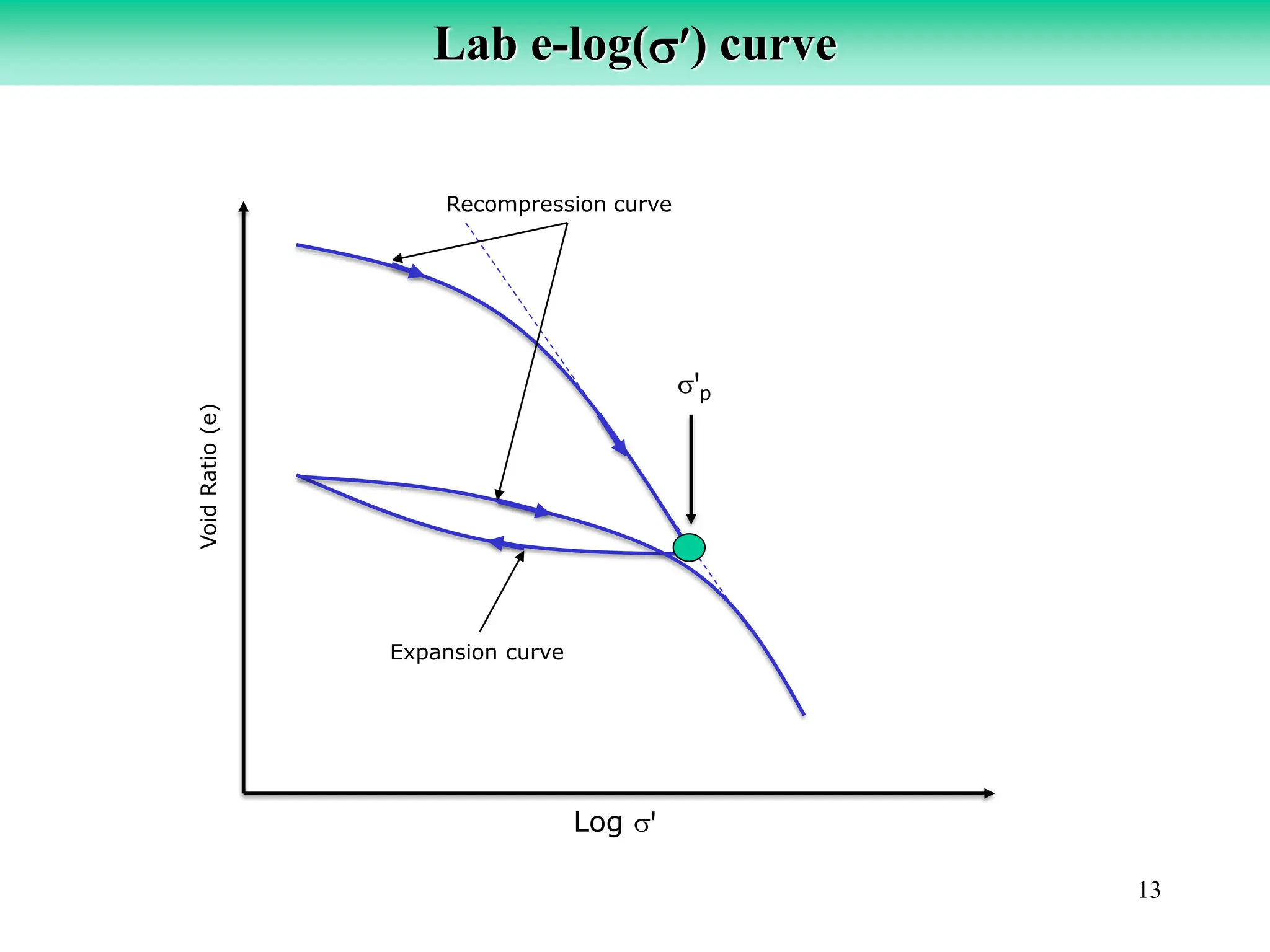
Lab e-log() curve
Void
Ratio
(e)
Log ꞌ
Recompression curve
Expansion curve
ꞌp
14
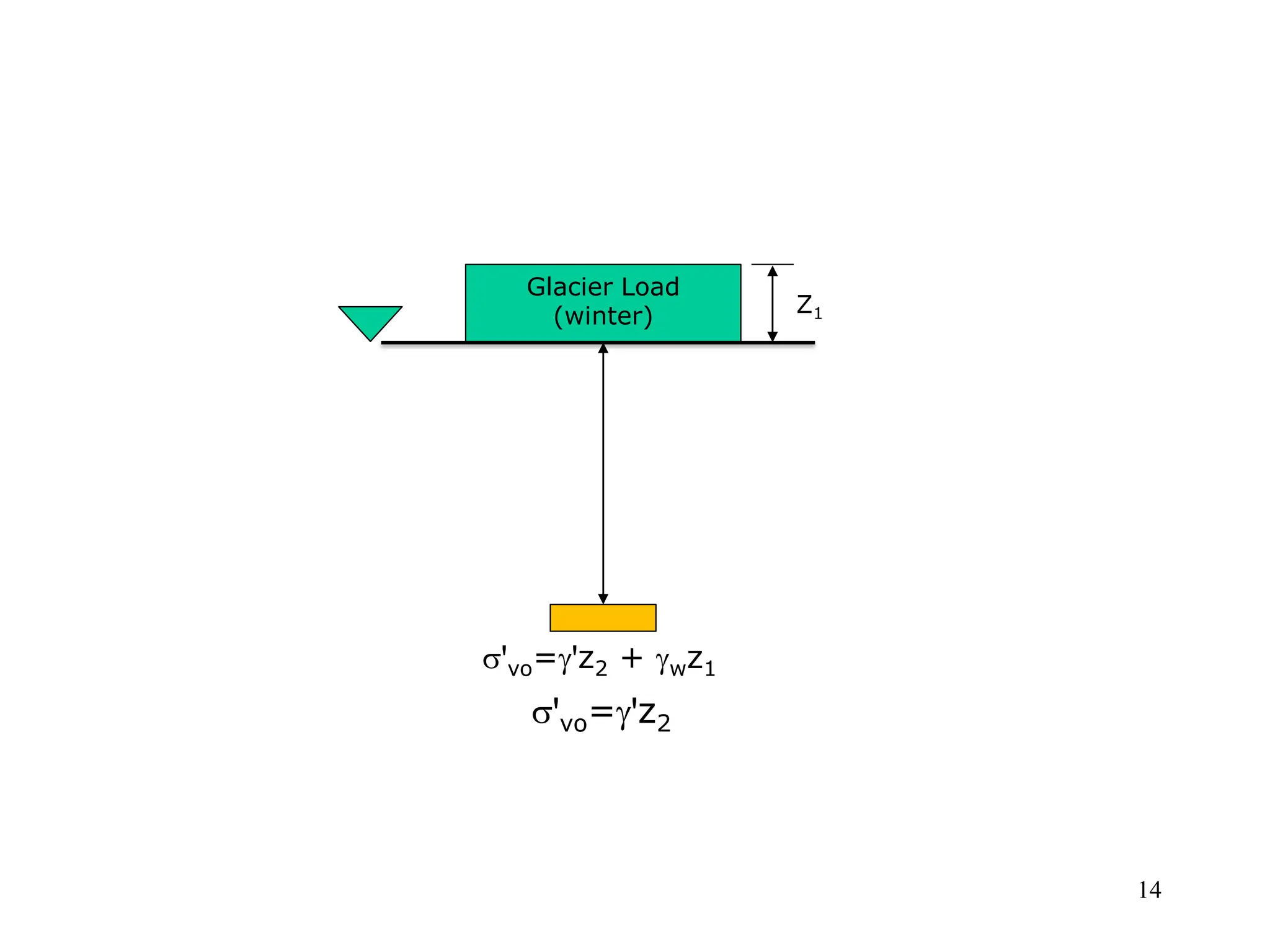
Glacier Load
(winter)
ꞌvo=ꞌz2
Z1
ꞌvo=ꞌz2 + wz1
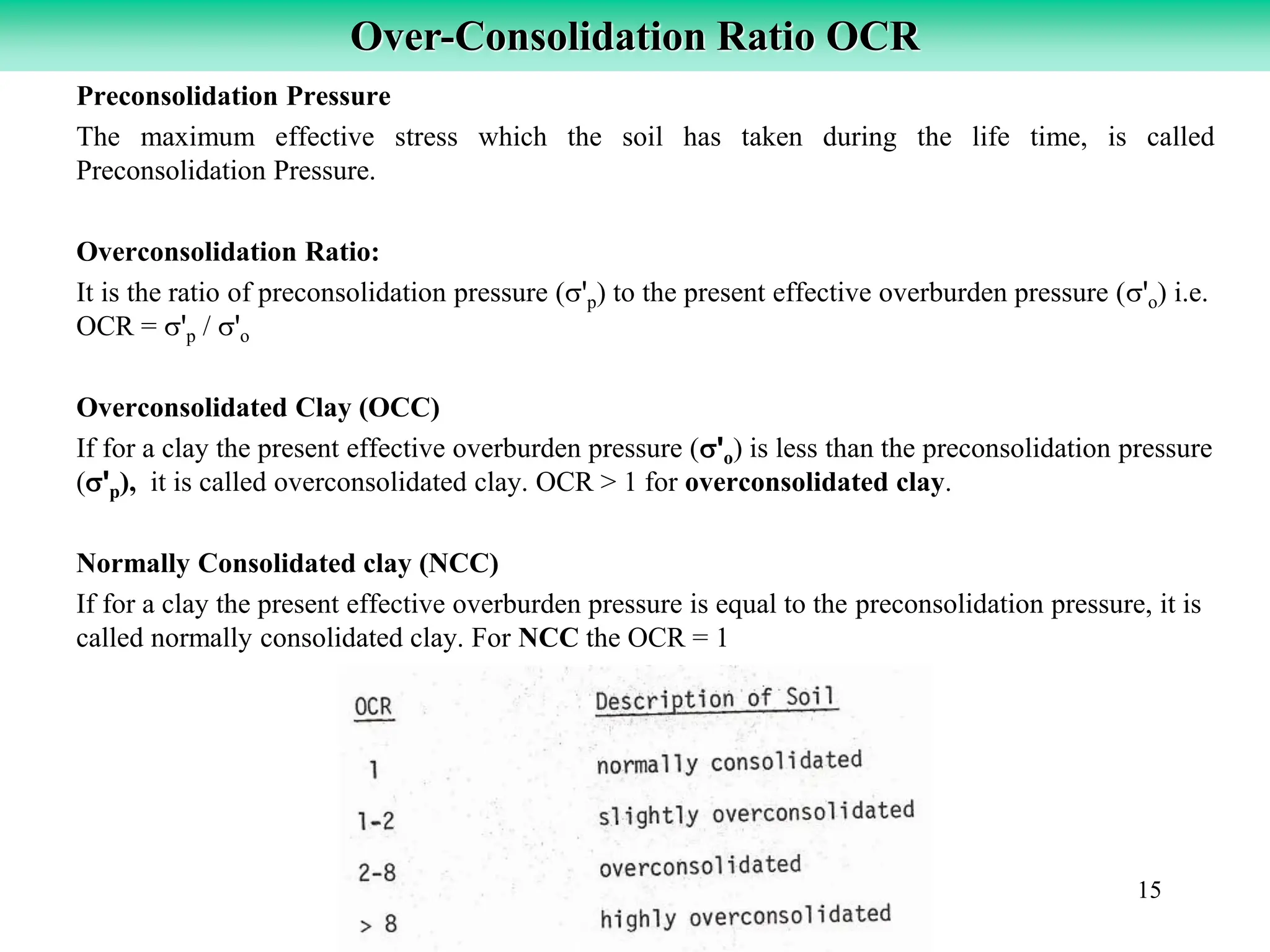
Preconsolidation Pressure
The maximum effective stress which the soil has taken during the life time, is called
Preconsolidation Pressure.
Overconsolidation Ratio:
It is the ratio of preconsolidation pressure (ꞌp) to the present effective overburden pressure (ꞌo) i.e.
OCR = ꞌp / ꞌo
Overconsolidated Clay (OCC)
If for a clay the present effective overburden pressure (ꞌo) is less than the preconsolidation pressure
(ꞌp), it is called overconsolidated clay. OCR > 1 for overconsolidated clay.
Normally Consolidated clay (NCC)
If for a clay the present effective overburden pressure is equal to the preconsolidation pressure, it is
called normally consolidated clay. For NCC the OCR = 1
15
Over-Consolidation Ratio OCR
16
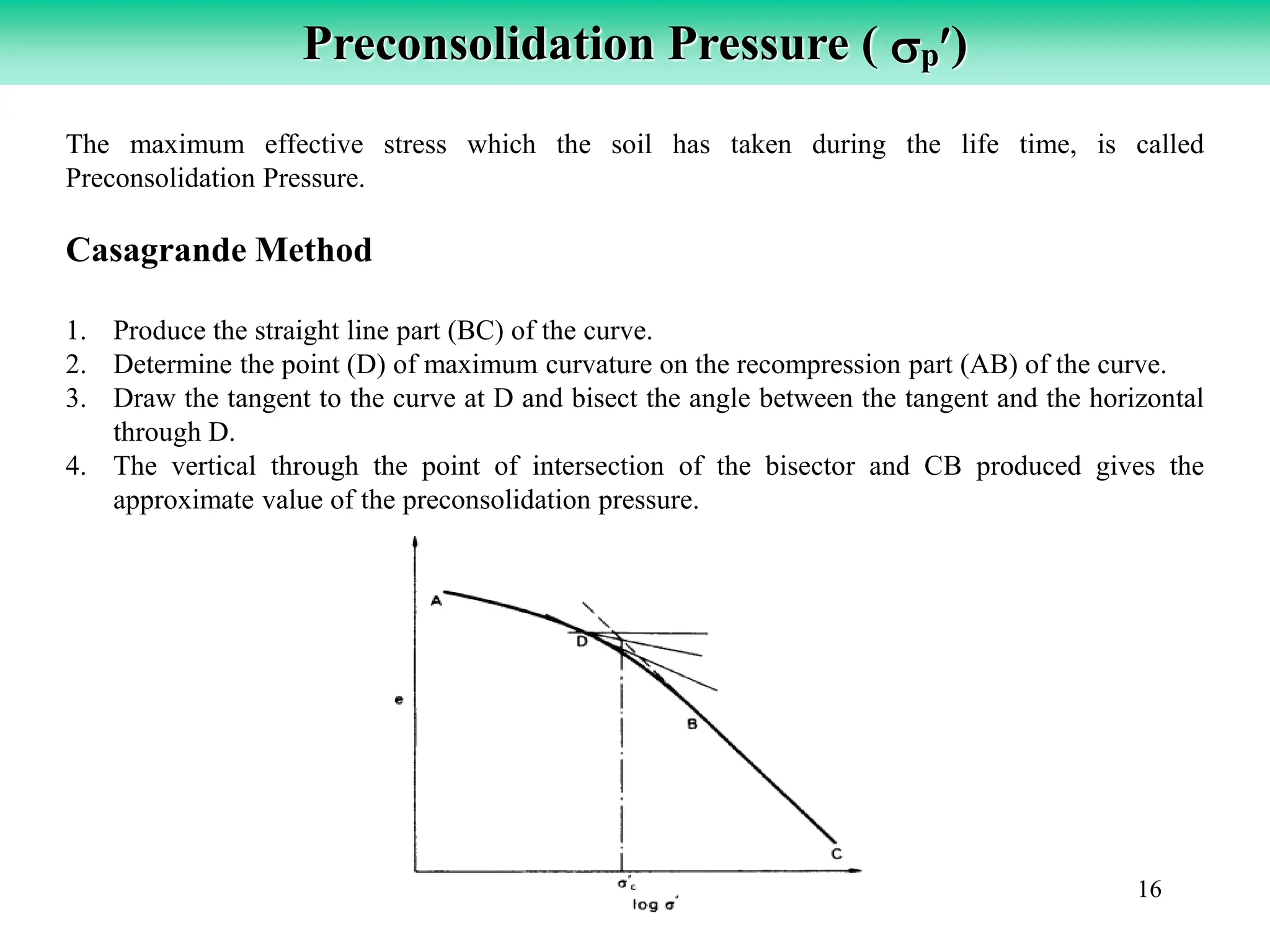
Preconsolidation Pressure ( p)
The maximum effective stress which the soil has taken during the life time, is called
Preconsolidation Pressure.
Casagrande Method
1. Produce the straight line part (BC) of the curve.
2. Determine the point (D) of maximum curvature on the recompression part (AB) of the curve.
3. Draw the tangent to the curve at D and bisect the angle between the tangent and the horizontal
through D.
4. The vertical through the point of intersection of the bisector and CB produced gives the
approximate value of the preconsolidation pressure.
17
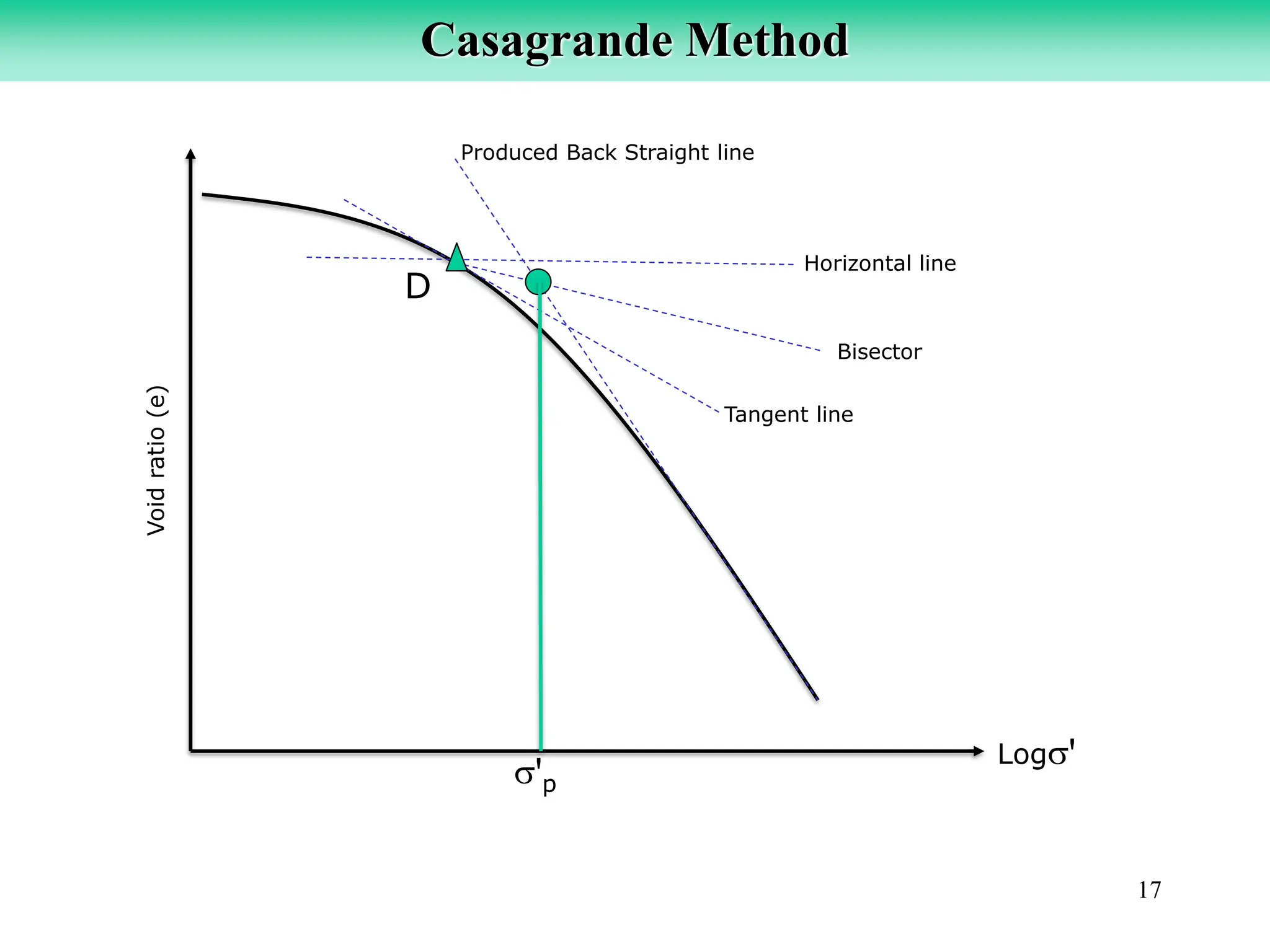
Void
ratio
(e)
D
Casagrande Method
ꞌp
Logꞌ
Horizontal line
Tangent line
Bisector
Produced Back Straight line
18
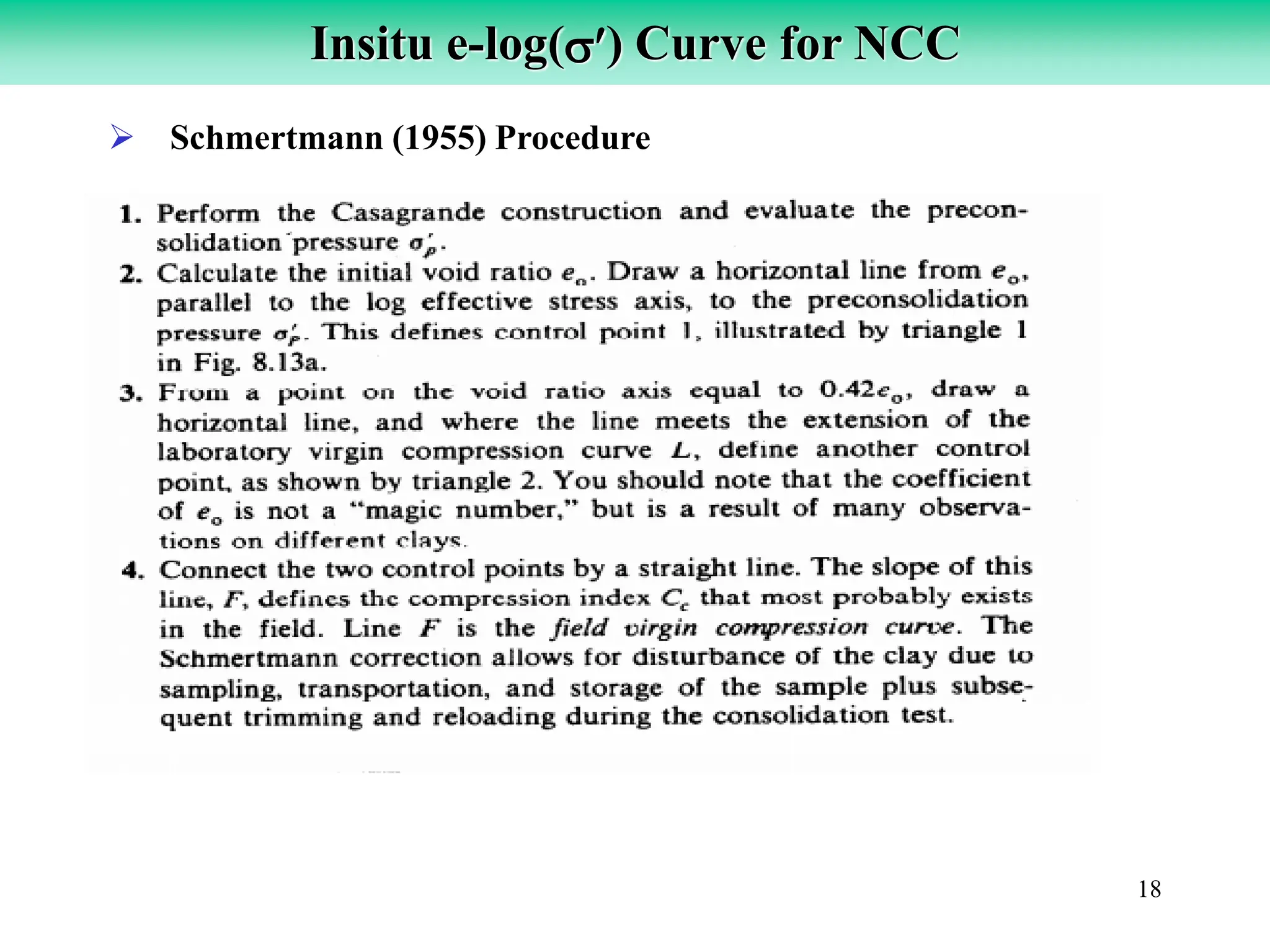
Insitu e-log() Curve for NCC
➢ Schmertmann (1955) Procedure
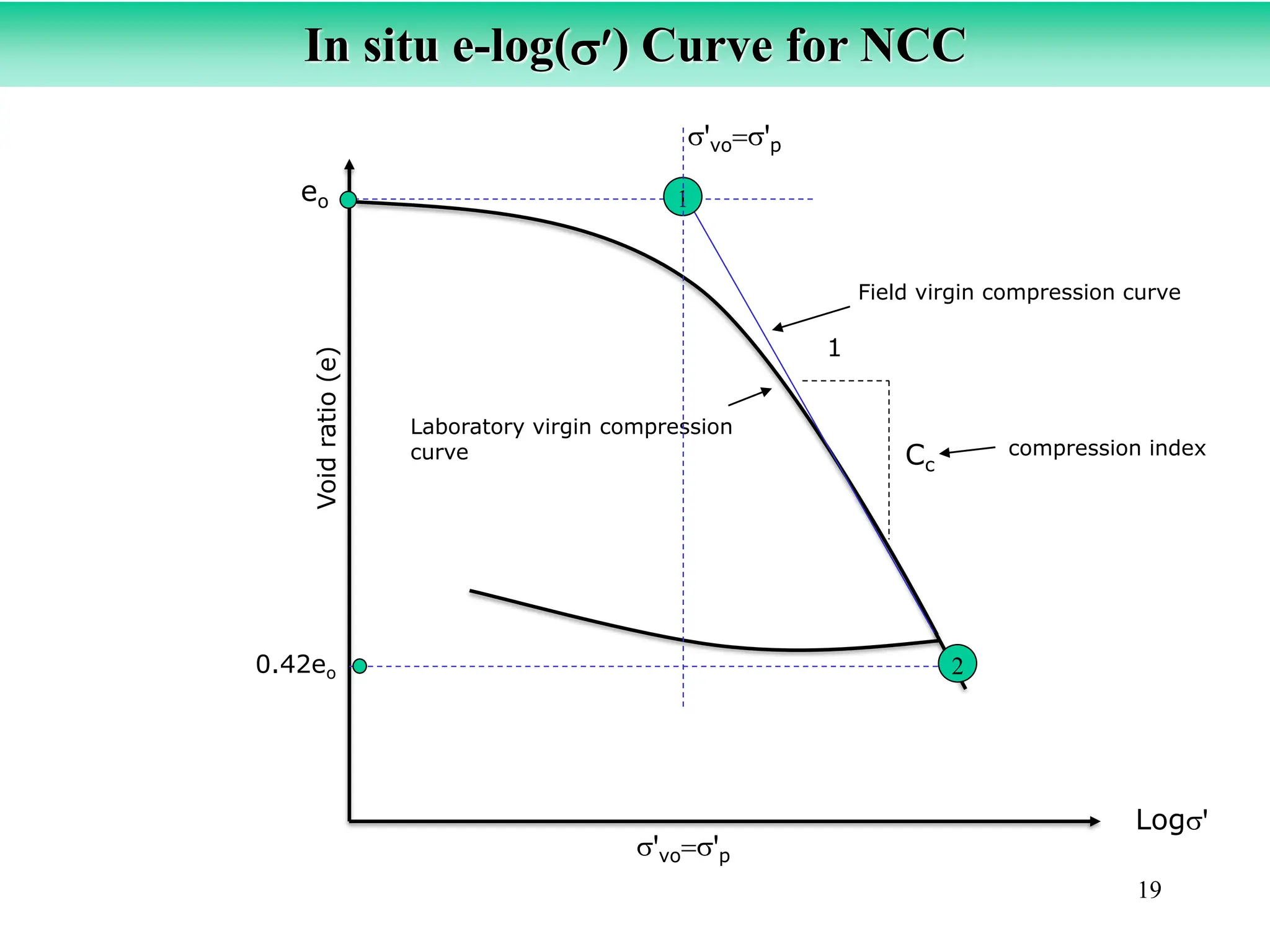
19
Void
ratio
(e)
eo
0.42eo
1
Cc
Field virgin compression curve
Laboratory virgin compression
curve
Logꞌ
In situ e-log() Curve for NCC
compression index
1
ꞌvo=ꞌp
ꞌvo=ꞌp
2
20
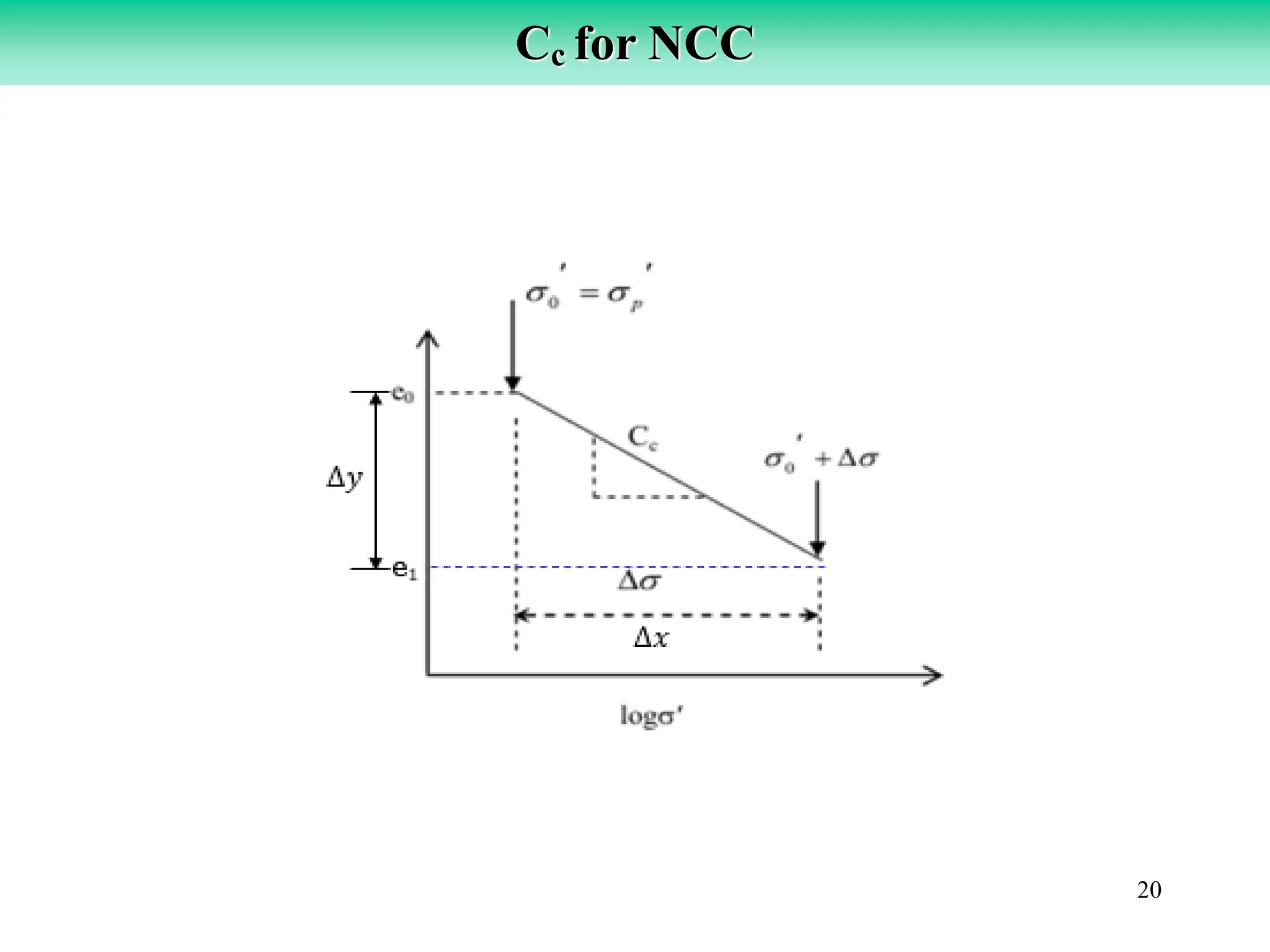
Cc for NCC
21
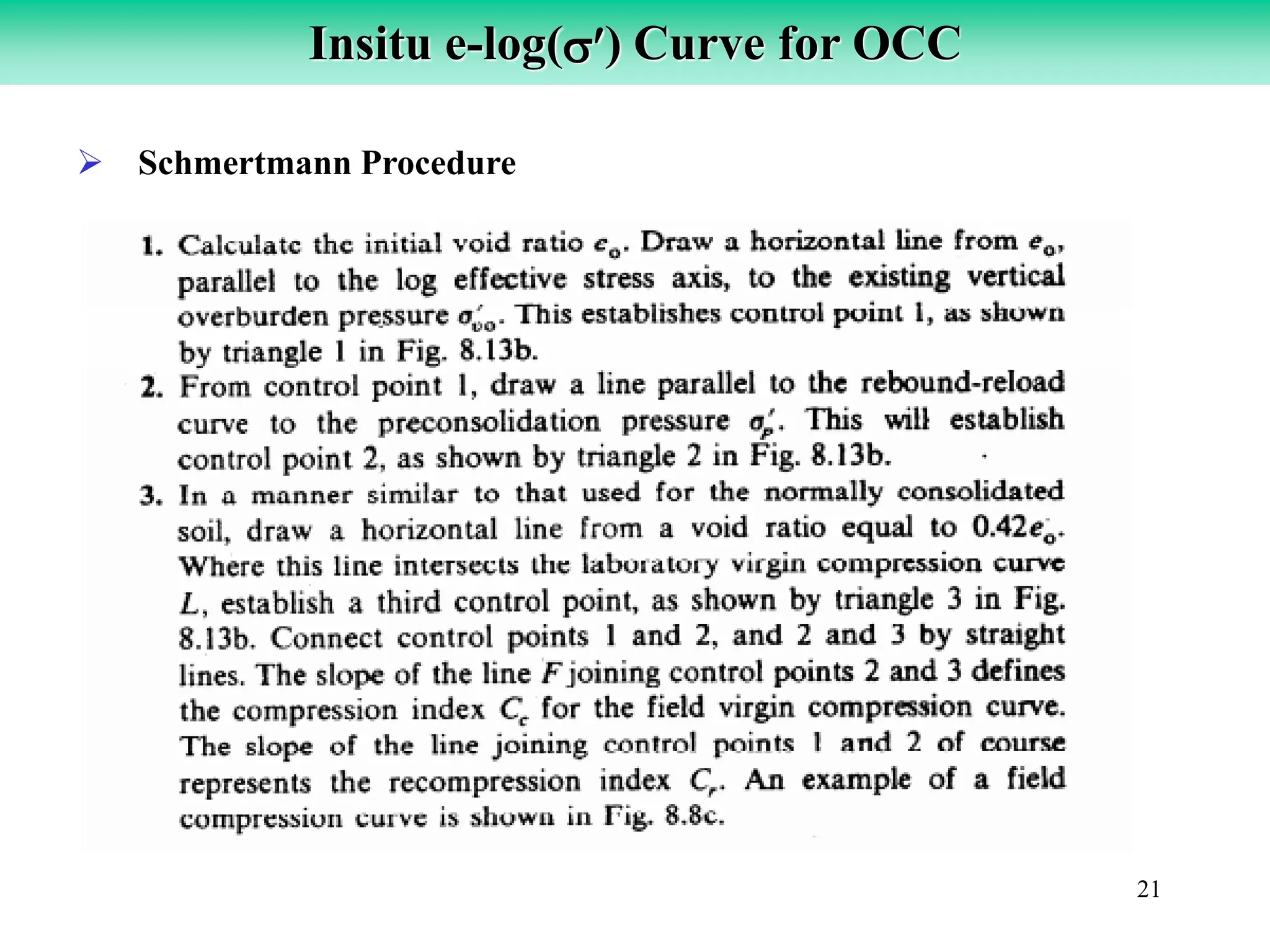
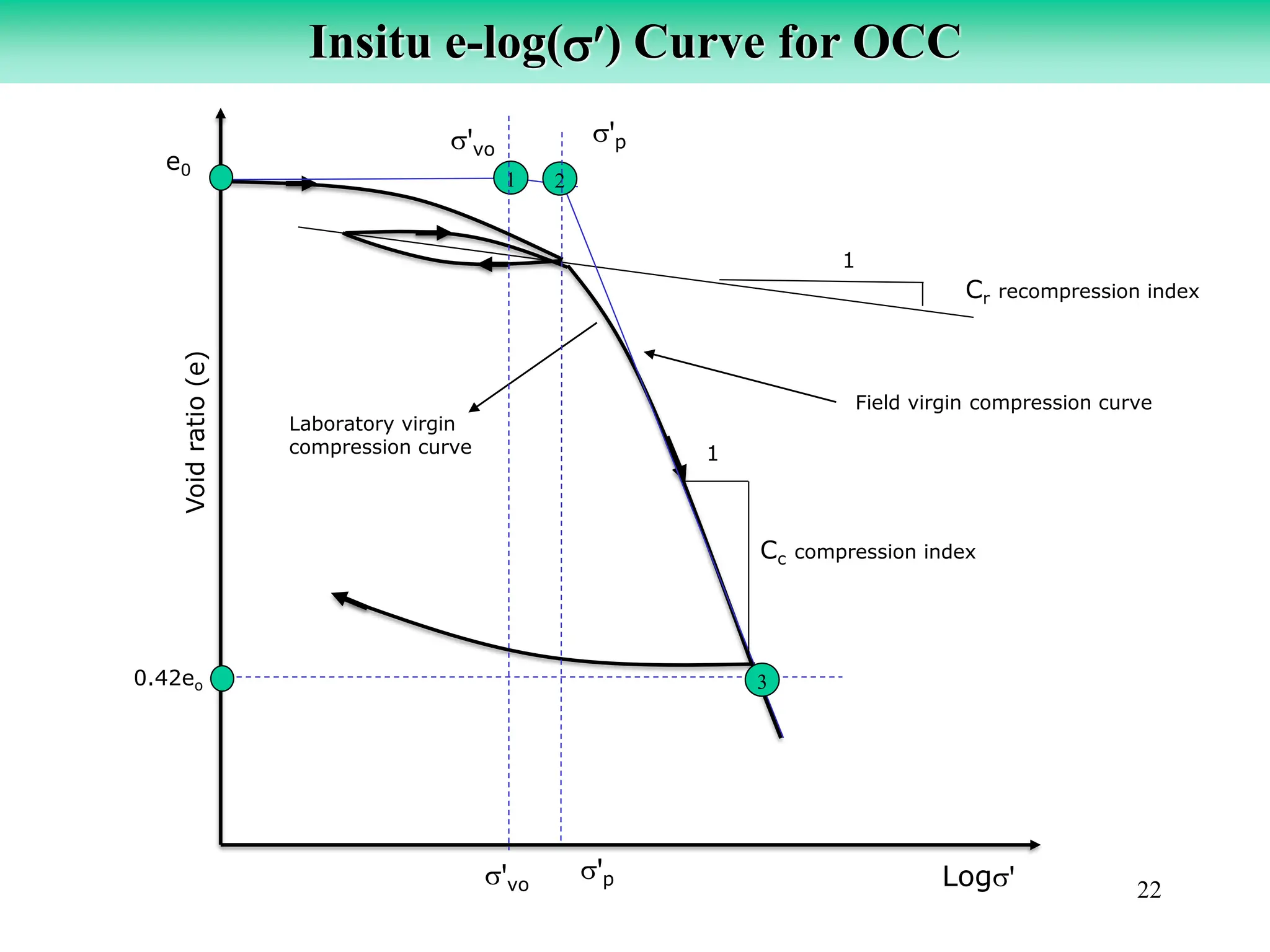
Insitu e-log() Curve for OCC
➢ Schmertmann Procedure
22
Void
ratio
(e)
e0
0.42eo
Cr recompression index
1
1
Field virgin compression curve
Laboratory virgin
compression curve
Insitu e-log() Curve for OCC
ꞌvo
ꞌp
Cc compression index
2
1
3
Logꞌ
ꞌp
ꞌvo
23
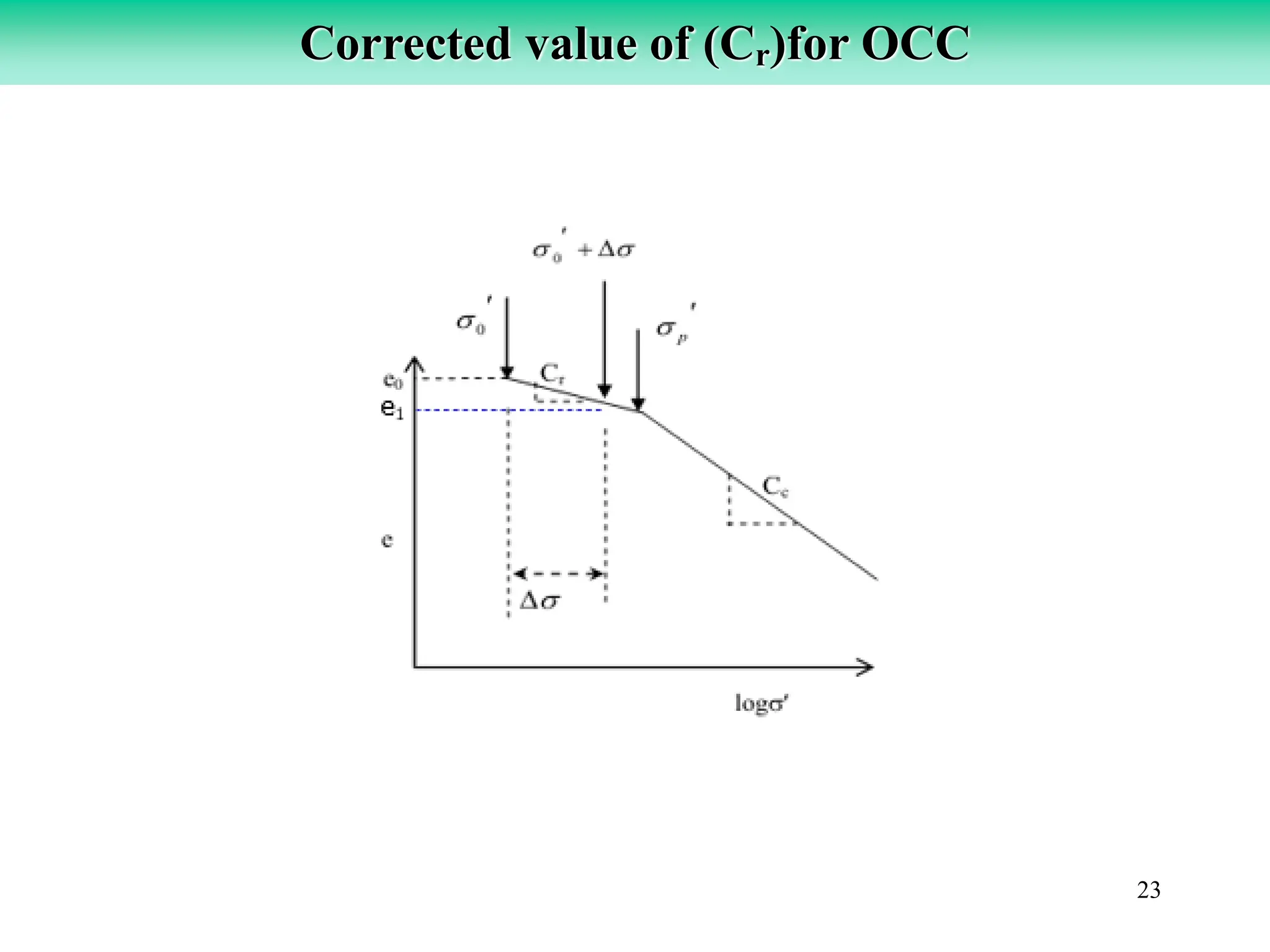
Corrected value of (Cr)for OCC
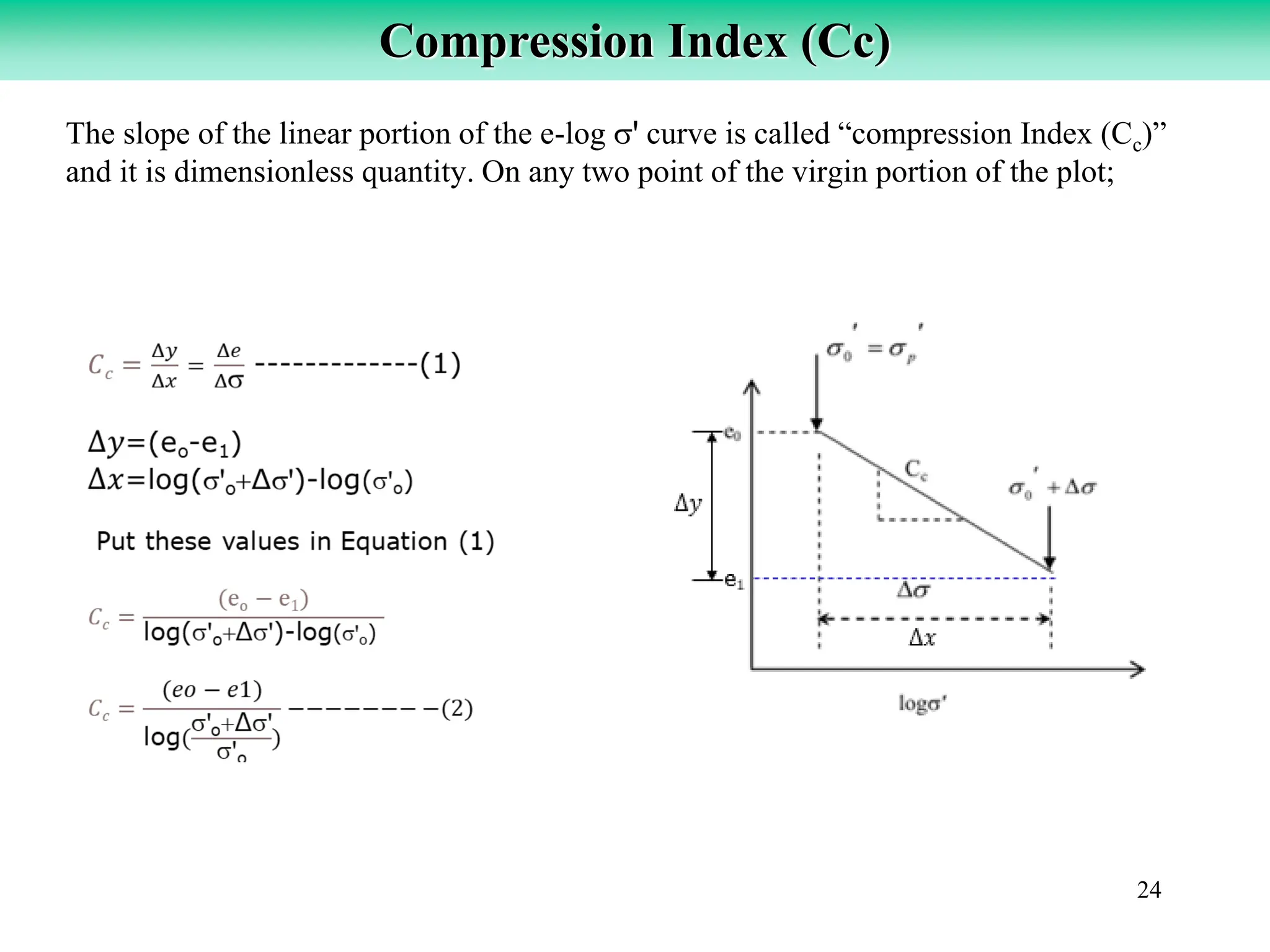
The slope of the linear portion of the e-log ꞌ curve is called “compression Index (Cc)”
and it is dimensionless quantity. On any two point of the virgin portion of the plot;
24
Compression Index (Cc)
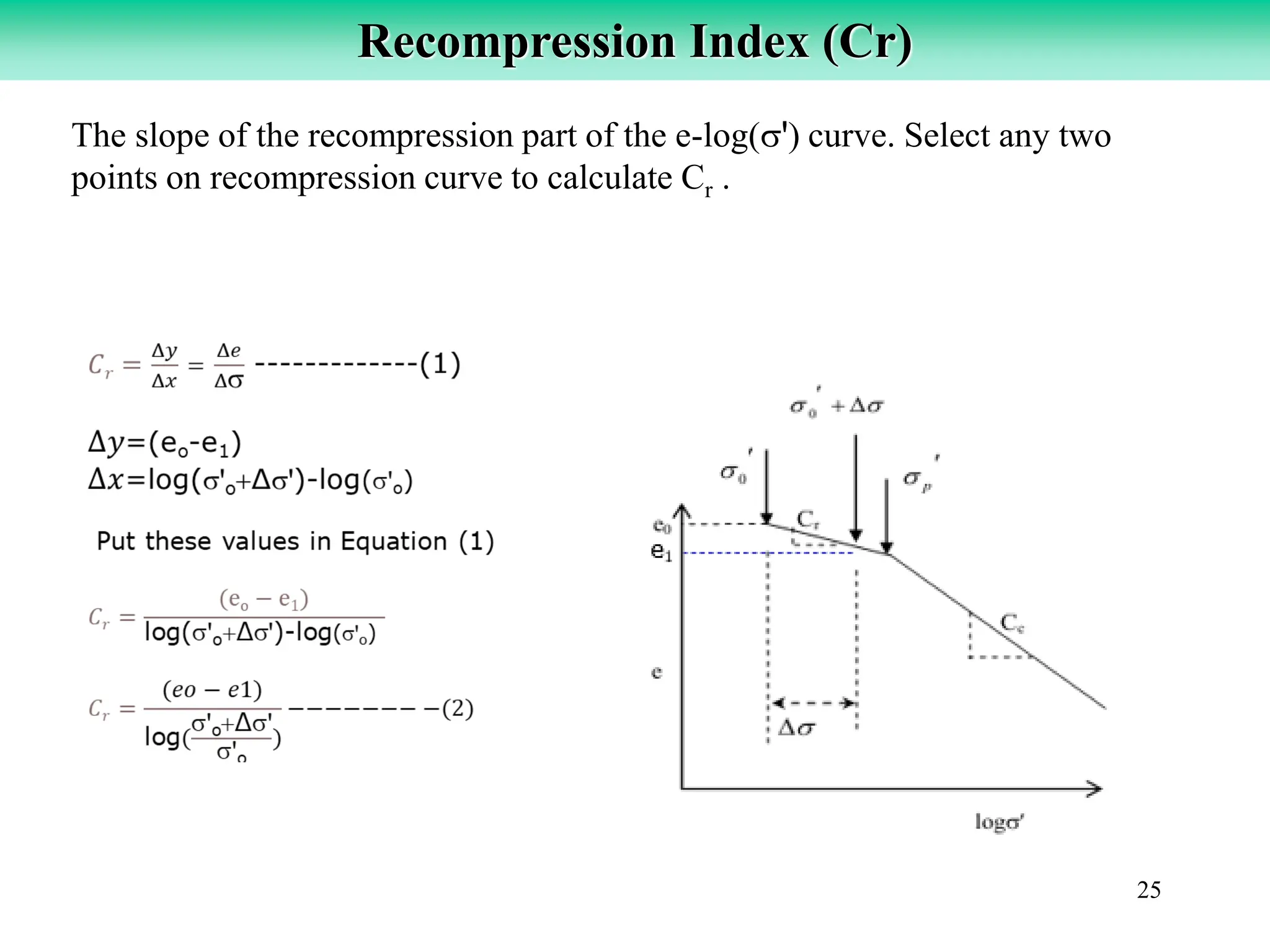
The slope of the recompression part of the e-log(ꞌ) curve. Select any two
points on recompression curve to calculate Cr .
25
Recompression Index (Cr)
26
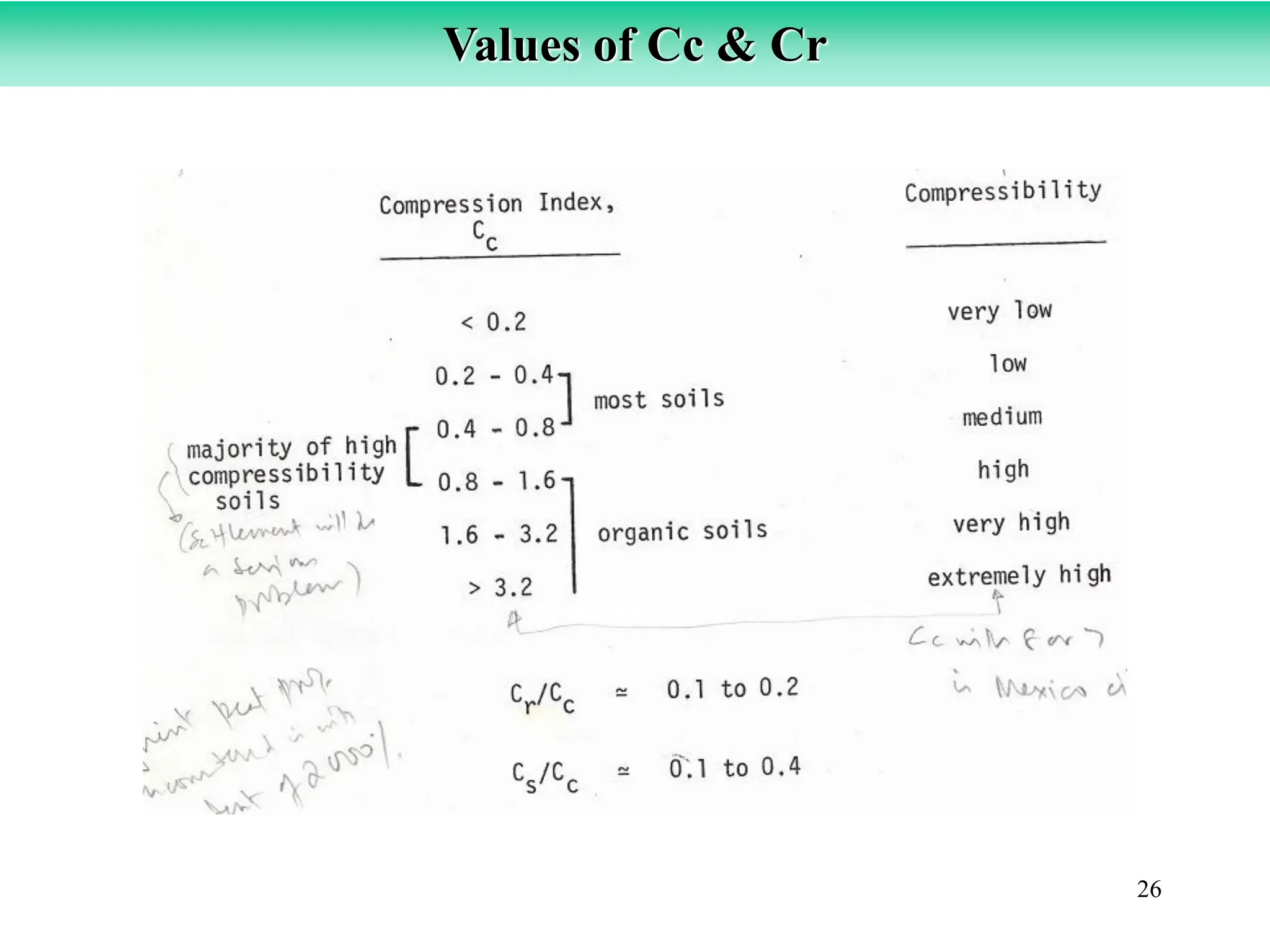
Values of Cc & Cr

Lecture-2 Consolidation PART-1 (geotechnical engineering).pdf

  • 1.
    1 CE-335 (2 CreditHours) Geotechnical Engineering-II Consolidation Instructor: Dr. Muhammad Adeel Arshad Courtesy: Prof- Dr Irshad Ahmad Lecture-02 Department of Civil Engineering University of Engineering and Technology, Peshawar
  • 2.
    2 CONTENTS • 1D Consolidation, •Oedometer Test, • e- curve, e-log() curve, • OCR, OCC, and NCC, • Compression index, recompression index, • Determination of Pre-consolidation Pressure by Casagrande Method • Schmertmann Procedure to obtain in-situ e-log() curve • Coefficient of volume compressibility • Consolidation settlement calculations for NCC and OCC
  • 3.
    3 One Dimensional Consolidation One-dimensionalcompression, in which deformation takes place in the direction of loading only, has a particular significance in soil mechanics and foundation engineering. In this case, the lateral strain of the soil mass is neglected. When a load is applied in a low permeability soil, it is initially carried by the water that exists in the pores of a saturated soil resulting in a rapid increase of pore water pressure. This excess pore water pressure is dissipated as water drains away from the soil’s voids and the pressure is transferred to the soil skeleton which is gradually compressed, resulting in settlements. The consolidation procedure lasts until the excess pore water pressure is dissipated. The increment of applied stress that causes consolidation may be due to either natural loads (e.g. sedimentation processes), or human-made loads (e.g. the construction of a building or an embankment above a soil mass) or even the decrease of the ground water table.
  • 4.
    4 One Dimensional Consolidation Durationof Consolidation: The duration of the consolidation process is a critical issue and highly depends on the permeability of the soil subjected to the load and on the drainage paths. In general, consolidation in sandy soils is a quick process (occurring possibly immediately during construction) whereas the process may last for many years or even decades in clay soils. The consolidation procedure is commonly separated into 3 stages: Initial consolidation: A quick volume loss of the soil mass associated with the application of external stress that compresses the air inside the soil’s voids. Primary consolidation: Soil settlement during which the excess pore water pressure is transferred to the soil’s skeleton. Secondary consolidation: A subsequent settlement procedure that occurs after primary consolidation and is associated with internal changes in the soil’s structure while subjected to nearly constant load. This process is commonly referred to as creep.
  • 5.
  • 6.
    6 Consolidation Parameter (Cc, Cr,mv ,Cv,ꞌp) Consolidation Equations Summary of the Chapter Undisturbed sample from the field is transported to the Laboratory
  • 7.
    7 ∆Hc Rate of consolidation ∆H Time(years) Importance of Consolidation (final consolidation settlement)
  • 8.
    8 1D Oedometer Test •Geotechnical investigation to measures a soil's consolidation properties. • The term “Oedometer” derives from the Ancient Greek language and means “to swell”. • Oedometer tests are performed by applying different loads to the cylindrical, saturated soil sample and measuring the deformation response.
  • 9.
    9 1D Oedometer Test-Procedure Atypical Oedometer test set-up, shown in figure below, consists of: i) a consolidation cell, ii) a loading frame, and iii) a deformation measurement mechanism.
  • 10.
  • 11.
    11 ∆h 1 Time Stress ()∆h e 0 0 0 eo 24 hrs ꞌ1 = 1 ∆h1 e1 24 hrs ꞌ2 = 2 ∆h2 e2 ------ ------ ------ ------- ------ ------ ------ -------
  • 12.
  • 13.
    13 Lab e-log() curve Void Ratio (e) Logꞌ Recompression curve Expansion curve ꞌp
  • 14.
  • 15.
    Preconsolidation Pressure The maximumeffective stress which the soil has taken during the life time, is called Preconsolidation Pressure. Overconsolidation Ratio: It is the ratio of preconsolidation pressure (ꞌp) to the present effective overburden pressure (ꞌo) i.e. OCR = ꞌp / ꞌo Overconsolidated Clay (OCC) If for a clay the present effective overburden pressure (ꞌo) is less than the preconsolidation pressure (ꞌp), it is called overconsolidated clay. OCR > 1 for overconsolidated clay. Normally Consolidated clay (NCC) If for a clay the present effective overburden pressure is equal to the preconsolidation pressure, it is called normally consolidated clay. For NCC the OCR = 1 15 Over-Consolidation Ratio OCR
  • 16.
    16 Preconsolidation Pressure (p) The maximum effective stress which the soil has taken during the life time, is called Preconsolidation Pressure. Casagrande Method 1. Produce the straight line part (BC) of the curve. 2. Determine the point (D) of maximum curvature on the recompression part (AB) of the curve. 3. Draw the tangent to the curve at D and bisect the angle between the tangent and the horizontal through D. 4. The vertical through the point of intersection of the bisector and CB produced gives the approximate value of the preconsolidation pressure.
  • 17.
  • 18.
    18 Insitu e-log() Curvefor NCC ➢ Schmertmann (1955) Procedure
  • 19.
    19 Void ratio (e) eo 0.42eo 1 Cc Field virgin compressioncurve Laboratory virgin compression curve Logꞌ In situ e-log() Curve for NCC compression index 1 ꞌvo=ꞌp ꞌvo=ꞌp 2
  • 20.
  • 21.
    21 Insitu e-log() Curvefor OCC ➢ Schmertmann Procedure
  • 22.
    22 Void ratio (e) e0 0.42eo Cr recompression index 1 1 Fieldvirgin compression curve Laboratory virgin compression curve Insitu e-log() Curve for OCC ꞌvo ꞌp Cc compression index 2 1 3 Logꞌ ꞌp ꞌvo
  • 23.
  • 24.
    The slope ofthe linear portion of the e-log ꞌ curve is called “compression Index (Cc)” and it is dimensionless quantity. On any two point of the virgin portion of the plot; 24 Compression Index (Cc)
  • 25.
    The slope ofthe recompression part of the e-log(ꞌ) curve. Select any two points on recompression curve to calculate Cr . 25 Recompression Index (Cr)
  • 26.