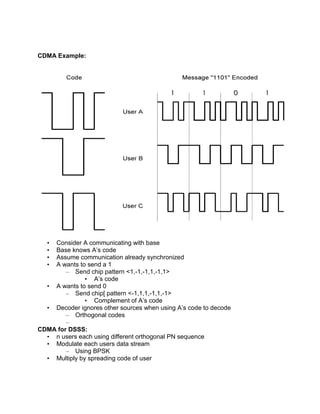
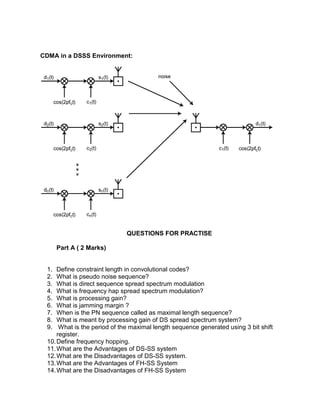
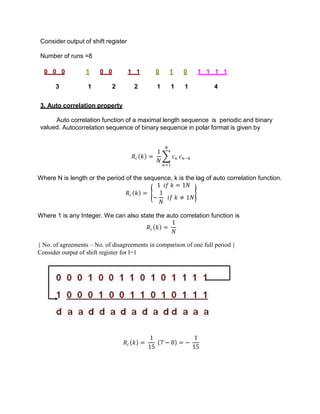
Spread spectrum modulation was initially developed for military applications to make radio transmissions less vulnerable to interference and jamming. It works by spreading a narrowband signal across a much wider bandwidth. This makes the signal difficult to detect and disrupt. There are two main advantages - it has a low probability of intercept and is difficult to interfere with through jamming. The spreading is done by multiplying the data signal with a pseudo-random noise code before transmission. At the receiver, the original data is recovered by multiplying the received signal by an identical code. This process provides interference rejection and allows multiple users to share the same frequency band.
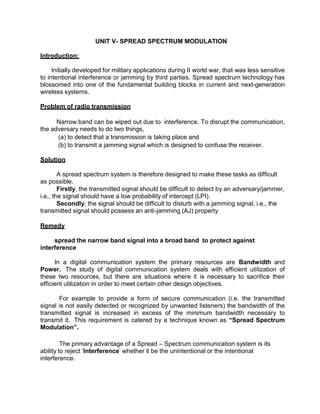
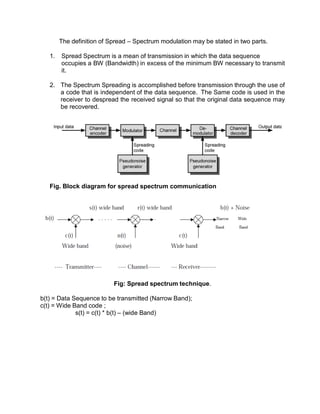
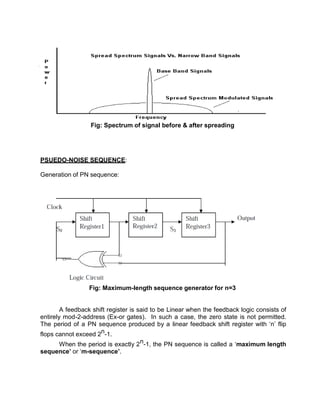
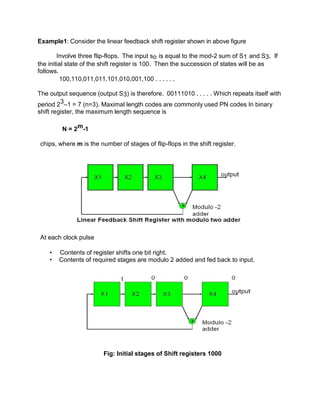
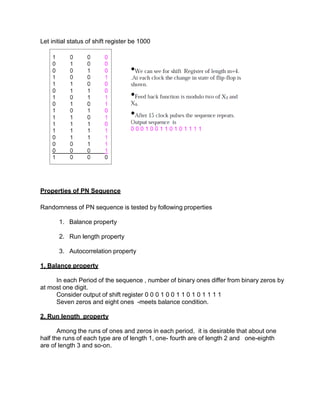
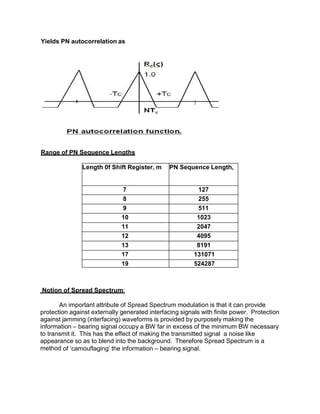
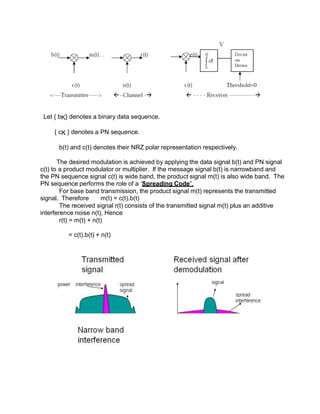
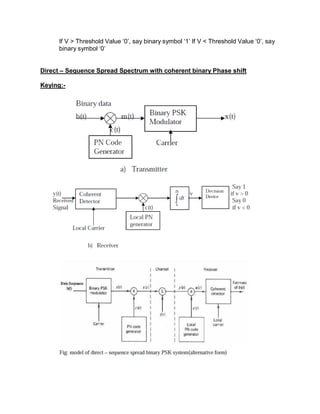
![To recover the original message signal b(t), the received signal r(t) is applied to a
demodulator that consists of a multiplier followed by an integrator and a decision device.
The multiplier is supplied with a locally generated PN sequence that is exact replica of
that used in the transmitter. The multiplier output is given by
Z(t) = r(t).c(t)
= [b(t) * c(t) + n(t)] c(t) = c2(t).b(t) + c(t).n(t)
The data signal b(t) is multiplied twice by the PN signal c(t), where as unwanted
signal n(t) is multiplied only once. But c2(t) = 1, hence the above equation reduces to
Z(t) = b(t) + c(t).n(t)
Now the data component b(t) is narrowband, where as the spurious component
c(t)n(t) is wide band. Hence by applying the multiplier output to a base band (low pass)
filter most of the power in the spurious component c(t)n(t) is filtered out. Thus the effect
of the interference n(t) is thus significantly reduced at the receiver output.
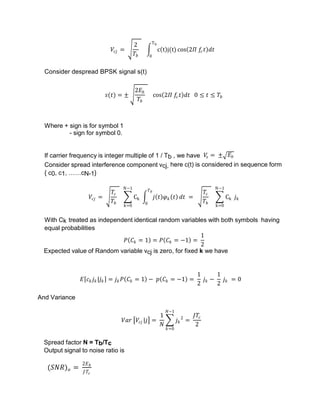
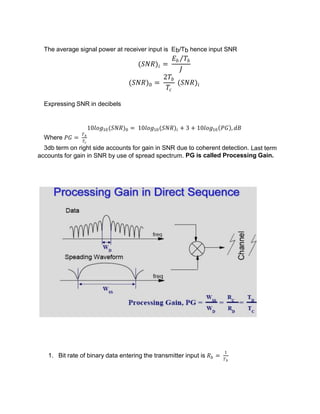
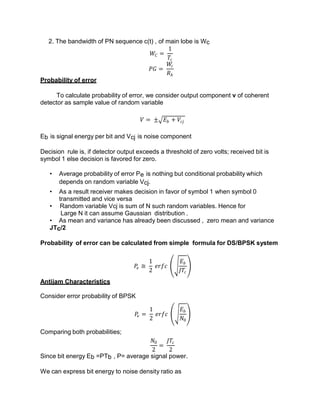
The integration is carried out for the bit interval 0 ≤ t ≤ Tb to provide the sample
value V. Finally, a decision is made by the receiver.](https://image.slidesharecdn.com/unit51-220420133542/85/UNIT5_1-pdf-9-320.jpg)
![Example3
A Spread spectrum communication system has the following parameters.
Information bit duration Tb = 1.024 msecs and PN chip duration of 1µsecs. The
average probability of error of system is not to exceed 10-5. calculate a) Length of
shift register b) Processing gain c) jamming margin
Solution
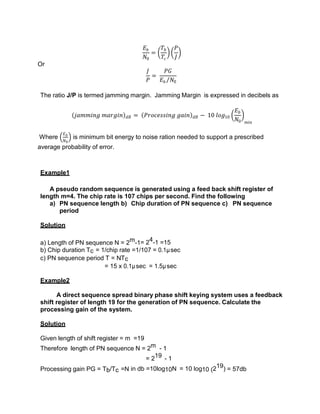
Processing gain PG =N= Tb/Tc =1024
corresponding length of shift register m = 10
In case of coherent BPSK For Probability of error 10-5. [Referring to error function table]
Eb/N0 =10.8
Therefore jamming margin
𝑗𝑎𝑚𝑚𝑖𝑛𝑔 𝑚𝑎𝑟𝑔𝑖𝑛 𝑑𝐵 = 𝑃𝑟𝑜𝑐𝑒𝑠𝑠𝑖𝑛𝑔 𝑔𝑎𝑖𝑛 𝑑𝐵 − 10 𝑙𝑜𝑔10
𝐸𝑏
𝑁0 𝑚𝑖𝑛
𝑗𝑎𝑚𝑚𝑖𝑛𝑔 𝑚𝑎𝑟𝑔𝑖𝑛 𝑑𝐵 = 10 𝑙𝑜𝑔10𝑃𝐺𝑑𝐵 − 10 𝑙𝑜𝑔10
𝐸𝑏
𝑁0 𝑚𝑖𝑛
𝑗𝑎𝑚𝑚𝑖𝑛𝑔 𝑚𝑎𝑟𝑔𝑖𝑛 𝑑𝐵 = 10 𝑙𝑜𝑔101024 − 10 𝑙𝑜𝑔1010.8
𝑗𝑎𝑚𝑚𝑖𝑛𝑔 𝑚𝑎𝑟𝑔𝑖𝑛 𝑑𝐵 = 30.10 − 10.33 = 19.8 𝑑𝐵
Frequency – Hop Spread Spectrum:
In a frequency – hop Spread – Spectrum technique, the spectrum of data
modulated carrier is widened by changing the carrier frequency in a pseudo – random
manner. The type of spread – spectrum in which the carrier hops randomly form one
frequency to another is called Frequency – Hop (FH) Spread Spectrum.
Since frequency hopping does not covers the entire spread spectrum
instantaneously. We are led to consider the rate at which the hop occurs. Depending
upon this we have two types of frequency hop.
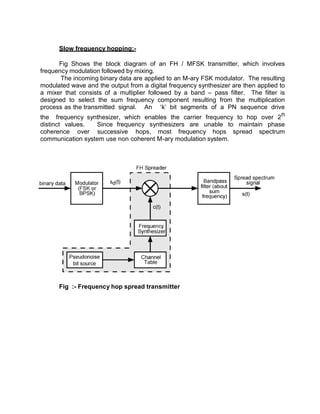
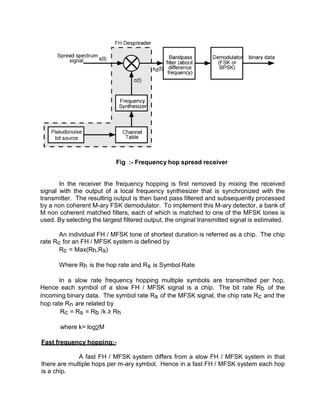
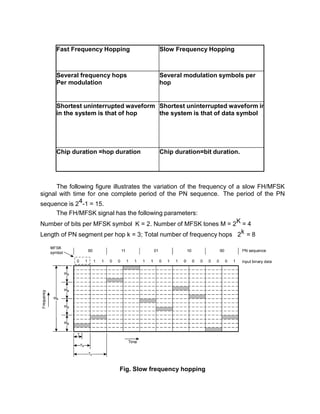
1. Slow frequency hopping:- In which the symbol rate Rs of the MFSK signal is an
integer multiple of the hop rate Rh. That is several symbols are transmitted on
each frequency hop.
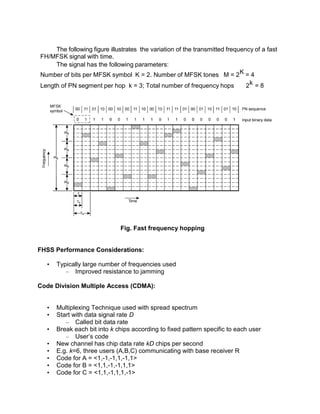
2. Fast – Frequency hopping:- In which the hop rate Rh is an integral multiple of the
MFSK symbol rate Rs. That is the carrier frequency will hoop several times
during the transmission of one symbol. A common modulation format for
frequency hopping system is that of M- ary frequency – shift – keying (MFSK).](https://image.slidesharecdn.com/unit51-220420133542/85/UNIT5_1-pdf-19-320.jpg)