WWW.ESISTREAM.COM
Protocol Specification
Version 1.1
ESIstream - 2014
www.ESIstream.com Protocol specification - Version 1.11 / 9
TABLE OF CONTENT
SCOPE........................................................................................................................................................2
1.1 OBJECTIVE .................................................................................................................................................2
1.2 TERMS AND DEFINITION................................................................................................................................2
2. ESISTREAM PROTOCOL .......................................................................................................................3
2.1 OVERVIEW .................................................................................................................................................3
2.2 SCRAMBLING..............................................................................................................................................4
2.3 ENCODING .................................................................................................................................................4
2.4 SYNCHRONIZATION......................................................................................................................................5
3. ANNEX A: PRBS ARCHITECTURE...........................................................................................................7
4. ANNEX B: LFSR EQUATIONS ................................................................................................................8
5. ANNEX C: EXAMPLE OF DISPARITY BIT IMPLEMENTATION ...................................................................9
FIGURE TABLE
Figure 1: Interface between TX and RX using multiple serial links..........................................................3
Figure 2: Frame ........................................................................................................................................3
Figure 3: LFSR operation..........................................................................................................................4
Figure 4: Frame ........................................................................................................................................4
Figure 5: Synchronization sequence........................................................................................................5
Figure 6: PRBS frames sent for PRBS initialization...................................................................................5
ESIstream is an Open high efficiency serial
interface protocol based on 14b/16b encoding.
Its main benefits are low overhead and ease of
hardware implementation.
www.ESIstream.com Protocol specification - Version 1.12 / 9
SCOPE
1.1 Objective
This specification describes the protocol of an efficient 14b/16b serial interface.
It has been designed for 12 and 14 bits resolution data converters but can be used in any system using serial
interface.
This interface provides an efficiency of 87.5% based on a 14b/16b encoding using LFSR scrambling unit.
It also uses a disparity bit to ensure DC balance transmission and a toggling bit to enable synchronization
monitoring.
1.2 Terms and definition
CDR: Clock and Data Recovery
ESIstream: Efficient Serial Interface
LFSR: Linear Feedback Shift Register
PLL: Phase Locked Loop
PRBS: Pseudo Random Binary Sequence
RX: Receiver
TX: Transmitter
www.ESIstream.com Protocol specification - Version 1.13 / 9
2. ESISTREAM PROTOCOL
2.1 Overview
The serial protocol presented in this specification can be used in multiple configurations.
It is based on a transmission line from the transmitter to the receiver working at high speed.
It also needs a SYNC signal from the receiver to the transmitter to synchronize them.
Only one occurrence of the SYNC signal is necessary between transmitter and receiver even if multiple serial
links are implemented (see example below).
Figure 1: Interface between TX and RX using multiple serial lanes
14 bits of useful data are transmitted between transmitter and receiver encoded in 16 bits.
Figure 2: Frame
These 14 bits are first scrambled, and then the overhead is added.
The clk bit is a single bit that is toggling and can be used to monitor the synchronization of the interface.
The disparity processing is then done on these 15 bits to obtain the 16 bits frame transmitted.
These different stages of encoding are realized to manage the limitations of a serial interface.
First, an AC coupled interface between transmitter and receiver implies that the transmission be DC balance,
otherwise the AC coupling capacitor will drift and the received data will be corrupted.
Then the CDR in the reception stage usually contains a PLL. This means that there must be transitions in the
transmission otherwise this PLL will lose its lock.
The scrambling, clk bit and disparity processing ensure a deterministic transmission with a DC balance
between +/- 16 and a max run length of the transmission of 32.
Note: Current CDR can work with max run length of 80 and above.
www.ESIstream.com Protocol specification - Version 1.14 / 9
2.2 Scrambling
Applying scrambling ensures a statistical DC balanced transmission.
It also statistically ensures that there are transitions in the transmission.
The scrambling technique used in ESIstream is an additive scrambling to avoid error propagation in case of a
single bit error.
It is based on Fibonacci architecture (see Annex A for more information) using the following polynomial:
X17
+X3
+1. It has a run length of 217
- 1.
Instead of using a shift of one bit per operation, it uses shifts of 14 bits per operation to adapt to the size of
the data being scrambled. See Annex B for the equations to use.
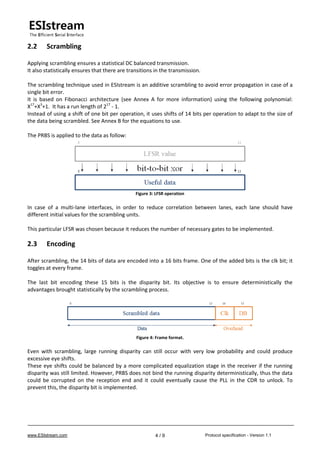
The PRBS is applied to the data as follow:
Figure 3: LFSR operation
In case of a multi-lane interfaces, in order to reduce correlation between lanes, each lane should have
different initial values for the scrambling units.
This particular LFSR was chosen because it reduces the number of necessary gates to be implemented.
2.3 Encoding
After scrambling, the 14 bits of data are encoded into a 16 bits frame. One of the added bits is the clk bit; it
toggles at every frame.
The last bit encoding these 15 bits is the disparity bit. Its objective is to ensure deterministically the
advantages brought statistically by the scrambling process.
Figure 4: Frame format.
Even with scrambling, large running disparity can still occur with very low probability and could produce
excessive eye shifts.
These eye shifts could be balanced by a more complicated equalization stage in the receiver if the running
disparity was still limited. However, PRBS does not bind the running disparity deterministically, thus the data
could be corrupted on the reception end and it could eventually cause the PLL in the CDR to unlock. To
prevent this, the disparity bit is implemented.
www.ESIstream.com Protocol specification - Version 1.15 / 9
The running disparity of the transmission is constantly monitored by the transmitter.
For each frame, its disparity is calculated, 2 cases can occur on the running disparity:
a. The running disparity of the transmission does not increase above +/- 16. In this case, the
disparity bit is set to ‘0’ and the 15 bits of data (scrambled data + clk bit) are transmitted as such.
b. The running disparity of the transmission does increase above +/-16. In this case, the 15 bits of
data (scrambled data + clk bit) are inverted and the disparity bit is set to ‘1’.
The running disparity is updated with the disparity of the frame. See Annex C for an example.
This disparity bit ensures that the longest possible series of ’1’ or ‘0’ transmitted is of 48 bits (the clk bit
reduce the effective value to 32). It also ensures that the running disparity does not exceed +/- 16 which
satisfies the DC balance condition.
In normal operating mode, the receiver will check the disparity bit first. If it is high then it will invert the
received data and descramble them. Otherwise it will only descramble them. From this point the data are
available for processing.
2.4 Synchronization
The link must be synchronized to align the frames between the transmitter and the receiver and to
synchronize the reception scrambler with the transmission scrambler.
The synchronization is controlled through the SYNC signal sent by the receiver to the transmitter.
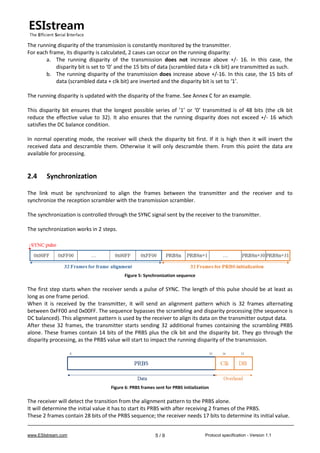
The synchronization works in 2 steps.
Figure 5: Synchronization sequence
The first step starts when the receiver sends a pulse of SYNC. The length of this pulse should be at least as
long as one frame period.
When it is received by the transmitter, it will send an alignment pattern which is 32 frames alternating
between 0xFF00 and 0x00FF. The sequence bypasses the scrambling and disparity processing (the sequence is
DC balanced). This alignment pattern is used by the receiver to align its data on the transmitter output data.
After these 32 frames, the transmitter starts sending 32 additional frames containing the scrambling PRBS
alone. These frames contain 14 bits of the PRBS plus the clk bit and the disparity bit. They go through the
disparity processing, as the PRBS value will start to impact the running disparity of the transmission.
Figure 6: PRBS frames sent for PRBS initialization
The receiver will detect the transition from the alignment pattern to the PRBS alone.
It will determine the initial value it has to start its PRBS with after receiving 2 frames of the PRBS.
These 2 frames contain 28 bits of the PRBS sequence; the receiver needs 17 bits to determine its initial value.
www.ESIstream.com Protocol specification - Version 1.16 / 9
After that, the synchronization of the link is complete.
It can be monitored by the receiver using the clk bit.
In case the receiver does not detect that the clk bit is toggling properly, then it can state that the link is not
synchronous or has lost its synchronization and restart the synchronization process.
www.ESIstream.com Protocol specification - Version 1.17 / 9
3. ANNEX A: PRBS ARCHITECTURE
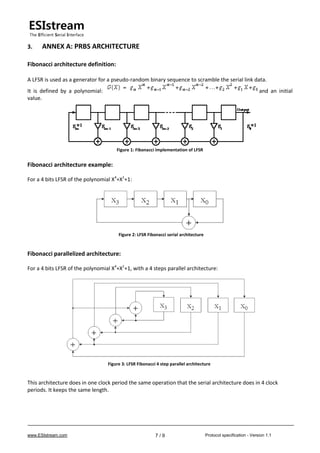
Fibonacci architecture definition:
A LFSR is used as a generator for a pseudo-random binary sequence to scramble the serial link data.
It is defined by a polynomial: and an initial
value.
Figure 1: Fibonacci implementation of LFSR
Fibonacci architecture example:
For a 4 bits LFSR of the polynomial X4
+X1
+1:
Fibonacci parallelized architecture:
For a 4 bits LFSR of the polynomial X4
+X1
+1, with a 4 steps parallel architecture:
This architecture does in one clock period the same operation that the serial architecture does in 4 clock
periods. It keeps the same length.
Figure 2: LFSR Fibonacci serial architecture
Figure 3: LFSR Fibonacci 4 step parallel architecture
www.ESIstream.com Protocol specification - Version 1.18 / 9
4. ANNEX B: LFSR EQUATIONS
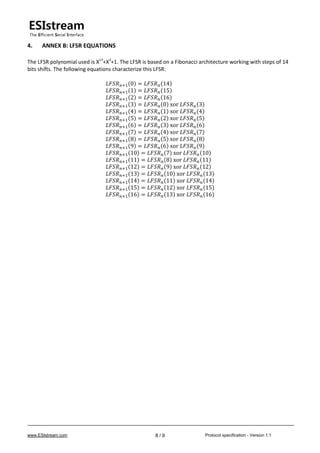
The LFSR polynomial used is X17
+X3
+1. The LFSR is based on a Fibonacci architecture working with steps of 14
bits shifts. The following equations characterize this LFSR:
𝐿𝐹𝑆𝑅 𝑛+1(0) = 𝐿𝐹𝑆𝑅 𝑛(14)
𝐿𝐹𝑆𝑅 𝑛+1(1) = 𝐿𝐹𝑆𝑅 𝑛(15)
𝐿𝐹𝑆𝑅 𝑛+1(2) = 𝐿𝐹𝑆𝑅 𝑛(16)
𝐿𝐹𝑆𝑅 𝑛+1(3) = 𝐿𝐹𝑆𝑅 𝑛(0) xor 𝐿𝐹𝑆𝑅 𝑛(3)
𝐿𝐹𝑆𝑅 𝑛+1(4) = 𝐿𝐹𝑆𝑅 𝑛(1) xor 𝐿𝐹𝑆𝑅 𝑛(4)
𝐿𝐹𝑆𝑅 𝑛+1(5) = 𝐿𝐹𝑆𝑅 𝑛(2) xor 𝐿𝐹𝑆𝑅 𝑛(5)
𝐿𝐹𝑆𝑅 𝑛+1(6) = 𝐿𝐹𝑆𝑅 𝑛(3) xor 𝐿𝐹𝑆𝑅 𝑛(6)
𝐿𝐹𝑆𝑅 𝑛+1(7) = 𝐿𝐹𝑆𝑅 𝑛(4) xor 𝐿𝐹𝑆𝑅 𝑛(7)
𝐿𝐹𝑆𝑅 𝑛+1(8) = 𝐿𝐹𝑆𝑅 𝑛(5) xor 𝐿𝐹𝑆𝑅 𝑛(8)
𝐿𝐹𝑆𝑅 𝑛+1(9) = 𝐿𝐹𝑆𝑅 𝑛(6) xor 𝐿𝐹𝑆𝑅 𝑛(9)
𝐿𝐹𝑆𝑅 𝑛+1(10) = 𝐿𝐹𝑆𝑅 𝑛(7) xor 𝐿𝐹𝑆𝑅 𝑛(10)
𝐿𝐹𝑆𝑅 𝑛+1(11) = 𝐿𝐹𝑆𝑅 𝑛(8) xor 𝐿𝐹𝑆𝑅 𝑛(11)
𝐿𝐹𝑆𝑅 𝑛+1(12) = 𝐿𝐹𝑆𝑅 𝑛(9) xor 𝐿𝐹𝑆𝑅 𝑛(12)
𝐿𝐹𝑆𝑅 𝑛+1(13) = 𝐿𝐹𝑆𝑅 𝑛(10) xor 𝐿𝐹𝑆𝑅 𝑛(13)
𝐿𝐹𝑆𝑅 𝑛+1(14) = 𝐿𝐹𝑆𝑅 𝑛(11) xor 𝐿𝐹𝑆𝑅 𝑛(14)
𝐿𝐹𝑆𝑅 𝑛+1(15) = 𝐿𝐹𝑆𝑅 𝑛(12) xor 𝐿𝐹𝑆𝑅 𝑛(15)
𝐿𝐹𝑆𝑅 𝑛+1(16) = 𝐿𝐹𝑆𝑅 𝑛(13) xor 𝐿𝐹𝑆𝑅 𝑛(16)
www.ESIstream.com Protocol specification - Version 1.19 / 9
5. ANNEX C: EXAMPLE OF DISPARITY BIT IMPLEMENTATION
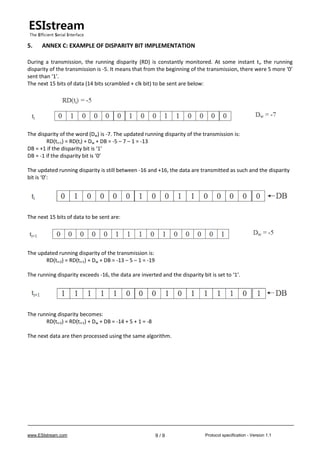
During a transmission, the running disparity (RD) is constantly monitored. At some instant ti, the running
disparity of the transmission is -5. It means that from the beginning of the transmission, there were 5 more ‘0’
sent than ‘1’.
The next 15 bits of data (14 bits scrambled + clk bit) to be sent are below:
The disparity of the word (Dw) is -7. The updated running disparity of the transmission is:
RD(ti+1) = RD(ti) + Dw + DB = -5 – 7 – 1 = -13
DB = +1 if the disparity bit is ‘1’
DB = -1 if the disparity bit is ‘0’
The updated running disparity is still between -16 and +16, the data are transmitted as such and the disparity
bit is ‘0’:
The next 15 bits of data to be sent are:
The updated running disparity of the transmission is:
RD(ti+2) = RD(ti+1) + Dw + DB = -13 – 5 – 1 = -19
The running disparity exceeds -16, the data are inverted and the disparity bit is set to ‘1’.
The running disparity becomes:
RD(ti+2) = RD(ti+1) + Dw + DB = -14 + 5 + 1 = -8
The next data are then processed using the same algorithm.

ESIstream specification v1.1.A1

  • 1.
  • 2.
    www.ESIstream.com Protocol specification- Version 1.11 / 9 TABLE OF CONTENT SCOPE........................................................................................................................................................2 1.1 OBJECTIVE .................................................................................................................................................2 1.2 TERMS AND DEFINITION................................................................................................................................2 2. ESISTREAM PROTOCOL .......................................................................................................................3 2.1 OVERVIEW .................................................................................................................................................3 2.2 SCRAMBLING..............................................................................................................................................4 2.3 ENCODING .................................................................................................................................................4 2.4 SYNCHRONIZATION......................................................................................................................................5 3. ANNEX A: PRBS ARCHITECTURE...........................................................................................................7 4. ANNEX B: LFSR EQUATIONS ................................................................................................................8 5. ANNEX C: EXAMPLE OF DISPARITY BIT IMPLEMENTATION ...................................................................9 FIGURE TABLE Figure 1: Interface between TX and RX using multiple serial links..........................................................3 Figure 2: Frame ........................................................................................................................................3 Figure 3: LFSR operation..........................................................................................................................4 Figure 4: Frame ........................................................................................................................................4 Figure 5: Synchronization sequence........................................................................................................5 Figure 6: PRBS frames sent for PRBS initialization...................................................................................5 ESIstream is an Open high efficiency serial interface protocol based on 14b/16b encoding. Its main benefits are low overhead and ease of hardware implementation.
  • 3.
    www.ESIstream.com Protocol specification- Version 1.12 / 9 SCOPE 1.1 Objective This specification describes the protocol of an efficient 14b/16b serial interface. It has been designed for 12 and 14 bits resolution data converters but can be used in any system using serial interface. This interface provides an efficiency of 87.5% based on a 14b/16b encoding using LFSR scrambling unit. It also uses a disparity bit to ensure DC balance transmission and a toggling bit to enable synchronization monitoring. 1.2 Terms and definition CDR: Clock and Data Recovery ESIstream: Efficient Serial Interface LFSR: Linear Feedback Shift Register PLL: Phase Locked Loop PRBS: Pseudo Random Binary Sequence RX: Receiver TX: Transmitter
  • 4.
    www.ESIstream.com Protocol specification- Version 1.13 / 9 2. ESISTREAM PROTOCOL 2.1 Overview The serial protocol presented in this specification can be used in multiple configurations. It is based on a transmission line from the transmitter to the receiver working at high speed. It also needs a SYNC signal from the receiver to the transmitter to synchronize them. Only one occurrence of the SYNC signal is necessary between transmitter and receiver even if multiple serial links are implemented (see example below). Figure 1: Interface between TX and RX using multiple serial lanes 14 bits of useful data are transmitted between transmitter and receiver encoded in 16 bits. Figure 2: Frame These 14 bits are first scrambled, and then the overhead is added. The clk bit is a single bit that is toggling and can be used to monitor the synchronization of the interface. The disparity processing is then done on these 15 bits to obtain the 16 bits frame transmitted. These different stages of encoding are realized to manage the limitations of a serial interface. First, an AC coupled interface between transmitter and receiver implies that the transmission be DC balance, otherwise the AC coupling capacitor will drift and the received data will be corrupted. Then the CDR in the reception stage usually contains a PLL. This means that there must be transitions in the transmission otherwise this PLL will lose its lock. The scrambling, clk bit and disparity processing ensure a deterministic transmission with a DC balance between +/- 16 and a max run length of the transmission of 32. Note: Current CDR can work with max run length of 80 and above.
  • 5.
    www.ESIstream.com Protocol specification- Version 1.14 / 9 2.2 Scrambling Applying scrambling ensures a statistical DC balanced transmission. It also statistically ensures that there are transitions in the transmission. The scrambling technique used in ESIstream is an additive scrambling to avoid error propagation in case of a single bit error. It is based on Fibonacci architecture (see Annex A for more information) using the following polynomial: X17 +X3 +1. It has a run length of 217 - 1. Instead of using a shift of one bit per operation, it uses shifts of 14 bits per operation to adapt to the size of the data being scrambled. See Annex B for the equations to use. The PRBS is applied to the data as follow: Figure 3: LFSR operation In case of a multi-lane interfaces, in order to reduce correlation between lanes, each lane should have different initial values for the scrambling units. This particular LFSR was chosen because it reduces the number of necessary gates to be implemented. 2.3 Encoding After scrambling, the 14 bits of data are encoded into a 16 bits frame. One of the added bits is the clk bit; it toggles at every frame. The last bit encoding these 15 bits is the disparity bit. Its objective is to ensure deterministically the advantages brought statistically by the scrambling process. Figure 4: Frame format. Even with scrambling, large running disparity can still occur with very low probability and could produce excessive eye shifts. These eye shifts could be balanced by a more complicated equalization stage in the receiver if the running disparity was still limited. However, PRBS does not bind the running disparity deterministically, thus the data could be corrupted on the reception end and it could eventually cause the PLL in the CDR to unlock. To prevent this, the disparity bit is implemented.
  • 6.
    www.ESIstream.com Protocol specification- Version 1.15 / 9 The running disparity of the transmission is constantly monitored by the transmitter. For each frame, its disparity is calculated, 2 cases can occur on the running disparity: a. The running disparity of the transmission does not increase above +/- 16. In this case, the disparity bit is set to ‘0’ and the 15 bits of data (scrambled data + clk bit) are transmitted as such. b. The running disparity of the transmission does increase above +/-16. In this case, the 15 bits of data (scrambled data + clk bit) are inverted and the disparity bit is set to ‘1’. The running disparity is updated with the disparity of the frame. See Annex C for an example. This disparity bit ensures that the longest possible series of ’1’ or ‘0’ transmitted is of 48 bits (the clk bit reduce the effective value to 32). It also ensures that the running disparity does not exceed +/- 16 which satisfies the DC balance condition. In normal operating mode, the receiver will check the disparity bit first. If it is high then it will invert the received data and descramble them. Otherwise it will only descramble them. From this point the data are available for processing. 2.4 Synchronization The link must be synchronized to align the frames between the transmitter and the receiver and to synchronize the reception scrambler with the transmission scrambler. The synchronization is controlled through the SYNC signal sent by the receiver to the transmitter. The synchronization works in 2 steps. Figure 5: Synchronization sequence The first step starts when the receiver sends a pulse of SYNC. The length of this pulse should be at least as long as one frame period. When it is received by the transmitter, it will send an alignment pattern which is 32 frames alternating between 0xFF00 and 0x00FF. The sequence bypasses the scrambling and disparity processing (the sequence is DC balanced). This alignment pattern is used by the receiver to align its data on the transmitter output data. After these 32 frames, the transmitter starts sending 32 additional frames containing the scrambling PRBS alone. These frames contain 14 bits of the PRBS plus the clk bit and the disparity bit. They go through the disparity processing, as the PRBS value will start to impact the running disparity of the transmission. Figure 6: PRBS frames sent for PRBS initialization The receiver will detect the transition from the alignment pattern to the PRBS alone. It will determine the initial value it has to start its PRBS with after receiving 2 frames of the PRBS. These 2 frames contain 28 bits of the PRBS sequence; the receiver needs 17 bits to determine its initial value.
  • 7.
    www.ESIstream.com Protocol specification- Version 1.16 / 9 After that, the synchronization of the link is complete. It can be monitored by the receiver using the clk bit. In case the receiver does not detect that the clk bit is toggling properly, then it can state that the link is not synchronous or has lost its synchronization and restart the synchronization process.
  • 8.
    www.ESIstream.com Protocol specification- Version 1.17 / 9 3. ANNEX A: PRBS ARCHITECTURE Fibonacci architecture definition: A LFSR is used as a generator for a pseudo-random binary sequence to scramble the serial link data. It is defined by a polynomial: and an initial value. Figure 1: Fibonacci implementation of LFSR Fibonacci architecture example: For a 4 bits LFSR of the polynomial X4 +X1 +1: Fibonacci parallelized architecture: For a 4 bits LFSR of the polynomial X4 +X1 +1, with a 4 steps parallel architecture: This architecture does in one clock period the same operation that the serial architecture does in 4 clock periods. It keeps the same length. Figure 2: LFSR Fibonacci serial architecture Figure 3: LFSR Fibonacci 4 step parallel architecture
  • 9.
    www.ESIstream.com Protocol specification- Version 1.18 / 9 4. ANNEX B: LFSR EQUATIONS The LFSR polynomial used is X17 +X3 +1. The LFSR is based on a Fibonacci architecture working with steps of 14 bits shifts. The following equations characterize this LFSR: 𝐿𝐹𝑆𝑅 𝑛+1(0) = 𝐿𝐹𝑆𝑅 𝑛(14) 𝐿𝐹𝑆𝑅 𝑛+1(1) = 𝐿𝐹𝑆𝑅 𝑛(15) 𝐿𝐹𝑆𝑅 𝑛+1(2) = 𝐿𝐹𝑆𝑅 𝑛(16) 𝐿𝐹𝑆𝑅 𝑛+1(3) = 𝐿𝐹𝑆𝑅 𝑛(0) xor 𝐿𝐹𝑆𝑅 𝑛(3) 𝐿𝐹𝑆𝑅 𝑛+1(4) = 𝐿𝐹𝑆𝑅 𝑛(1) xor 𝐿𝐹𝑆𝑅 𝑛(4) 𝐿𝐹𝑆𝑅 𝑛+1(5) = 𝐿𝐹𝑆𝑅 𝑛(2) xor 𝐿𝐹𝑆𝑅 𝑛(5) 𝐿𝐹𝑆𝑅 𝑛+1(6) = 𝐿𝐹𝑆𝑅 𝑛(3) xor 𝐿𝐹𝑆𝑅 𝑛(6) 𝐿𝐹𝑆𝑅 𝑛+1(7) = 𝐿𝐹𝑆𝑅 𝑛(4) xor 𝐿𝐹𝑆𝑅 𝑛(7) 𝐿𝐹𝑆𝑅 𝑛+1(8) = 𝐿𝐹𝑆𝑅 𝑛(5) xor 𝐿𝐹𝑆𝑅 𝑛(8) 𝐿𝐹𝑆𝑅 𝑛+1(9) = 𝐿𝐹𝑆𝑅 𝑛(6) xor 𝐿𝐹𝑆𝑅 𝑛(9) 𝐿𝐹𝑆𝑅 𝑛+1(10) = 𝐿𝐹𝑆𝑅 𝑛(7) xor 𝐿𝐹𝑆𝑅 𝑛(10) 𝐿𝐹𝑆𝑅 𝑛+1(11) = 𝐿𝐹𝑆𝑅 𝑛(8) xor 𝐿𝐹𝑆𝑅 𝑛(11) 𝐿𝐹𝑆𝑅 𝑛+1(12) = 𝐿𝐹𝑆𝑅 𝑛(9) xor 𝐿𝐹𝑆𝑅 𝑛(12) 𝐿𝐹𝑆𝑅 𝑛+1(13) = 𝐿𝐹𝑆𝑅 𝑛(10) xor 𝐿𝐹𝑆𝑅 𝑛(13) 𝐿𝐹𝑆𝑅 𝑛+1(14) = 𝐿𝐹𝑆𝑅 𝑛(11) xor 𝐿𝐹𝑆𝑅 𝑛(14) 𝐿𝐹𝑆𝑅 𝑛+1(15) = 𝐿𝐹𝑆𝑅 𝑛(12) xor 𝐿𝐹𝑆𝑅 𝑛(15) 𝐿𝐹𝑆𝑅 𝑛+1(16) = 𝐿𝐹𝑆𝑅 𝑛(13) xor 𝐿𝐹𝑆𝑅 𝑛(16)
  • 10.
    www.ESIstream.com Protocol specification- Version 1.19 / 9 5. ANNEX C: EXAMPLE OF DISPARITY BIT IMPLEMENTATION During a transmission, the running disparity (RD) is constantly monitored. At some instant ti, the running disparity of the transmission is -5. It means that from the beginning of the transmission, there were 5 more ‘0’ sent than ‘1’. The next 15 bits of data (14 bits scrambled + clk bit) to be sent are below: The disparity of the word (Dw) is -7. The updated running disparity of the transmission is: RD(ti+1) = RD(ti) + Dw + DB = -5 – 7 – 1 = -13 DB = +1 if the disparity bit is ‘1’ DB = -1 if the disparity bit is ‘0’ The updated running disparity is still between -16 and +16, the data are transmitted as such and the disparity bit is ‘0’: The next 15 bits of data to be sent are: The updated running disparity of the transmission is: RD(ti+2) = RD(ti+1) + Dw + DB = -13 – 5 – 1 = -19 The running disparity exceeds -16, the data are inverted and the disparity bit is set to ‘1’. The running disparity becomes: RD(ti+2) = RD(ti+1) + Dw + DB = -14 + 5 + 1 = -8 The next data are then processed using the same algorithm.