Acute abdomen for EP


         Prasit Wuthisuthimethawee
         Department of Emergency Medicine
         Prince of Songkla University
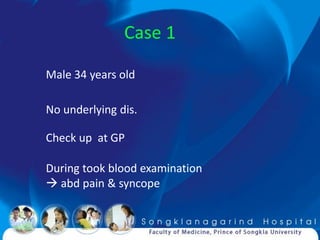
Male 34 years old

No underlying dis.

Check up at GP

During took blood examination
 abd pain & syncope
Objectives
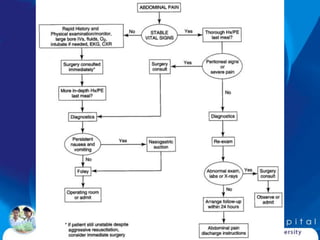
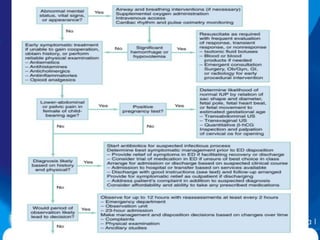
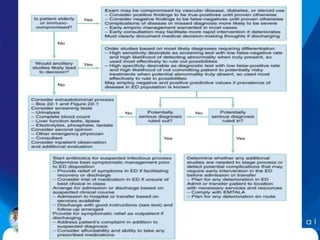
Abdominal pain pathway

Critical points for assessing abdominal pain
Epidemiology

4-10 % of all emergency department visit

50 % have clearly diagnosis


15-30% require surgical procedure esp. elderly

Acute appendicitis is the most common
Epidemiology
Unique in Pediatric and Elderly
Acute abdominal pain among elderly patients
3 years, 831 cases

Non-specific 22-24%

Misdiagnosis (52% VS 45%), high mortality (2.8% VS 0.1%)
less peritoneal signs


                         Laurell H, Hansson LE, Gunnarsson U.
                         Gerontology. 2006;52(6): 339-44
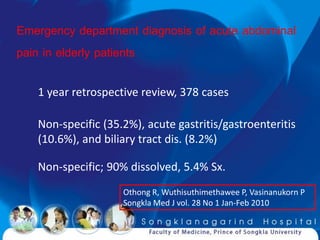
Emergency department diagnosis of acute abdominal
pain in elderly patients

   1 year retrospective review, 378 cases

   Non-specific (35.2%), acute gastritis/gastroenteritis
   (10.6%), and biliary tract dis. (8.2%)

   Non-specific; 90% dissolved, 5.4% Sx.
                    Othong R, Wuthisuthimethawee P, Vasinanukorn P
                    Songkla Med J vol. 28 No 1 Jan-Feb 2010
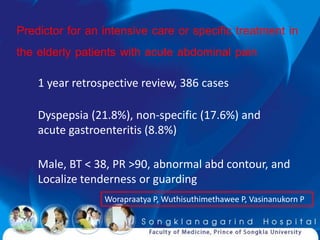
Predictor for an intensive care or specific treatment in
the elderly patients with acute abdominal pain
    1 year retrospective review, 386 cases

    Dyspepsia (21.8%), non-specific (17.6%) and
    acute gastroenteritis (8.8%)

    Male, BT < 38, PR >90, abnormal abd contour, and
    Localize tenderness or guarding
                 Worapraatya P, Wuthisuthimethawee P, Vasinanukorn P
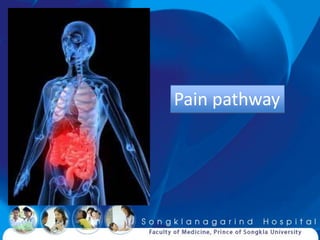
Pain pathway
Abdominal pain pathway


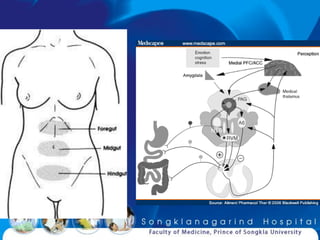
3 type; visceral, somatic, and referred pain
Abdominal pain pathway
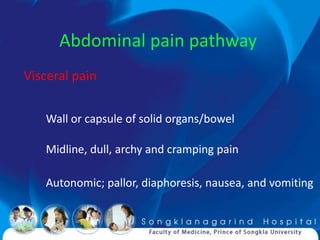
Visceral pain

   Wall or capsule of solid organs/bowel

   Midline, dull, archy and cramping pain

   Autonomic; pallor, diaphoresis, nausea, and vomiting
Abdominal pain pathway
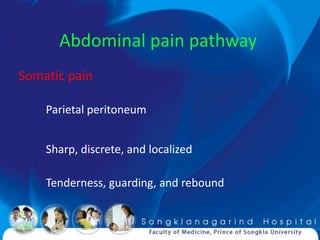
Somatic pain

    Parietal peritoneum


    Sharp, discrete, and localized

    Tenderness, guarding, and rebound
Abdominal pain pathway
Somatic pain
Abdominal pain pathway

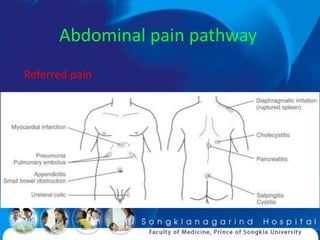
Referred pain

    Cutaneous site distant from the diseased organ

    Diaphragm  C3-5: neck and shoulder pain
Abdominal pain pathway
Referred pain
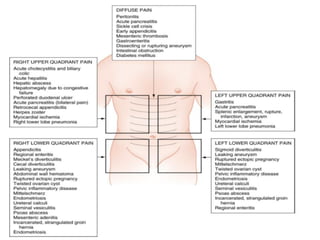
Critical points for assessing abdominal pain
Life threatening conditions

Vascular disease

Acute myocardial infarction

Ruptured ectopic pregnancy

Perforated visceral organs
Life threatening conditions

Intestinal obstruction

Acute hemorrhagic pancreatitis

Esophageal rupture
Aim

Surgical or Non-surgical
Physical examination

Accuracy 55-65% with final diagnosis

Reexamination and observation

Technique !
Physical examination


    Bowel sound

Little diagnostic value
Physical examination


 Do not forget PR
Physical examination


   Analgesic ?
Analgesia on abdominal examination

 Effect on diagnostic efficiency of analgesia for
 undifferentiated abdominal pain


   Analgesia is safe in abdominal pain


                              Br J Surg. 2003 Jan;90(1):5-9
Analgesia on abdominal examination
Effects of morphine analgesia on diagnostic accuracy in
Emergency Department patients with abdominal pain:
a prospective, randomized trial

    Prospective, double-blind clinical trial

    Reexam in 60 minutes

    No differences with respect to changes in physical
    examination or diagnostic accuracy

                                J Am Coll Surg. 2003 Jan;196(1):18-31
Analgesia on abdominal examination

 Analgesia in patients with acute abdominal pain


    Opioid improve patients comfort and
    does not retard decision to treat


          Cochrane Database Syst Rev. 2007 Jul 18;(3): CD005660
Analgesia on abdominal examination
Efficacy and impact of intravenous morphine before surgical
consultation in children with right lower quadrant pain
suggestive of appendicitis: a randomized controlled trial

      Randomized double-blind placebo-controlled trial

      8-18 years old, 90 patients

      Morphine did not delay surgical decision,
      not more effective than placebo to diminishing pain
                              Ann Emerg Med. 2007 Oct;50(4):371-8.
                              Epub 2007 Jun 27
Medication on abdominal examination


           Buscopan ?
Clinical assessment


 Reassessment
Clinical assessment


Patient’s quantification of pain
is unreliable
Clinical assessment


Corticosteroids and
immunosuppressants
Clinical assessment

Chronic dis.: CRF
Clinical assessment


      Fever ?
Clinical assessment


Prior abdominal surgery
Clinical assessment


    Hernia

    Genitalia
Clinical assessment


Peripheral pulse
Clinical assessment


Menstrual history

Urine pregnancy test
Clinical assessment


WBC 30% in abdominal
pain of unknown etiology
Clinical assessment


20% of pancreatitis
have normal amylase
Clinical assessment


20% of pancreatitis
have normal amylase
Clinical assessment


Lactase and mesenteric ischemia


100% sensitive and 42% specific
Clinical assessment

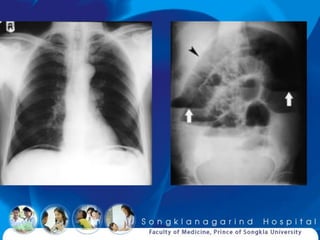
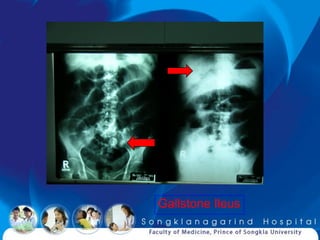
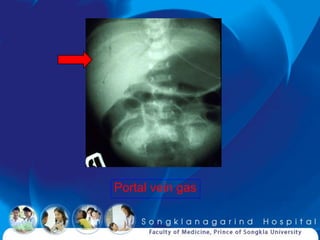
Film acute abdomen

10-38% confirm diagnosis
Gallstone Ileus
Portal vein gas
Clinical assessment

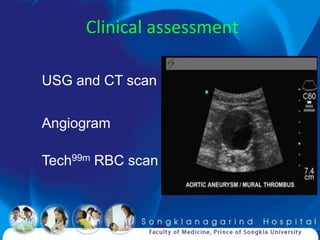
USG and CT scan

Angiogram

Tech99m RBC scan
Clinical assessment


Myocardial infarction, pneumonia,
or pulmonary embolus can present
as abdominal pain
Clinical assessment

Psychiatric disorder

The last diagnosis
Mamagement

Bowel rest +/- decompression

IV resuscitation with correct electrolyte

Antiemesis ? Analgesia ? Antibiotic ?

Pre-op in surgical case
Uncertain Diagnosis


Observation

Review the cause

Consultation
Uncertain Diagnosis


When in doubt, don’t send them out!


              Cope’s Early Diagnosis of the Acute
              Abdomen, 20th ed.. New York, Oxford
              University Press, 2000.
Case 1

Male 34 years old

No underlying dis.

Check up at GP

During took blood examination
 abd pain & syncope
Case 1

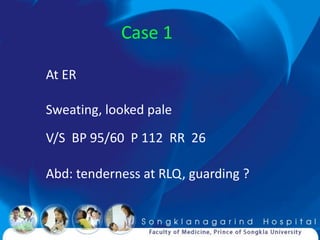
At ER

Sweating, looked pale
V/S BP 95/60 P 112 RR 26

Abd: tenderness at RLQ, guarding ?
What is diagnosis ?
Case 2

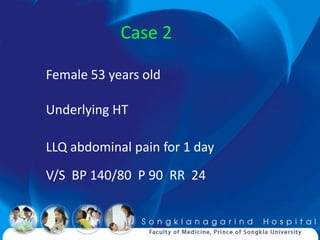
Female 53 years old

Underlying HT

LLQ abdominal pain for 1 day
V/S BP 140/80 P 90 RR 24
Case 2

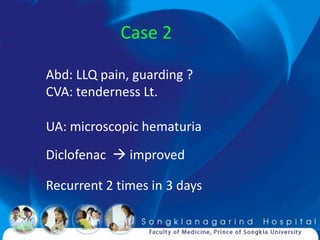
Abd: LLQ pain, guarding ?
CVA: tenderness Lt.

UA: microscopic hematuria
Diclofenac  improved

Recurrent 2 times in 3 days
What is diagnosis ?
Hematuria may be seen in
abdominal aortic aneurysm (30%)
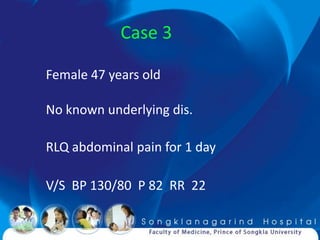
Case 3

Female 47 years old

No known underlying dis.

RLQ abdominal pain for 1 day

V/S BP 130/80 P 82 RR 22
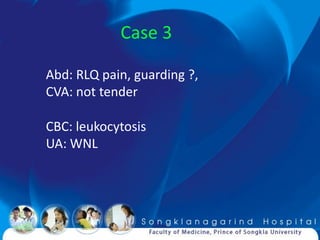
Case 3

Abd: RLQ pain, guarding ?,
CVA: not tender

CBC: leukocytosis
UA: WNL
What is diagnosis ?
?
Clinical assessment
ขอบคุณครับ
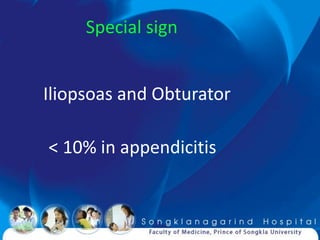
Special sign


Iliopsoas and Obturator

< 10% in appendicitis
Special sign


Fist Percussion
Special sign


Rovsing’s Sign

Only 5% of patients
High-Yield historical questions

  How old are you ?

  Which came first-pain or vomiting ?

  How long have you had the pain ?

  Have you ever had abdominal surgery ?
High-Yield historical questions

  Is the pain constant or intermittent ?

  Have you ever had this before ?

  Do you have a history of cancer diverticulosis ?

  Do you have HIV ?
High-Yield historical questions

  How much alcohol do you drink per day ?

  Are you pregnant ?

  Are you taking antibiotic or steroid ?
  Did the pain start centrally and migrate ?
  Do you have a history of CAD, HT, AF ?
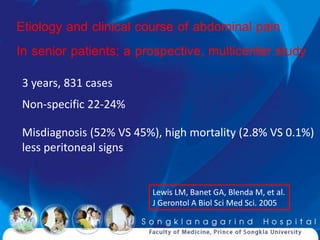
Etiology and clinical course of abdominal pain
In senior patients; a prospective, multicenter study
3 years, 831 cases
Non-specific 22-24%

Misdiagnosis (52% VS 45%), high mortality (2.8% VS 0.1%)
less peritoneal signs


                         Lewis LM, Banet GA, Blenda M, et al.
                         J Gerontol A Biol Sci Med Sci. 2005
Prasit acute abdomen