The Future of Drought in Texas:
What Does It Have to Do With Groundwater??
John W. Nielsen-Gammon
Texas A&M University
and…
…and a cast of several!
• Jay Banner, UT Austin
• Benjamin Cook, NASA GISS
• Darrel Tremaine, UT Austin
• Corinne Wong, UT Austin
• Robert Mace, Texas State
• Huilin Gao, Texas A&M
• Zong-Liang Yang, UT Austin
• Marisa Flores Gonzalez, City of
Austin
• Richard Hoffpauir, Hoffpauir
Consulting, Bryan
• Tom Gooch, Freese and Nichols,
Fort Worth
• Kevin Kloesel, Univ. of Oklahoma
• With help from Katharine Hayhoe,
Ron Anderson, and Tim Finley
Supported by: The National Science Foundation Coupled Natural and Human Systems program,
grant number AGS-1518541, the Cynthia and George Mitchell Foundation grant number G-
1809-55892, and by The University of Texas at Austin’s Planet Texas 2050 Bridging Barriers
research initiative.
-1
0
1
1900 1920 1940 1960 1980 2000 2020
Degrees
Celsius Annual Temperature Anomalies
HadCRUT GISTEMP Hist+RCP8.5 Texas 9yRM a b
Degrees/Decade
°F °C
0.25 - 0.28
0.28 - 0.31
0.31 - 0.33
0.33 - 0.36
0.36 - 0.39
0.39 - 0.42
0.42 - 0.44
0.44 - 0.47
0
200
400
600
800
1000
0
10
20
30
40
1895 1910 1925 1940 1955 1970 1985 2000 2015
Millimeters
Inches
Texas Annual Precipitation
a b
Benjamin I. Cook et al. Sci Adv 2015;1:e1400082
Copyright Ā© 2015, The Authors
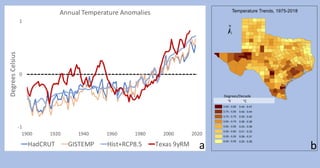
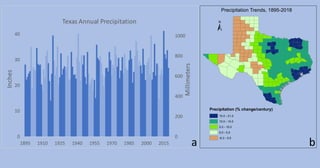
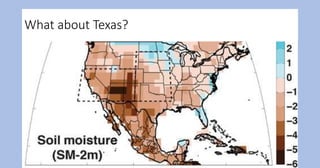
What about Texas?
What does this mean for surface water supply?
• Uncertainty for future
• How much carbon dioxide etc.?
• How much will the climate system respond?
• How do we infer local details, given the climate system response?
• How do we model the hydrology?
• How important is all of this compared to natural variability?
• Tool: calibrated hydrologic model for major rivers
• Tool: combined hydrology-reservoir model that is management-aware
• Also relevant: demand and flood resilience
What does this mean for groundwater supply?
• Fast-recharge aquifers: supply-driven impacts
• Slow-recharge aquifers: demand-driven impacts
• In between: demand-driven impacts + future supply-driven impacts
What do stakeholders need?
Example: Small groundwater management districts
• Prediction of demand-side response driven by climate change
• Technical expertise
• Short-term and long-term outlooks tailored to needs
Why more droughts? Or more aridity?
• On the drying side…
• Decreases in annual precipitation
• Changes in temperature
• Changes in rainfall extremes, month
to month
• Changes in rainfall seasonality
• Changes in biomass (short term)
• On the wetting side…
• Increases in annual precipitation
• Changes in biosphere water use
efficiency
• Changes in biomass (long term)
• On the mixed effects side…
• Changes in rainfall extremes, single
storms
• Changes in soil moisture
What did Austin Water do?
• Water Forward: a 100-year integrated water resources plan
• Input: Global climate model projections of temperature and precipitation
• Input: Historical statistical relationship with streamflow
• Tool: Future scenarios = drought of record and 3x drought of record
• All info tailored for direct input to Water Availability Model
• Key: working directly with climate scientists
Research for scientists and stakeholders
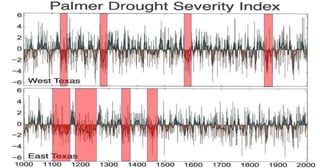
• Reconstructing last 8,000 years of arid-wet dividing line in Texas
• Developing tools to connect downscaled projections and local streamflow
• Adjusting the ā€˜drought of record’ to ensure equivalent future resilience
• Transparent communication and understanding of unknowns
Paper online, open access: google Nielsen-Gammon Earth’s Future
Email me: n-g@tamu.edu

Keynote - John Nielsen-Gammon

  • 1.
    The Future ofDrought in Texas: What Does It Have to Do With Groundwater?? John W. Nielsen-Gammon Texas A&M University and…
  • 2.
    …and a castof several! • Jay Banner, UT Austin • Benjamin Cook, NASA GISS • Darrel Tremaine, UT Austin • Corinne Wong, UT Austin • Robert Mace, Texas State • Huilin Gao, Texas A&M • Zong-Liang Yang, UT Austin • Marisa Flores Gonzalez, City of Austin • Richard Hoffpauir, Hoffpauir Consulting, Bryan • Tom Gooch, Freese and Nichols, Fort Worth • Kevin Kloesel, Univ. of Oklahoma • With help from Katharine Hayhoe, Ron Anderson, and Tim Finley Supported by: The National Science Foundation Coupled Natural and Human Systems program, grant number AGS-1518541, the Cynthia and George Mitchell Foundation grant number G- 1809-55892, and by The University of Texas at Austin’s Planet Texas 2050 Bridging Barriers research initiative.
  • 3.
    -1 0 1 1900 1920 19401960 1980 2000 2020 Degrees Celsius Annual Temperature Anomalies HadCRUT GISTEMP Hist+RCP8.5 Texas 9yRM a b Degrees/Decade °F °C 0.25 - 0.28 0.28 - 0.31 0.31 - 0.33 0.33 - 0.36 0.36 - 0.39 0.39 - 0.42 0.42 - 0.44 0.44 - 0.47
  • 4.
    0 200 400 600 800 1000 0 10 20 30 40 1895 1910 19251940 1955 1970 1985 2000 2015 Millimeters Inches Texas Annual Precipitation a b
  • 6.
    Benjamin I. Cooket al. Sci Adv 2015;1:e1400082 Copyright Ā© 2015, The Authors
  • 7.
  • 15.
    What does thismean for surface water supply? • Uncertainty for future • How much carbon dioxide etc.? • How much will the climate system respond? • How do we infer local details, given the climate system response? • How do we model the hydrology? • How important is all of this compared to natural variability? • Tool: calibrated hydrologic model for major rivers • Tool: combined hydrology-reservoir model that is management-aware • Also relevant: demand and flood resilience
  • 16.
    What does thismean for groundwater supply? • Fast-recharge aquifers: supply-driven impacts • Slow-recharge aquifers: demand-driven impacts • In between: demand-driven impacts + future supply-driven impacts
  • 17.
    What do stakeholdersneed? Example: Small groundwater management districts • Prediction of demand-side response driven by climate change • Technical expertise • Short-term and long-term outlooks tailored to needs
  • 18.
    Why more droughts?Or more aridity? • On the drying side… • Decreases in annual precipitation • Changes in temperature • Changes in rainfall extremes, month to month • Changes in rainfall seasonality • Changes in biomass (short term) • On the wetting side… • Increases in annual precipitation • Changes in biosphere water use efficiency • Changes in biomass (long term) • On the mixed effects side… • Changes in rainfall extremes, single storms • Changes in soil moisture
  • 19.
    What did AustinWater do? • Water Forward: a 100-year integrated water resources plan • Input: Global climate model projections of temperature and precipitation • Input: Historical statistical relationship with streamflow • Tool: Future scenarios = drought of record and 3x drought of record • All info tailored for direct input to Water Availability Model • Key: working directly with climate scientists
  • 20.
    Research for scientistsand stakeholders • Reconstructing last 8,000 years of arid-wet dividing line in Texas • Developing tools to connect downscaled projections and local streamflow • Adjusting the ā€˜drought of record’ to ensure equivalent future resilience • Transparent communication and understanding of unknowns Paper online, open access: google Nielsen-Gammon Earth’s Future Email me: n-g@tamu.edu

Editor's Notes

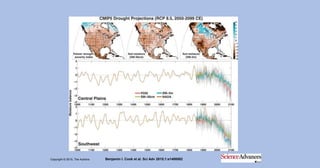
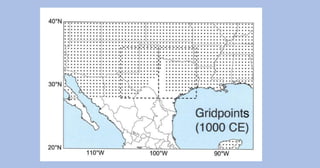
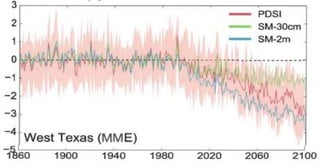
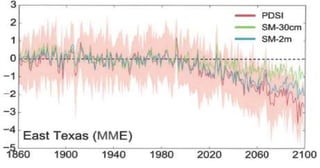
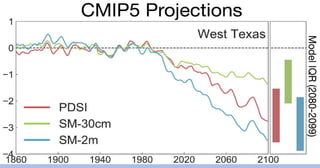
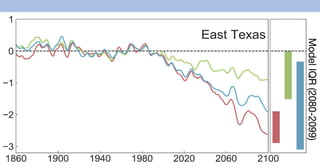
  • #7Ā Top: Multimodel mean summer (JJA) PDSI and standardized soil moisture (SM-30cm and SM-2m) over North America for 2050–2099 from 17 CMIP5 model projections using the RCP 8.5 emissions scenario. SM-30cm and SM-2m are standardized to the same mean and variance as the model PDSI over the calibration interval fromthe associated historical scenario (1931–1990). Dashed boxes represent the regions of interest: the Central Plains (105°W–92°W, 32°N–46°N) and the Southwest (125°W–105°W, 32°N–41°N). Bottom: Regional average time series of the summer season moisture balance metrics from the NADA and CMIP5models. The observational NADA PDSI series (brown) is smoothed using a 50-year loess spline to emphasize the low-frequency variability in the paleo-record. Model time series (PDSI, SM-30cm, and SM-2m) are the multimodel means averaged across the 17 CMIP5models, and the gray shaded area is the multimodel interquartile range for model PDSI.