1
Topic 2. Cost allocation
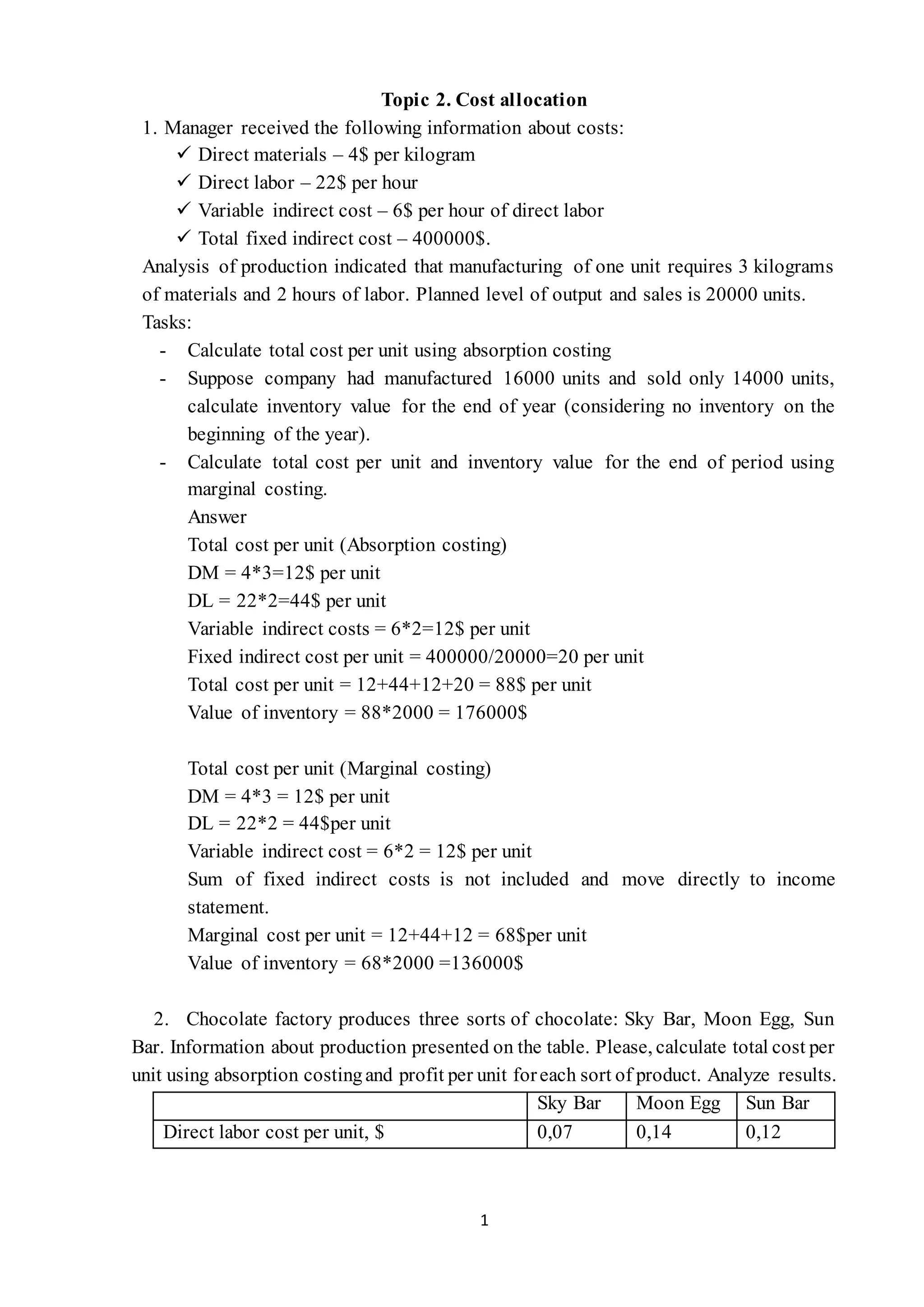
1. Manager received the following information about costs:
 Direct materials – 4$ per kilogram
 Direct labor – 22$ per hour
 Variable indirect cost – 6$ per hour of direct labor
 Total fixed indirect cost – 400000$.
Analysis of production indicated that manufacturing of one unit requires 3 kilograms
of materials and 2 hours of labor. Planned level of output and sales is 20000 units.
Tasks:
- Calculate total cost per unit using absorption costing
- Suppose company had manufactured 16000 units and sold only 14000 units,
calculate inventory value for the end of year (considering no inventory on the
beginning of the year).
- Calculate total cost per unit and inventory value for the end of period using
marginal costing.
Answer
Total cost per unit (Absorption costing)
DM = 4*3=12$ per unit
DL = 22*2=44$ per unit
Variable indirect costs = 6*2=12$ per unit
Fixed indirect cost per unit = 400000/20000=20 per unit
Total cost per unit = 12+44+12+20 = 88$ per unit
Value of inventory = 88*2000 = 176000$
Total cost per unit (Marginal costing)
DM = 4*3 = 12$ per unit
DL = 22*2 = 44$per unit
Variable indirect cost = 6*2 = 12$ per unit
Sum of fixed indirect costs is not included and move directly to income
statement.
Marginal cost per unit = 12+44+12 = 68$per unit
Value of inventory = 68*2000 =136000$
2. Chocolate factory produces three sorts of chocolate: Sky Bar, Moon Egg, Sun
Bar. Information about production presented on the table. Please, calculate total cost per
unit using absorption costingand profit per unit foreach sort of product. Analyze results.
Sky Bar Moon Egg Sun Bar
Direct labor cost per unit, $ 0,07 0,14 0,12
2
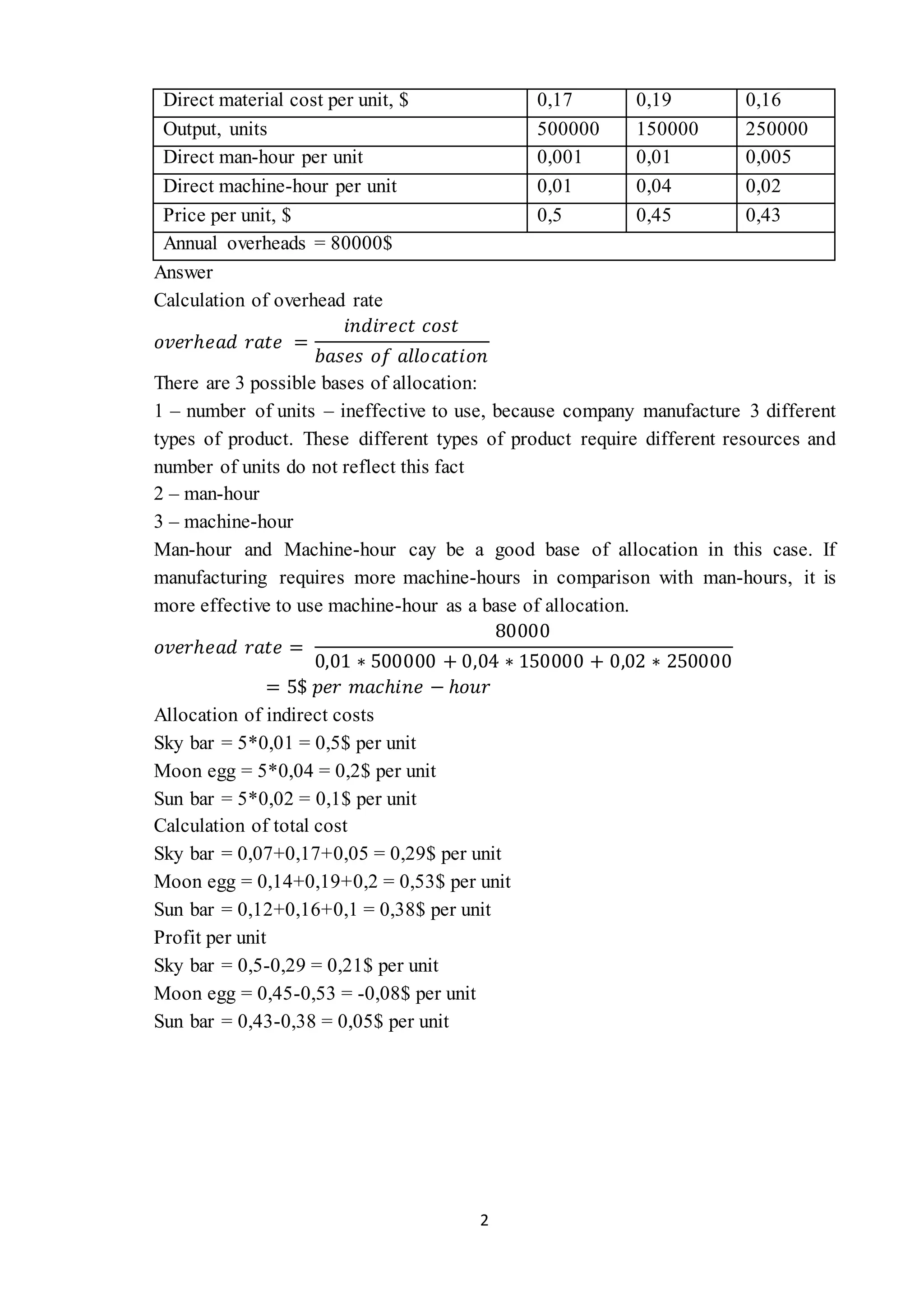
Direct material cost per unit, $ 0,17 0,19 0,16
Output, units 500000 150000 250000
Direct man-hour per unit 0,001 0,01 0,005
Direct machine-hour per unit 0,01 0,04 0,02
Price per unit, $ 0,5 0,45 0,43
Annual overheads = 80000$
Answer
Calculation of overhead rate
𝑜𝑣𝑒𝑟ℎ𝑒𝑎𝑑 𝑟𝑎𝑡𝑒 =
𝑖𝑛𝑑𝑖𝑟𝑒𝑐𝑡 𝑐𝑜𝑠𝑡
𝑏𝑎𝑠𝑒𝑠 𝑜𝑓 𝑎𝑙𝑙𝑜𝑐𝑎𝑡𝑖𝑜𝑛
There are 3 possible bases of allocation:
1 – number of units – ineffective to use, because company manufacture 3 different
types of product. These different types of product require different resources and
number of units do not reflect this fact
2 – man-hour
3 – machine-hour
Man-hour and Machine-hour cay be a good base of allocation in this case. If
manufacturing requires more machine-hours in comparison with man-hours, it is
more effective to use machine-hour as a base of allocation.
𝑜𝑣𝑒𝑟ℎ𝑒𝑎𝑑 𝑟𝑎𝑡𝑒 =
80000
0,01 ∗ 500000 + 0,04 ∗ 150000 + 0,02 ∗ 250000
= 5$ 𝑝𝑒𝑟 𝑚𝑎𝑐ℎ𝑖𝑛𝑒 − ℎ𝑜𝑢𝑟
Allocation of indirect costs
Sky bar = 5*0,01 = 0,5$ per unit
Moon egg = 5*0,04 = 0,2$ per unit
Sun bar = 5*0,02 = 0,1$ per unit
Calculation of total cost
Sky bar = 0,07+0,17+0,05 = 0,29$ per unit
Moon egg = 0,14+0,19+0,2 = 0,53$ per unit
Sun bar = 0,12+0,16+0,1 = 0,38$ per unit
Profit per unit
Sky bar = 0,5-0,29 = 0,21$ per unit
Moon egg = 0,45-0,53 = -0,08$ per unit
Sun bar = 0,43-0,38 = 0,05$ per unit
3
3. Company XZ makes two types of product X and Z. It estimates it will produce
423694 units of X and 652200 units of Z. Using the following information calculate
overhead for X and Z:
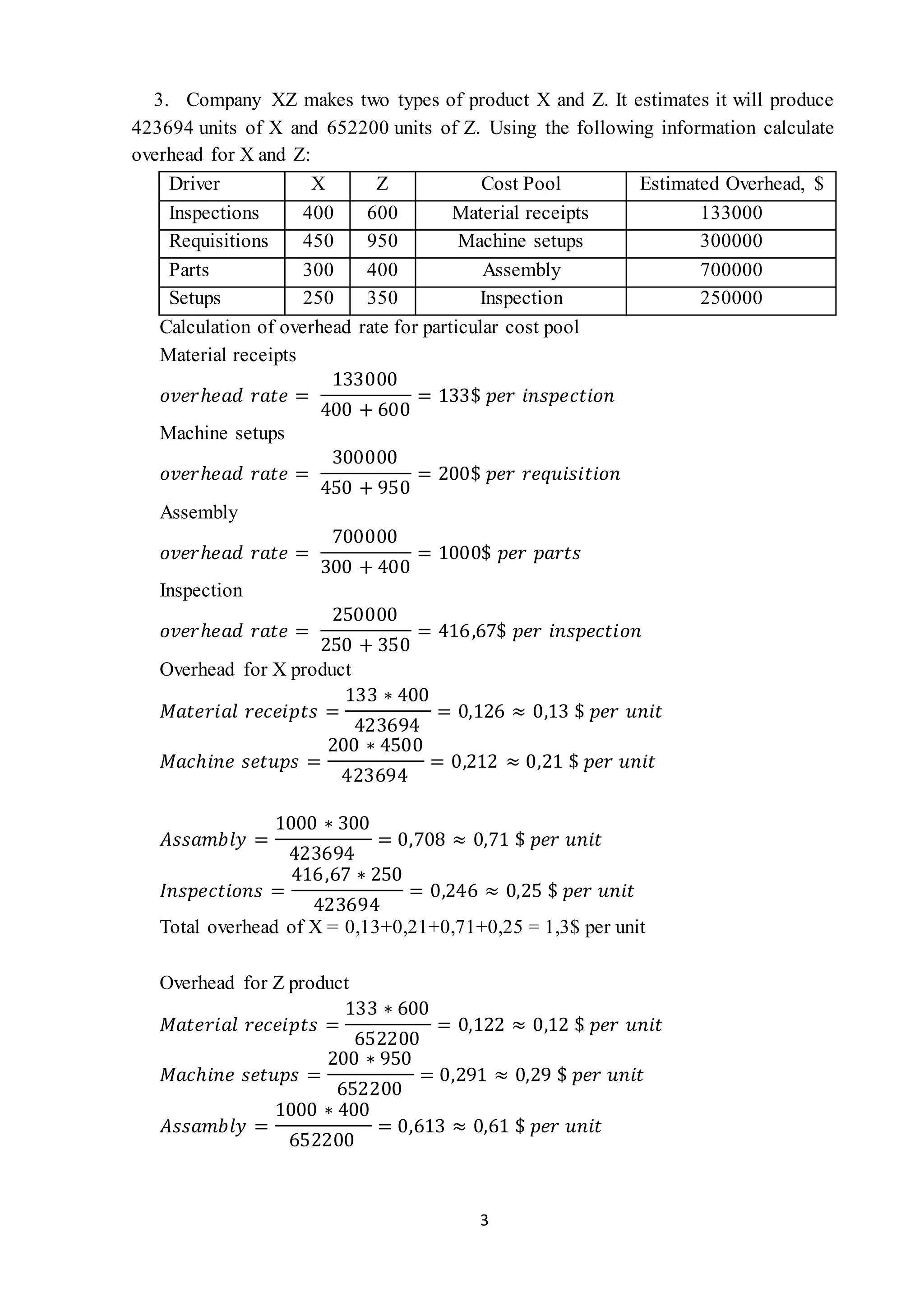
Driver X Z Cost Pool Estimated Overhead, $
Inspections 400 600 Material receipts 133000
Requisitions 450 950 Machine setups 300000
Parts 300 400 Assembly 700000
Setups 250 350 Inspection 250000
Calculation of overhead rate for particular cost pool
Material receipts
𝑜𝑣𝑒𝑟ℎ𝑒𝑎𝑑 𝑟𝑎𝑡𝑒 =
133000
400 + 600
= 133$ 𝑝𝑒𝑟 𝑖𝑛𝑠𝑝𝑒𝑐𝑡𝑖𝑜𝑛
Machine setups
𝑜𝑣𝑒𝑟ℎ𝑒𝑎𝑑 𝑟𝑎𝑡𝑒 =
300000
450 + 950
= 200$ 𝑝𝑒𝑟 𝑟𝑒𝑞𝑢𝑖𝑠𝑖𝑡𝑖𝑜𝑛
Assembly
𝑜𝑣𝑒𝑟ℎ𝑒𝑎𝑑 𝑟𝑎𝑡𝑒 =
700000
300 + 400
= 1000$ 𝑝𝑒𝑟 𝑝𝑎𝑟𝑡𝑠
Inspection
𝑜𝑣𝑒𝑟ℎ𝑒𝑎𝑑 𝑟𝑎𝑡𝑒 =
250000
250 + 350
= 416,67$ 𝑝𝑒𝑟 𝑖𝑛𝑠𝑝𝑒𝑐𝑡𝑖𝑜𝑛
Overhead for X product
𝑀𝑎𝑡𝑒𝑟𝑖𝑎𝑙 𝑟𝑒𝑐𝑒𝑖𝑝𝑡𝑠 =
133 ∗ 400
423694
= 0,126 ≈ 0,13 $ 𝑝𝑒𝑟 𝑢𝑛𝑖𝑡
𝑀𝑎𝑐ℎ𝑖𝑛𝑒 𝑠𝑒𝑡𝑢𝑝𝑠 =
200 ∗ 4500
423694
= 0,212 ≈ 0,21 $ 𝑝𝑒𝑟 𝑢𝑛𝑖𝑡
𝐴𝑠𝑠𝑎𝑚𝑏𝑙𝑦 =
1000 ∗ 300
423694
= 0,708 ≈ 0,71 $ 𝑝𝑒𝑟 𝑢𝑛𝑖𝑡
𝐼𝑛𝑠𝑝𝑒𝑐𝑡𝑖𝑜𝑛𝑠 =
416,67 ∗ 250
423694
= 0,246 ≈ 0,25 $ 𝑝𝑒𝑟 𝑢𝑛𝑖𝑡
Total overhead of X = 0,13+0,21+0,71+0,25 = 1,3$ per unit
Overhead for Z product
𝑀𝑎𝑡𝑒𝑟𝑖𝑎𝑙 𝑟𝑒𝑐𝑒𝑖𝑝𝑡𝑠 =
133 ∗ 600
652200
= 0,122 ≈ 0,12 $ 𝑝𝑒𝑟 𝑢𝑛𝑖𝑡
𝑀𝑎𝑐ℎ𝑖𝑛𝑒 𝑠𝑒𝑡𝑢𝑝𝑠 =
200 ∗ 950
652200
= 0,291 ≈ 0,29 $ 𝑝𝑒𝑟 𝑢𝑛𝑖𝑡
𝐴𝑠𝑠𝑎𝑚𝑏𝑙𝑦 =
1000 ∗ 400
652200
= 0,613 ≈ 0,61 $ 𝑝𝑒𝑟 𝑢𝑛𝑖𝑡
4
𝐼𝑛𝑠𝑝𝑒𝑐𝑡𝑖𝑜𝑛𝑠 =
416,67 ∗ 350
652200
= 0,224 ≈ 0,22 $ 𝑝𝑒𝑟 𝑢𝑛𝑖𝑡
Total overhead of Z = 0,12+0,29+0,61+0,22 = 1,24$ per unit
4. Company manufactures two types of products: M1 and M2. Manager uses ABC
and has the following information about indirect cost and cost drivers:
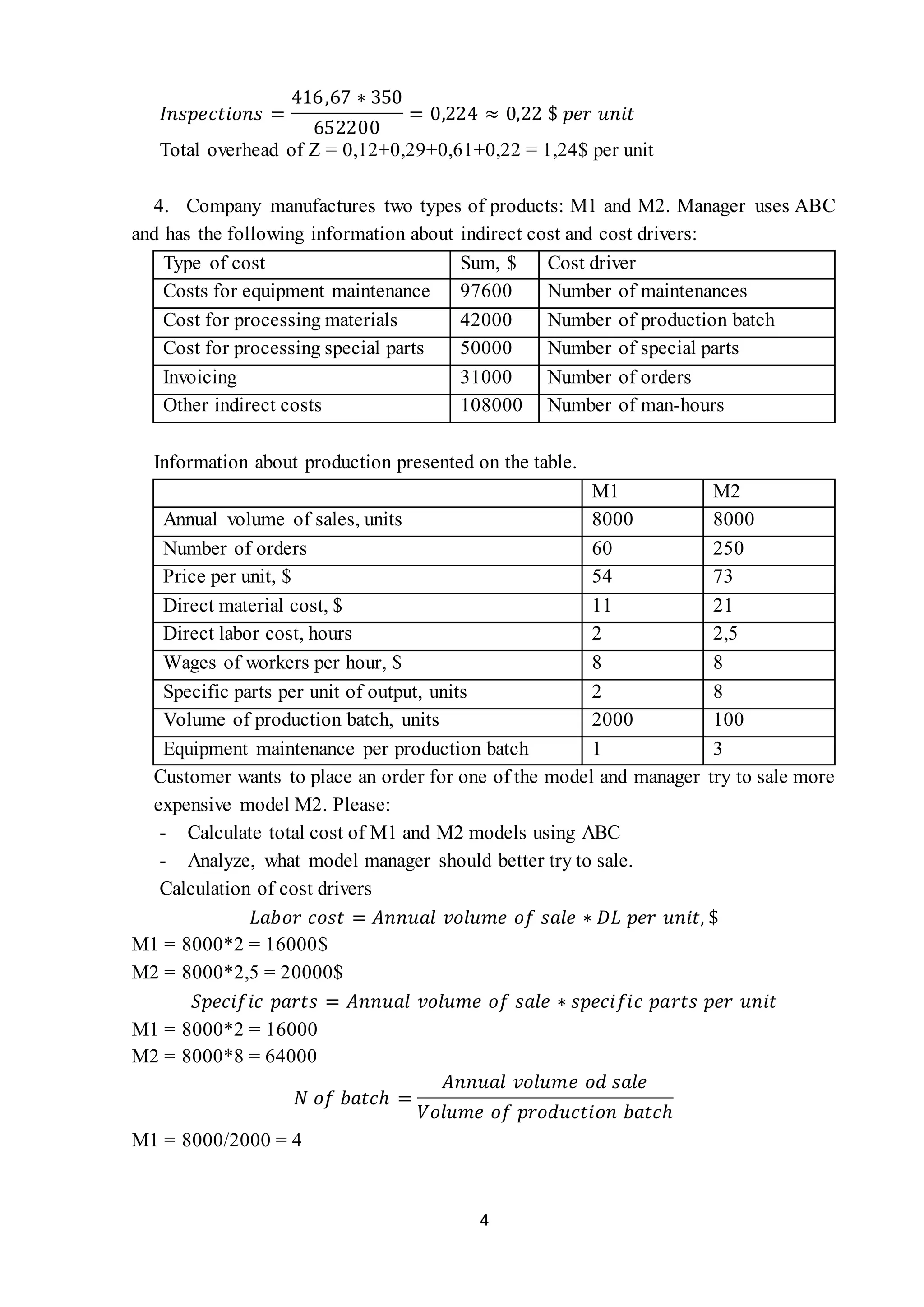
Type of cost Sum, $ Cost driver
Costs for equipment maintenance 97600 Number of maintenances
Cost for processing materials 42000 Number of production batch
Cost for processing special parts 50000 Number of special parts
Invoicing 31000 Number of orders
Other indirect costs 108000 Number of man-hours
Information about production presented on the table.
M1 M2
Annual volume of sales, units 8000 8000
Number of orders 60 250
Price per unit, $ 54 73
Direct material cost, $ 11 21
Direct labor cost, hours 2 2,5
Wages of workers per hour, $ 8 8
Specific parts per unit of output, units 2 8
Volume of production batch, units 2000 100
Equipment maintenance per production batch 1 3
Customer wants to place an order for one of the model and manager try to sale more
expensive model M2. Please:
- Calculate total cost of M1 and M2 models using ABC
- Analyze, what model manager should better try to sale.
Calculation of cost drivers
𝐿𝑎𝑏𝑜𝑟 𝑐𝑜𝑠𝑡 = 𝐴𝑛𝑛𝑢𝑎𝑙 𝑣𝑜𝑙𝑢𝑚𝑒 𝑜𝑓 𝑠𝑎𝑙𝑒 ∗ 𝐷𝐿 𝑝𝑒𝑟 𝑢𝑛𝑖𝑡, $
M1 = 8000*2 = 16000$
M2 = 8000*2,5 = 20000$
𝑆𝑝𝑒𝑐𝑖𝑓𝑖𝑐 𝑝𝑎𝑟𝑡𝑠 = 𝐴𝑛𝑛𝑢𝑎𝑙 𝑣𝑜𝑙𝑢𝑚𝑒 𝑜𝑓 𝑠𝑎𝑙𝑒 ∗ 𝑠𝑝𝑒𝑐𝑖𝑓𝑖𝑐 𝑝𝑎𝑟𝑡𝑠 𝑝𝑒𝑟 𝑢𝑛𝑖𝑡
M1 = 8000*2 = 16000
M2 = 8000*8 = 64000
𝑁 𝑜𝑓 𝑏𝑎𝑡𝑐ℎ =
𝐴𝑛𝑛𝑢𝑎𝑙 𝑣𝑜𝑙𝑢𝑚𝑒 𝑜𝑑 𝑠𝑎𝑙𝑒
𝑉𝑜𝑙𝑢𝑚𝑒 𝑜𝑓 𝑝𝑟𝑜𝑑𝑢𝑐𝑡𝑖𝑜𝑛 𝑏𝑎𝑡𝑐ℎ
M1 = 8000/2000 = 4
5
M2 = 8000/100 = 80
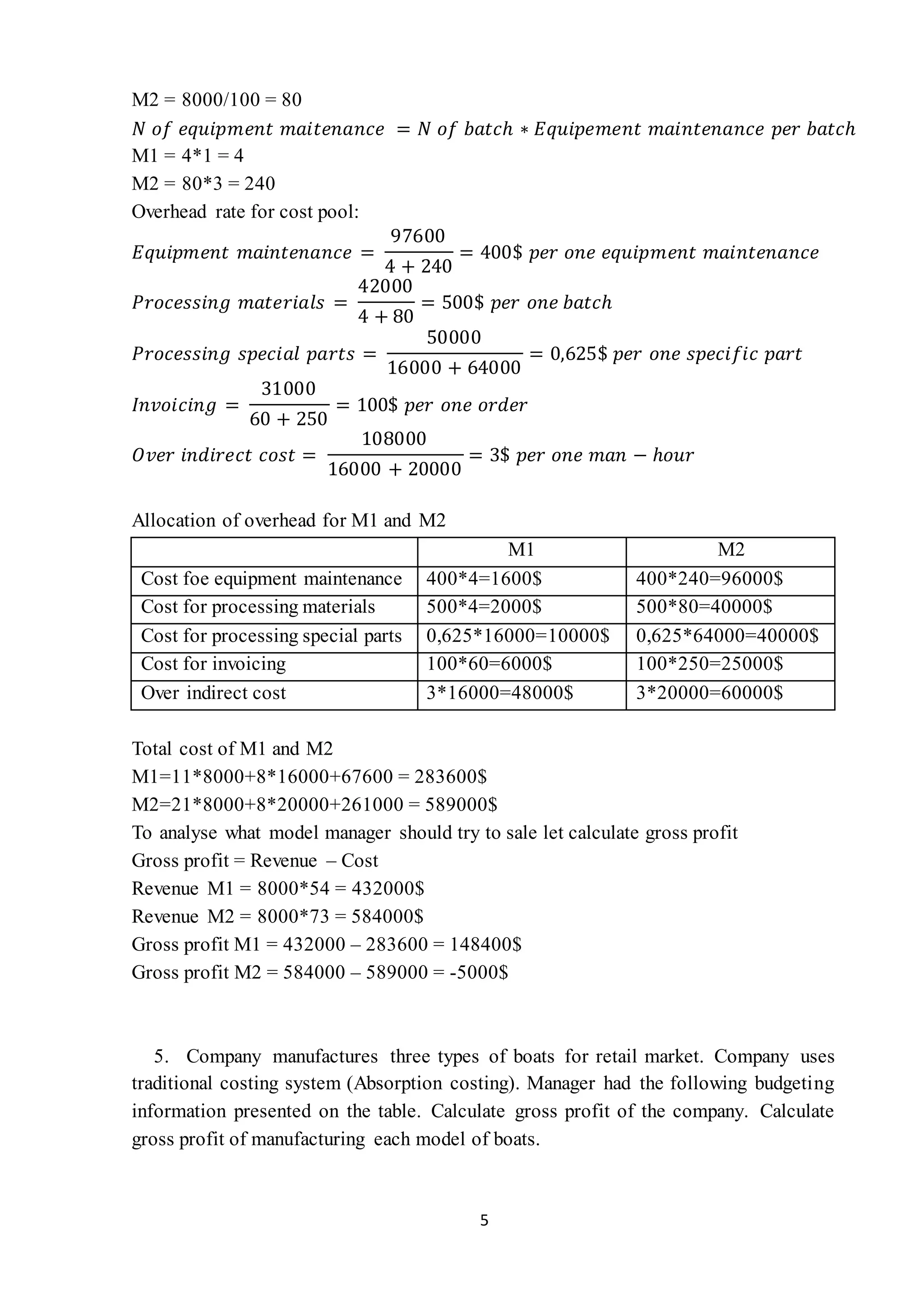
𝑁 𝑜𝑓 𝑒𝑞𝑢𝑖𝑝𝑚𝑒𝑛𝑡 𝑚𝑎𝑖𝑡𝑒𝑛𝑎𝑛𝑐𝑒 = 𝑁 𝑜𝑓 𝑏𝑎𝑡𝑐ℎ ∗ 𝐸𝑞𝑢𝑖𝑝𝑒𝑚𝑒𝑛𝑡 𝑚𝑎𝑖𝑛𝑡𝑒𝑛𝑎𝑛𝑐𝑒 𝑝𝑒𝑟 𝑏𝑎𝑡𝑐ℎ
M1 = 4*1 = 4
M2 = 80*3 = 240
Overhead rate for cost pool:
𝐸𝑞𝑢𝑖𝑝𝑚𝑒𝑛𝑡 𝑚𝑎𝑖𝑛𝑡𝑒𝑛𝑎𝑛𝑐𝑒 =
97600
4 + 240
= 400$ 𝑝𝑒𝑟 𝑜𝑛𝑒 𝑒𝑞𝑢𝑖𝑝𝑚𝑒𝑛𝑡 𝑚𝑎𝑖𝑛𝑡𝑒𝑛𝑎𝑛𝑐𝑒
𝑃𝑟𝑜𝑐𝑒𝑠𝑠𝑖𝑛𝑔 𝑚𝑎𝑡𝑒𝑟𝑖𝑎𝑙𝑠 =
42000
4 + 80
= 500$ 𝑝𝑒𝑟 𝑜𝑛𝑒 𝑏𝑎𝑡𝑐ℎ
𝑃𝑟𝑜𝑐𝑒𝑠𝑠𝑖𝑛𝑔 𝑠𝑝𝑒𝑐𝑖𝑎𝑙 𝑝𝑎𝑟𝑡𝑠 =
50000
16000 + 64000
= 0,625$ 𝑝𝑒𝑟 𝑜𝑛𝑒 𝑠𝑝𝑒𝑐𝑖𝑓𝑖𝑐 𝑝𝑎𝑟𝑡
𝐼𝑛𝑣𝑜𝑖𝑐𝑖𝑛𝑔 =
31000
60 + 250
= 100$ 𝑝𝑒𝑟 𝑜𝑛𝑒 𝑜𝑟𝑑𝑒𝑟
𝑂𝑣𝑒𝑟 𝑖𝑛𝑑𝑖𝑟𝑒𝑐𝑡 𝑐𝑜𝑠𝑡 =
108000
16000 + 20000
= 3$ 𝑝𝑒𝑟 𝑜𝑛𝑒 𝑚𝑎𝑛 − ℎ𝑜𝑢𝑟
Allocation of overhead for M1 and M2
M1 M2
Cost foe equipment maintenance 400*4=1600$ 400*240=96000$
Cost for processing materials 500*4=2000$ 500*80=40000$
Cost for processing special parts 0,625*16000=10000$ 0,625*64000=40000$
Cost for invoicing 100*60=6000$ 100*250=25000$
Over indirect cost 3*16000=48000$ 3*20000=60000$
Total cost of M1 and M2
M1=11*8000+8*16000+67600 = 283600$
M2=21*8000+8*20000+261000 = 589000$
To analyse what model manager should try to sale let calculate gross profit
Gross profit = Revenue – Cost
Revenue M1 = 8000*54 = 432000$
Revenue M2 = 8000*73 = 584000$
Gross profit M1 = 432000 – 283600 = 148400$
Gross profit M2 = 584000 – 589000 = -5000$
5. Company manufactures three types of boats for retail market. Company uses
traditional costing system (Absorption costing). Manager had the following budgeting
information presented on the table. Calculate gross profit of the company. Calculate
gross profit of manufacturing each model of boats.
6
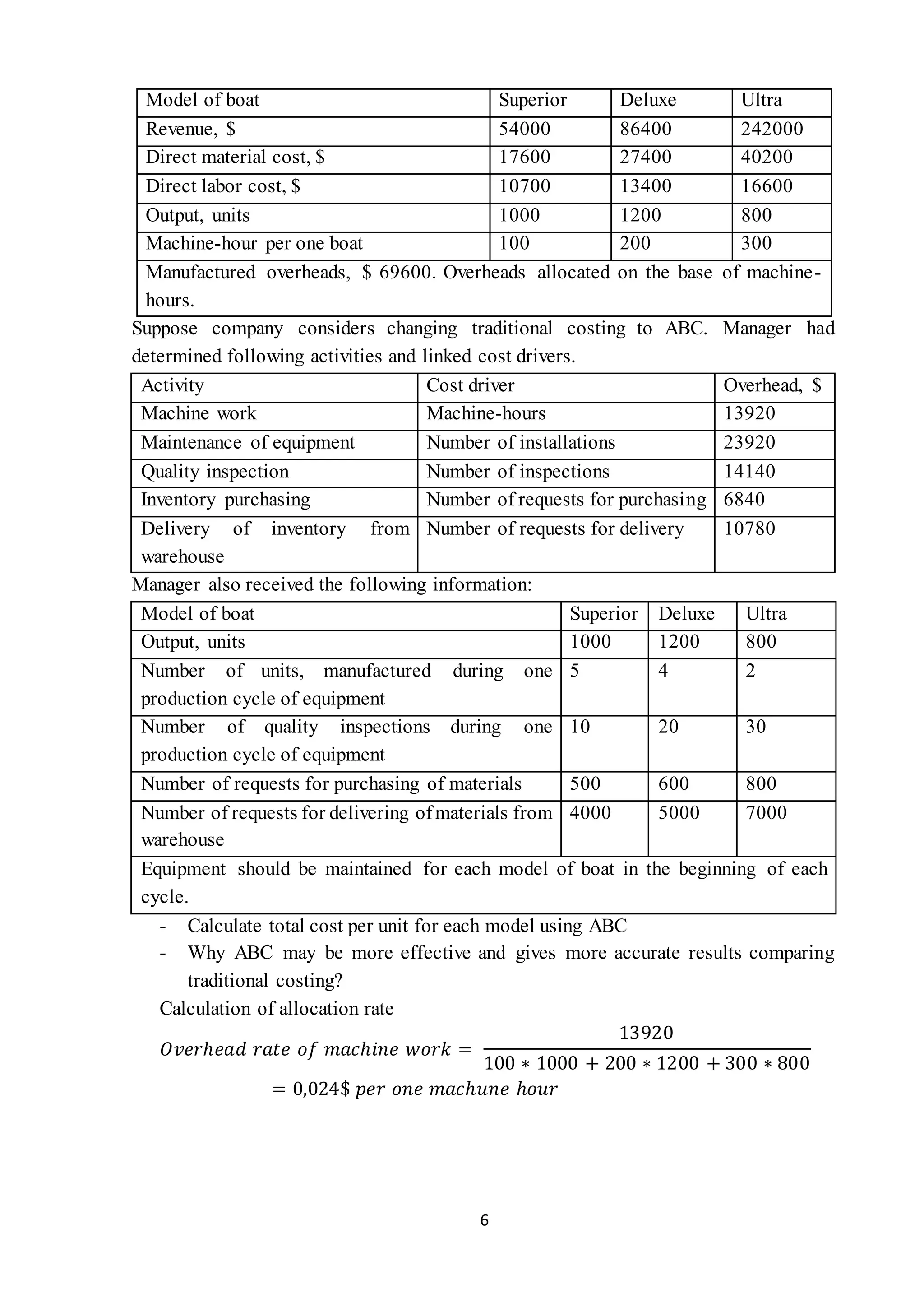
Model of boat Superior Deluxe Ultra
Revenue, $ 54000 86400 242000
Direct material cost, $ 17600 27400 40200
Direct labor cost, $ 10700 13400 16600
Output, units 1000 1200 800
Machine-hour per one boat 100 200 300
Manufactured overheads, $ 69600. Overheads allocated on the base of machine-
hours.
Suppose company considers changing traditional costing to ABC. Manager had
determined following activities and linked cost drivers.
Activity Cost driver Overhead, $
Machine work Machine-hours 13920
Maintenance of equipment Number of installations 23920
Quality inspection Number of inspections 14140
Inventory purchasing Number of requests for purchasing 6840
Delivery of inventory from
warehouse
Number of requests for delivery 10780
Manager also received the following information:
Model of boat Superior Deluxe Ultra
Output, units 1000 1200 800
Number of units, manufactured during one
production cycle of equipment
5 4 2
Number of quality inspections during one
production cycle of equipment
10 20 30
Number of requests for purchasing of materials 500 600 800
Number of requests for delivering ofmaterials from
warehouse
4000 5000 7000
Equipment should be maintained for each model of boat in the beginning of each
cycle.
- Calculate total cost per unit for each model using ABC
- Why ABC may be more effective and gives more accurate results comparing
traditional costing?
Calculation of allocation rate
𝑂𝑣𝑒𝑟ℎ𝑒𝑎𝑑 𝑟𝑎𝑡𝑒 𝑜𝑓 𝑚𝑎𝑐ℎ𝑖𝑛𝑒 𝑤𝑜𝑟𝑘 =
13920
100 ∗ 1000 + 200 ∗ 1200 + 300 ∗ 800
= 0,024$ 𝑝𝑒𝑟 𝑜𝑛𝑒 𝑚𝑎𝑐ℎ𝑢𝑛𝑒 ℎ𝑜𝑢𝑟
7
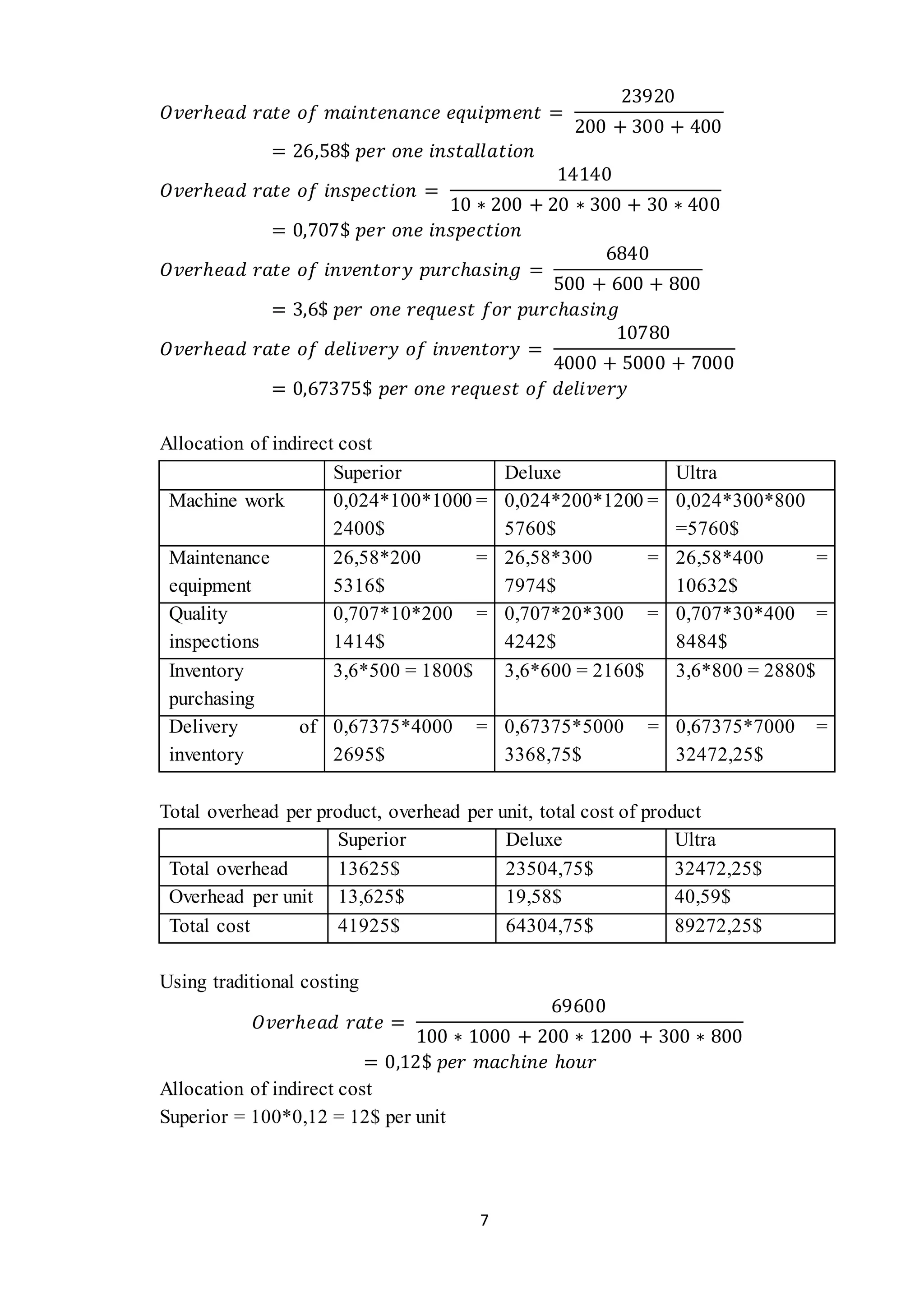
𝑂𝑣𝑒𝑟ℎ𝑒𝑎𝑑 𝑟𝑎𝑡𝑒 𝑜𝑓 𝑚𝑎𝑖𝑛𝑡𝑒𝑛𝑎𝑛𝑐𝑒 𝑒𝑞𝑢𝑖𝑝𝑚𝑒𝑛𝑡 =
23920
200 + 300 + 400
= 26,58$ 𝑝𝑒𝑟 𝑜𝑛𝑒 𝑖𝑛𝑠𝑡𝑎𝑙𝑙𝑎𝑡𝑖𝑜𝑛
𝑂𝑣𝑒𝑟ℎ𝑒𝑎𝑑 𝑟𝑎𝑡𝑒 𝑜𝑓 𝑖𝑛𝑠𝑝𝑒𝑐𝑡𝑖𝑜𝑛 =
14140
10 ∗ 200 + 20 ∗ 300 + 30 ∗ 400
= 0,707$ 𝑝𝑒𝑟 𝑜𝑛𝑒 𝑖𝑛𝑠𝑝𝑒𝑐𝑡𝑖𝑜𝑛
𝑂𝑣𝑒𝑟ℎ𝑒𝑎𝑑 𝑟𝑎𝑡𝑒 𝑜𝑓 𝑖𝑛𝑣𝑒𝑛𝑡𝑜𝑟𝑦 𝑝𝑢𝑟𝑐ℎ𝑎𝑠𝑖𝑛𝑔 =
6840
500 + 600 + 800
= 3,6$ 𝑝𝑒𝑟 𝑜𝑛𝑒 𝑟𝑒𝑞𝑢𝑒𝑠𝑡 𝑓𝑜𝑟 𝑝𝑢𝑟𝑐ℎ𝑎𝑠𝑖𝑛𝑔
𝑂𝑣𝑒𝑟ℎ𝑒𝑎𝑑 𝑟𝑎𝑡𝑒 𝑜𝑓 𝑑𝑒𝑙𝑖𝑣𝑒𝑟𝑦 𝑜𝑓 𝑖𝑛𝑣𝑒𝑛𝑡𝑜𝑟𝑦 =
10780
4000 + 5000 + 7000
= 0,67375$ 𝑝𝑒𝑟 𝑜𝑛𝑒 𝑟𝑒𝑞𝑢𝑒𝑠𝑡 𝑜𝑓 𝑑𝑒𝑙𝑖𝑣𝑒𝑟𝑦
Allocation of indirect cost
Superior Deluxe Ultra
Machine work 0,024*100*1000 =
2400$
0,024*200*1200 =
5760$
0,024*300*800
=5760$
Maintenance
equipment
26,58*200 =
5316$
26,58*300 =
7974$
26,58*400 =
10632$
Quality
inspections
0,707*10*200 =
1414$
0,707*20*300 =
4242$
0,707*30*400 =
8484$
Inventory
purchasing
3,6*500 = 1800$ 3,6*600 = 2160$ 3,6*800 = 2880$
Delivery of
inventory
0,67375*4000 =
2695$
0,67375*5000 =
3368,75$
0,67375*7000 =
32472,25$
Total overhead per product, overhead per unit, total cost of product
Superior Deluxe Ultra
Total overhead 13625$ 23504,75$ 32472,25$
Overhead per unit 13,625$ 19,58$ 40,59$
Total cost 41925$ 64304,75$ 89272,25$
Using traditional costing
𝑂𝑣𝑒𝑟ℎ𝑒𝑎𝑑 𝑟𝑎𝑡𝑒 =
69600
100 ∗ 1000 + 200 ∗ 1200 + 300 ∗ 800
= 0,12$ 𝑝𝑒𝑟 𝑚𝑎𝑐ℎ𝑖𝑛𝑒 ℎ𝑜𝑢𝑟
Allocation of indirect cost
Superior = 100*0,12 = 12$ per unit
8
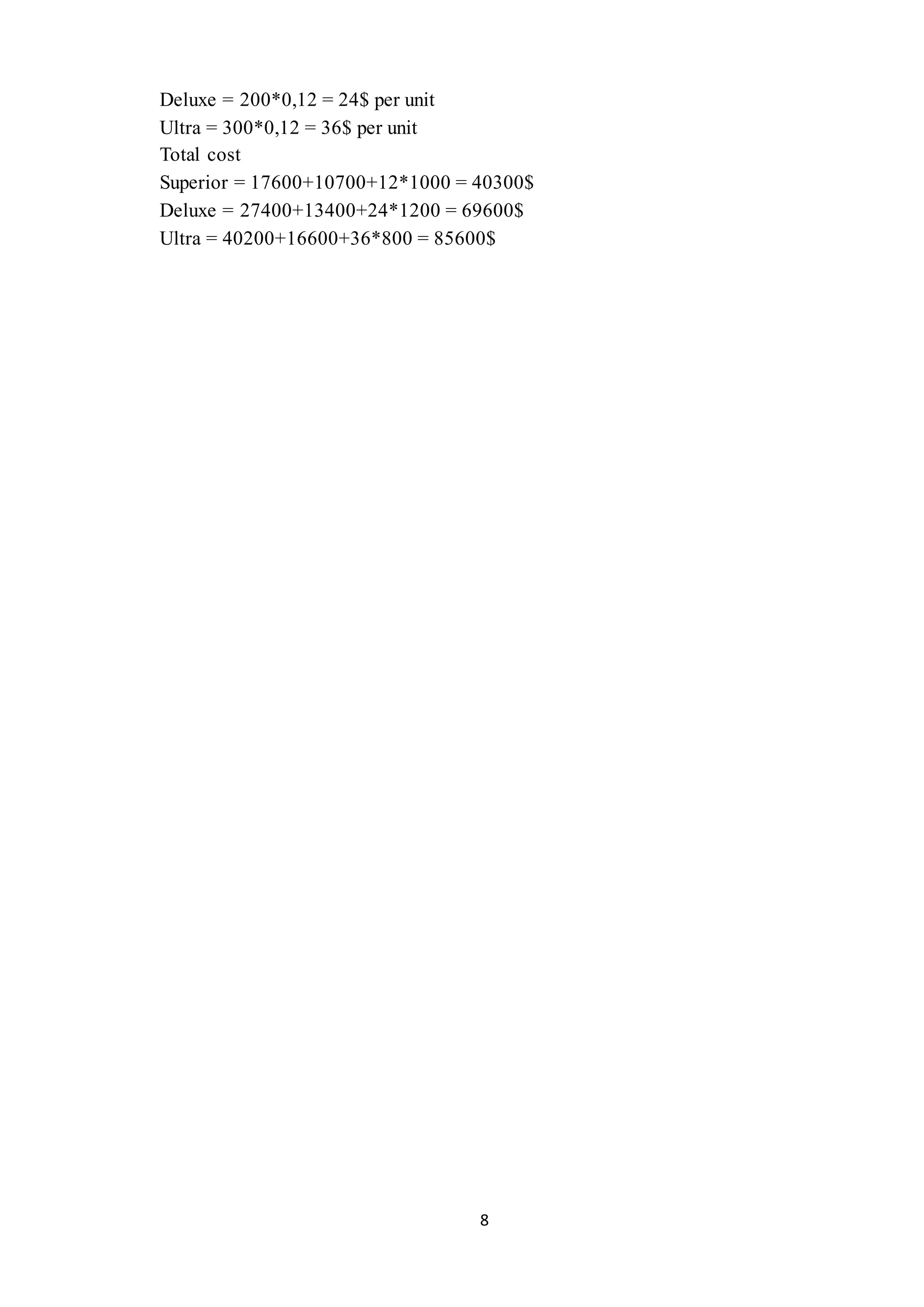
Deluxe = 200*0,12 = 24$ per unit
Ultra = 300*0,12 = 36$ per unit
Total cost
Superior = 17600+10700+12*1000 = 40300$
Deluxe = 27400+13400+24*1200 = 69600$
Ultra = 40200+16600+36*800 = 85600$

Practice topic 9 - answers (1)

  • 1.
    1 Topic 2. Costallocation 1. Manager received the following information about costs:  Direct materials – 4$ per kilogram  Direct labor – 22$ per hour  Variable indirect cost – 6$ per hour of direct labor  Total fixed indirect cost – 400000$. Analysis of production indicated that manufacturing of one unit requires 3 kilograms of materials and 2 hours of labor. Planned level of output and sales is 20000 units. Tasks: - Calculate total cost per unit using absorption costing - Suppose company had manufactured 16000 units and sold only 14000 units, calculate inventory value for the end of year (considering no inventory on the beginning of the year). - Calculate total cost per unit and inventory value for the end of period using marginal costing. Answer Total cost per unit (Absorption costing) DM = 4*3=12$ per unit DL = 22*2=44$ per unit Variable indirect costs = 6*2=12$ per unit Fixed indirect cost per unit = 400000/20000=20 per unit Total cost per unit = 12+44+12+20 = 88$ per unit Value of inventory = 88*2000 = 176000$ Total cost per unit (Marginal costing) DM = 4*3 = 12$ per unit DL = 22*2 = 44$per unit Variable indirect cost = 6*2 = 12$ per unit Sum of fixed indirect costs is not included and move directly to income statement. Marginal cost per unit = 12+44+12 = 68$per unit Value of inventory = 68*2000 =136000$ 2. Chocolate factory produces three sorts of chocolate: Sky Bar, Moon Egg, Sun Bar. Information about production presented on the table. Please, calculate total cost per unit using absorption costingand profit per unit foreach sort of product. Analyze results. Sky Bar Moon Egg Sun Bar Direct labor cost per unit, $ 0,07 0,14 0,12
  • 2.
    2 Direct material costper unit, $ 0,17 0,19 0,16 Output, units 500000 150000 250000 Direct man-hour per unit 0,001 0,01 0,005 Direct machine-hour per unit 0,01 0,04 0,02 Price per unit, $ 0,5 0,45 0,43 Annual overheads = 80000$ Answer Calculation of overhead rate 𝑜𝑣𝑒𝑟ℎ𝑒𝑎𝑑 𝑟𝑎𝑡𝑒 = 𝑖𝑛𝑑𝑖𝑟𝑒𝑐𝑡 𝑐𝑜𝑠𝑡 𝑏𝑎𝑠𝑒𝑠 𝑜𝑓 𝑎𝑙𝑙𝑜𝑐𝑎𝑡𝑖𝑜𝑛 There are 3 possible bases of allocation: 1 – number of units – ineffective to use, because company manufacture 3 different types of product. These different types of product require different resources and number of units do not reflect this fact 2 – man-hour 3 – machine-hour Man-hour and Machine-hour cay be a good base of allocation in this case. If manufacturing requires more machine-hours in comparison with man-hours, it is more effective to use machine-hour as a base of allocation. 𝑜𝑣𝑒𝑟ℎ𝑒𝑎𝑑 𝑟𝑎𝑡𝑒 = 80000 0,01 ∗ 500000 + 0,04 ∗ 150000 + 0,02 ∗ 250000 = 5$ 𝑝𝑒𝑟 𝑚𝑎𝑐ℎ𝑖𝑛𝑒 − ℎ𝑜𝑢𝑟 Allocation of indirect costs Sky bar = 5*0,01 = 0,5$ per unit Moon egg = 5*0,04 = 0,2$ per unit Sun bar = 5*0,02 = 0,1$ per unit Calculation of total cost Sky bar = 0,07+0,17+0,05 = 0,29$ per unit Moon egg = 0,14+0,19+0,2 = 0,53$ per unit Sun bar = 0,12+0,16+0,1 = 0,38$ per unit Profit per unit Sky bar = 0,5-0,29 = 0,21$ per unit Moon egg = 0,45-0,53 = -0,08$ per unit Sun bar = 0,43-0,38 = 0,05$ per unit
  • 3.
    3 3. Company XZmakes two types of product X and Z. It estimates it will produce 423694 units of X and 652200 units of Z. Using the following information calculate overhead for X and Z: Driver X Z Cost Pool Estimated Overhead, $ Inspections 400 600 Material receipts 133000 Requisitions 450 950 Machine setups 300000 Parts 300 400 Assembly 700000 Setups 250 350 Inspection 250000 Calculation of overhead rate for particular cost pool Material receipts 𝑜𝑣𝑒𝑟ℎ𝑒𝑎𝑑 𝑟𝑎𝑡𝑒 = 133000 400 + 600 = 133$ 𝑝𝑒𝑟 𝑖𝑛𝑠𝑝𝑒𝑐𝑡𝑖𝑜𝑛 Machine setups 𝑜𝑣𝑒𝑟ℎ𝑒𝑎𝑑 𝑟𝑎𝑡𝑒 = 300000 450 + 950 = 200$ 𝑝𝑒𝑟 𝑟𝑒𝑞𝑢𝑖𝑠𝑖𝑡𝑖𝑜𝑛 Assembly 𝑜𝑣𝑒𝑟ℎ𝑒𝑎𝑑 𝑟𝑎𝑡𝑒 = 700000 300 + 400 = 1000$ 𝑝𝑒𝑟 𝑝𝑎𝑟𝑡𝑠 Inspection 𝑜𝑣𝑒𝑟ℎ𝑒𝑎𝑑 𝑟𝑎𝑡𝑒 = 250000 250 + 350 = 416,67$ 𝑝𝑒𝑟 𝑖𝑛𝑠𝑝𝑒𝑐𝑡𝑖𝑜𝑛 Overhead for X product 𝑀𝑎𝑡𝑒𝑟𝑖𝑎𝑙 𝑟𝑒𝑐𝑒𝑖𝑝𝑡𝑠 = 133 ∗ 400 423694 = 0,126 ≈ 0,13 $ 𝑝𝑒𝑟 𝑢𝑛𝑖𝑡 𝑀𝑎𝑐ℎ𝑖𝑛𝑒 𝑠𝑒𝑡𝑢𝑝𝑠 = 200 ∗ 4500 423694 = 0,212 ≈ 0,21 $ 𝑝𝑒𝑟 𝑢𝑛𝑖𝑡 𝐴𝑠𝑠𝑎𝑚𝑏𝑙𝑦 = 1000 ∗ 300 423694 = 0,708 ≈ 0,71 $ 𝑝𝑒𝑟 𝑢𝑛𝑖𝑡 𝐼𝑛𝑠𝑝𝑒𝑐𝑡𝑖𝑜𝑛𝑠 = 416,67 ∗ 250 423694 = 0,246 ≈ 0,25 $ 𝑝𝑒𝑟 𝑢𝑛𝑖𝑡 Total overhead of X = 0,13+0,21+0,71+0,25 = 1,3$ per unit Overhead for Z product 𝑀𝑎𝑡𝑒𝑟𝑖𝑎𝑙 𝑟𝑒𝑐𝑒𝑖𝑝𝑡𝑠 = 133 ∗ 600 652200 = 0,122 ≈ 0,12 $ 𝑝𝑒𝑟 𝑢𝑛𝑖𝑡 𝑀𝑎𝑐ℎ𝑖𝑛𝑒 𝑠𝑒𝑡𝑢𝑝𝑠 = 200 ∗ 950 652200 = 0,291 ≈ 0,29 $ 𝑝𝑒𝑟 𝑢𝑛𝑖𝑡 𝐴𝑠𝑠𝑎𝑚𝑏𝑙𝑦 = 1000 ∗ 400 652200 = 0,613 ≈ 0,61 $ 𝑝𝑒𝑟 𝑢𝑛𝑖𝑡
  • 4.
    4 𝐼𝑛𝑠𝑝𝑒𝑐𝑡𝑖𝑜𝑛𝑠 = 416,67 ∗350 652200 = 0,224 ≈ 0,22 $ 𝑝𝑒𝑟 𝑢𝑛𝑖𝑡 Total overhead of Z = 0,12+0,29+0,61+0,22 = 1,24$ per unit 4. Company manufactures two types of products: M1 and M2. Manager uses ABC and has the following information about indirect cost and cost drivers: Type of cost Sum, $ Cost driver Costs for equipment maintenance 97600 Number of maintenances Cost for processing materials 42000 Number of production batch Cost for processing special parts 50000 Number of special parts Invoicing 31000 Number of orders Other indirect costs 108000 Number of man-hours Information about production presented on the table. M1 M2 Annual volume of sales, units 8000 8000 Number of orders 60 250 Price per unit, $ 54 73 Direct material cost, $ 11 21 Direct labor cost, hours 2 2,5 Wages of workers per hour, $ 8 8 Specific parts per unit of output, units 2 8 Volume of production batch, units 2000 100 Equipment maintenance per production batch 1 3 Customer wants to place an order for one of the model and manager try to sale more expensive model M2. Please: - Calculate total cost of M1 and M2 models using ABC - Analyze, what model manager should better try to sale. Calculation of cost drivers 𝐿𝑎𝑏𝑜𝑟 𝑐𝑜𝑠𝑡 = 𝐴𝑛𝑛𝑢𝑎𝑙 𝑣𝑜𝑙𝑢𝑚𝑒 𝑜𝑓 𝑠𝑎𝑙𝑒 ∗ 𝐷𝐿 𝑝𝑒𝑟 𝑢𝑛𝑖𝑡, $ M1 = 8000*2 = 16000$ M2 = 8000*2,5 = 20000$ 𝑆𝑝𝑒𝑐𝑖𝑓𝑖𝑐 𝑝𝑎𝑟𝑡𝑠 = 𝐴𝑛𝑛𝑢𝑎𝑙 𝑣𝑜𝑙𝑢𝑚𝑒 𝑜𝑓 𝑠𝑎𝑙𝑒 ∗ 𝑠𝑝𝑒𝑐𝑖𝑓𝑖𝑐 𝑝𝑎𝑟𝑡𝑠 𝑝𝑒𝑟 𝑢𝑛𝑖𝑡 M1 = 8000*2 = 16000 M2 = 8000*8 = 64000 𝑁 𝑜𝑓 𝑏𝑎𝑡𝑐ℎ = 𝐴𝑛𝑛𝑢𝑎𝑙 𝑣𝑜𝑙𝑢𝑚𝑒 𝑜𝑑 𝑠𝑎𝑙𝑒 𝑉𝑜𝑙𝑢𝑚𝑒 𝑜𝑓 𝑝𝑟𝑜𝑑𝑢𝑐𝑡𝑖𝑜𝑛 𝑏𝑎𝑡𝑐ℎ M1 = 8000/2000 = 4
  • 5.
    5 M2 = 8000/100= 80 𝑁 𝑜𝑓 𝑒𝑞𝑢𝑖𝑝𝑚𝑒𝑛𝑡 𝑚𝑎𝑖𝑡𝑒𝑛𝑎𝑛𝑐𝑒 = 𝑁 𝑜𝑓 𝑏𝑎𝑡𝑐ℎ ∗ 𝐸𝑞𝑢𝑖𝑝𝑒𝑚𝑒𝑛𝑡 𝑚𝑎𝑖𝑛𝑡𝑒𝑛𝑎𝑛𝑐𝑒 𝑝𝑒𝑟 𝑏𝑎𝑡𝑐ℎ M1 = 4*1 = 4 M2 = 80*3 = 240 Overhead rate for cost pool: 𝐸𝑞𝑢𝑖𝑝𝑚𝑒𝑛𝑡 𝑚𝑎𝑖𝑛𝑡𝑒𝑛𝑎𝑛𝑐𝑒 = 97600 4 + 240 = 400$ 𝑝𝑒𝑟 𝑜𝑛𝑒 𝑒𝑞𝑢𝑖𝑝𝑚𝑒𝑛𝑡 𝑚𝑎𝑖𝑛𝑡𝑒𝑛𝑎𝑛𝑐𝑒 𝑃𝑟𝑜𝑐𝑒𝑠𝑠𝑖𝑛𝑔 𝑚𝑎𝑡𝑒𝑟𝑖𝑎𝑙𝑠 = 42000 4 + 80 = 500$ 𝑝𝑒𝑟 𝑜𝑛𝑒 𝑏𝑎𝑡𝑐ℎ 𝑃𝑟𝑜𝑐𝑒𝑠𝑠𝑖𝑛𝑔 𝑠𝑝𝑒𝑐𝑖𝑎𝑙 𝑝𝑎𝑟𝑡𝑠 = 50000 16000 + 64000 = 0,625$ 𝑝𝑒𝑟 𝑜𝑛𝑒 𝑠𝑝𝑒𝑐𝑖𝑓𝑖𝑐 𝑝𝑎𝑟𝑡 𝐼𝑛𝑣𝑜𝑖𝑐𝑖𝑛𝑔 = 31000 60 + 250 = 100$ 𝑝𝑒𝑟 𝑜𝑛𝑒 𝑜𝑟𝑑𝑒𝑟 𝑂𝑣𝑒𝑟 𝑖𝑛𝑑𝑖𝑟𝑒𝑐𝑡 𝑐𝑜𝑠𝑡 = 108000 16000 + 20000 = 3$ 𝑝𝑒𝑟 𝑜𝑛𝑒 𝑚𝑎𝑛 − ℎ𝑜𝑢𝑟 Allocation of overhead for M1 and M2 M1 M2 Cost foe equipment maintenance 400*4=1600$ 400*240=96000$ Cost for processing materials 500*4=2000$ 500*80=40000$ Cost for processing special parts 0,625*16000=10000$ 0,625*64000=40000$ Cost for invoicing 100*60=6000$ 100*250=25000$ Over indirect cost 3*16000=48000$ 3*20000=60000$ Total cost of M1 and M2 M1=11*8000+8*16000+67600 = 283600$ M2=21*8000+8*20000+261000 = 589000$ To analyse what model manager should try to sale let calculate gross profit Gross profit = Revenue – Cost Revenue M1 = 8000*54 = 432000$ Revenue M2 = 8000*73 = 584000$ Gross profit M1 = 432000 – 283600 = 148400$ Gross profit M2 = 584000 – 589000 = -5000$ 5. Company manufactures three types of boats for retail market. Company uses traditional costing system (Absorption costing). Manager had the following budgeting information presented on the table. Calculate gross profit of the company. Calculate gross profit of manufacturing each model of boats.
  • 6.
    6 Model of boatSuperior Deluxe Ultra Revenue, $ 54000 86400 242000 Direct material cost, $ 17600 27400 40200 Direct labor cost, $ 10700 13400 16600 Output, units 1000 1200 800 Machine-hour per one boat 100 200 300 Manufactured overheads, $ 69600. Overheads allocated on the base of machine- hours. Suppose company considers changing traditional costing to ABC. Manager had determined following activities and linked cost drivers. Activity Cost driver Overhead, $ Machine work Machine-hours 13920 Maintenance of equipment Number of installations 23920 Quality inspection Number of inspections 14140 Inventory purchasing Number of requests for purchasing 6840 Delivery of inventory from warehouse Number of requests for delivery 10780 Manager also received the following information: Model of boat Superior Deluxe Ultra Output, units 1000 1200 800 Number of units, manufactured during one production cycle of equipment 5 4 2 Number of quality inspections during one production cycle of equipment 10 20 30 Number of requests for purchasing of materials 500 600 800 Number of requests for delivering ofmaterials from warehouse 4000 5000 7000 Equipment should be maintained for each model of boat in the beginning of each cycle. - Calculate total cost per unit for each model using ABC - Why ABC may be more effective and gives more accurate results comparing traditional costing? Calculation of allocation rate 𝑂𝑣𝑒𝑟ℎ𝑒𝑎𝑑 𝑟𝑎𝑡𝑒 𝑜𝑓 𝑚𝑎𝑐ℎ𝑖𝑛𝑒 𝑤𝑜𝑟𝑘 = 13920 100 ∗ 1000 + 200 ∗ 1200 + 300 ∗ 800 = 0,024$ 𝑝𝑒𝑟 𝑜𝑛𝑒 𝑚𝑎𝑐ℎ𝑢𝑛𝑒 ℎ𝑜𝑢𝑟
  • 7.
    7 𝑂𝑣𝑒𝑟ℎ𝑒𝑎𝑑 𝑟𝑎𝑡𝑒 𝑜𝑓𝑚𝑎𝑖𝑛𝑡𝑒𝑛𝑎𝑛𝑐𝑒 𝑒𝑞𝑢𝑖𝑝𝑚𝑒𝑛𝑡 = 23920 200 + 300 + 400 = 26,58$ 𝑝𝑒𝑟 𝑜𝑛𝑒 𝑖𝑛𝑠𝑡𝑎𝑙𝑙𝑎𝑡𝑖𝑜𝑛 𝑂𝑣𝑒𝑟ℎ𝑒𝑎𝑑 𝑟𝑎𝑡𝑒 𝑜𝑓 𝑖𝑛𝑠𝑝𝑒𝑐𝑡𝑖𝑜𝑛 = 14140 10 ∗ 200 + 20 ∗ 300 + 30 ∗ 400 = 0,707$ 𝑝𝑒𝑟 𝑜𝑛𝑒 𝑖𝑛𝑠𝑝𝑒𝑐𝑡𝑖𝑜𝑛 𝑂𝑣𝑒𝑟ℎ𝑒𝑎𝑑 𝑟𝑎𝑡𝑒 𝑜𝑓 𝑖𝑛𝑣𝑒𝑛𝑡𝑜𝑟𝑦 𝑝𝑢𝑟𝑐ℎ𝑎𝑠𝑖𝑛𝑔 = 6840 500 + 600 + 800 = 3,6$ 𝑝𝑒𝑟 𝑜𝑛𝑒 𝑟𝑒𝑞𝑢𝑒𝑠𝑡 𝑓𝑜𝑟 𝑝𝑢𝑟𝑐ℎ𝑎𝑠𝑖𝑛𝑔 𝑂𝑣𝑒𝑟ℎ𝑒𝑎𝑑 𝑟𝑎𝑡𝑒 𝑜𝑓 𝑑𝑒𝑙𝑖𝑣𝑒𝑟𝑦 𝑜𝑓 𝑖𝑛𝑣𝑒𝑛𝑡𝑜𝑟𝑦 = 10780 4000 + 5000 + 7000 = 0,67375$ 𝑝𝑒𝑟 𝑜𝑛𝑒 𝑟𝑒𝑞𝑢𝑒𝑠𝑡 𝑜𝑓 𝑑𝑒𝑙𝑖𝑣𝑒𝑟𝑦 Allocation of indirect cost Superior Deluxe Ultra Machine work 0,024*100*1000 = 2400$ 0,024*200*1200 = 5760$ 0,024*300*800 =5760$ Maintenance equipment 26,58*200 = 5316$ 26,58*300 = 7974$ 26,58*400 = 10632$ Quality inspections 0,707*10*200 = 1414$ 0,707*20*300 = 4242$ 0,707*30*400 = 8484$ Inventory purchasing 3,6*500 = 1800$ 3,6*600 = 2160$ 3,6*800 = 2880$ Delivery of inventory 0,67375*4000 = 2695$ 0,67375*5000 = 3368,75$ 0,67375*7000 = 32472,25$ Total overhead per product, overhead per unit, total cost of product Superior Deluxe Ultra Total overhead 13625$ 23504,75$ 32472,25$ Overhead per unit 13,625$ 19,58$ 40,59$ Total cost 41925$ 64304,75$ 89272,25$ Using traditional costing 𝑂𝑣𝑒𝑟ℎ𝑒𝑎𝑑 𝑟𝑎𝑡𝑒 = 69600 100 ∗ 1000 + 200 ∗ 1200 + 300 ∗ 800 = 0,12$ 𝑝𝑒𝑟 𝑚𝑎𝑐ℎ𝑖𝑛𝑒 ℎ𝑜𝑢𝑟 Allocation of indirect cost Superior = 100*0,12 = 12$ per unit
  • 8.
    8 Deluxe = 200*0,12= 24$ per unit Ultra = 300*0,12 = 36$ per unit Total cost Superior = 17600+10700+12*1000 = 40300$ Deluxe = 27400+13400+24*1200 = 69600$ Ultra = 40200+16600+36*800 = 85600$