Answer the following questions using the information below:
The Swivel Chair Company manufacturers a standard recliner. During February, the
firm'ʹs Assembly Department started production of 145,000 chairs. During the month, the
firm completed 175,000 chairs and transferred them to the Finishing Department. The firm
ended the month with 18,000 chairs in ending inventory. All direct materials costs are
added at the beginning of the production cycle. Weighted-‐-average costing is used by
Swivel.
21) What were the equivalent units for materials for February?
A)193,000 chairs
B)173,000 chairs
C)163,000 chairs
D)153,000 chairs
Answer: A
Explanation: A) Equivalent units for materials = 18,000 units (ending units) + 175,000
units (completed and transferred) = 193,000 units.
Diff: 3
Objective: 4
AACSB: Application of knowledge
22) What were the equivalent units for conversion costs for February if the beginning
inventory was 70% complete as to conversion costs and the ending inventory was 40%
complete as to conversion costs?
A)182,200
B)152,200
C)172,200
D)162,200
Answer: A
Explanation: A) Equivalent units for conversion costs for February = 175,000 units +
7,200 equivalent units = 182,200 units
Diff: 3
Objective: 4
AACSB: Application of knowledge
23) Of the 145,000 units Swivel started during February, how many were finished
during the month? A) 177,000
B) 197,000 C)
127,000 D)
217,000
Answer: C
Explanation: C) Number of units started and finished during the month = 145,000 units –
18,000 units = 127,000 units
Diff: 3 Objective: 4
AACSB: Application of knowledge
24) Weighty Steel processes a single type of steel. For the current period the following
information is given:
Units Material
Costs
Conversion
Costs
Beginning Inventory 3,000 $4,500 $5,400
Started During the Current
Period
20,000 32,000 78,200
Ending Inventory 2,500
All materials are added at the beginning of the production process. The beginning
inventory was 40% complete as to conversion, while the ending inventory was 30%
completed for conversion purposes.
Weighty uses the weighted-‐-average costing method.
What is the total cost assigned to the units completed and transferred this period?
A)$107,010
B)$109,440
C)$113,160
D) $120,100
Answer: C
Explanation: C) EU (materials) = 20,500 + (2,500 × 100%) =
23,000. ($4,500 + $32,000) / 23,000 = $1.59 per unit for
material
EU (conversion) = 20,500 + (2,500 × 30%) = 21,250.
($5,400 + $78,200) / 21,250 = $3.93 per unit for
conversion. Total cost per unit = $1.59 + $3.93 = $5.52
Cost of transferred units = 20,500 × $5.52 = $113,160
Diff: 3 Objective: 4
AACSB: Application of knowledge
Answer the following questions using the information below:
Comfort chair company manufacturers a standard recliner. During February, the firm'ʹs Assembly Department
started production of 73,000 chairs. During the month, the firm completed 78,000 chairs, and transferred them to
the Finishing Department. The firm ended the month with 10,000 chairs in ending inventory. There were 15,000
chairs in beginning inventory. All direct materials costs are added at the beginning of the production cycle and
conversion costs are added uniformly throughout the production process. The FIFO method of process costing is
used by Comfort. Beginning work in process was 30% complete as to conversion costs, while ending work in
process was 80% complete as to conversion costs.
Beginning inventory:
Direct materials $24,000
Conversion costs $35,000
Manufacturing costs added during the accounting period:
Direct materials $168,000
Conversion costs $278,000
28) How many of the units that were started and completed
during February? A) 83,000
B) 78,000 C)
73,000 D)
63,000
Answer: D
Explanation: D) Number of units started and completed during February = 73,000 chairs
(units started in production) – 10,000 chairs (ending inventory) = 63,000 chairs
Diff: 2
Objective: 4
AACSB: Application of knowledge
29) What were the equivalent units for conversion costs during February?
A)81,500
B)83,000
C)73,000
D)77,500
Answer: A
Explanation: A) Number of equivalent units in beginning inventory = 10,500
(15,000 × 0.7) Total equivalent units for conversion costs = 10,500 + 63,000 +
8,000 = 81,500 units
Diff: 2
Objective: 4
AACSB: Application of knowledge
30) What is the amount of direct materials cost assigned to ending work-‐-in-‐-process
inventory at the end of February?
A)$19,000
B)$23,000
C)$25,000
D)$27,000
Answer: B
Explanation: B) Direct material cost per unit = $168,000 / 73,000 = $2.30
Direct materials cost assigned to ending work-‐-in-‐-process inventory = $2.30 × 10,000 =
$23,000
Diff: 3
Objective: 4
AACSB: Application of knowledge
31) What is the cost of the goods transferred out during February?
A)$417,750.5
B)$454,694.8
C)$476,750.6
D)$505,000 .2
Answer: B
Explanation: B) Number of units started and completed during February = 73,000 chairs
(Units started in production) – 10,000 chairs (Ending inventory) = 63,000 chairs
Number of equivalent units in beginning inventory = 10,500 (15,000 × 0.7)
Total equivalent units for conversion costs = 10,500 + 63,000 + 8,000 = 81,500 units
Direct material cost per unit = $168,000 / 73,000 = $2.30
Direct materials cost assigned to ending work-‐-in-‐-process inventory = $2.30 × 10,000 =
$23,000
Work in process, beginning inventory $24,000 +
$35,000 =
$
59,000.0
Costs added to beginning inventory = 15,000 ×
0.7 × $3.411
35,815.5
Total from beginning inventory
Started and completed
Direct materials = $2.30 × 63,000 = 144,986.
3
Conversion costs =
[$278,000 / (10,500 + 8,000 + 65,000)] × 63,000 = 214,895.
0
Total costs of units completed and transferred out = 454,694.
8
Diff: 3
Objective: 4
AACSB:
Application of
knowledge
Answer the following questions using the information below:
Jane Industries manufactures plastic toys. During October, Jane'ʹs Fabrication Department
started work on 10,000 models. During the month, the company completed 11,000 models,
and transferred them to the Distribution Department. The company ended the month with
1,500 models in ending inventory. There were 2,500 models in beginning inventory. All
direct materials costs are added at the beginning of the production cycle and conversion
costs are added uniformly throughout the production process. The FIFO method of
process costing is being followed. Beginning work in process was 25% complete as to
conversion costs, while ending work in process was 50% complete as to conversion costs.
Beginning inventory:
Direct materials
costs
$19,200
Conversion costs $10,800
Manufacturing costs added during the accounting period:
Direct materials
costs
$70,000
Conversion costs $240,000
32) How many of the units that were started and completed
during October? A) 13,500
B) 8,500 C)
9,000 D)
10,000
Answer: B
Explanation: B) Number of units started and completed during October = 11,000 units
– 2,500 units (ending inventory) = 8,500 units
Diff: 2
Objective: 4
AACSB: Application of knowledge
33) What were the equivalent units for conversion costs during October?
A)10,125
B)11,375
C)11,125
D)9,000
Answer: C
Explanation: C) Number of equivalent units in beginning inventory = 1,875 equivalent
units (2,500 × 0.75) Total of equivalent units = 1,875 units + 8,500 units+ 750 units = 11,125
units
Diff: 2
Objective: 4
AACSB:
Application of
knowledge
34) What is the amount of direct materials cost assigned to ending work-‐-in-‐-process
inventory at the end of October?
A)$22,727
B)$17,202
C)$7,720
D)$10,500
Answer: D
Explanation: D) Direct material cost per unit = $70,000 / 10,000 units = $7.00
Direct materials cost assigned to ending work-‐-in-‐-process inventory = $7.00 × 1,500 =
$10,500
Diff: 3 Objective:
4
AACSB: Application of knowledge
35) What is the cost assigned to ending inventory during October?
A)$26,678
B)$31,536
C)$36,000
D)$38,000
Answer: A
Explanation: A) Number of units started and completed during October = 11,000 units
– 2,500 units (ending inventory) = 8,500 units
Number of equivalent units in beginning inventory = 1,875 equivalent units
(2,500 × 0.75) Total of equivalent units = 1,875 units + 8,500 units+ 750 units =
11,125 units
Direct material cost per unit = $70,000 / 10,000 units = $7.00
Direct materials cost assigned to ending work-‐-in-‐-process inventory = $7.00 × 1,500 = $10,500
Work in process, ending
Direct material 1,500 × $7.00 = $10,500
Conversion costs = 1,500 × 0.50 ×
$21.57 =
$16,178
Total cost of work in process, ending
=
$26,678
Diff: 3
Objective: 4
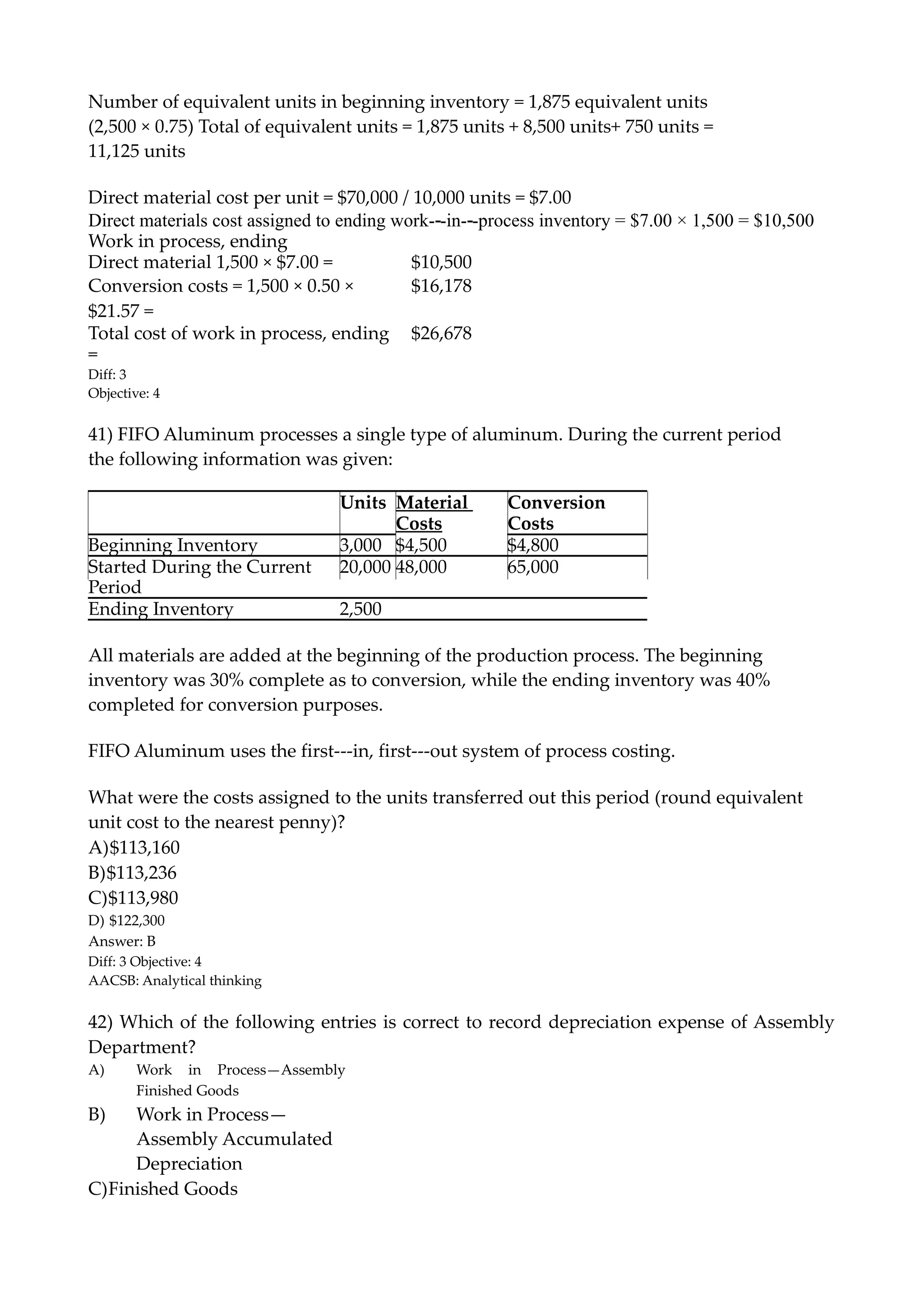
41) FIFO Aluminum processes a single type of aluminum. During the current period
the following information was given:
Units Material
Costs
Conversion
Costs
Beginning Inventory 3,000 $4,500 $4,800
Started During the Current
Period
20,000 48,000 65,000
Ending Inventory 2,500
All materials are added at the beginning of the production process. The beginning
inventory was 30% complete as to conversion, while the ending inventory was 40%
completed for conversion purposes.
FIFO Aluminum uses the first-‐-in, first-‐-out system of process costing.
What were the costs assigned to the units transferred out this period (round equivalent
unit cost to the nearest penny)?
A)$113,160
B)$113,236
C)$113,980
D) $122,300
Answer: B
Diff: 3 Objective: 4
AACSB: Analytical thinking
42) Which of the following entries is correct to record depreciation expense of Assembly
Department?
A) Work in Process—Assembly
Finished Goods
B) Work in Process—
Assembly Accumulated
Depreciation
C)Finished Goods
Work in Process—Assembly
D) Accumulated Depreciation
Work in Process—Assembly
Answer: B
Diff: 2
Objective: 4
AACSB:
Analytical
thinking
43) Audrey Auto Accessories manufactures plastic moldings for car seats. Its costing
system uses two cost categories, direct materials and conversion costs. Each product must
pass through Department A and Department B. Direct materials are added at the
beginning of production. Conversion costs are allocated evenly throughout production.
Data for Department A for February 2015 are:
Work in process, beginning inventory, 40%
converted
200 units
Units started during February 800 units
Work in process, ending inventory: 100 units
30% complete as to conversion costs
100% complete as to materials
Costs for the Department A for February 2015 are:
Work in process, beginning inventory:
Direct materials $600,000
Conversion costs $150,000
Direct materials costs added during February $4,000,000
Conversion costs added during February $2,250,000
What were the equivalent units of direct materials and conversion costs, respectively,
at the end of February? Assume Audrey uses the weighted-‐-average process costing
method.
A)1,000; 930
B)1,000; 1,000
C)1,000; 900
D)800; 700
Answer: A
Explanation: A) Equivalent units of direct materials under weighted average = units
completed + equivalent units in ending inventory = 900 + 100 = 1,000 equivalent
units
Conversion costs = 900 + (100 × 30%) = 930 equivalent units
Diff: 2
Objective: 4
AACSB:
Application of
knowledge
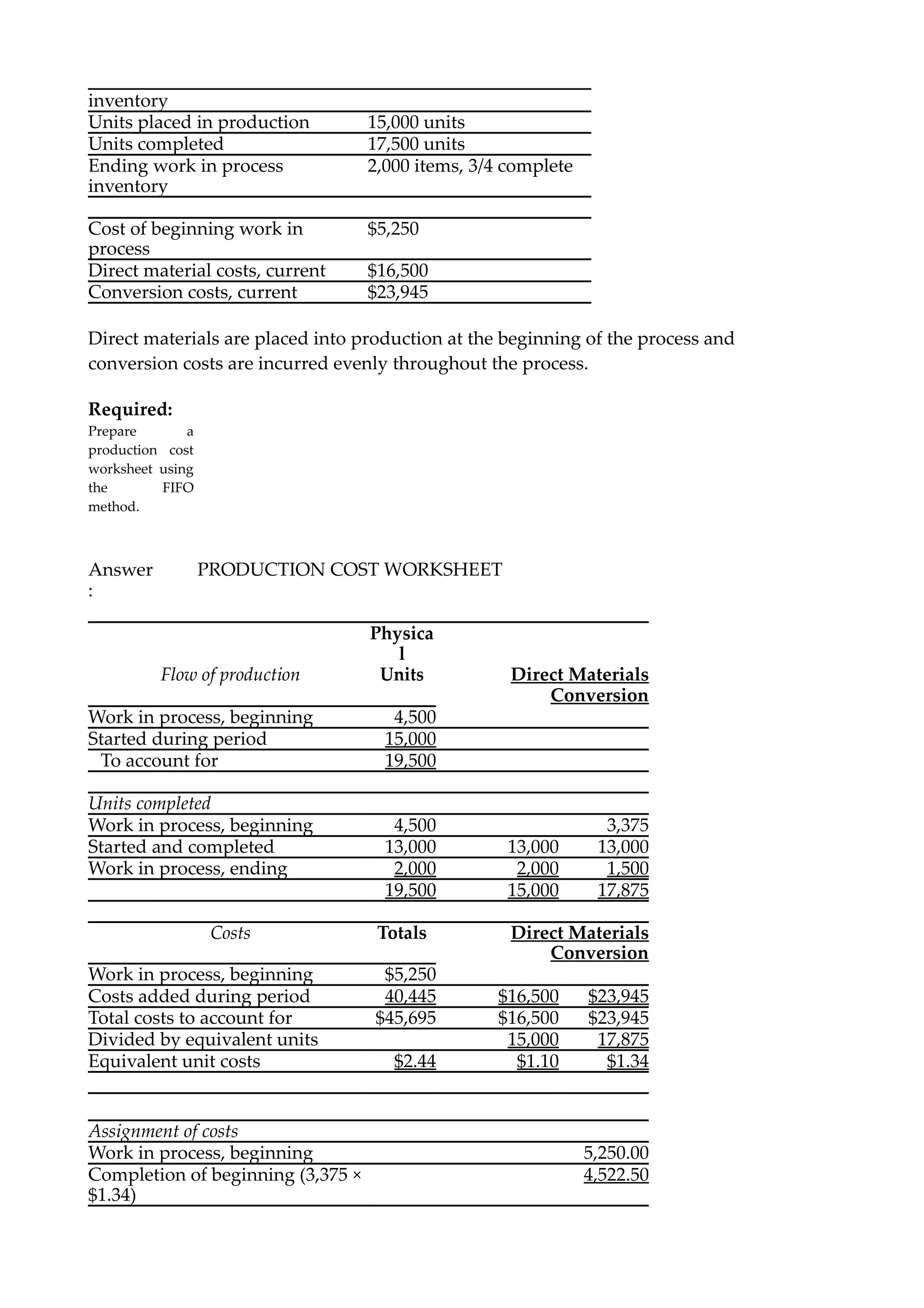
59) Pet Products Company uses an automated process to manufacture its pet replica
products. For June, the company had the following activities:
Beginning work in process 4,500 items, 1/4 complete
inventory
Units placed in production 15,000 units
Units completed 17,500 units
Ending work in process
inventory
2,000 items, 3/4 complete
Cost of beginning work in
process
$5,250
Direct material costs, current $16,500
Conversion costs, current $23,945
Direct materials are placed into production at the beginning of the process and
conversion costs are incurred evenly throughout the process.
Required:
Prepare a
production cost
worksheet using
the FIFO
method.
Answer
:
PRODUCTION COST WORKSHEET
Physica
l
Flow of production Units Direct Materials
Conversion
Work in process, beginning 4,500
Started during period 15,000
To account for 19,500
Units completed
Work in process, beginning 4,500 3,375
Started and completed 13,000 13,000 13,000
Work in process, ending 2,000 2,000 1,500
19,500 15,000 17,875
Costs Totals Direct Materials
Conversion
Work in process, beginning $5,250
Costs added during period 40,445 $16,500 $23,945
Total costs to account for $45,695 $16,500 $23,945
Divided by equivalent units 15,000 17,875
Equivalent unit costs $2.44 $1.10 $1.34
Assignment of costs
Work in process, beginning 5,250.00
Completion of beginning (3,375 ×
$1.34)
4,522.50
Total beginning inventory 9,772.50
Started and Completed (13,000 ×
$2.44)
31,720.00
Total costs transferred out $41,492.50
Work in process, ending
Direct materials (2,000 × $1.10) $2,200.00
Conversion (2,000 × $1.34 × 0.75) 2,010.00 4,210.00
Costs accounted for $45,702.50
Diff: 3
Objective: 4
AACSB: Analytical thinking

Cost ch17 quis

  • 1.
    Answer the followingquestions using the information below: The Swivel Chair Company manufacturers a standard recliner. During February, the firm'ʹs Assembly Department started production of 145,000 chairs. During the month, the firm completed 175,000 chairs and transferred them to the Finishing Department. The firm ended the month with 18,000 chairs in ending inventory. All direct materials costs are added at the beginning of the production cycle. Weighted-‐-average costing is used by Swivel. 21) What were the equivalent units for materials for February? A)193,000 chairs B)173,000 chairs C)163,000 chairs D)153,000 chairs Answer: A Explanation: A) Equivalent units for materials = 18,000 units (ending units) + 175,000 units (completed and transferred) = 193,000 units. Diff: 3 Objective: 4 AACSB: Application of knowledge 22) What were the equivalent units for conversion costs for February if the beginning inventory was 70% complete as to conversion costs and the ending inventory was 40% complete as to conversion costs? A)182,200 B)152,200 C)172,200 D)162,200 Answer: A Explanation: A) Equivalent units for conversion costs for February = 175,000 units + 7,200 equivalent units = 182,200 units Diff: 3 Objective: 4 AACSB: Application of knowledge 23) Of the 145,000 units Swivel started during February, how many were finished during the month? A) 177,000 B) 197,000 C) 127,000 D) 217,000 Answer: C Explanation: C) Number of units started and finished during the month = 145,000 units – 18,000 units = 127,000 units Diff: 3 Objective: 4 AACSB: Application of knowledge
  • 2.
    24) Weighty Steelprocesses a single type of steel. For the current period the following information is given: Units Material Costs Conversion Costs Beginning Inventory 3,000 $4,500 $5,400 Started During the Current Period 20,000 32,000 78,200 Ending Inventory 2,500 All materials are added at the beginning of the production process. The beginning inventory was 40% complete as to conversion, while the ending inventory was 30% completed for conversion purposes. Weighty uses the weighted-‐-average costing method. What is the total cost assigned to the units completed and transferred this period? A)$107,010 B)$109,440 C)$113,160 D) $120,100 Answer: C Explanation: C) EU (materials) = 20,500 + (2,500 × 100%) = 23,000. ($4,500 + $32,000) / 23,000 = $1.59 per unit for material EU (conversion) = 20,500 + (2,500 × 30%) = 21,250. ($5,400 + $78,200) / 21,250 = $3.93 per unit for conversion. Total cost per unit = $1.59 + $3.93 = $5.52 Cost of transferred units = 20,500 × $5.52 = $113,160 Diff: 3 Objective: 4 AACSB: Application of knowledge Answer the following questions using the information below: Comfort chair company manufacturers a standard recliner. During February, the firm'ʹs Assembly Department started production of 73,000 chairs. During the month, the firm completed 78,000 chairs, and transferred them to the Finishing Department. The firm ended the month with 10,000 chairs in ending inventory. There were 15,000 chairs in beginning inventory. All direct materials costs are added at the beginning of the production cycle and conversion costs are added uniformly throughout the production process. The FIFO method of process costing is used by Comfort. Beginning work in process was 30% complete as to conversion costs, while ending work in process was 80% complete as to conversion costs. Beginning inventory: Direct materials $24,000 Conversion costs $35,000 Manufacturing costs added during the accounting period: Direct materials $168,000 Conversion costs $278,000
  • 3.
    28) How manyof the units that were started and completed during February? A) 83,000 B) 78,000 C) 73,000 D) 63,000 Answer: D Explanation: D) Number of units started and completed during February = 73,000 chairs (units started in production) – 10,000 chairs (ending inventory) = 63,000 chairs Diff: 2 Objective: 4 AACSB: Application of knowledge 29) What were the equivalent units for conversion costs during February? A)81,500 B)83,000 C)73,000 D)77,500 Answer: A Explanation: A) Number of equivalent units in beginning inventory = 10,500 (15,000 × 0.7) Total equivalent units for conversion costs = 10,500 + 63,000 + 8,000 = 81,500 units Diff: 2 Objective: 4 AACSB: Application of knowledge 30) What is the amount of direct materials cost assigned to ending work-‐-in-‐-process inventory at the end of February? A)$19,000 B)$23,000 C)$25,000 D)$27,000 Answer: B Explanation: B) Direct material cost per unit = $168,000 / 73,000 = $2.30 Direct materials cost assigned to ending work-‐-in-‐-process inventory = $2.30 × 10,000 = $23,000 Diff: 3 Objective: 4 AACSB: Application of knowledge 31) What is the cost of the goods transferred out during February? A)$417,750.5 B)$454,694.8 C)$476,750.6 D)$505,000 .2 Answer: B Explanation: B) Number of units started and completed during February = 73,000 chairs (Units started in production) – 10,000 chairs (Ending inventory) = 63,000 chairs
  • 4.
    Number of equivalentunits in beginning inventory = 10,500 (15,000 × 0.7) Total equivalent units for conversion costs = 10,500 + 63,000 + 8,000 = 81,500 units Direct material cost per unit = $168,000 / 73,000 = $2.30 Direct materials cost assigned to ending work-‐-in-‐-process inventory = $2.30 × 10,000 = $23,000 Work in process, beginning inventory $24,000 + $35,000 = $ 59,000.0 Costs added to beginning inventory = 15,000 × 0.7 × $3.411 35,815.5 Total from beginning inventory Started and completed Direct materials = $2.30 × 63,000 = 144,986. 3 Conversion costs = [$278,000 / (10,500 + 8,000 + 65,000)] × 63,000 = 214,895. 0 Total costs of units completed and transferred out = 454,694. 8 Diff: 3 Objective: 4 AACSB: Application of knowledge Answer the following questions using the information below: Jane Industries manufactures plastic toys. During October, Jane'ʹs Fabrication Department started work on 10,000 models. During the month, the company completed 11,000 models, and transferred them to the Distribution Department. The company ended the month with 1,500 models in ending inventory. There were 2,500 models in beginning inventory. All direct materials costs are added at the beginning of the production cycle and conversion costs are added uniformly throughout the production process. The FIFO method of process costing is being followed. Beginning work in process was 25% complete as to conversion costs, while ending work in process was 50% complete as to conversion costs. Beginning inventory: Direct materials costs $19,200 Conversion costs $10,800 Manufacturing costs added during the accounting period: Direct materials costs $70,000 Conversion costs $240,000 32) How many of the units that were started and completed during October? A) 13,500
  • 5.
    B) 8,500 C) 9,000D) 10,000 Answer: B Explanation: B) Number of units started and completed during October = 11,000 units – 2,500 units (ending inventory) = 8,500 units Diff: 2 Objective: 4 AACSB: Application of knowledge 33) What were the equivalent units for conversion costs during October? A)10,125 B)11,375 C)11,125 D)9,000 Answer: C Explanation: C) Number of equivalent units in beginning inventory = 1,875 equivalent units (2,500 × 0.75) Total of equivalent units = 1,875 units + 8,500 units+ 750 units = 11,125 units Diff: 2 Objective: 4 AACSB: Application of knowledge 34) What is the amount of direct materials cost assigned to ending work-‐-in-‐-process inventory at the end of October? A)$22,727 B)$17,202 C)$7,720 D)$10,500 Answer: D Explanation: D) Direct material cost per unit = $70,000 / 10,000 units = $7.00 Direct materials cost assigned to ending work-‐-in-‐-process inventory = $7.00 × 1,500 = $10,500 Diff: 3 Objective: 4 AACSB: Application of knowledge 35) What is the cost assigned to ending inventory during October? A)$26,678 B)$31,536 C)$36,000 D)$38,000 Answer: A Explanation: A) Number of units started and completed during October = 11,000 units – 2,500 units (ending inventory) = 8,500 units
  • 6.
    Number of equivalentunits in beginning inventory = 1,875 equivalent units (2,500 × 0.75) Total of equivalent units = 1,875 units + 8,500 units+ 750 units = 11,125 units Direct material cost per unit = $70,000 / 10,000 units = $7.00 Direct materials cost assigned to ending work-‐-in-‐-process inventory = $7.00 × 1,500 = $10,500 Work in process, ending Direct material 1,500 × $7.00 = $10,500 Conversion costs = 1,500 × 0.50 × $21.57 = $16,178 Total cost of work in process, ending = $26,678 Diff: 3 Objective: 4 41) FIFO Aluminum processes a single type of aluminum. During the current period the following information was given: Units Material Costs Conversion Costs Beginning Inventory 3,000 $4,500 $4,800 Started During the Current Period 20,000 48,000 65,000 Ending Inventory 2,500 All materials are added at the beginning of the production process. The beginning inventory was 30% complete as to conversion, while the ending inventory was 40% completed for conversion purposes. FIFO Aluminum uses the first-‐-in, first-‐-out system of process costing. What were the costs assigned to the units transferred out this period (round equivalent unit cost to the nearest penny)? A)$113,160 B)$113,236 C)$113,980 D) $122,300 Answer: B Diff: 3 Objective: 4 AACSB: Analytical thinking 42) Which of the following entries is correct to record depreciation expense of Assembly Department? A) Work in Process—Assembly Finished Goods B) Work in Process— Assembly Accumulated Depreciation C)Finished Goods
  • 7.
    Work in Process—Assembly D)Accumulated Depreciation Work in Process—Assembly Answer: B Diff: 2 Objective: 4 AACSB: Analytical thinking 43) Audrey Auto Accessories manufactures plastic moldings for car seats. Its costing system uses two cost categories, direct materials and conversion costs. Each product must pass through Department A and Department B. Direct materials are added at the beginning of production. Conversion costs are allocated evenly throughout production. Data for Department A for February 2015 are: Work in process, beginning inventory, 40% converted 200 units Units started during February 800 units Work in process, ending inventory: 100 units 30% complete as to conversion costs 100% complete as to materials Costs for the Department A for February 2015 are: Work in process, beginning inventory: Direct materials $600,000 Conversion costs $150,000 Direct materials costs added during February $4,000,000 Conversion costs added during February $2,250,000 What were the equivalent units of direct materials and conversion costs, respectively, at the end of February? Assume Audrey uses the weighted-‐-average process costing method. A)1,000; 930 B)1,000; 1,000 C)1,000; 900 D)800; 700 Answer: A Explanation: A) Equivalent units of direct materials under weighted average = units completed + equivalent units in ending inventory = 900 + 100 = 1,000 equivalent units Conversion costs = 900 + (100 × 30%) = 930 equivalent units Diff: 2 Objective: 4 AACSB: Application of knowledge 59) Pet Products Company uses an automated process to manufacture its pet replica products. For June, the company had the following activities: Beginning work in process 4,500 items, 1/4 complete
  • 8.
    inventory Units placed inproduction 15,000 units Units completed 17,500 units Ending work in process inventory 2,000 items, 3/4 complete Cost of beginning work in process $5,250 Direct material costs, current $16,500 Conversion costs, current $23,945 Direct materials are placed into production at the beginning of the process and conversion costs are incurred evenly throughout the process. Required: Prepare a production cost worksheet using the FIFO method. Answer : PRODUCTION COST WORKSHEET Physica l Flow of production Units Direct Materials Conversion Work in process, beginning 4,500 Started during period 15,000 To account for 19,500 Units completed Work in process, beginning 4,500 3,375 Started and completed 13,000 13,000 13,000 Work in process, ending 2,000 2,000 1,500 19,500 15,000 17,875 Costs Totals Direct Materials Conversion Work in process, beginning $5,250 Costs added during period 40,445 $16,500 $23,945 Total costs to account for $45,695 $16,500 $23,945 Divided by equivalent units 15,000 17,875 Equivalent unit costs $2.44 $1.10 $1.34 Assignment of costs Work in process, beginning 5,250.00 Completion of beginning (3,375 × $1.34) 4,522.50
  • 9.
    Total beginning inventory9,772.50 Started and Completed (13,000 × $2.44) 31,720.00 Total costs transferred out $41,492.50 Work in process, ending Direct materials (2,000 × $1.10) $2,200.00 Conversion (2,000 × $1.34 × 0.75) 2,010.00 4,210.00 Costs accounted for $45,702.50 Diff: 3 Objective: 4 AACSB: Analytical thinking