Legacy Data Remediation: A Practical Approach
Presented to the Association of Litigation Support Professionals
                                     Wednesday, March 30, 2011
Today’s Panel
Andy Cosgrove
Partner, Redgrave LLP
acosgrove@redgravellp.com


Christian Rummelhoff
Senior Analyst, Redgrave LLP
crummelhoff@redgravellp.com


Diana Fasching
Senior Analyst, Redgrave LLP
dfasching@redgravellp.com

                                               2
Presentation Goals

• Gain legal and technical perspectives into a legacy
  data remediation project

• Identify unique issues associated with the remediation
  of paper and electronic legacy data

• Introduce ways to manage costs and limit burdens on
  everyday business operations


                                                           3
Top 5 Reasons to Take Notice

TOP   #5) Litigation Costs

      #4) Litigation Risks; Why Keep Tomorrow’s
          Smoking Gun?

      #3) Reputation Risks; The WikiLeaks Effect

      #2) State & Federal Privacy Regulations

      #1) Retention Costs; The Box Burden

                                                   4
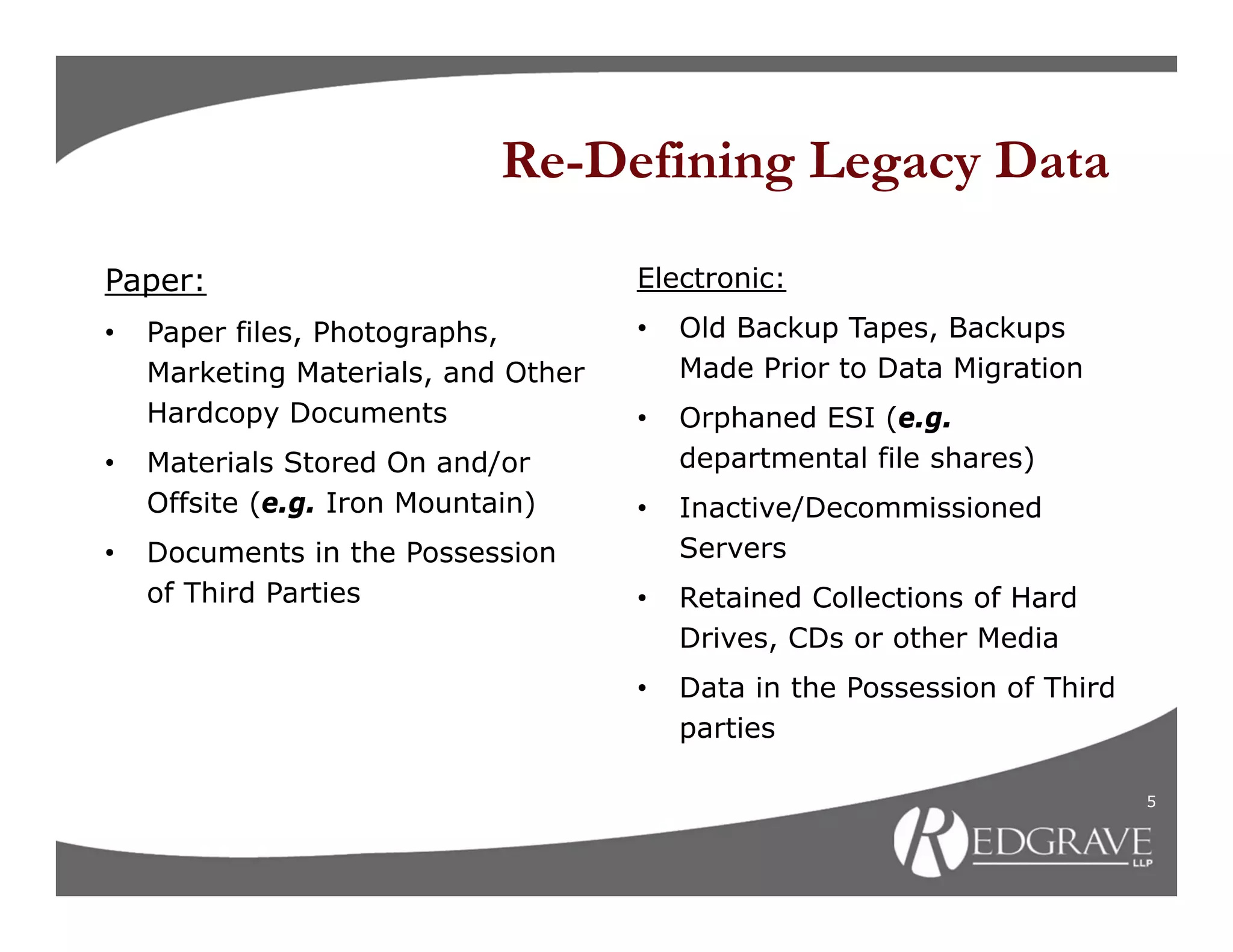
Re-Defining Legacy Data

Paper:                               Electronic:
•   Paper files, Photographs,        •   Old Backup Tapes, Backups
    Marketing Materials, and Other       Made Prior to Data Migration
    Hardcopy Documents               •   Orphaned ESI (e.g.
•   Materials Stored On and/or           departmental file shares)
    Offsite (e.g. Iron Mountain)     •   Inactive/Decommissioned
•   Documents in the Possession          Servers
    of Third Parties                 •   Retained Collections of Hard
                                         Drives, CDs or other Media
                                     •   Data in the Possession of Third
                                         parties

                                                                           5
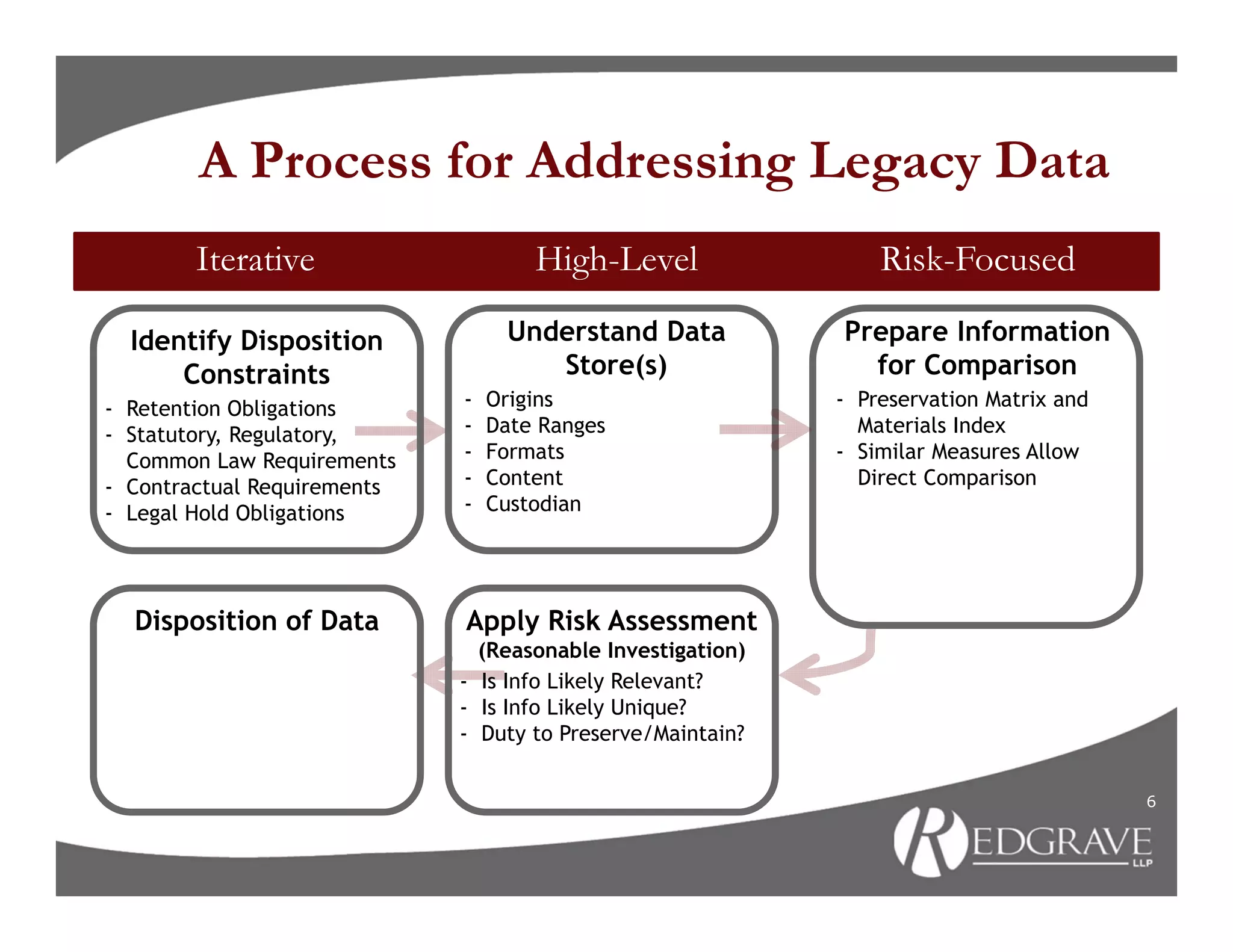
A Process for Addressing Legacy Data
        Iterative                    High-Level                 Risk-Focused

  Identify Disposition            Understand Data           Prepare Information
      Constraints                    Store(s)                 for Comparison
- Retention Obligations      -   Origins                    - Preservation Matrix and
- Statutory, Regulatory,     -   Date Ranges                  Materials Index
  Common Law Requirements    -   Formats                    - Similar Measures Allow
- Contractual Requirements   -   Content                      Direct Comparison
- Legal Hold Obligations     -   Custodian


  Disposition of Data        Apply Risk Assessment
                               (Reasonable Investigation)
                             - Is Info Likely Relevant?
                             - Is Info Likely Unique?
                             - Duty to Preserve/Maintain?


                                                                                        6
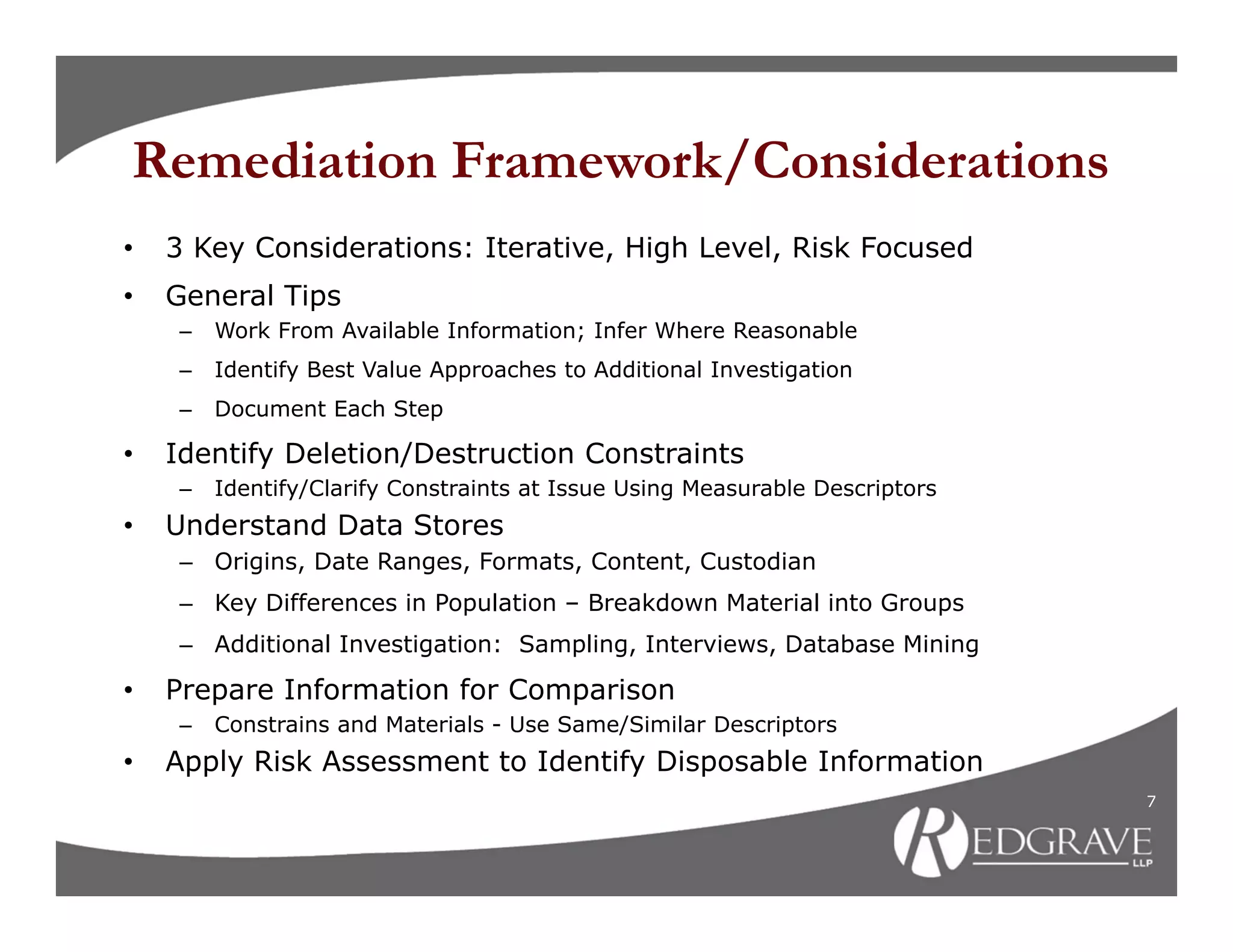
Remediation Framework/Considerations
•   3 Key Considerations: Iterative, High Level, Risk Focused
•   General Tips
    –   Work From Available Information; Infer Where Reasonable
    –   Identify Best Value Approaches to Additional Investigation
    –   Document Each Step

•   Identify Deletion/Destruction Constraints
    –   Identify/Clarify Constraints at Issue Using Measurable Descriptors
•   Understand Data Stores
    – Origins, Date Ranges, Formats, Content, Custodian
    – Key Differences in Population – Breakdown Material into Groups
    – Additional Investigation: Sampling, Interviews, Database Mining

•   Prepare Information for Comparison
    –   Constrains and Materials - Use Same/Similar Descriptors
•   Apply Risk Assessment to Identify Disposable Information
                                                                             7
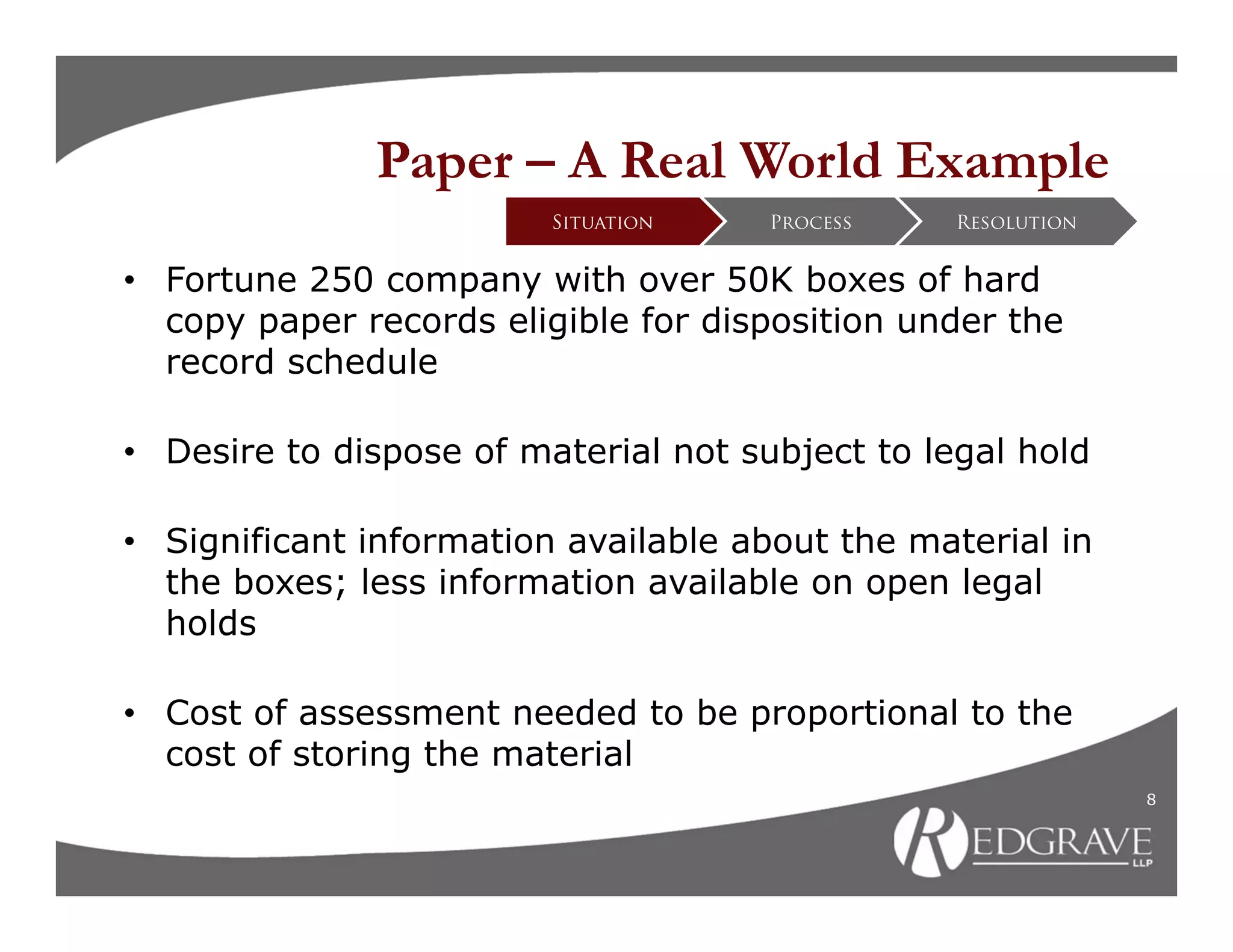
Paper – A Real World Example
                         Situation    Process    Resolution


• Fortune 250 company with over 50K boxes of hard
  copy paper records eligible for disposition under the
  record schedule

• Desire to dispose of material not subject to legal hold

• Significant information available about the material in
  the boxes; less information available on open legal
  holds

• Cost of assessment needed to be proportional to the
  cost of storing the material
                                                              8
Paper – A Real World Example
                                   Situation         Process        Resolution


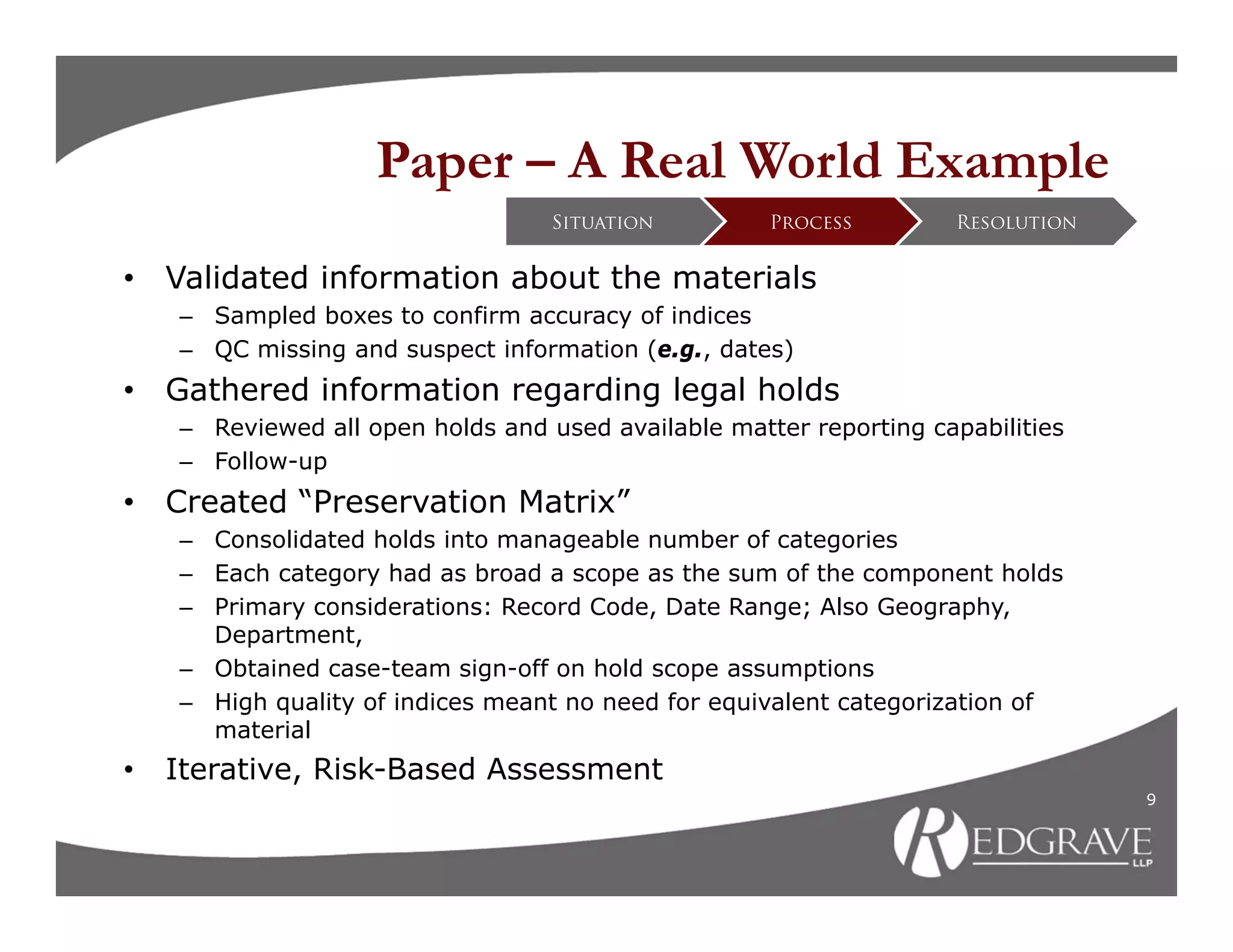
•   Validated information about the materials
    – Sampled boxes to confirm accuracy of indices
    – QC missing and suspect information (e.g., dates)
•   Gathered information regarding legal holds
    – Reviewed all open holds and used available matter reporting capabilities
    – Follow-up
•   Created “Preservation Matrix”
    – Consolidated holds into manageable number of categories
    – Each category had as broad a scope as the sum of the component holds
    – Primary considerations: Record Code, Date Range; Also Geography,
      Department,
    – Obtained case-team sign-off on hold scope assumptions
    – High quality of indices meant no need for equivalent categorization of
      material
•   Iterative, Risk-Based Assessment
                                                                                 9
Paper – A Real World Example
                                 Situation         Process        Resolution


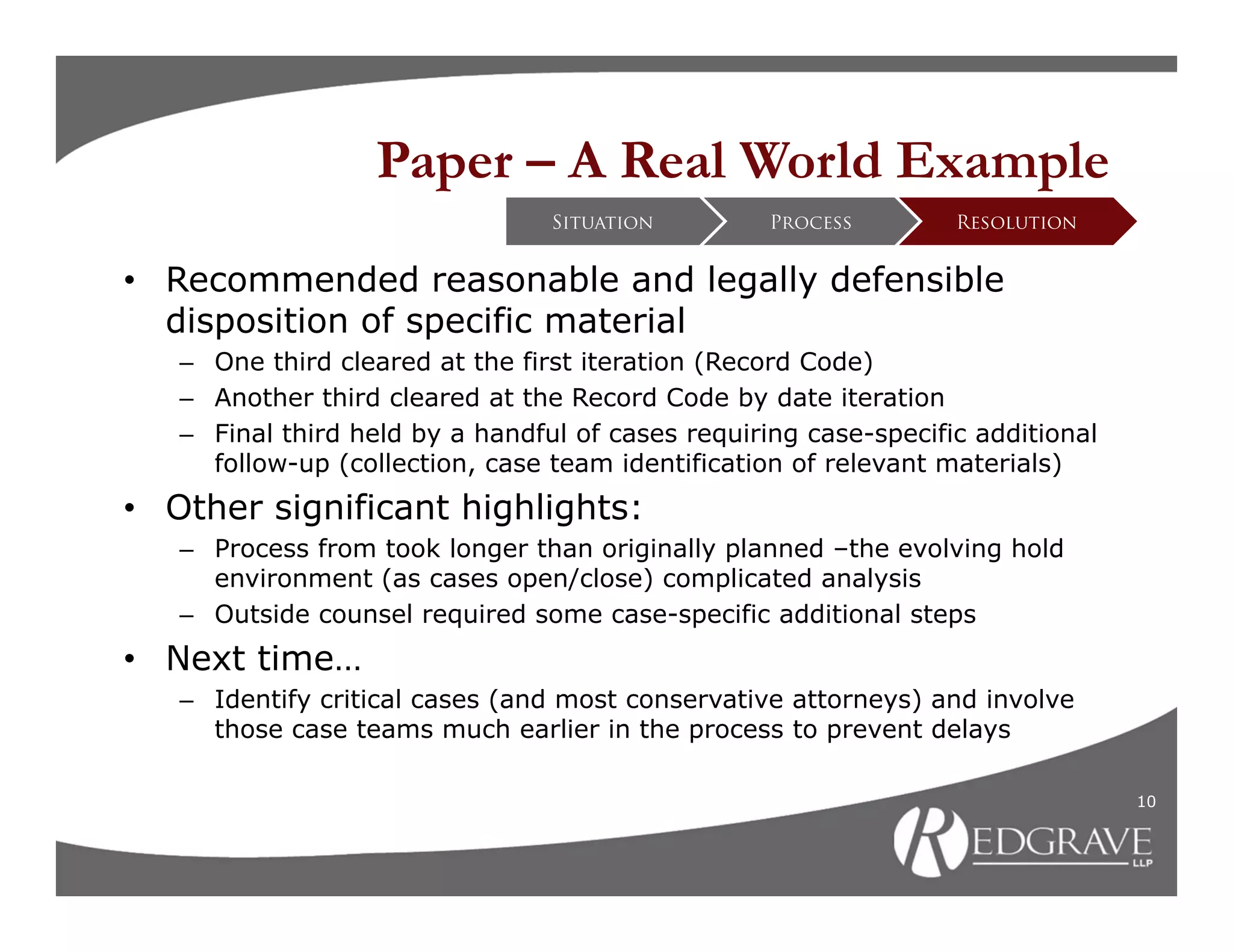
• Recommended reasonable and legally defensible
  disposition of specific material
   – One third cleared at the first iteration (Record Code)
   – Another third cleared at the Record Code by date iteration
   – Final third held by a handful of cases requiring case-specific additional
     follow-up (collection, case team identification of relevant materials)
• Other significant highlights:
   – Process from took longer than originally planned –the evolving hold
     environment (as cases open/close) complicated analysis
   – Outside counsel required some case-specific additional steps
• Next time…
   – Identify critical cases (and most conservative attorneys) and involve
     those case teams much earlier in the process to prevent delays

                                                                                 10
ESI – A Real World Example
                             Situation       Process       Resolution


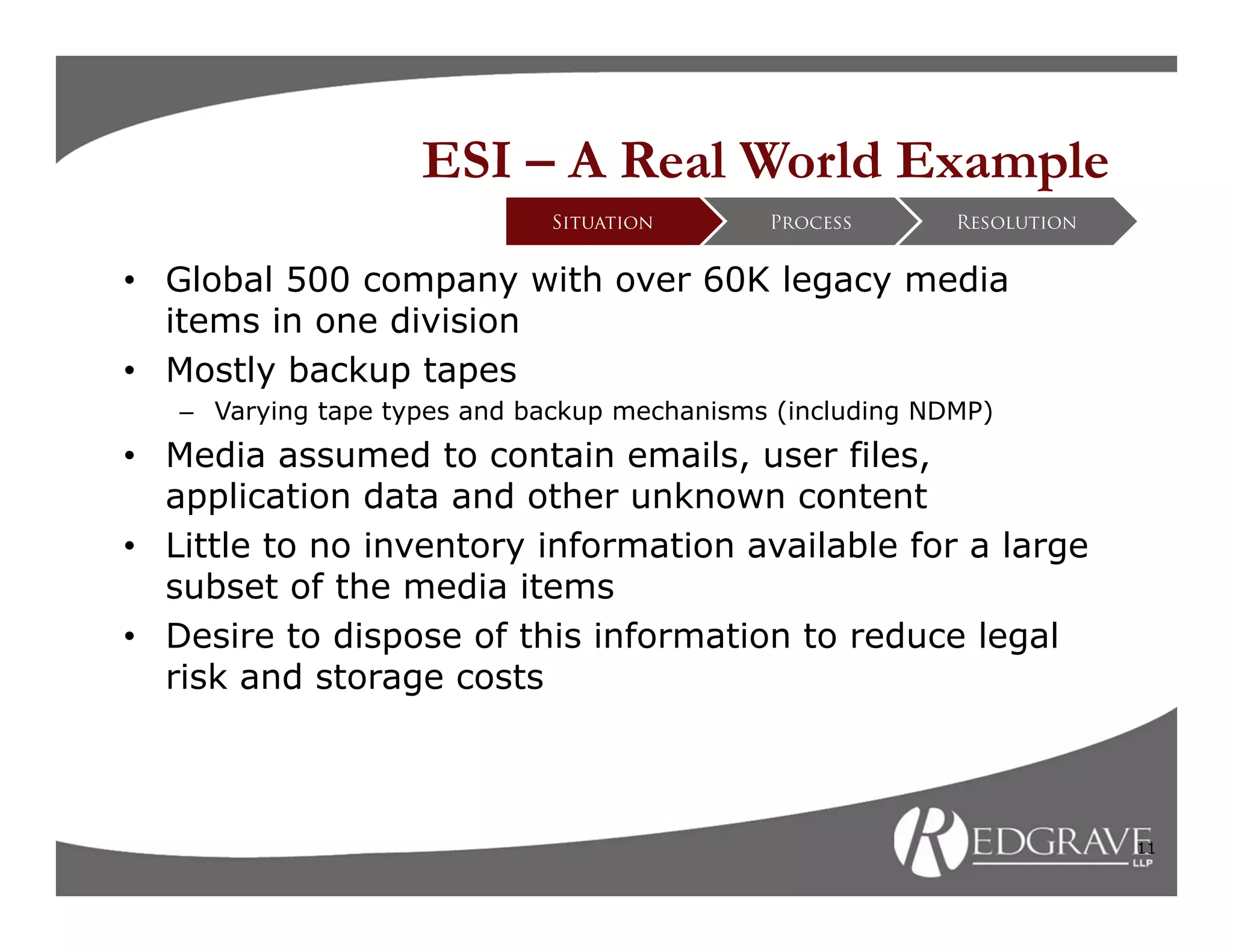
• Global 500 company with over 60K legacy media
  items in one division
• Mostly backup tapes
   – Varying tape types and backup mechanisms (including NDMP)
• Media assumed to contain emails, user files,
  application data and other unknown content
• Little to no inventory information available for a large
  subset of the media items
• Desire to dispose of this information to reduce legal
  risk and storage costs


                                                                        11
ESI – A Real World Example
                                  Situation         Process         Resolution


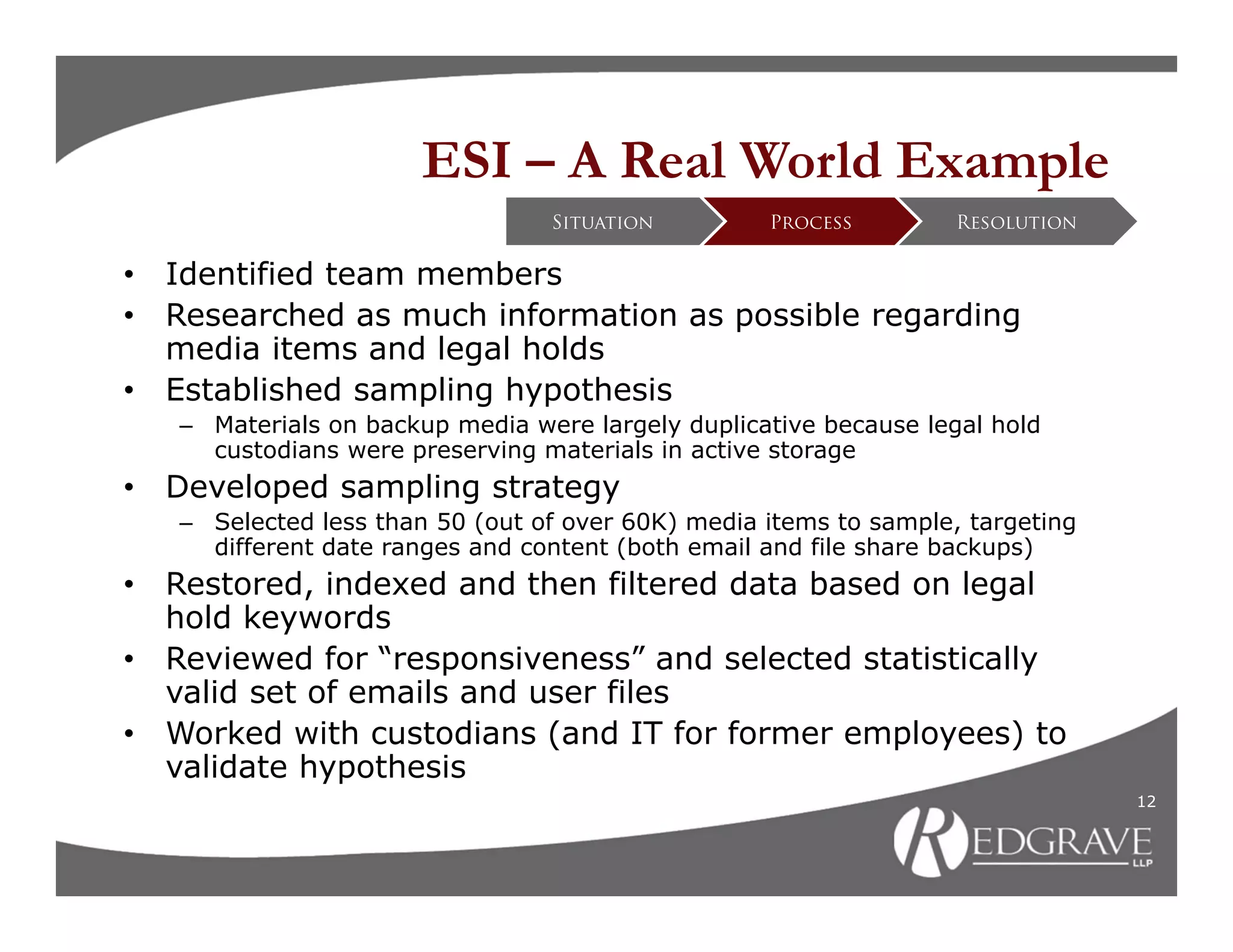
•   Identified team members
•   Researched as much information as possible regarding
    media items and legal holds
•   Established sampling hypothesis
    – Materials on backup media were largely duplicative because legal hold
      custodians were preserving materials in active storage
•   Developed sampling strategy
    – Selected less than 50 (out of over 60K) media items to sample, targeting
      different date ranges and content (both email and file share backups)
•   Restored, indexed and then filtered data based on legal
    hold keywords
•   Reviewed for “responsiveness” and selected statistically
    valid set of emails and user files
•   Worked with custodians (and IT for former employees) to
    validate hypothesis
                                                                                 12
ESI – A Real World Example
                               Situation        Process       Resolution


• Recommended reasonable and legally defensible
  disposition of media items
• Proceeded with destruction/recycling of approximately
  80% of legacy media items
• Continued hold on the remaining media items
• Other significant highlights:
   – Process from kick-off to recommendations took about 8 months —
     several months longer than originally planned
   – Had to be flexible and adjust plan as issues were encountered
   – End result was well-received within Legal and by IT
   – Considering different approach on subsequent projects to minimize
     vendor costs


                                                                           13
Other Real World Examples


Examples?


                                  14
Additional Resources

• www.redgravellp.com:
  – Webcasts: “What do you want your legacy to be?”
  – Link: Sedona Commentary on Inactive Information
  – Podcast Links:
     • Dealing with Legacy Data – What to do About ESI Messes Today
     • Will Judges Think it is Okay to Use Clustering & Suggestive Coding Tools


• Organizations:


                                                                                  15

Practical Legacy Data Remediation - Redgrave LLP

  • 1.
    Legacy Data Remediation:A Practical Approach Presented to the Association of Litigation Support Professionals Wednesday, March 30, 2011
  • 2.
    Today’s Panel Andy Cosgrove Partner,Redgrave LLP acosgrove@redgravellp.com Christian Rummelhoff Senior Analyst, Redgrave LLP crummelhoff@redgravellp.com Diana Fasching Senior Analyst, Redgrave LLP dfasching@redgravellp.com 2
  • 3.
    Presentation Goals • Gainlegal and technical perspectives into a legacy data remediation project • Identify unique issues associated with the remediation of paper and electronic legacy data • Introduce ways to manage costs and limit burdens on everyday business operations 3
  • 4.
    Top 5 Reasonsto Take Notice TOP #5) Litigation Costs #4) Litigation Risks; Why Keep Tomorrow’s Smoking Gun? #3) Reputation Risks; The WikiLeaks Effect #2) State & Federal Privacy Regulations #1) Retention Costs; The Box Burden 4
  • 5.
    Re-Defining Legacy Data Paper: Electronic: • Paper files, Photographs, • Old Backup Tapes, Backups Marketing Materials, and Other Made Prior to Data Migration Hardcopy Documents • Orphaned ESI (e.g. • Materials Stored On and/or departmental file shares) Offsite (e.g. Iron Mountain) • Inactive/Decommissioned • Documents in the Possession Servers of Third Parties • Retained Collections of Hard Drives, CDs or other Media • Data in the Possession of Third parties 5
  • 6.
    A Process forAddressing Legacy Data Iterative High-Level Risk-Focused Identify Disposition Understand Data Prepare Information Constraints Store(s) for Comparison - Retention Obligations - Origins - Preservation Matrix and - Statutory, Regulatory, - Date Ranges Materials Index Common Law Requirements - Formats - Similar Measures Allow - Contractual Requirements - Content Direct Comparison - Legal Hold Obligations - Custodian Disposition of Data Apply Risk Assessment (Reasonable Investigation) - Is Info Likely Relevant? - Is Info Likely Unique? - Duty to Preserve/Maintain? 6
  • 7.
    Remediation Framework/Considerations • 3 Key Considerations: Iterative, High Level, Risk Focused • General Tips – Work From Available Information; Infer Where Reasonable – Identify Best Value Approaches to Additional Investigation – Document Each Step • Identify Deletion/Destruction Constraints – Identify/Clarify Constraints at Issue Using Measurable Descriptors • Understand Data Stores – Origins, Date Ranges, Formats, Content, Custodian – Key Differences in Population – Breakdown Material into Groups – Additional Investigation: Sampling, Interviews, Database Mining • Prepare Information for Comparison – Constrains and Materials - Use Same/Similar Descriptors • Apply Risk Assessment to Identify Disposable Information 7
  • 8.
    Paper – AReal World Example Situation Process Resolution • Fortune 250 company with over 50K boxes of hard copy paper records eligible for disposition under the record schedule • Desire to dispose of material not subject to legal hold • Significant information available about the material in the boxes; less information available on open legal holds • Cost of assessment needed to be proportional to the cost of storing the material 8
  • 9.
    Paper – AReal World Example Situation Process Resolution • Validated information about the materials – Sampled boxes to confirm accuracy of indices – QC missing and suspect information (e.g., dates) • Gathered information regarding legal holds – Reviewed all open holds and used available matter reporting capabilities – Follow-up • Created “Preservation Matrix” – Consolidated holds into manageable number of categories – Each category had as broad a scope as the sum of the component holds – Primary considerations: Record Code, Date Range; Also Geography, Department, – Obtained case-team sign-off on hold scope assumptions – High quality of indices meant no need for equivalent categorization of material • Iterative, Risk-Based Assessment 9
  • 10.
    Paper – AReal World Example Situation Process Resolution • Recommended reasonable and legally defensible disposition of specific material – One third cleared at the first iteration (Record Code) – Another third cleared at the Record Code by date iteration – Final third held by a handful of cases requiring case-specific additional follow-up (collection, case team identification of relevant materials) • Other significant highlights: – Process from took longer than originally planned –the evolving hold environment (as cases open/close) complicated analysis – Outside counsel required some case-specific additional steps • Next time… – Identify critical cases (and most conservative attorneys) and involve those case teams much earlier in the process to prevent delays 10
  • 11.
    ESI – AReal World Example Situation Process Resolution • Global 500 company with over 60K legacy media items in one division • Mostly backup tapes – Varying tape types and backup mechanisms (including NDMP) • Media assumed to contain emails, user files, application data and other unknown content • Little to no inventory information available for a large subset of the media items • Desire to dispose of this information to reduce legal risk and storage costs 11
  • 12.
    ESI – AReal World Example Situation Process Resolution • Identified team members • Researched as much information as possible regarding media items and legal holds • Established sampling hypothesis – Materials on backup media were largely duplicative because legal hold custodians were preserving materials in active storage • Developed sampling strategy – Selected less than 50 (out of over 60K) media items to sample, targeting different date ranges and content (both email and file share backups) • Restored, indexed and then filtered data based on legal hold keywords • Reviewed for “responsiveness” and selected statistically valid set of emails and user files • Worked with custodians (and IT for former employees) to validate hypothesis 12
  • 13.
    ESI – AReal World Example Situation Process Resolution • Recommended reasonable and legally defensible disposition of media items • Proceeded with destruction/recycling of approximately 80% of legacy media items • Continued hold on the remaining media items • Other significant highlights: – Process from kick-off to recommendations took about 8 months — several months longer than originally planned – Had to be flexible and adjust plan as issues were encountered – End result was well-received within Legal and by IT – Considering different approach on subsequent projects to minimize vendor costs 13
  • 14.
    Other Real WorldExamples Examples? 14
  • 15.
    Additional Resources • www.redgravellp.com: – Webcasts: “What do you want your legacy to be?” – Link: Sedona Commentary on Inactive Information – Podcast Links: • Dealing with Legacy Data – What to do About ESI Messes Today • Will Judges Think it is Okay to Use Clustering & Suggestive Coding Tools • Organizations: 15