Practical Guide to Hybrid Cloud Computing
http://www.cloud-council.org/deliverables/CSCC-Practical-Guide-to-Hybrid-
Cloud-Computing.pdf
March 3, 2016
© 2016 Cloud Standards Customer Council www.cloud-council.org 2
The Cloud Standards Customer Council
• Provide customer-led guidance to multiple cloud
standards-defining bodies
• Establishing criteria for open
standards based cloud computing 550+ Organizations
participating
2011/2012 Deliverables
 Practical Guide to Cloud Computing
 Practical Guide to Cloud SLAs
 Security for Cloud Computing
 Impact of Cloud on Healthcare
2013/2014 Deliverables
 Convergence of SoMoClo
 Analysis of Public Cloud SLAs
 Cloud Security Standards
 Migrating Apps to Public Cloud Services
 Social Business in the Cloud
 Big Data in the Cloud
 Practical Guide to Cloud Computing V2
 Migrating Apps: Performance Rqmnts
 Cloud Interoperability/Portability
http://cloud-council.org
2015 Deliverables
 Web App Hosting Architecture
 Mobile Cloud Architecture
 Big Data Cloud Architecture
 Security for Cloud Computing V2
 Practical Guide to Cloud SLAs V2
 Practical Guide to PaaS
THE Customer’s Voice for Cloud Standards!
2016 Projects
 Prac Guide to Hybrid Cloud Computing
 IoT Reference Architecture
 DevOps Cloud Reference Architecture
 More
© 2016 Cloud Standards Customer Council www.cloud-council.org 3
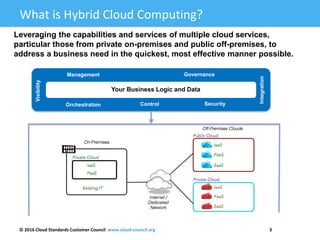
What is Hybrid Cloud Computing?
Leveraging the capabilities and services of multiple cloud services,
particular those from private on-premises and public off-premises, to
address a business need in the quickest, most effective manner possible.
Governance
Orchestration
Integration
Management
Control
Visibility
Security
Your Business Logic and Data
© 2016 Cloud Standards Customer Council www.cloud-council.org 4
1. Enables a highly cost-effective, rapidly responsive and elastic
IT, better aligned with the business needs in order to support
two speed
 Hybrid cloud enables a more responsive and elastic IT that is able to quickly respond to
the demands and needs of both steady speed systems of record (SoR) and new fast
speed systems of engagement (SoE).
2. Provides a portfolio of business and IT services that leverage
the best capabilities of cloud service providers, enabling
flexibility in what can be built and where it can be deployed.
 New tools and data for innovation. The business is no longer constrained by what they
have available on premises.
3. Enables the business to innovate faster while leveraging
existing systems and capabilities
 The ability to compose services from both on premises and off premises (i.e. hybrid) is a
key enabler to increase speed to market and to reduce costs.
Why Hybrid Cloud is important to the business
© 2016 Cloud Standards Customer Council www.cloud-council.org 5
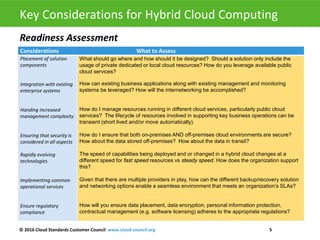
Considerations What to Assess
Placement of solution
components
Integration with existing
enterprise systems
Handing increased
management complexity
Ensuring that security is
considered in all aspects
Rapidly evolving
technologies
Implementing common
operational services
Ensure regulatory
compliance
What should go where and how should it be designed? Should a solution only include the
usage of private dedicated or local cloud resources? How do you leverage available public
cloud services?
How can existing business applications along with existing management and monitoring
systems be leveraged? How will the internetworking be accomplished?
How do I manage resources running in different cloud services, particularly public cloud
services? The lifecycle of resources involved in supporting key business operations can be
transient (short lived and/or move automatically).
How do I ensure that both on-premises AND off-premises cloud environments are secure?
How about the data stored off-premises? How about the data in transit?
The speed of capabilities being deployed and or changed in a hybrid cloud changes at a
different speed for fast speed resources vs steady speed. How does the organization support
this?
Given that there are multiple providers in play, how can the different backup/recovery solution
and networking options enable a seamless environment that meets an organization’s SLAs?
How will you ensure data placement, data encryption, personal information protection,
contractual management (e.g. software licensing) adheres to the appropriate regulations?
Key Considerations for Hybrid Cloud Computing
Readiness Assessment
© 2016 Cloud Standards Customer Council www.cloud-council.org 6
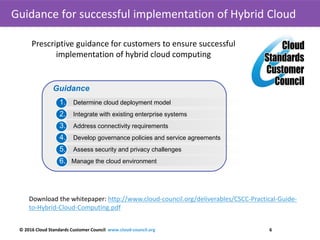
Prescriptive guidance for customers to ensure successful
implementation of hybrid cloud computing
Guidance
1. Determine cloud deployment model
2. Integrate with existing enterprise systems
3. Address connectivity requirements
4. Develop governance policies and service agreements
5. Assess security and privacy challenges
6. Manage the cloud environment
Download the whitepaper: http://www.cloud-council.org/deliverables/CSCC-Practical-Guide-
to-Hybrid-Cloud-Computing.pdf
Guidance for successful implementation of Hybrid Cloud
© 2016 Cloud Standards Customer Council www.cloud-council.org 7
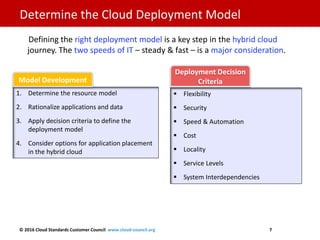
1. Determine the resource model
2. Rationalize applications and data
3. Apply decision criteria to define the
deployment model
4. Consider options for application placement
in the hybrid cloud
 Flexibility
 Security
 Speed & Automation
 Cost
 Locality
 Service Levels
 System Interdependencies
Determine the Cloud Deployment Model
Model Development
Deployment Decision
Criteria
Defining the right deployment model is a key step in the hybrid cloud
journey. The two speeds of IT – steady & fast – is a major consideration.
© 2016 Cloud Standards Customer Council www.cloud-council.org 8
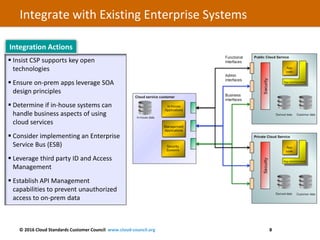
Integrate with Existing Enterprise Systems
 Insist CSP supports key open
technologies
 Ensure on-prem apps leverage SOA
design principles
 Determine if in-house systems can
handle business aspects of using
cloud services
 Consider implementing an Enterprise
Service Bus (ESB)
 Leverage third party ID and Access
Management
 Establish API Management
capabilities to prevent unauthorized
access to on-prem data
Integration Actions
© 2016 Cloud Standards Customer Council www.cloud-council.org 9
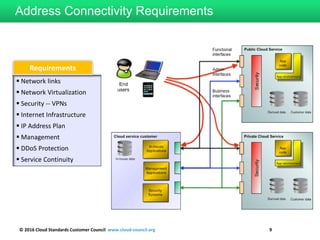
Address Connectivity Requirements
 Network links
 Network Virtualization
 Security -- VPNs
 Internet Infrastructure
 IP Address Plan
 Management
 DDoS Protection
 Service Continuity
Requirements
© 2016 Cloud Standards Customer Council www.cloud-council.org 10
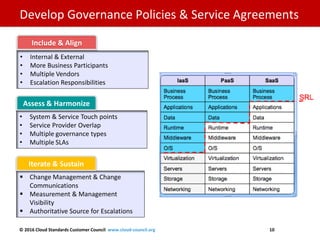
 Change Management & Change
Communications
 Measurement & Management
Visibility
 Authoritative Source for Escalations
• System & Service Touch points
• Service Provider Overlap
• Multiple governance types
• Multiple SLAs
• Internal & External
• More Business Participants
• Multiple Vendors
• Escalation Responsibilities
Develop Governance Policies & Service Agreements
Assess & Harmonize
Iterate & Sustain
Include & Align
11
 Clarify significant risks
 Be realistic: Security may be
better in the cloud!
 10 steps proposed for the
specific case of application
migration
Also see the CSCC’s Security for Cloud
Computing: 10 Steps to Ensure Success
http://www.cloud-
council.org/resource-hub.htm#security-
for-cloud-computing-10-steps-to-
ensure-success
1. Understand what data will migrate
2. Map it to security classification
3. Identify the privacy concerns
4. Examine applicable regulations
5. Apply a risk management method
(probability, impact, mitigation)
6. Review cloud provider’s measures
7. Go/No-Go decision based on the
above
8. Protect data in transit and at rest
9. Design authentication and
authorization method (SSO, etc.)
10. Put in place a rapid de-provisioning
process
Address and Resolve Security & Privacy Challenges
© 2016 Cloud Standards Customer Council www.cloud-council.org 11
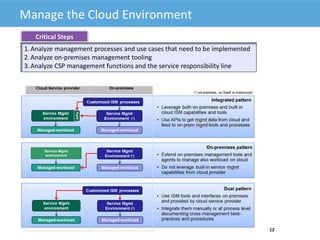
Manage the Cloud Environment
© 2016 Cloud Standards Customer Council www.cloud-council.org 12
Critical Steps
1.Analyze management processes and use cases that need to be implemented
2.Analyze on-premises management tooling
3.Analyze CSP management functions and the service responsibility line
Service Mgmt
environment
© 2016 Cloud Standards Customer Council www.cloud-council.org 13
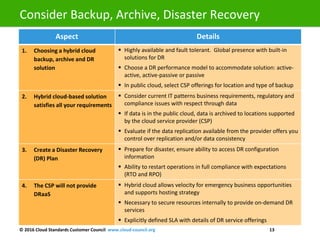
Aspect Details
1. Choosing a hybrid cloud
backup, archive and DR
solution
 Highly available and fault tolerant. Global presence with built-in
solutions for DR
 Choose a DR performance model to accommodate solution: active-
active, active-passive or passive
 In public cloud, select CSP offerings for location and type of backup
2. Hybrid cloud-based solution
satisfies all your requirements
 Consider current IT patterns business requirements, regulatory and
compliance issues with respect through data
 If data is in the public cloud, data is archived to locations supported
by the cloud service provider (CSP)
 Evaluate if the data replication available from the provider offers you
control over replication and/or data consistency
3. Create a Disaster Recovery
(DR) Plan
 Prepare for disaster, ensure ability to access DR configuration
information
 Ability to restart operations in full compliance with expectations
(RTO and RPO)
4. The CSP will not provide
DRaaS
 Hybrid cloud allows velocity for emergency business opportunities
and supports hosting strategy
 Necessary to secure resources internally to provide on-demand DR
services
 Explicitly defined SLA with details of DR service offerings
Consider Backup, Archive, Disaster Recovery
© 2016 Cloud Standards Customer Council www.cloud-council.org 14
Join the CSCC Now!
– To have an impact on customer use case based standards requirements
– To learn about all Cloud Standards within one organization
– To help define the CSCC’s future roadmap
– Membership is free & easy: http://www.cloud-council.org/become-a-
member.htm
Get Involved!
– Join one or more of the CSCC Working Groups
http://www.cloud-council.org/workinggroups.htm
Leverage CSCC Collateral
– Visit http://www.cloud-council.org/resource-hub.htm
Call to Action
15
Thank You

Practical Guide to Hybrid Cloud Computing

  • 1.
    Practical Guide toHybrid Cloud Computing http://www.cloud-council.org/deliverables/CSCC-Practical-Guide-to-Hybrid- Cloud-Computing.pdf March 3, 2016
  • 2.
    © 2016 CloudStandards Customer Council www.cloud-council.org 2 The Cloud Standards Customer Council • Provide customer-led guidance to multiple cloud standards-defining bodies • Establishing criteria for open standards based cloud computing 550+ Organizations participating 2011/2012 Deliverables  Practical Guide to Cloud Computing  Practical Guide to Cloud SLAs  Security for Cloud Computing  Impact of Cloud on Healthcare 2013/2014 Deliverables  Convergence of SoMoClo  Analysis of Public Cloud SLAs  Cloud Security Standards  Migrating Apps to Public Cloud Services  Social Business in the Cloud  Big Data in the Cloud  Practical Guide to Cloud Computing V2  Migrating Apps: Performance Rqmnts  Cloud Interoperability/Portability http://cloud-council.org 2015 Deliverables  Web App Hosting Architecture  Mobile Cloud Architecture  Big Data Cloud Architecture  Security for Cloud Computing V2  Practical Guide to Cloud SLAs V2  Practical Guide to PaaS THE Customer’s Voice for Cloud Standards! 2016 Projects  Prac Guide to Hybrid Cloud Computing  IoT Reference Architecture  DevOps Cloud Reference Architecture  More
  • 3.
    © 2016 CloudStandards Customer Council www.cloud-council.org 3 What is Hybrid Cloud Computing? Leveraging the capabilities and services of multiple cloud services, particular those from private on-premises and public off-premises, to address a business need in the quickest, most effective manner possible. Governance Orchestration Integration Management Control Visibility Security Your Business Logic and Data
  • 4.
    © 2016 CloudStandards Customer Council www.cloud-council.org 4 1. Enables a highly cost-effective, rapidly responsive and elastic IT, better aligned with the business needs in order to support two speed  Hybrid cloud enables a more responsive and elastic IT that is able to quickly respond to the demands and needs of both steady speed systems of record (SoR) and new fast speed systems of engagement (SoE). 2. Provides a portfolio of business and IT services that leverage the best capabilities of cloud service providers, enabling flexibility in what can be built and where it can be deployed.  New tools and data for innovation. The business is no longer constrained by what they have available on premises. 3. Enables the business to innovate faster while leveraging existing systems and capabilities  The ability to compose services from both on premises and off premises (i.e. hybrid) is a key enabler to increase speed to market and to reduce costs. Why Hybrid Cloud is important to the business
  • 5.
    © 2016 CloudStandards Customer Council www.cloud-council.org 5 Considerations What to Assess Placement of solution components Integration with existing enterprise systems Handing increased management complexity Ensuring that security is considered in all aspects Rapidly evolving technologies Implementing common operational services Ensure regulatory compliance What should go where and how should it be designed? Should a solution only include the usage of private dedicated or local cloud resources? How do you leverage available public cloud services? How can existing business applications along with existing management and monitoring systems be leveraged? How will the internetworking be accomplished? How do I manage resources running in different cloud services, particularly public cloud services? The lifecycle of resources involved in supporting key business operations can be transient (short lived and/or move automatically). How do I ensure that both on-premises AND off-premises cloud environments are secure? How about the data stored off-premises? How about the data in transit? The speed of capabilities being deployed and or changed in a hybrid cloud changes at a different speed for fast speed resources vs steady speed. How does the organization support this? Given that there are multiple providers in play, how can the different backup/recovery solution and networking options enable a seamless environment that meets an organization’s SLAs? How will you ensure data placement, data encryption, personal information protection, contractual management (e.g. software licensing) adheres to the appropriate regulations? Key Considerations for Hybrid Cloud Computing Readiness Assessment
  • 6.
    © 2016 CloudStandards Customer Council www.cloud-council.org 6 Prescriptive guidance for customers to ensure successful implementation of hybrid cloud computing Guidance 1. Determine cloud deployment model 2. Integrate with existing enterprise systems 3. Address connectivity requirements 4. Develop governance policies and service agreements 5. Assess security and privacy challenges 6. Manage the cloud environment Download the whitepaper: http://www.cloud-council.org/deliverables/CSCC-Practical-Guide- to-Hybrid-Cloud-Computing.pdf Guidance for successful implementation of Hybrid Cloud
  • 7.
    © 2016 CloudStandards Customer Council www.cloud-council.org 7 1. Determine the resource model 2. Rationalize applications and data 3. Apply decision criteria to define the deployment model 4. Consider options for application placement in the hybrid cloud  Flexibility  Security  Speed & Automation  Cost  Locality  Service Levels  System Interdependencies Determine the Cloud Deployment Model Model Development Deployment Decision Criteria Defining the right deployment model is a key step in the hybrid cloud journey. The two speeds of IT – steady & fast – is a major consideration.
  • 8.
    © 2016 CloudStandards Customer Council www.cloud-council.org 8 Integrate with Existing Enterprise Systems  Insist CSP supports key open technologies  Ensure on-prem apps leverage SOA design principles  Determine if in-house systems can handle business aspects of using cloud services  Consider implementing an Enterprise Service Bus (ESB)  Leverage third party ID and Access Management  Establish API Management capabilities to prevent unauthorized access to on-prem data Integration Actions
  • 9.
    © 2016 CloudStandards Customer Council www.cloud-council.org 9 Address Connectivity Requirements  Network links  Network Virtualization  Security -- VPNs  Internet Infrastructure  IP Address Plan  Management  DDoS Protection  Service Continuity Requirements
  • 10.
    © 2016 CloudStandards Customer Council www.cloud-council.org 10  Change Management & Change Communications  Measurement & Management Visibility  Authoritative Source for Escalations • System & Service Touch points • Service Provider Overlap • Multiple governance types • Multiple SLAs • Internal & External • More Business Participants • Multiple Vendors • Escalation Responsibilities Develop Governance Policies & Service Agreements Assess & Harmonize Iterate & Sustain Include & Align
  • 11.
    11  Clarify significantrisks  Be realistic: Security may be better in the cloud!  10 steps proposed for the specific case of application migration Also see the CSCC’s Security for Cloud Computing: 10 Steps to Ensure Success http://www.cloud- council.org/resource-hub.htm#security- for-cloud-computing-10-steps-to- ensure-success 1. Understand what data will migrate 2. Map it to security classification 3. Identify the privacy concerns 4. Examine applicable regulations 5. Apply a risk management method (probability, impact, mitigation) 6. Review cloud provider’s measures 7. Go/No-Go decision based on the above 8. Protect data in transit and at rest 9. Design authentication and authorization method (SSO, etc.) 10. Put in place a rapid de-provisioning process Address and Resolve Security & Privacy Challenges © 2016 Cloud Standards Customer Council www.cloud-council.org 11
  • 12.
    Manage the CloudEnvironment © 2016 Cloud Standards Customer Council www.cloud-council.org 12 Critical Steps 1.Analyze management processes and use cases that need to be implemented 2.Analyze on-premises management tooling 3.Analyze CSP management functions and the service responsibility line Service Mgmt environment
  • 13.
    © 2016 CloudStandards Customer Council www.cloud-council.org 13 Aspect Details 1. Choosing a hybrid cloud backup, archive and DR solution  Highly available and fault tolerant. Global presence with built-in solutions for DR  Choose a DR performance model to accommodate solution: active- active, active-passive or passive  In public cloud, select CSP offerings for location and type of backup 2. Hybrid cloud-based solution satisfies all your requirements  Consider current IT patterns business requirements, regulatory and compliance issues with respect through data  If data is in the public cloud, data is archived to locations supported by the cloud service provider (CSP)  Evaluate if the data replication available from the provider offers you control over replication and/or data consistency 3. Create a Disaster Recovery (DR) Plan  Prepare for disaster, ensure ability to access DR configuration information  Ability to restart operations in full compliance with expectations (RTO and RPO) 4. The CSP will not provide DRaaS  Hybrid cloud allows velocity for emergency business opportunities and supports hosting strategy  Necessary to secure resources internally to provide on-demand DR services  Explicitly defined SLA with details of DR service offerings Consider Backup, Archive, Disaster Recovery
  • 14.
    © 2016 CloudStandards Customer Council www.cloud-council.org 14 Join the CSCC Now! – To have an impact on customer use case based standards requirements – To learn about all Cloud Standards within one organization – To help define the CSCC’s future roadmap – Membership is free & easy: http://www.cloud-council.org/become-a- member.htm Get Involved! – Join one or more of the CSCC Working Groups http://www.cloud-council.org/workinggroups.htm Leverage CSCC Collateral – Visit http://www.cloud-council.org/resource-hub.htm Call to Action
  • 15.