Cloud Customer Architecture for Securing
Workloads on Cloud Services
Webinar April 19, 2017
http://www.cloud-council.org/deliverables/cloud-customer-architecture-for-securing-workloads-on-cloud-services.htm
The Cloud Standards Customer Council
• Provide customer-led guidance to multiple cloud
standards-defining bodies
• Establishing criteria for open
standards based cloud computing 650+ Organizations
participating
2013/2014 Deliverables
 Convergence of Social, Mobile, Cloud
 Analysis of Public Cloud SLAs
 Cloud Security Standards
 Migrating Apps to Public Cloud Services
 Social Business in the Cloud
 Deploying Big Data in the Cloud
 Practical Guide to Cloud Computing, V2
 Migrating Apps: Performance Rqmnts
 Cloud Interoperability/Portability
http://cloud-council.org
2015 Deliverables
 Web App Hosting Ref. Architecture
 Mobile Ref. Architecture
 Big Data & Analytics Ref. Architecture
 Security for Cloud Computing, V2
 Practical Guide to Cloud SLAs, V2
 Practical Guide to PaaS
THE Customer’s Voice for Cloud Standards!
2016 Deliverables
 Prac Guide to Hybrid Cloud Computing
 Public Cloud Service Agreements, V2
 Cloud Security Standards, V2
 IoT Ref. Architecture
 e-Commerce Ref. Architecture
 Impact of Cloud Computing on Healthcare, V2
 Enterprise Social Collaboration Ref. Architecture
2017 Projects
 Security for Cloud Services Ref. Architecture
 Impact of Cloud Computing on Healthcare
 Hybrid Integration Ref. Architecture
 API Management Ref. Architecture
 Data Residency discussion paper
 Blockchain Ref. Architecture
 Multi-cloud Management whitepaper
 And more!
© 2017 Cloud Standards Customer Council 2
© 2017 Cloud Standards Customer Council www.cloud-council.org 3
Abstract & Agenda
This talk introduces the Cloud Customer Architecture for Securing
Workloads on Cloud Services
 What are Cloud Solution Architectures?
 CSCC’s Cloud Reference Architecture series
• Cloud Customer Architecture for e-Commerce http://bit.ly/2camhIz
• Cloud Customer Architecture for IoT http://bit.ly/2cLcomc
• Cloud Customer Architecture for Big Data http://bit.ly/2crffR2
• Cloud Customer Architecture for Mobile http://bit.ly/2cIYtdI
• Cloud Customer Architecture for Web Application Hosting http://bit.ly/2cgTVK2
• Cloud Customer Architecture for Enterprise Social Collaboration
http://bit.ly/2jDiMPD
• Cloud Customer Architecture for Hybrid Integration http://bit.ly/2lHlLs0
• Cloud Customer Architecture for API Management http://bit.ly/2n59GgY
• Cloud Customer Architecture for Securing Workloads on Cloud Services
http://bit.ly/2puolzX
© 2017 Cloud Standards Customer Council www.cloud-council.org 4
 Cloud Customer Reference Architectures are…
• straightforward description of elements needed to implement particular application
solutions using cloud infrastructure, cloud platforms, cloud software, and cloud services
• deployment neutral (public, private, hybrid) & implementable via IaaS, PaaS, SaaS
• general purpose reusable architectures as well as industry specific architectures
• vendor neutral & open
 Important because they…
• enable cloud customers to understand unique features & advantages of using cloud
computing
• bridge gap between understanding cloud customer needs and cloud provider offerings
• provide practical guidance on how common business applications can be realized from a
cloud customer role perspective
• are stable anchors in a rapidly innovating cloud landscape
• save time, effort & money: be more productive
 Useful when…
• those planning to build cloud based applications
• talking with cloud providers about their offerings
• understanding of the common elements and relationships in relevant solutions
 Target audience:
• those planning on building/purchasing cloud based applications
• developers, architects, managers
 Consistent with ISO/IEC 17789 International Standard Cloud Computing Reference Architecture
Cloud Customer Reference Architectures
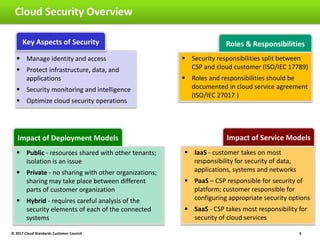
Cloud Security Overview
© 2017 Cloud Standards Customer Council 5
 Manage identity and access
 Protect infrastructure, data, and
applications
 Security monitoring and intelligence
 Optimize cloud security operations
Impact of Deployment Models
 Public - resources shared with other tenants;
isolation is an issue
 Private - no sharing with other organizations;
sharing may take place between different
parts of customer organization
 Hybrid - requires careful analysis of the
security elements of each of the connected
systems
Impact of Service Models
 IaaS - customer takes on most
responsibility for security of data,
applications, systems and networks
 PaaS – CSP responsible for security of
platform; customer responsible for
configuring appropriate security options
 SaaS - CSP takes most responsibility for
security of cloud services
Key Aspects of Security Roles & Responsibilities
 Security responsibilities split between
CSP and cloud customer (ISO/IEC 17789)
 Roles and responsibilities should be
documented in cloud service agreement
(ISO/IEC 27017 )
Architecture: Overview
© 2017 Cloud Standards Customer Council 6
Architecture: User Roles
© 2017 Cloud Standards Customer Council 7
 Application User
• Usually have access and control of data
which can be sensitive
• Service accounts may have access for
bulk data updates in cloud environment
 Cloud Admin
• Privileged access users
• Application publishers
• Operators
• Cloud administrators
• Managers and team leads
• Auditors
• Authorized to read sensitive info and
execute potentially destructive actions
• Require an increased level of auditing
 Cloud Developer
• Create, update, and delete applications
• Create cloud service instances and bind
to applications
• Authorized to read sensitive info and
manipulate applications
• Require an increased level of auditing
Architecture: Devices
© 2017 Cloud Standards Customer Council 8
Managed Device – devices that have
Directory Services membership and/or are
controlled by IT under compliance policies
Unmanaged Device – devices which
include personal devices (laptops, mobile
devices), printers, cameras, etc.
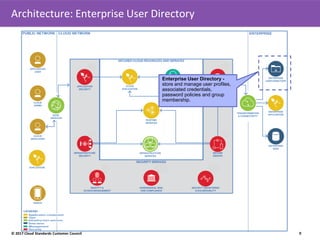
Architecture: Enterprise User Directory
© 2017 Cloud Standards Customer Council 9
Enterprise User Directory -
store and manage user profiles,
associated credentials,
password policies and group
membership.
Architecture: Enterprise Applications & Data
© 2017 Cloud Standards Customer Council 10
Enterprise Application
represents applications that run
enterprise business processes
and logic within existing
enterprise systems.
Enterprise Data represents the
one or more systems of record,
for example, transactional data
or data warehouses that
represent the existing data in the
enterprise.
Architecture: Identity & Access Management
© 2017 Cloud Standards Customer Council 11
 Identity lifecycle management –
management of accounts and roles
 Segregation of duties – controlling access
to capabilities based on user role
 Identity-as-a-Service (IDaaS) – enables
cloud apps to externalize user authentication
to a range of different identity providers
 Federation Services – also known as a
Single Sign-on (SSO)
 Privileged Account Management (PAM) – a
set of additional controls for privileged access
accounts
 Multifactor authentication (MFA) –
additional levels of authentication for higher
security
 Mobile Device Management (MDM) –
ensure that mobile devices are compliant with
corporate policies
 Reporting – view of access by users
 Audit and compliance – validates security
controls
 Cloud Security Services – tools for handling
security across cloud environments
Architecture: Infrastructure Security
© 2017 Cloud Standards Customer Council 12
 Physical security
• Implementation guidance is in ISO 27002,
PCI DSS 3.2 and other standards
• Provider should give assurances about
physical security - independent SOC 2
report or ISO 27001 certification
 Infrastructure isolation
• Bare metal systems or dedicated hosts
provide the most isolation
• VMs provide a significant amount of isolation
• Containers provide a lower level of isolation
 Network security
• Proper network segmentation is important
• Controls, such as firewall rules, between
segmented networks are also important
• Use transport level security (i.e., TLS) in
cases where sensitive data is transmitted
• Employ certificate checking
• For Internet facing web services consider the
use of a Web Application Firewall
• Consider your audience
Architecture: Application Security
© 2017 Cloud Standards Customer Council 13
 Threat modelling
• Analyze attack surface
• Identify targets of attack
• Document bad actors & motivations
• Assess operational risks
 Secure design
• Analyze attack surface
• Service and data isolation
 Secure coding
• Input validation
• Output encoding
• Session management
• Credential and password handling
• Protect sensitive data in storage and
in motion
• Error handling and logging
• Protect log information
• Selection and proper use of APIs
and network services
 Security testing
• Attack surface review
• Fuzz testing
• Web app scanning and penetration
testing
 Cloud application security controls
• Cryptography
• Identity & Access Management
• Web Application Firewall
• API security
• Container security
Architecture: Data Security
© 2017 Cloud Standards Customer Council 14
 Data Classification:
• Public, Private, Regulated, Etc.
 Data Protection:
• Data de-identification vs encryption
• Scope & technique of encryption
• Importance of key management
 Data activity monitoring
• Including tenant specific views
 Data access & control
• Secure deletion
• Right to be forgotten
Architecture: Secure DevOps
© 2017 Cloud Standards Customer Council 15
 Secure DevOps is an extension of
application security
 Embed security in a DevOps operational
framework
 Security testing categories:
• Functional testing for authentication,
authorization and identity management
• Non-functional testing for known
weaknesses
• Application and infrastructure security
scanning
• Testing application logic for
vulnerabilities
 Security testing activities:
• Static & Dynamic scans
• Manual code review
• Validated testing of integrated services
 Secure deployment management
Architecture: Governance, Risk & Compliance
© 2017 Cloud Standards Customer Council 16
 Understand the line of responsibility:
• IaaS, PaaS, SaaS all have very different
lines
• Education is essential
 Start with an understanding of risk
• Consider applicable laws, regulations &
organizational security policies
 Consider policy changes needed for cloud:
• Terminology
• Scope (IaaS, PaaS, SaaS)
 Map customer & provider policies
 Leverage the value of compliance &
industry certifications
Architecture: Security Monitoring & Vulnerability
© 2017 Cloud Standards Customer Council 17
 Security monitoring enables proactive
tracking & reaction to security incidents
 Monitoring challenges:
• “Shadow IT”
• Extending corporate security policies to
cloud services
 Monitoring implementation considerations:
• Proxy
• Mobile device manager (MDM)
• Mobile content manager (MCM)
• Gateway device
• Transparent gateway
 Security analytics
• Detect deviations from regular patterns
• Uncover changes in network traffic
• Find activities that exceed defined levels
 Vulnerability management focus:
• Subscribe to Common Vulnerability
Exposure (CVE) lists
• Analyze CVE data to identify and prioritize
relevant vulnerabilities
• Develop a plan to remediate vulnerabilities
in a timely manner
• Test to verify vulnerabilities have been
remediated
 Vulnerability management is multi-phase
process
1. Establish policies
2. Scan to identify vulnerabilities
3. Prioritize vulnerabilities
4. Mitigate vulnerabilities
5. Maintain & monitor vulnerabilities
Key to Success Considerations
Manage access to cloud
applications and resources
 IdAM for use of cloud services and for the applications and resources within
those cloud services
 Seamless IdAM systems covering cloud services and on-premises systems
Protect and secure cloud
apps, data & infrastructure
 Ensure boundary controls in place for all assets related to cloud services
 Encrypt sensitive data
 Encrypt communications
Gain visibility into all
resources on cloud services
 Ensure monitoring of cloud services and the apps/data located on cloud
services
 Integrate cloud service monitoring with monitoring of on-premises resources
Incorporate security into
DevOps for cloud services
 Include “Secure by Design” and “Data Protection by Design” principles into
all applications destined to run on cloud services
 Include security elements into DevOps processes and test security elements
before and during production deployment
Strong security policy and
governance
 Build a comprehensive security policy for all cloud services
 Ensure compliance with all corporate, industry and government
requirements and regulations
 Enforce security policy through measurable security controls
 Check cloud service provider compliance through certifications
Automation of security
services
 Automated , reusable security services provide best support for security
standardization and consistency
Keys to Success
© 2017 Cloud Standards Customer Council 18
© 2017 Cloud Standards Customer Council www.cloud-council.org 19
Call to Action
Join the CSCC Now!
– To have an impact on customer use case based standards requirements
– To learn about all Cloud Standards within one organization
– To help define the CSCC’s future roadmap
– Membership is free & easy: http://www.cloud-council.org/become-a-
member
Get Involved!
– Join one or more of the CSCC Working Groups
http://www.cloud-council.org/workinggroups
Leverage CSCC Collateral
– Visit http://www.cloud-council.org/resource-hub
© 2017 Cloud Standards Customer Council www.cloud-council.org 20
Whitepapers
• Security for Cloud Computing: 10 Steps to Ensure Success v2.0
http://www.cloud-council.org/deliverables/security-for-cloud-computing-10-steps-to-ensure-success.htm
• Cloud Security Standards: What to Expect and What to Negotiate v2.0
http://www.cloud-council.org/deliverables/cloud-security-standards-what-to-expect-and-what-to-
negotiate.htm
Cloud Customer Reference Architectures
• Web Application Hosting
http://www.cloud-council.org/deliverables/cloud-customer-architecture-for-web-application-hosting.htm
• Big Data & Analytics
http://www.cloud-council.org/deliverables/cloud-customer-architecture-for-big-data-and-analytics.htm
• IoT
http://www.cloud-council.org/deliverables/cloud-customer-architecture-for-iot.htm
• Mobile
http://www.cloud-council.org/deliverables/cloud-customer-architecture-for-mobile.htm
• And more!
Additional Resources from the CSCC
View all papers www.cloud-council.org/resource-hub and companion webinars www.cloud-council.org/events
© 2017 Cloud Standards Customer Council 20
21
Thank You

Cloud Customer Architecture for Securing Workloads on Cloud Services

  • 1.
    Cloud Customer Architecturefor Securing Workloads on Cloud Services Webinar April 19, 2017 http://www.cloud-council.org/deliverables/cloud-customer-architecture-for-securing-workloads-on-cloud-services.htm
  • 2.
    The Cloud StandardsCustomer Council • Provide customer-led guidance to multiple cloud standards-defining bodies • Establishing criteria for open standards based cloud computing 650+ Organizations participating 2013/2014 Deliverables  Convergence of Social, Mobile, Cloud  Analysis of Public Cloud SLAs  Cloud Security Standards  Migrating Apps to Public Cloud Services  Social Business in the Cloud  Deploying Big Data in the Cloud  Practical Guide to Cloud Computing, V2  Migrating Apps: Performance Rqmnts  Cloud Interoperability/Portability http://cloud-council.org 2015 Deliverables  Web App Hosting Ref. Architecture  Mobile Ref. Architecture  Big Data & Analytics Ref. Architecture  Security for Cloud Computing, V2  Practical Guide to Cloud SLAs, V2  Practical Guide to PaaS THE Customer’s Voice for Cloud Standards! 2016 Deliverables  Prac Guide to Hybrid Cloud Computing  Public Cloud Service Agreements, V2  Cloud Security Standards, V2  IoT Ref. Architecture  e-Commerce Ref. Architecture  Impact of Cloud Computing on Healthcare, V2  Enterprise Social Collaboration Ref. Architecture 2017 Projects  Security for Cloud Services Ref. Architecture  Impact of Cloud Computing on Healthcare  Hybrid Integration Ref. Architecture  API Management Ref. Architecture  Data Residency discussion paper  Blockchain Ref. Architecture  Multi-cloud Management whitepaper  And more! © 2017 Cloud Standards Customer Council 2
  • 3.
    © 2017 CloudStandards Customer Council www.cloud-council.org 3 Abstract & Agenda This talk introduces the Cloud Customer Architecture for Securing Workloads on Cloud Services  What are Cloud Solution Architectures?  CSCC’s Cloud Reference Architecture series • Cloud Customer Architecture for e-Commerce http://bit.ly/2camhIz • Cloud Customer Architecture for IoT http://bit.ly/2cLcomc • Cloud Customer Architecture for Big Data http://bit.ly/2crffR2 • Cloud Customer Architecture for Mobile http://bit.ly/2cIYtdI • Cloud Customer Architecture for Web Application Hosting http://bit.ly/2cgTVK2 • Cloud Customer Architecture for Enterprise Social Collaboration http://bit.ly/2jDiMPD • Cloud Customer Architecture for Hybrid Integration http://bit.ly/2lHlLs0 • Cloud Customer Architecture for API Management http://bit.ly/2n59GgY • Cloud Customer Architecture for Securing Workloads on Cloud Services http://bit.ly/2puolzX
  • 4.
    © 2017 CloudStandards Customer Council www.cloud-council.org 4  Cloud Customer Reference Architectures are… • straightforward description of elements needed to implement particular application solutions using cloud infrastructure, cloud platforms, cloud software, and cloud services • deployment neutral (public, private, hybrid) & implementable via IaaS, PaaS, SaaS • general purpose reusable architectures as well as industry specific architectures • vendor neutral & open  Important because they… • enable cloud customers to understand unique features & advantages of using cloud computing • bridge gap between understanding cloud customer needs and cloud provider offerings • provide practical guidance on how common business applications can be realized from a cloud customer role perspective • are stable anchors in a rapidly innovating cloud landscape • save time, effort & money: be more productive  Useful when… • those planning to build cloud based applications • talking with cloud providers about their offerings • understanding of the common elements and relationships in relevant solutions  Target audience: • those planning on building/purchasing cloud based applications • developers, architects, managers  Consistent with ISO/IEC 17789 International Standard Cloud Computing Reference Architecture Cloud Customer Reference Architectures
  • 5.
    Cloud Security Overview ©2017 Cloud Standards Customer Council 5  Manage identity and access  Protect infrastructure, data, and applications  Security monitoring and intelligence  Optimize cloud security operations Impact of Deployment Models  Public - resources shared with other tenants; isolation is an issue  Private - no sharing with other organizations; sharing may take place between different parts of customer organization  Hybrid - requires careful analysis of the security elements of each of the connected systems Impact of Service Models  IaaS - customer takes on most responsibility for security of data, applications, systems and networks  PaaS – CSP responsible for security of platform; customer responsible for configuring appropriate security options  SaaS - CSP takes most responsibility for security of cloud services Key Aspects of Security Roles & Responsibilities  Security responsibilities split between CSP and cloud customer (ISO/IEC 17789)  Roles and responsibilities should be documented in cloud service agreement (ISO/IEC 27017 )
  • 6.
    Architecture: Overview © 2017Cloud Standards Customer Council 6
  • 7.
    Architecture: User Roles ©2017 Cloud Standards Customer Council 7  Application User • Usually have access and control of data which can be sensitive • Service accounts may have access for bulk data updates in cloud environment  Cloud Admin • Privileged access users • Application publishers • Operators • Cloud administrators • Managers and team leads • Auditors • Authorized to read sensitive info and execute potentially destructive actions • Require an increased level of auditing  Cloud Developer • Create, update, and delete applications • Create cloud service instances and bind to applications • Authorized to read sensitive info and manipulate applications • Require an increased level of auditing
  • 8.
    Architecture: Devices © 2017Cloud Standards Customer Council 8 Managed Device – devices that have Directory Services membership and/or are controlled by IT under compliance policies Unmanaged Device – devices which include personal devices (laptops, mobile devices), printers, cameras, etc.
  • 9.
    Architecture: Enterprise UserDirectory © 2017 Cloud Standards Customer Council 9 Enterprise User Directory - store and manage user profiles, associated credentials, password policies and group membership.
  • 10.
    Architecture: Enterprise Applications& Data © 2017 Cloud Standards Customer Council 10 Enterprise Application represents applications that run enterprise business processes and logic within existing enterprise systems. Enterprise Data represents the one or more systems of record, for example, transactional data or data warehouses that represent the existing data in the enterprise.
  • 11.
    Architecture: Identity &Access Management © 2017 Cloud Standards Customer Council 11  Identity lifecycle management – management of accounts and roles  Segregation of duties – controlling access to capabilities based on user role  Identity-as-a-Service (IDaaS) – enables cloud apps to externalize user authentication to a range of different identity providers  Federation Services – also known as a Single Sign-on (SSO)  Privileged Account Management (PAM) – a set of additional controls for privileged access accounts  Multifactor authentication (MFA) – additional levels of authentication for higher security  Mobile Device Management (MDM) – ensure that mobile devices are compliant with corporate policies  Reporting – view of access by users  Audit and compliance – validates security controls  Cloud Security Services – tools for handling security across cloud environments
  • 12.
    Architecture: Infrastructure Security ©2017 Cloud Standards Customer Council 12  Physical security • Implementation guidance is in ISO 27002, PCI DSS 3.2 and other standards • Provider should give assurances about physical security - independent SOC 2 report or ISO 27001 certification  Infrastructure isolation • Bare metal systems or dedicated hosts provide the most isolation • VMs provide a significant amount of isolation • Containers provide a lower level of isolation  Network security • Proper network segmentation is important • Controls, such as firewall rules, between segmented networks are also important • Use transport level security (i.e., TLS) in cases where sensitive data is transmitted • Employ certificate checking • For Internet facing web services consider the use of a Web Application Firewall • Consider your audience
  • 13.
    Architecture: Application Security ©2017 Cloud Standards Customer Council 13  Threat modelling • Analyze attack surface • Identify targets of attack • Document bad actors & motivations • Assess operational risks  Secure design • Analyze attack surface • Service and data isolation  Secure coding • Input validation • Output encoding • Session management • Credential and password handling • Protect sensitive data in storage and in motion • Error handling and logging • Protect log information • Selection and proper use of APIs and network services  Security testing • Attack surface review • Fuzz testing • Web app scanning and penetration testing  Cloud application security controls • Cryptography • Identity & Access Management • Web Application Firewall • API security • Container security
  • 14.
    Architecture: Data Security ©2017 Cloud Standards Customer Council 14  Data Classification: • Public, Private, Regulated, Etc.  Data Protection: • Data de-identification vs encryption • Scope & technique of encryption • Importance of key management  Data activity monitoring • Including tenant specific views  Data access & control • Secure deletion • Right to be forgotten
  • 15.
    Architecture: Secure DevOps ©2017 Cloud Standards Customer Council 15  Secure DevOps is an extension of application security  Embed security in a DevOps operational framework  Security testing categories: • Functional testing for authentication, authorization and identity management • Non-functional testing for known weaknesses • Application and infrastructure security scanning • Testing application logic for vulnerabilities  Security testing activities: • Static & Dynamic scans • Manual code review • Validated testing of integrated services  Secure deployment management
  • 16.
    Architecture: Governance, Risk& Compliance © 2017 Cloud Standards Customer Council 16  Understand the line of responsibility: • IaaS, PaaS, SaaS all have very different lines • Education is essential  Start with an understanding of risk • Consider applicable laws, regulations & organizational security policies  Consider policy changes needed for cloud: • Terminology • Scope (IaaS, PaaS, SaaS)  Map customer & provider policies  Leverage the value of compliance & industry certifications
  • 17.
    Architecture: Security Monitoring& Vulnerability © 2017 Cloud Standards Customer Council 17  Security monitoring enables proactive tracking & reaction to security incidents  Monitoring challenges: • “Shadow IT” • Extending corporate security policies to cloud services  Monitoring implementation considerations: • Proxy • Mobile device manager (MDM) • Mobile content manager (MCM) • Gateway device • Transparent gateway  Security analytics • Detect deviations from regular patterns • Uncover changes in network traffic • Find activities that exceed defined levels  Vulnerability management focus: • Subscribe to Common Vulnerability Exposure (CVE) lists • Analyze CVE data to identify and prioritize relevant vulnerabilities • Develop a plan to remediate vulnerabilities in a timely manner • Test to verify vulnerabilities have been remediated  Vulnerability management is multi-phase process 1. Establish policies 2. Scan to identify vulnerabilities 3. Prioritize vulnerabilities 4. Mitigate vulnerabilities 5. Maintain & monitor vulnerabilities
  • 18.
    Key to SuccessConsiderations Manage access to cloud applications and resources  IdAM for use of cloud services and for the applications and resources within those cloud services  Seamless IdAM systems covering cloud services and on-premises systems Protect and secure cloud apps, data & infrastructure  Ensure boundary controls in place for all assets related to cloud services  Encrypt sensitive data  Encrypt communications Gain visibility into all resources on cloud services  Ensure monitoring of cloud services and the apps/data located on cloud services  Integrate cloud service monitoring with monitoring of on-premises resources Incorporate security into DevOps for cloud services  Include “Secure by Design” and “Data Protection by Design” principles into all applications destined to run on cloud services  Include security elements into DevOps processes and test security elements before and during production deployment Strong security policy and governance  Build a comprehensive security policy for all cloud services  Ensure compliance with all corporate, industry and government requirements and regulations  Enforce security policy through measurable security controls  Check cloud service provider compliance through certifications Automation of security services  Automated , reusable security services provide best support for security standardization and consistency Keys to Success © 2017 Cloud Standards Customer Council 18
  • 19.
    © 2017 CloudStandards Customer Council www.cloud-council.org 19 Call to Action Join the CSCC Now! – To have an impact on customer use case based standards requirements – To learn about all Cloud Standards within one organization – To help define the CSCC’s future roadmap – Membership is free & easy: http://www.cloud-council.org/become-a- member Get Involved! – Join one or more of the CSCC Working Groups http://www.cloud-council.org/workinggroups Leverage CSCC Collateral – Visit http://www.cloud-council.org/resource-hub
  • 20.
    © 2017 CloudStandards Customer Council www.cloud-council.org 20 Whitepapers • Security for Cloud Computing: 10 Steps to Ensure Success v2.0 http://www.cloud-council.org/deliverables/security-for-cloud-computing-10-steps-to-ensure-success.htm • Cloud Security Standards: What to Expect and What to Negotiate v2.0 http://www.cloud-council.org/deliverables/cloud-security-standards-what-to-expect-and-what-to- negotiate.htm Cloud Customer Reference Architectures • Web Application Hosting http://www.cloud-council.org/deliverables/cloud-customer-architecture-for-web-application-hosting.htm • Big Data & Analytics http://www.cloud-council.org/deliverables/cloud-customer-architecture-for-big-data-and-analytics.htm • IoT http://www.cloud-council.org/deliverables/cloud-customer-architecture-for-iot.htm • Mobile http://www.cloud-council.org/deliverables/cloud-customer-architecture-for-mobile.htm • And more! Additional Resources from the CSCC View all papers www.cloud-council.org/resource-hub and companion webinars www.cloud-council.org/events © 2017 Cloud Standards Customer Council 20
  • 21.