Cloud Customer Architecture for
API Management
Webinar April 4, 2017
http://www.cloud-council.org/deliverables/cloud-customer-architecture-for-api-management.htm
© 2017 Cloud Standards Customer Council www.cloud-council.org 2
The Cloud Standards Customer Council
• Provide customer-led guidance to multiple cloud
standards-defining bodies
• Establishing criteria for open
standards based cloud computing 650+ Organizations
participating
2013/2014 Deliverables
 Convergence of Social, Mobile, Cloud
 Analysis of Public Cloud SLAs
 Cloud Security Standards
 Migrating Apps to Public Cloud Services
 Social Business in the Cloud
 Deploying Big Data in the Cloud
 Practical Guide to Cloud Computing, V2
 Migrating Apps: Performance Rqmnts
 Cloud Interoperability/Portability
http://cloud-council.org
2015 Deliverables
 Web App Hosting Ref. Architecture
 Mobile Ref. Architecture
 Big Data & Analytics Ref. Architecture
 Security for Cloud Computing, V2
 Practical Guide to Cloud SLAs, V2
 Practical Guide to PaaS
THE Customer’s Voice for Cloud Standards!
2016 Deliverables
 Prac Guide to Hybrid Cloud Computing
 Public Cloud Service Agreements, V2
 Cloud Security Standards, V2
 IoT Ref. Architecture
 e-Commerce Ref. Architecture
 Impact of Cloud Computing on Healthcare, V2
 Enterprise Social Collaboration Ref. Architecture
2017 Projects
 Hybrid Integration Ref. Architecture
 API Management Ref. Architecture
 Security for Cloud Services Ref. Architecture
 Data Residency discussion paper
 Blockchain Ref. Architecture
 Multi-cloud Management whitepaper
 Cognitive Computing Ref. Architecture
 And more!
© 2017 Cloud Standards Customer Council www.cloud-council.org 3
Abstract & Agenda
This talk introduces the Cloud Customer Architecture for API Management
 What are Cloud Solution Architectures?
 API Management Cloud Architecture
 CSCC’s Cloud Reference Architecture series
• Cloud Customer Architecture for e-Commerce http://bit.ly/2camhIz
• Cloud Customer Architecture for IoT http://bit.ly/2cLcomc
• Cloud Customer Architecture for Big Data http://bit.ly/2crffR2
• Cloud Customer Architecture for Mobile http://bit.ly/2cIYtdI
• Cloud Customer Architecture for Web Application Hosting http://bit.ly/2cgTVK2
• Cloud Customer Architecture for Enterprise Social Collaboration
http://bit.ly/2jDiMPD
• Cloud Customer Architecture for Hybrid Integration http://bit.ly/2lHlLs0
© 2017 Cloud Standards Customer Council www.cloud-council.org 4
 Cloud Customer Reference Architectures are…
• straightforward description of elements needed to implement particular application
solutions using cloud infrastructure, cloud platforms, cloud software, and cloud services
• deployment neutral (public, private, hybrid) & implementable via IaaS, PaaS, SaaS
• general purpose reusable architectures as well as industry specific architectures
• vendor neutral & open
 Important because they…
• enable cloud customers to understand unique features & advantages of using cloud
computing
• bridge gap between understanding cloud customer needs and cloud provider offerings
• provide practical guidance on how common business applications can be realized from a
cloud customer role perspective
• are stable anchors in a rapidly innovating cloud landscape
• save time, effort & money: be more productive
 Useful when…
• those planning to build cloud based applications
• talking with cloud providers about their offerings
• understanding of the common elements and relationships in relevant solutions
 Target audience:
• those planning on building/purchasing cloud based applications
• developers, architects, managers
 Consistent with ISO/IEC 17789 International Standard Cloud Computing Reference Architecture
Cloud Customer Reference Architectures
5
Cloud Customer Reference Architecture for API Management
Executive Summary
An Application Programming Interface (API)
• ... is a public persona for a company, exposing defined assets, data, or services for public consumption.
• ... is a way for services and products to communicate with each other through a documented interface.
• ... allows companies to open up data and services to external third party developers, to business
partners and to internal departments within their company.
• ... can be leveraged by application developers of web and mobile apps.
© 2017 Cloud Standards Customer Council www.cloud-council.org 5
6
Cloud Customer Reference Architecture for API Management
Key Questions
API Management Reference Architecture addresses the following questions:
• Why?
The value proposition of adopting a long term API strategy and embarking on the enterprise digital transformation
journey.
• Where?
The principles and characteristics of a solid API Management Platform.
• How?
Lifecycle approach to creating, running, managing and securing APIs.
• Who?
Personas and stakeholders in API Management and their use cases.
• What?
Define the architectural components and capabilities that make up a superior API Management Platform.
© 2017 Cloud Standards Customer Council www.cloud-council.org 6
7
Cloud Customer Reference Architecture for API Management
APIs, Cloud Computing and Enterprise Digital Transformation
Enterprises should consider five opportunities to include in their API strategy:
1. Accelerating in-house development to decouple / expose enterprise functionality as a reusable set of
APIs for self-service consumption.
2. Innovating with digital applications on a cloud platform for rapid deployment and quick creation of a
system of engagement to new channels.
3. Providing secure and controlled access to APIs from those digital applications in a hybrid cloud
environment where the likes of mobile or IoT applications on a public cloud consume exposed APIs.
4. Joining/forming an ecosystem with a wider community of external developers and partners who will
publish and consume APIs beyond enterprise boundaries.
5. Monetizing existing and new data and algorithms while enabling new business models.
© 2017 Cloud Standards Customer Council www.cloud-council.org 7
8
Cloud Customer Reference Architecture for API Management
API Management: Lifecycle & Platform
• Create
Development lifecycle: design, model, test, build
and deploy.
• Run
Performance, scalability, load and resilience of the
API runtime platform.
• Manage
Publicizing, socializing, management, governance
and cataloging of APIs, and user management of
API consumers and providers.
• Secure
Runtime security enforcement of APIs
(authentication, authorization, rate limits,
encryption and proxying of APIs).
© 2017 Cloud Standards Customer Council www.cloud-council.org 8
API Management Lifecycle API Management Platform Capabilities
• Automated, visual and coding options for
creating APIs.
• Polyglot runtime support for creating
microservices.
• Integrated enterprise grade clustering,
management and security for polyglot runtimes.
• Lifecycle and governance for APIs, products and
plans.
• Access control over API’s, API plans and API
products:
o Advanced API usage analytics.
o Customizable, self-service developer portal.
o Support of self-service diagnostics.
o Policy enforcement, security and control.
o Real-time analytics.
9
Cloud Customer Reference Architecture for API Management
Architecture Overview
© 2017 Cloud Standards Customer Council www.cloud-council.org 9
10
Cloud Customer Reference Architecture for API Management
Architecture Overview - Personas
© 2017 Cloud Standards Customer Council www.cloud-council.org 10
• App Developers: Consumers of APIs
• API Developers: Creators of APIs
• API Owners/Product Managers
• IT Operations
• End Users: Access applications using a
browser or via a mobile native app
11
Cloud Customer Reference Architecture for API Management
Architecture Overview – Business Assets
© 2017 Cloud Standards Customer Council www.cloud-council.org 11
Enterprise Application
represents applications that run
enterprise business processes
and logic within existing
enterprise systems.
Enterprise Data represents the
one or more systems of record,
for example, transactional data
or data warehouses that
represent the existing data in the
enterprise.
12
Cloud Customer Reference Architecture for API Management
Architecture Overview - Supporting Capabilities
© 2017 Cloud Standards Customer Council www.cloud-council.org 12
Edge services
include service
capabilities
needed to
deliver function
and content to
the users via the
internet
The
Transformation
and Connectivity
component
enables
secure
connections
to the enterprise
systems.
Security for
hybrid
integration
addresses
the following
needs –
• Integrity
• Threat Management
• Compliance
13
Cloud Customer Reference Architecture for API Management
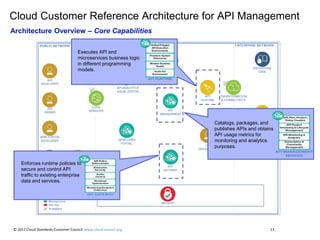
Architecture Overview – Core Capabilities
© 2017 Cloud Standards Customer Council www.cloud-council.org 13
Executes API and
microservices business logic
in different programming
models.
Catalogs, packages, and
publishes APIs and obtains
API usage metrics for
monitoring and analytics
purposes.
Enforces runtime policies to
secure and control API
traffic to existing enterprise
data and services.
14
Cloud Customer Reference Architecture for API Management
Architecture Overview – Core Capabilities
© 2017 Cloud Standards Customer Council www.cloud-council.org 14
A web site where APIs are
made public to the
application developer
communities to discover the
APIs and subscribe to their
usage.
An SDK for API developers
to model, create and test
APIs locally and use cloud
DevOps services to
automate API build-deploy-
publish tasks.
Provides API monitoring & analytics
functionality and allows the creation
of custom analytics dashboards for
catalogs.
15
Cloud Customer Reference Architecture for API Management
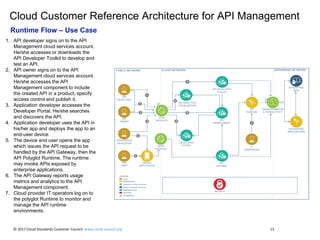
Runtime Flow – Use Case
1. API developer signs on to the API
Management cloud services account.
He/she accesses or downloads the
API Developer Toolkit to develop and
test an API.
2. API owner signs on to the API
Management cloud services account.
He/she accesses the API
Management component to include
the created API in a product, specify
access control and publish it.
3. Application developer accesses the
Developer Portal. He/she searches
and discovers the API.
4. Application developer uses the API in
his/her app and deploys the app to an
end-user device.
5. The device end user opens the app
which issues the API request to be
handled by the API Gateway, then the
API Polyglot Runtime. The runtime
may invoke APIs exposed by
enterprise applications.
6. The API Gateway reports usage
metrics and analytics to the API
Management component.
7. Cloud provider IT operators log on to
the polyglot Runtime to monitor and
manage the API runtime
environments.
© 2017 Cloud Standards Customer Council www.cloud-council.org 15
16
Cloud Customer Reference Architecture for API Management
Hybrid Cloud and APIs
© 2017 Cloud Standards Customer Council www.cloud-council.org 16
Businesses implementing hybrid cloud solutions are looking for flexibility and agility in delivering new
capabilities. Examples:
Mobile workforce
Using mobile applications deployed on the public or private cloud and invoking APIs that access data and
transactions located in on-premises data centers.
Market channel expansion
The enterprise digital platform is hosted on a cloud environment and exposes core business capabilities
from backend systems residing on-premises via a set of APIs.
Enterprise B2B integration
Inter-enterprise collaboration is enabled through a set of APIs hosted on a cloud platform and brokers B2B
capabilities from on-premises back-ends, enterprise private clouds or external cloud services such as
commercial SaaS applications.
Cloud Customer Architecture for Hybrid Integration: http://bit.ly/2lHlLs0
17
Cloud Customer Reference Architecture for API Management
Deployment Considerations
© 2017 Cloud Standards Customer Council www.cloud-council.org 17
Security Isolation
Scalability &
Load Balancing
• Adding more instances.
• Service clustering.
• Prioritizing services within a
time period.
• Using internal vs. external
load balancers.
• Platform level.
• Organization level.
• Catalog level.
• Encryption Support
• Policy Authoring
• Open Standards
• OAuth authorization standard
Cloud deployment considerations also apply.
© 2017 Cloud Standards Customer Council www.cloud-council.org 18
Call to Action
Join the CSCC Now!
– To have an impact on customer use case based standards requirements
– To learn about all Cloud Standards within one organization
– To help define the CSCC’s future roadmap
– Membership is free & easy: http://www.cloud-council.org/become-a-
member
Get Involved!
– Join one or more of the CSCC Working Groups
http://www.cloud-council.org/workinggroups
Leverage CSCC Collateral
– Visit http://www.cloud-council.org/resource-hub
© 2017 Cloud Standards Customer Council www.cloud-council.org 19
 Practical Guide to Hybrid Cloud Computing
http://www.cloud-council.org/deliverables/practical-guide-to-hybrid-cloud-computing.htm
 Cloud Customer Architecture for Hybrid Integration
http://www.cloud-council.org/deliverables/cloud-customer-architecture-for-hybrid-integration.htm
 Security for Cloud Computing: 10 Steps to Ensure Success v2
http://www.cloud-council.org/deliverables/security-for-cloud-computing-10-steps-to-ensure-
success.htm
 Cloud Security Standards: What to Expect and What to Negotiate v1
http://www.cloud-council.org/deliverables/cloud-security-standards-what-to-expect-and-what-to-
negotiate.htm
 Practical Guide to Cloud Service Agreements v2
http://www.cloud-council.org/deliverables/practical-guide-to-cloud-service-agreements.htm
 Migrating Applications to Public Cloud Services: Roadmap for Success
http://www.cloud-council.org/deliverables/migrating-applications-to-public-cloud-services-roadmap-
for-success.htm
 Cloud Customer Architecture for Big Data & Analytics
http://www.cloud-council.org/deliverables/cloud-customer-architecture-for-big-data-and-
analytics.htm
Additional Resources from the CSCC
View all papers www.cloud-council.org/resource-hub and companion webinars www.cloud-council.org/events
20
Thank You

Cloud Customer Architecture for API Management

  • 1.
    Cloud Customer Architecturefor API Management Webinar April 4, 2017 http://www.cloud-council.org/deliverables/cloud-customer-architecture-for-api-management.htm
  • 2.
    © 2017 CloudStandards Customer Council www.cloud-council.org 2 The Cloud Standards Customer Council • Provide customer-led guidance to multiple cloud standards-defining bodies • Establishing criteria for open standards based cloud computing 650+ Organizations participating 2013/2014 Deliverables  Convergence of Social, Mobile, Cloud  Analysis of Public Cloud SLAs  Cloud Security Standards  Migrating Apps to Public Cloud Services  Social Business in the Cloud  Deploying Big Data in the Cloud  Practical Guide to Cloud Computing, V2  Migrating Apps: Performance Rqmnts  Cloud Interoperability/Portability http://cloud-council.org 2015 Deliverables  Web App Hosting Ref. Architecture  Mobile Ref. Architecture  Big Data & Analytics Ref. Architecture  Security for Cloud Computing, V2  Practical Guide to Cloud SLAs, V2  Practical Guide to PaaS THE Customer’s Voice for Cloud Standards! 2016 Deliverables  Prac Guide to Hybrid Cloud Computing  Public Cloud Service Agreements, V2  Cloud Security Standards, V2  IoT Ref. Architecture  e-Commerce Ref. Architecture  Impact of Cloud Computing on Healthcare, V2  Enterprise Social Collaboration Ref. Architecture 2017 Projects  Hybrid Integration Ref. Architecture  API Management Ref. Architecture  Security for Cloud Services Ref. Architecture  Data Residency discussion paper  Blockchain Ref. Architecture  Multi-cloud Management whitepaper  Cognitive Computing Ref. Architecture  And more!
  • 3.
    © 2017 CloudStandards Customer Council www.cloud-council.org 3 Abstract & Agenda This talk introduces the Cloud Customer Architecture for API Management  What are Cloud Solution Architectures?  API Management Cloud Architecture  CSCC’s Cloud Reference Architecture series • Cloud Customer Architecture for e-Commerce http://bit.ly/2camhIz • Cloud Customer Architecture for IoT http://bit.ly/2cLcomc • Cloud Customer Architecture for Big Data http://bit.ly/2crffR2 • Cloud Customer Architecture for Mobile http://bit.ly/2cIYtdI • Cloud Customer Architecture for Web Application Hosting http://bit.ly/2cgTVK2 • Cloud Customer Architecture for Enterprise Social Collaboration http://bit.ly/2jDiMPD • Cloud Customer Architecture for Hybrid Integration http://bit.ly/2lHlLs0
  • 4.
    © 2017 CloudStandards Customer Council www.cloud-council.org 4  Cloud Customer Reference Architectures are… • straightforward description of elements needed to implement particular application solutions using cloud infrastructure, cloud platforms, cloud software, and cloud services • deployment neutral (public, private, hybrid) & implementable via IaaS, PaaS, SaaS • general purpose reusable architectures as well as industry specific architectures • vendor neutral & open  Important because they… • enable cloud customers to understand unique features & advantages of using cloud computing • bridge gap between understanding cloud customer needs and cloud provider offerings • provide practical guidance on how common business applications can be realized from a cloud customer role perspective • are stable anchors in a rapidly innovating cloud landscape • save time, effort & money: be more productive  Useful when… • those planning to build cloud based applications • talking with cloud providers about their offerings • understanding of the common elements and relationships in relevant solutions  Target audience: • those planning on building/purchasing cloud based applications • developers, architects, managers  Consistent with ISO/IEC 17789 International Standard Cloud Computing Reference Architecture Cloud Customer Reference Architectures
  • 5.
    5 Cloud Customer ReferenceArchitecture for API Management Executive Summary An Application Programming Interface (API) • ... is a public persona for a company, exposing defined assets, data, or services for public consumption. • ... is a way for services and products to communicate with each other through a documented interface. • ... allows companies to open up data and services to external third party developers, to business partners and to internal departments within their company. • ... can be leveraged by application developers of web and mobile apps. © 2017 Cloud Standards Customer Council www.cloud-council.org 5
  • 6.
    6 Cloud Customer ReferenceArchitecture for API Management Key Questions API Management Reference Architecture addresses the following questions: • Why? The value proposition of adopting a long term API strategy and embarking on the enterprise digital transformation journey. • Where? The principles and characteristics of a solid API Management Platform. • How? Lifecycle approach to creating, running, managing and securing APIs. • Who? Personas and stakeholders in API Management and their use cases. • What? Define the architectural components and capabilities that make up a superior API Management Platform. © 2017 Cloud Standards Customer Council www.cloud-council.org 6
  • 7.
    7 Cloud Customer ReferenceArchitecture for API Management APIs, Cloud Computing and Enterprise Digital Transformation Enterprises should consider five opportunities to include in their API strategy: 1. Accelerating in-house development to decouple / expose enterprise functionality as a reusable set of APIs for self-service consumption. 2. Innovating with digital applications on a cloud platform for rapid deployment and quick creation of a system of engagement to new channels. 3. Providing secure and controlled access to APIs from those digital applications in a hybrid cloud environment where the likes of mobile or IoT applications on a public cloud consume exposed APIs. 4. Joining/forming an ecosystem with a wider community of external developers and partners who will publish and consume APIs beyond enterprise boundaries. 5. Monetizing existing and new data and algorithms while enabling new business models. © 2017 Cloud Standards Customer Council www.cloud-council.org 7
  • 8.
    8 Cloud Customer ReferenceArchitecture for API Management API Management: Lifecycle & Platform • Create Development lifecycle: design, model, test, build and deploy. • Run Performance, scalability, load and resilience of the API runtime platform. • Manage Publicizing, socializing, management, governance and cataloging of APIs, and user management of API consumers and providers. • Secure Runtime security enforcement of APIs (authentication, authorization, rate limits, encryption and proxying of APIs). © 2017 Cloud Standards Customer Council www.cloud-council.org 8 API Management Lifecycle API Management Platform Capabilities • Automated, visual and coding options for creating APIs. • Polyglot runtime support for creating microservices. • Integrated enterprise grade clustering, management and security for polyglot runtimes. • Lifecycle and governance for APIs, products and plans. • Access control over API’s, API plans and API products: o Advanced API usage analytics. o Customizable, self-service developer portal. o Support of self-service diagnostics. o Policy enforcement, security and control. o Real-time analytics.
  • 9.
    9 Cloud Customer ReferenceArchitecture for API Management Architecture Overview © 2017 Cloud Standards Customer Council www.cloud-council.org 9
  • 10.
    10 Cloud Customer ReferenceArchitecture for API Management Architecture Overview - Personas © 2017 Cloud Standards Customer Council www.cloud-council.org 10 • App Developers: Consumers of APIs • API Developers: Creators of APIs • API Owners/Product Managers • IT Operations • End Users: Access applications using a browser or via a mobile native app
  • 11.
    11 Cloud Customer ReferenceArchitecture for API Management Architecture Overview – Business Assets © 2017 Cloud Standards Customer Council www.cloud-council.org 11 Enterprise Application represents applications that run enterprise business processes and logic within existing enterprise systems. Enterprise Data represents the one or more systems of record, for example, transactional data or data warehouses that represent the existing data in the enterprise.
  • 12.
    12 Cloud Customer ReferenceArchitecture for API Management Architecture Overview - Supporting Capabilities © 2017 Cloud Standards Customer Council www.cloud-council.org 12 Edge services include service capabilities needed to deliver function and content to the users via the internet The Transformation and Connectivity component enables secure connections to the enterprise systems. Security for hybrid integration addresses the following needs – • Integrity • Threat Management • Compliance
  • 13.
    13 Cloud Customer ReferenceArchitecture for API Management Architecture Overview – Core Capabilities © 2017 Cloud Standards Customer Council www.cloud-council.org 13 Executes API and microservices business logic in different programming models. Catalogs, packages, and publishes APIs and obtains API usage metrics for monitoring and analytics purposes. Enforces runtime policies to secure and control API traffic to existing enterprise data and services.
  • 14.
    14 Cloud Customer ReferenceArchitecture for API Management Architecture Overview – Core Capabilities © 2017 Cloud Standards Customer Council www.cloud-council.org 14 A web site where APIs are made public to the application developer communities to discover the APIs and subscribe to their usage. An SDK for API developers to model, create and test APIs locally and use cloud DevOps services to automate API build-deploy- publish tasks. Provides API monitoring & analytics functionality and allows the creation of custom analytics dashboards for catalogs.
  • 15.
    15 Cloud Customer ReferenceArchitecture for API Management Runtime Flow – Use Case 1. API developer signs on to the API Management cloud services account. He/she accesses or downloads the API Developer Toolkit to develop and test an API. 2. API owner signs on to the API Management cloud services account. He/she accesses the API Management component to include the created API in a product, specify access control and publish it. 3. Application developer accesses the Developer Portal. He/she searches and discovers the API. 4. Application developer uses the API in his/her app and deploys the app to an end-user device. 5. The device end user opens the app which issues the API request to be handled by the API Gateway, then the API Polyglot Runtime. The runtime may invoke APIs exposed by enterprise applications. 6. The API Gateway reports usage metrics and analytics to the API Management component. 7. Cloud provider IT operators log on to the polyglot Runtime to monitor and manage the API runtime environments. © 2017 Cloud Standards Customer Council www.cloud-council.org 15
  • 16.
    16 Cloud Customer ReferenceArchitecture for API Management Hybrid Cloud and APIs © 2017 Cloud Standards Customer Council www.cloud-council.org 16 Businesses implementing hybrid cloud solutions are looking for flexibility and agility in delivering new capabilities. Examples: Mobile workforce Using mobile applications deployed on the public or private cloud and invoking APIs that access data and transactions located in on-premises data centers. Market channel expansion The enterprise digital platform is hosted on a cloud environment and exposes core business capabilities from backend systems residing on-premises via a set of APIs. Enterprise B2B integration Inter-enterprise collaboration is enabled through a set of APIs hosted on a cloud platform and brokers B2B capabilities from on-premises back-ends, enterprise private clouds or external cloud services such as commercial SaaS applications. Cloud Customer Architecture for Hybrid Integration: http://bit.ly/2lHlLs0
  • 17.
    17 Cloud Customer ReferenceArchitecture for API Management Deployment Considerations © 2017 Cloud Standards Customer Council www.cloud-council.org 17 Security Isolation Scalability & Load Balancing • Adding more instances. • Service clustering. • Prioritizing services within a time period. • Using internal vs. external load balancers. • Platform level. • Organization level. • Catalog level. • Encryption Support • Policy Authoring • Open Standards • OAuth authorization standard Cloud deployment considerations also apply.
  • 18.
    © 2017 CloudStandards Customer Council www.cloud-council.org 18 Call to Action Join the CSCC Now! – To have an impact on customer use case based standards requirements – To learn about all Cloud Standards within one organization – To help define the CSCC’s future roadmap – Membership is free & easy: http://www.cloud-council.org/become-a- member Get Involved! – Join one or more of the CSCC Working Groups http://www.cloud-council.org/workinggroups Leverage CSCC Collateral – Visit http://www.cloud-council.org/resource-hub
  • 19.
    © 2017 CloudStandards Customer Council www.cloud-council.org 19  Practical Guide to Hybrid Cloud Computing http://www.cloud-council.org/deliverables/practical-guide-to-hybrid-cloud-computing.htm  Cloud Customer Architecture for Hybrid Integration http://www.cloud-council.org/deliverables/cloud-customer-architecture-for-hybrid-integration.htm  Security for Cloud Computing: 10 Steps to Ensure Success v2 http://www.cloud-council.org/deliverables/security-for-cloud-computing-10-steps-to-ensure- success.htm  Cloud Security Standards: What to Expect and What to Negotiate v1 http://www.cloud-council.org/deliverables/cloud-security-standards-what-to-expect-and-what-to- negotiate.htm  Practical Guide to Cloud Service Agreements v2 http://www.cloud-council.org/deliverables/practical-guide-to-cloud-service-agreements.htm  Migrating Applications to Public Cloud Services: Roadmap for Success http://www.cloud-council.org/deliverables/migrating-applications-to-public-cloud-services-roadmap- for-success.htm  Cloud Customer Architecture for Big Data & Analytics http://www.cloud-council.org/deliverables/cloud-customer-architecture-for-big-data-and- analytics.htm Additional Resources from the CSCC View all papers www.cloud-council.org/resource-hub and companion webinars www.cloud-council.org/events
  • 20.