

Practical Field Training
&
Report Submission III
NAME MISKEEN ALI
ROLL NO 47107
SEMESTER 6TH
REGISTRATION NO 2015-GCUF-060078
SUBNITTED TO GCUF
DEPARTMENT OF CIVIL ENGINEERING
TECHNOLOGY
AIMS INSTITUTE OF MANAGEMENT
SCIENCES LAHORE
Table of Content:
 INFORMATION ABOUT PROJECT
 PLAN
 EXCAVATION
 CONCRETING
 FOUNDATIONS
 MATERIALS
 BRICK WORK
 REINFORCEMENT
 SHUTTRING
 FORM WORK
 REMOVEL OF FORM WORK
 STRUCTURAL COMPONENTS AGE
 CONCLUSION
INFORMATION ABOUT PROJECT:
 NAME OF PROJECT PARKING AREA AND
SPORTS COMPLEX
 TYPE OF BUILDING MULTISTOREY BUILDING
 LOCATION LAHORE GARRISON
UNIVERSITY DHA PHASE 6
 CONTRACTOR MUHAMMAD RIZWAN
 SITE ENGINEER BASAL ALI
 START DATE NOVEMBER 15, 2017.
 COMPLITION DATE CONTINUE
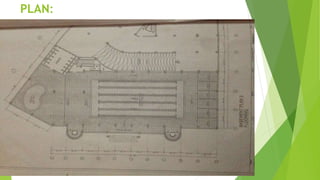
PLAN:
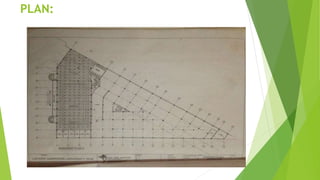
PLAN:
EXCAVATION:
 Excavation was carried out both manually
as well as mechanically.
 Normally 1-2 earth excavators (JCB’s)
were used for excavating the soil.
 The filling is done in layer not exceeding
20 cm layer and than its compacted.
 Depth of excavation was 5’4” from Ground
Level.
CONCRETING:
 After the process of excavation, laying of
plain cement concrete that is PCC is done.
 A layer of 4 inches was made in such a
manner that it was not mixed with the soil.
 It provides a solid bars for the raft foundation
and a mix of 1:5:10 that is, 1 part of cement
to 5 parts of fine aggregates and 10 parts of
coarse aggregates by volume were used in it.
CONCRETING:
 Plain concrete is vibrated to achieve full
compaction.
 Concrete placed below ground should be
protected from falling earth during and
after placing.
FOUNDATIONS:
 At our site, Raft foundations are used to
spread the load from a structure over a
large area, normally the entire area of
the structure.
 Normally raft foundation is used when
large load is to be distributed and it is
not possible to provide individual
footings due to space constraints that is
they would overlap on each other.
FOUNDATIONS:
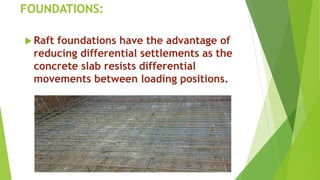
 Raft foundations have the advantage of
reducing differential settlements as the
concrete slab resists differential
movements between loading positions.
MATERIALS:
CEMENT
 Portland cement is composed of calcium
silicates and aluminate and alumino
ferrite It is obtained by blending
predetermined proportions limestone clay
and other minerals in small quantities
which is pulverized and heated at high
temperature – around 1500 deg
centigrade to produce ‘clinker’.
MATERIALS:
 The clinker is then ground with small
quantities of gypsum to produce a fine
powder called Ordinary Portland Cement
(OPC).
 When mixed with water, sand and stone,
it combines slowly with the water to form
a hard mass called concrete.
MATERIALS:
SETTING OF CEMENT
 When water is mixed with cement, the
paste so formed remains pliable and
plastic for a short time.
 During this period it is possible to disturb
the paste and remit it without any
deleterious effects.
MATERIALS:
COARSE AGGREGATE
 Coarse aggregate for the works should be
river gravel or crushed stone .
 It should be hard, strong, dense, durable,
clean, and free from clay or loamy
admixtures or quarry refuse or vegetable
matter.
MATERIALS:
FINE AGGREGATE
 Aggregate which is passed through 4.75 IS
Sieve is termed as fine aggregate.
 Fine aggregate is added to concrete to
assist workability and to bring uniformity
in mixture.
BRICK WORK:
 Brickwork is masonry done with bricks and
mortar and is generally used to build
partition walls.
 In our site, all the external walls were of
concrete and most of the internal walls
were made of bricks.
 English bond was used and a ratio of 1:4 (1
cement: 4 coarse sand) and 1:6 were used
depending upon whether the wall is 4.5
inches or 9 inches.
BRICK WORK:
 TYPES OF BRICKS
 Bricks can be of two types. These are:
Traditional Bricks
 The dimension if traditional bricks vary from 21
cm to 25cm in length,10 to 13 cm in width and
7.5 cm in height in different parts of country.
 The commonly adopted normal size of
traditional brick is 23 * 11.5*7.5 cm with a
view to achieve uniformity in size of bricks
all over country.
BRICK WORK:
 Modular Bricks
 Pakistan standard institution has established a
standard size of bricks such a brick is known as a
modular brick.
 The normal size of brick is taken as 20*10*10
cm whereas its actual dimensions are 19*9*9
cm masonry with modular bricks workout to be
cheaper there is saving in the consumption of
bricks, mortar and labor as compared with
masonry with traditional bricks.
REINFORCEMENT:
 Steel reinforcements are used generally,
in the form of bars of circular cross
section in concrete structure.
 They are like a skeleton in human body.
Plain concrete without steel or any other
reinforcement is strong in compression
but weak in tension.
 Steel is one of the best forms of
reinforcements. Bars range in diameter
from 6 to 50 mm.
SHUTTRING:
 The term ‘SHUTTERING’ or ‘FORMWORK’
includes all forms, moulds, sheeting,
shuttering planks, walrus, poles, posts,
standards, leizers, V-Heads, struts, and
structure, ties, prights, walling steel rods,
bolts, wedges, and all other temporary
supports to the concrete during the
process of sheeting.
FORM WORK:
 Forms or moulds or shutters are the
receptacles in which concrete is placed,
so that it will have the desired shape or
outline when hardened.
 Forms are generally made of the materials
like timber, plywood, steel, etc.
 The steel form work was designed and
constructed to the shapes, lines and
dimensions.
REMOVEL OF FORM WORK:
 Forms were not struck until the concrete
has attained a strength at least twice the
stress to which the concrete may be
subjected at the time of removal of form
work.
 Form work was removed in such a manner as
would not cause any shock or vibration that
would damage the concrete.
 the form work was removed as soon as
possible after the concrete has set, to avoid
shrinkage cracking occurring due to the
restraint imposed.
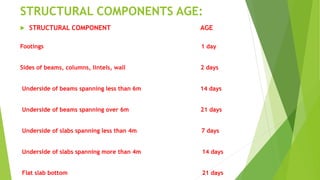
STRUCTURAL COMPONENTS AGE:
 STRUCTURAL COMPONENT AGE
Footings 1 day
Sides of beams, columns, lintels, wall 2 days
Underside of beams spanning less than 6m 14 days
Underside of beams spanning over 6m 21 days
Underside of slabs spanning less than 4m 7 days
Underside of slabs spanning more than 4m 14 days
Flat slab bottom 21 days
CONCLUSION:
 This program played an important role to
break the conventional thought that
field works can be only implemented by
students who hold degree and people
who have an experience in building
construction.
 We have to acquire high confidence
level to deal with problems arise in a
building construction.

Practical field Training and Report submission

  • 1.
    Practical Field Training & ReportSubmission III NAME MISKEEN ALI ROLL NO 47107 SEMESTER 6TH REGISTRATION NO 2015-GCUF-060078 SUBNITTED TO GCUF DEPARTMENT OF CIVIL ENGINEERING TECHNOLOGY AIMS INSTITUTE OF MANAGEMENT SCIENCES LAHORE
  • 2.
    Table of Content: INFORMATION ABOUT PROJECT  PLAN  EXCAVATION  CONCRETING  FOUNDATIONS  MATERIALS  BRICK WORK  REINFORCEMENT  SHUTTRING  FORM WORK  REMOVEL OF FORM WORK  STRUCTURAL COMPONENTS AGE  CONCLUSION
  • 3.
    INFORMATION ABOUT PROJECT: NAME OF PROJECT PARKING AREA AND SPORTS COMPLEX  TYPE OF BUILDING MULTISTOREY BUILDING  LOCATION LAHORE GARRISON UNIVERSITY DHA PHASE 6  CONTRACTOR MUHAMMAD RIZWAN  SITE ENGINEER BASAL ALI  START DATE NOVEMBER 15, 2017.  COMPLITION DATE CONTINUE
  • 4.
  • 5.
  • 6.
    EXCAVATION:  Excavation wascarried out both manually as well as mechanically.  Normally 1-2 earth excavators (JCB’s) were used for excavating the soil.  The filling is done in layer not exceeding 20 cm layer and than its compacted.  Depth of excavation was 5’4” from Ground Level.
  • 7.
    CONCRETING:  After theprocess of excavation, laying of plain cement concrete that is PCC is done.  A layer of 4 inches was made in such a manner that it was not mixed with the soil.  It provides a solid bars for the raft foundation and a mix of 1:5:10 that is, 1 part of cement to 5 parts of fine aggregates and 10 parts of coarse aggregates by volume were used in it.
  • 8.
    CONCRETING:  Plain concreteis vibrated to achieve full compaction.  Concrete placed below ground should be protected from falling earth during and after placing.
  • 9.
    FOUNDATIONS:  At oursite, Raft foundations are used to spread the load from a structure over a large area, normally the entire area of the structure.  Normally raft foundation is used when large load is to be distributed and it is not possible to provide individual footings due to space constraints that is they would overlap on each other.
  • 10.
    FOUNDATIONS:  Raft foundationshave the advantage of reducing differential settlements as the concrete slab resists differential movements between loading positions.
  • 11.
    MATERIALS: CEMENT  Portland cementis composed of calcium silicates and aluminate and alumino ferrite It is obtained by blending predetermined proportions limestone clay and other minerals in small quantities which is pulverized and heated at high temperature – around 1500 deg centigrade to produce ‘clinker’.
  • 12.
    MATERIALS:  The clinkeris then ground with small quantities of gypsum to produce a fine powder called Ordinary Portland Cement (OPC).  When mixed with water, sand and stone, it combines slowly with the water to form a hard mass called concrete.
  • 13.
    MATERIALS: SETTING OF CEMENT When water is mixed with cement, the paste so formed remains pliable and plastic for a short time.  During this period it is possible to disturb the paste and remit it without any deleterious effects.
  • 14.
    MATERIALS: COARSE AGGREGATE  Coarseaggregate for the works should be river gravel or crushed stone .  It should be hard, strong, dense, durable, clean, and free from clay or loamy admixtures or quarry refuse or vegetable matter.
  • 15.
    MATERIALS: FINE AGGREGATE  Aggregatewhich is passed through 4.75 IS Sieve is termed as fine aggregate.  Fine aggregate is added to concrete to assist workability and to bring uniformity in mixture.
  • 16.
    BRICK WORK:  Brickworkis masonry done with bricks and mortar and is generally used to build partition walls.  In our site, all the external walls were of concrete and most of the internal walls were made of bricks.  English bond was used and a ratio of 1:4 (1 cement: 4 coarse sand) and 1:6 were used depending upon whether the wall is 4.5 inches or 9 inches.
  • 17.
    BRICK WORK:  TYPESOF BRICKS  Bricks can be of two types. These are: Traditional Bricks  The dimension if traditional bricks vary from 21 cm to 25cm in length,10 to 13 cm in width and 7.5 cm in height in different parts of country.  The commonly adopted normal size of traditional brick is 23 * 11.5*7.5 cm with a view to achieve uniformity in size of bricks all over country.
  • 18.
    BRICK WORK:  ModularBricks  Pakistan standard institution has established a standard size of bricks such a brick is known as a modular brick.  The normal size of brick is taken as 20*10*10 cm whereas its actual dimensions are 19*9*9 cm masonry with modular bricks workout to be cheaper there is saving in the consumption of bricks, mortar and labor as compared with masonry with traditional bricks.
  • 19.
    REINFORCEMENT:  Steel reinforcementsare used generally, in the form of bars of circular cross section in concrete structure.  They are like a skeleton in human body. Plain concrete without steel or any other reinforcement is strong in compression but weak in tension.  Steel is one of the best forms of reinforcements. Bars range in diameter from 6 to 50 mm.
  • 20.
    SHUTTRING:  The term‘SHUTTERING’ or ‘FORMWORK’ includes all forms, moulds, sheeting, shuttering planks, walrus, poles, posts, standards, leizers, V-Heads, struts, and structure, ties, prights, walling steel rods, bolts, wedges, and all other temporary supports to the concrete during the process of sheeting.
  • 21.
    FORM WORK:  Formsor moulds or shutters are the receptacles in which concrete is placed, so that it will have the desired shape or outline when hardened.  Forms are generally made of the materials like timber, plywood, steel, etc.  The steel form work was designed and constructed to the shapes, lines and dimensions.
  • 22.
    REMOVEL OF FORMWORK:  Forms were not struck until the concrete has attained a strength at least twice the stress to which the concrete may be subjected at the time of removal of form work.  Form work was removed in such a manner as would not cause any shock or vibration that would damage the concrete.  the form work was removed as soon as possible after the concrete has set, to avoid shrinkage cracking occurring due to the restraint imposed.
  • 23.
    STRUCTURAL COMPONENTS AGE: STRUCTURAL COMPONENT AGE Footings 1 day Sides of beams, columns, lintels, wall 2 days Underside of beams spanning less than 6m 14 days Underside of beams spanning over 6m 21 days Underside of slabs spanning less than 4m 7 days Underside of slabs spanning more than 4m 14 days Flat slab bottom 21 days
  • 24.
    CONCLUSION:  This programplayed an important role to break the conventional thought that field works can be only implemented by students who hold degree and people who have an experience in building construction.  We have to acquire high confidence level to deal with problems arise in a building construction.