CONCRETE Assoc. Prof./Doç. Dr.
Mustafa KUCUKTUVEK
CONCRETE
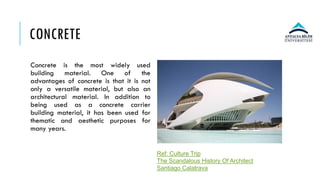
Concrete is the most widely used
building material. One of the
advantages of concrete is that it is not
only a versatile material, but also an
architectural material. In addition to
being used as a concrete carrier
building material, it has been used for
thematic and aesthetic purposes for
many years.
Ref: Culture Trip
The Scandalous History Of Architect
Santiago Calatrava
CONCRETE
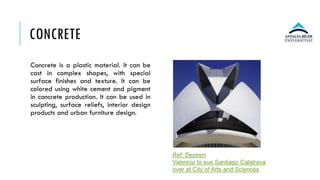
Concrete is a plastic material. It can be
cast in complex shapes, with special
surface finishes and texture. It can be
colored using white cement and pigment
in concrete production. It can be used in
sculpting, surface reliefs, interior design
products and urban furniture design.
Ref: Dezeen
Valencia to sue Santiago Calatrava
over at City of Arts and Sciences
CONCRETE
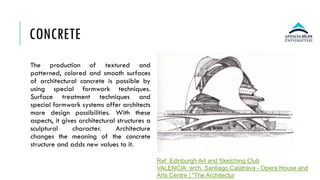
The production of textured and
patterned, colored and smooth surfaces
of architectural concrete is possible by
using special formwork techniques.
Surface treatment techniques and
special formwork systems offer architects
more design possibilities. With these
aspects, it gives architectural structures a
sculptural character. Architecture
changes the meaning of the concrete
structure and adds new values to it.
Ref: Edinburgh Art and Sketching Club
VALENCIA: arch. Santiago Calatrava - Opera House and
Arts Centre | "The Architectur
CONCRETE
SANTIAGO CALATRAVA OPERA HOUSE
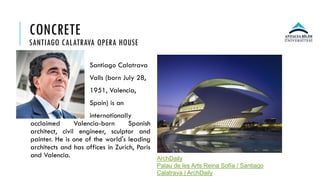
Santiago Calatrava
Valls (born July 28,
1951, Valencia,
Spain) is an
internationally
acclaimed Valencia-born Spanish
architect, civil engineer, sculptor and
painter. He is one of the world's leading
architects and has offices in Zurich, Paris
and Valencia. ArchDaily
Palau de les Arts Reina Sofía / Santiago
Calatrava | ArchDaily
CONCRETE
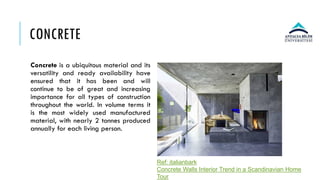
Concrete is a ubiquitous material and its
versatility and ready availability have
ensured that it has been and will
continue to be of great and increasing
importance for all types of construction
throughout the world. In volume terms it
is the most widely used manufactured
material, with nearly 2 tonnes produced
annually for each living person.
Ref: italianbark
Concrete Walls Interior Trend in a Scandinavian Home
Tour
CONCRETE
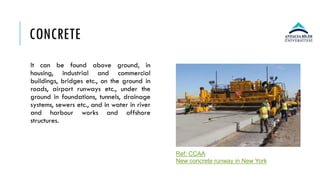
It can be found above ground, in
housing, industrial and commercial
buildings, bridges etc., on the ground in
roads, airport runways etc., under the
ground in foundations, tunnels, drainage
systems, sewers etc., and in water in river
and harbour works and offshore
structures.
Ref: CCAA
New concrete runway in New York
CONCRETE
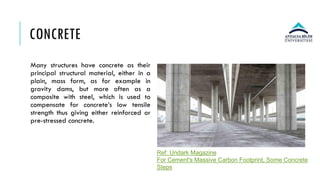
Many structures have concrete as their
principal structural material, either in a
plain, mass form, as for example in
gravity dams, but more often as a
composite with steel, which is used to
compensate for concrete’s low tensile
strength thus giving either reinforced or
pre-stressed concrete.
Ref: Undark Magazine
For Cement's Massive Carbon Footprint, Some Concrete
Steps
CONCRETE
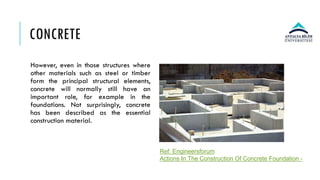
However, even in those structures where
other materials such as steel or timber
form the principal structural elements,
concrete will normally still have an
important role, for example in the
foundations. Not surprisingly, concrete
has been described as the essential
construction material.
Ref: Engineersforum
Actions In The Construction Of Concrete Foundation -
CONCRETE
THE ULTIMATE PERMEABLE CONCRETE SYSTEM
CONCRETE
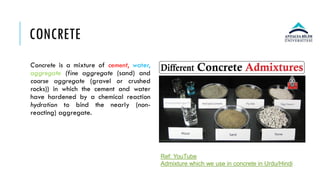
Concrete is a mixture of cement, water,
aggregate (fine aggregate (sand) and
coarse aggregate (gravel or crushed
rocks)) in which the cement and water
have hardened by a chemical reaction
hydration to bind the nearly (non-
reacting) aggregate.
Ref: YouTube
Admixture which we use in concrete in Urdu/Hindi
CONCRETE
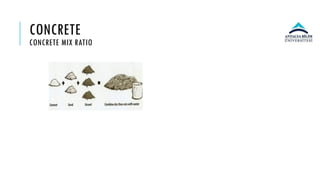
CONCRETE MIX RATIO
CONCRETE
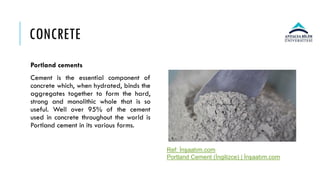
Portland cements
Cement is the essential component of
concrete which, when hydrated, binds the
aggregates together to form the hard,
strong and monolithic whole that is so
useful. Well over 95% of the cement
used in concrete throughout the world is
Portland cement in its various forms.
Ref: İnşaatım.com
Portland Cement (İngilizce) | İnşaatım.com
PORTLAND CEMENT MANUFATURING PROCESS
CONCRETE
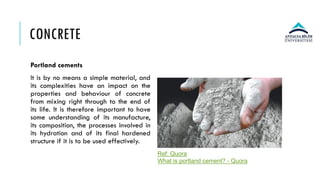
Portland cements
It is by no means a simple material, and
its complexities have an impact on the
properties and behaviour of concrete
from mixing right through to the end of
its life. It is therefore important to have
some understanding of its manufacture,
its composition, the processes involved in
its hydration and of its final hardened
structure if it is to be used effectively.
Ref: Quora
What is portland cement? - Quora
CONCRETE
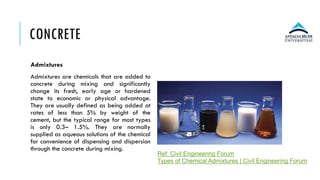
Admixtures
Admixtures are chemicals that are added to
concrete during mixing and significantly
change its fresh, early age or hardened
state to economic or physical advantage.
They are usually defined as being added at
rates of less than 5% by weight of the
cement, but the typical range for most types
is only 0.3– 1.5%. They are normally
supplied as aqueous solutions of the chemical
for convenience of dispensing and dispersion
through the concrete during mixing.
Ref: Civil Engineering Forum
Types of Chemical Admixtures | Civil Engineering Forum
CONCRETE
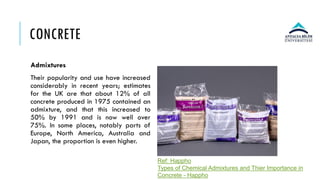
Admixtures
Their popularity and use have increased
considerably in recent years; estimates
for the UK are that about 12% of all
concrete produced in 1975 contained an
admixture, and that this increased to
50% by 1991 and is now well over
75%. In some places, notably parts of
Europe, North America, Australia and
Japan, the proportion is even higher.
Ref: Happho
Types of Chemical Admixtures and Thier Importance in
Concrete - Happho
CONCRETE
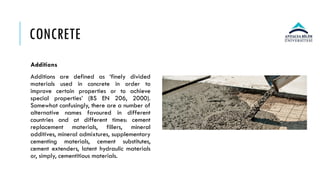
Additions
Additions are defined as ‘finely divided
materials used in concrete in order to
improve certain properties or to achieve
special properties’ (BS EN 206, 2000).
Somewhat confusingly, there are a number of
alternative names favoured in different
countries and at different times: cement
replacement materials, fillers, mineral
additives, mineral admixtures, supplementary
cementing materials, cement substitutes,
cement extenders, latent hydraulic materials
or, simply, cementitious materials.
CONCRETE
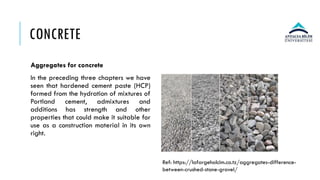
Aggregates for concrete
In the preceding three chapters we have
seen that hardened cement paste (HCP)
formed from the hydration of mixtures of
Portland cement, admixtures and
additions has strength and other
properties that could make it suitable for
use as a construction material in its own
right.
Ref: https://lafargeholcim.co.tz/aggregates-difference-
between-crushed-stone-gravel/
CONCRETE
Aggregates for concrete
This means that:
• the largest possible aggregate size
consistent with the mixing, handling and
placing requirements of fresh concrete should
be used
• a continuous range of particle sizes from
fine sand up to coarse stones is desirable;
this minimizes the void content of the
aggregate mixture and therefore the amount
of HCP required, and helps the fresh
concrete to flow more easily. Normally
aggregates occupy about 65–80% of the
total concrete volume.
The Constructor
Aggregates for Concrete as per American Standards -
ASTM [PDF]
CONCRETE
HOW TO MIX SAND AND CEMENT MORTAR
CONCRETE
INTERIOR USE OF CONCRETE
Plain concrete walls have become the
expression of a new style that
concentrates on both interior and
exterior key points. Especially in the
bathroom, the concrete looks more
impressive when combined with white
ceramic.
Ref:https://www.icmimarlikdergisi.com/2016/12/12
/%E2%80%8Bsaf-tasarim-banyoda-beton-kullanimi/
CONCRETE
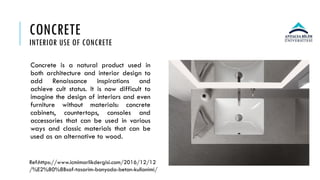
INTERIOR USE OF CONCRETE
Concrete is a natural product used in
both architecture and interior design to
add Renaissance inspirations and
achieve cult status. It is now difficult to
imagine the design of interiors and even
furniture without materials: concrete
cabinets, countertops, consoles and
accessories that can be used in various
ways and classic materials that can be
used as an alternative to wood.
Ref:https://www.icmimarlikdergisi.com/2016/12/12
/%E2%80%8Bsaf-tasarim-banyoda-beton-kullanimi/
CONCRETE
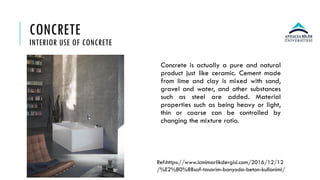
INTERIOR USE OF CONCRETE
Concrete is actually a pure and natural
product just like ceramic. Cement made
from lime and clay is mixed with sand,
gravel and water, and other substances
such as steel are added. Material
properties such as being heavy or light,
thin or coarse can be controlled by
changing the mixture ratio.
Ref:https://www.icmimarlikdergisi.com/2016/12/12
/%E2%80%8Bsaf-tasarim-banyoda-beton-kullanimi/
CONCRETE
INTERIOR USE OF CONCRETE
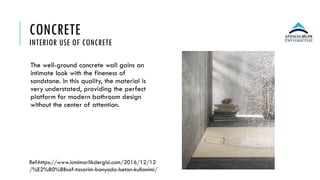
The well-ground concrete wall gains an
intimate look with the fineness of
sandstone. In this quality, the material is
very understated, providing the perfect
platform for modern bathroom design
without the center of attention.
Ref:https://www.icmimarlikdergisi.com/2016/12/12
/%E2%80%8Bsaf-tasarim-banyoda-beton-kullanimi/
CONCRETE
TECHNICHAL TERMS
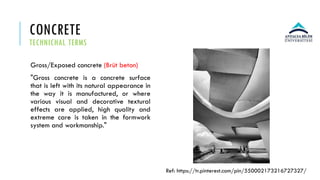
Gross/Exposed concrete (Brüt beton)
"Gross concrete is a concrete surface
that is left with its natural appearance in
the way it is manufactured, or where
various visual and decorative textural
effects are applied, high quality and
extreme care is taken in the formwork
system and workmanship."
Ref: https://tr.pinterest.com/pin/550002173216727327/
CONCRETE
TECHNICHAL TERMS
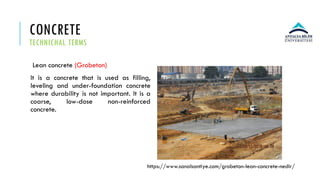
Lean concrete (Grobeton)
It is a concrete that is used as filling,
leveling and under-foundation concrete
where durability is not important. It is a
coarse, low-dose non-reinforced
concrete.
https://www.sanalsantiye.com/grobeton-lean-concrete-nedir/
CONCRETE
TECHNICHAL TERMS
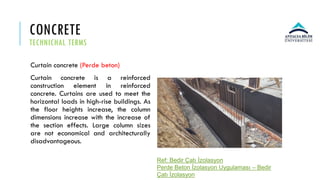
Curtain concrete (Perde beton)
Curtain concrete is a reinforced
construction element in reinforced
concrete. Curtains are used to meet the
horizontal loads in high-rise buildings. As
the floor heights increase, the column
dimensions increase with the increase of
the section effects. Large column sizes
are not economical and architecturally
disadvantageous.
Ref: Bedir Çatı İzolasyon
Perde Beton İzolasyon Uygulaması – Bedir
Çatı İzolasyon
CONCRETE
TECHNICHAL TERMS
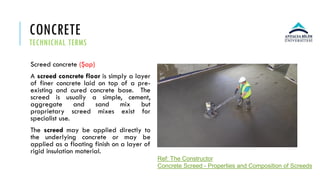
Screed concrete (Şap)
A screed concrete floor is simply a layer
of finer concrete laid on top of a pre-
existing and cured concrete base. The
screed is usually a simple, cement,
aggregate and sand mix but
proprietary screed mixes exist for
specialist use.
The screed may be applied directly to
the underlying concrete or may be
applied as a floating finish on a layer of
rigid insulation material.
Ref: The Constructor
Concrete Screed - Properties and Composition of Screeds
THANK YOU FOR YOUR ATTENTION

Building Materials: Concrete

  • 1.
    CONCRETE Assoc. Prof./Doç.Dr. Mustafa KUCUKTUVEK
  • 2.
    CONCRETE Concrete is themost widely used building material. One of the advantages of concrete is that it is not only a versatile material, but also an architectural material. In addition to being used as a concrete carrier building material, it has been used for thematic and aesthetic purposes for many years. Ref: Culture Trip The Scandalous History Of Architect Santiago Calatrava
  • 3.
    CONCRETE Concrete is aplastic material. It can be cast in complex shapes, with special surface finishes and texture. It can be colored using white cement and pigment in concrete production. It can be used in sculpting, surface reliefs, interior design products and urban furniture design. Ref: Dezeen Valencia to sue Santiago Calatrava over at City of Arts and Sciences
  • 4.
    CONCRETE The production oftextured and patterned, colored and smooth surfaces of architectural concrete is possible by using special formwork techniques. Surface treatment techniques and special formwork systems offer architects more design possibilities. With these aspects, it gives architectural structures a sculptural character. Architecture changes the meaning of the concrete structure and adds new values to it. Ref: Edinburgh Art and Sketching Club VALENCIA: arch. Santiago Calatrava - Opera House and Arts Centre | "The Architectur
  • 5.
    CONCRETE SANTIAGO CALATRAVA OPERAHOUSE Santiago Calatrava Valls (born July 28, 1951, Valencia, Spain) is an internationally acclaimed Valencia-born Spanish architect, civil engineer, sculptor and painter. He is one of the world's leading architects and has offices in Zurich, Paris and Valencia. ArchDaily Palau de les Arts Reina Sofía / Santiago Calatrava | ArchDaily
  • 6.
    CONCRETE Concrete is aubiquitous material and its versatility and ready availability have ensured that it has been and will continue to be of great and increasing importance for all types of construction throughout the world. In volume terms it is the most widely used manufactured material, with nearly 2 tonnes produced annually for each living person. Ref: italianbark Concrete Walls Interior Trend in a Scandinavian Home Tour
  • 7.
    CONCRETE It can befound above ground, in housing, industrial and commercial buildings, bridges etc., on the ground in roads, airport runways etc., under the ground in foundations, tunnels, drainage systems, sewers etc., and in water in river and harbour works and offshore structures. Ref: CCAA New concrete runway in New York
  • 8.
    CONCRETE Many structures haveconcrete as their principal structural material, either in a plain, mass form, as for example in gravity dams, but more often as a composite with steel, which is used to compensate for concrete’s low tensile strength thus giving either reinforced or pre-stressed concrete. Ref: Undark Magazine For Cement's Massive Carbon Footprint, Some Concrete Steps
  • 9.
    CONCRETE However, even inthose structures where other materials such as steel or timber form the principal structural elements, concrete will normally still have an important role, for example in the foundations. Not surprisingly, concrete has been described as the essential construction material. Ref: Engineersforum Actions In The Construction Of Concrete Foundation -
  • 10.
  • 11.
    CONCRETE Concrete is amixture of cement, water, aggregate (fine aggregate (sand) and coarse aggregate (gravel or crushed rocks)) in which the cement and water have hardened by a chemical reaction hydration to bind the nearly (non- reacting) aggregate. Ref: YouTube Admixture which we use in concrete in Urdu/Hindi
  • 12.
  • 13.
    CONCRETE Portland cements Cement isthe essential component of concrete which, when hydrated, binds the aggregates together to form the hard, strong and monolithic whole that is so useful. Well over 95% of the cement used in concrete throughout the world is Portland cement in its various forms. Ref: İnşaatım.com Portland Cement (İngilizce) | İnşaatım.com
  • 14.
  • 15.
    CONCRETE Portland cements It isby no means a simple material, and its complexities have an impact on the properties and behaviour of concrete from mixing right through to the end of its life. It is therefore important to have some understanding of its manufacture, its composition, the processes involved in its hydration and of its final hardened structure if it is to be used effectively. Ref: Quora What is portland cement? - Quora
  • 16.
    CONCRETE Admixtures Admixtures are chemicalsthat are added to concrete during mixing and significantly change its fresh, early age or hardened state to economic or physical advantage. They are usually defined as being added at rates of less than 5% by weight of the cement, but the typical range for most types is only 0.3– 1.5%. They are normally supplied as aqueous solutions of the chemical for convenience of dispensing and dispersion through the concrete during mixing. Ref: Civil Engineering Forum Types of Chemical Admixtures | Civil Engineering Forum
  • 17.
    CONCRETE Admixtures Their popularity anduse have increased considerably in recent years; estimates for the UK are that about 12% of all concrete produced in 1975 contained an admixture, and that this increased to 50% by 1991 and is now well over 75%. In some places, notably parts of Europe, North America, Australia and Japan, the proportion is even higher. Ref: Happho Types of Chemical Admixtures and Thier Importance in Concrete - Happho
  • 18.
    CONCRETE Additions Additions are definedas ‘finely divided materials used in concrete in order to improve certain properties or to achieve special properties’ (BS EN 206, 2000). Somewhat confusingly, there are a number of alternative names favoured in different countries and at different times: cement replacement materials, fillers, mineral additives, mineral admixtures, supplementary cementing materials, cement substitutes, cement extenders, latent hydraulic materials or, simply, cementitious materials.
  • 19.
    CONCRETE Aggregates for concrete Inthe preceding three chapters we have seen that hardened cement paste (HCP) formed from the hydration of mixtures of Portland cement, admixtures and additions has strength and other properties that could make it suitable for use as a construction material in its own right. Ref: https://lafargeholcim.co.tz/aggregates-difference- between-crushed-stone-gravel/
  • 20.
    CONCRETE Aggregates for concrete Thismeans that: • the largest possible aggregate size consistent with the mixing, handling and placing requirements of fresh concrete should be used • a continuous range of particle sizes from fine sand up to coarse stones is desirable; this minimizes the void content of the aggregate mixture and therefore the amount of HCP required, and helps the fresh concrete to flow more easily. Normally aggregates occupy about 65–80% of the total concrete volume. The Constructor Aggregates for Concrete as per American Standards - ASTM [PDF]
  • 21.
    CONCRETE HOW TO MIXSAND AND CEMENT MORTAR
  • 22.
    CONCRETE INTERIOR USE OFCONCRETE Plain concrete walls have become the expression of a new style that concentrates on both interior and exterior key points. Especially in the bathroom, the concrete looks more impressive when combined with white ceramic. Ref:https://www.icmimarlikdergisi.com/2016/12/12 /%E2%80%8Bsaf-tasarim-banyoda-beton-kullanimi/
  • 23.
    CONCRETE INTERIOR USE OFCONCRETE Concrete is a natural product used in both architecture and interior design to add Renaissance inspirations and achieve cult status. It is now difficult to imagine the design of interiors and even furniture without materials: concrete cabinets, countertops, consoles and accessories that can be used in various ways and classic materials that can be used as an alternative to wood. Ref:https://www.icmimarlikdergisi.com/2016/12/12 /%E2%80%8Bsaf-tasarim-banyoda-beton-kullanimi/
  • 24.
    CONCRETE INTERIOR USE OFCONCRETE Concrete is actually a pure and natural product just like ceramic. Cement made from lime and clay is mixed with sand, gravel and water, and other substances such as steel are added. Material properties such as being heavy or light, thin or coarse can be controlled by changing the mixture ratio. Ref:https://www.icmimarlikdergisi.com/2016/12/12 /%E2%80%8Bsaf-tasarim-banyoda-beton-kullanimi/
  • 25.
    CONCRETE INTERIOR USE OFCONCRETE The well-ground concrete wall gains an intimate look with the fineness of sandstone. In this quality, the material is very understated, providing the perfect platform for modern bathroom design without the center of attention. Ref:https://www.icmimarlikdergisi.com/2016/12/12 /%E2%80%8Bsaf-tasarim-banyoda-beton-kullanimi/
  • 26.
    CONCRETE TECHNICHAL TERMS Gross/Exposed concrete(Brüt beton) "Gross concrete is a concrete surface that is left with its natural appearance in the way it is manufactured, or where various visual and decorative textural effects are applied, high quality and extreme care is taken in the formwork system and workmanship." Ref: https://tr.pinterest.com/pin/550002173216727327/
  • 27.
    CONCRETE TECHNICHAL TERMS Lean concrete(Grobeton) It is a concrete that is used as filling, leveling and under-foundation concrete where durability is not important. It is a coarse, low-dose non-reinforced concrete. https://www.sanalsantiye.com/grobeton-lean-concrete-nedir/
  • 28.
    CONCRETE TECHNICHAL TERMS Curtain concrete(Perde beton) Curtain concrete is a reinforced construction element in reinforced concrete. Curtains are used to meet the horizontal loads in high-rise buildings. As the floor heights increase, the column dimensions increase with the increase of the section effects. Large column sizes are not economical and architecturally disadvantageous. Ref: Bedir Çatı İzolasyon Perde Beton İzolasyon Uygulaması – Bedir Çatı İzolasyon
  • 29.
    CONCRETE TECHNICHAL TERMS Screed concrete(Şap) A screed concrete floor is simply a layer of finer concrete laid on top of a pre- existing and cured concrete base. The screed is usually a simple, cement, aggregate and sand mix but proprietary screed mixes exist for specialist use. The screed may be applied directly to the underlying concrete or may be applied as a floating finish on a layer of rigid insulation material. Ref: The Constructor Concrete Screed - Properties and Composition of Screeds
  • 30.
    THANK YOU FORYOUR ATTENTION