YOGANANDA COLLEGE OF
ENGINEERING AND TECHNOLOGY
JAMMU
Internship Presentation On
Construction of Hostel Block at Government
Polytechnic College Larkipora Anantnag
Kashmir
SUBMITTED BY:
 INSHA IQBAL (191506017)
 HAFIZ TAFAZUL (191506022)
 MEHVISH MUSHTAQ (191506035)
 TAHLEEL BILAL ZARGAR (191506040)
 WASEEM AHMAD SHERGOJRY (191506059)
 JUNAID NISAR (191506060)
CONTENTS
 Introduction
 Project Detail
 Objectives
 Methodology
 Work done
 Conclusion
 References
INTRODUCTION
 The J&K Projects Construction Corporation Ltd. A Govt. owned company
was incorporated in 1965.
 It had an authorized share capital of Rs. 25.00 lacs. And corresponding paid
up capital of Rs. 10.00 lacs.
 Corporation has constructed its own building complexes both in Jammu and
Srinagar and has added a fleet of Machinery to augment the construction
methods on modern lines.
 Also JKPCC has set up material testing laboratories on modern lines both at
Jammu and Srinagar on collusion with M/s AIMIL.
PROJECT DETAIL
 Name of the project:- 63 Bedded Hostel for Boys At Govt. Polytechnic
College
Larkipora Anantnag.
 Cost of project:- 500.00 Lacs
 Date of start:- August 2021
 Expected date of completion:- August 2023
 Number of floors:- G+1(Kitchen/ Dining block= Single storeyed)
 Plinth area:- 8683.00Sft.
 Type of structure:- RCC Framed Structure
 Type of foundation:- Isolated/ Combined footings
 Purposed Ground Floor Area:- 8683.00Sft.
 Purposed First Floor Area:- 6220.00Sft.
 Purposed Total Area:- 14903.00Sft.
 Total Bed Capacity:- a) Ground Floor = 3x8=24
b) First Floor = 3x13=39
OBJECTIVES
 To acquire knowledge involving construction process.
 To acquire knowledge about the structural drawing and design
specifications.
 To implement the structural drawing into the construction site.
 Appropriate selection of machinery and equipment.
 To obtain knowledge about steps involving construction process.
METHODOLOGY
FOUNDATION
 Part of structural system that supports and anchors the
superstructure of a building and transmits its loads directly to the
earth.
 The foundation of a structure is always constructed below ground
level so as to increase the lateral stability of the structure.
 It includes the portion of the structure below ground level and other
artificial arrangements in the form of concrete block grillage, raft,
piles, etc. At its base so as to provide a firm and level surface for
transmitting the load of the structure on a large area of the soil laying
underneath.
RAFT FOUNDATION:
 The foundation that covers the entire area under the structure is
known as raft foundation.
 It is made up of a thick reinforced cement concrete(R.C.C) slab that
covers the entire area in the form of a mat.
 This type of foundation is used to construct heavy structures on soft
ground.
SHUTTERING
 Shuttering is basically defined as wood in planks or strips used as
temporary structure to contain setting concrete, to support the sides
of trenches, or similar.
 It provides supports to horizontal, vertical and inclined surfaces or
also provides support to cast concrete according to required shape
and size.
 The formwork also produces desired finish concrete surface.
TYPES OF SHUTTERING
CONCRETING
 Concrete is made of 3 basic components; water, aggregates (rock,
sand or gravel) and Portland cement.
 Cement, usually in powder form, acts as a binding agent when
mixed with water and aggregates. This combination, or concrete mix,
will be poured and harden into the durable material with which we all
are familiar.
 RCC is designed as per IS:456 2000 with different grades of
concrete for components:-
Column M20
Foundation M20
Plinth beam M20
Slab beam M20
COLUMNS AND BEAMS
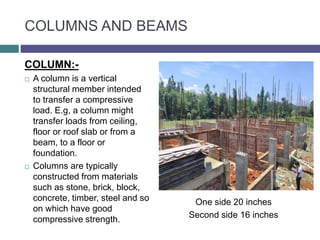
COLUMN:-
 A column is a vertical
structural member intended
to transfer a compressive
load. E.g, a column might
transfer loads from ceiling,
floor or roof slab or from a
beam, to a floor or
foundation.
 Columns are typically
constructed from materials
such as stone, brick, block,
concrete, timber, steel and so
on which have good
compressive strength.
One side 20 inches
Second side 16 inches
BEAMS:-
 A beam is a horizontal structural member in a building to resist the
lateral loads applied to the beam’s axis. The structural member
which resists the forces laterally or transversely applied to
the(beam) axis is called beam.
 The lateral load acting on the beams is the main cause of bending of
the beam. They are responsible for transferring the load from the
slab to the column.
BRICKWORK
 Brickwork is masonry produced by a bricklayer, using bricks and
mortar.
 Rows of bricks called courses are laid on top of one another to build
up a structure such as a brick wall.
 Brick masonry in 1:6 cement mortar (1 cement: 6 coarse sand)
bricks up to desired height in all floors as per architectural design
and drawings.
MATERIALS USED
1. Grade of concrete used: M20
2. Cement used: OPC 43 GRADE
3. Mix Design: 1:1.5:3
FINAL DESIGN OF BUILDING
CONCLUSION
 The main objective of industrial training is to provide an opportunity
to undergraduates to identify, observe and practice how it is
applicable in the real industry.
 Gained basic knowledge
 Learned an importance of proper communication between office and
site.
 Learned about safety requirements at site.
REFERENCE
 IS 456:2000 for concrete
 IS 1489-1991 (part I) for cement in PCC
 IS 383- 1970 for coarse aggregates.
THANK
YOU

TRAINING PPT.pptx

  • 1.
    YOGANANDA COLLEGE OF ENGINEERINGAND TECHNOLOGY JAMMU Internship Presentation On Construction of Hostel Block at Government Polytechnic College Larkipora Anantnag Kashmir SUBMITTED BY:  INSHA IQBAL (191506017)  HAFIZ TAFAZUL (191506022)  MEHVISH MUSHTAQ (191506035)  TAHLEEL BILAL ZARGAR (191506040)  WASEEM AHMAD SHERGOJRY (191506059)  JUNAID NISAR (191506060)
  • 2.
    CONTENTS  Introduction  ProjectDetail  Objectives  Methodology  Work done  Conclusion  References
  • 3.
    INTRODUCTION  The J&KProjects Construction Corporation Ltd. A Govt. owned company was incorporated in 1965.  It had an authorized share capital of Rs. 25.00 lacs. And corresponding paid up capital of Rs. 10.00 lacs.  Corporation has constructed its own building complexes both in Jammu and Srinagar and has added a fleet of Machinery to augment the construction methods on modern lines.  Also JKPCC has set up material testing laboratories on modern lines both at Jammu and Srinagar on collusion with M/s AIMIL.
  • 4.
    PROJECT DETAIL  Nameof the project:- 63 Bedded Hostel for Boys At Govt. Polytechnic College Larkipora Anantnag.  Cost of project:- 500.00 Lacs  Date of start:- August 2021  Expected date of completion:- August 2023  Number of floors:- G+1(Kitchen/ Dining block= Single storeyed)  Plinth area:- 8683.00Sft.  Type of structure:- RCC Framed Structure  Type of foundation:- Isolated/ Combined footings  Purposed Ground Floor Area:- 8683.00Sft.  Purposed First Floor Area:- 6220.00Sft.  Purposed Total Area:- 14903.00Sft.  Total Bed Capacity:- a) Ground Floor = 3x8=24 b) First Floor = 3x13=39
  • 5.
    OBJECTIVES  To acquireknowledge involving construction process.  To acquire knowledge about the structural drawing and design specifications.  To implement the structural drawing into the construction site.  Appropriate selection of machinery and equipment.  To obtain knowledge about steps involving construction process.
  • 6.
    METHODOLOGY FOUNDATION  Part ofstructural system that supports and anchors the superstructure of a building and transmits its loads directly to the earth.  The foundation of a structure is always constructed below ground level so as to increase the lateral stability of the structure.  It includes the portion of the structure below ground level and other artificial arrangements in the form of concrete block grillage, raft, piles, etc. At its base so as to provide a firm and level surface for transmitting the load of the structure on a large area of the soil laying underneath.
  • 7.
    RAFT FOUNDATION:  Thefoundation that covers the entire area under the structure is known as raft foundation.  It is made up of a thick reinforced cement concrete(R.C.C) slab that covers the entire area in the form of a mat.  This type of foundation is used to construct heavy structures on soft ground.
  • 9.
    SHUTTERING  Shuttering isbasically defined as wood in planks or strips used as temporary structure to contain setting concrete, to support the sides of trenches, or similar.  It provides supports to horizontal, vertical and inclined surfaces or also provides support to cast concrete according to required shape and size.  The formwork also produces desired finish concrete surface.
  • 10.
  • 12.
    CONCRETING  Concrete ismade of 3 basic components; water, aggregates (rock, sand or gravel) and Portland cement.  Cement, usually in powder form, acts as a binding agent when mixed with water and aggregates. This combination, or concrete mix, will be poured and harden into the durable material with which we all are familiar.  RCC is designed as per IS:456 2000 with different grades of concrete for components:- Column M20 Foundation M20 Plinth beam M20 Slab beam M20
  • 13.
    COLUMNS AND BEAMS COLUMN:- A column is a vertical structural member intended to transfer a compressive load. E.g, a column might transfer loads from ceiling, floor or roof slab or from a beam, to a floor or foundation.  Columns are typically constructed from materials such as stone, brick, block, concrete, timber, steel and so on which have good compressive strength. One side 20 inches Second side 16 inches
  • 14.
    BEAMS:-  A beamis a horizontal structural member in a building to resist the lateral loads applied to the beam’s axis. The structural member which resists the forces laterally or transversely applied to the(beam) axis is called beam.  The lateral load acting on the beams is the main cause of bending of the beam. They are responsible for transferring the load from the slab to the column.
  • 15.
    BRICKWORK  Brickwork ismasonry produced by a bricklayer, using bricks and mortar.  Rows of bricks called courses are laid on top of one another to build up a structure such as a brick wall.  Brick masonry in 1:6 cement mortar (1 cement: 6 coarse sand) bricks up to desired height in all floors as per architectural design and drawings.
  • 18.
    MATERIALS USED 1. Gradeof concrete used: M20 2. Cement used: OPC 43 GRADE 3. Mix Design: 1:1.5:3
  • 20.
  • 21.
    CONCLUSION  The mainobjective of industrial training is to provide an opportunity to undergraduates to identify, observe and practice how it is applicable in the real industry.  Gained basic knowledge  Learned an importance of proper communication between office and site.  Learned about safety requirements at site.
  • 22.
    REFERENCE  IS 456:2000for concrete  IS 1489-1991 (part I) for cement in PCC  IS 383- 1970 for coarse aggregates.
  • 23.