TYPES OF CELLS
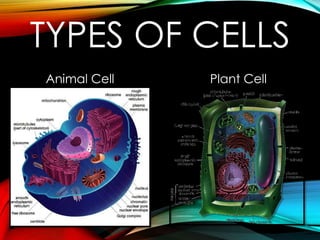
Animal Cell

Plant Cell
CELL
A cell is the smallest independently
functioning unit in the structure of an
organism, usually consisting of one or
more nuclei surrounded by cytoplasm and
enclosed by a membrane. Cells also
contain organelles such as mitochondria,
lysosomes, and ribosomes.
Atom

Orga
n

Organ
System

Molecule

Tissue

Organism

Organelle

Cell
CONNECTIVE TISSUE CELL
•Connective tissue is a
form of fibrous tissue.
•It is one of the four
types of tissue in
traditional classifications
(the others being
epithelial, muscle, and
nervous tissue).
MUSCLE CELL
•Body tissue producing
movement
•Can undergo repeated
contraction and relaxation, so
that it is able to produce
movement of body parts,
maintain tension, or pump fluids
within the body.
•There are three types: voluntary
striped muscle, involuntary
smooth muscle, and branched
or heart muscle.
Muscle Cells
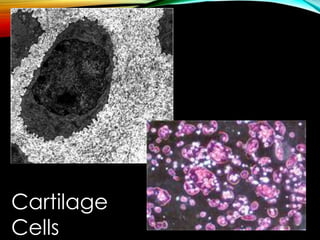
CARTILAGE CELLS
• Strong elastic tissue
in the body
• found in the nose,
throat, and ear and
in other parts of the
body
• forms most of the
skeleton in infancy,
changing to bone
during growth
Cartilage
Cells
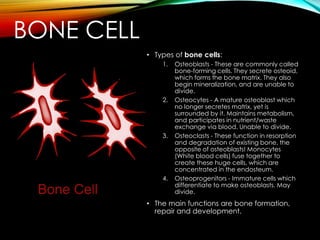
BONE CELL
• Types of bone cells:
1.

2.

3.

4.

Osteoblasts - These are commonly called
bone-forming cells. They secrete osteoid,
which forms the bone matrix. They also
begin mineralization, and are unable to
divide.
Osteocytes - A mature osteoblast which
no longer secretes matrix, yet is
surrounded by it. Maintains metabolism,
and participates in nutrient/waste
exchange via blood. Unable to divide.
Osteoclasts - These function in resorption
and degradation of existing bone, the
opposite of osteoblasts! Monocytes
(White blood cells) fuse together to
create these huge cells, which are
concentrated in the endosteum.
Osteoprogenitors - Immature cells which
differentiate to make osteoblasts. May
divide.

• The main functions are bone formation,
repair and development.
Bone Cells
RED BLOOD CELL
• Any of the hemoglobincontaining cells that
carry oxygen to the
tissues and are
responsible for the red
color of vertebrate
blood
• Called also erythrocyte,
red blood corpuscle, red
cell, red corpuscle.
Red Blood
Cells
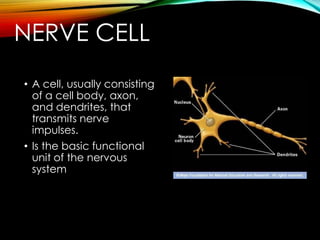
NERVE CELL
• A cell, usually consisting
of a cell body, axon,
and dendrites, that
transmits nerve
impulses.
• Is the basic functional
unit of the nervous
system
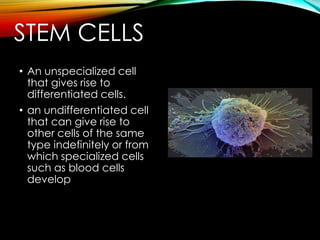
STEM CELLS
• An unspecialized cell
that gives rise to
differentiated cells.
• an undifferentiated cell
that can give rise to
other cells of the same
type indefinitely or from
which specialized cells
such as blood cells
develop
Stem
Cells

Cells

  • 1.
    TYPES OF CELLS AnimalCell Plant Cell
  • 2.
    CELL A cell isthe smallest independently functioning unit in the structure of an organism, usually consisting of one or more nuclei surrounded by cytoplasm and enclosed by a membrane. Cells also contain organelles such as mitochondria, lysosomes, and ribosomes.
  • 3.
  • 4.
    CONNECTIVE TISSUE CELL •Connectivetissue is a form of fibrous tissue. •It is one of the four types of tissue in traditional classifications (the others being epithelial, muscle, and nervous tissue).
  • 6.
    MUSCLE CELL •Body tissueproducing movement •Can undergo repeated contraction and relaxation, so that it is able to produce movement of body parts, maintain tension, or pump fluids within the body. •There are three types: voluntary striped muscle, involuntary smooth muscle, and branched or heart muscle.
  • 7.
  • 8.
    CARTILAGE CELLS • Strongelastic tissue in the body • found in the nose, throat, and ear and in other parts of the body • forms most of the skeleton in infancy, changing to bone during growth
  • 9.
  • 10.
    BONE CELL • Typesof bone cells: 1. 2. 3. 4. Osteoblasts - These are commonly called bone-forming cells. They secrete osteoid, which forms the bone matrix. They also begin mineralization, and are unable to divide. Osteocytes - A mature osteoblast which no longer secretes matrix, yet is surrounded by it. Maintains metabolism, and participates in nutrient/waste exchange via blood. Unable to divide. Osteoclasts - These function in resorption and degradation of existing bone, the opposite of osteoblasts! Monocytes (White blood cells) fuse together to create these huge cells, which are concentrated in the endosteum. Osteoprogenitors - Immature cells which differentiate to make osteoblasts. May divide. • The main functions are bone formation, repair and development.
  • 11.
  • 12.
    RED BLOOD CELL •Any of the hemoglobincontaining cells that carry oxygen to the tissues and are responsible for the red color of vertebrate blood • Called also erythrocyte, red blood corpuscle, red cell, red corpuscle.
  • 13.
  • 14.
    NERVE CELL • Acell, usually consisting of a cell body, axon, and dendrites, that transmits nerve impulses. • Is the basic functional unit of the nervous system
  • 16.
    STEM CELLS • Anunspecialized cell that gives rise to differentiated cells. • an undifferentiated cell that can give rise to other cells of the same type indefinitely or from which specialized cells such as blood cells develop
  • 17.