PREPARED BY:
Ankita Sharma
Twinkle
Chandni
Hema
Piyush
 Zara is the flagship chain store of Inditex Group owned
by Spanish tycoon Amancio Ortega, who also owns
brands such as Massimo Dutti, Pull and Bear, Oysho,
Uterqüe, Stradivarius and Bershka.
 The group is headquartered in A Coruña, Spain, where
the first Zara store opened in 1975.
 It is claimed that Zara launches around 10,000 new
designs each year.
 Its most unusual strategy was its policy of zero
advertising; the company preferred to invest a
percentage of revenues in opening new stores
 ZARA is a Spanish clothing and accessories retailer
 Zara delivers new products twice each week to its 1,763
stores around the world.
 Zara has developed a highly responsive supply chain that
enables delivery of new fashions as soon as a trend
emerges.
 Board Members:
 Mr. Pablo Isla Álvarez de Tejera
(Chairman and CEO)
 Mr. Amancio Ortega Gaona
(Founder of Inditex and Member of the Board)
 Mr. José Arnau Sierra
(Deputy Chairman)
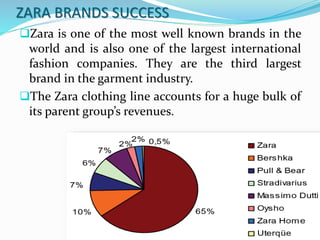
ZARA BRANDS SUCCESS
Zara is one of the most well known brands in the
world and is also one of the largest international
fashion companies. They are the third largest
brand in the garment industry.
The Zara clothing line accounts for a huge bulk of
its parent group’s revenues.
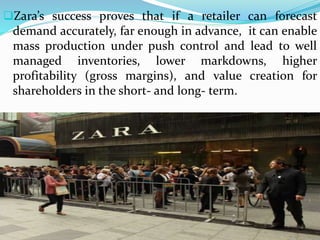
Zara’s success proves that if a retailer can forecast
demand accurately, far enough in advance, it can enable
mass production under push control and lead to well
managed inventories, lower markdowns, higher
profitability (gross margins), and value creation for
shareholders in the short- and long- term.
ZARA’s BUSINESS MODEL: Adding value beyond profits
Main Issues
The elements supporting Zara’s business structure
and strategy are also greatly interlinked and
interdependent. The following three factors stand
out:
Extensive market research providing a constant stream
of inputs into the product development process, rather
than in batches or discrete seasons.
Locating various business function in close proximity of
the headquarters, and tight control, allows the various
functions to coordinate and take joint-decision very
quickly.These provide the capability to respond very
quickly to the market research-influenced decions.
Communication and information Technology are
absolutely vital to managing the constant interface of
various and management of the huge variety of product
information.
ZARA‘S STRATEGY OF DISTRIBUTION AND
VERTICAL INTEGRATION
 Zara is a chain that has developed a successful diverse
method of doing business in the fashion industry. Zara
by working through the whole value chain is very
vertically integrated and highly capital intensive.
 VERTICAL INTEGRATION: a distinctive feature of Zara’s
business model, has allowed the company to successfully
develop a strong merchandising strategy. This strategy
has led Zara to create a climate of scarcity and
opportunity as well as a fast-fashion system. Zara
manufactures 60% of its own products. By owning its in-
house production, Zara is able to be flexible in the
variety, amount, and frequency of the new styles they
produce
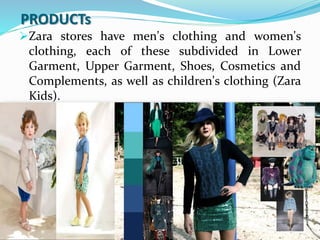
PRODUCTs
Zara stores have men's clothing and women's
clothing, each of these subdivided in Lower
Garment, Upper Garment, Shoes, Cosmetics and
Complements, as well as children's clothing (Zara
Kids).
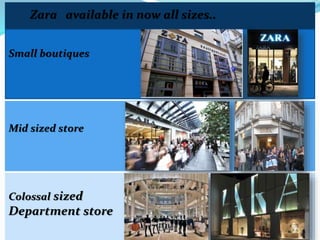
Zara available in now all sizes..
Small boutiques
Mid sized store
Colossal sized
Department store
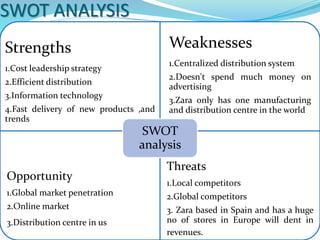
Strengths
1.Cost leadership strategy
2.Efficient distribution
3.Information technology
4.Fast delivery of new products ,and
trends
Weaknesses
1.Centralized distribution system
2.Doesn't spend much money on
advertising
3.Zara only has one manufacturing
and distribution centre in the world
Opportunity
1.Global market penetration
2.Online market
3.Distribution centre in us
Threats
1.Local competitors
2.Global competitors
3. Zara based in Spain and has a huge
no of stores in Europe will dent in
revenues.
SWOT
analysis
SWOT ANALYSIS
THANK YOU

Ppt on zara

  • 1.
  • 2.
     Zara isthe flagship chain store of Inditex Group owned by Spanish tycoon Amancio Ortega, who also owns brands such as Massimo Dutti, Pull and Bear, Oysho, Uterqüe, Stradivarius and Bershka.  The group is headquartered in A Coruña, Spain, where the first Zara store opened in 1975.  It is claimed that Zara launches around 10,000 new designs each year.  Its most unusual strategy was its policy of zero advertising; the company preferred to invest a percentage of revenues in opening new stores
  • 3.
     ZARA isa Spanish clothing and accessories retailer  Zara delivers new products twice each week to its 1,763 stores around the world.  Zara has developed a highly responsive supply chain that enables delivery of new fashions as soon as a trend emerges.  Board Members:  Mr. Pablo Isla Álvarez de Tejera (Chairman and CEO)  Mr. Amancio Ortega Gaona (Founder of Inditex and Member of the Board)  Mr. José Arnau Sierra (Deputy Chairman)
  • 5.
    ZARA BRANDS SUCCESS Zarais one of the most well known brands in the world and is also one of the largest international fashion companies. They are the third largest brand in the garment industry. The Zara clothing line accounts for a huge bulk of its parent group’s revenues.
  • 6.
    Zara’s success provesthat if a retailer can forecast demand accurately, far enough in advance, it can enable mass production under push control and lead to well managed inventories, lower markdowns, higher profitability (gross margins), and value creation for shareholders in the short- and long- term.
  • 8.
    ZARA’s BUSINESS MODEL:Adding value beyond profits
  • 9.
    Main Issues The elementssupporting Zara’s business structure and strategy are also greatly interlinked and interdependent. The following three factors stand out: Extensive market research providing a constant stream of inputs into the product development process, rather than in batches or discrete seasons. Locating various business function in close proximity of the headquarters, and tight control, allows the various functions to coordinate and take joint-decision very quickly.These provide the capability to respond very quickly to the market research-influenced decions. Communication and information Technology are absolutely vital to managing the constant interface of various and management of the huge variety of product information.
  • 11.
    ZARA‘S STRATEGY OFDISTRIBUTION AND VERTICAL INTEGRATION  Zara is a chain that has developed a successful diverse method of doing business in the fashion industry. Zara by working through the whole value chain is very vertically integrated and highly capital intensive.  VERTICAL INTEGRATION: a distinctive feature of Zara’s business model, has allowed the company to successfully develop a strong merchandising strategy. This strategy has led Zara to create a climate of scarcity and opportunity as well as a fast-fashion system. Zara manufactures 60% of its own products. By owning its in- house production, Zara is able to be flexible in the variety, amount, and frequency of the new styles they produce
  • 12.
    PRODUCTs Zara stores havemen's clothing and women's clothing, each of these subdivided in Lower Garment, Upper Garment, Shoes, Cosmetics and Complements, as well as children's clothing (Zara Kids).
  • 13.
    Zara available innow all sizes.. Small boutiques Mid sized store Colossal sized Department store
  • 14.
    Strengths 1.Cost leadership strategy 2.Efficientdistribution 3.Information technology 4.Fast delivery of new products ,and trends Weaknesses 1.Centralized distribution system 2.Doesn't spend much money on advertising 3.Zara only has one manufacturing and distribution centre in the world Opportunity 1.Global market penetration 2.Online market 3.Distribution centre in us Threats 1.Local competitors 2.Global competitors 3. Zara based in Spain and has a huge no of stores in Europe will dent in revenues. SWOT analysis SWOT ANALYSIS
  • 16.