Introduction
Digital educationmeans digital learning. It is a type of
learning that is supported by digital technology or by
instructional practice that makes effective use of digital
technology.
Teachers and professors too find it convenient to prepare
their teaching plans aided by digital technology. Teaching
and learning becomes a smoother experience as it includes
animations, gamification and audio-visual effects.
3.
Digital learningguarantee more
participation from students as the
current generation of students are
well-versed with laptops, I-pads,
and smart phones.
5.
Emerging Trends ofDigital Education
In India, where mobile penetration is nearing a billion
people with over 200 million connected to the internet,
and this expected to reach 550 million by 2018, the
potential to digitally educate the masses seems very rich.
With evolution of technologies such as cloud, data centres
and video based learning there is huge potential for
technology to be integrated with the Education Industry.
6.
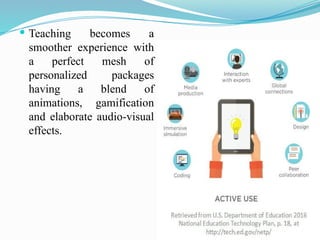
Teaching becomesa
smoother experience with
a perfect mesh of
personalized packages
having a blend of
animations, gamification
and elaborate audio-visual
effects.
7.
Challenges of Digital
Education
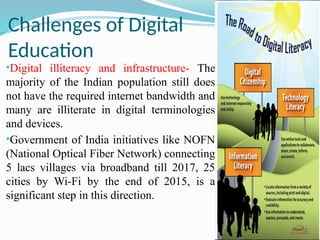
•Digitalilliteracy and infrastructure- The
majority of the Indian population still does
not have the required internet bandwidth and
many are illiterate in digital terminologies
and devices.
•Government of India initiatives like NOFN
(National Optical Fiber Network) connecting
5 lacs villages via broadband till 2017, 25
cities by Wi-Fi by the end of 2015, is a
significant step in this direction.
8.
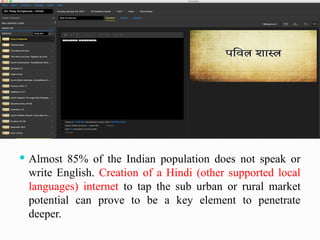
Almost 85%of the Indian population does not speak or
write English. Creation of a Hindi (other supported local
languages) internet to tap the sub urban or rural market
potential can prove to be a key element to penetrate
deeper.
9.
Active campaigning,informative sessions, technical
workshops and a multi-pronged approach is needed to
bring about Digital awareness and change trends like
Distance Education to Digital Education.
10.
Digital educationinvolves
effective and efficient
usage of appropriate and
latest hardware and
software technology
available in the market.
Through Digital India
programme, the
government has promised
availability of funds for
technology
implementation.
11.
Jayesh M.Patel (2017). There are many web based tools
which can be used in the classroom for digital education
like twitter, Glogster, Prezi, Diigo, Dropbox, and Moodle.
Web based tools will make the learning interesting and
students will get motivated which normal classroom
cannot do. Currently the teacher centric approaches are
making learning boring even for interesting chapters , use
of digital technology makes even boring content
interesting and joyful. The concept of child centred
approach will be fulfilled only with the help of digital
technology.
12.
Conclusion
Education sectorin India has seen a series of rapid
expansion in last couple of years which helped to transform
the country into a knowledge haven. Development of
education infrastructure is required for the development of
digital education across the country. This will lead to
considerable increase in infrastructure investment in the
education sector. Democratic governance, English speaking
tech-educated talent and a strong legal and intellectual
property protection framework are required for the
development of digital education in Indian society.