Download to read offline


![NUMERICAL
• PROBLEM 1 : Find the discharge of water flowing
over a rectangular notch of 2m length when the
constant head over the notch is 300mm. Take
Cd=0.6.
• PROBLEM 2: Determine the height of a rectangular
weir of length 6m to be built across a rectangular
channel. The maximum depth of water on the
upstream side of the weir is 1.8m and discharge is
2000 lt/s. Take Cd=0.6. [AKTU 2015-16]](https://image.slidesharecdn.com/pptnotchandweir-230128134856-4c147b6e/85/PPT-NOTCH-AND-WEIR-pptx-5-320.jpg)


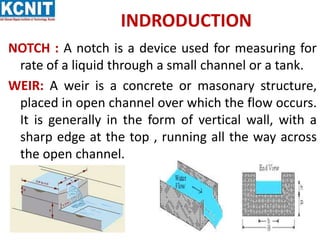
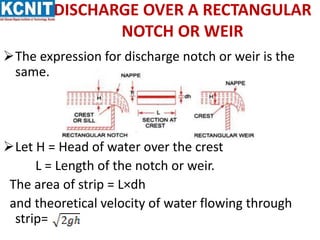
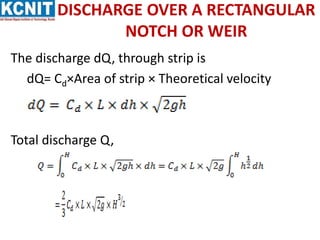
This document summarizes a lecture on notches and weirs for fluid mechanics. It introduces notches as devices for measuring liquid flow rates through small channels or tanks. Weirs are described as concrete or masonry structures placed in open channels that water flows over. The document discusses that the discharge equation is the same for rectangular notches and weirs, and involves the length, head of water, theoretical velocity, and discharge coefficient. It provides two numerical problems applying this equation to calculate discharge for a notch and to determine the required weir height.


