


Presentation on
Flow Over a Sharp Crested Weir
Course Name: Fluid Mechanics (Sessional)
Course Code: CE-262
Group No: B2-06
Prepared By:
1. Farhan Sadek Efaz (1601124)
2. Mostofa Humayun Akram (1601125)
3. Waliul Islam (1601126)
4. Mehedi Hasan (1601127)
5. Pranjol Chakraborty (1601130)
6. Joy Shakhar (1301013)
Introduction
Weirs are elevated hydraulic
structures used to measure flow
and/or control the water elevation at
outflows from basins and channels.
The sharp-crested weir is a thin
plate located vertically across the
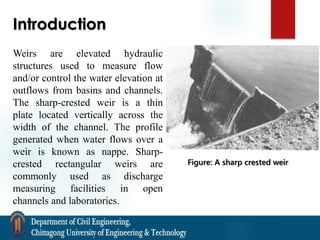
width of the channel. The profile
generated when water flows over a
weir is known as nappe. Sharp-
crested rectangular weirs are
commonly used as discharge
measuring facilities in open
channels and laboratories.
Figure: A sharp crested weir
Theoretical Background
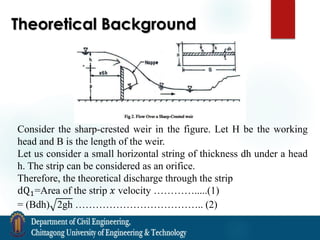
Consider the sharp-crested weir in the figure. Let H be the working
head and B is the length of the weir.
Let us consider a small horizontal string of thickness dh under a head
h. The strip can be considered as an orifice.
Therefore, the theoretical discharge through the strip
dQ1=Area of the strip 𝑥 velocity ………….....(1)
= (Bdh) 2gh ……………………………….. (2)
Theoretical Background
Integrating between the limits 0 and H, the total theoretical
discharge over the weir is given by
Qt =
2
3
2g BH
3
2 ............................................(3)
Let Qa be the actual discharge. Then the co-efficient of discharge,
Cd, is given by
Cd =
Qa
Qt
……………………………………....(4)
Therefore,
Qa =
2
3
Cd 2g BH
3
2………………………..(5)
Methods
1. Firstly a sharp crested weir was installed at the end of the
channel.
2. Then the water head (H) was measured using the hook
gauge.
3. The final gauge reading was noted down.
4. After that, the time (t) to fill water to a certain depth (h) of
the tank was counted.
5. Using the above recorded data, actual and theoretical
discharge of the sharp crested weir was measured.
6. Then the co-efficient of discharge was calculated.
Result
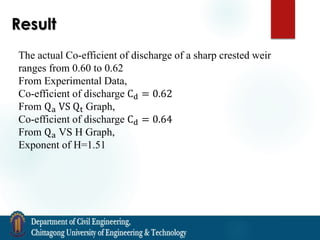
The actual Co-efficient of discharge of a sharp crested weir
ranges from 0.60 to 0.62
From Experimental Data,
Co-efficient of discharge Cd = 0.62
From Qa VS Qt Graph,
Co-efficient of discharge Cd = 0.64
From Qa VS H Graph,
Exponent of H=1.51
Application
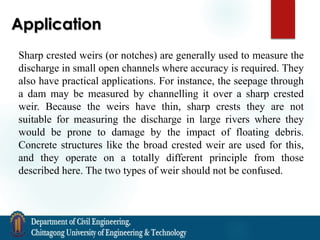
Sharp crested weirs (or notches) are generally used to measure the
discharge in small open channels where accuracy is required. They
also have practical applications. For instance, the seepage through
a dam may be measured by channelling it over a sharp crested
weir. Because the weirs have thin, sharp crests they are not
suitable for measuring the discharge in large rivers where they
would be prone to damage by the impact of floating debris.
Concrete structures like the broad crested weir are used for this,
and they operate on a totally different principle from those
described here. The two types of weir should not be confused.
Conclusion & Discussion
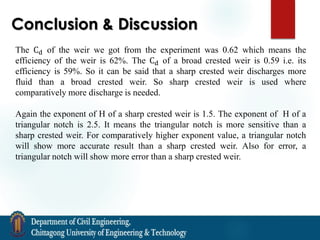
The Cd of the weir we got from the experiment was 0.62 which means the
efficiency of the weir is 62%. The Cd of a broad crested weir is 0.59 i.e. its
efficiency is 59%. So it can be said that a sharp crested weir discharges more
fluid than a broad crested weir. So sharp crested weir is used where
comparatively more discharge is needed.
Again the exponent of H of a sharp crested weir is 1.5. The exponent of H of a
triangular notch is 2.5. It means the triangular notch is more sensitive than a
sharp crested weir. For comparatively higher exponent value, a triangular notch
will show more accurate result than a sharp crested weir. Also for error, a
triangular notch will show more error than a sharp crested weir.
Thank You!!
Any Question??

Flow Over A Sharp Crested Weir Experiment

  • 1.
    Presentation on Flow Overa Sharp Crested Weir Course Name: Fluid Mechanics (Sessional) Course Code: CE-262 Group No: B2-06 Prepared By: 1. Farhan Sadek Efaz (1601124) 2. Mostofa Humayun Akram (1601125) 3. Waliul Islam (1601126) 4. Mehedi Hasan (1601127) 5. Pranjol Chakraborty (1601130) 6. Joy Shakhar (1301013)
  • 2.
    Introduction Weirs are elevatedhydraulic structures used to measure flow and/or control the water elevation at outflows from basins and channels. The sharp-crested weir is a thin plate located vertically across the width of the channel. The profile generated when water flows over a weir is known as nappe. Sharp- crested rectangular weirs are commonly used as discharge measuring facilities in open channels and laboratories. Figure: A sharp crested weir
  • 3.
    Theoretical Background Consider thesharp-crested weir in the figure. Let H be the working head and B is the length of the weir. Let us consider a small horizontal string of thickness dh under a head h. The strip can be considered as an orifice. Therefore, the theoretical discharge through the strip dQ1=Area of the strip 𝑥 velocity ………….....(1) = (Bdh) 2gh ……………………………….. (2)
  • 4.
    Theoretical Background Integrating betweenthe limits 0 and H, the total theoretical discharge over the weir is given by Qt = 2 3 2g BH 3 2 ............................................(3) Let Qa be the actual discharge. Then the co-efficient of discharge, Cd, is given by Cd = Qa Qt ……………………………………....(4) Therefore, Qa = 2 3 Cd 2g BH 3 2………………………..(5)
  • 5.
    Methods 1. Firstly asharp crested weir was installed at the end of the channel. 2. Then the water head (H) was measured using the hook gauge. 3. The final gauge reading was noted down. 4. After that, the time (t) to fill water to a certain depth (h) of the tank was counted. 5. Using the above recorded data, actual and theoretical discharge of the sharp crested weir was measured. 6. Then the co-efficient of discharge was calculated.
  • 6.
    Result The actual Co-efficientof discharge of a sharp crested weir ranges from 0.60 to 0.62 From Experimental Data, Co-efficient of discharge Cd = 0.62 From Qa VS Qt Graph, Co-efficient of discharge Cd = 0.64 From Qa VS H Graph, Exponent of H=1.51
  • 7.
    Application Sharp crested weirs(or notches) are generally used to measure the discharge in small open channels where accuracy is required. They also have practical applications. For instance, the seepage through a dam may be measured by channelling it over a sharp crested weir. Because the weirs have thin, sharp crests they are not suitable for measuring the discharge in large rivers where they would be prone to damage by the impact of floating debris. Concrete structures like the broad crested weir are used for this, and they operate on a totally different principle from those described here. The two types of weir should not be confused.
  • 8.
    Conclusion & Discussion TheCd of the weir we got from the experiment was 0.62 which means the efficiency of the weir is 62%. The Cd of a broad crested weir is 0.59 i.e. its efficiency is 59%. So it can be said that a sharp crested weir discharges more fluid than a broad crested weir. So sharp crested weir is used where comparatively more discharge is needed. Again the exponent of H of a sharp crested weir is 1.5. The exponent of H of a triangular notch is 2.5. It means the triangular notch is more sensitive than a sharp crested weir. For comparatively higher exponent value, a triangular notch will show more accurate result than a sharp crested weir. Also for error, a triangular notch will show more error than a sharp crested weir.
  • 9.