Newton’s Laws – L1
At the end of this session, you’ll be able to:
State Newton’s 1st Law of Motion
Describe examples of Newton’s 1st Law
State the conditions for equilibrium and be able to
solve problems involving equilibrium.
State Newton’s 2nd Law of motion (F = ma and F =
∆p / ∆t)
Solve problems involving Newton’s 2nd Law
The definition of force
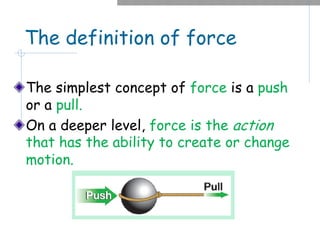
The simplest concept of force is a push
or a pull.
On a deeper level, force is the action
that has the ability to create or change
motion.
Force
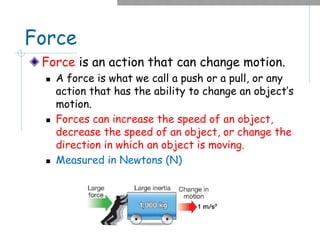
Force is an action that can change motion.
n A force is what we call a push or a pull, or any
action that has the ability to change an object’s
motion.
n Forces can increase the speed of an object,
decrease the speed of an object, or change the
direction in which an object is moving.
n Measured in Newtons (N)
Mass and Inertia
Chemists like to define mass (kg) as
the amount of “stuff” or “matter” a
substance has.
Physicists define mass (kg) as inertia,
which is the ability of a body to
resist acceleration by a net force.
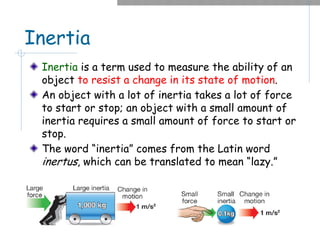
Inertia
Inertia is a term used to measure the ability of an
object to resist a change in its state of motion.
An object with a lot of inertia takes a lot of force
to start or stop; an object with a small amount of
inertia requires a small amount of force to start or
stop.
The word “inertia” comes from the Latin word
inertus, which can be translated to mean “lazy.”
Newton’s laws of motion
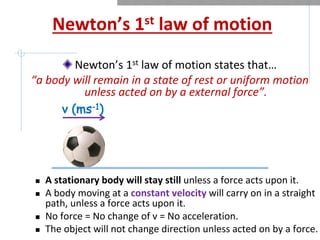
Newton’s 1st law of motion
Newton’s 1st law of motion states that…
“a body will remain in a state of rest or uniform motion
unless acted on by a external force”.
n A stationary body will stay still unless a force acts upon it.
n A body moving at a constant velocity will carry on in a straight
path, unless a force acts upon it.
n No force = No change of v = No acceleration.
n The object will not change direction unless acted on by a force.
v (ms-1)
Implications of Newton’s 1st Law
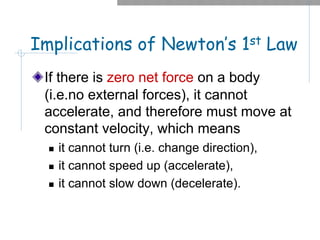
If there is zero net force on a body
(i.e.no external forces), it cannot
accelerate, and therefore must move at
constant velocity, which means
n it cannot turn (i.e. change direction),
n it cannot speed up (accelerate),
n it cannot slow down (decelerate).
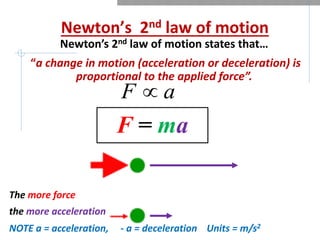
Newton’s 2nd law of motion
a
F µ
Newton’s 2nd law of motion states that…
“a change in motion (acceleration or deceleration) is
proportional to the applied force”.
The more force
the more acceleration
NOTE a = acceleration, - a = deceleration Units = m/s2
F = ma
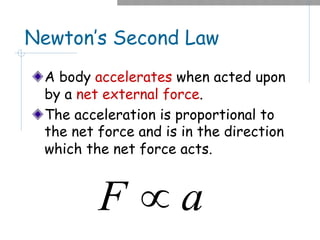
Newton’s Second Law
A body accelerates when acted upon
by a net external force.
The acceleration is proportional to
the net force and is in the direction
which the net force acts.
a
F µ
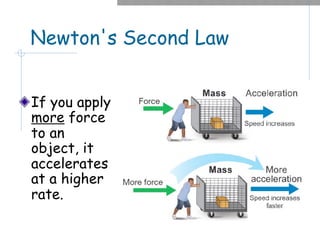
Newton's Second Law
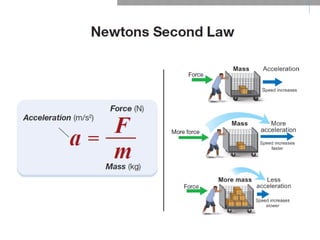
If you apply
more force
to an
object, it
accelerates
at a higher
rate.
Newton's Second Law
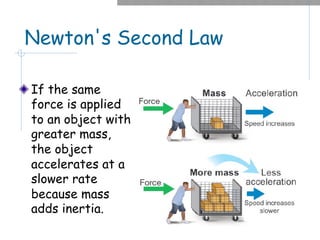
If the same
force is applied
to an object with
greater mass,
the object
accelerates at a
slower rate
because mass
adds inertia.
Newton's Second Law -
UNITS
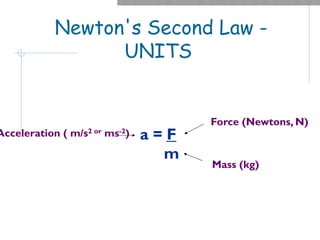
a = F
m
Force (Newtons, N)
Mass (kg)
Acceleration ( m/s2 or ms-2)
Newton's Second Law
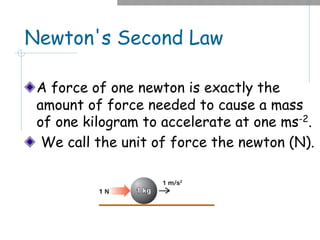
A force of one newton is exactly the
amount of force needed to cause a mass
of one kilogram to accelerate at one ms-2.
We call the unit of force the newton (N).
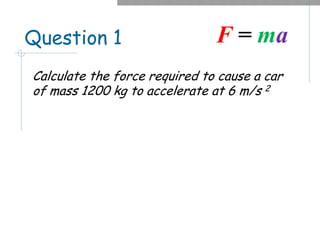
Question 1
Calculate the force required to cause a car
of mass 1200 kg to accelerate at 6 m/s 2
F = ma
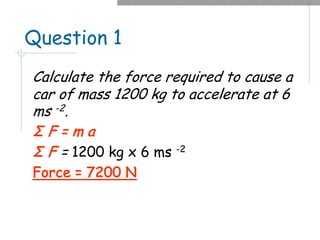
Question 1
Calculate the force required to cause a
car of mass 1200 kg to accelerate at 6
ms -2.
Σ F = m a
Σ F = 1200 kg x 6 ms -2
Force = 7200 N
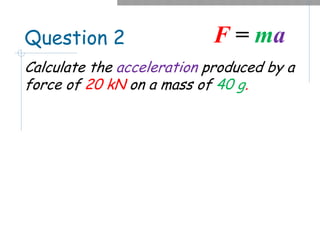
Question 2
Calculate the acceleration produced by a
force of 20 kN on a mass of 40 g.
F = ma
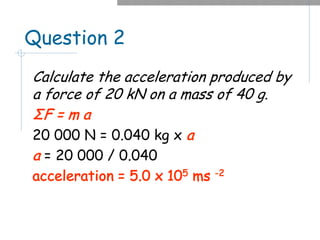
Question 2
Calculate the acceleration produced by
a force of 20 kN on a mass of 40 g.
ΣF = m a
20 000 N = 0.040 kg x a
a = 20 000 / 0.040
acceleration = 5.0 x 10⁵ ms -2
Using the second law of motion
There are often many forces acting on the
same object.
The force F that appears in the second law
is the net force.
Acceleration results from the combined
action of all the forces that act on an
object.
When used this way, the word net means
“total.”
Positive and negative
acceleration
We often use positive and negative numbers to
show the direction of force and acceleration.
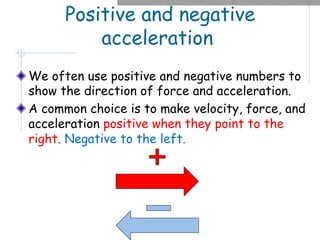
A common choice is to make velocity, force, and
acceleration positive when they point to the
right. Negative to the left.
Using the second law of motion
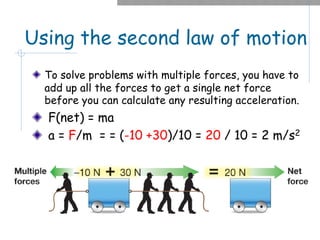
To solve problems with multiple forces, you have to
add up all the forces to get a single net force
before you can calculate any resulting acceleration.
F(net) = ma
a = F/m = = (-10 +30)/10 = 20 / 10 = 2 m/s2
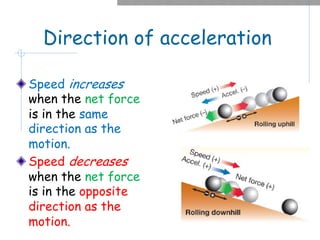
Direction of acceleration
Speed increases
when the net force
is in the same
direction as the
motion.
Speed decreases
when the net force
is in the opposite
direction as the
motion.
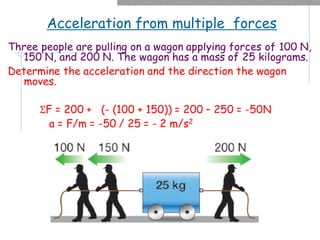
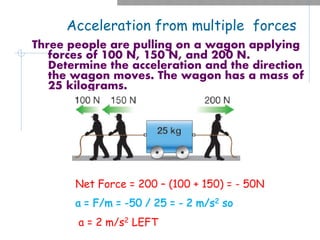
Acceleration from multiple forces
Net Force = 200 – (100 + 150) = - 50N
a = F/m = -50 / 25 = - 2 m/s2 so
a = 2 m/s2 LEFT
Acceleration from multiple forces
Three people are pulling on a wagon applying
forces of 100 N, 150 N, and 200 N.
Determine the acceleration and the direction
the wagon moves. The wagon has a mass of
25 kilograms.
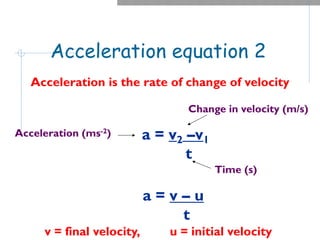
Acceleration equation 2
a = v2 –v1
t
Change in velocity (m/s)
Time (s)
Acceleration (ms-2)
Acceleration is the rate of change of velocity
v = final velocity, u = initial velocity
a = v – u
t
Question 1
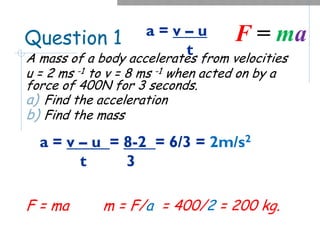
A mass of a body accelerates from velocities
u = 2 ms -1 to v = 8 ms -1 when acted on by a
force of 400N for 3 seconds.
a) Find the acceleration
b) Find the mass
F = ma m = F/a = 400/2 = 200 kg.
a = v – u
t
F = ma
a = v – u = 8-2 = 6/3 = 2m/s2
t 3
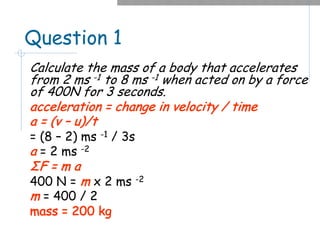
Question 1
Calculate the mass of a body that accelerates
from 2 ms -1 to 8 ms -1 when acted on by a force
of 400N for 3 seconds.
acceleration = change in velocity / time
a = (v – u)/t
= (8 – 2) ms -1 / 3s
a = 2 ms -2
ΣF = m a
400 N = m x 2 ms -2
m = 400 / 2
mass = 200 kg

Topic 3 - Newtons Laws L1 (1).pdf

  • 1.
    Newton’s Laws –L1 At the end of this session, you’ll be able to: State Newton’s 1st Law of Motion Describe examples of Newton’s 1st Law State the conditions for equilibrium and be able to solve problems involving equilibrium. State Newton’s 2nd Law of motion (F = ma and F = ∆p / ∆t) Solve problems involving Newton’s 2nd Law
  • 2.
    The definition offorce The simplest concept of force is a push or a pull. On a deeper level, force is the action that has the ability to create or change motion.
  • 3.
    Force Force is anaction that can change motion. n A force is what we call a push or a pull, or any action that has the ability to change an object’s motion. n Forces can increase the speed of an object, decrease the speed of an object, or change the direction in which an object is moving. n Measured in Newtons (N)
  • 4.
    Mass and Inertia Chemistslike to define mass (kg) as the amount of “stuff” or “matter” a substance has. Physicists define mass (kg) as inertia, which is the ability of a body to resist acceleration by a net force.
  • 5.
    Inertia Inertia is aterm used to measure the ability of an object to resist a change in its state of motion. An object with a lot of inertia takes a lot of force to start or stop; an object with a small amount of inertia requires a small amount of force to start or stop. The word “inertia” comes from the Latin word inertus, which can be translated to mean “lazy.”
  • 6.
  • 7.
    Newton’s 1st lawof motion Newton’s 1st law of motion states that… “a body will remain in a state of rest or uniform motion unless acted on by a external force”. n A stationary body will stay still unless a force acts upon it. n A body moving at a constant velocity will carry on in a straight path, unless a force acts upon it. n No force = No change of v = No acceleration. n The object will not change direction unless acted on by a force. v (ms-1)
  • 8.
    Implications of Newton’s1st Law If there is zero net force on a body (i.e.no external forces), it cannot accelerate, and therefore must move at constant velocity, which means n it cannot turn (i.e. change direction), n it cannot speed up (accelerate), n it cannot slow down (decelerate).
  • 9.
    Newton’s 2nd lawof motion a F µ Newton’s 2nd law of motion states that… “a change in motion (acceleration or deceleration) is proportional to the applied force”. The more force the more acceleration NOTE a = acceleration, - a = deceleration Units = m/s2 F = ma
  • 10.
    Newton’s Second Law Abody accelerates when acted upon by a net external force. The acceleration is proportional to the net force and is in the direction which the net force acts. a F µ
  • 11.
    Newton's Second Law Ifyou apply more force to an object, it accelerates at a higher rate.
  • 12.
    Newton's Second Law Ifthe same force is applied to an object with greater mass, the object accelerates at a slower rate because mass adds inertia.
  • 14.
    Newton's Second Law- UNITS a = F m Force (Newtons, N) Mass (kg) Acceleration ( m/s2 or ms-2)
  • 15.
    Newton's Second Law Aforce of one newton is exactly the amount of force needed to cause a mass of one kilogram to accelerate at one ms-2. We call the unit of force the newton (N).
  • 16.
    Question 1 Calculate theforce required to cause a car of mass 1200 kg to accelerate at 6 m/s 2 F = ma
  • 17.
    Question 1 Calculate theforce required to cause a car of mass 1200 kg to accelerate at 6 ms -2. Σ F = m a Σ F = 1200 kg x 6 ms -2 Force = 7200 N
  • 18.
    Question 2 Calculate theacceleration produced by a force of 20 kN on a mass of 40 g. F = ma
  • 19.
    Question 2 Calculate theacceleration produced by a force of 20 kN on a mass of 40 g. ΣF = m a 20 000 N = 0.040 kg x a a = 20 000 / 0.040 acceleration = 5.0 x 10⁵ ms -2
  • 20.
    Using the secondlaw of motion There are often many forces acting on the same object. The force F that appears in the second law is the net force. Acceleration results from the combined action of all the forces that act on an object. When used this way, the word net means “total.”
  • 21.
    Positive and negative acceleration Weoften use positive and negative numbers to show the direction of force and acceleration. A common choice is to make velocity, force, and acceleration positive when they point to the right. Negative to the left.
  • 22.
    Using the secondlaw of motion To solve problems with multiple forces, you have to add up all the forces to get a single net force before you can calculate any resulting acceleration. F(net) = ma a = F/m = = (-10 +30)/10 = 20 / 10 = 2 m/s2
  • 23.
    Direction of acceleration Speedincreases when the net force is in the same direction as the motion. Speed decreases when the net force is in the opposite direction as the motion.
  • 24.
  • 25.
    Net Force =200 – (100 + 150) = - 50N a = F/m = -50 / 25 = - 2 m/s2 so a = 2 m/s2 LEFT Acceleration from multiple forces Three people are pulling on a wagon applying forces of 100 N, 150 N, and 200 N. Determine the acceleration and the direction the wagon moves. The wagon has a mass of 25 kilograms.
  • 26.
    Acceleration equation 2 a= v2 –v1 t Change in velocity (m/s) Time (s) Acceleration (ms-2) Acceleration is the rate of change of velocity v = final velocity, u = initial velocity a = v – u t
  • 27.
    Question 1 A massof a body accelerates from velocities u = 2 ms -1 to v = 8 ms -1 when acted on by a force of 400N for 3 seconds. a) Find the acceleration b) Find the mass F = ma m = F/a = 400/2 = 200 kg. a = v – u t F = ma a = v – u = 8-2 = 6/3 = 2m/s2 t 3
  • 28.
    Question 1 Calculate themass of a body that accelerates from 2 ms -1 to 8 ms -1 when acted on by a force of 400N for 3 seconds. acceleration = change in velocity / time a = (v – u)/t = (8 – 2) ms -1 / 3s a = 2 ms -2 ΣF = m a 400 N = m x 2 ms -2 m = 400 / 2 mass = 200 kg