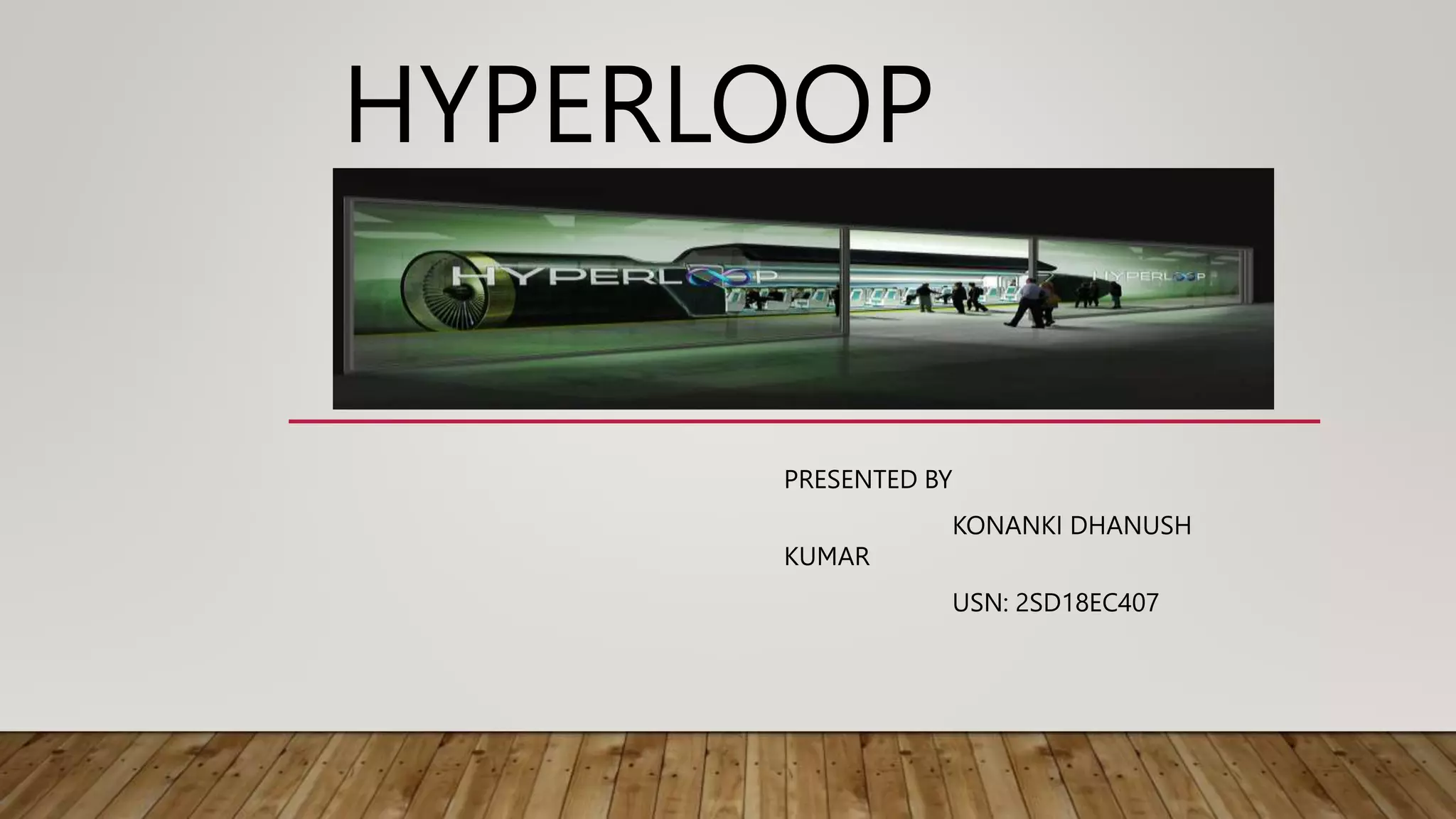
HYPERLOOP
PRESENTED BY
KONANKI DHANUSH
KUMAR
USN: 2SD18EC407
CONTENTS
• INTRODUCTION
• BACKGROUND
• WHAT IS HYPERLOOP
• COMPONENTS OF HYPERLOOOP
• WORKING PRINCIPLE
• SPECIFICATIONS
• SWOT ANALYSIS
• MERITS & DEMERITS
• CONCLUSION
• Hyperloop is a conceptual transportation system designed to lower cost and travel time
relative to current high speed rail system.
E.g. Bullet train.
• Elon Musk and the team of engineers from Tesla motors and the Space X proposed the
idea in August 2013
• This system can achieve an average speed of 598 mph (962 km/h), and a top speed of
760 mph (1,220 km/h).
• Propulsion is handled by a set of linear electromagnetic accelerators mounted to the
tube
INTRODUCTION
Existing conventional modes of transportation of people consists of four unique types : rail, road,
Water , and air. These modes of transport tend to be either relatively slow and expensive.
Hyperloop is a new mode of transport that seeks to change this trend by being both fast and
Inexpensive for people and goods.
This new transportation system should be
• Safer
• Faster
• Economical
• Convenient
• Immune to weather
• Self powered
• Resistant to earthquakes
• Less hindrance to existing infrastructure
BACKGROUND
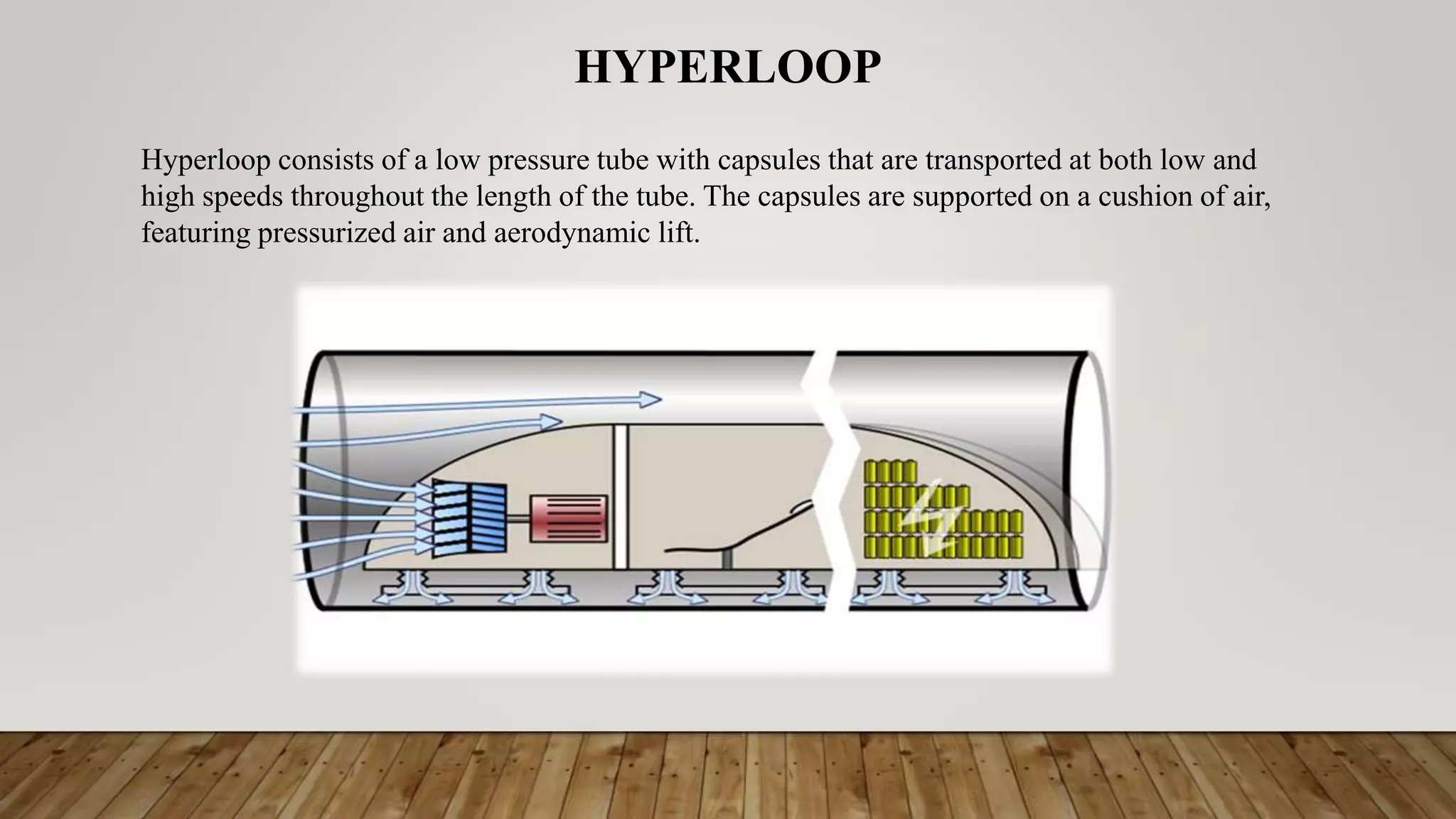
Hyperloop consists of a low pressure tube with capsules that are transported at both low and
high speeds throughout the length of the tube. The capsules are supported on a cushion of air,
featuring pressurized air and aerodynamic lift.
HYPERLOOP
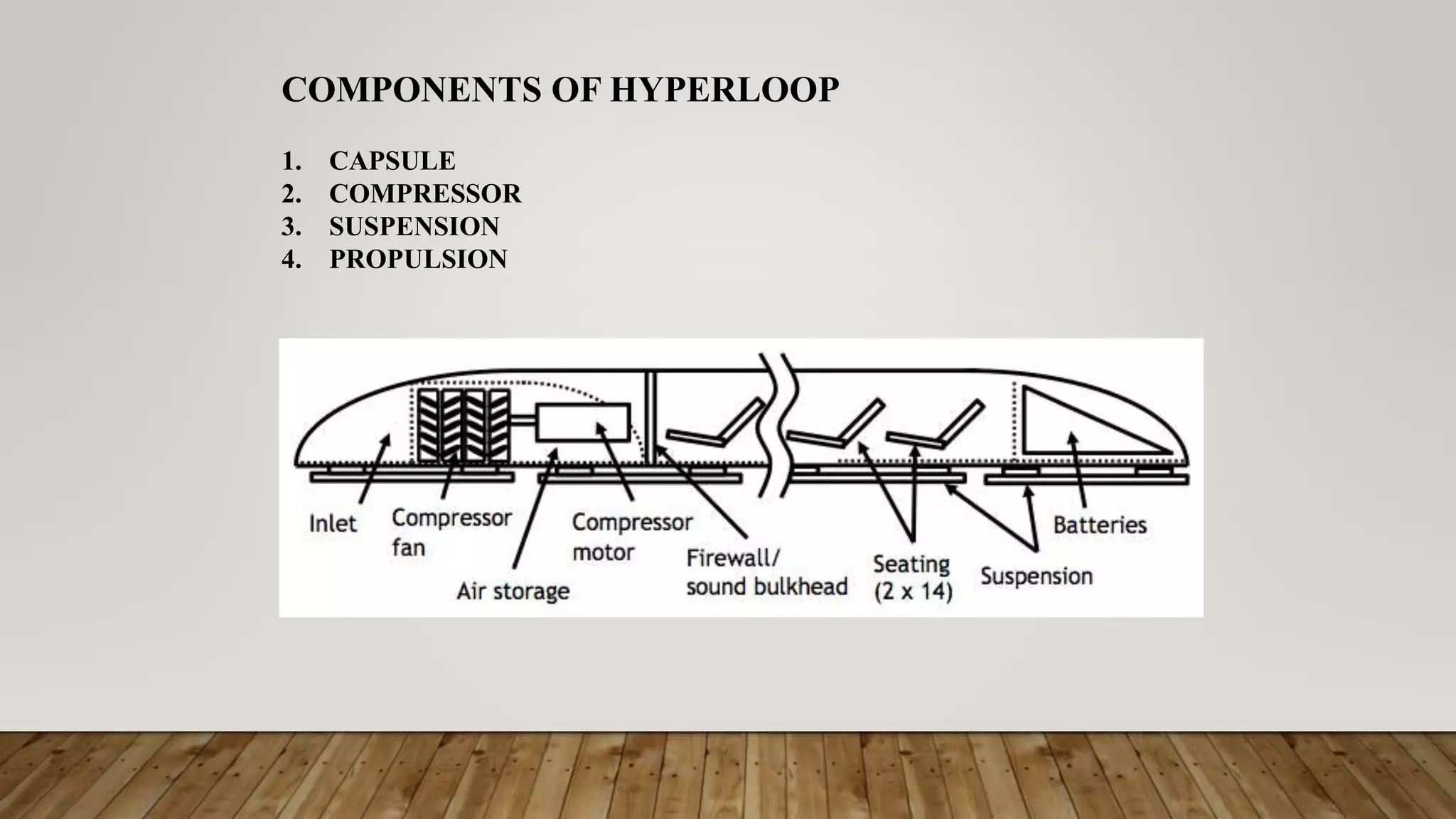
COMPONENTS OF HYPERLOOP
1. CAPSULE
2. COMPRESSOR
3. SUSPENSION
4. PROPULSION
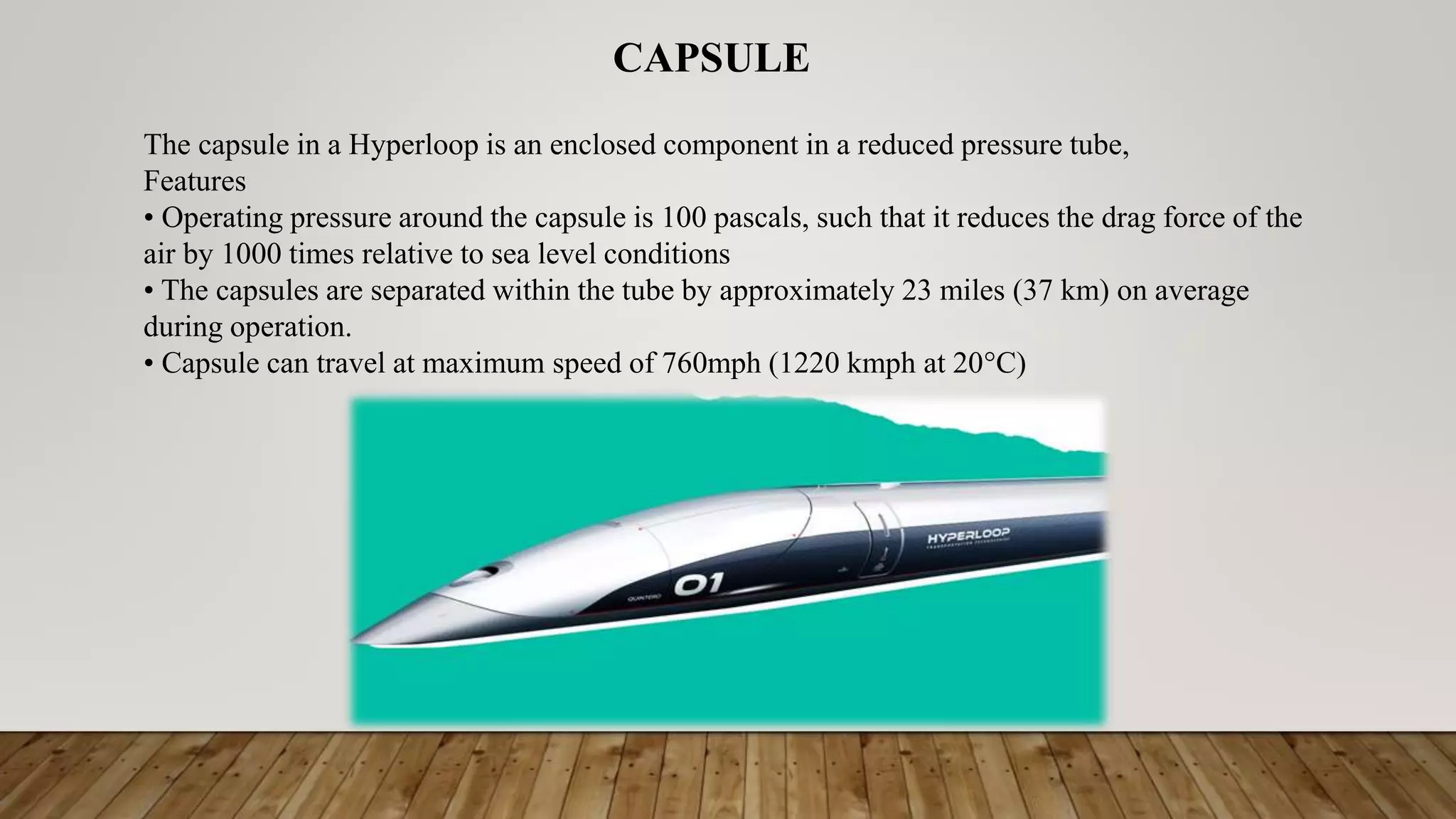
The capsule in a Hyperloop is an enclosed component in a reduced pressure tube,
Features
• Operating pressure around the capsule is 100 pascals, such that it reduces the drag force of the
air by 1000 times relative to sea level conditions
• The capsules are separated within the tube by approximately 23 miles (37 km) on average
during operation.
• Capsule can travel at maximum speed of 760mph (1220 kmph at 20°C)
CAPSULE
COMPRESSOR
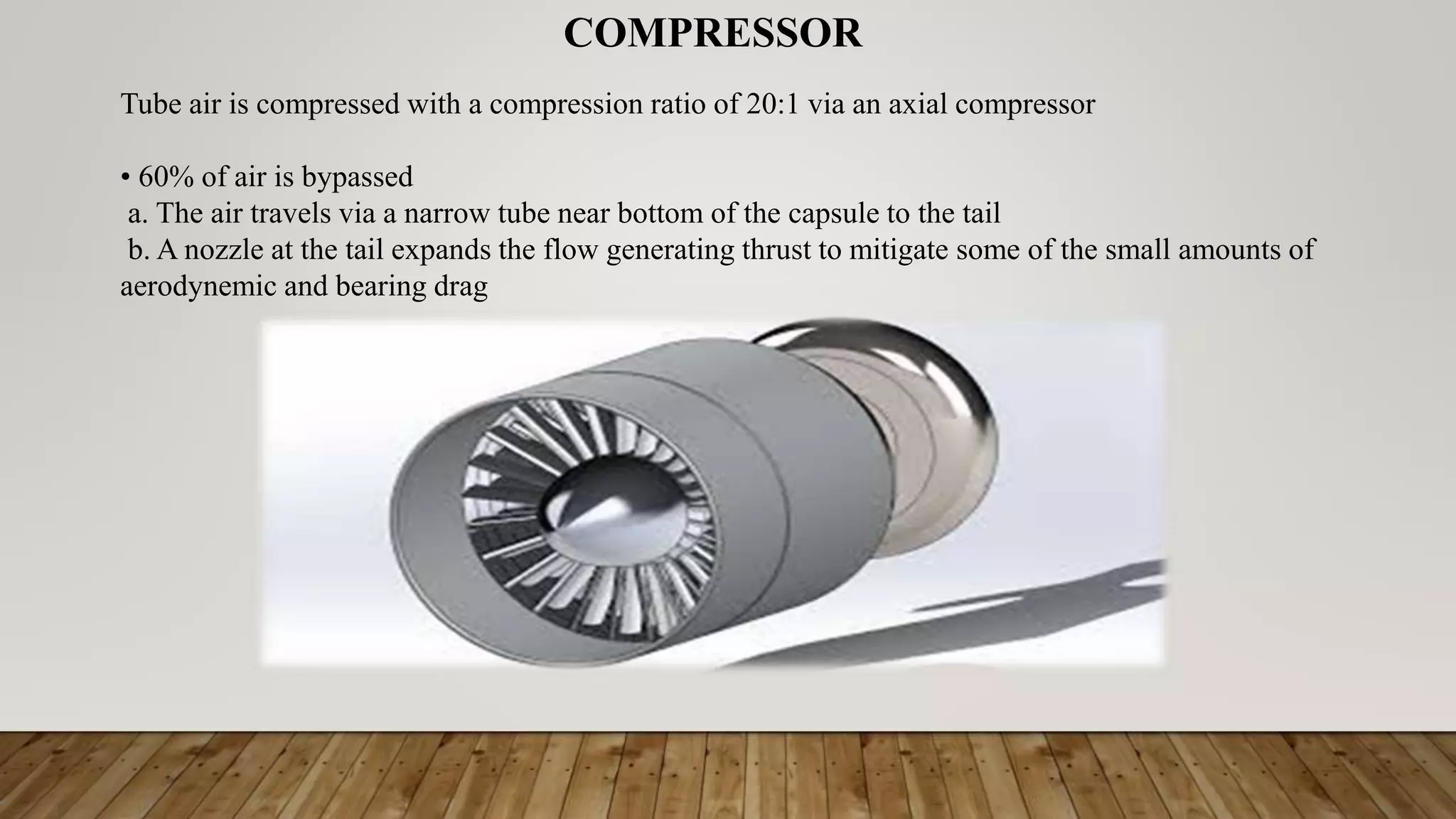
Tube air is compressed with a compression ratio of 20:1 via an axial compressor
• 60% of air is bypassed
a. The air travels via a narrow tube near bottom of the capsule to the tail
b. A nozzle at the tail expands the flow generating thrust to mitigate some of the small amounts of
aerodynemic and bearing drag
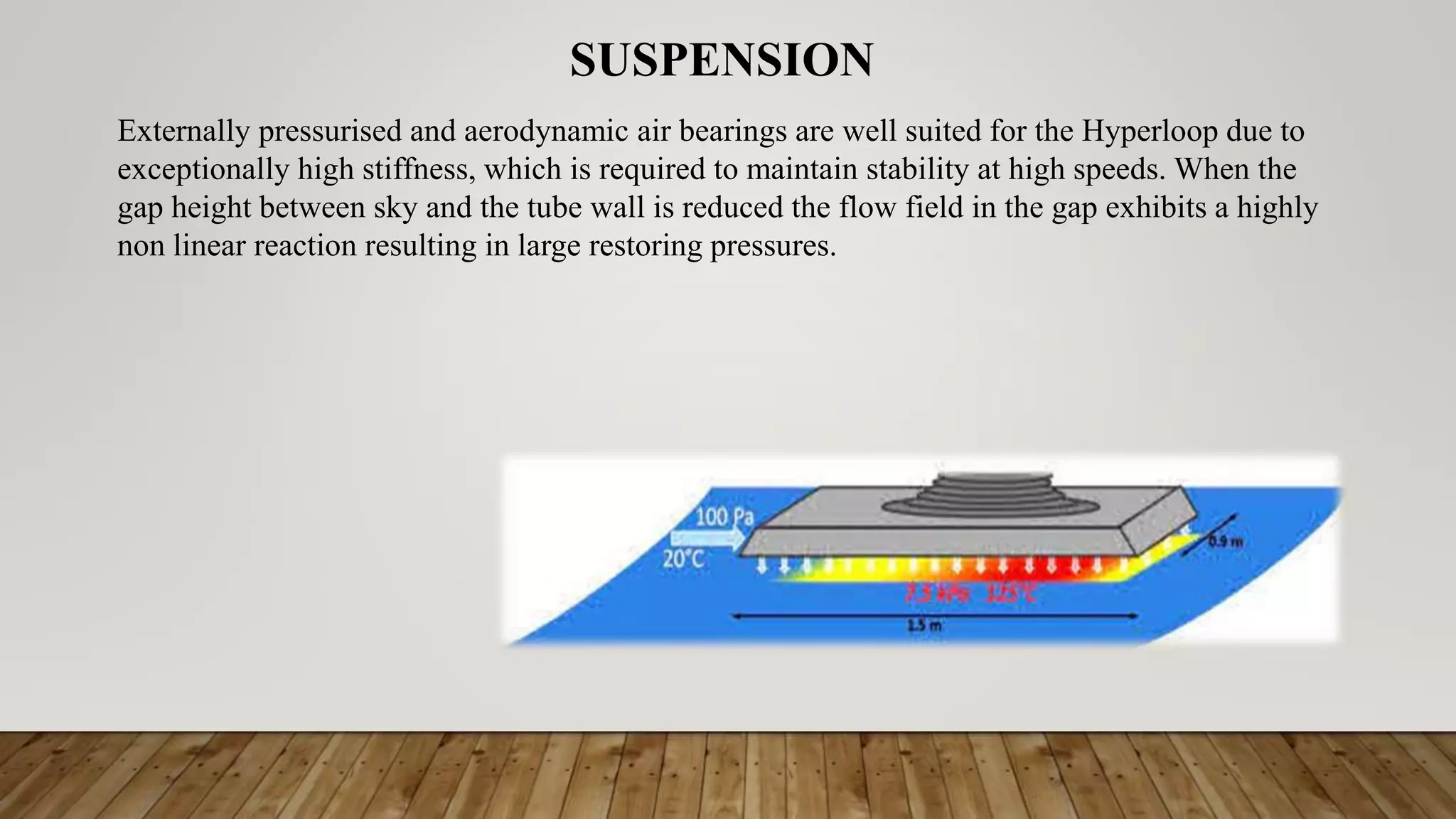
Externally pressurised and aerodynamic air bearings are well suited for the Hyperloop due to
exceptionally high stiffness, which is required to maintain stability at high speeds. When the
gap height between sky and the tube wall is reduced the flow field in the gap exhibits a highly
non linear reaction resulting in large restoring pressures.
SUSPENSION
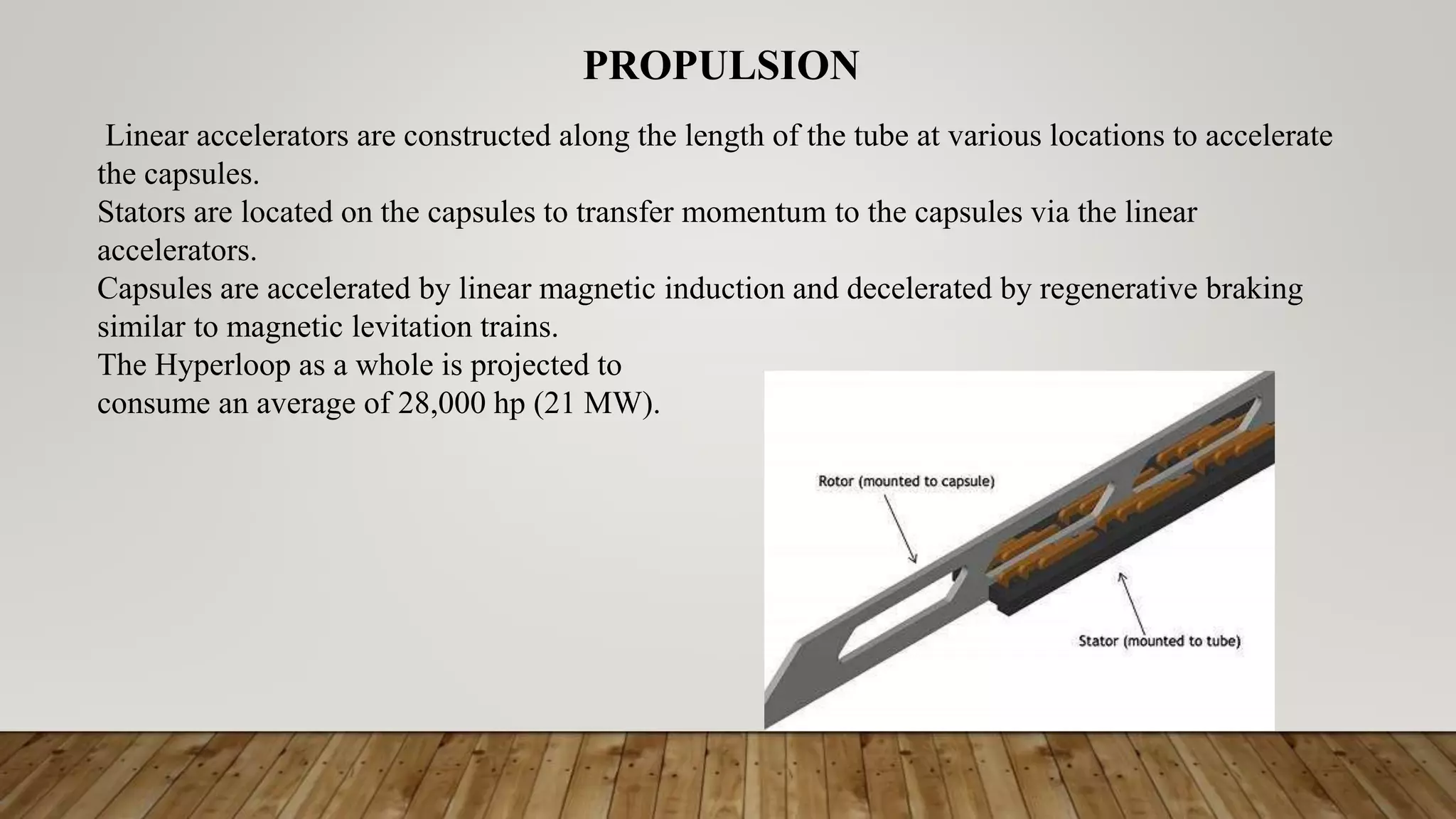
Linear accelerators are constructed along the length of the tube at various locations to accelerate
the capsules.
Stators are located on the capsules to transfer momentum to the capsules via the linear
accelerators.
Capsules are accelerated by linear magnetic induction and decelerated by regenerative braking
similar to magnetic levitation trains.
The Hyperloop as a whole is projected to
consume an average of 28,000 hp (21 MW).
PROPULSION
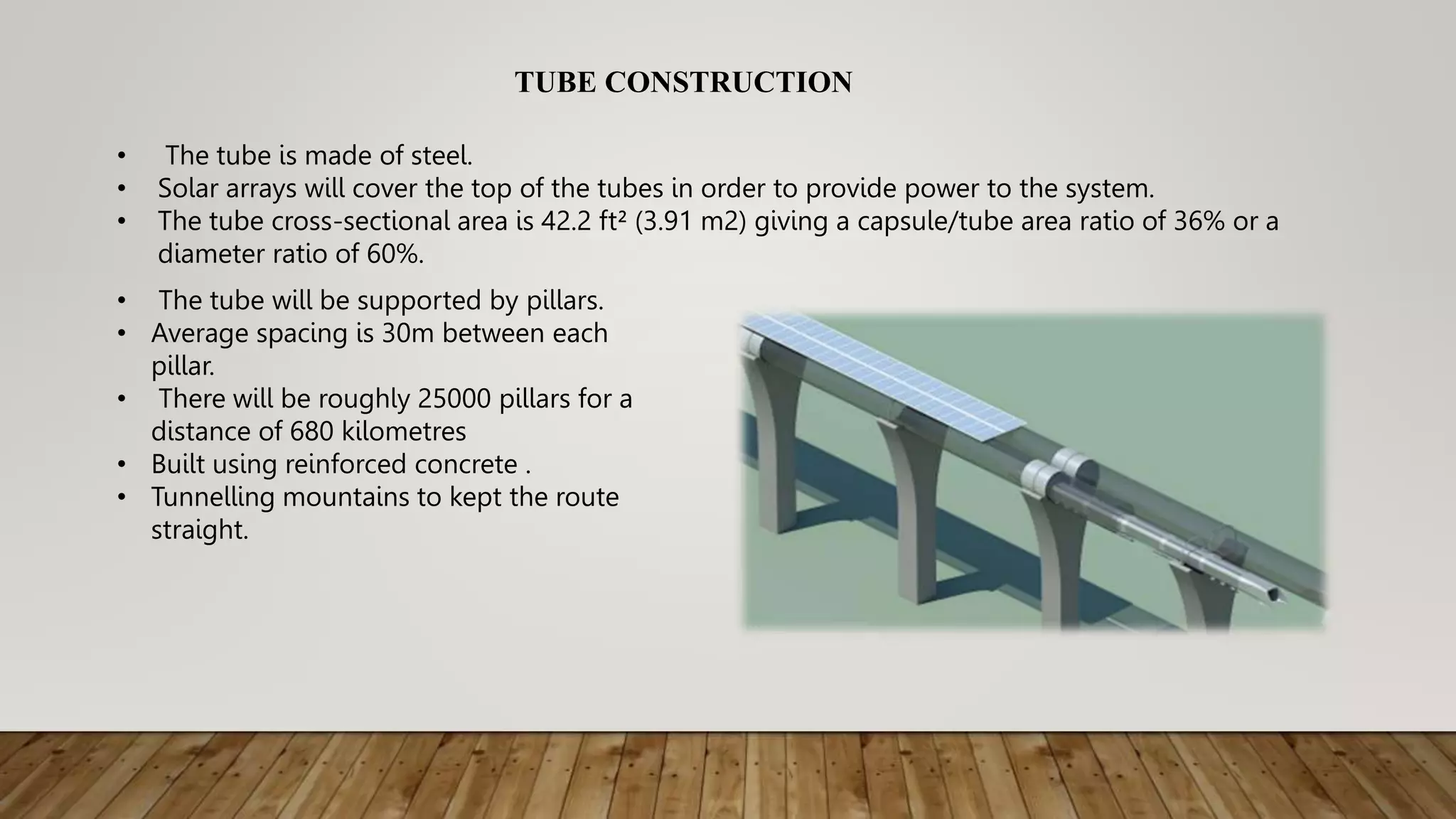
TUBE CONSTRUCTION
• The tube is made of steel.
• Solar arrays will cover the top of the tubes in order to provide power to the system.
• The tube cross-sectional area is 42.2 ft² (3.91 m2) giving a capsule/tube area ratio of 36% or a
diameter ratio of 60%.
• The tube will be supported by pillars.
• Average spacing is 30m between each
pillar.
• There will be roughly 25000 pillars for a
distance of 680 kilometres
• Built using reinforced concrete .
• Tunnelling mountains to kept the route
straight.
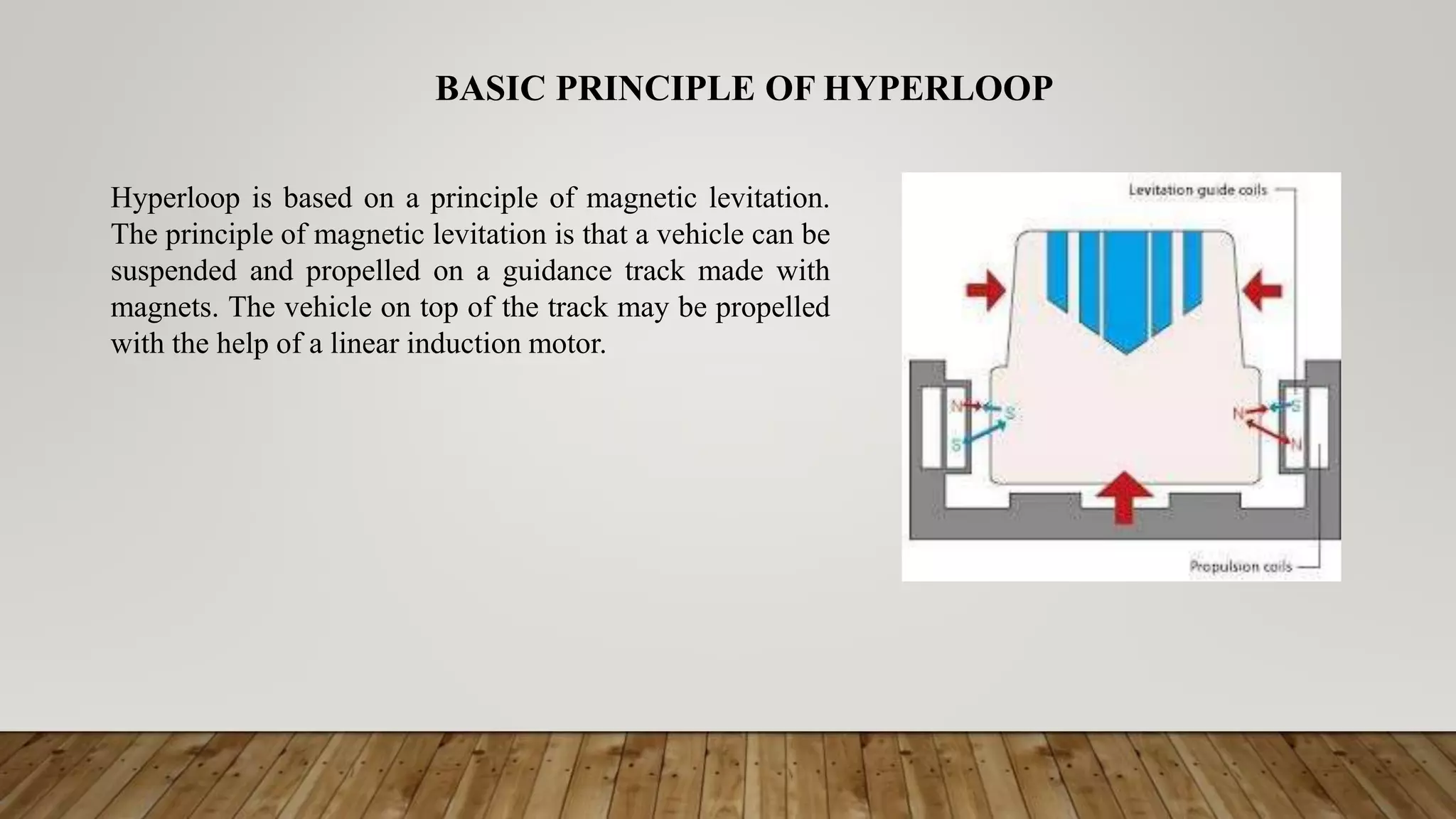
BASIC PRINCIPLE OF HYPERLOOP
Hyperloop is based on a principle of magnetic levitation.
The principle of magnetic levitation is that a vehicle can be
suspended and propelled on a guidance track made with
magnets. The vehicle on top of the track may be propelled
with the help of a linear induction motor.
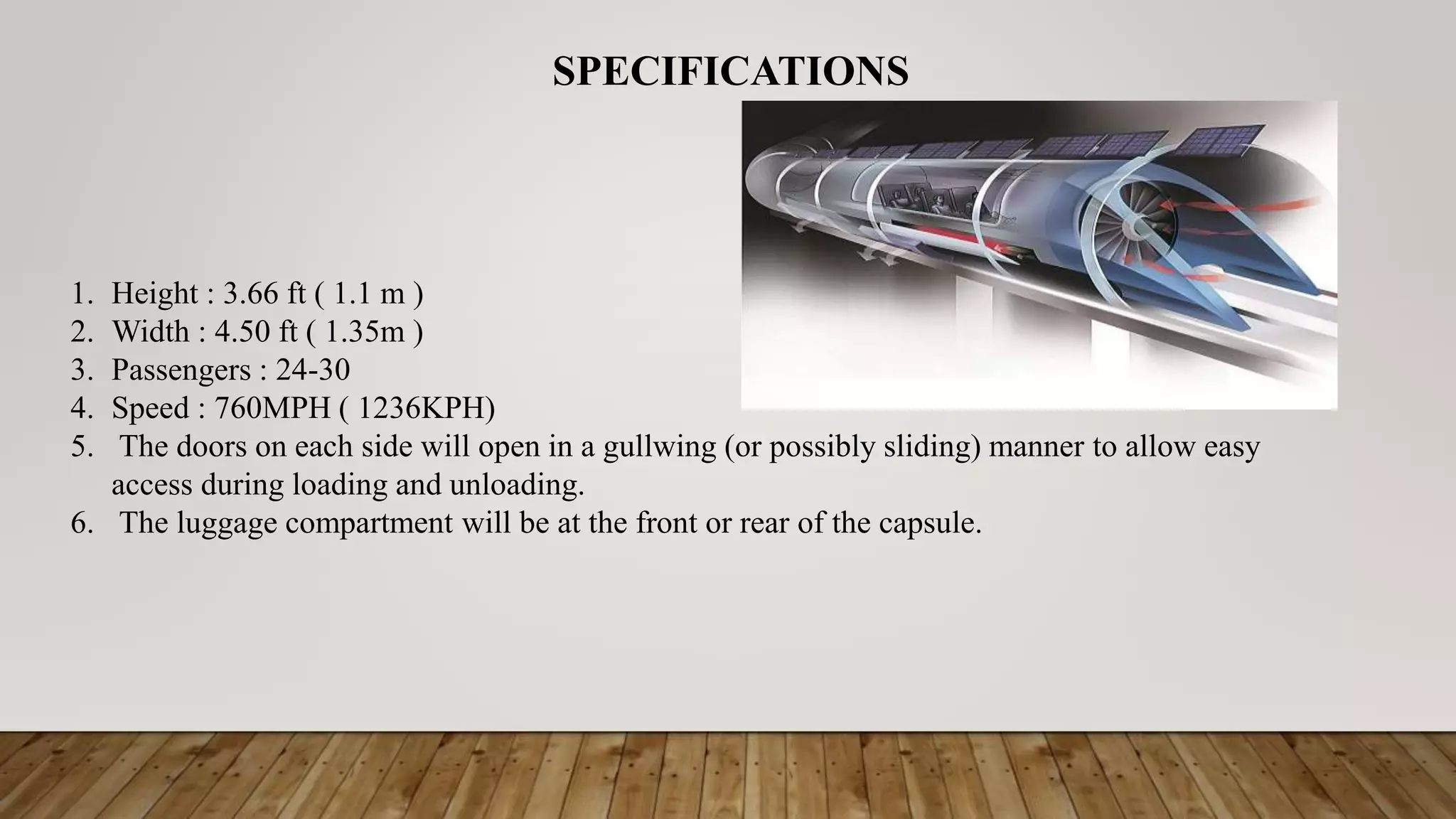
1. Height : 3.66 ft ( 1.1 m )
2. Width : 4.50 ft ( 1.35m )
3. Passengers : 24-30
4. Speed : 760MPH ( 1236KPH)
5. The doors on each side will open in a gullwing (or possibly sliding) manner to allow easy
access during loading and unloading.
6. The luggage compartment will be at the front or rear of the capsule.
SPECIFICATIONS
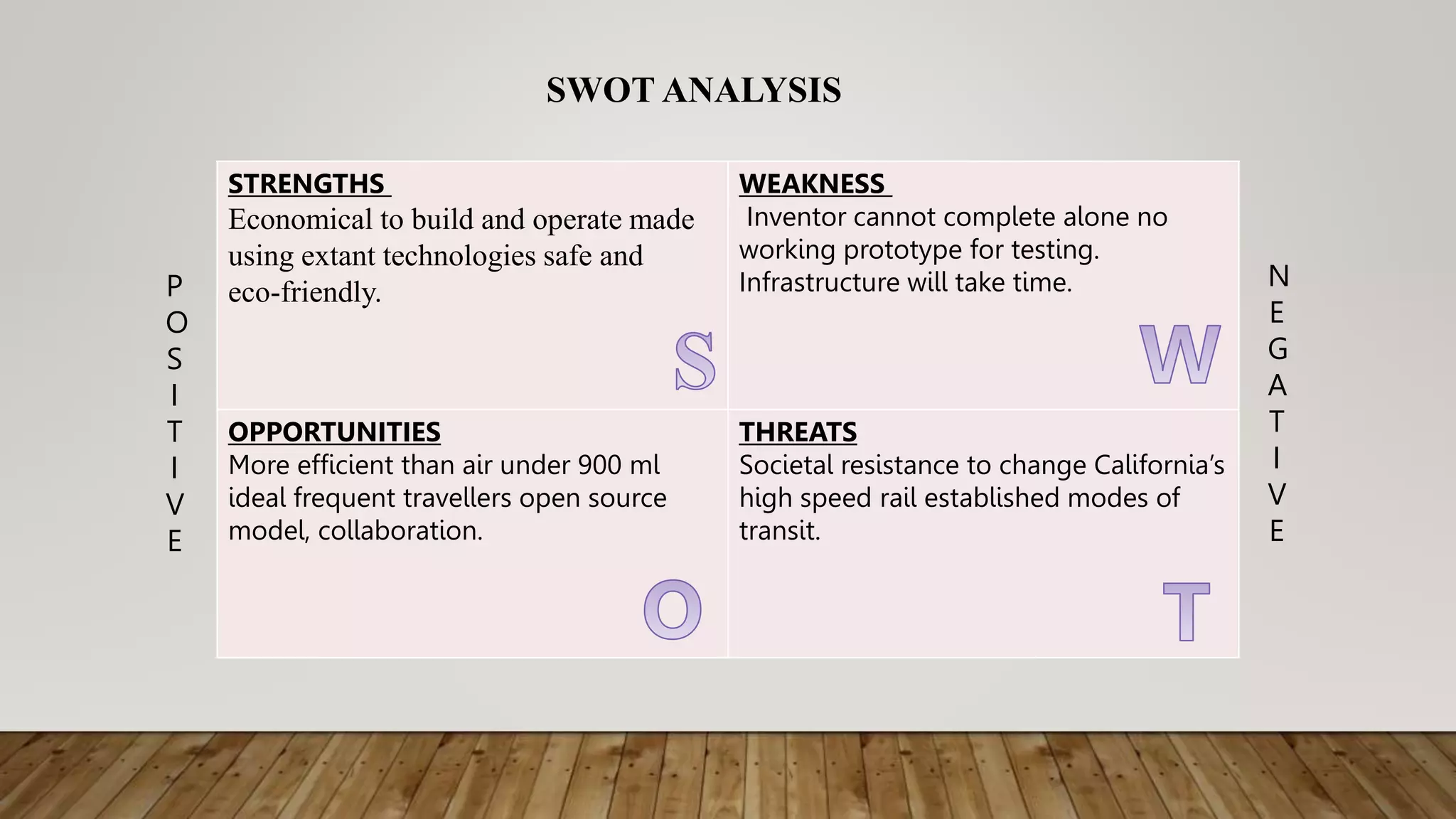
STRENGTHS
Economical to build and operate made
using extant technologies safe and
eco-friendly.
WEAKNESS
Inventor cannot complete alone no
working prototype for testing.
Infrastructure will take time.
OPPORTUNITIES
More efficient than air under 900 ml
ideal frequent travellers open source
model, collaboration.
THREATS
Societal resistance to change California’s
high speed rail established modes of
transit.
SWOT ANALYSIS
P
O
S
I
T
I
V
E
N
E
G
A
T
I
V
E
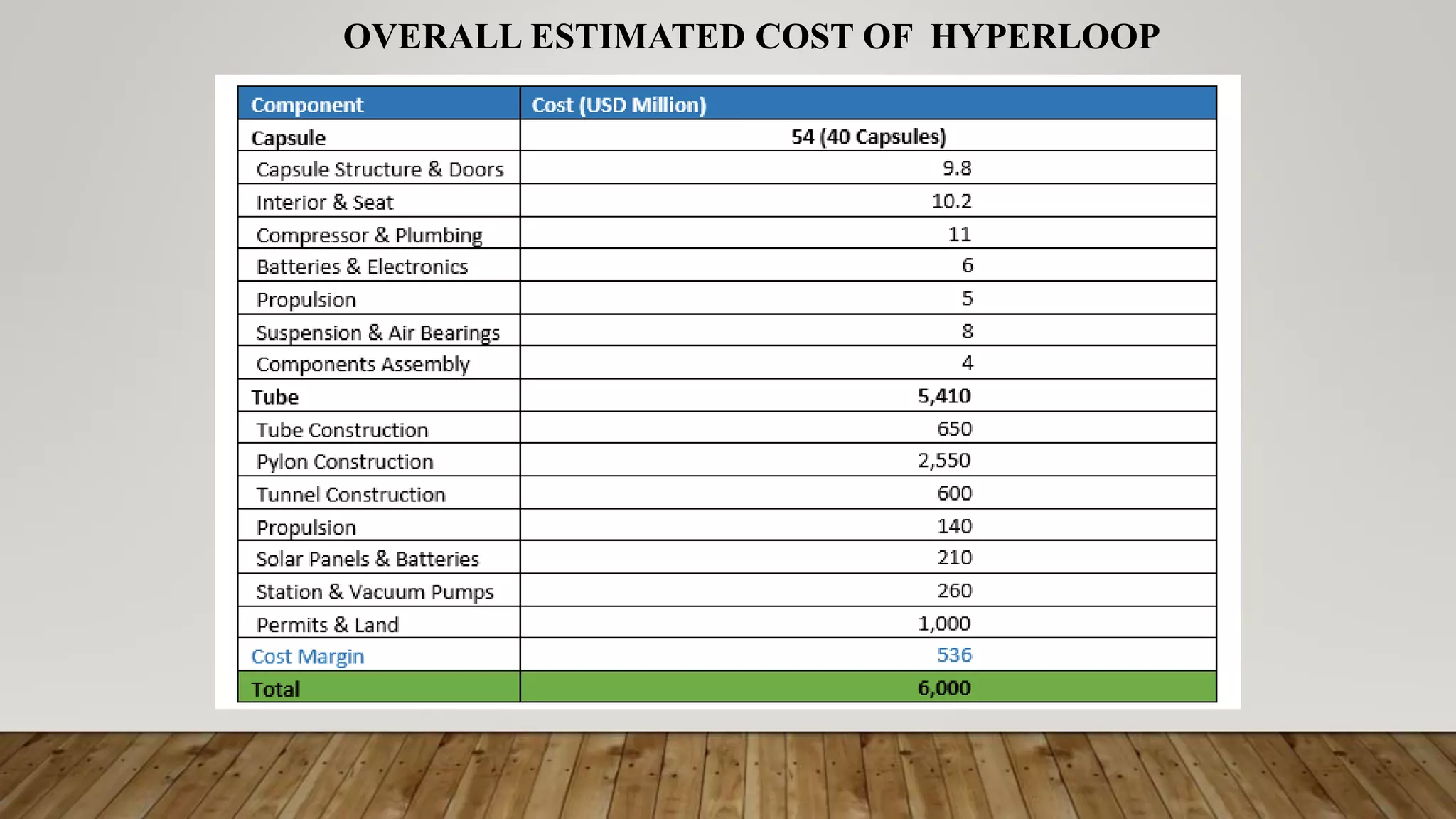
OVERALL ESTIMATED COST OF HYPERLOOP
MERITS
1. It saves the travelling time.
2. There is no problem of traffic.
3. It is powered by the solar panel.
4. It can travel in any kind of weather.
5. Cost of hyperloop is low.
6. Not disruptive to those along the route.
7. More convenient.
8. Resistance to earthquake.
DEMERITS
1. Turning will be critical.
2. Less movable space for passenger.
3. High speed might cause dizziness in some passenger.
4. Punctured tunnel could cause shockwaves.
CONCLUSION
1. A high speed transportation system known as Hyperloop has been developed in this report.
2. Hyperloop transportation system can be used over the conventional modes of transportation that are
rail, road, water and air.
3. At very high speed it provides better comfort and cost is also low.
4. By reducing the pressure of the air in the tube which reduces simple air drag and enables the capsule
to move faster than through a tube at atmospheric pressure.
hyperloop.pptx

hyperloop.pptx

  • 1.
  • 2.
    CONTENTS • INTRODUCTION • BACKGROUND •WHAT IS HYPERLOOP • COMPONENTS OF HYPERLOOOP • WORKING PRINCIPLE • SPECIFICATIONS • SWOT ANALYSIS • MERITS & DEMERITS • CONCLUSION
  • 3.
    • Hyperloop isa conceptual transportation system designed to lower cost and travel time relative to current high speed rail system. E.g. Bullet train. • Elon Musk and the team of engineers from Tesla motors and the Space X proposed the idea in August 2013 • This system can achieve an average speed of 598 mph (962 km/h), and a top speed of 760 mph (1,220 km/h). • Propulsion is handled by a set of linear electromagnetic accelerators mounted to the tube INTRODUCTION
  • 4.
    Existing conventional modesof transportation of people consists of four unique types : rail, road, Water , and air. These modes of transport tend to be either relatively slow and expensive. Hyperloop is a new mode of transport that seeks to change this trend by being both fast and Inexpensive for people and goods. This new transportation system should be • Safer • Faster • Economical • Convenient • Immune to weather • Self powered • Resistant to earthquakes • Less hindrance to existing infrastructure BACKGROUND
  • 5.
    Hyperloop consists ofa low pressure tube with capsules that are transported at both low and high speeds throughout the length of the tube. The capsules are supported on a cushion of air, featuring pressurized air and aerodynamic lift. HYPERLOOP
  • 6.
    COMPONENTS OF HYPERLOOP 1.CAPSULE 2. COMPRESSOR 3. SUSPENSION 4. PROPULSION
  • 7.
    The capsule ina Hyperloop is an enclosed component in a reduced pressure tube, Features • Operating pressure around the capsule is 100 pascals, such that it reduces the drag force of the air by 1000 times relative to sea level conditions • The capsules are separated within the tube by approximately 23 miles (37 km) on average during operation. • Capsule can travel at maximum speed of 760mph (1220 kmph at 20°C) CAPSULE
  • 8.
    COMPRESSOR Tube air iscompressed with a compression ratio of 20:1 via an axial compressor • 60% of air is bypassed a. The air travels via a narrow tube near bottom of the capsule to the tail b. A nozzle at the tail expands the flow generating thrust to mitigate some of the small amounts of aerodynemic and bearing drag
  • 9.
    Externally pressurised andaerodynamic air bearings are well suited for the Hyperloop due to exceptionally high stiffness, which is required to maintain stability at high speeds. When the gap height between sky and the tube wall is reduced the flow field in the gap exhibits a highly non linear reaction resulting in large restoring pressures. SUSPENSION
  • 10.
    Linear accelerators areconstructed along the length of the tube at various locations to accelerate the capsules. Stators are located on the capsules to transfer momentum to the capsules via the linear accelerators. Capsules are accelerated by linear magnetic induction and decelerated by regenerative braking similar to magnetic levitation trains. The Hyperloop as a whole is projected to consume an average of 28,000 hp (21 MW). PROPULSION
  • 11.
    TUBE CONSTRUCTION • Thetube is made of steel. • Solar arrays will cover the top of the tubes in order to provide power to the system. • The tube cross-sectional area is 42.2 ft² (3.91 m2) giving a capsule/tube area ratio of 36% or a diameter ratio of 60%. • The tube will be supported by pillars. • Average spacing is 30m between each pillar. • There will be roughly 25000 pillars for a distance of 680 kilometres • Built using reinforced concrete . • Tunnelling mountains to kept the route straight.
  • 12.
    BASIC PRINCIPLE OFHYPERLOOP Hyperloop is based on a principle of magnetic levitation. The principle of magnetic levitation is that a vehicle can be suspended and propelled on a guidance track made with magnets. The vehicle on top of the track may be propelled with the help of a linear induction motor.
  • 13.
    1. Height :3.66 ft ( 1.1 m ) 2. Width : 4.50 ft ( 1.35m ) 3. Passengers : 24-30 4. Speed : 760MPH ( 1236KPH) 5. The doors on each side will open in a gullwing (or possibly sliding) manner to allow easy access during loading and unloading. 6. The luggage compartment will be at the front or rear of the capsule. SPECIFICATIONS
  • 14.
    STRENGTHS Economical to buildand operate made using extant technologies safe and eco-friendly. WEAKNESS Inventor cannot complete alone no working prototype for testing. Infrastructure will take time. OPPORTUNITIES More efficient than air under 900 ml ideal frequent travellers open source model, collaboration. THREATS Societal resistance to change California’s high speed rail established modes of transit. SWOT ANALYSIS P O S I T I V E N E G A T I V E
  • 15.
  • 16.
    MERITS 1. It savesthe travelling time. 2. There is no problem of traffic. 3. It is powered by the solar panel. 4. It can travel in any kind of weather. 5. Cost of hyperloop is low. 6. Not disruptive to those along the route. 7. More convenient. 8. Resistance to earthquake.
  • 17.
    DEMERITS 1. Turning willbe critical. 2. Less movable space for passenger. 3. High speed might cause dizziness in some passenger. 4. Punctured tunnel could cause shockwaves.
  • 18.
    CONCLUSION 1. A highspeed transportation system known as Hyperloop has been developed in this report. 2. Hyperloop transportation system can be used over the conventional modes of transportation that are rail, road, water and air. 3. At very high speed it provides better comfort and cost is also low. 4. By reducing the pressure of the air in the tube which reduces simple air drag and enables the capsule to move faster than through a tube at atmospheric pressure.