CURRENT MODES OF
TRANSPORTATION:
 ROAD ( Slow and Time consuming)
 WATER (Slow and risky)
 RAILWAYS (Slow and Time consuming)
 AIR (Expensive and risky)
Is there a new mode of
transportation technology?
 Yes, here comes the new innovation in
transportation that takes a step towards dynamic
future, framed by the great personality, a
successive entrepreneur, CEO and Co-founder of
TESLA and SpaceX “ELON MUSK”, ignited an
idea of,
HYPERLOOP
What is HYPERLOOP?
⚫Hyperloop is a mode of passenger and goods
transportation that propels a capsule like vehicle
through a near vacuum tube at more than airline
speed.
⚫Hyperloop is currently in development by a
number of companies, which could see
passenger travelling at 700 miles per hour in
floating capsules.
⚫ The tube is made of steel. Two tubes will be welded together
in a side
by side configuration to allow the capsules to travel both
directions.
⚫ Pylons are placed every 100 ft (30 m) to support the tube.
COMPONENTS OF HYPERLOOP:
1) TUBE-
⚫ Capsules are used to carry
passengers and goods.
⚫ These capsules are shaped
aerodynamically to reduce the drag.
⚫ Capsules consists of linear induction
motor under the hood, compressor at
the front and air bearings at the
bottom.
⚫ Capsules are designed with latest
technologies and houses new form of
gadgets for the comfort and
2) CAPSULE/POD-
⚫ Compressor is placed at the front
part of the capsule.
⚫ Compressor fans sucks the low
pressure air. After compression,
compressed air is supplied to the
air bearings and also at the rear
end of the capsule.
3) COMPRESSOR-
⚫ Air bearings are used as
suspension for the capsule.
⚫ Air bearings can also be used
to levitate the capsule with the
help of compressed air that
flows from compressor to air
bearings.
4) SUSPENSION:
accelerators.
5) PROPULSION-
⚫ Capsule houses linear induction
motor along the length to
accelerate and decelerate.
⚫ Linear stators are placed on the
capsules to transfer momentum
to the capsule via linear
6) POWER SOURCE-
⚫ The main resource for the power is
Solar energy.
⚫ Solar arrays are placed along the
length of the tube.
⚫ Necessary battery arrangements are
made to store the energy to operate
at night and in cloudy weather
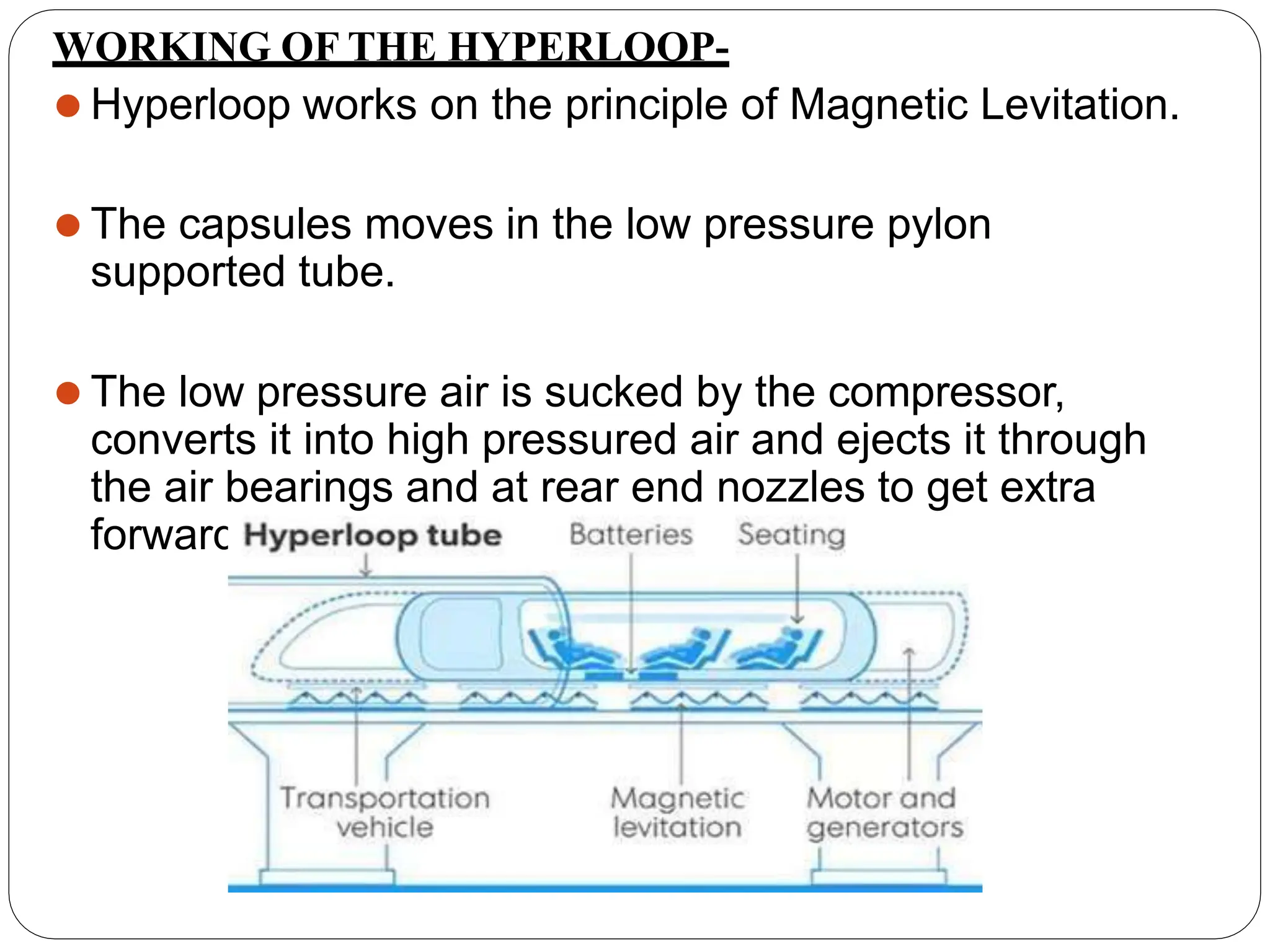
WORKING OF THE HYPERLOOP-
⚫ Hyperloop works on the principle of Magnetic Levitation.
⚫ The capsules moves in the low pressure pylon
supported tube.
⚫ The low pressure air is sucked by the compressor,
converts it into high pressured air and ejects it through
the air bearings and at rear end nozzles to get extra
forward thrust.
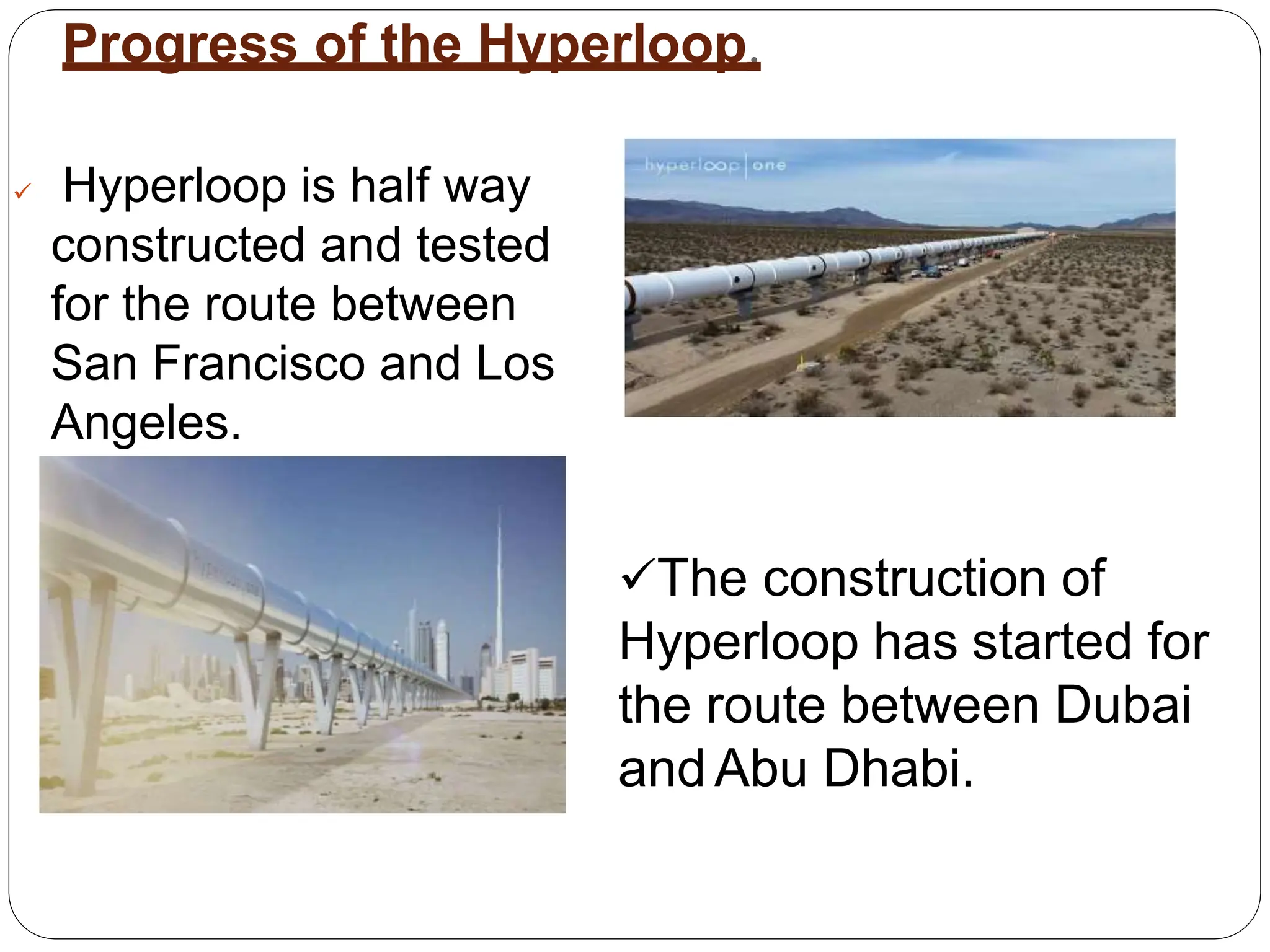
Progress of the Hyperloop.
 Hyperloop is half way
constructed and tested
for the route between
San Francisco and Los
Angeles.
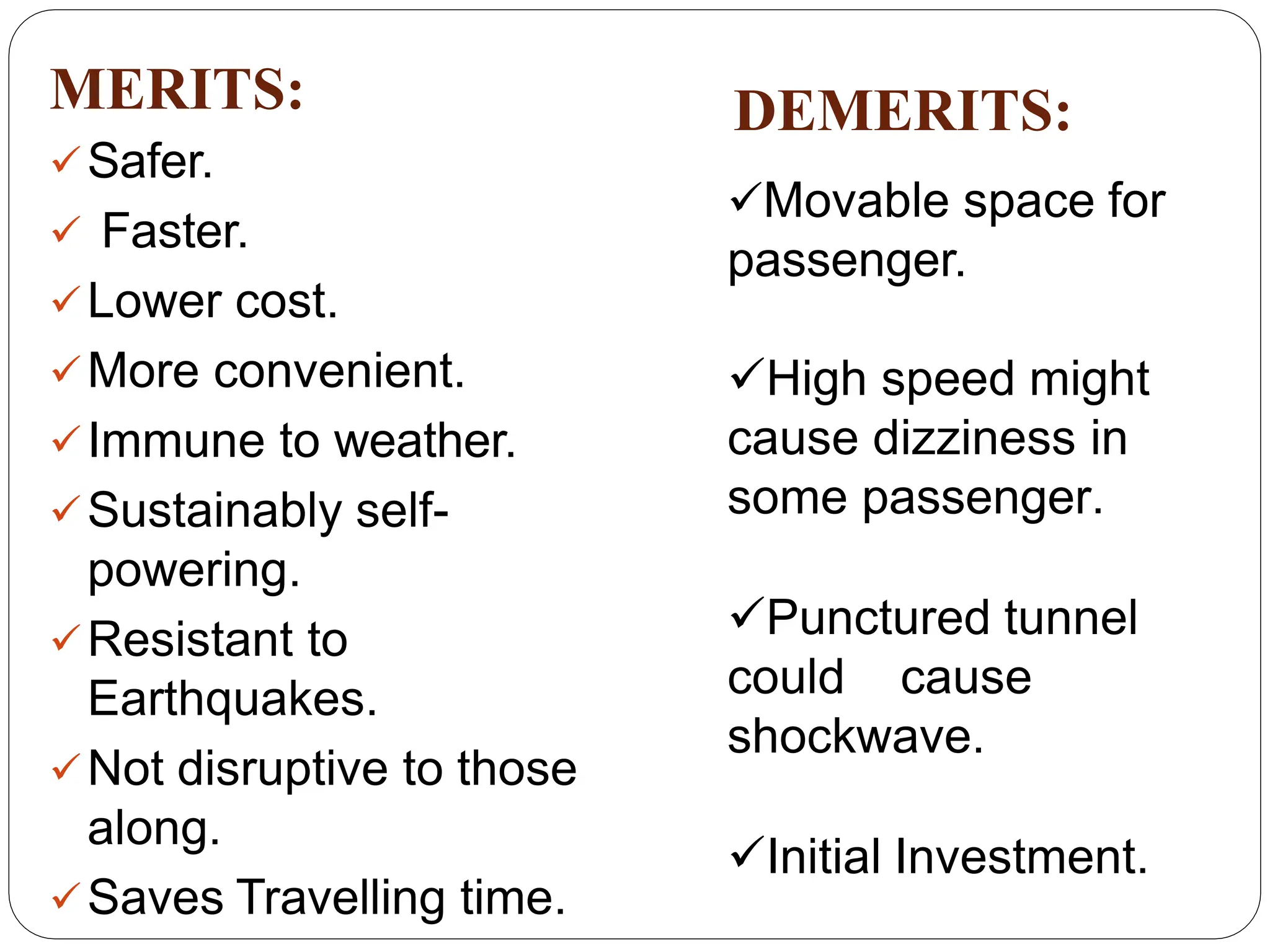
The construction of
Hyperloop has started for
the route between Dubai
and Abu Dhabi.
Development of Hyperloop in India-
⚫ Projects have been approved by the Indian Government for
constructing the Hyperloop for the routes between,
• Amravati to Vijayawada (estimated time 6-8 minutes to
reach)
• Mumbai to Chennai (estimated time 63 minutes)
• Bengaluru to Chennai (estimated time 30 minutes)
• Mumbai to Pune (estimated time 25 minutes)
MERITS:
Safer.
 Faster.
Lower cost.
More convenient.
Immune to weather.
Sustainably self-
powering.
Resistant to
Earthquakes.
Not disruptive to those
along.
Saves Travelling time.
DEMERITS:
Movable space for
passenger.
High speed might
cause dizziness in
some passenger.
Punctured tunnel
could cause
shockwave.
Initial Investment.
CONCLUSION:
⚫ Hyperloop transportation system can be used over
the conventional modes of transportation that are rail,
road, water and air.
⚫ At very high speed it provides better comfort and cost
is also low.
⚫ By reducing the pressure of the air in the tube which
reduces simple air drag and enables the capsule to
move faster.
⚫ Even taking demerits into the account,Hyperloop still
proves to be a dynamic transportation mode for the
future.
SOME BASIC QUERIES RELATED
TO HYPERLOOP...
⚫ Are Passengers able to breathe in the Hyperloop?
YES, it’s similar to how we breathe in aeroplanes
⚫Will the passengers be able to cope up with the speed of
Hyperloop?
YES, NASA has some interesting answer related to it:
“If you’re traveling at exactly 700 mph, you can drink a Coke,
you can do anything you like,” said NASAAmes research
psychologist Lee Stone.
So, a passenger would experience airplane-takeoff levels of
unease for close to two minutes,that would be the ride’s
only discomfort.
THANK-YOU

Construction management and their uses of materials

  • 1.
    CURRENT MODES OF TRANSPORTATION: ROAD ( Slow and Time consuming)  WATER (Slow and risky)  RAILWAYS (Slow and Time consuming)  AIR (Expensive and risky)
  • 2.
    Is there anew mode of transportation technology?  Yes, here comes the new innovation in transportation that takes a step towards dynamic future, framed by the great personality, a successive entrepreneur, CEO and Co-founder of TESLA and SpaceX “ELON MUSK”, ignited an idea of, HYPERLOOP
  • 3.
    What is HYPERLOOP? ⚫Hyperloopis a mode of passenger and goods transportation that propels a capsule like vehicle through a near vacuum tube at more than airline speed. ⚫Hyperloop is currently in development by a number of companies, which could see passenger travelling at 700 miles per hour in floating capsules.
  • 4.
    ⚫ The tubeis made of steel. Two tubes will be welded together in a side by side configuration to allow the capsules to travel both directions. ⚫ Pylons are placed every 100 ft (30 m) to support the tube. COMPONENTS OF HYPERLOOP: 1) TUBE-
  • 5.
    ⚫ Capsules areused to carry passengers and goods. ⚫ These capsules are shaped aerodynamically to reduce the drag. ⚫ Capsules consists of linear induction motor under the hood, compressor at the front and air bearings at the bottom. ⚫ Capsules are designed with latest technologies and houses new form of gadgets for the comfort and 2) CAPSULE/POD-
  • 6.
    ⚫ Compressor isplaced at the front part of the capsule. ⚫ Compressor fans sucks the low pressure air. After compression, compressed air is supplied to the air bearings and also at the rear end of the capsule. 3) COMPRESSOR- ⚫ Air bearings are used as suspension for the capsule. ⚫ Air bearings can also be used to levitate the capsule with the help of compressed air that flows from compressor to air bearings. 4) SUSPENSION:
  • 7.
    accelerators. 5) PROPULSION- ⚫ Capsulehouses linear induction motor along the length to accelerate and decelerate. ⚫ Linear stators are placed on the capsules to transfer momentum to the capsule via linear 6) POWER SOURCE- ⚫ The main resource for the power is Solar energy. ⚫ Solar arrays are placed along the length of the tube. ⚫ Necessary battery arrangements are made to store the energy to operate at night and in cloudy weather
  • 8.
    WORKING OF THEHYPERLOOP- ⚫ Hyperloop works on the principle of Magnetic Levitation. ⚫ The capsules moves in the low pressure pylon supported tube. ⚫ The low pressure air is sucked by the compressor, converts it into high pressured air and ejects it through the air bearings and at rear end nozzles to get extra forward thrust.
  • 9.
    Progress of theHyperloop.  Hyperloop is half way constructed and tested for the route between San Francisco and Los Angeles. The construction of Hyperloop has started for the route between Dubai and Abu Dhabi.
  • 10.
    Development of Hyperloopin India- ⚫ Projects have been approved by the Indian Government for constructing the Hyperloop for the routes between, • Amravati to Vijayawada (estimated time 6-8 minutes to reach) • Mumbai to Chennai (estimated time 63 minutes) • Bengaluru to Chennai (estimated time 30 minutes) • Mumbai to Pune (estimated time 25 minutes)
  • 11.
    MERITS: Safer.  Faster. Lower cost. Moreconvenient. Immune to weather. Sustainably self- powering. Resistant to Earthquakes. Not disruptive to those along. Saves Travelling time. DEMERITS: Movable space for passenger. High speed might cause dizziness in some passenger. Punctured tunnel could cause shockwave. Initial Investment.
  • 12.
    CONCLUSION: ⚫ Hyperloop transportationsystem can be used over the conventional modes of transportation that are rail, road, water and air. ⚫ At very high speed it provides better comfort and cost is also low. ⚫ By reducing the pressure of the air in the tube which reduces simple air drag and enables the capsule to move faster. ⚫ Even taking demerits into the account,Hyperloop still proves to be a dynamic transportation mode for the future.
  • 13.
    SOME BASIC QUERIESRELATED TO HYPERLOOP... ⚫ Are Passengers able to breathe in the Hyperloop? YES, it’s similar to how we breathe in aeroplanes ⚫Will the passengers be able to cope up with the speed of Hyperloop? YES, NASA has some interesting answer related to it: “If you’re traveling at exactly 700 mph, you can drink a Coke, you can do anything you like,” said NASAAmes research psychologist Lee Stone. So, a passenger would experience airplane-takeoff levels of unease for close to two minutes,that would be the ride’s only discomfort.
  • 14.