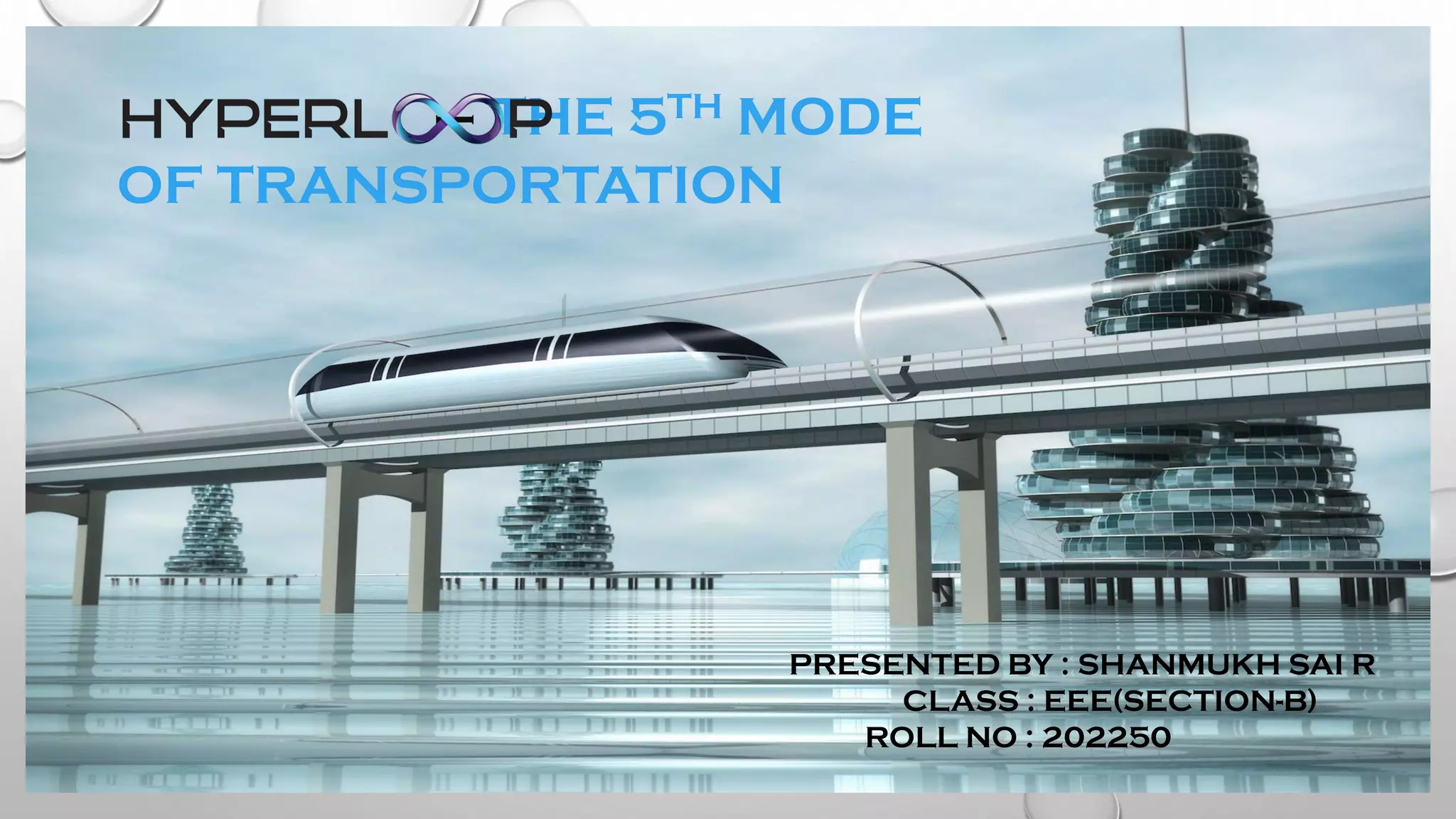
– THE 5TH MODE
OF TRANSPORTATION
PRESENTED BY : SHANMUKH SAI R
CLASS : EEE(SECTION-B)
ROLL NO : 202250
CONTENTS
➢CONVENTIONAL MODES OF TRANSPORTATION
➢WHAT IS HYPERLOOP ?
➢ORIGIN OF SPARK
➢WHO’S IDEA ?
➢COMPONENTS AND WORKING PRINCIPLE
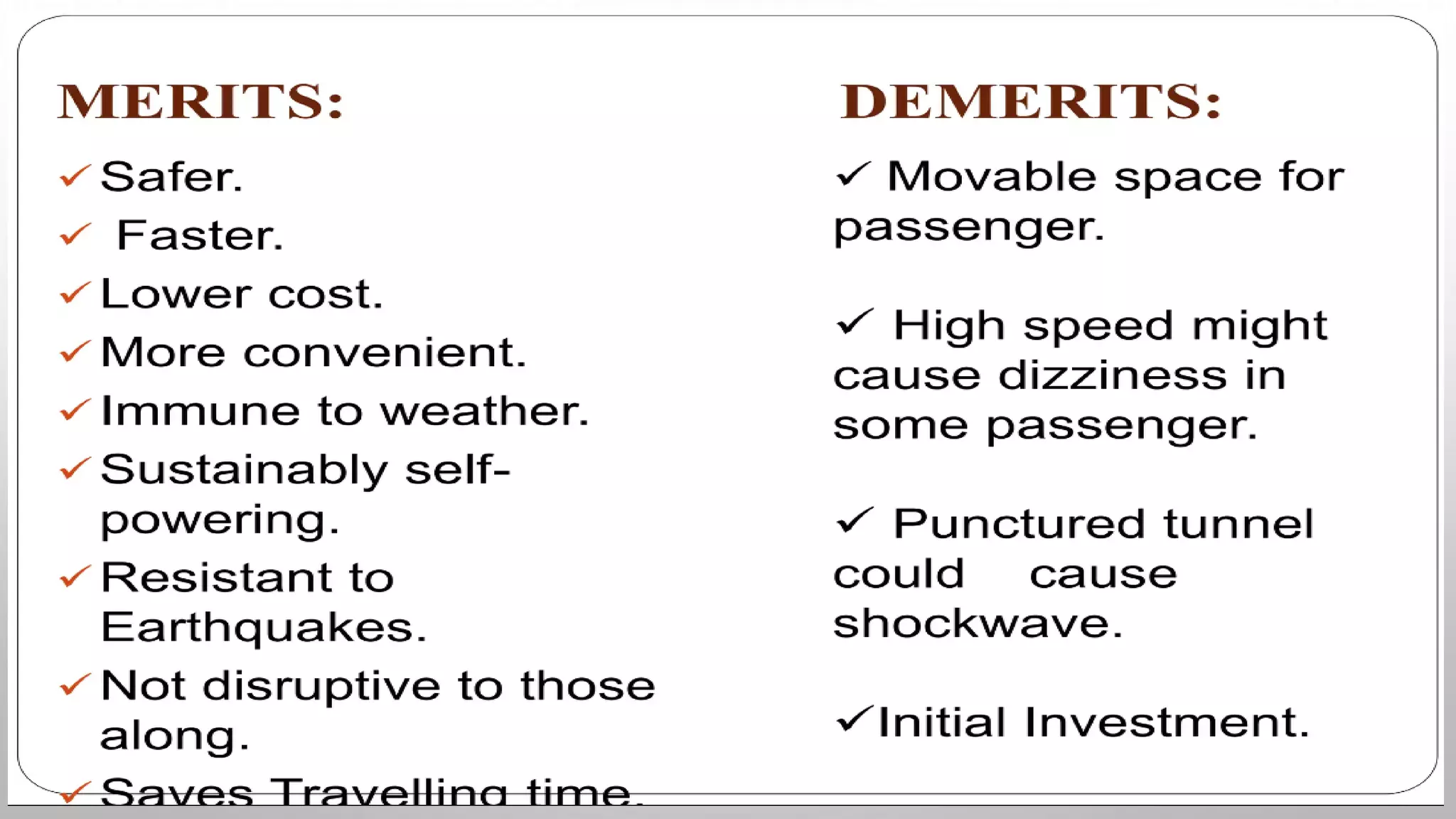
➢MERITS AND DEMERITS
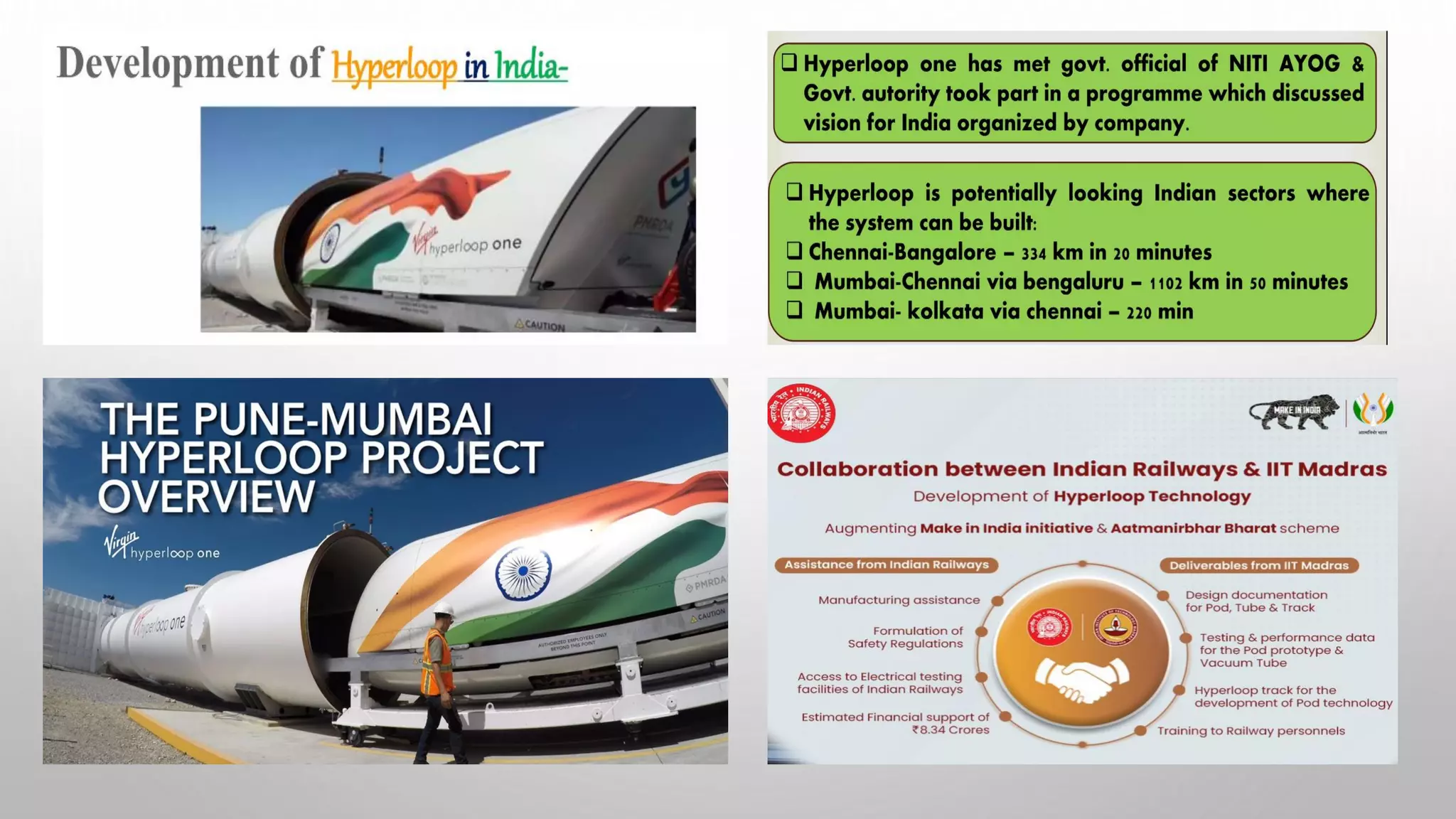
➢RECENT DEVELOPMENTS AND INSIGHT FOR INDIA
➢CONCLUSION
➢REFERENCES
CONVENTIONAL MODES OF TRANSPORTATION
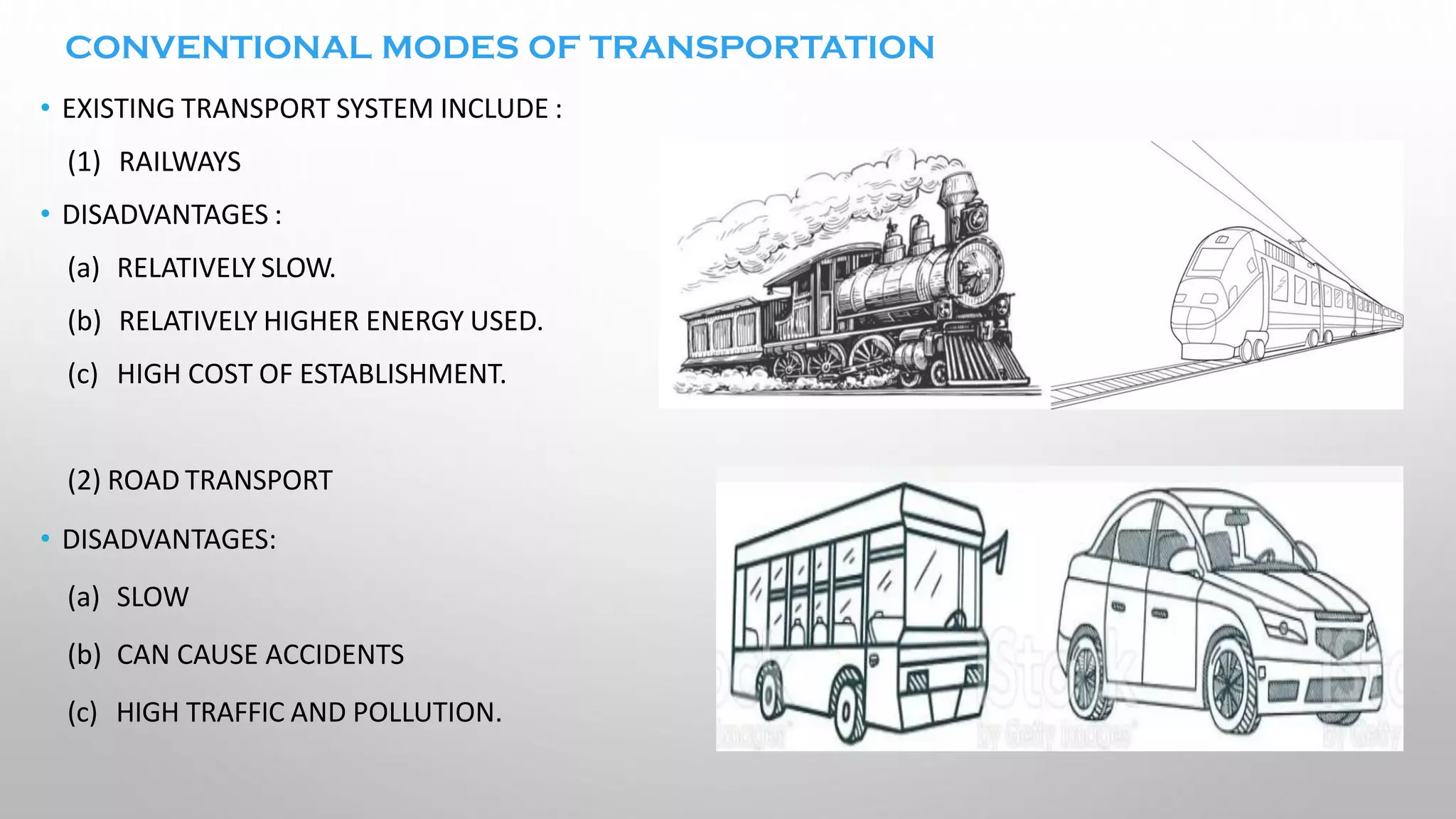
• EXISTING TRANSPORT SYSTEM INCLUDE :
(1) RAILWAYS
• DISADVANTAGES :
(a) RELATIVELY SLOW.
(b) RELATIVELY HIGHER ENERGY USED.
(c) HIGH COST OF ESTABLISHMENT.
(2) ROAD TRANSPORT
• DISADVANTAGES:
(a) SLOW
(b) CAN CAUSE ACCIDENTS
(c) HIGH TRAFFIC AND POLLUTION.
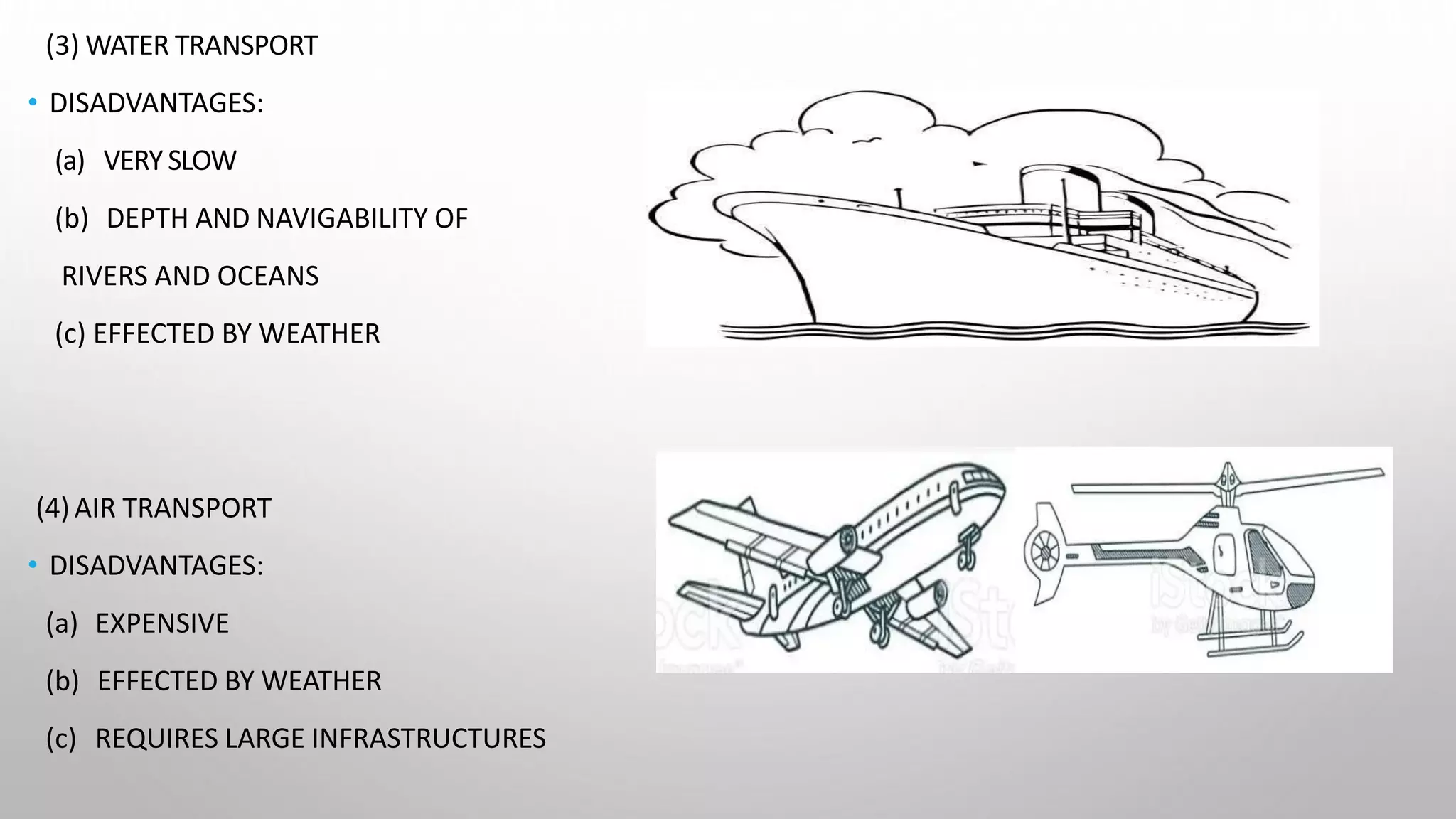
(3) WATER TRANSPORT
• DISADVANTAGES:
(a) VERYSLOW
(b) DEPTH AND NAVIGABILITY OF
RIVERS AND OCEANS
(c) EFFECTED BY WEATHER
(4) AIR TRANSPORT
• DISADVANTAGES:
(a) EXPENSIVE
(b) EFFECTED BY WEATHER
(c) REQUIRES LARGE INFRASTRUCTURES
WHAT IS HYPERLOOP ?
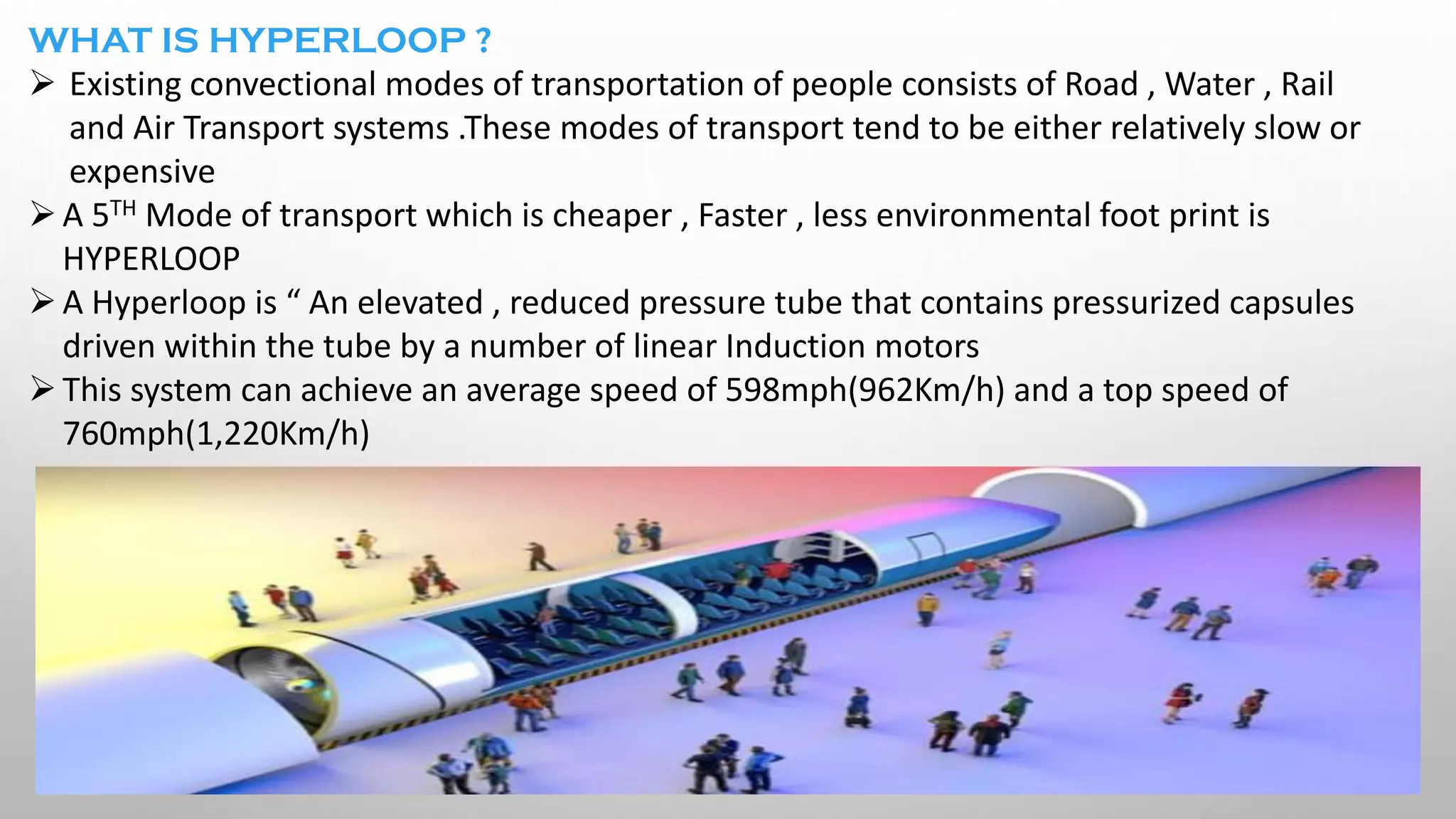
➢ Existing convectional modes of transportation of people consists of Road , Water , Rail
and Air Transport systems .These modes of transport tend to be either relatively slow or
expensive
➢A 5TH Mode of transport which is cheaper , Faster , less environmental foot print is
HYPERLOOP
➢A Hyperloop is “ An elevated , reduced pressure tube that contains pressurized capsules
driven within the tube by a number of linear Induction motors
➢This system can achieve an average speed of 598mph(962Km/h) and a top speed of
760mph(1,220Km/h)
ORIGIN OF SPARK
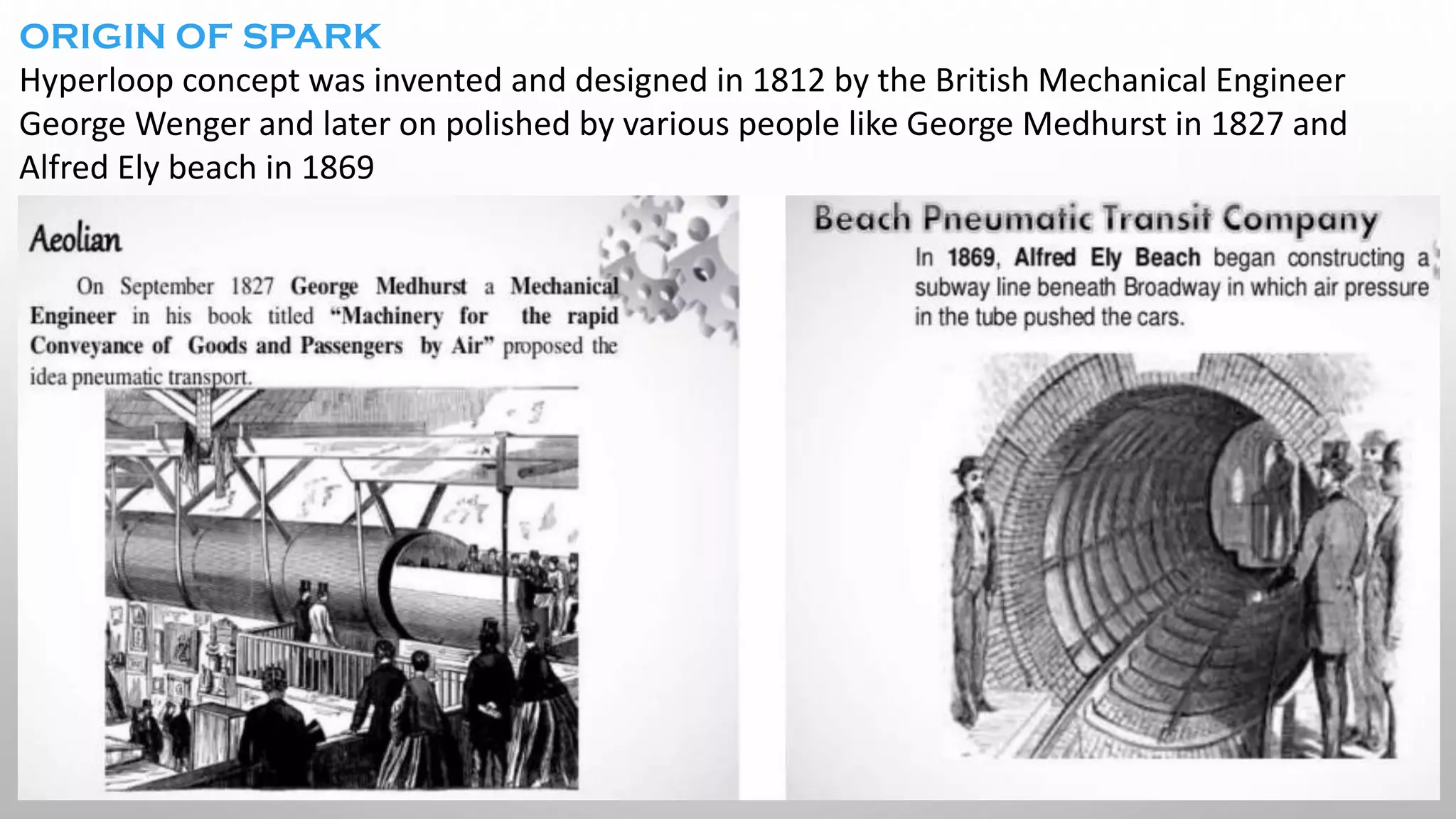
Hyperloop concept was invented and designed in 1812 by the British Mechanical Engineer
George Wenger and later on polished by various people like George Medhurst in 1827 and
Alfred Ely beach in 1869
WHO’S IDEA ?
➢ EVEN THE CONCEPT OF HYPERLOOP IS INVENTED LONG BACK
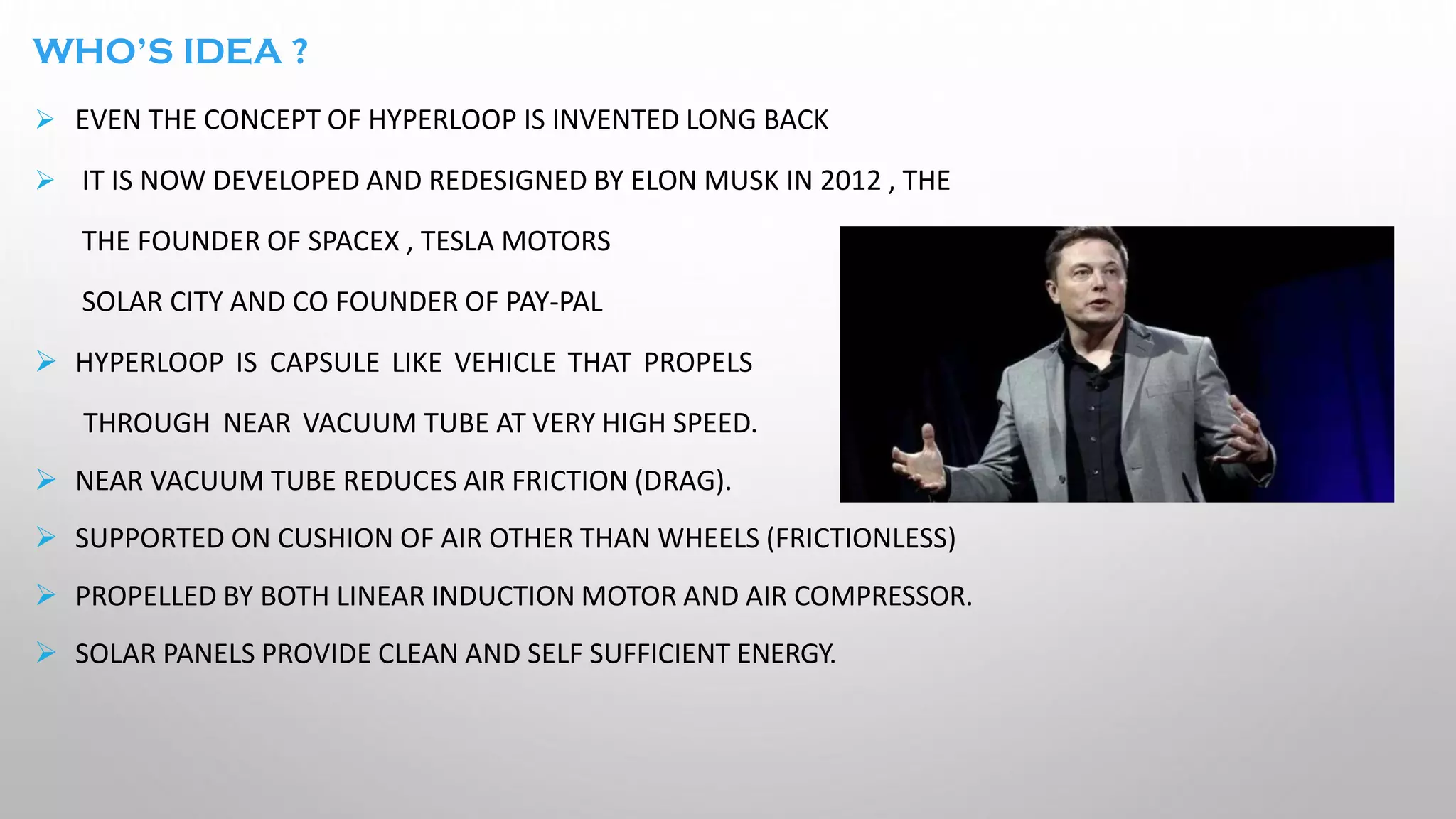
➢ IT IS NOW DEVELOPED AND REDESIGNED BY ELON MUSK IN 2012 , THE
THE FOUNDER OF SPACEX , TESLA MOTORS
SOLAR CITY AND CO FOUNDER OF PAY-PAL
➢ HYPERLOOP IS CAPSULE LIKE VEHICLE THAT PROPELS
THROUGH NEAR VACUUM TUBE AT VERY HIGH SPEED.
➢ NEAR VACUUM TUBE REDUCES AIR FRICTION (DRAG).
➢ SUPPORTED ON CUSHION OF AIR OTHER THAN WHEELS (FRICTIONLESS)
➢ PROPELLED BY BOTH LINEAR INDUCTION MOTOR AND AIR COMPRESSOR.
➢ SOLAR PANELS PROVIDE CLEAN AND SELF SUFFICIENT ENERGY.
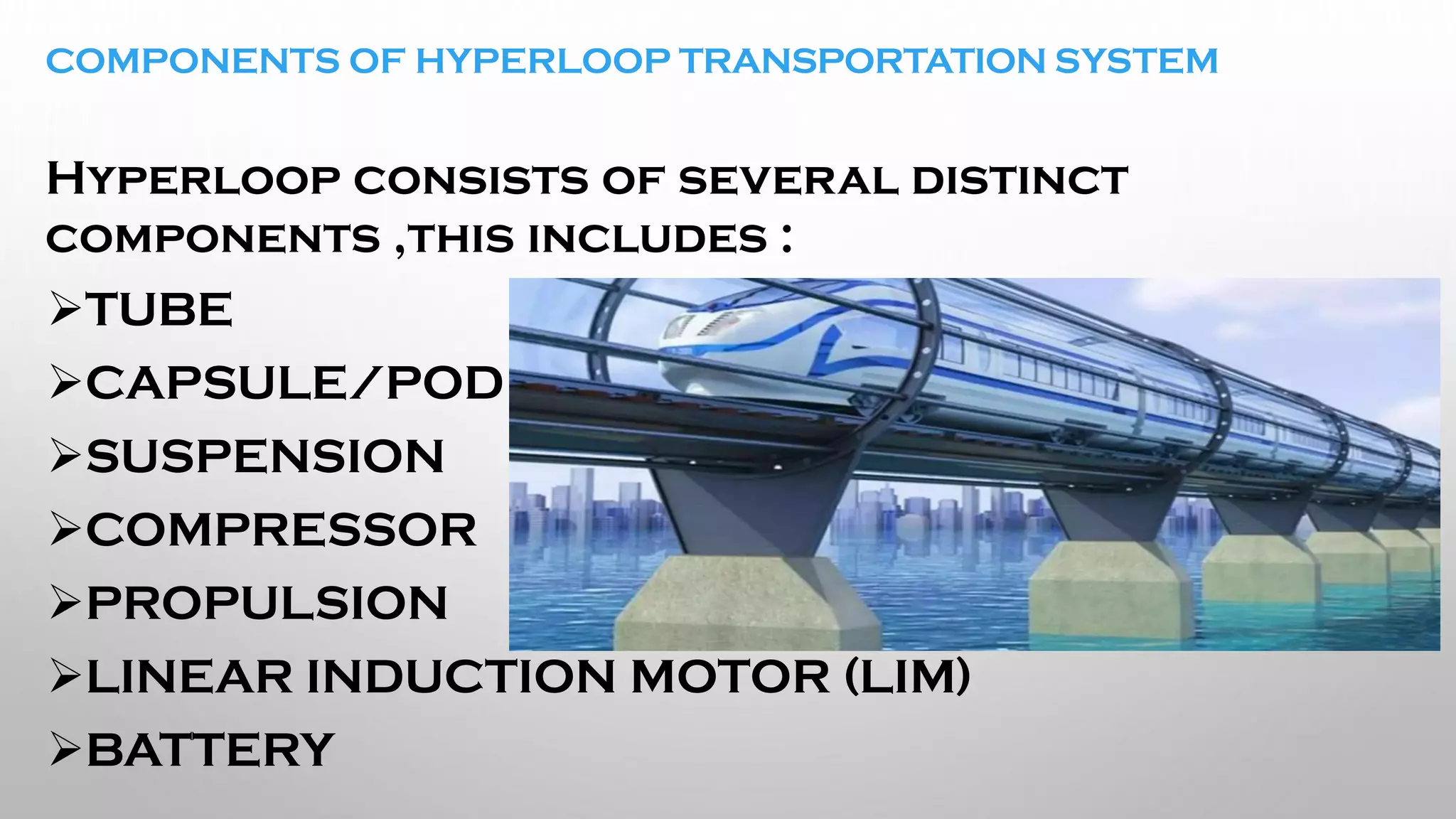
COMPONENTS OF HYPERLOOP TRANSPORTATION SYSTEM
H
Hyperloop consists of several distinct
components ,this includes :
➢TUBE
➢CAPSULE/POD
➢SUSPENSION
➢COMPRESSOR
➢PROPULSION
➢LINEAR INDUCTION MOTOR (LIM)
➢BATTERY
TUBE
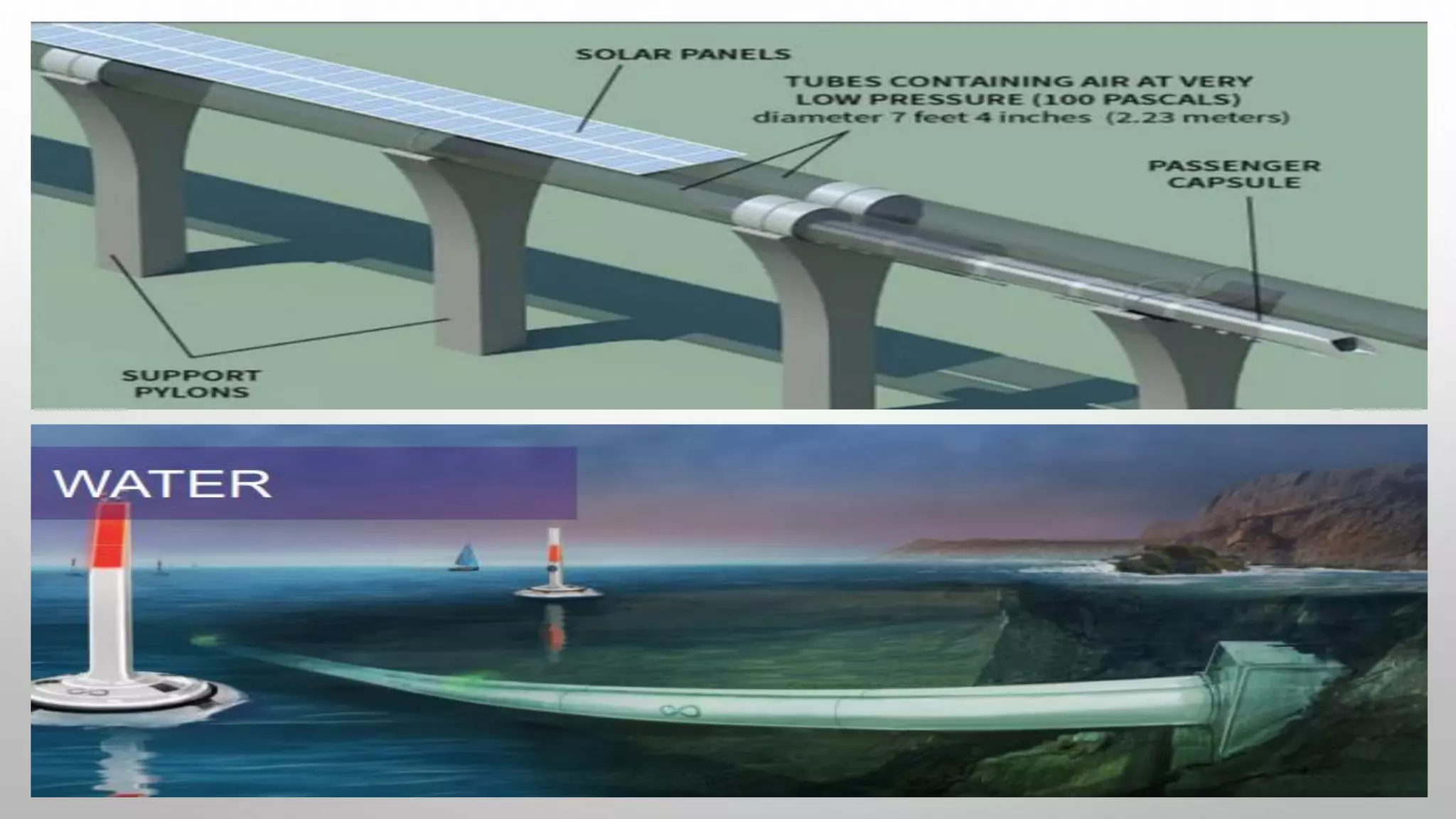
➢The tube is made of carbon fiber and steel. Two tubes will be welded together in a side by
side configuration to allow the capsules to travel both directions.
➢Tube is supported by pillars called Pylons and are placed every 100 ft (30 m) to support the
tube.
➢Solar arrays will cover the top of the tubes in order to provide power to the system.
➢The inner diameter of the tube is optimized to be 7 ft 4 in. (2.23 m) The tube cross-sectional
area is 42.2 ft2 (3.91 m2)
➢High-speed transport more generally, have historically been impeded by the difficulties in
managing friction and air resistance, both of which become substantial when vehicles
approach high speeds.
➢vactrain concept : tubes kept at a complete vacuum, allowing for theoretical speeds of
thousands of miles per hour.
➢The expected pressure inside the tube will be maintained around 100pa (less pressure)
➢Which is 1/6th the pressure on Mars . It also reduces the drag force of air by 1000 times
relative to sea level, Equivalent to flying above 1,50,000 feet Altitude
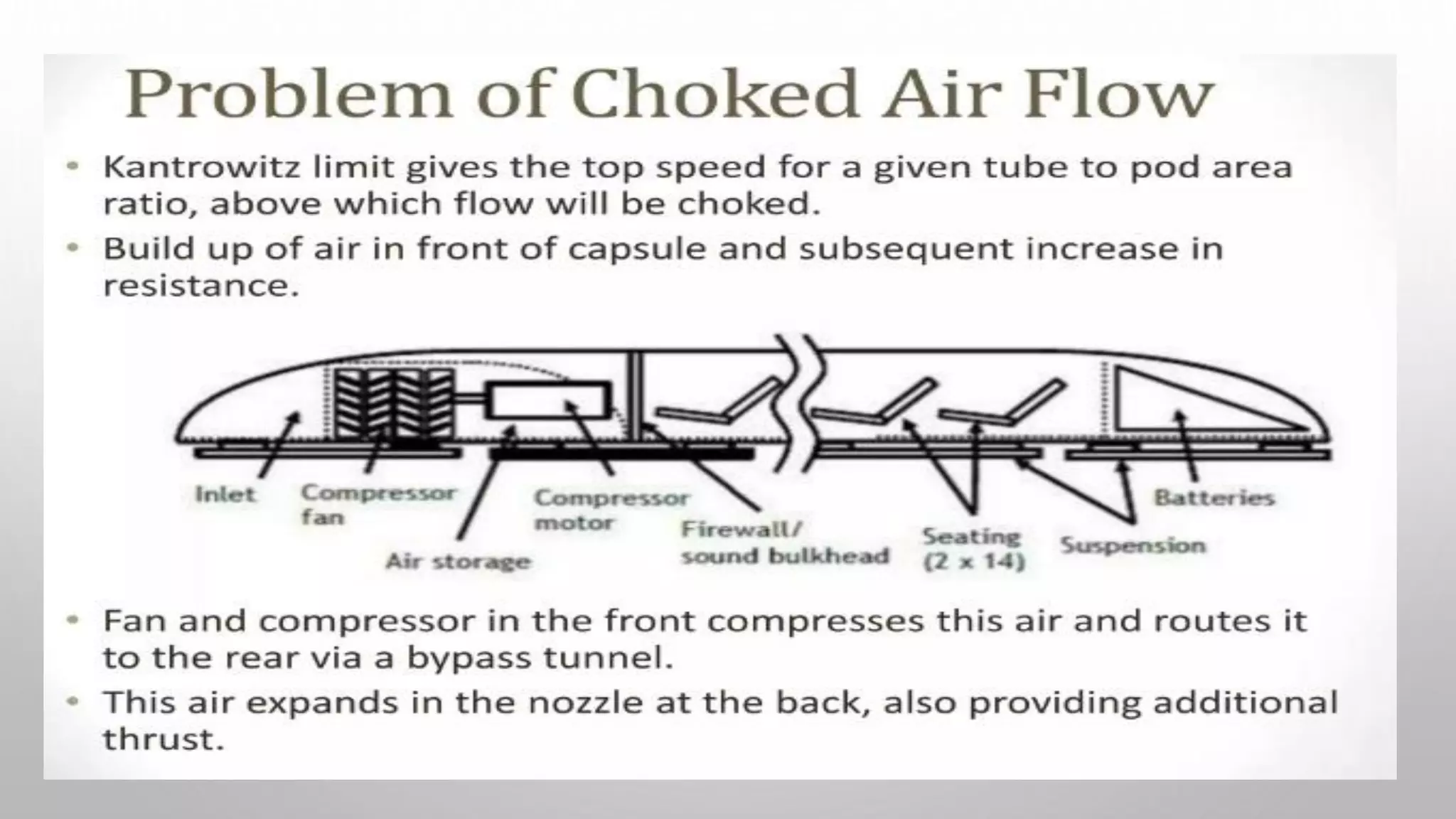
CAPSULE /POD
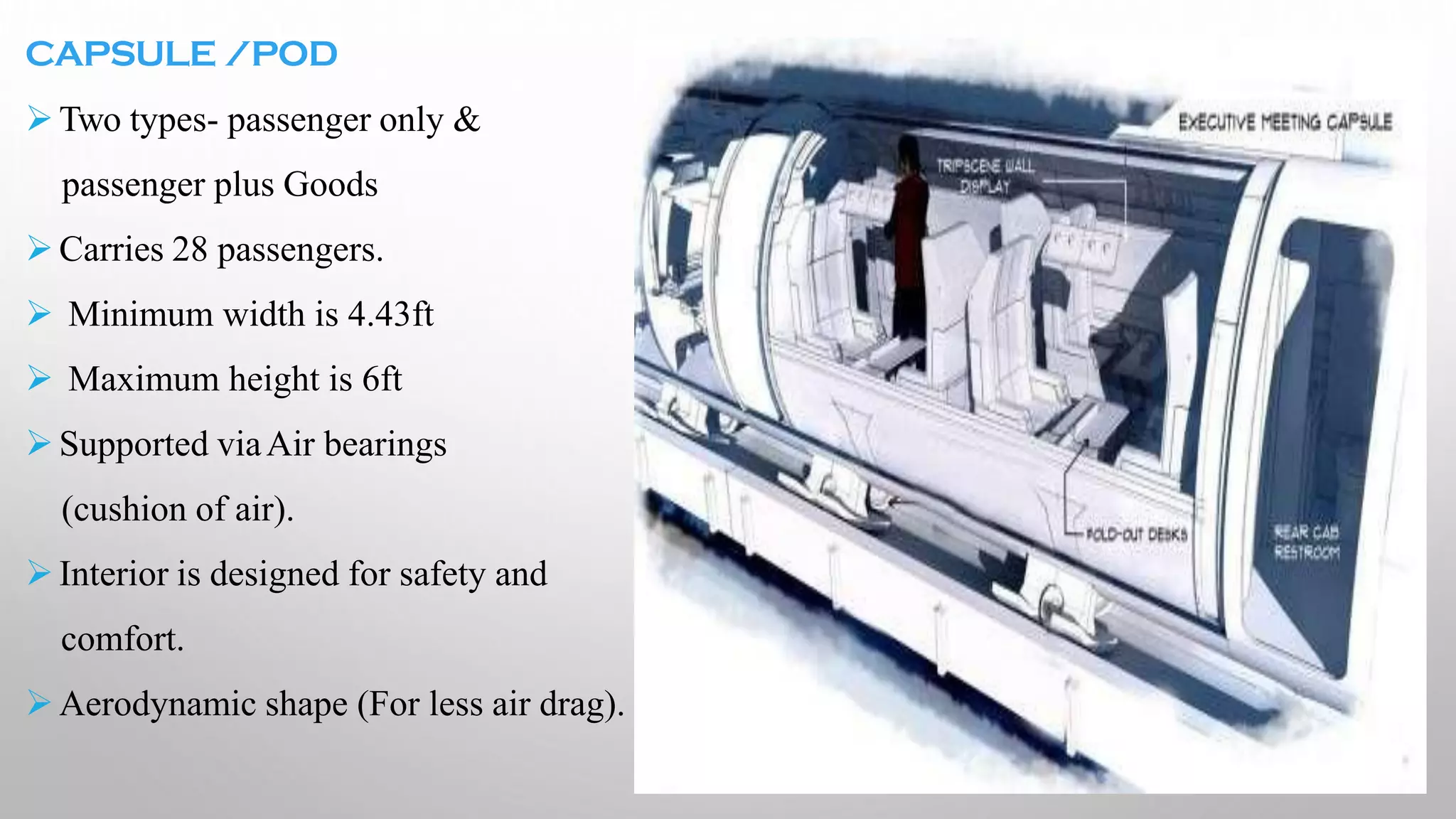
➢Two types- passenger only &
passenger plus Goods
➢Carries 28 passengers.
➢ Minimum width is 4.43ft
➢ Maximum height is 6ft
➢Supported viaAir bearings
(cushion of air).
➢Interior is designed for safety and
comfort.
➢Aerodynamic shape (For less air drag).
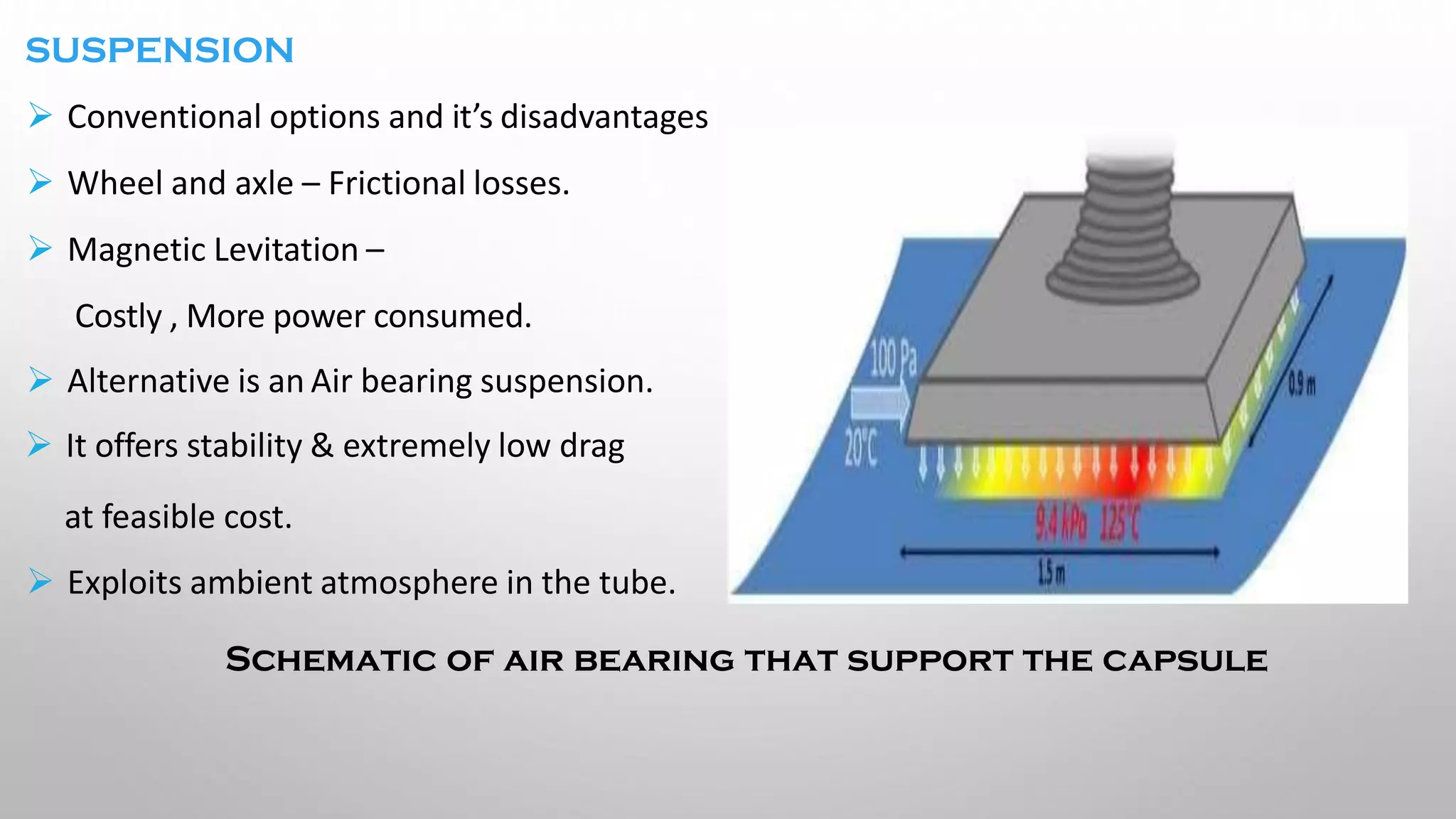
SUSPENSION
➢ Conventional options and it’s disadvantages
➢ Wheel and axle – Frictional losses.
➢ Magnetic Levitation –
Costly , More power consumed.
➢ Alternative is an Air bearing suspension.
➢ It offers stability & extremely low drag
at feasible cost.
➢ Exploits ambient atmosphere in the tube.
Schematic of air bearing that support the capsule
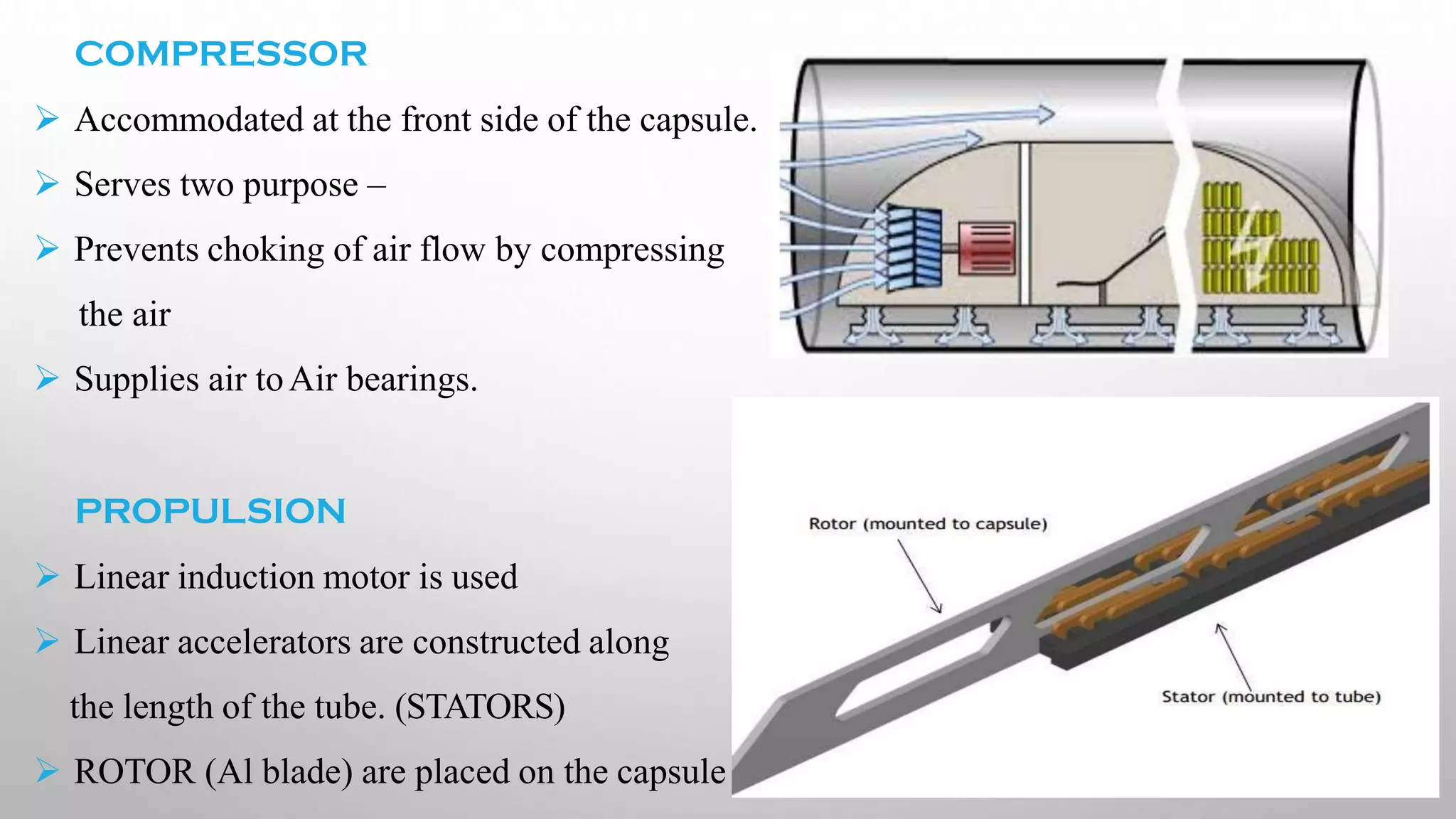
COMPRESSOR
➢ Accommodated at the front side of the capsule.
➢ Serves two purpose –
➢ Prevents choking of air flow by compressing
the air
➢ Supplies air toAir bearings.
PROPULSION
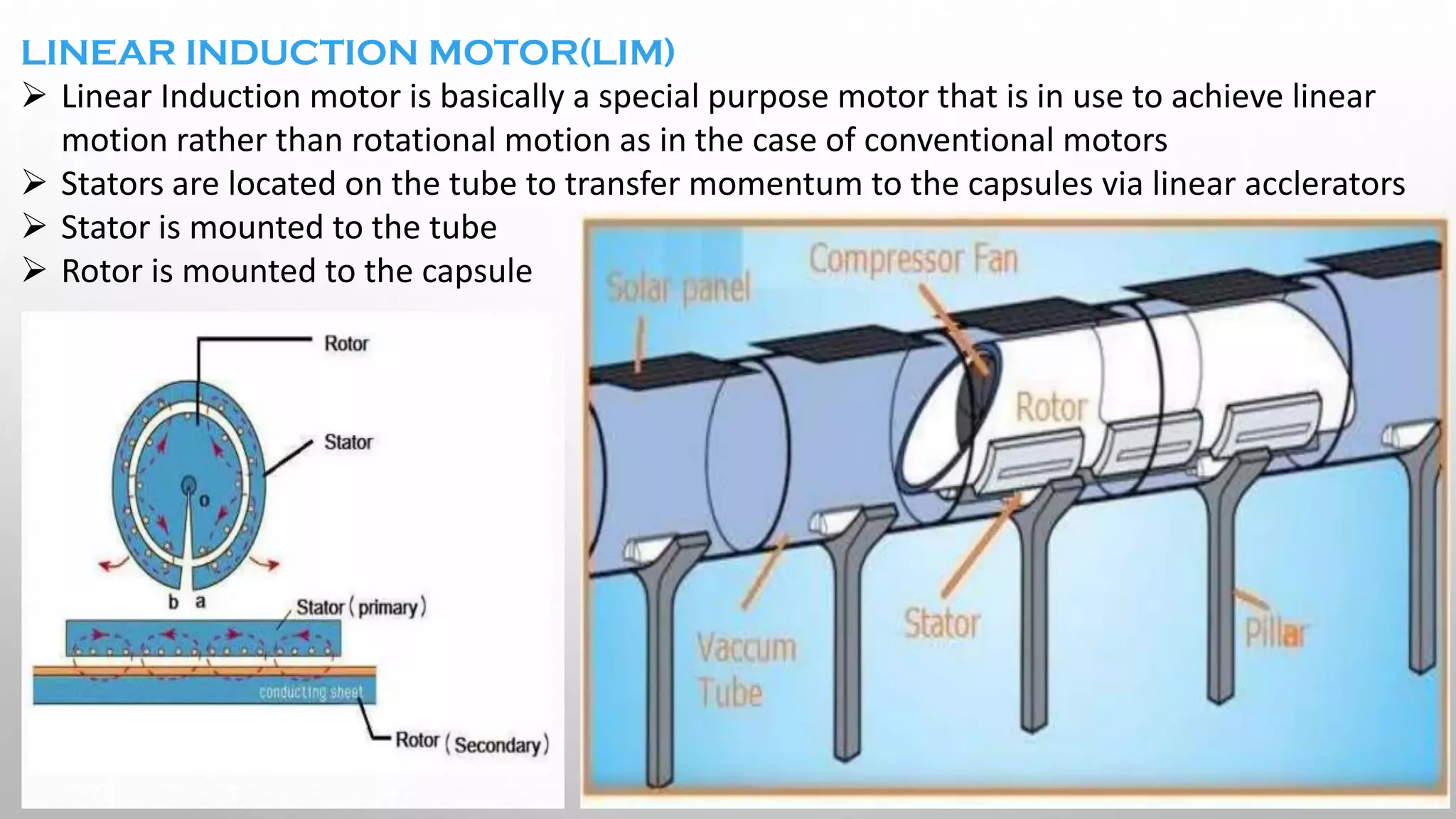
➢ Linear induction motor is used
➢ Linear accelerators are constructed along
the length of the tube. (STATORS)
➢ ROTOR (Al blade) are placed on the capsule
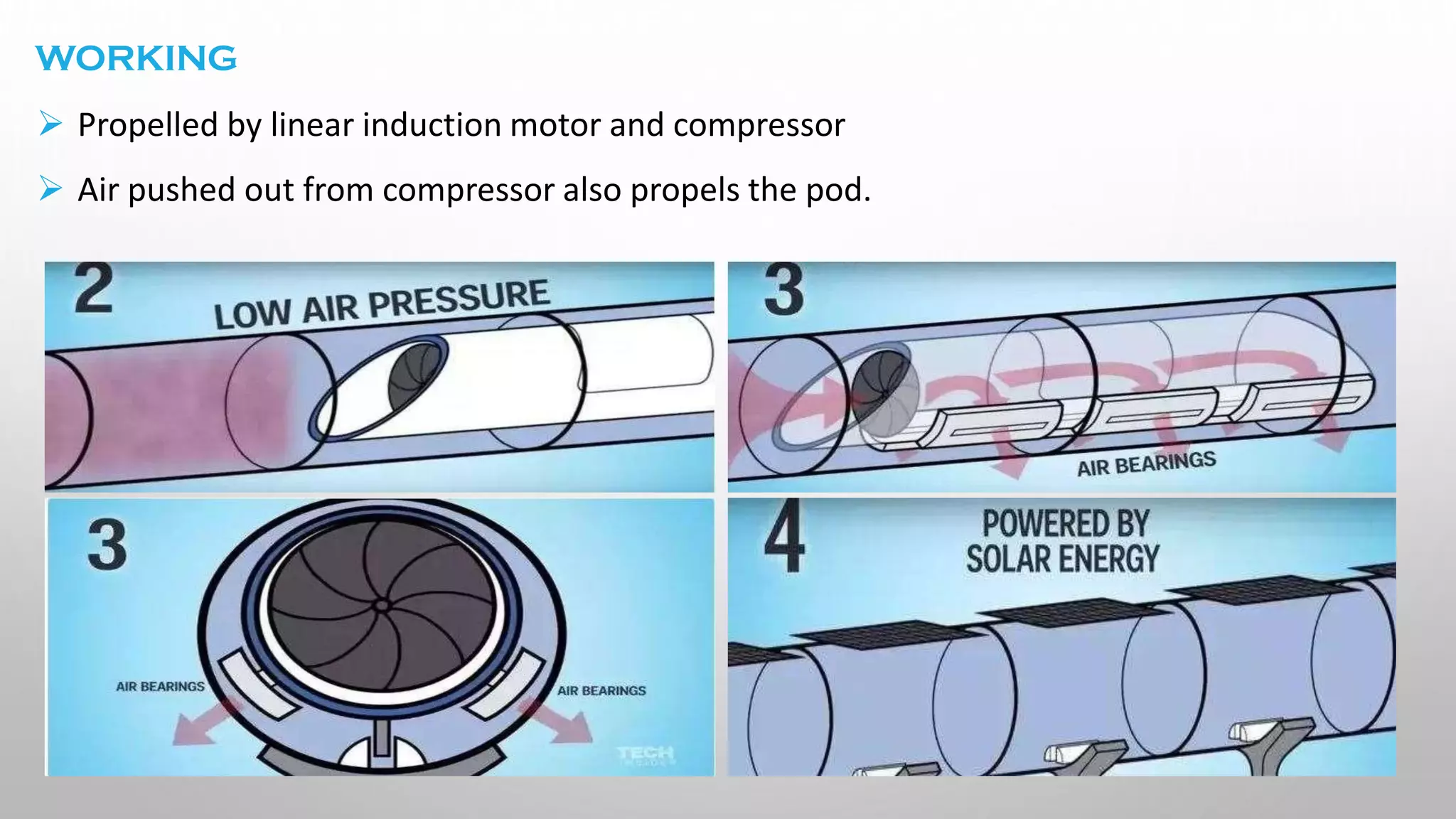
WORKING
➢ Propelled by linear induction motor and compressor
➢ Air pushed out from compressor also propels the pod.
LINEAR INDUCTION MOTOR(LIM)
➢ Linear Induction motor is basically a special purpose motor that is in use to achieve linear
motion rather than rotational motion as in the case of conventional motors
➢ Stators are located on the tube to transfer momentum to the capsules via linear acclerators
➢ Stator is mounted to the tube
➢ Rotor is mounted to the capsule
POWER(BATTERY)
➢ Estimated 5,500 lb (2,500kg) batteries
is required.
➢ The solar array provides an annual average
of 57MW more than what Hyperloop requires.
➢ Hyperloop uses about 21MW.
COST AND CAPACITY
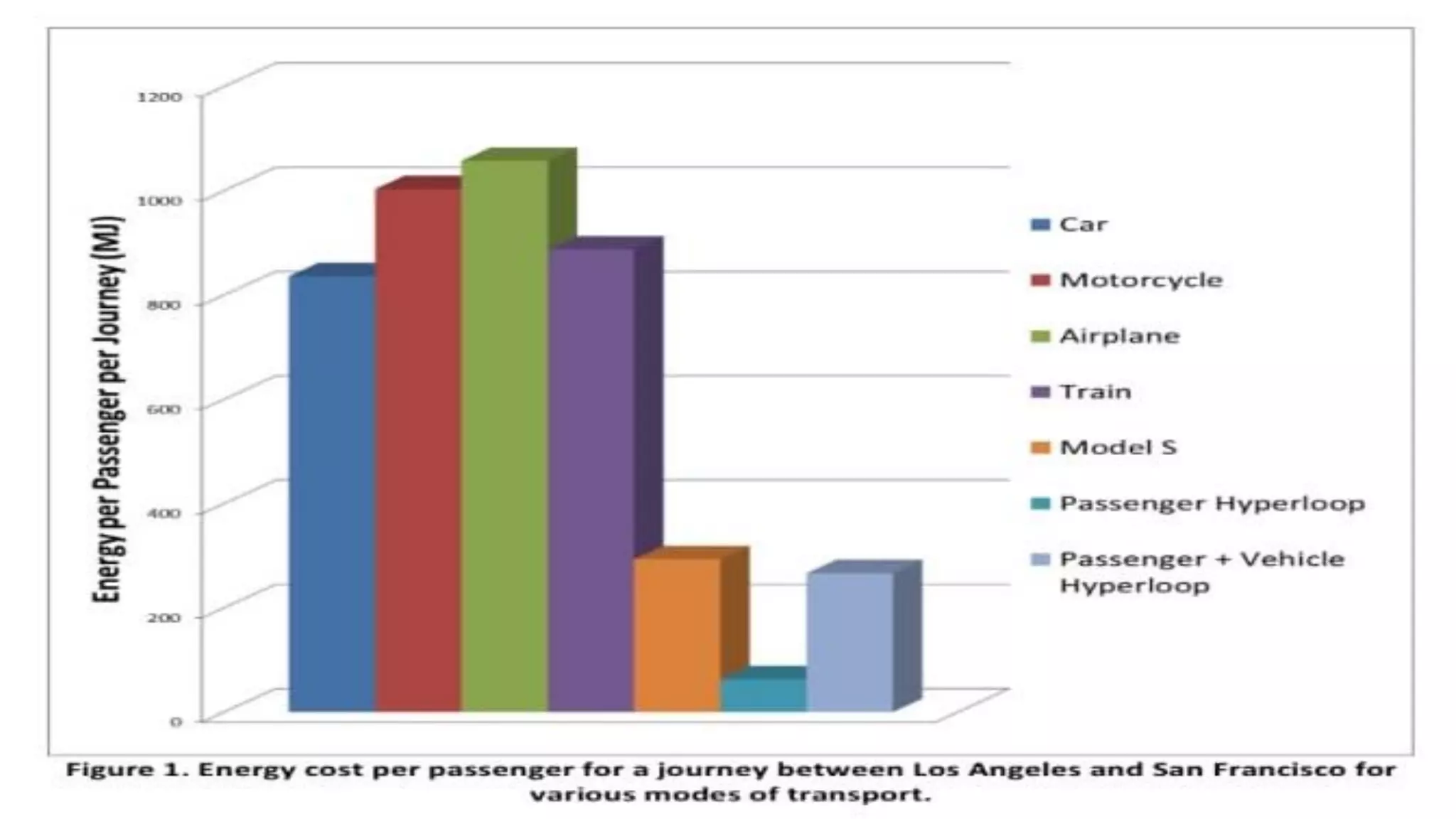
➢ 350 mile trip between Los Angeles and San Francisco will cost between($ 6-7.5) Billion
compared to 68 Billion for high speed Rail
➢ It can be able to transport 67,000 people a day
➢ It would cost $20 for a passenger version of hyperloop which is less than 9% of the cost of
high speed rail system
CONCLUSION
➢Hyperloop transportation system can be used over the
conventional modes of transportation that are rail, road, water
and air.
➢It travels with super sonic speed
➢Hyperloop uses a controlled and low pressure environment to offer
reliable and energy efficient travel
➢If the research work continue at current pace it is estimated that
we will be able to fully implement hyperloop for both people and
goods by the year 2045.
REFERENCES
➢Musk, Elon (August 12, 2013). "Hyperloop Alpha". SpaceX.
➢“Hyperloop” ,Wikipedia
➢Garber, Megan (July 13, 2012). "The Real iPod: Elon Musk's
Wild Idea for a 'Jetson Tunnel' from S.F. to L.A.". The Atlantic.
➢ "Beyond the hype of Hyperloop: An analysis of Elon Musk's
proposed transit system". Gizmag .com. August 22, 2013.
➢ Bilton , Nick. "Could the Hyperloop Really Cost $6 Billion? Critics
Say No". The New York Times.
HYPER LOOP SEMINAR PPT (1)_085046.pdf

HYPER LOOP SEMINAR PPT (1)_085046.pdf

  • 1.
    – THE 5THMODE OF TRANSPORTATION PRESENTED BY : SHANMUKH SAI R CLASS : EEE(SECTION-B) ROLL NO : 202250
  • 2.
    CONTENTS ➢CONVENTIONAL MODES OFTRANSPORTATION ➢WHAT IS HYPERLOOP ? ➢ORIGIN OF SPARK ➢WHO’S IDEA ? ➢COMPONENTS AND WORKING PRINCIPLE ➢MERITS AND DEMERITS ➢RECENT DEVELOPMENTS AND INSIGHT FOR INDIA ➢CONCLUSION ➢REFERENCES
  • 3.
    CONVENTIONAL MODES OFTRANSPORTATION • EXISTING TRANSPORT SYSTEM INCLUDE : (1) RAILWAYS • DISADVANTAGES : (a) RELATIVELY SLOW. (b) RELATIVELY HIGHER ENERGY USED. (c) HIGH COST OF ESTABLISHMENT. (2) ROAD TRANSPORT • DISADVANTAGES: (a) SLOW (b) CAN CAUSE ACCIDENTS (c) HIGH TRAFFIC AND POLLUTION.
  • 4.
    (3) WATER TRANSPORT •DISADVANTAGES: (a) VERYSLOW (b) DEPTH AND NAVIGABILITY OF RIVERS AND OCEANS (c) EFFECTED BY WEATHER (4) AIR TRANSPORT • DISADVANTAGES: (a) EXPENSIVE (b) EFFECTED BY WEATHER (c) REQUIRES LARGE INFRASTRUCTURES
  • 6.
    WHAT IS HYPERLOOP? ➢ Existing convectional modes of transportation of people consists of Road , Water , Rail and Air Transport systems .These modes of transport tend to be either relatively slow or expensive ➢A 5TH Mode of transport which is cheaper , Faster , less environmental foot print is HYPERLOOP ➢A Hyperloop is “ An elevated , reduced pressure tube that contains pressurized capsules driven within the tube by a number of linear Induction motors ➢This system can achieve an average speed of 598mph(962Km/h) and a top speed of 760mph(1,220Km/h)
  • 7.
    ORIGIN OF SPARK Hyperloopconcept was invented and designed in 1812 by the British Mechanical Engineer George Wenger and later on polished by various people like George Medhurst in 1827 and Alfred Ely beach in 1869
  • 8.
    WHO’S IDEA ? ➢EVEN THE CONCEPT OF HYPERLOOP IS INVENTED LONG BACK ➢ IT IS NOW DEVELOPED AND REDESIGNED BY ELON MUSK IN 2012 , THE THE FOUNDER OF SPACEX , TESLA MOTORS SOLAR CITY AND CO FOUNDER OF PAY-PAL ➢ HYPERLOOP IS CAPSULE LIKE VEHICLE THAT PROPELS THROUGH NEAR VACUUM TUBE AT VERY HIGH SPEED. ➢ NEAR VACUUM TUBE REDUCES AIR FRICTION (DRAG). ➢ SUPPORTED ON CUSHION OF AIR OTHER THAN WHEELS (FRICTIONLESS) ➢ PROPELLED BY BOTH LINEAR INDUCTION MOTOR AND AIR COMPRESSOR. ➢ SOLAR PANELS PROVIDE CLEAN AND SELF SUFFICIENT ENERGY.
  • 9.
    COMPONENTS OF HYPERLOOPTRANSPORTATION SYSTEM H Hyperloop consists of several distinct components ,this includes : ➢TUBE ➢CAPSULE/POD ➢SUSPENSION ➢COMPRESSOR ➢PROPULSION ➢LINEAR INDUCTION MOTOR (LIM) ➢BATTERY
  • 10.
    TUBE ➢The tube ismade of carbon fiber and steel. Two tubes will be welded together in a side by side configuration to allow the capsules to travel both directions. ➢Tube is supported by pillars called Pylons and are placed every 100 ft (30 m) to support the tube. ➢Solar arrays will cover the top of the tubes in order to provide power to the system. ➢The inner diameter of the tube is optimized to be 7 ft 4 in. (2.23 m) The tube cross-sectional area is 42.2 ft2 (3.91 m2) ➢High-speed transport more generally, have historically been impeded by the difficulties in managing friction and air resistance, both of which become substantial when vehicles approach high speeds. ➢vactrain concept : tubes kept at a complete vacuum, allowing for theoretical speeds of thousands of miles per hour. ➢The expected pressure inside the tube will be maintained around 100pa (less pressure) ➢Which is 1/6th the pressure on Mars . It also reduces the drag force of air by 1000 times relative to sea level, Equivalent to flying above 1,50,000 feet Altitude
  • 12.
    CAPSULE /POD ➢Two types-passenger only & passenger plus Goods ➢Carries 28 passengers. ➢ Minimum width is 4.43ft ➢ Maximum height is 6ft ➢Supported viaAir bearings (cushion of air). ➢Interior is designed for safety and comfort. ➢Aerodynamic shape (For less air drag).
  • 14.
    SUSPENSION ➢ Conventional optionsand it’s disadvantages ➢ Wheel and axle – Frictional losses. ➢ Magnetic Levitation – Costly , More power consumed. ➢ Alternative is an Air bearing suspension. ➢ It offers stability & extremely low drag at feasible cost. ➢ Exploits ambient atmosphere in the tube. Schematic of air bearing that support the capsule
  • 15.
    COMPRESSOR ➢ Accommodated atthe front side of the capsule. ➢ Serves two purpose – ➢ Prevents choking of air flow by compressing the air ➢ Supplies air toAir bearings. PROPULSION ➢ Linear induction motor is used ➢ Linear accelerators are constructed along the length of the tube. (STATORS) ➢ ROTOR (Al blade) are placed on the capsule
  • 16.
    WORKING ➢ Propelled bylinear induction motor and compressor ➢ Air pushed out from compressor also propels the pod.
  • 17.
    LINEAR INDUCTION MOTOR(LIM) ➢Linear Induction motor is basically a special purpose motor that is in use to achieve linear motion rather than rotational motion as in the case of conventional motors ➢ Stators are located on the tube to transfer momentum to the capsules via linear acclerators ➢ Stator is mounted to the tube ➢ Rotor is mounted to the capsule
  • 18.
    POWER(BATTERY) ➢ Estimated 5,500lb (2,500kg) batteries is required. ➢ The solar array provides an annual average of 57MW more than what Hyperloop requires. ➢ Hyperloop uses about 21MW. COST AND CAPACITY ➢ 350 mile trip between Los Angeles and San Francisco will cost between($ 6-7.5) Billion compared to 68 Billion for high speed Rail ➢ It can be able to transport 67,000 people a day ➢ It would cost $20 for a passenger version of hyperloop which is less than 9% of the cost of high speed rail system
  • 22.
    CONCLUSION ➢Hyperloop transportation systemcan be used over the conventional modes of transportation that are rail, road, water and air. ➢It travels with super sonic speed ➢Hyperloop uses a controlled and low pressure environment to offer reliable and energy efficient travel ➢If the research work continue at current pace it is estimated that we will be able to fully implement hyperloop for both people and goods by the year 2045.
  • 23.
    REFERENCES ➢Musk, Elon (August12, 2013). "Hyperloop Alpha". SpaceX. ➢“Hyperloop” ,Wikipedia ➢Garber, Megan (July 13, 2012). "The Real iPod: Elon Musk's Wild Idea for a 'Jetson Tunnel' from S.F. to L.A.". The Atlantic. ➢ "Beyond the hype of Hyperloop: An analysis of Elon Musk's proposed transit system". Gizmag .com. August 22, 2013. ➢ Bilton , Nick. "Could the Hyperloop Really Cost $6 Billion? Critics Say No". The New York Times.