HYPERLOOP:
A FIFTH MODE OF
TRANSPORTATION
SUBMITTED BY:-
RAVI SHANKAR KUMAR
B.TECH (FINAL YEAR)
ROLL NO- 14EEJEC014
GOVERNMENT ENGINEERING COLLEGE JHALAWAR
CONTENTS:
 INTRODUCTION
 CONCEPT
 WHOSE IDEA
 WHAT IS HYPERLOOP
 COMPONENTS OF
HYPERLOOOP
 SPECIFICATIONS
 HYPERLOOP PROJECT IN INDIA
 ADVANTAGES
 DISADVANTAGES
 CONCLUSION
 REFERENCES
INTRODUCTION
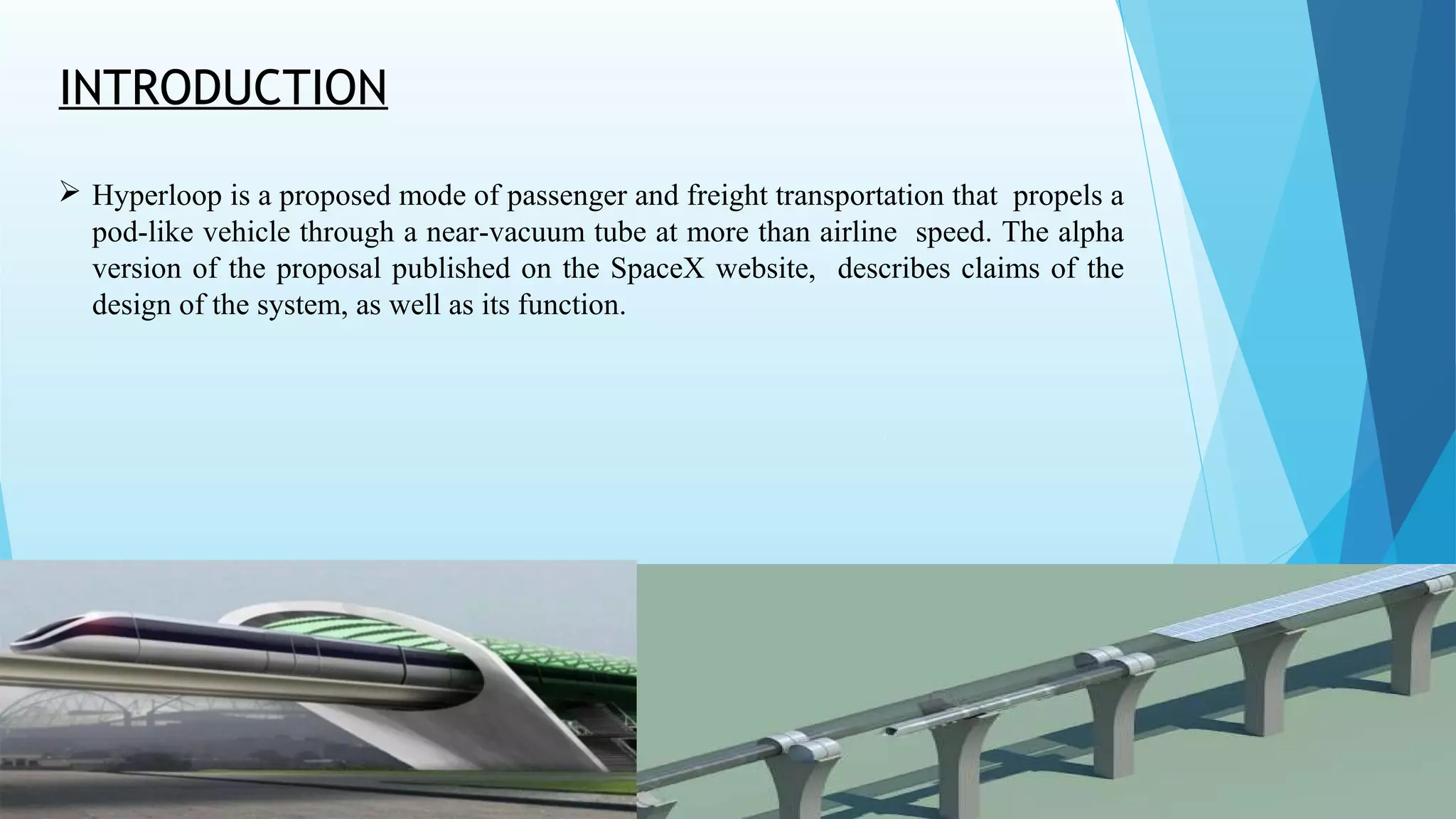
 Hyperloop is a proposed mode of passenger and freight transportation that propels a
pod-like vehicle through a near-vacuum tube at more than airline speed. The alpha
version of the proposal published on the SpaceX website, describes claims of the
design of the system, as well as its function.
THE
CONCEPT:
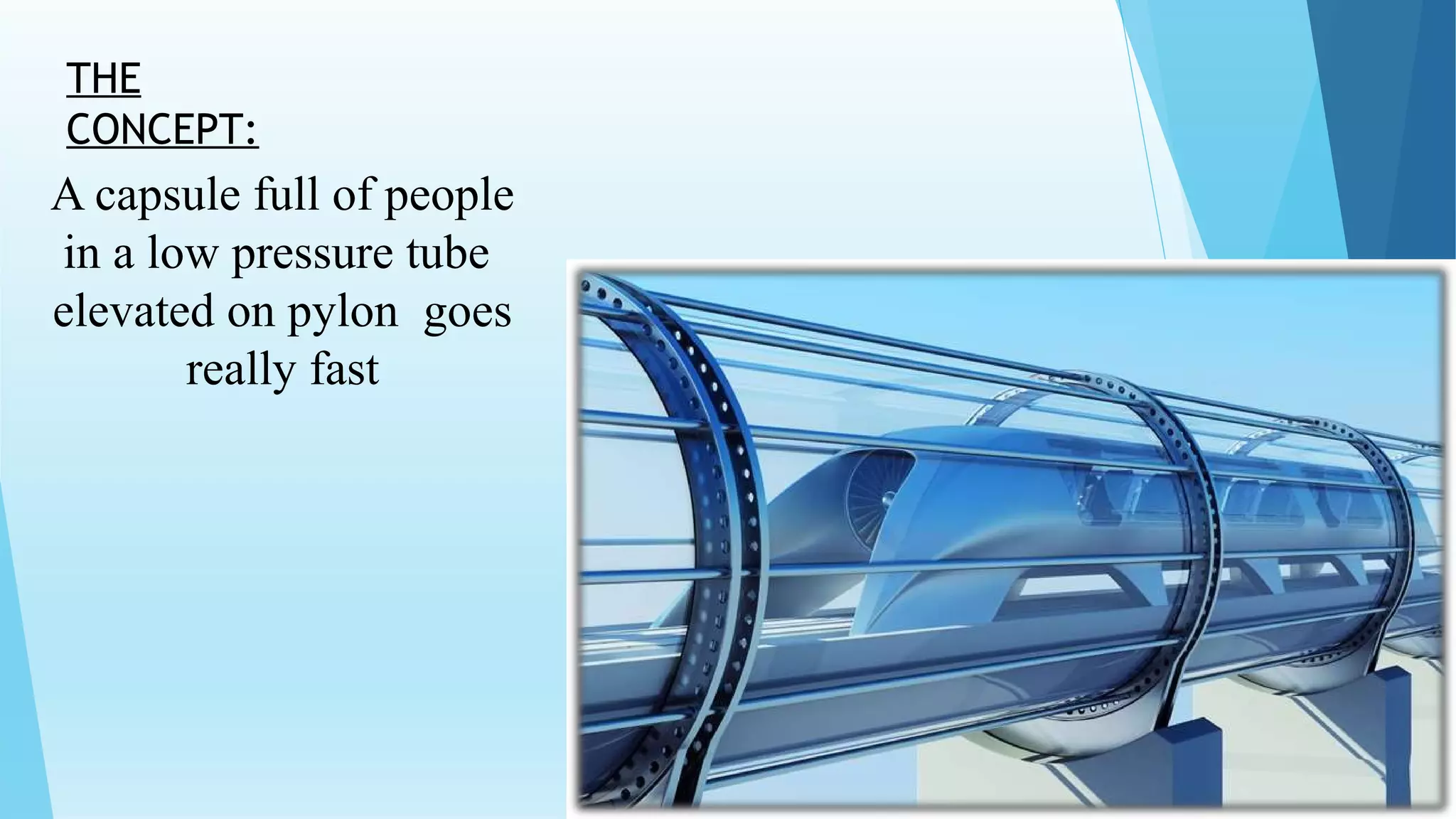
A capsule full of people
in a low pressure tube
elevated on pylon goes
really fast
WHAT IS
HYPERLOOP ?Existing conventional modes of transportation of people consists of four
unique types: rail, road, water, and air. These modes of transport tend to be
either relatively slow (i.e., road and water), expensive (i.e., air), or a
combination of relatively slow and expensive .
It is the fifth mode generation of transportation .
Hyperloop is a new mode of transport that seeks to change this paradigm by
being both fast and inexpensive for people and goods.
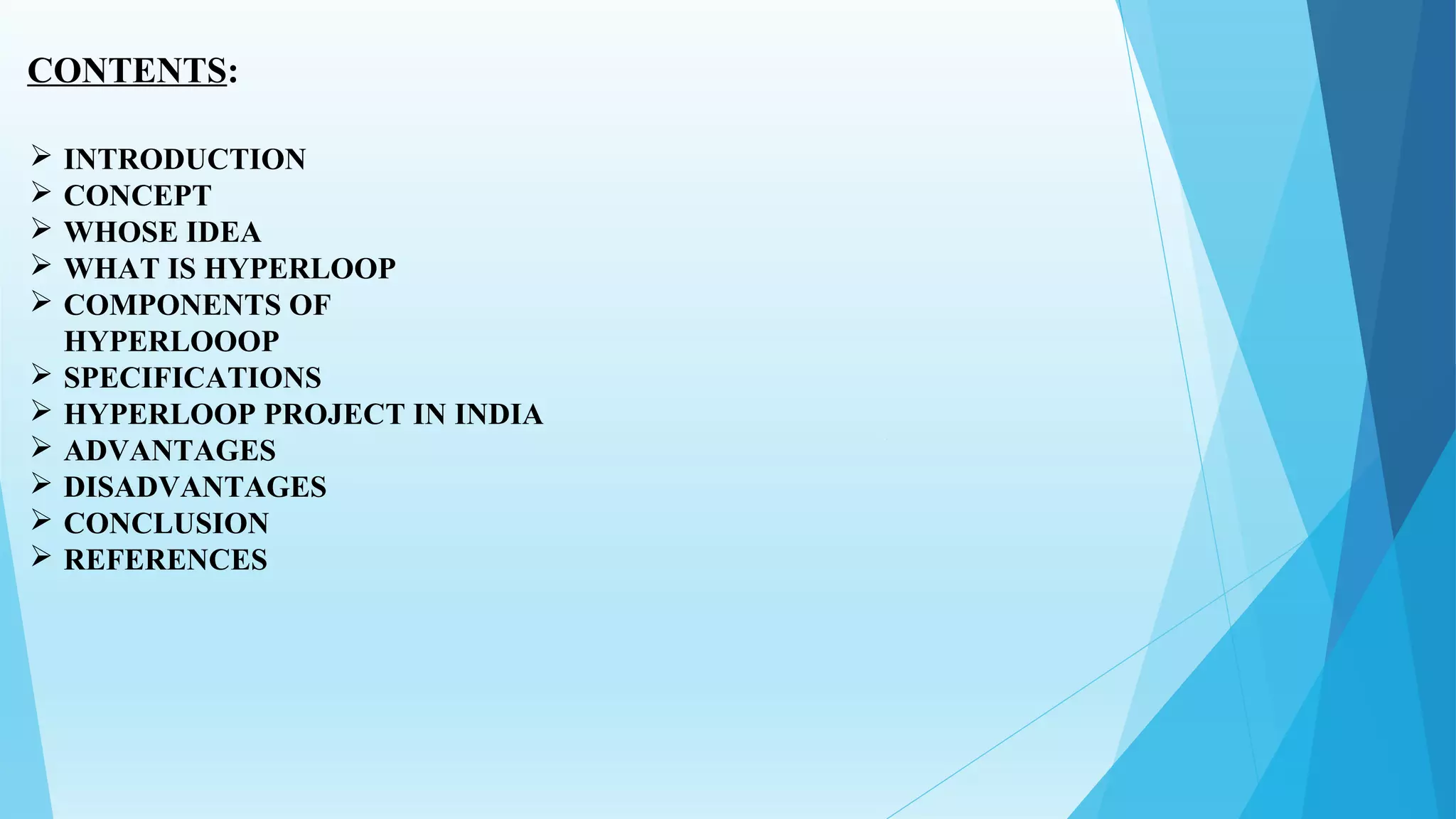
Hyperloop consists of a low pressure tube with capsules that are transported
at both low and high speeds throughout the length of the tube .
COMPONENTS OF
HYPERLOOP:TUBES
CAPSULE
PROPULSION
1.TUBES
 The tube is made of steel. Two tubes will be welded together in a side by side
configuration to allow the capsules to travel both directions.
 Pylons are placed every 100 ft. (30 m) to support the tube.
 Solar arrays will cover the top of the tubes in order to provide power to the
system.
 Tubes are made by the new material ‘ VIBRANIUM ‘
2.CAPSULES
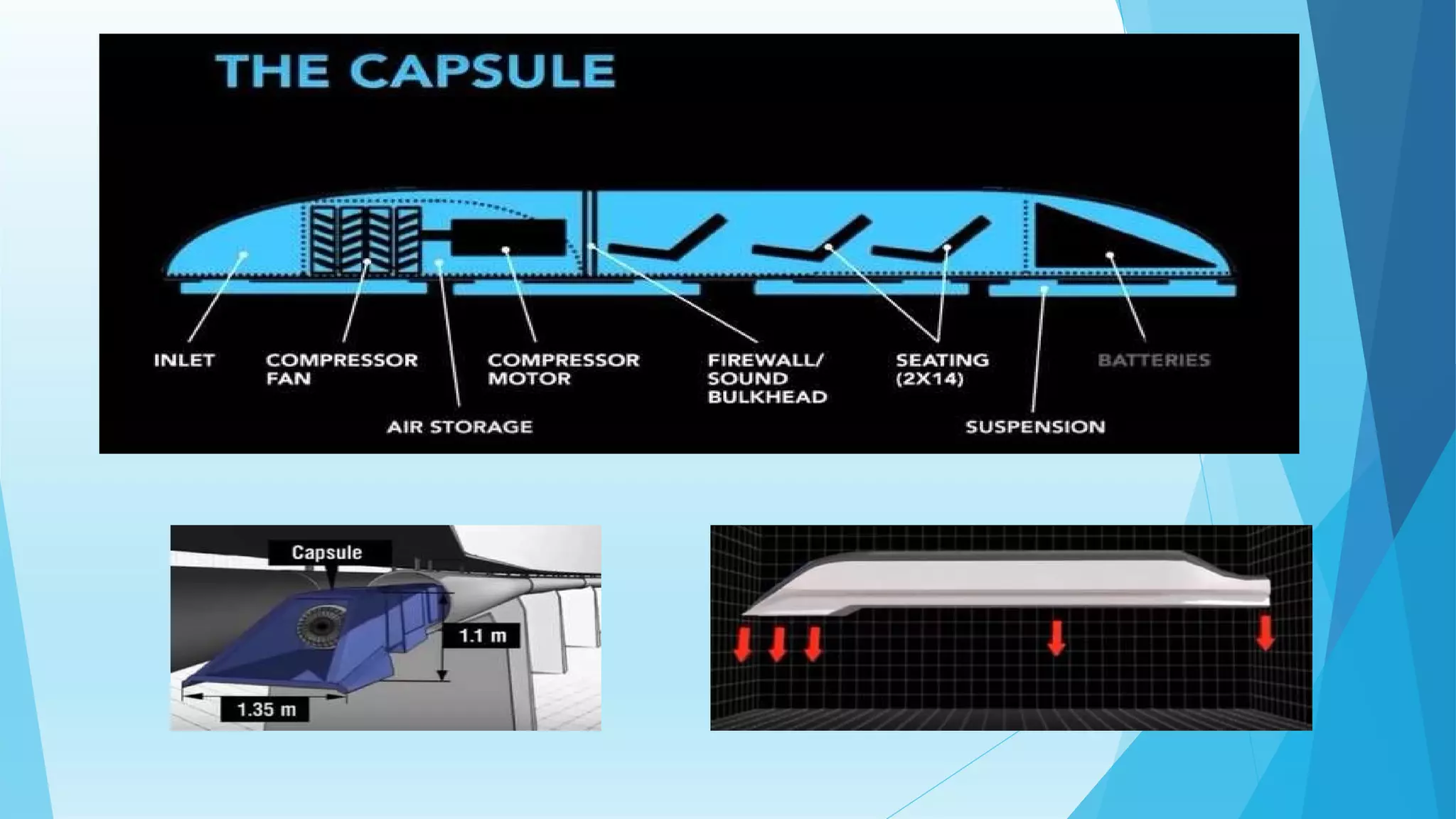
 Sealed capsules carrying 28 passengers each that travel along the interior of
the tube.
 A larger system has also been sized that allows transport of 3 full size automobiles
with passengers to travel in the capsule.
 The capsules are supported via air bearings that operate using a compressed air
reservoir and aerodynamic lift .
3.PROPULSION
Linear accelerations are constructed along the length of the tube at various
locations to accelerate the capsule.
Stators are located on the capsules via the linear acceleration.
The propulsion system has these basic requirements:
1.Accelerate the capsule from 0 to 300 mph (480 kph) for relatively low speed
travel in urban areas.
2.Maintain the capsule at 300 mph (480 kph) as necessary, including during
ascents over the mountains surroundings.
WORKING PRINCIPLES OF HYPERLOOP:
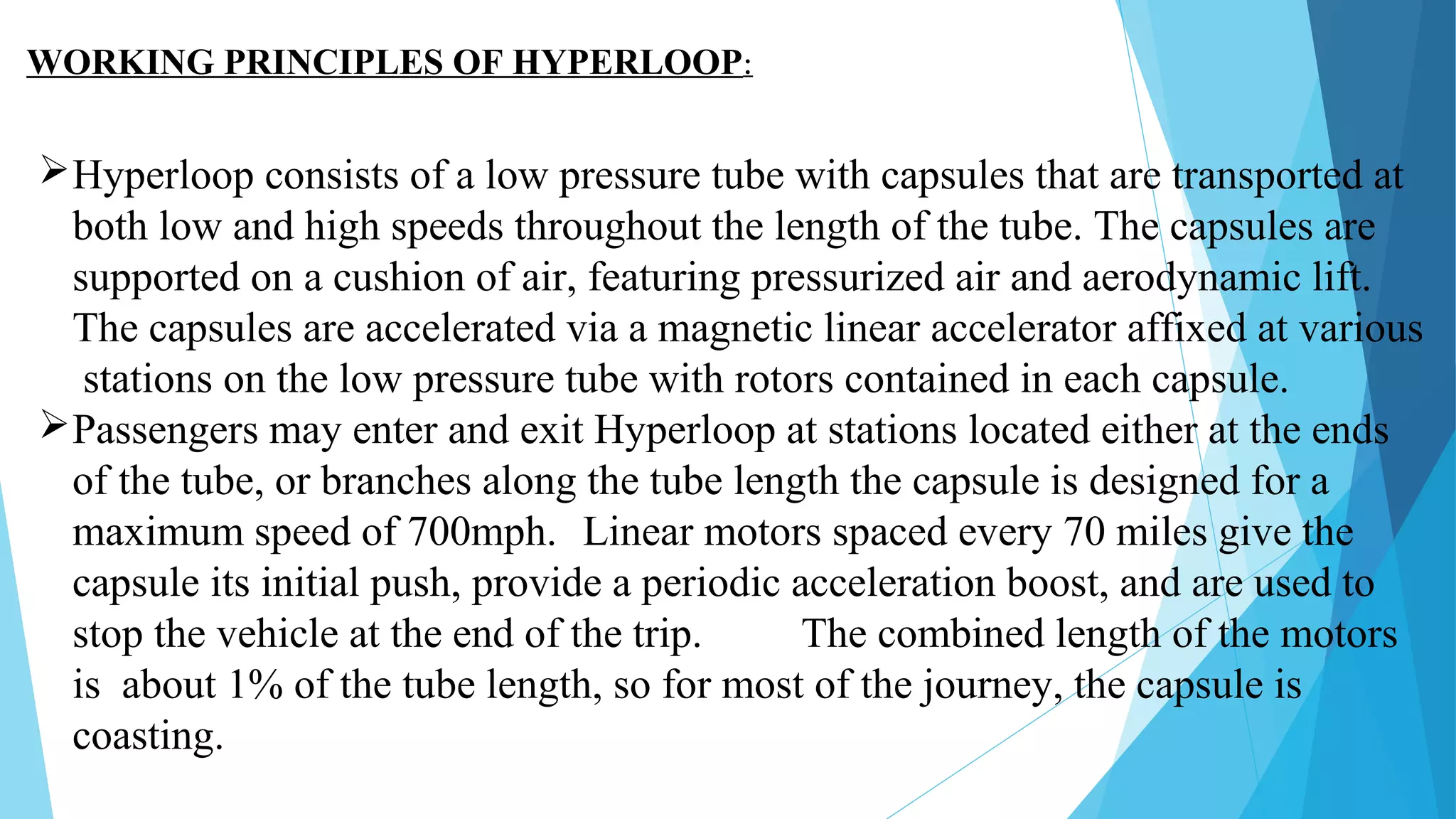
Hyperloop consists of a low pressure tube with capsules that are transported at
both low and high speeds throughout the length of the tube. The capsules are
supported on a cushion of air, featuring pressurized air and aerodynamic lift.
The capsules are accelerated via a magnetic linear accelerator affixed at various
stations on the low pressure tube with rotors contained in each capsule.
Passengers may enter and exit Hyperloop at stations located either at the ends
of the tube, or branches along the tube length the capsule is designed for a
maximum speed of 700mph. Linear motors spaced every 70 miles give the
capsule its initial push, provide a periodic acceleration boost, and are used to
stop the vehicle at the end of the trip. The combined length of the motors
is about 1% of the tube length, so for most of the journey, the capsule is
coasting.
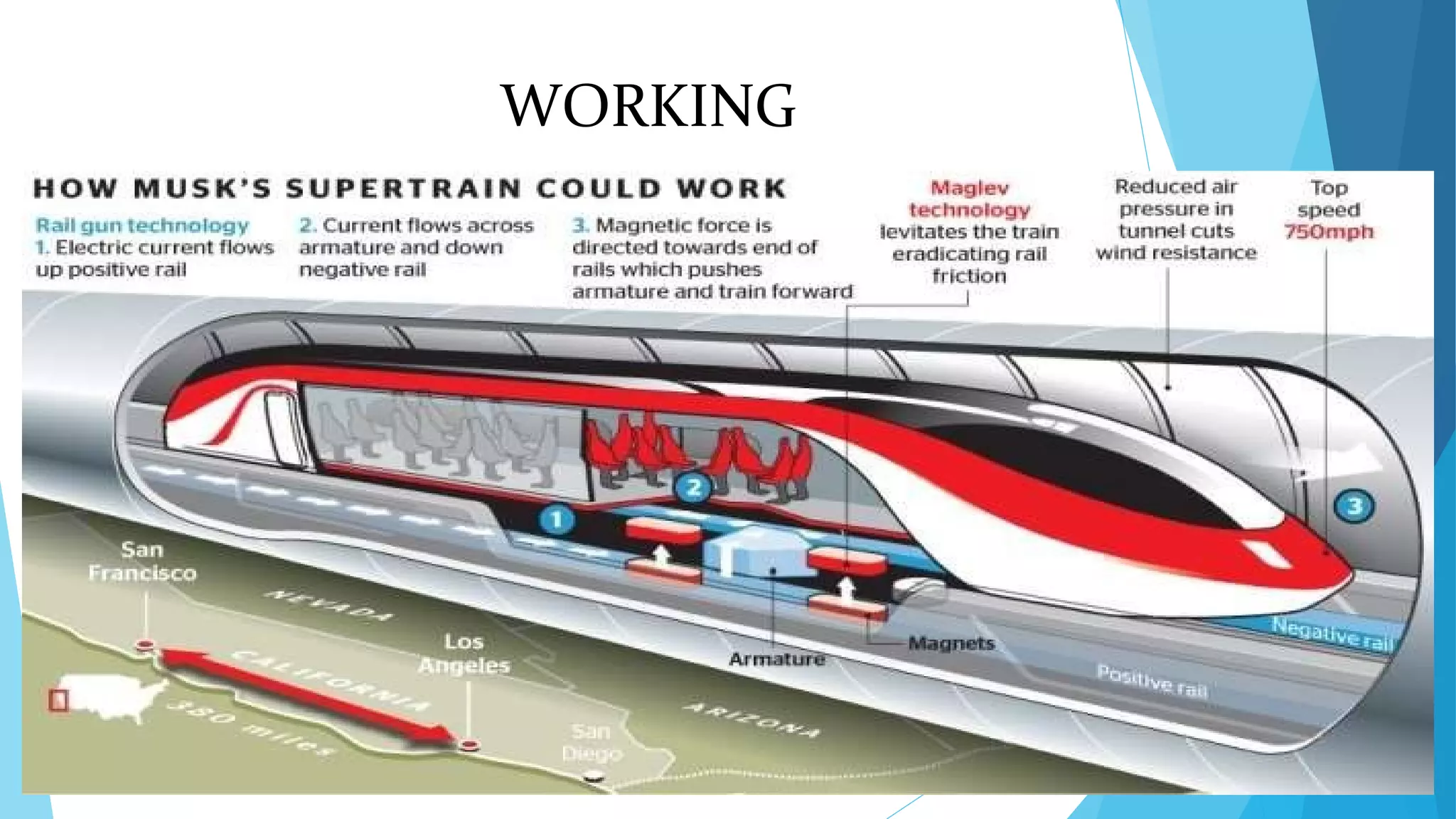
WORKING
Even though the air pressure in the tube is very low, a capsule
traveling at 700mph will cause significant air pressure at the nose
of the vehicle, which must be considered in the design. Since the
tube has a larger cross-section than the capsule, some air flows
around the vehicle. Even so, compressor fans that actively
transfer air from the front to the rear of the capsule must be
installed.
Solar panels installed on top of the tubes provide power for the
linear motors. In addition, energy is recaptured when
capsules are slowed down.
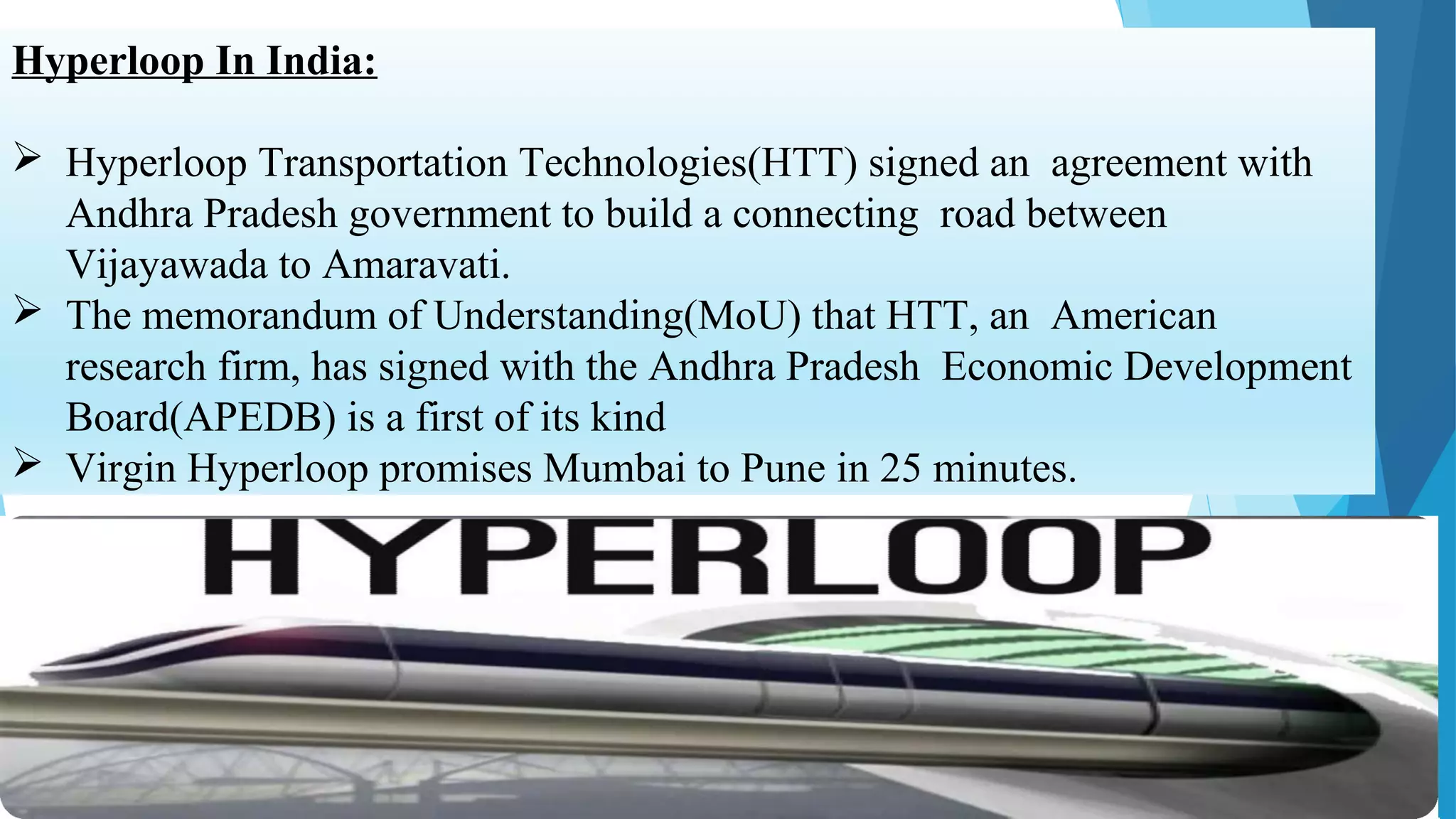
Hyperloop In India:
 Hyperloop Transportation Technologies(HTT) signed an agreement with
Andhra Pradesh government to build a connecting road between
Vijayawada to Amaravati.
 The memorandum of Understanding(MoU) that HTT, an American
research firm, has signed with the Andhra Pradesh Economic Development
Board(APEDB) is a first of its kind
 Virgin Hyperloop promises Mumbai to Pune in 25 minutes.
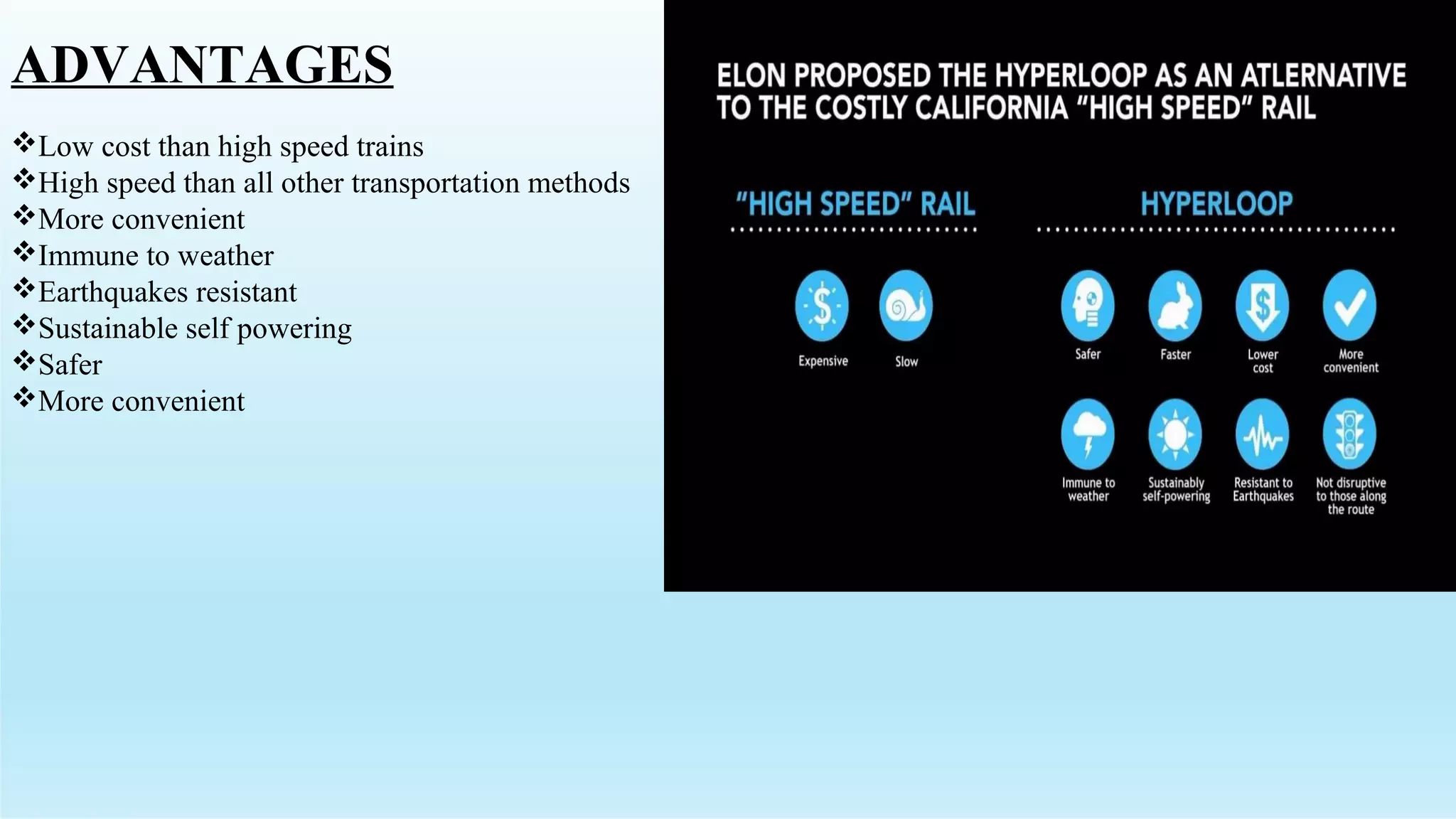
ADVANTAGES
Low cost than high speed trains
High speed than all other transportation methods
More convenient
Immune to weather
Earthquakes resistant
Sustainable self powering
Safer
More convenient
DISADVANTAGES
Tube pressurization
Less movable space for passengers
Turning will be critical
No answer for equipment malfunction,
accidents,
emergency evacuation Experience could be
frightening.
CONCLUSION
As it has number of advantages it will very helpful for
transport public as well as goods in a very short time ( at
top speed of 1220 kmph) and also in low cost.
It is new concept so there is some future work will be
required for development of this project.
[1]http://www.spacex.com/sites/spacex/files/hyperloop_al
p a.pdf
[2]https://en.wikipedia.org/wiki/Hyperloop
[3]http://www.spacex.com/hyperloop
[4]http://hyperloop.tamu.edu/
[5]https://www.quora.com/Tesla-Motors-company-What-
is the-working-principle-of-thehyperloop-proposed-by-
Elon-
Musk
REFERENCES
THANK
YOU

Hyperloop

  • 1.
    HYPERLOOP: A FIFTH MODEOF TRANSPORTATION SUBMITTED BY:- RAVI SHANKAR KUMAR B.TECH (FINAL YEAR) ROLL NO- 14EEJEC014 GOVERNMENT ENGINEERING COLLEGE JHALAWAR
  • 2.
    CONTENTS:  INTRODUCTION  CONCEPT WHOSE IDEA  WHAT IS HYPERLOOP  COMPONENTS OF HYPERLOOOP  SPECIFICATIONS  HYPERLOOP PROJECT IN INDIA  ADVANTAGES  DISADVANTAGES  CONCLUSION  REFERENCES
  • 3.
    INTRODUCTION  Hyperloop isa proposed mode of passenger and freight transportation that propels a pod-like vehicle through a near-vacuum tube at more than airline speed. The alpha version of the proposal published on the SpaceX website, describes claims of the design of the system, as well as its function.
  • 4.
    THE CONCEPT: A capsule fullof people in a low pressure tube elevated on pylon goes really fast
  • 5.
    WHAT IS HYPERLOOP ?Existingconventional modes of transportation of people consists of four unique types: rail, road, water, and air. These modes of transport tend to be either relatively slow (i.e., road and water), expensive (i.e., air), or a combination of relatively slow and expensive . It is the fifth mode generation of transportation . Hyperloop is a new mode of transport that seeks to change this paradigm by being both fast and inexpensive for people and goods. Hyperloop consists of a low pressure tube with capsules that are transported at both low and high speeds throughout the length of the tube .
  • 6.
  • 7.
    1.TUBES  The tubeis made of steel. Two tubes will be welded together in a side by side configuration to allow the capsules to travel both directions.  Pylons are placed every 100 ft. (30 m) to support the tube.  Solar arrays will cover the top of the tubes in order to provide power to the system.  Tubes are made by the new material ‘ VIBRANIUM ‘ 2.CAPSULES  Sealed capsules carrying 28 passengers each that travel along the interior of the tube.  A larger system has also been sized that allows transport of 3 full size automobiles with passengers to travel in the capsule.  The capsules are supported via air bearings that operate using a compressed air reservoir and aerodynamic lift .
  • 9.
    3.PROPULSION Linear accelerations areconstructed along the length of the tube at various locations to accelerate the capsule. Stators are located on the capsules via the linear acceleration. The propulsion system has these basic requirements: 1.Accelerate the capsule from 0 to 300 mph (480 kph) for relatively low speed travel in urban areas. 2.Maintain the capsule at 300 mph (480 kph) as necessary, including during ascents over the mountains surroundings.
  • 10.
    WORKING PRINCIPLES OFHYPERLOOP: Hyperloop consists of a low pressure tube with capsules that are transported at both low and high speeds throughout the length of the tube. The capsules are supported on a cushion of air, featuring pressurized air and aerodynamic lift. The capsules are accelerated via a magnetic linear accelerator affixed at various stations on the low pressure tube with rotors contained in each capsule. Passengers may enter and exit Hyperloop at stations located either at the ends of the tube, or branches along the tube length the capsule is designed for a maximum speed of 700mph. Linear motors spaced every 70 miles give the capsule its initial push, provide a periodic acceleration boost, and are used to stop the vehicle at the end of the trip. The combined length of the motors is about 1% of the tube length, so for most of the journey, the capsule is coasting.
  • 11.
  • 12.
    Even though theair pressure in the tube is very low, a capsule traveling at 700mph will cause significant air pressure at the nose of the vehicle, which must be considered in the design. Since the tube has a larger cross-section than the capsule, some air flows around the vehicle. Even so, compressor fans that actively transfer air from the front to the rear of the capsule must be installed. Solar panels installed on top of the tubes provide power for the linear motors. In addition, energy is recaptured when capsules are slowed down.
  • 13.
    Hyperloop In India: Hyperloop Transportation Technologies(HTT) signed an agreement with Andhra Pradesh government to build a connecting road between Vijayawada to Amaravati.  The memorandum of Understanding(MoU) that HTT, an American research firm, has signed with the Andhra Pradesh Economic Development Board(APEDB) is a first of its kind  Virgin Hyperloop promises Mumbai to Pune in 25 minutes.
  • 14.
    ADVANTAGES Low cost thanhigh speed trains High speed than all other transportation methods More convenient Immune to weather Earthquakes resistant Sustainable self powering Safer More convenient
  • 15.
    DISADVANTAGES Tube pressurization Less movablespace for passengers Turning will be critical No answer for equipment malfunction, accidents, emergency evacuation Experience could be frightening.
  • 16.
    CONCLUSION As it hasnumber of advantages it will very helpful for transport public as well as goods in a very short time ( at top speed of 1220 kmph) and also in low cost. It is new concept so there is some future work will be required for development of this project.
  • 17.
  • 20.