Prepared by:
JAYPEE S. TILLOR
EPP 6 Teacher
Sewing of Household Linens
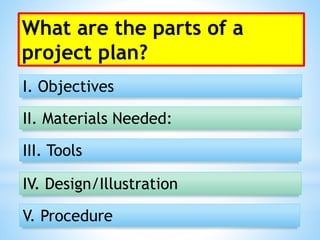
What are the parts of a
project plan?
I. Objectives
II. Materials Needed:
III. Tools
IV. Design/Illustration
V. Procedure
Why it’s necessary to have a
project plan first before making
the project?
Its primary use is to certify
planning assumption and
decisions, project design
marketability and profitability
of a chosen project.
Checking of assignments
Watch Me….
What is your preferences in
choosing a clothes/ linens,
quality or design? Why?
Assign each group a kind of project
Have the group read and analyze the kind of fabric
assigned to them.
Answer the following:
What kind of fabric you have?
What sewing project is applicable for your kind of
fabric?
Publishing of work
Why do we need to choose the right
kind and quality fabric?
What are the kinds of fabrics?
To what sewing project it is suited
for?
How to prepare clothes for cutting?
Analysis:
Fabric - refers to the materials that
resembles cloth. Quality of a fabric
should be considered in making a
project. An easy way to tell the quality
of a fabric is by its, appearance,
weight and feel. A good fabric has fine
finish. The weave is even and close.
The warp and woof of threads are of
the same size and the thread runs at a
right angle.
The fabric has parts:
*Raw edge – the edge when the material is cut
or torn from.
*Selvage – the smooth machine finished edge of
closely woven threads which will not ravel.
*Grain lines – the directions in which the threads
run
*Warp threads – the lengthwise threads of the
fabric or the straight of the materials.
*Woof threads – the crosswise thread or filling
threads.
Analysis:
Cloth/Fabric comes from plant
fibers, animal fibers, or man-
made synthetic fibers (nylon,
darcon, rayon)
Different Kinds of Fabrics:
1. Cotton- is best to wear in tropical
countries for it absorbs perspiration
and comfortable. This cloth can be
used best in shirt, blouses, duster,
pajama, pillow cases and
handkerchief.
Examples of cotton are: katsa, calico,
viole, oxford, crepe and percale.
Different Kinds of Fabrics:
2. Linen – the oldest kind of fabric
used in golden age.
It comes from flax plant which are
grown in cold countries. It also
absorbs perspiration like cotton and is
comfortable to wear, some of them
are thick and thin, shiny or not.
Different Kinds of Fabrics:
3. Wool – This comes from the
fur of lamb or sheep.
It is rough, thick and warm to
the body and is good to wear
on cold weather.
Different Kinds of Fabrics:
4. Silk – it is shiny, fine and
smooth. It comes from the
house or cocoon of the
silkworm.
Example of this fabric are
satin, brocade and taffeta.
Different Kinds of Fabrics:
5. Synthetic – this is a man-
made fabric.
It is commonly used because of
the texture that doesn’t
crumple easily. It is a wash and
wear kind of fabric
Ways of Preparing Clothes/fabric for
Cutting:
1. Perfecting thread fabric – it
is when one thread carries the
ends of the fabric from one
selvage to another.
This could be done by pulling out the
first thread that goes all the way
across the fabric.
Ways of Preparing Clothes/fabric for
Cutting:
2. Shrinking the fabric – (unless the label states
that the fabric has been pre-shrunk) it is a must
that a fabric must be shrink before sewing the
garments.
Steps:
*Fold the fabric evenly in lengthwise manner
with wrong side out
*Soak in lukewarm water until fabric is
thoroughly saturated.
*Hang fabrics to squeeze out excess water
without twisting it.
Ways of Preparing Clothes/fabric for
Cutting:
3. Pressing the fabric – test
the fabrics pressing effect.
Place the fabric so that it will not be
creased or stretched out or shape
during pressing. Always press along
the lengthwise grain of the wrong side
of the fabric.
Group Work:
Group work on filling a
project plan on
proposed project
GENERALIZATION
1. What are the parts of a
successful project planning?
2. What is the primary use of a
project plan?
Application:
Make a project plan of
a two-toned pillow
case.
Assessment:
Evaluate the finished
project plan using a
rubric. (based on
teacher’s standards)
Assignments:
*Research the answer of the
following question.
*What type of project is
necessary in making linens?
*Why do you need to choose
the right fabric for a sewing
project?
Wrap-up:
“Cautious and
systematic planning
with the standard skills
are best ticket to a
successful project
making.”
Ppt dlp 11 he-6

Ppt dlp 11 he-6

  • 1.
    Prepared by: JAYPEE S.TILLOR EPP 6 Teacher Sewing of Household Linens
  • 2.
    What are theparts of a project plan? I. Objectives II. Materials Needed: III. Tools IV. Design/Illustration V. Procedure
  • 3.
    Why it’s necessaryto have a project plan first before making the project? Its primary use is to certify planning assumption and decisions, project design marketability and profitability of a chosen project.
  • 4.
  • 5.
  • 6.
    What is yourpreferences in choosing a clothes/ linens, quality or design? Why?
  • 7.
    Assign each groupa kind of project Have the group read and analyze the kind of fabric assigned to them. Answer the following: What kind of fabric you have? What sewing project is applicable for your kind of fabric? Publishing of work
  • 8.
    Why do weneed to choose the right kind and quality fabric? What are the kinds of fabrics? To what sewing project it is suited for? How to prepare clothes for cutting?
  • 9.
    Analysis: Fabric - refersto the materials that resembles cloth. Quality of a fabric should be considered in making a project. An easy way to tell the quality of a fabric is by its, appearance, weight and feel. A good fabric has fine finish. The weave is even and close. The warp and woof of threads are of the same size and the thread runs at a right angle.
  • 10.
    The fabric hasparts: *Raw edge – the edge when the material is cut or torn from. *Selvage – the smooth machine finished edge of closely woven threads which will not ravel. *Grain lines – the directions in which the threads run *Warp threads – the lengthwise threads of the fabric or the straight of the materials. *Woof threads – the crosswise thread or filling threads.
  • 11.
    Analysis: Cloth/Fabric comes fromplant fibers, animal fibers, or man- made synthetic fibers (nylon, darcon, rayon)
  • 12.
    Different Kinds ofFabrics: 1. Cotton- is best to wear in tropical countries for it absorbs perspiration and comfortable. This cloth can be used best in shirt, blouses, duster, pajama, pillow cases and handkerchief. Examples of cotton are: katsa, calico, viole, oxford, crepe and percale.
  • 13.
    Different Kinds ofFabrics: 2. Linen – the oldest kind of fabric used in golden age. It comes from flax plant which are grown in cold countries. It also absorbs perspiration like cotton and is comfortable to wear, some of them are thick and thin, shiny or not.
  • 14.
    Different Kinds ofFabrics: 3. Wool – This comes from the fur of lamb or sheep. It is rough, thick and warm to the body and is good to wear on cold weather.
  • 15.
    Different Kinds ofFabrics: 4. Silk – it is shiny, fine and smooth. It comes from the house or cocoon of the silkworm. Example of this fabric are satin, brocade and taffeta.
  • 16.
    Different Kinds ofFabrics: 5. Synthetic – this is a man- made fabric. It is commonly used because of the texture that doesn’t crumple easily. It is a wash and wear kind of fabric
  • 17.
    Ways of PreparingClothes/fabric for Cutting: 1. Perfecting thread fabric – it is when one thread carries the ends of the fabric from one selvage to another. This could be done by pulling out the first thread that goes all the way across the fabric.
  • 18.
    Ways of PreparingClothes/fabric for Cutting: 2. Shrinking the fabric – (unless the label states that the fabric has been pre-shrunk) it is a must that a fabric must be shrink before sewing the garments. Steps: *Fold the fabric evenly in lengthwise manner with wrong side out *Soak in lukewarm water until fabric is thoroughly saturated. *Hang fabrics to squeeze out excess water without twisting it.
  • 19.
    Ways of PreparingClothes/fabric for Cutting: 3. Pressing the fabric – test the fabrics pressing effect. Place the fabric so that it will not be creased or stretched out or shape during pressing. Always press along the lengthwise grain of the wrong side of the fabric.
  • 20.
    Group Work: Group workon filling a project plan on proposed project
  • 21.
    GENERALIZATION 1. What arethe parts of a successful project planning? 2. What is the primary use of a project plan?
  • 22.
    Application: Make a projectplan of a two-toned pillow case.
  • 23.
    Assessment: Evaluate the finished projectplan using a rubric. (based on teacher’s standards)
  • 24.
    Assignments: *Research the answerof the following question. *What type of project is necessary in making linens? *Why do you need to choose the right fabric for a sewing project?
  • 25.
    Wrap-up: “Cautious and systematic planning withthe standard skills are best ticket to a successful project making.”